Strength & Weights

Best Weight Plates for a Home Gym of 2026

A plate stamped 45 pounds that actually weighs 44.2 is not a 45-pound plate, and a set that wobbles on the sleeve is one you'll curse every time you load it. I've lifted with rusty cast-offs and shiny new sets, and the difference is rarely obvious in photos. Over the past six months, my team and I worked through nine sets in a home gym, weighing each one, loading them on standard barbell sleeves, and noting smell, greasy residue, fit, thickness, and finish. Good plates are the quiet foundation of a home gym—they make every lift feel solid instead of sketchy.

Appearance matters more than I expected—fresh paint and clean edges make a rack look intentional—but value is not just price per pound. It's whether the plates still look and feel right after months of stacking, dragging, and chalky hands. A little variance is normal; a lot of it changes your numbers. The right set is the one that slides on cleanly, weighs what it says, and doesn't leave you washing your hands after every set.

#1

CAP Olympic Cast Iron Grip Plate

Top Pick
CAP Olympic Cast Iron Grip Plate

Building a set

Our Score 9.6/10
Check Price

Worth Noting

  • Hole tolerance varies plate to plate
Grip
Grip holes
Finish
Black baked enamel on cast iron
Center Hole
2 inches
Plate Weight
25 lb single
Read the full review

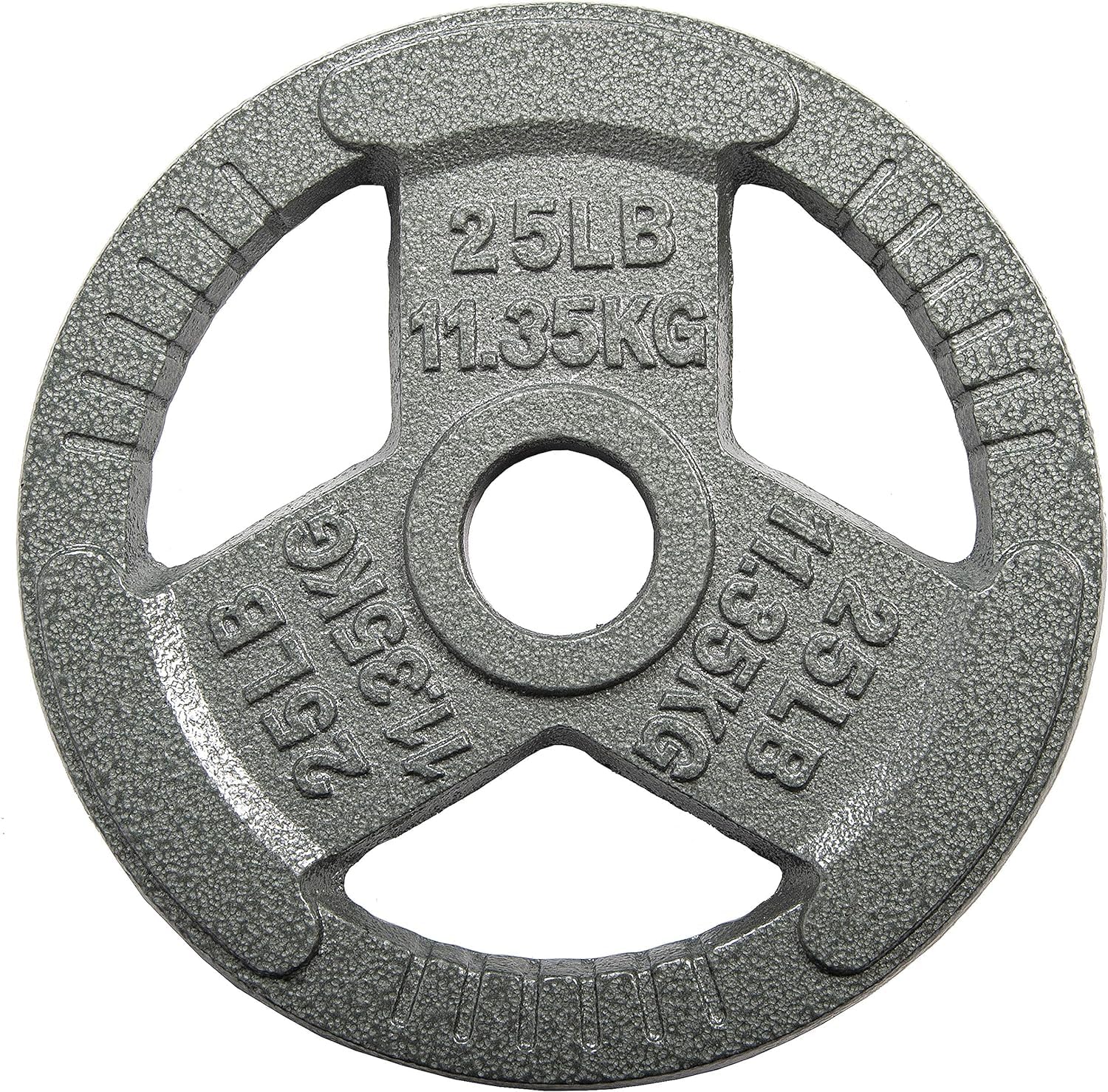
A 25-pound plate does more work in a home gym than any other size — heavy enough to matter, light enough to carry in one hand between sets. What made this one our top pick is how little sleeve it eats. It's a genuinely thin casting, so several plates go on before the collar runs out of room, and that's the difference between a bar you can keep adding to and one you have to strip.

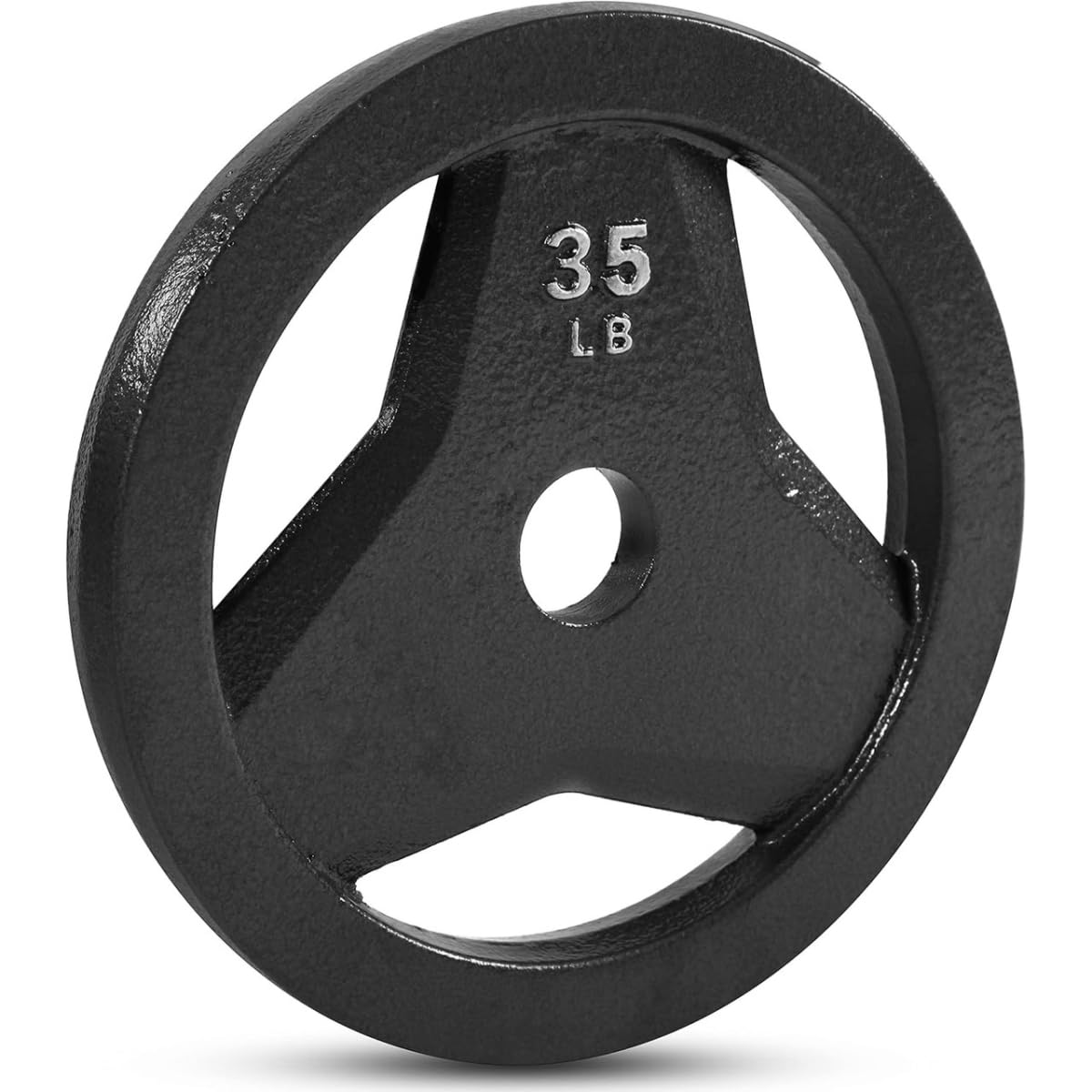
The grip openings are the detail we kept using. Pulling plates off the floor by the rim gets old fast, and being able to get a hand through the face makes loading, unloading, and carrying a plate across the garage a one-handed job. The finish is better than the rest of the category: a black baked enamel with a slight sheen that wipes clean and still looks new after months of loading, with raised markings that stay readable under chalk. Marked weight runs true, which matters more the stronger you get and the smaller the jumps become.

What to check is the bore. The machined 2-inch hole isn't identical from plate to plate — some slide on with a little play, others need a nudge, and a snug collar takes care of the rest. Put every plate on the bar the day it arrives rather than discovering the tight one mid-set.

It's sold one plate at a time, which suits anyone topping up a pile and frustrates anyone starting from scratch; the Amazon Basics set below covers that case. On its own, though, a single 25 is the most versatile plate you can own: sit it on your chest for crunches, rest it across your back for push-ups, carry it down the driveway.

Bottom line: Our default Olympic plate for anyone topping up an existing bar: accurate, thin enough to stack, and easy to carry by the grip openings.

#2

Amazon Basics 2-Inch Olympic Plates

Amazon Basics 2-Inch Olympic Plates

Set value

Our Score 9.6/10
Check Price

Worth Noting

Material
Cast iron, charcoal finish
Center Hole
2 inches
Set Contents
4 × 10 lb plates
Recycled Content
GRS-certified recycled iron
Read the full review

Four tens, one order, one finish. Building an Olympic collection out of singles means four separate shipments, four chances at a slightly different shade of charcoal, and a garage full of cardboard. This set arrives matched, and four 10s let you put 20 pounds on the bar without hunting for a second pair. For anyone starting from nothing, that's the fastest route to a usable bar.

The plates are cast from GRS-certified recycled iron and finished in a charcoal coat that hides chalk dust well. Grip openings on a 10 matter more than they sound, since light plates are the ones you're forever picking up off the floor and sliding back on — we noticed it most mid-set, when plates are going on and off in a hurry. Each plate is labeled clearly on the face, which keeps the light ones from vanishing into a pile of larger iron.

Ten-pound plates are small across the face, though, and that has a consequence at the bottom of a deadlift: a bar loaded only with these sits low, changing the pull. Plan on a pair of larger plates, or pull from blocks, once you're lifting from the floor. That isn't a fault in the set — it's what a 10 is.

Bottom line: The cleanest way to start an Olympic plate collection: four matched 10s in one order, clearly marked, and accurate enough to stop thinking about.

#3

EVERYMATE Change Plates

EVERYMATE Change Plates

Small increments

Our Score 9.6/10
Check Price

Worth Noting

  • Costs well above cast iron per pound
  • Only useful alongside full-size plates
Marking
Color coded by weight
Center Hole
2 inches
Construction
Rubber-coated steel core
Set Contents
17.5 LB (1.25+2.5+5) x2
Read the full review

Ten pounds is the smallest jump a pair of 5s gives you, and somewhere past your first year of training that stops being a small jump. Change plates are the answer: 1.25s and 2.5s that put 2.5 or 5 pounds on the bar instead of 10, so a stalled press keeps moving without a week of grinding at the same weight.

This set is a pair of each — 1.25, 2.5, and 5 pounds, 17.5 pounds in total — in a rubber coat over a steel core, with each size in its own color so you can grab the right one without reading it. The 1.25s are the ones that earn their keep; nothing else here gets you a step that small.

The rubber is the right call at this size. They go on quietly, don't chew up the finish on your larger plates, and sit still on the sleeve rather than chiming. The steel core keeps them from being chunky, which matters when they're going on after four other plates and sleeve space is tight.

What you pay for is resolution, and the per-pound cost is well above cast iron — a fair trade for something you buy once and use every session. If 2.5 pounds a side is all the resolution you need, JFIT's cast iron singles will do it for less. The 1.25s are the reason to buy this set.

Bottom line: The fix for anyone stuck making 10-pound jumps: buy this set once and you can take 2.5 pounds onto the bar instead.

#4

Amazon Basics 1-Inch Grip Plates

Amazon Basics 1-Inch Grip Plates

1-inch bars

Our Score 9.4/10
Check Price

Worth Noting

  • Grip cutouts make them wider than plain 10s
Grip
Grip holes
Material
Cast iron, charcoal finish
Center Hole
1 inch
Set Contents
4 × 10 lb plates
Read the full review

Standard 1-inch bars and adjustable dumbbell handles are what most home gyms actually start with, and Olympic plates are useless on them. This is the set for that bar: four 10-pound plates with grip cutouts and a hole sized for a one-inch sleeve.

Four tens is a sensible building block — enough to load a pair of adjustable dumbbells for a real set of curls, or to put 40 pounds on a standard bar. The grip openings are the detail that sells them: threaded collars are fiddly, and holding a plate steady while you spin the collar down saves real time. We noticed it most on dumbbell work, where you're changing plates every set.

One inch is a nominal figure, and handles vary — a plate that drops onto one bar can need a shove on another. Measure the sleeve on your bar or handle before ordering four plates, because returning iron is no fun. The charcoal coating holds up under spin collars, which is more than bare cast iron manages.

Bottom line: The set to buy if your bar is a standard 1-inch or your dumbbells are adjustable — four 10s that make that bar worth owning.

#5

RitFit Olympic Rubber Grip Plates

RitFit Olympic Rubber Grip Plates

Quiet home gym

Our Score 9.4/10
Check Price

Worth Noting

  • Arrives greasy with a strong rubber smell
Grip
3-hole grip
Sizes
2.5 to 45 lb, singles and pairs
Center Hole
2 inches
Construction
Rubber over solid iron core
Read the full review

A rubber-coated plate is what you buy when the bar lives above someone else's ceiling. Setting a loaded bar down on rubber is quiet, and the coating won't scuff a floor or leave a mark where a plate sat, which is the difference between lifting at home and lifting at home without a complaint from downstairs.

Underneath the rubber is a solid iron core, and the three grip openings are cut through both. The line runs from 2.5 up to 45 pounds, so you can build a matching set or fill one gap in a pile you already own. Rubber adds thickness at a given weight, though, which is worth knowing if you're already short on sleeve room.

It's a coated iron plate, not a bumper: fine to set down, not built to be dumped from overhead, and we think that's the honest boundary of what it's for. Fill out a mixed set with it a pair at a time; the black finish and cut-in grips make it look like it belongs rather than like the odd plate you grabbed on sale.

Bottom line: The quiet choice for an apartment gym: rubber-coated Olympic plates you can fill a set with one pair at a time without gouging the floor.

#6

JFIT Olympic Grip Plates

JFIT Olympic Grip Plates

Budget increments

Our Score 9.4/10
Check Price

Worth Noting

Grip
Grip holes
Sizes
2.5 to 45 lb, singles and pairs
Material
Cast iron, semi-gloss finish
Center Hole
2 inches
Read the full review

The least expensive plate here is also the one that solves the most specific problem: a single 2.5 buys you a step on the bar when the next full-size jump is too much. For that job, spending more buys you nothing but a prettier finish.

Cast iron, semi-gloss, grip openings, a 2-inch bore — nothing exotic, and nothing to go wrong. The line runs from 2.5 to 45 pounds in singles and pairs, so you can fill any gap in a set without the new plates looking like they came from a different gym, and the weight is marked plainly on the face.

The semi-gloss finish reads as no-nonsense rather than pretty, which is the trade we want on a plate you handle one at a time. Fit on standard Olympic sleeves is snug rather than sloppy, so collars do less work. Order two: a single small plate on one side of a bar is a mistake you only make once.

Bottom line: The cheapest way to buy one more step: cast iron grip plates that fill a gap in a set without asking you to spend much.

#7

HulkFit Multi-Grip Weight Plate

HulkFit Multi-Grip Weight Plate

Plate-only work

Our Score 9.4/10
Check Price

Worth Noting

  • Enamel can chip where plates contact
Material
Enamel-coated cast iron
Dimensions
11.8 x 11.8 x 1.37 inches
Center Hole
2 inches
Plate Weight
25 lb single
Read the full review

The handles are the point. A 25-pound plate with cut-in grips becomes a hand weight you can hold in several positions, which is what you want for Russian twists, plate presses, and carries without loading a bar at all. Plenty of plates have a hole you can hook a finger through; this one is built to be gripped.

The casting is enamel-coated iron backed by a two-year warranty, and the dimensions are published per size — the 25 comes in at 11.8 x 11.8 x 1.37 inches, so you know whether it will clear a rack or fit on the shelf before it lands.

Watch the bore. It's cut tight on some of these, tight enough that a plate which ought to slide on has to be worked onto the sleeve. Try it the day it arrives, while the packaging is still around; a plate that fights the bar is a plate you stop using.

As barbell weight, this one is expensive per pound next to the CAP and the Amazon Basics set, and if all you need is mass on a bar, one of those is the sensible buy. As a single heavy plate for hand-held work and plate-loaded machines, the handles justify it for us — and the enamel looks better in a living room than bare iron ever does.

Bottom line: Buy it as a hand weight, not as barbell tonnage: one 25 lb plate with real handles for twists, presses, and carries.

#8

CAP Rubber Olympic Bumper Plate

CAP Rubber Olympic Bumper Plate

Dropping lifts

Our Score 9.0/10
Check Price

Worth Noting

  • Arrives oily with a lingering rubber smell
Bounce
Medium-bounce blend
Center Hole
2 inches
Construction
Rubber with steel floating hub
Plate Weight
45 lb single
Read the full review

Bumpers exist for the rep you don't finish. Learning cleans and snatches means missing lifts, and a rubber plate you can bail out of changes what you're willing to try — particularly alone in a garage, where dropping cast iron is loud, expensive, and hard on the floor.

We like the combination of a steel floating hub and a medium-bounce rubber blend. The hub takes the wear at the center so the rubber doesn't tear out over time, and the bounce comes back at you less than a competition plate while landing far quieter than iron. For a garage gym, where the point is to keep training rather than to certify a total, that's the right compromise — and it's priced closer to cast iron than to a competition bumper.

If you never drop the bar, cast iron buys you more plate for the money, and the other picks here serve that lifter better. The color-coded markers are a small thing that speeds up loading when you're working through sets and don't want to read numbers. Load it, lift it, and it feels like any other 45; it's the rep you don't finish that you're paying for.

Bottom line: Buy this if you drop lifts: the only true bumper here, and the affordable way to make missed reps safe in a garage gym.

How We Tested Nine Sets of Weight Plates

We started by narrowing the field to plates sold as singles, pairs, and sets, then filtered for stated weight tolerance, collar diameter, finish, available sizes, and return policy. From that list, we picked nine sets that represent the range of what shoppers actually consider—cast iron, rubber-coated, and calibrated styles—and used them for six months in a garage gym and a basement setup. We didn't treat them gently: they were loaded, unloaded, stacked, and moved between racks.

Each plate went on a calibrated scale, and we logged the difference between the stamped weight and the real one, noting whether the error was consistent across a set. We slid every plate onto a standard barbell sleeve, checking for wobble, burrs, and how much play there was at the collar; we also noted thickness and outside diameter, since a plate that's too wide or too tall can crowd a loaded bar or a storage rack. In daily sessions—squats, bench presses, deadlifts, rows, and overhead presses—we paid attention to how easily the plates seated and came off, especially when loading alone.

Out of the box, we smelled each set and handled it bare-handed before wiping it down, looking for oily film, greasy residue, and any odor that lingered in the gym. Over six months, we checked for chipped paint, rust, cracked rubber, loose inserts, and fading, and we compared value by price per pound against how the plates actually held up. The sets that scored best were the ones that weighed true, fit cleanly, and still looked decent after being stacked and dragged around.

How to Choose Weight Plates

Start With the Hole, Not the Plate

Olympic bars take a 2-inch plate; standard bars and most adjustable dumbbell handles take a 1-inch plate, and the two never interchange. Measure across the sleeve before you order anything, because a plate that doesn't fit means shipping 40 pounds of iron back. The trap is assuming "standard" means one thing: nominal 1-inch handles vary enough that a plate which drops onto one bar can need a shove on another, so test the first plate before you open the whole box.

Cast Iron, Rubber-Coated, or Bumper

Enameled cast iron is the thin, inexpensive-per-pound option. It loads the most weight on a short sleeve and rings like a bell when you set it down. Rubber-coated iron trades some of that thinness for quiet loading and a floor that doesn't get gouged, which is what you want in an apartment or over a garage. Bumper plates are rubber through the whole body and are the only ones built to be dropped from overhead, but they're thick enough that a sleeve holds noticeably fewer.

If you lower the bar under control, cast iron is fine and cheaper. If you bail out of lifts, buy bumpers — a missed clean is exactly the rep they exist for.

Check the Diameter Before You Fall for the Price

A plate's width across the face sets how high the bar sits off the floor. Full-size plates put a deadlift at a sensible starting height; a bar loaded only with 10s sits several inches lower, which changes the pull. That's the argument for owning at least one pair of large plates even when your working weights are modest, and for reading the published dimensions on heavier singles: HulkFit lists 11.8 x 11.8 x 1.37 inches for its 25, which tells you more than a photo does.

Build in Small Increments

Most sets jump 5 or 10 pounds per side, which is fine until it isn't. Past a certain point, another 10 pounds on the bar stops being a small change. A pair of 2.5s gets you to a 5-pound total jump; fractional change plates at 1.25 go finer still. Buy the small sizes before a third pair of 45s: they're the plates you use every session once the weight gets heavy, and they cost far less than the ones that sit on the rack.

Sets, Singles, and What You're Paying For

Price per pound is the only fair comparison between plates, and sets usually win it. Singles make sense when you're topping up a pile you already own, or when you want one heavy plate for hand-held work. What the extra money buys beyond the iron is a clean bore, accurate marking, and a coating that doesn't chip the first time two plates touch. That's worth a little more than the cheapest plate on the page, since you'll own these for a decade.

Frequently Asked Questions

Final Verdict

Start with the CAP 25-pounder if you already own a bar. It's the size that does the most work, it's thin enough to stack, and the grip openings make it pleasant to move around a garage. Buying your first Olympic set instead? The Amazon Basics four-pack puts a matched load on the bar in one order.

Add the CAP bumper if you drop lifts, and the EVERYMATE change plates the moment 10-pound jumps stop working. Those are the two upgrades that change what you can train, and everything else on this list is filling in around them.