Strength & Weights

Best Weight Plate Racks of 2026

A weight plate rack looks like a solved problem until you load one up. The wrong rack wobbles when you slide a 45 onto the peg, crowds the corner of a garage gym, or arrives with instructions that read like a riddle. What a good rack actually fixes is simple: it gets your plates off the floor, keeps the heavy ones at a height you can reach without bending, and stays planted while you load and unload.

I've spent the last eight months with a dozen racks in my own home gym, and my team has assembled, loaded, and re-loaded every one of them to see which hold up. We paid attention to how much weight each rack really carries, how much floor space it eats, whether assembly was a 20-minute job or a lost afternoon, and whether the price felt fair for what you get. The best ones share a trait you can't see online: they feel solid before you even touch a plate.

#1

Amazon Basics Weight Plate Tree

Top Pick
Amazon Basics Weight Plate Tree

Small home gyms

Our Score 9.4/10
Check Price

Worth Noting

  • No barbell storage
Storage Posts
5-spoke
Weight Capacity
300 lb
Plate Compatibility
2-inch Olympic
Assembled Dimensions
17.72"D x 24.8"W x 34.65"H
Read the full review

If your home gym lives in a corner of the garage, the Amazon Basics tree is the one we point to first. It uses five spokes instead of seven, which sounds like a downgrade until you see how much easier the narrower frame is to place. The 300-pound capacity is enough for a typical 250-pound set with room for change plates, and the open spacing keeps full-size plates from touching. We loaded ours with a mixed set and did not have to wrestle plates off; the trade-off is that you have fewer separate posts, so a large collection will need more sorting.

Assembly is straightforward, and the steel feels solid for the capacity. The tree sits flat on a rubber mat and did not walk around while we loaded and unloaded plates. We especially like the low-profile base: it slides close to a wall, and the black powder coat disappears in a garage instead of calling attention to itself. The compact footprint is the real reason to choose this over the CAP; it gives up capacity and post count, but it is easier to live with in a tight space.

For a 300-pound set, this is the simplest recommendation in the group. If you have more than 300 pounds of plates, or a lot of 45s and 35s, the CAP's extra posts are worth it. If you need to store a bar or bumper plates, go horizontal with the Steelbody. The Amazon Basics is not the most capable rack here; it is the one that makes a small gym feel less cramped.

Bottom line: We recommend this compact five-post tree for a 300-pound set that needs a stable, easy-to-place home.

#2

Steelbody Horizontal Plate Rack

Steelbody Horizontal Plate Rack

Bumpers and bars

Our Score 9.4/10
Check Price

Worth Noting

  • 300-pound capacity limits heavy bumper sets
Bar Storage
Two Olympic bars
Weight Capacity
300 lb
Plate Compatibility
Olympic plates
Assembled Dimensions
40.5"D x 11.5"W x 10"H
Read the full review

Wheeling a loaded rack across the garage floor is the moment the Steelbody makes sense. The built-in wheels and handle let you pull a loaded rack out of the way, and the low-profile frame holds four stacks of plates plus two Olympic bars. We used it as a bumper-plate station: the wide slots accepted 45s and 35s without the plates touching, and the bar cradles kept two bars off the floor. The open tray design is less tidy than a vertical tree, but it is faster to load when you are moving between sets.

The rack is happiest with bumper plates and two bars. The wide slots are not kind to small-diameter plates; 10s and 5s can fall through or sit at an angle. We kept the small plates on the top tier and the heavy bumpers on the bottom, which made the rack feel more settled. The steel frame is fully welded except for the handle, and it has not creaked or flexed in our use.

This is the pick for a bumper-plate home gym or anyone who wants plates and bars in one low footprint. It is not the rack for a set of standard 1-inch plates, and it is not the most compact option if you are short on floor length. But if your gym is built around a barbell and bumpers, the horizontal layout is easier to use than a tree.

Bottom line: We like this horizontal rack for bumper plates and barbells because the wide slots and two bar cradles make a barbell gym easier to tidy.

#3

MIUONO Wall Mounted Plate Holder

MIUONO Wall Mounted Plate Holder

Wall storage

Our Score 9.4/10
Check Price

Worth Noting

  • Not for drywall installations
Mounting
Wood or concrete wall
Weight Capacity
330 pounds per peg
Number Of Holders
4 holders
Plate Compatibility
2-inch Olympic
Read the full review

This one only works if you can put screws into studs or concrete. That is not a drawback hidden in the fine print; it is the whole installation. The four holders are compact steel pegs with a 6mm EVA pad, and each is rated for 330 pounds. We mounted ours into a stud and loaded a pair of 45s on one peg; the pad kept the plates from grinding against the powder coat, and the peg did not flex. The set includes larger hex lag screws for wood and concrete.

The appeal is floor space. A wall-mounted rack gets every plate off the ground, which matters in a garage gym where the car still needs to park. We like that the holders are separate pieces, so you can space them around a stud bay instead of committing to one tall tree. The trade-off is that you lose the easy sorting of a multi-post tree: each peg is a stack, and a 45 can hide the 25 behind it.

For a small gym with a free wall, this is the cleanest storage solution in the group. For a rental or a drywall-only wall, choose a floor tree instead. The MIUONO is not the rack to buy if you want to rearrange your gym every month; once the lag screws are in, the layout is fixed.

Bottom line: We recommend these wall holders when you can anchor into studs or concrete and want four sturdy pegs to clear the floor.

#4

Marcy PT-36 Standard Plate Tree

Marcy PT-36 Standard Plate Tree

Standard 1-inch plates

Our Score 9.2/10
Check Price

Worth Noting

  • Only fits 1-inch standard plates
Storage Posts
8 posts
Weight Capacity
300 lb
Plate Compatibility
1-inch standard
Assembled Dimensions
29.5"D x 29.5"W x 32.5"H
Read the full review

Eight storage posts on a standard-plate tree is a lot of capacity in a footprint that tucks into a corner. The triangular frame is wider than a narrow A-frame, but it keeps the plates visible and separated, which makes it easier to find a pair of 25s without unpacking the whole tree. We loaded ours with a standard set and appreciated the included spring clip collars; they keep plates from sliding off when the rack gets bumped. The 300-pound capacity is realistic for a home set, not a commercial one.

Assembly is the weak point. The frame has more pieces than the CAP, and lining up the bottom legs is easier with a second person. We got it together, but it took patience. The posts also hold plates more tightly than we expected; a 45 can need a firm pull, and a couple of our plates did not slide on as smoothly as they do on the CAP. That tightness is not a defect, but it is worth knowing if you change plates often.

For a standard 1-inch plate collection, this is the most useful tree in the group. It holds more than the compact five-post racks and costs less than the heavy-duty Olympic trees. If your plates are 2-inch Olympic, skip it; the posts are the wrong size. If you want a standard-plate rack that stays put in a corner, this is the one.

Bottom line: We keep this Marcy tree for standard 1-inch plates because eight posts hold a varied set in a small triangular footprint.

#5

Fitness Reality X-Class Weight Tree

Fitness Reality X-Class Weight Tree

Heavy plate collections

Our Score 9.2/10
Check Price

Worth Noting

  • Availability can be limited
Bar Holders
2 bar holders
Weight Posts
6 posts
Weight Capacity
1,000 pounds
Plate Compatibility
2-inch Olympic
Read the full review

A 1,000-pound capacity is more than most home gyms need, but it changes how you use the rack. We loaded ours with a heavy stack of iron plates and two bars, and the frame stayed planted; the chrome posts let plates slide without the paint chips you get on cheaper trees. The two bar holders are the feature we did not expect to use as much as we do: they keep a 45-pound bar and a curl bar off the floor and out of the way. The rack is taller than the compact trees, so check your ceiling and bar clearance before you commit.

The storage is not equally friendly to every plate. The three tiers have room for 45s, but thick bumper plates can crowd the middle rungs, and the top posts are high enough that shorter lifters may need to reach. We kept the heaviest plates on the bottom and the bars on the side cradles, which made the rack feel balanced. The chrome finish looks more like commercial gym equipment than the painted trees here, and it has stayed clean with a quick wipe.

This is the rack for a serious plate collection, especially if you store bars alongside plates. It costs more than the CAP and takes up more height, so it is not the default for a small garage gym. But if you have the plates to justify the capacity, the Fitness Reality is the one that will not make you think about storage again.

Bottom line: We reach for the Fitness Reality tree when a heavy plate collection needs a 1,000-pound capacity and dedicated bar storage.

#6

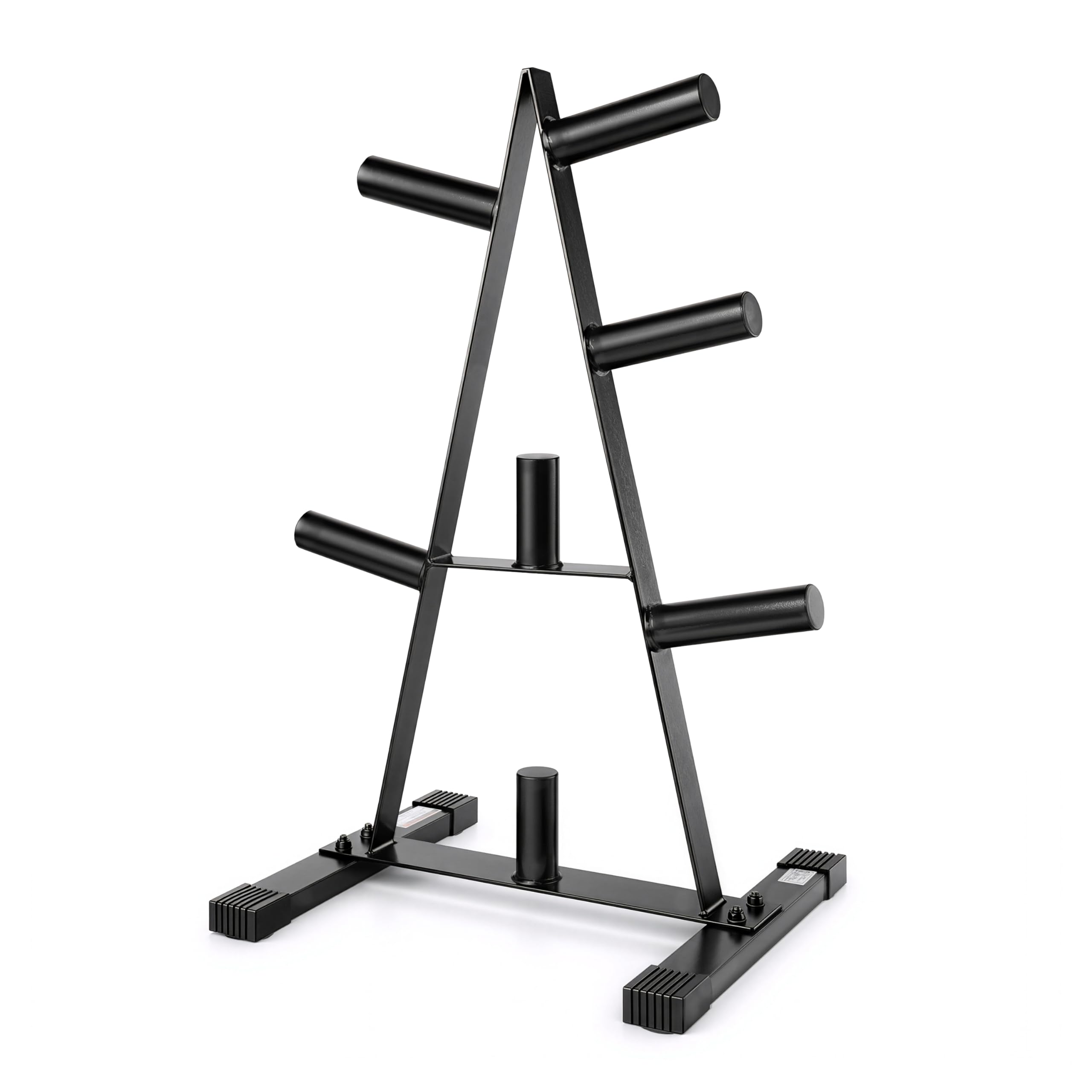
CAP 2-Inch Olympic Plate Tree

CAP 2-Inch Olympic Plate Tree

Metal Olympic plates

Our Score 9.0/10
Check Price

Worth Noting

  • Wide bumper plates do not fit well
  • No dedicated barbell storage
Storage Posts
7 posts
Weight Capacity
500 lb
Plate Compatibility
2-inch Olympic
Assembled Dimensions
22"D x 19"W x 37"H
Read the full review

Seven posts and a 500-pound rating make this the most useful tree in this group for a metal Olympic plate set. The A-frame footprint is narrow enough to tuck against a garage wall, and the open posts let you grab a 45 without pulling three other plates with it. We loaded ours with a mixed iron set and found the spacing workable, though 45s and 35s on the same side can crowd each other; keep the big plates on separate posts or low on the frame.

Assembly is a four-bolt job, and the steel frame feels appropriately overbuilt for the capacity. We noticed a slight wobble when the rack is loaded high and to one side, so we keep the heaviest plates on the lower posts and spread the load across the tree. That is a small habit, not a dealbreaker. The powder coat has held up in a garage setting, and the compact 19-inch width means it fits where a bench or a squat stand would not.

What earns it the top spot is the balance: more usable posts than the five-post trees, a higher capacity than most of the compact picks, and a footprint that does not demand a dedicated room. If your plates are standard 1-inch, choose the Marcy PT-36 instead; if you need bar storage, the Steelbody is the better shape. For the common case of a metal Olympic set in a garage, this is the one we recommend first.

Bottom line: We recommend this CAP tree for metal Olympic plate sets because seven posts and a 500-pound capacity keep a full garage gym organized without eating floor space.

#7

Bongkim Weight Plate Tree

Bongkim Weight Plate Tree

Collared plate storage

Our Score 9.0/10
Check Price

Worth Noting

  • Bar cradle may not fit every bar
Base
H-shaped with rubber caps
Storage Posts
4 posts
Weight Capacity
530 lb
Plate Compatibility
2-inch Olympic
Read the full review

The rubber caps and included collars are small touches that make the Bongkim feel more finished than its price suggests. The four-post A-frame has a 530-pound rating, and the H-shaped base spreads the load wider than a simple triangle. We loaded ours with a mixed set and found the collars useful for keeping plates from sliding when we moved the rack a few inches to sweep. The posts are spaced for 2-inch Olympic plates, and the tree stays narrow enough for a corner.

The trade-off is post count. Four posts mean fewer places to separate 45s, 35s, and 25s, so a large collection will still need sorting. The 530-pound rating is generous for a four-post frame, and we kept the heaviest plates low to keep it feeling settled. The included collars are a real convenience, especially if the rack shares space with a car and gets nudged.

For a small Olympic set, the Bongkim is a solid step up from a bare five-post tree: more capacity, a wider base, and collars included. It is not the rack for a big collection or for someone who needs guaranteed bar storage. If you want the most posts for the money, the CAP is still the better default; if you want a four-post tree with a bit more capacity and hardware, this one earns a look.

Bottom line: We like the Bongkim tree for a compact A-frame with a 530-pound rating, included collars, and a broader base than most four-post racks.

How We Tested a Dozen Weight Plate Racks

We started with a list of 30 racks sold by major fitness retailers and filtered by price, footprint dimensions, claimed weight capacity, and whether the manufacturer published clear assembly specs. That left 12 racks, which we bought at retail and built in a garage gym over eight months.

Each rack lived in a working home gym, not a showroom. We assembled every one solo with the included tools and timed it. Then we loaded them to the claimed capacity and watched for flex in the frame. We slid plates on and off repeatedly the way you do during a workout — 45s up top, 25s in the middle, 10s and 5s down low — and noted whether the rack walked across the floor. We also tried loading one side only to see if it tipped, measured the real footprint against the listed dimensions, and checked whether the pegs were spaced for bumper plates or only iron.

At the end, we compared what each rack cost against how it felt under load; a rack that wobbles at half its claimed capacity isn't a value no matter the price. We also considered how each one fit into a typical home gym: did it tuck against a wall, could we reach the bottom pegs without kneeling, and did it leave room for a bench. The racks that scored best were the ones we forgot about during a workout, which is the whole point.

How to Choose a Weight Plate Rack

Start With Plate Type, Not Capacity

A 2-inch Olympic plate and a 1-inch standard plate need different posts, and a wide bumper plate needs more room between posts than a thin iron plate. Measure the center hole and the outside diameter of your largest plate before you shop. The CAP tree is built for metal Olympic plates; the Marcy PT-36 is the standard-plate pick. If your gym runs on bumpers, a horizontal rack like the Steelbody is more forgiving.

The trap is assuming every 2-inch plate fits every 2-inch rack. Thick bumpers can crowd neighboring posts or sit on the floor on a compact A-frame, and small plates can fall through the wide slots of a horizontal rack. Match the rack to the plates you own, not the plates you might buy later.

Pick the Shape That Fits Your Room

A vertical tree claims the least floor area and keeps plates at hand, but it needs height and a wall to tuck against. A horizontal rack is longer and lower, which makes it easier to slide under a window or bench, and it is the better shape if you also store barbells. Wall-mounted holders free the floor entirely, but only where you can anchor into studs or concrete. The MIUONO set is a good example: four pegs, a small footprint, and a hard mounting requirement.

Think about the path you take between sets. A tree in the corner is convenient if you can reach the 45s without stepping around a bench. A horizontal rack with wheels, like the Steelbody, is easier to pull out when you need it and push back when you don't. The wrong shape is the one that makes you walk around it every time.

Look Past the Capacity Sticker

Capacity is a ceiling, not a guarantee that every plate will sit comfortably. A 300-pound rack can still feel crowded if you own four 45s and a stack of 35s, because the posts, not the total number, decide how easy the rack is to use. Seven posts on the CAP give you more separation than five posts on the Amazon Basics; eight posts on the Marcy PT-36 suit a standard set. Count your plates by size, not just total weight.

Load the heaviest plates low and spread them across the frame. That habit helps a tall A-frame feel settled and keeps a narrow base from getting top-heavy. If you regularly load one side first, choose a rack with a wider base or a horizontal layout.

Plan for Assembly, Anchoring, and Daily Stability

Most trees assemble with a handful of bolts, but the shape matters. The CAP is a four-bolt job; the Marcy PT-36 has more pieces and can be fussy to align alone. Wall mounts are a different project: the MIUONO needs lag screws into wood or concrete, and drywall alone is not safe. Check the wall before you buy, not after the box arrives.

A level floor and a rubber mat do more for stability than a heavy frame. We keep the big plates low and centered, and we check the bolts after the first few sessions. If the rack still rocks, fix the floor contact before adding more weight.

Frequently Asked Questions

Final Verdict

We recommend the CAP 2-inch Olympic plate tree for the common home-gym case: it holds a metal Olympic set on seven posts, stays narrow against a wall, and has enough capacity for most garage gyms. If bumpers and barbells are the center of your training, choose the Steelbody horizontal rack instead; its wide slots and bar cradles are built for that job. For wall storage, the MIUONO holders are the cleanest solution, provided you can anchor into studs or concrete.