Strength & Weights

Best Power Racks of 2026

A power rack makes one promise that matters: when you fail a squat, the safeties catch the bar. Everything else — the attachments, the powder coat, the price — is supporting detail. So the questions worth asking first are unglamorous ones: does the frame shift when you rack a heavy bar, will your ceiling let you press overhead inside it, and how much of an afternoon does assembly actually take?

I've lifted in commercial gyms for years and still ended up training in a garage, so I know the difference between a rack that feels planted and one that hums. My team and I assembled seven racks over six months in garages, basements, and spare rooms, squatting, benching, and doing pull-ups in each one. The lesson that surprised me: the cable and pulley attachments people treat as a luxury are often what keeps them out of a gym membership, provided the cable runs smooth under load.

Below are the racks worth their footprint, whether you're outfitting a dedicated gym or carving out a corner.

#1

pooboo P43 Power Cage

Top Pick
pooboo P43 Power Cage

Smith machine training

Our Score 9.8/10
Check Price

Worth Noting

  • 417 pounds, several boxes, two-person build
  • Newest design here, shortest track record
Unit Weight
417 lb
Cable System
Dual pulley plus Smith bar
Assembled Size
62.9 x 43.3 x 82.6 in
Stated Capacity
2,000 lb
Read the full review

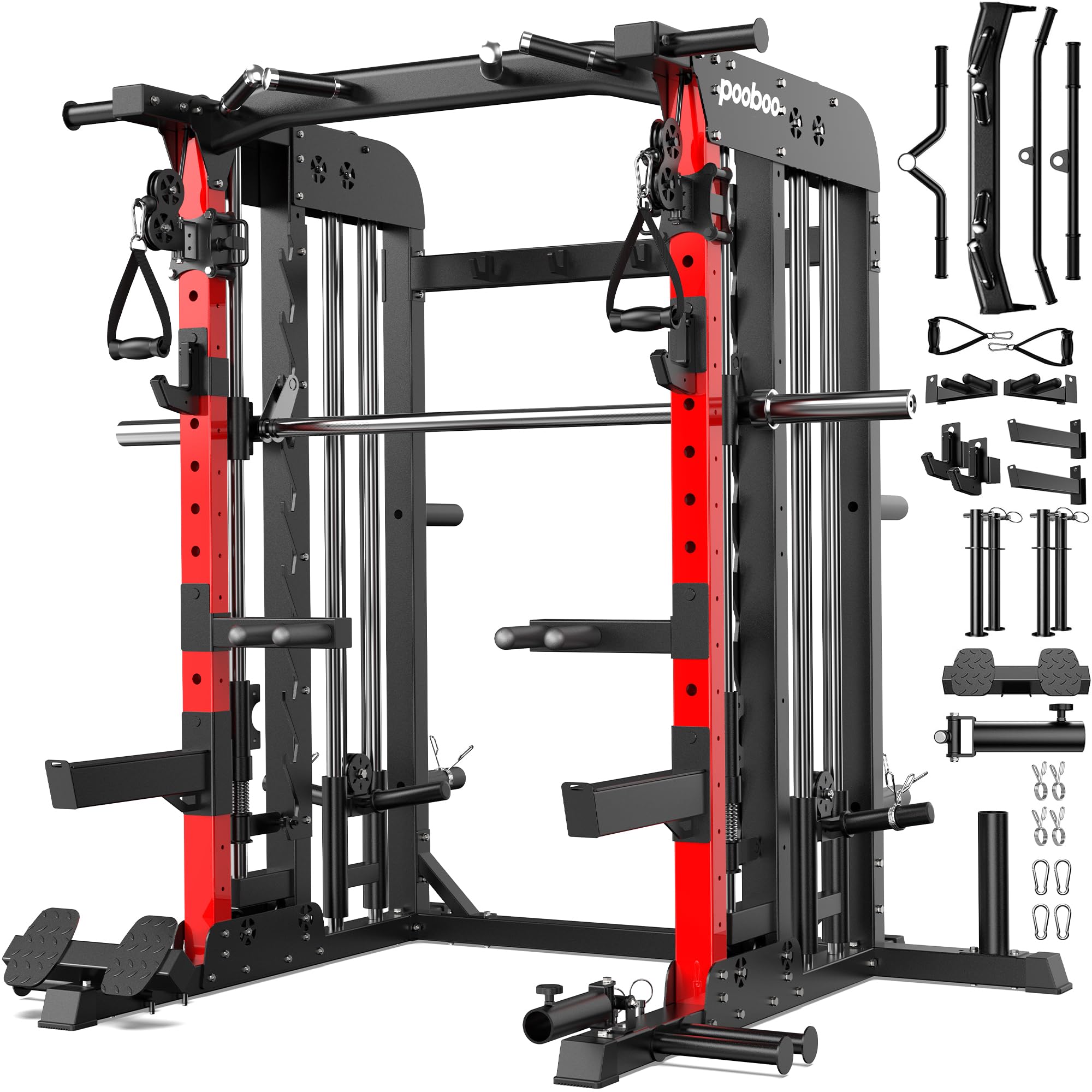
The most expensive rack here is also the only one with a Smith bar. The P43 pairs a guided bar on rails with a dual cable crossover, in a frame 62.9 inches deep, 43.3 wide and 82.6 tall, rated to 2,000 pounds and covered by a 2-year warranty. More than 20 attachments arrive with it, among them J-hooks, spotter arms, dip bars, a lat bar and cable handles.

A Smith bar changes what you can do alone. You can take a set to failure without a spotter, and the fixed path is genuinely useful for rear delts, calves and anything where you want the bar to stay on a line. It does not replace a free bar for squats, because the path is fixed and your body has to fit it rather than the other way round. The cables cover the rest, with a rated pull of 1,000 pounds.

Where it earns the money is density. One 63-inch-deep footprint replaces a rack, a Smith machine and a crossover, three things that otherwise fill a garage between them, and the warranty covers the frame for as long as the racks costing half as much cover theirs. For a garage where the car still has to fit, three machines in one outline is not a luxury, it is the only way the gym happens at all.

Bottom line: For a garage that has to hold everything: a Smith bar, two cable runs and a 2,000-pound frame in one footprint, backed by a two-year warranty.

#2

Sunny Health & Fitness Power Rack

Sunny Health & Fitness Power Rack

Small home gyms

Our Score 9.4/10
Check Price

Worth Noting

  • Pull-up bar shimmies when a heavy bar is re-racked
Pull-up Bar
8-position angled
Frame Weight
83 lb
Assembled Size
38 x 53 x 87 in
J-hook Positions
18
Read the full review

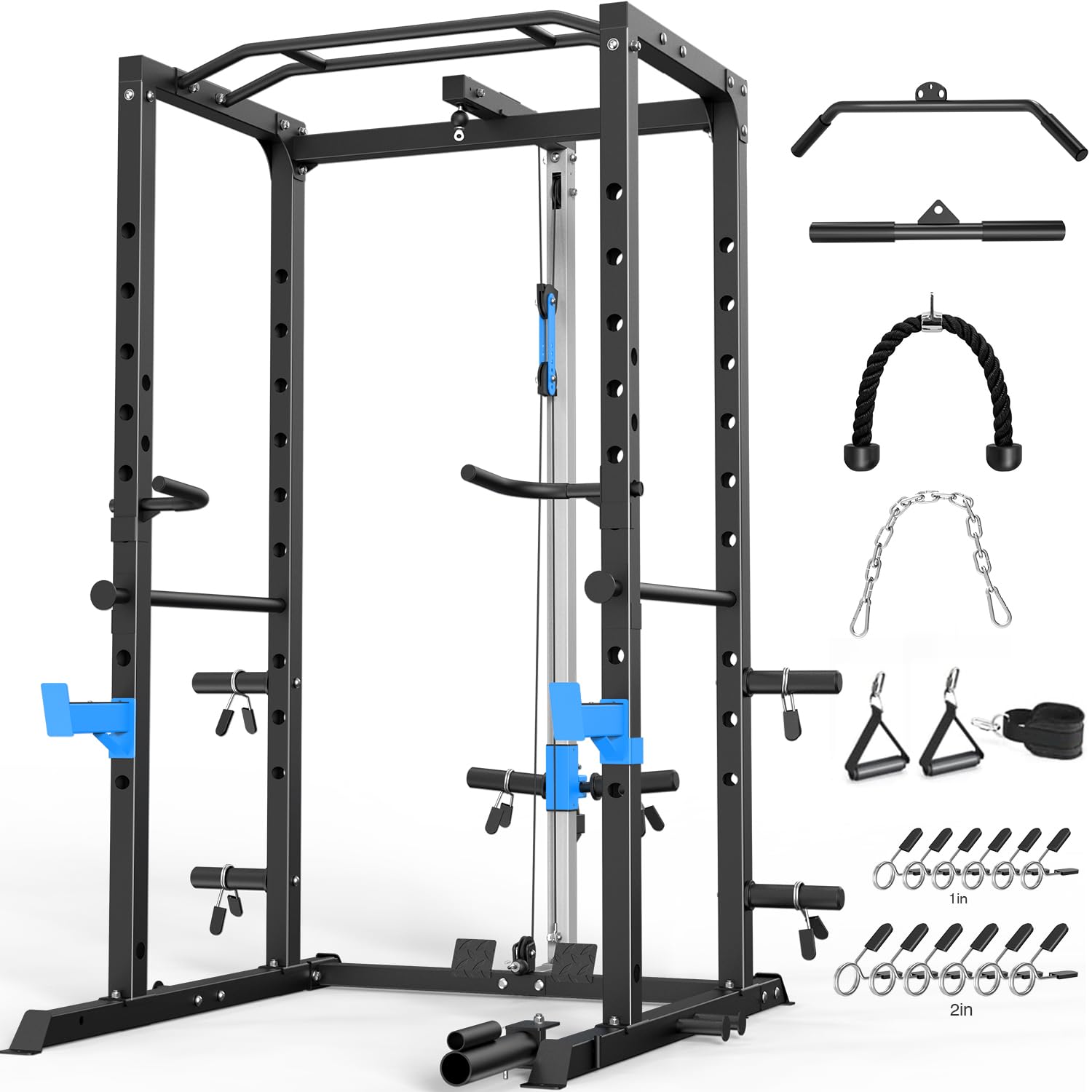
Thirty-eight inches deep, 53 wide and 87 tall: those three numbers are why this is our top pick. It is a four-post rack with locking spotter arms, 18 J-hook positions and an eight-grip angled pull-up bar, and it sits in a spare bedroom or the end of a garage where the bigger cages here will not. We recommend it because it does the barbell work most people actually do, in a footprint that does not take over the house.

Assembly is the least dramatic of anything on this list. The hardware comes bagged and numbered to match the steps, the tools are in the box, and one person can get it upright without a second set of hands, which is not true of the 220-pound cages further down. The 83-pound frame is also light enough that a bedroom gym stays a bedroom: you are not committing the room permanently.

The trade-off is expansion. The uprights use smaller holes than the aftermarket standard, so the generic J-cups, dip bars and landmines sold for most cages will not slide on. What ships in the box is what you get, and there is no cable or landmine here, which is honest rather than stingy: if your program is squats, bench, press and pull-ups, you are not paying for the rest.

Under load it is calmer than 83 pounds suggests. Weight on the bar settles it, the spotter arms hold their setting through repeated sets, and a missed rep stopped one notch below your bottom position lands on steel. Everything else about this rack is unremarkable in exactly the way a good rack should be.

Bottom line: We recommend this one to anyone building a first home gym: a genuine four-post rack with locking spotter arms, in a footprint that fits a spare room.

#3

Mikolo K6 Power Cage

Mikolo K6 Power Cage

Cable crossover work

Our Score 9.4/10
Check Price

Worth Noting

  • 67.5-inch depth needs a dedicated bay
  • Coarse grips on the pull-up bar
Cable Ratio
2:1
Frame Weight
220 lb
Assembled Size
67.5 x 56.5 x 86.4 in
Stated Capacity
1,500 lb
Read the full review

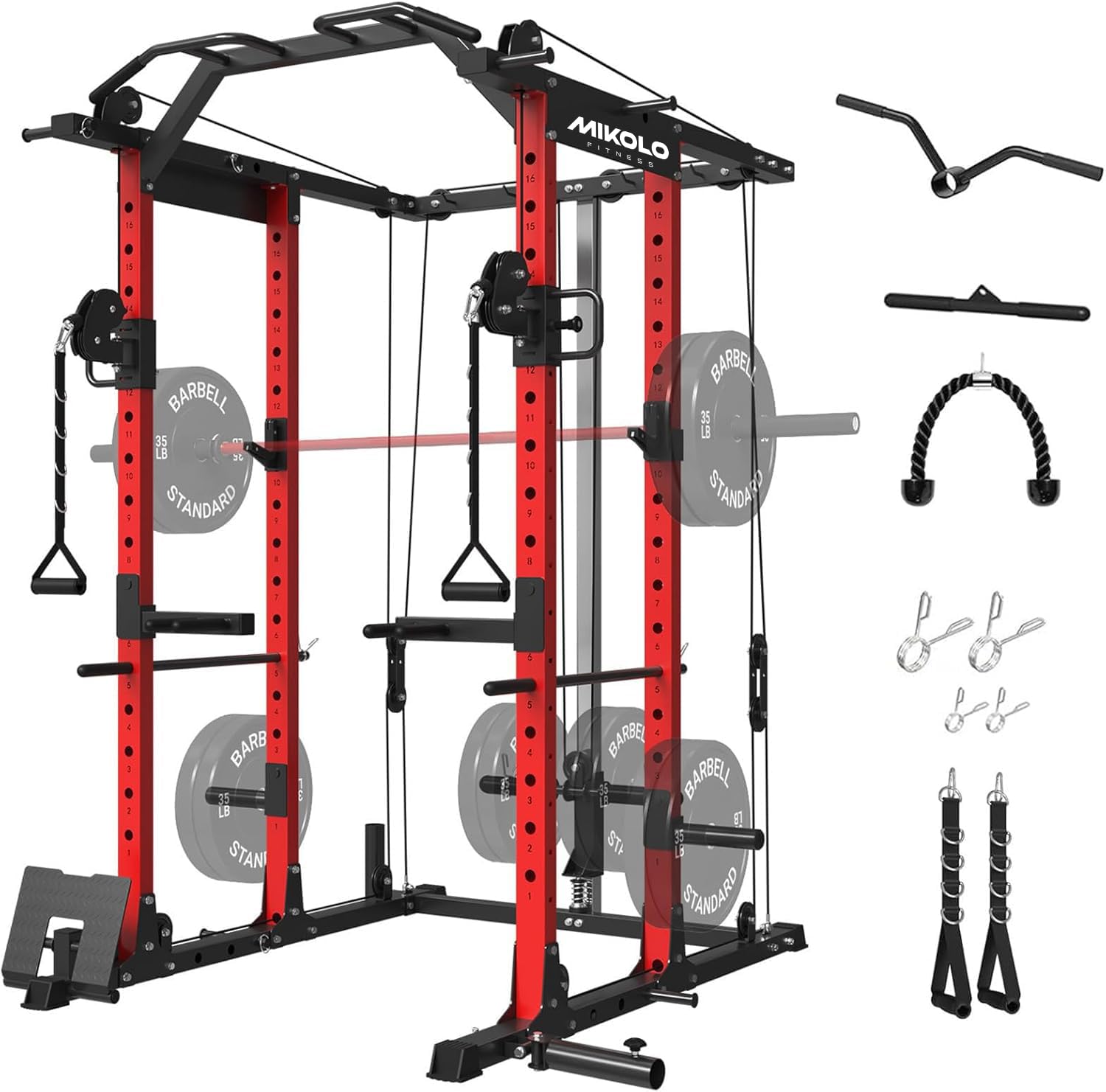
Give a rack a garage bay and it can be this: 67.5 inches deep, 56.5 wide, 86.4 tall and 220 pounds of steel, with cables on both sides and a low row at the bottom. That depth is the number to sit with, because it is the deepest footprint we recommend and it wants a dedicated bay rather than the corner of a room.

What the floor space buys is close to a full commercial setup: a cable crossover with independent pulleys each side, a lat pulldown, a 2:1 low-row station with a footplate, chin-up and pull-up grips, band pegs and a landmine, on a frame rated to 1,500 pounds with a 2-year warranty. The 2:1 ratio halves the weight you feel and doubles the cable travel, which is why it suits high reps and long pulls.

A 220-pound frame does not move, and that is the first thing you notice. The trolleys slide on four rollers a side, the low row tracks straight, and nothing creaks under a hard pull. Two people get it built in an afternoon, and the pull-up bar grips are coarse enough that bare hands will want chalk or gloves.

It is the most expensive of the cable cages here, and the extra buys two independent pulley runs rather than one shared cable, which is the difference between real crossover work and a lat pulldown with extra steps. Set one side high and the other low and the frame holds both without complaint. That is the case for it; if you only ever pull from overhead, a single-pulley cage does the job for less.

Bottom line: Worth the money if you have the floor and ceiling: independent pulleys on both sides, a low row, and 220 pounds of frame that does not move.

#4

ULTRA FUEGO Power Cage

ULTRA FUEGO Power Cage

Budget cable work

Our Score 9.2/10
Check Price

Worth Noting

  • Wobbles on pull-ups until loaded or anchored
  • 1,000-pound rating totals every load point
Uprights
50 x 50 mm, 1.5 mm steel
J-hook Levels
10
Assembled Size
63 x 47 x 82.7 in
Stated Capacity
1,000 lb
Read the full review

For a little more than our top pick, this cage adds what a bare rack cannot: a full pulley run for lat pulldowns, a landmine, dip handles, a tricep rope, an ankle strap and a lat bar. The uprights are 50mm square in 1.5mm steel, the frame is 63 inches deep and 82.7 tall, and the J-hooks and safety bars move through 10 height settings.

We point lifters here when cables are part of the program but a second machine is not. A lat pulldown and a landmine cover most of what a home gym misses, and the 2-year warranty is longer than most of the racks here carry. What you give up is some of the stillness: the frame is tall and light enough that pull-ups set it rocking, and loading the weight pegs or anchoring the base is what settles it.

One number to read slowly. The 1,000-pound capacity adds up every place you can hang a weight, meaning the bar, the storage pegs and the cable, so it is not a grand on your back. Treat your working load as well under that and this cage is honest about what it is: a good mid-priced rack that also happens to do cables.

Bottom line: Our pick when cables belong in the program: a lat pulldown, landmine and dip handles come in the frame, for barely more than a bare rack.

#5

FLYBIRD SR1 Squat Rack

FLYBIRD SR1 Squat Rack

Tight spaces

Our Score 9.2/10
Check Price

Worth Noting

  • Upper frame fastened with four bolts
  • One pair of J-hooks slows the bench switch
Barbell Fit
6 ft and 7 ft
Frame Weight
68 lb
Assembled Size
42 x 51 x 83 in
Height Positions
22
Read the full review

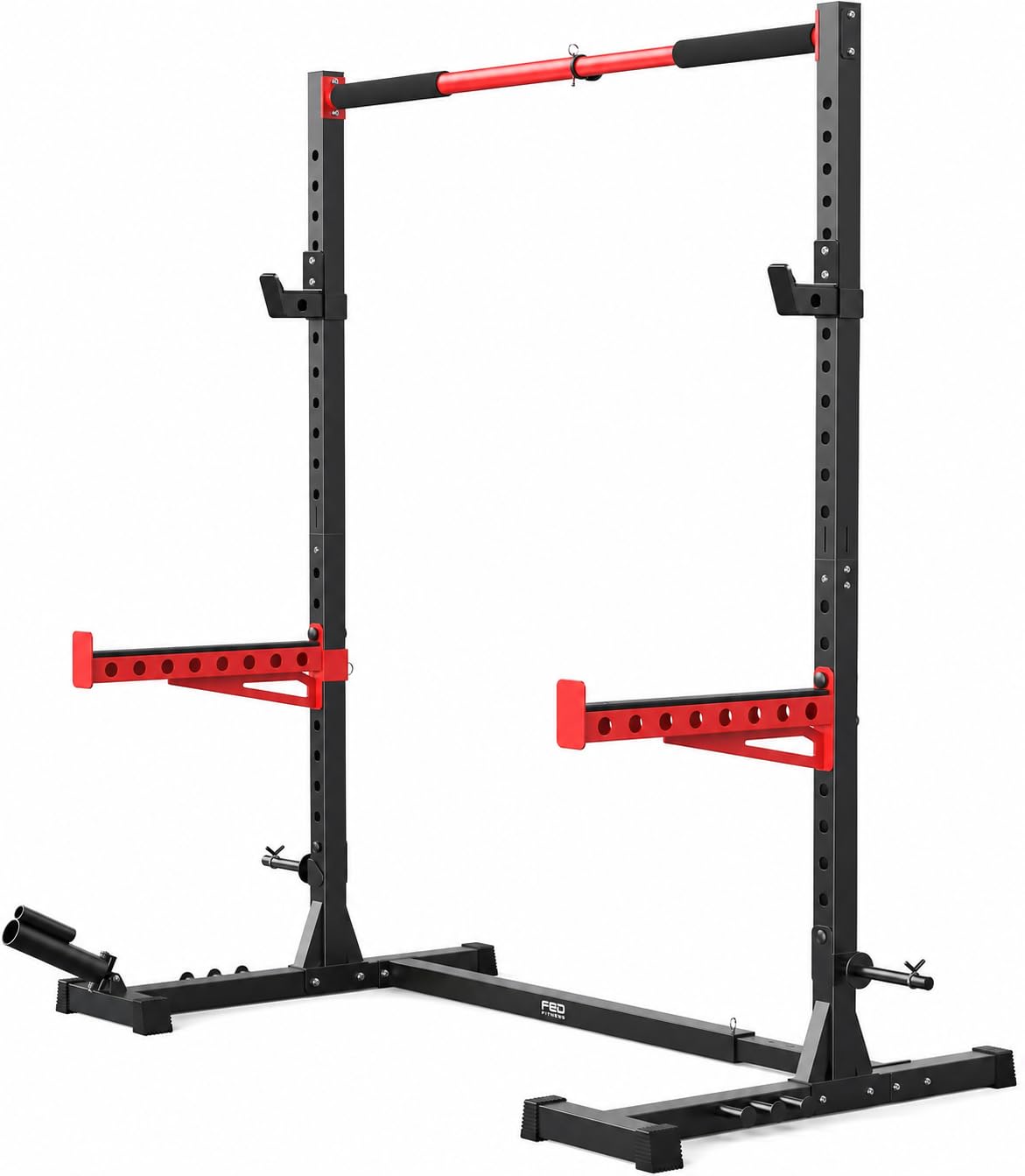
The width adjusts, and that is the unusual thing here. The SR1 is a half rack, 42 inches deep, 51 wide and 83 tall, and its uprights slide in or out to take a 6- or 7-foot bar. It carries 22 height settings on 1-inch holes, 16.7-inch safety arms with protective liners, a landmine, six band pegs and a foam-padded pull-up bar, with a 950-pound rating and a 1-year warranty.

We like it best for the room that cannot spare a cage. It fits inside a five-foot square, it is short enough for a basement with ductwork overhead, and those 22 one-inch holes give finer safety-arm placement than most of the four-post racks here. That matters more than it sounds, because the catch belongs one notch under your bottom position rather than three inches under it.

Two things to know. The frame is 68 pounds, so the base is what keeps it planted: set it on a solid, level floor and lower the bar into the hooks rather than slamming it home. And the upper cross member goes on with four fasteners, which are worth checking after your first few sessions and again once you start pulling hard. There is a single pair of J-hooks, so switching from squats to bench means resetting them.

Bottom line: Buy it when the room is the constraint: it fits a five-foot square, adjusts to a 6- or 7-foot bar, and the 22 settings put the safeties where you need them.

#6

JELENS S11 Power Cage

JELENS S11 Power Cage

Tight basement gyms

Our Score 9.2/10
Check Price

Worth Noting

  • One-year warranty, the shortest here
  • Dip handles sit high for shorter users
Uprights
50 x 50 mm steel
Footprint
12.5 sq ft
Assembled Size
57.5 x 44.5 x 82.6 in
Stated Capacity
2,000 lb
Read the full review

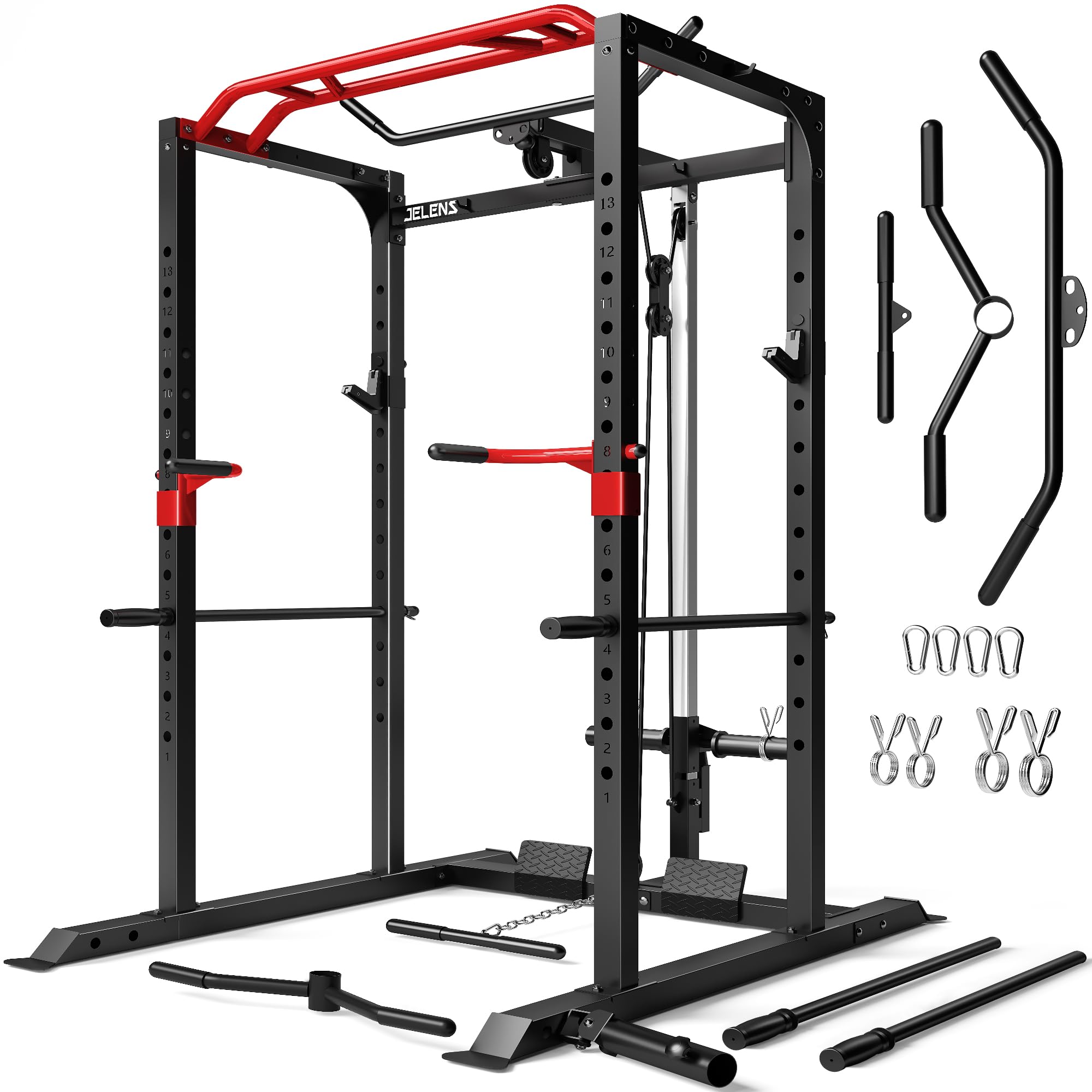
Twelve and a half square feet is the whole claim: 57.5 inches deep, 44.5 wide and 82.6 tall, the smallest floor plan of any cage here with a pulley on it. The uprights are 50mm square steel, the pulley runs up and down the front for lat work and rows, and the frame is rated on paper to 2,000 pounds, with a 1-year warranty behind it.

Compact cages usually give something up, and here it is not stability. At 82.6 inches it slides under basement ductwork that rules out the Mikolo, and once every bolt is tight the frame feels solid rather than springy. Check that the safety bars have seated fully before you load a bar, because they are the one part of the assembly that wants a deliberate hand.

The pulley is the pleasant part. The load runs smooth from the first pull, the cable keeps tension through a long lat set, and the whole thing goes together with the manual spread on the floor, though the instructions take a second read. For a basement sharing space with a water heater, that package is the point.

Our reservation is the warranty: one year against two on the ULTRA FUEGO and the Mikolo, on a cage whose headline is a 2,000-pound rating. We read that number as a ceiling rather than a working load, since 50mm uprights in this footprint will not behave like a 220-pound frame. For moderate barbell work and a lot of cable work, the small footprint is worth more than the last few hundred pounds of rating.

Bottom line: The compact cable cage: 12.5 square feet, a smooth pulley and a frame short enough for a low basement, with a one-year warranty to weigh against the claims.

#7

SunHome Power Cage

SunHome Power Cage

Plate storage

Our Score 9.0/10
Check Price

Worth Noting

  • Uprights sit closer together than our other cages
Frame Weight
115 lb
Plate Storage
4 posts, 2 bar hooks
Assembled Size
46.9 x 42.4 x 84.9 in
Hook Positions
28
Read the full review

Twenty-eight positions for the J-hooks and spotter arms, four plate posts, two barbell hooks, dip handles and a multi-position pull-up bar, on a frame 46.9 inches deep, 42.4 wide and 84.9 tall. That is more adjustment and more storage than anything else at this end of the group.

Storage is the quiet win. Four posts at the back take every plate you own off the floor and two bar hooks keep a spare barbell out of the way, which in a garage that still parks a car is the difference between a gym and a pile. Assembly is a one-sitting job with clear instructions, and the 115-pound frame does not sway once it is up and bolted together.

Hung with plates, the frame gains the ballast a 115-pound cage wants, and the 28 settings let the spotter arms sit exactly where your bottom position is rather than near it. We point people here when the plates need a home as much as the bar does: the storage is not a bonus feature, it is what keeps the floor clear enough to lift on.

Bottom line: For a garage where the plates need a home: four storage posts, 28 settings and a 115-pound frame that two people can stand up in one session.

#8

CANPA Power Rack

CANPA Power Rack

Squats and pull-ups

Our Score 9.0/10
Check Price

Worth Noting

  • Pull-up bar sits high for shorter lifters
Assembled Size
43 x 40.75 x 85.7 in
Stated Capacity
800 lb
Support Arm Holes
17 per side
Frame Height Settings
6
Read the full review

At 40.75 inches across, this is the narrowest frame we recommend, and the width is the first thing you notice with a bench inside it. What it does well is everything that does not need elbow room. The double-support frame carries an 800-pound rating, the multi-grip pull-up bar offers several hand positions, and each side has 17 holes for the barbell support arms. If you want to bench inside the uprights this is not the rack for you; if you squat, press and pull up in front of it, it is a lot of rack for the money.

Setup is quick, the main frame has six height settings so the whole rack can drop a few inches under ductwork, and the plate bar at the back holds the weight that otherwise ends up stacked on the floor. It shakes when a bar comes down hard, which loading that rear bar settles. For a low-ceiling basement where the rack has to sit against a wall, that is the job done.

Bottom line: Buy it for squats, presses and pull-ups in a tight room, and bench outside the uprights; the width is the one number that decides whether it works for you.

How We Chose and Tested the Best Power Racks

We started with research rather than a shopping cart: we compared listed heights and footprints against real ceiling and floor space, checked which racks accepted standard 7-foot barbells, and noted what came in the box versus what was sold separately. From that pool we bought seven racks across the price range and spent six months with them in garages, basements, and spare rooms, with lifters from 5-foot-4 to 6-foot-2 taking turns.

We built each rack ourselves, timing the job and noting whether hardware arrived bagged by step, whether the manual matched the parts on the floor, and where we needed a second set of hands. Once assembled, we ran a hand over welds and powder coat and checked that the uprights sat flush to the floor.

To judge sturdiness, we loaded a bar to working weights, squatted and benched, and deliberately dumped reps onto the spotter arms to watch the uprights and feet. We racked the bar hard a dozen times and checked whether the frame walked across concrete and rubber mats.

Fit and adjustability got the fussiest attention: we set the J-hooks and safeties for squats, then reset them for bench, noting whether pins slid cleanly or bound up and whether the height increments suited both shorter and taller lifters. Pull-up bars were judged by actual sets — overhand, neutral where available — and by how much the bar flexed. On racks with cable systems, we ran lat pulldowns and crossovers and listened for grit or snagging in the pulley. Finally, mobility: we measured footprints, pushed each rack a few feet to sweep underneath, and tallied what a buyer would still need to purchase for basic training.

How to Choose a Power Rack

Start With the Ceiling, Not the Rack

Uprights here run from 82.6 to 87 inches, and the pull-up bar is the highest point on every one of them. An eight-foot garage ceiling measures 96 inches, so a full rack clears it with room to spare. A finished basement often measures 84 inches or less, which takes the tall cages off the table before anything else matters.

The trap is the word compact. In a listing it describes floor space, not height, and a cage can cover 12.5 square feet in plan while still needing 83 inches of clearance. Measure from the floor to the lowest thing above it, ducts and door tracks included, subtract three inches, and shop against that number rather than the one in the title.

Read the Frame, Not the Capacity Headline

Two racks can both claim 1,500 pounds and behave nothing alike. The figures that travel better are the steel: 2x2 uprights in 12- or 14-gauge are the home-gym standard, 50mm square in 1.5mm steel is the same thing said in metric, and 2x3 uprights are a step up in stiffness. Frame weight is the number you can actually compare, because 68 pounds and 220 pounds feel like different machines when a bar comes down hard.

Capacity numbers are usually static and often total every load point, including plates on the storage pegs and the cable run. Treat them as a ceiling rather than a working load and leave yourself some margin.

Hooks, Safeties and the Add-On Trap

The safety arms are the reason to buy a rack instead of a pair of stands, and their usefulness is measured in holes. Set them one notch below the bottom of your squat and a missed rep lands on steel rather than on you. More positions means smaller jumps between settings, which matters most for bench pressing and for lifters in the middle of a height range.

The trap is attachment compatibility. Aftermarket J-cups, dip bars and landmines are built around a standard upright hole, and a rack with smaller holes shuts that market out entirely. If you plan to add pieces over the years, check hole size and upright dimensions before you order, not after the rack is built.

What Cables and a Smith Bar Cost You

A pulley buys lat pulldowns, rows and crossovers without a second machine, and a Smith bar buys a fixed path you can take to failure alone. Both add height, weight and money, and both narrow the list of racks that fit your room. The ratio matters too: a 2:1 pulley halves the weight you feel and doubles the cable travel, which suits high reps and long pulls.

Tall cable cages move on pull-ups unless the base is loaded or anchored, so budget for plates on the storage pegs or a set of concrete anchors. If you will use cables twice a week, pay for them. If you are buying them for someday, a bare rack and a set of bands will do more.

Frequently Asked Questions

Final Verdict

For most people, the Sunny Health & Fitness Full Size Power Rack is the answer: a four-post frame with locking spotter arms that fits in a spare room, goes up in one sitting, and does not charge you for a pulley you will never use. It is the rack we point to when someone asks what to buy first.

If cables are part of your program, the ULTRA FUEGO adds a lat pulldown, landmine and dip handles for barely more. With a garage bay and a real appetite for crossover work, the Mikolo K6 and its independent pulleys are worth the jump; for a basement that has to hold everything, the pooboo P43 puts a Smith bar and two cables in the same outline.