Strength & Weights

Best Stall Bars of 2026

A stall bar is just a ladder bolted flat to a wall, which means every hang, stretch, and knee raise pulls the whole frame away from the wall a little. The bars themselves are simple; the difference between a set you trust at full bodyweight and one you quietly avoid comes down to the frame, the hardware, and how it meets your studs. What you're buying, really, is a way to open up your shoulders and low back after a day at a desk, and a place to hang and decompress when nothing else loosens you. There's a set in my garage that's been there for years, and my team and I have spent the last eight months living with nine more.

Here's what first-time buyers don't know: studs sit 16 inches apart, and most frames are wider than that, so mounting decides whether a set feels solid or skitters. Check the hardware list before the spec sheet, because a set that shifts once is a set you stop using. The picks below span budgets, heights, and wall situations, so there's one for whichever wall you've got.

#1

DHT Wood Stall Bar

Top Pick
DHT Wood Stall Bar

Heavy-duty use

Our Score 9.2/10
Check Price

Worth Noting

  • No pull-up or dip bars included
Frame
Steel and wood
Max Load
330 lb
Footprint
31.5 W x 78.1 H in
Rung Range
7.2 to 78 in
Read the full review

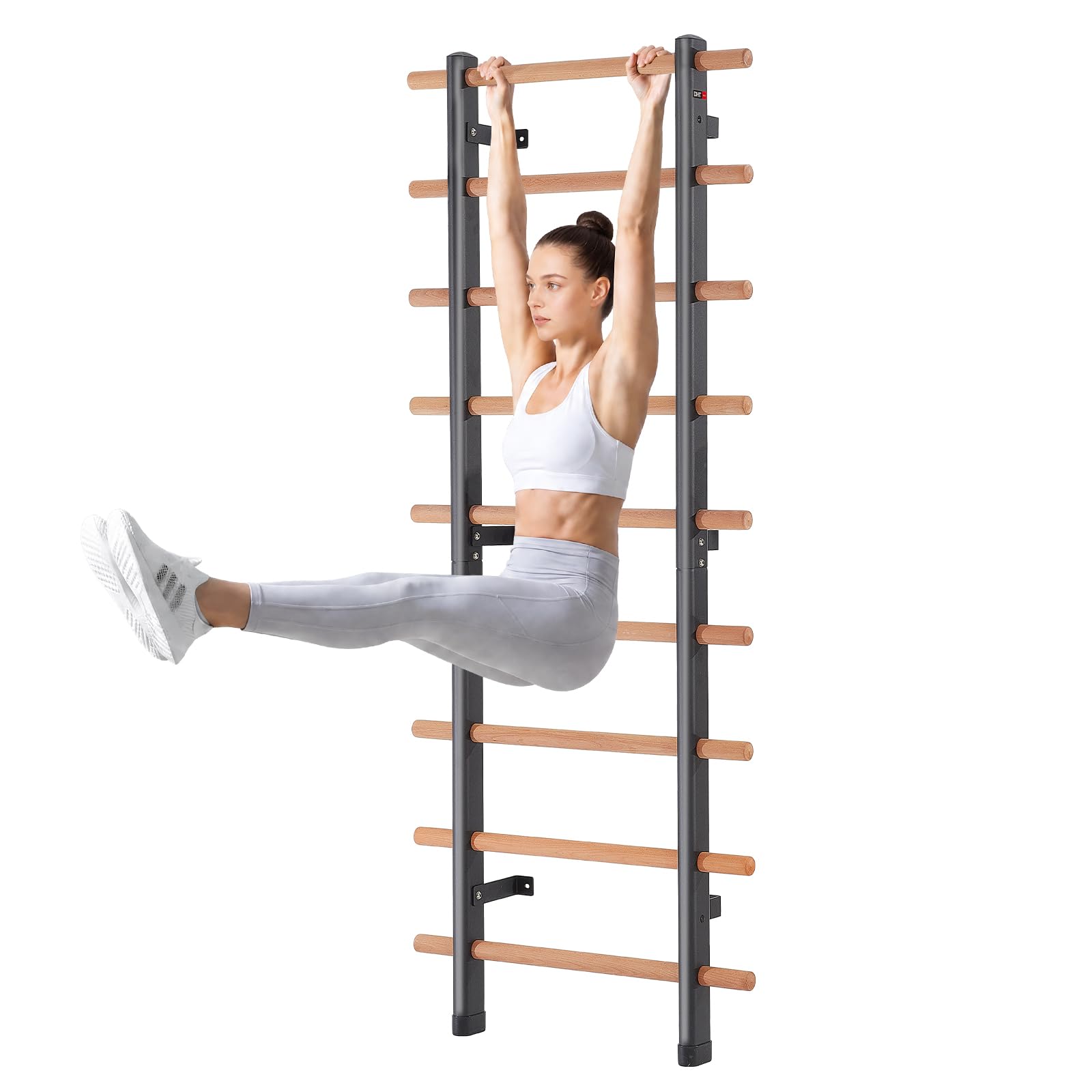
The DHT's 330-pound weight rating is the highest in this group, and it is the first number we check when a wall bar will be shared by two adults or used by someone heavy. The frame uses steel uprights with solid wood rungs, and the 31.5-inch width keeps the footprint tidy.

The detail we liked most is the lowest rung at 7.2 inches. That is lower than the GMWD's 11-inch bottom rung, and it changes how the ladder works for foot-supported stretches and low rows. You can anchor a foot closer to the floor instead of reaching for a high rung. The top rung reaches 78 inches, so the usable range is tall enough for hanging and overhead work despite the 78.1-inch frame being shorter than the RokePro's 88-inch frame.

We treat this as the hard-use ladder in the group. The 330-pound rating and steel construction give it a margin that the lighter-rated picks can't match, and the wood rungs keep it comfortable under hand. It is also the pick for a small home gym where the ladder will see daily stretching and hanging rather than occasional use. For a single user who wants a simple, very strong ladder, it is the one to beat.

Bottom line: We point heavier users to the DHT: its 330-pound rating is the highest here, backed by a steel frame.
#2

GMWD Swedish Ladder

GMWD Swedish Ladder

Complete home gym

Our Score 9.0/10
Check Price

Worth Noting

  • 265-lb capacity trails heavier-duty picks
Included
Pull-up bar and dip bars
Max Load
265 lb
Footprint
32 W x 85.8 H in
Rung Range
11 to 78 in
Read the full review

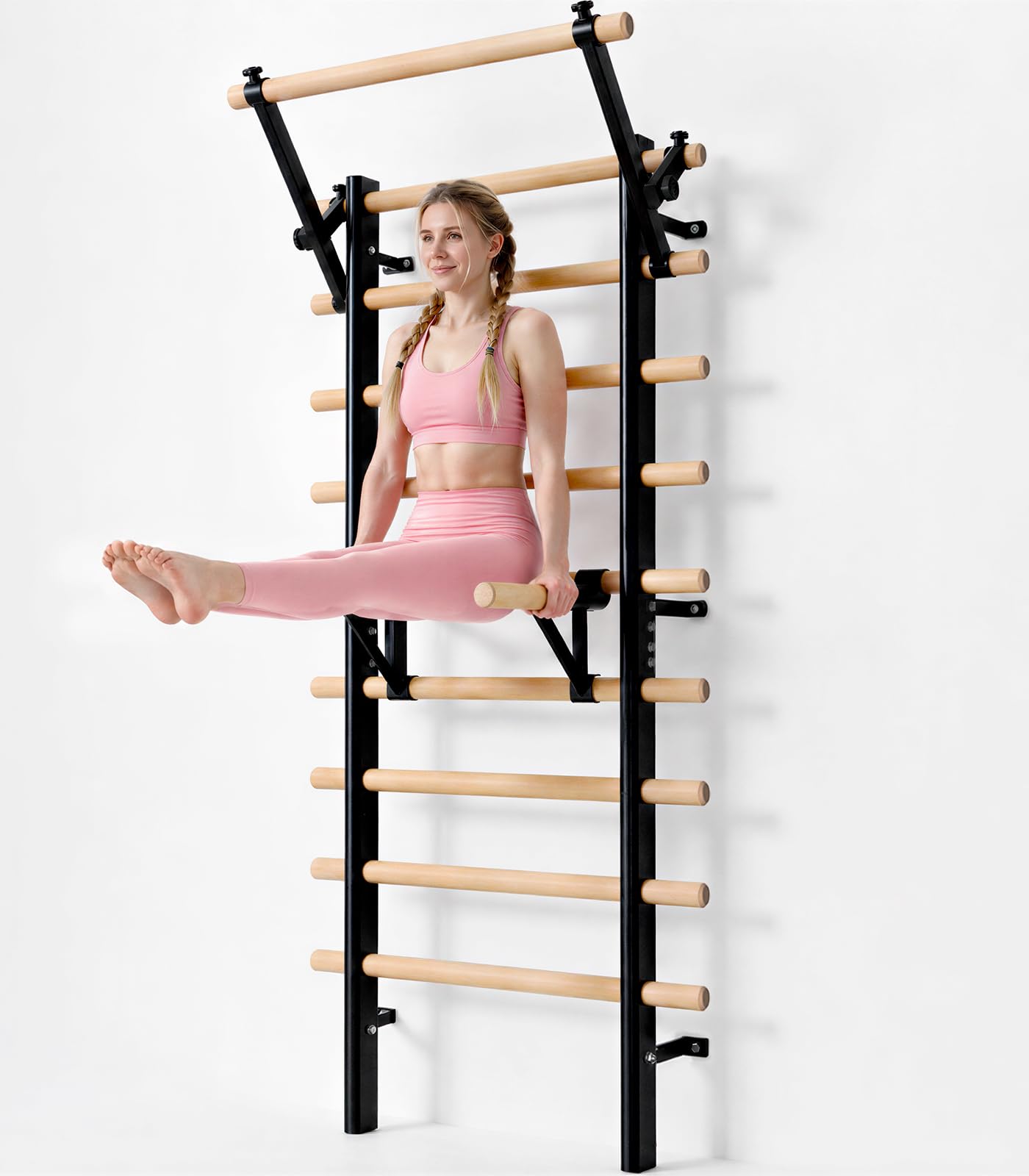
The first thing we noticed about the GMWD is how much of a home gym arrives in one box: the Swedish ladder, a pull-up bar, and dip bars all mount to the same wall footprint. That completeness is why it's our top pick. With nine rungs running from 11 to 78 inches and a 32-inch-wide frame, it covers hanging, stretching, and bodyweight work without asking you to buy three separate stations or give up a whole wall.

The 1.5-inch New Zealand pine rungs are sanded and polished, and that finish matters more than it sounds. Your hands and bare feet spend a lot of time on those rungs, and the smoother surface makes the ladder feel friendly rather than utilitarian. We also like that the lowest rung sits at 11 inches: it's low enough for foot-supported stretches and for shorter family members to reach without a step stool. The 85.8-inch height is tall enough to feel like a real ladder, not a decorative rail.

The steel uprights give the ladder a rigid feel, and the open frame leaves room for a mat or bands alongside it. We also appreciated that the pull-up and dip attachments don't turn the ladder into a bulky cage; the whole station still reads as a ladder on the wall. If you want a single wall that handles a warm-up, a stretch session, and a few pull-ups without adding a rack, this is the one that makes the most sense.

What keeps this at the top is the way the pieces work together. We didn't have to decide between a stretching ladder and a pull-up bar, and the 32-inch width leaves room for a mat alongside it. That makes it the easiest one to recommend as a first stall bar.

Bottom line: For most home gyms, we think this is the stall bar to buy: nine usable rungs, a pull-up bar, and dip bars in one wall-mounted package.

#3

RokePro Swedish Ladder

RokePro Swedish Ladder

Taller users

Our Score 9.0/10
Check Price

Worth Noting

  • Brackets may not match standard stud spacing
Mounting
Wall mount
Footprint
33 W x 88 H in
Rung Material
Beech wood
Depth From Wall
8.2 in
Read the full review

At 88 inches tall, the RokePro is the tallest frame in this group, and that height is the reason to start here if you want a high reach for hanging or overhead stretching. The 33-inch width and 8.2-inch wall projection keep it from feeling like a bulky rig; it sits close enough to the wall that a small room can still work around it.

Beech wood gives the rungs a different feel from the pine on the GMWD. They are 1.4 inches in diameter with a varnished finish, and the smaller diameter is easy to wrap a hand around for hangs and rows. We rank it as our pick for taller users because the extra frame height gives long-limbed people more room to work. The wooden ladder is the main event here; if you want a bundle with rings and a rope ladder, look at the WEDANTA instead.

The RokePro's advantage is simple: more height in a slim footprint. If your ceiling can take an 88-inch frame and your priority is a wooden ladder that disappears against the wall, it is the better fit than the GMWD. The GMWD remains our default because it adds the pull-up and dip bars, but the RokePro is the one we point to when height comes first.

Bottom line: Our tall-user pick: the 88-inch frame gives long-limbed bodies more room than the top pick, with a slim 8.2-inch wall projection.

#4

WEDANTA Wooden Swedish Ladder Set

WEDANTA Wooden Swedish Ladder Set

Kids and families

Our Score 8.8/10
Check Price

Worth Noting

  • More involved assembly than a plain ladder
Included
Ladder, pull-up bar, rope ladder, rope, rings
Material
Wood
Max Load
290 lb
Footprint
31.5" x 7'2"
Read the full review

If the wall bars are going into a playroom rather than a garage gym, the WEDANTA is the set that turns the wall into a climbing frame. The box includes the Swedish ladder, a pull-up bar, a rope ladder, a rope, and gymnastic rings, all sized around a 31.5-inch by 7-foot-2-inch footprint. That is a lot of activity in the same space as a single ladder.

The 290-pound load rating means adults can hang and use the pull-up bar, not just kids. What we appreciate most is that the ladder doesn't become a dead piece of wall between adult workouts; the rings and rope give children a reason to use it every day. It is one of the few pieces of home gym equipment that genuinely works for young children and a parent in the same session, provided an adult is watching.

The rope ladder is the part to keep an eye on. It is a wear item on a kids' set, and it should be checked before anyone climbs; replace it at the first sign of fraying. That is normal upkeep for a play set, not a reason to skip the ladder, but it belongs on your maintenance list.

Bottom line: This is the family pick we keep coming back to: rings, a rope ladder, and a pull-up bar turn one wall into a playroom.

#5

PreGymnastic Stall Bars

PreGymnastic Stall Bars

White steel frame

Our Score 8.4/10
Check Price

Worth Noting

  • Mounting hardware may need upgrading
Frame
Powder-coated steel
Included
Single-bar bracket and dip bars
Warranty
1 year
Rod Diameter
1.5 in
Read the full review

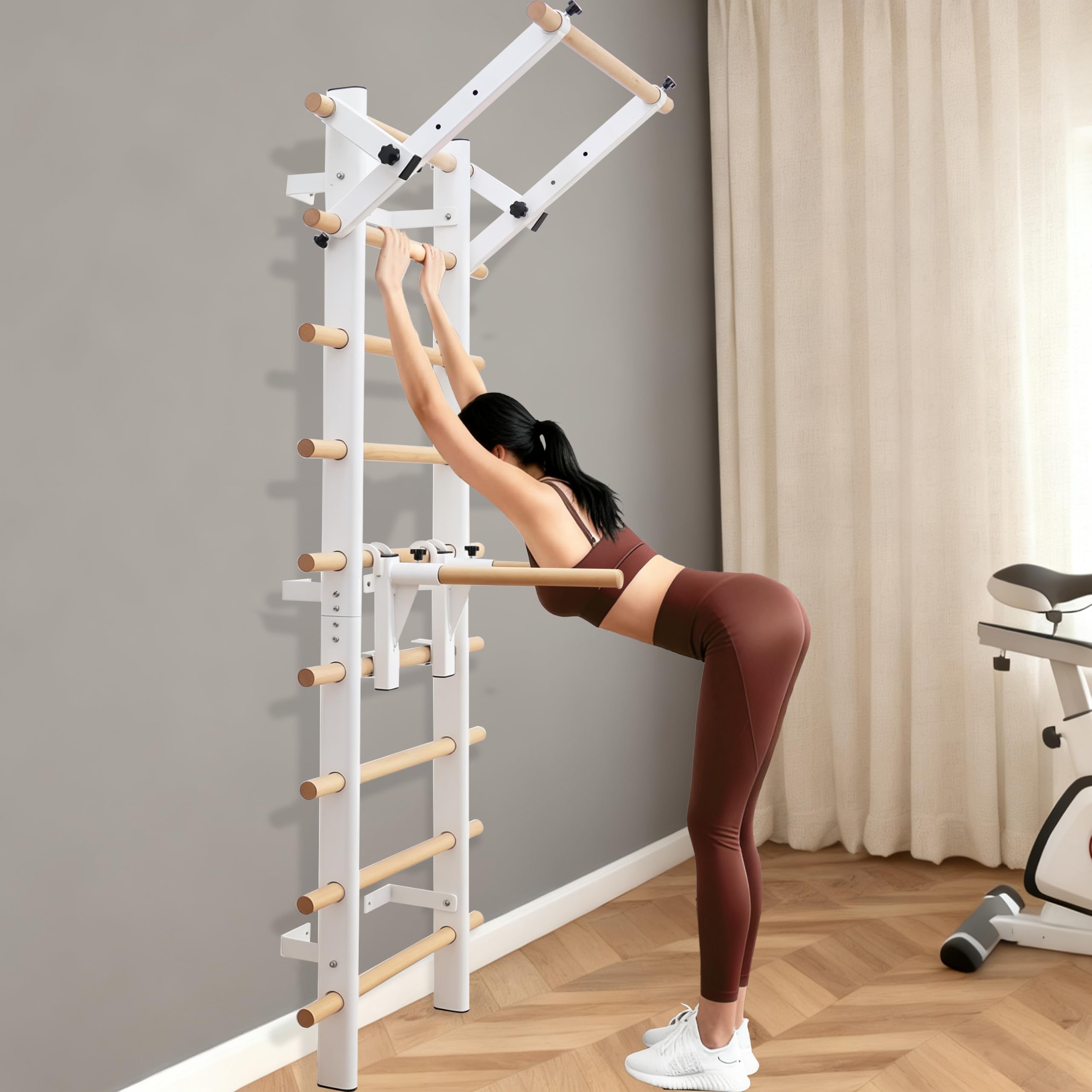
The PreGymnastic is the white steel-framed option in a group of mostly wood-look ladders, and that finish is the first thing that sets it apart. The frame is powder-coated steel, the rods are 1.5-inch beech, and the set includes a single-bar bracket and dip bars. If your gym has white walls and chrome racks, this is the one that blends in instead of shouting for attention.

The beech rods are sanded and varnished twice, and the 1.5-inch diameter is the same size as the GMWD's pine rungs. That makes the grip familiar, while the steel frame gives the ladder a more clinical look. We see it as a good fit for a clinic or a spare room where the wall bar should read as equipment rather than furniture.

It lands in also-consider because the package is not as complete as the top pick's. The GMWD bundles a pull-up bar and dip bars with a similar rung size, and it has the stronger overall case. The PreGymnastic's advantage is the white steel frame and the dip bars; if that look is what you want on the wall, it is a reasonable alternative.

Bottom line: We like the PreGymnastic for a clinic or spare room where a white steel frame matters; the beech rods and dip bars make it more than a pretty wall piece.

How We Tested the Stall Bars

We began with roughly 30 sets sold in the U.S., then cut anything with vague mounting hardware, an unlisted wood species, or a frame too narrow to span a standard stud bay. Nine made the cut: a mix of pine, beech, and birch frames, some with steel brackets, some with wood standoffs, ranging from a single-column set to a full-height ladder.

Assembly and installation came first. I built each one solo with a drill and a level, timing the whole thing, counting every bolt, washer, and lag screw against the parts list, and noting whether the instructions said anything useful about stud spacing or wall type. Then we mounted them — into studs where we could, into a garage wall, a spare-bedroom wall, and a basement corner — and hung on each one at full bodyweight, watching for flex in the frame and any give at the brackets.

For eight months we used them the way people actually do: morning shoulder stretches before work, evening hangs, hip flexor and hamstring work on the lower rungs, the occasional climb. We ran fingers along the rungs for splinters, checked how the finish held up where sweaty hands landed, and every few weeks re-tightened every fastener and looked for wobble, cracks around the screw holes, and gaps opening at the wall. Looks got graded too, since a set that's homely in a spare room quietly stops getting used. Value came last: what the frame actually gave us in height, rung count, and included hardware for what it cost.

How to Choose Stall Bars

Start With the Wall

Stall bars are wall-mounted equipment, so the installation decides whether the purchase works. You need to locate the studs or a suitable masonry wall, then compare the bracket spacing to the framing before you order. Standard studs are often 16 inches on center, but that is not a guarantee, and older homes can be different. If the brackets do not line up, a plywood backer board or added blocking spreads the load. The trap is treating drywall anchors as enough: they are not a substitute for structural framing or proper masonry fasteners. Check the wall first; the ladder is the easy part.

Look at the Rung Range, Not Just the Height

Overall height tells you how much wall the ladder occupies. The rung range tells you what you can actually do with it. A low bottom rung, such as the DHT's 7.2-inch starting point, is useful for foot-supported stretches and low rows; an 11-inch bottom rung, like the GMWD's, is easier to reach but less useful for anchoring a foot near the floor. At the top, 78 inches is a common ceiling for hanging and overhead work, while an 88-inch frame like the RokePro's gives taller users more room. Check both ends of the range and the ceiling clearance above the top rung.

Decide How Much Station You Want

Stall bars can be a simple ladder or the anchor for a whole training corner. The GMWD includes a pull-up bar and dip bars; the WEDANTA adds rings and a rope ladder for kids; the DHT is the ladder alone. More attachments mean more ways to train, but also more hardware, more clearance, and more to check. If you mainly want stretching, hanging, and band work, a bare ladder is simpler and often sturdier for the money. If you want one wall to cover pull-ups, dips, and family play, a bundle earns its complexity. Decide before you buy; adding attachments later is rarely as clean.

Plan for Depth, Width, and Assembly

A stall bar needs clear floor in front of it, not just wall space. The RokePro projects 8.2 inches from the wall; the GMWD's 32-inch width is typical here, and the DHT is 31.5 inches. Leave enough room to stand, lie down, and extend your arms without hitting furniture. Above the ladder, check that a pull-up or hanging position will not put your head into a ceiling or beam. Assembly is the other variable: some sets go up in an afternoon, others need a second person and a trip to the hardware store. Read the mounting instructions before the box arrives.

Frequently Asked Questions

Final Verdict

The GMWD is the stall bar we recommend for most homes. It gives you nine usable rungs, a 32-inch-wide footprint, and both pull-up and dip bars without turning the wall into a commercial rig. That combination is why it earns the top spot over ladders that ask you to buy the extras separately. If weight capacity is the deciding factor, go with the DHT and its 330-pound rating. If the wall is going in a playroom, the WEDANTA's rings and rope ladder make more sense for kids. The RokePro remains the tall-user alternative when an 88-inch frame matters more than the attachments.