Strength & Weights

Best Ab Machines of 2026

Most ab machines don’t fail because they’re too easy—they fail because they hurt in the wrong places. A seat that digs into your hips or a back pad that leaves your lower back sore turns a 10-minute workout into a negotiation. The right machine supports your back and neck, stays stable, and puts the work in your abs, not your shoulders or hip flexors. That’s the difference between a machine you use three times and one that earns its spot.

I’ve tried plenty of gear that looked good in photos and felt flimsy by week two, so I was skeptical. Over six months, we tested 11 ab machines in living rooms, spare bedrooms, and a cramped garage corner. Some assembled in 15 minutes; others had me rereading instructions with a wrench in hand. The best stayed stable through side bends, felt comfortable on the lower back, and were still tight after months of use. The worst wobbled, pinched, or hogged floor space until moving them became a chore. Below are the ones that delivered on performance, quality, and value.

#1

MERACH MR-2510 Ab Machine

Top Pick
MERACH MR-2510 Ab Machine

All-round core training

Our Score 9.2/10
Check Price

Worth Noting

  • Most expensive machine in this group
  • 24 pounds makes moving it a two-handed job
Item Weight
24 lb
Track Design
Independent dual tracks
Height Settings
4
Weight Capacity
440 lb
Read the full review

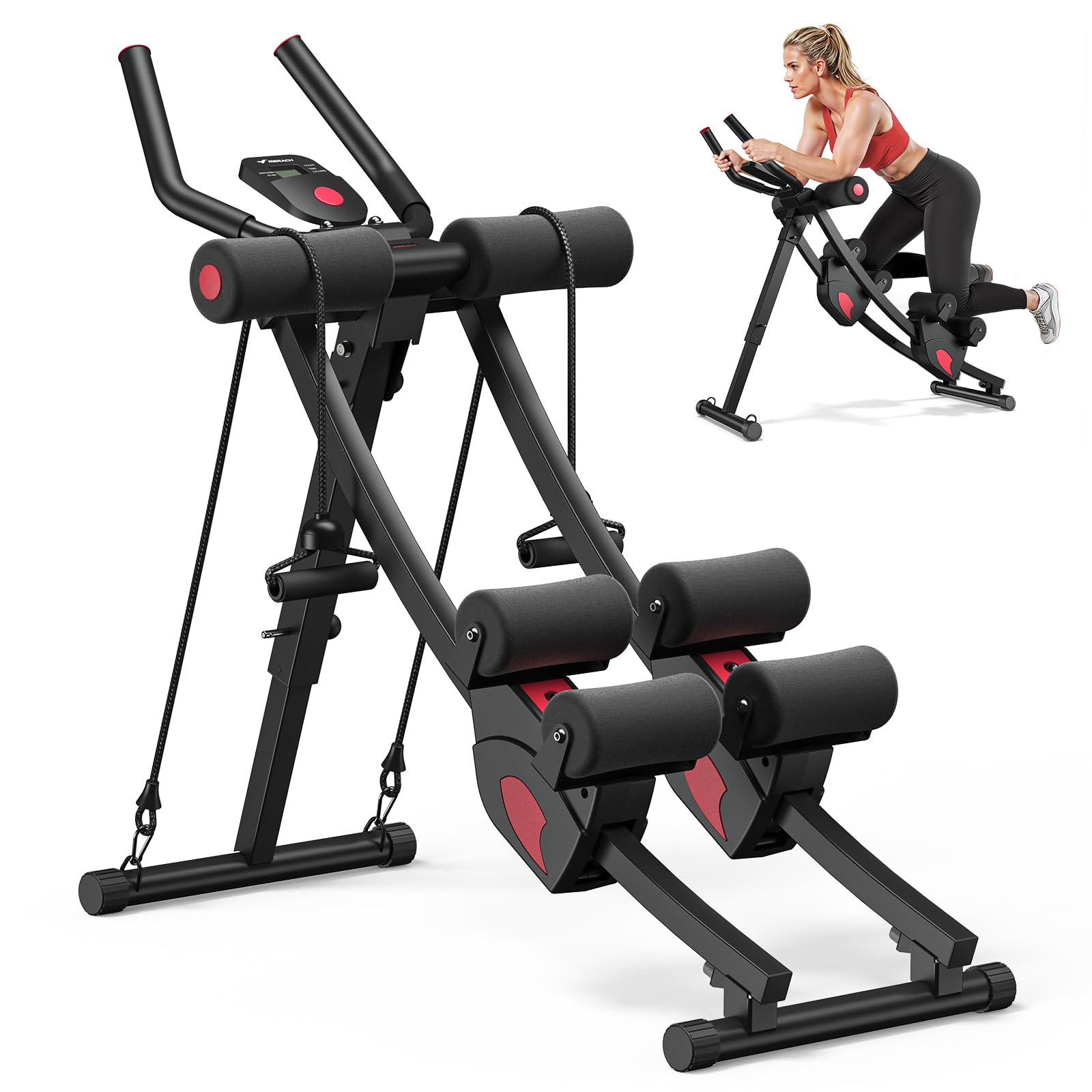
Every ab machine in this group claims a sturdy frame, and stability is the first thing we checked, because a machine that rocks mid-rep turns a core set into a balance exercise. The MR-2510 is the one that felt settled from the first rep. The triangular dual-track frame is heavier than most here at 24 pounds, and the wide steel base sits flat instead of tipping forward as you drive. That is the reason it is our top pick; everything else about it is a bonus on top of a frame you can trust.

The two tracks move independently, which turned out to be the feature we kept using. You can push both knees together for a standard crunch, or alternate them for a motion closer to a mountain climber, and the 110-degree curve keeps the pull through your abs rather than your neck. Alternating changes how a session is structured rather than just how hard it is, and none of the joined-carriage machines here can do it.

Four height settings cover a wide spread of users, and the foam on the handles and knee block is thick enough that a long set does not become a test of pain tolerance. It folds for storage despite the heavier frame, though you will move it with two hands rather than one.

Two things to keep in mind before you commit. It is the most expensive machine in this group by a clear margin, and the resistance bands that come with it are the part worth watching over time — they take wear the steel never will. Neither changes the recommendation; they just tell you what you are paying for and what to keep an eye on.

Bottom line: The one we steer most people toward: the steadiest frame in this group, a 440-pound rating, and independent tracks that make core work less repetitive.

#2

FLYBIRD AW1 Ab Machine

FLYBIRD AW1 Ab Machine

Progressive crunch work

Our Score 9.2/10
Check Price

Worth Noting

  • 330-pound capacity, among the lowest here
  • Compact track suits shorter users better
Item Weight
18 lb
Adjustability
4 incline angles, 5 heights
Weight Capacity
330 lb
Read the full review

The AW1 does not use the same motion as everything else here. Instead of sliding back and forward along a shallow curve, you drive upward against a rising track, so the abs are loaded through a different part of the range. It takes a set or two to stop fighting the unfamiliar path, and then it feels like more work per rep than a flat rail.

The adjustment grid is the part that sold us. Four incline angles and five heights are paired rather than stacked, so you get a real progression instead of two settings and a hope. Incline sets how steep the climb is; height sets where your knees sit, which is how the machine fits a five-foot-two user and a six-footer without either feeling folded up. It works as well for a total beginner as for someone who has trained for years.

Two things to know. At 18 pounds it is light enough to fold and push into a corner, and the folded package stays slim. But the frame is rated to 330 pounds, among the lowest ceilings here, and the machine is compact in length, so taller users may find the track runs out before their range of motion does. Neither matters if you are average height and well under the rating; if you are not, the MR-2510 is the safer buy.

Bottom line: Worth it if flat crunch tracks bore you: the bottom-up arc changes the angle of the work, and four inclines plus five heights let you keep raising the bar.

#3

MERACH MR-2314 Ab Machine

MERACH MR-2314 Ab Machine

First home machine

Our Score 9.0/10
Check Price

Worth Noting

  • Can feel wobbly at the knee pad
Monitor
LCD display
Adjustability
2 incline settings, 5 heights
Weight Capacity
440 lb
Read the full review

Capacity is where the MR-2314 makes its case. It is rated to 440 pounds, the same ceiling as machines that cost far more in this group, and it pairs that with two incline settings and five height adjustments. That is not the widest adjustment range here, but it is enough to take someone from a shaky first set to a genuinely hard one.

The details are sensible for the money. Thick foam at the knees and elbows means a longer session does not end because a pad gave out, the alloy steel frame folds, and the LCD counts exercises so you are not guessing whether you did twelve reps or twenty. Assembly is quick and the fold makes it livable in a small room.

We think it is the right first machine for most people. It is not the most refined frame in this group, and heavier users will want the MR-2510, but it is the one we hand to anyone starting from zero.

Bottom line: The easiest recommendation for a first machine: a 440-pound frame, an LCD rep counter, and padded knees at a price that undercuts the rest of this group.

#4

Fitlaya Curve Track Ab Machine

Fitlaya Curve Track Ab Machine

Alternating slider work

Our Score 8.8/10
Check Price

Worth Noting

  • Knee padding is thin for heavier users
Monitor
LCD display
Item Weight
23 lb
Weight Capacity
440 lb
Resistance Levels
4
Read the full review

The separated sliders are what make this Fitlaya different. Each knee rides its own track, so you can drive both legs together or alternate them, and the second option is where the machine earns its place — the alternating pattern reaches the obliques and hip flexors in a way a single joined carriage cannot. That mattered more than we expected once we stopped matching legs and started alternating them, because it changes the shape of a session rather than just its difficulty.

The rest is solid. Four resistance levels give you a progression, the LCD reports calories, time, and reps, and the heavy-duty steel frame carries a 440-pound rating. At 23 pounds it is light enough to fold and move, and assembly is about as quick as this category gets.

The catch is fit. The knee padding is thin under a heavier user, and the range of motion runs out sooner than the length of the track suggests, so tall users may find themselves shortening the stroke. If either applies to you, the MR-2510 has more travel and more padding underfoot; if not, this is the most interesting machine to train on in this group.

Bottom line: Best for alternating work: the two sliders move separately, so each side of your core has to do its own job, and the frame is rated to 440 pounds.

#5

AIRHOP Auto Rebound Ab Machine

AIRHOP Auto Rebound Ab Machine

Small apartments

Our Score 8.8/10
Check Price

Worth Noting

  • 330-pound weight ceiling
  • Seat is small for larger frames
Assembly
Fully assembled
Item Weight
11 lb
Weight Capacity
330 lb
Resistance Levels
4
Read the full review

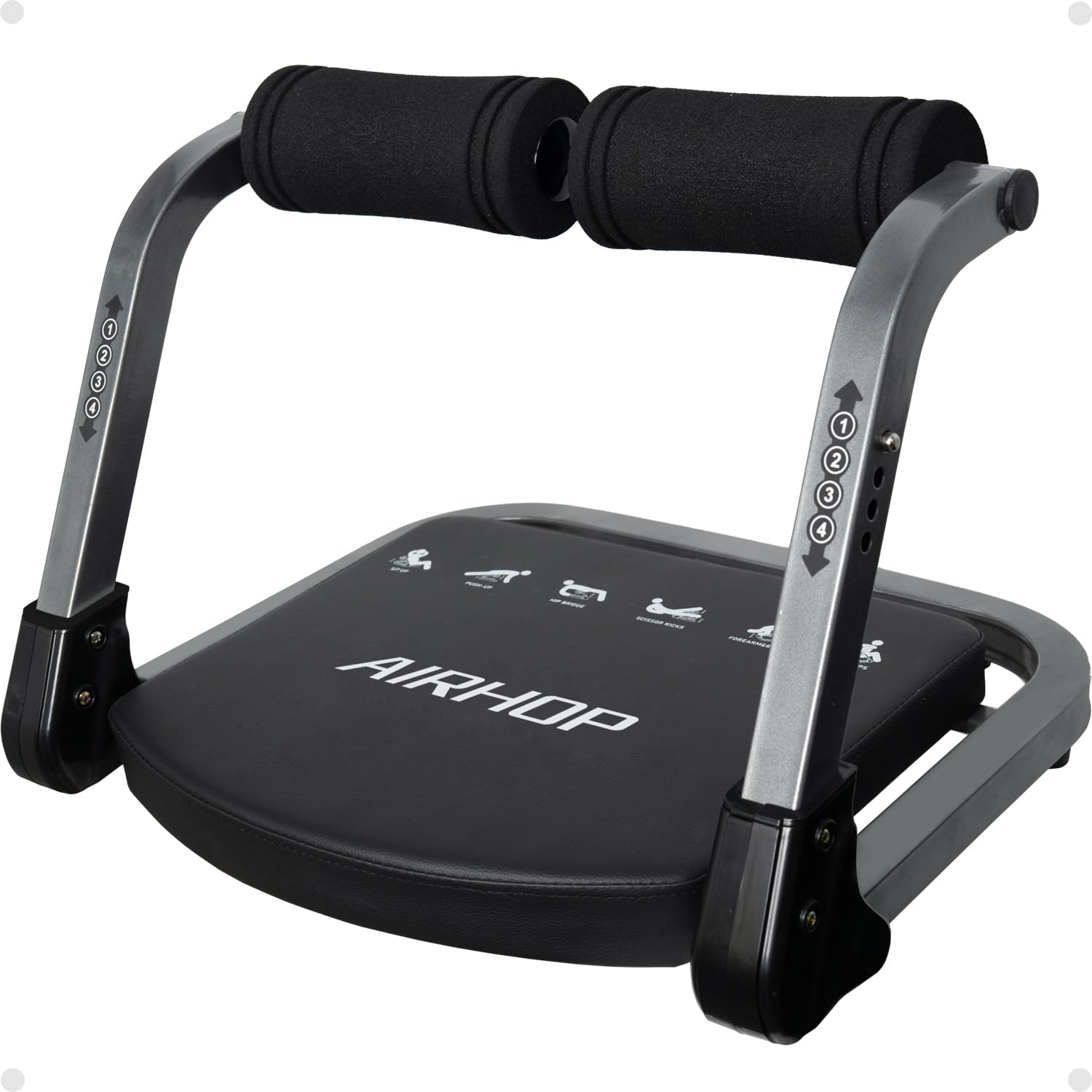
There is no box of bolts with the AIRHOP. It comes out of the packaging assembled, which sounds like a small thing until you have spent an evening with an Allen key and a diagram that does not match the parts. At 11 pounds it is the lightest machine here, and the fold is simple enough to do one-handed, so it can live under a bed and come out for fifteen minutes.

We were pleasantly surprised by how much the auto-rebound changes the feel. The seat springs back through the lowering phase, which takes load off the part of a sit-up where the lower back usually complains, and four resistance levels mean the assist can do most of the work at first and less of it later. The 19.7-by-15.75-inch leather seat and the two-inch foam rollers are comfortable for a full set.

The 330-pound ceiling and the light frame put a boundary around who this suits: smaller users and smaller rooms. Within that brief it does more than sit-ups — crunches, push-ups on the handles, scissor kicks, glute bridges — and the variety is what keeps it in rotation rather than folded away.

Bottom line: The one to buy if the machine has to disappear between workouts: it arrives assembled, weighs 11 pounds, and folds flat under a bed.

#6

RELIFE Adjustable Ab Machine

RELIFE Adjustable Ab Machine

Tracking progress

Our Score 8.8/10
Check Price

Worth Noting

  • Knee pads get uncomfortable on long sets
Monitor
LCD display
Item Weight
20 lb
Adjustability
5 heights, 2 inclines
Weight Capacity
440 lb
Read the full review

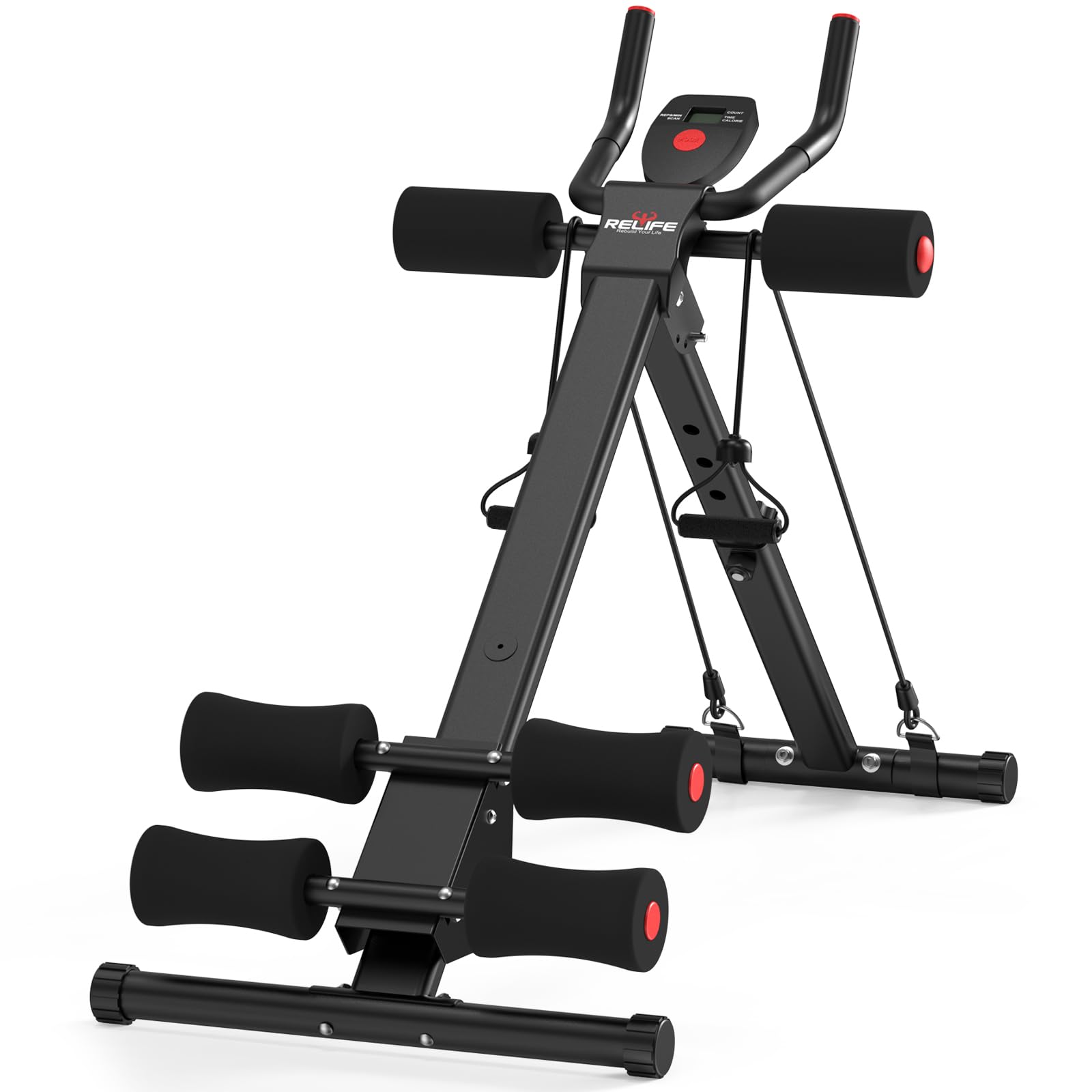
Five height settings and two incline levels is a lot of adjustment for the money here, and the LCD tracks reps, counts, and time so a session has a shape rather than a vague sense of effort. The steel frame is rated to 440 pounds, which is the same ceiling the top pick carries.

RELIFE also thickened the rollers and used NBR foam on the pads, which is the sort of detail that matters more as a machine ages than on the day it arrives. It folds, it weighs 20 pounds, and it moves and stores without drama.

We noted that the value story here is stronger than the refinement story. The printed instructions are thinner than they should be, so check the parts against the diagram before you start bolting, but nothing about the machine gets in the way of a hard set.

Bottom line: A good value if you want options: five heights and two inclines to grow into, plus a rep counter, all on a 440-pound frame.

#7

Fitlaya PP1 Ab Machine

Fitlaya PP1 Ab Machine

Tight spaces

Our Score 8.8/10
Check Price

Worth Noting

  • Plastic rollers and knee pads wear first
  • Compact frame suits smaller users
Monitor
LCD display
Item Weight
16.5 lb
Height Levels
4
Weight Capacity
440 lb
Read the full review

Footprint is this machine's argument. It weighs 16.5 pounds and runs about 35 inches long, so it folds and leans into a closet or slides under a bed without rearranging the room. If the reason you have not bought an ab machine is that you do not have a gym, this is the one we point to first.

The curve track does the basics well. Four height levels let you change the difficulty, the LCD counts reps, time, and calories, and the sliding motion keeps the work in your abs rather than your neck — which is the point for anyone whose sit-ups usually end in a sore neck.

The weak seam is the hardware. Plastic rollers and knee pads are the parts that go first, and the frame is compact enough that taller or heavier users will feel the size even though it is rated to 440 pounds.

So where does that leave it? As a low-cost first machine for an average-sized user who wants to find out whether they will actually stick with core work, it is a sensible spend. If you already know you will, put the money into the MR-2510 and get the frame that does not move.

Bottom line: A light, low-cost way into curve-track training that suits smaller users, as long as you do not expect the rollers and pads to take heavy daily use.

#8

Bigzzia 5-in-1 Ab Bench

Bigzzia 5-in-1 Ab Bench

Bench-style training

Our Score 8.8/10
Check Price

Worth Noting

  • Slider binds and handlebars flex
  • 150 kg rating limits heavier users
Modes
5-in-1
Item Weight
27.8 lb
Weight Capacity
330.7 lb
Resistance Levels
3
Read the full review

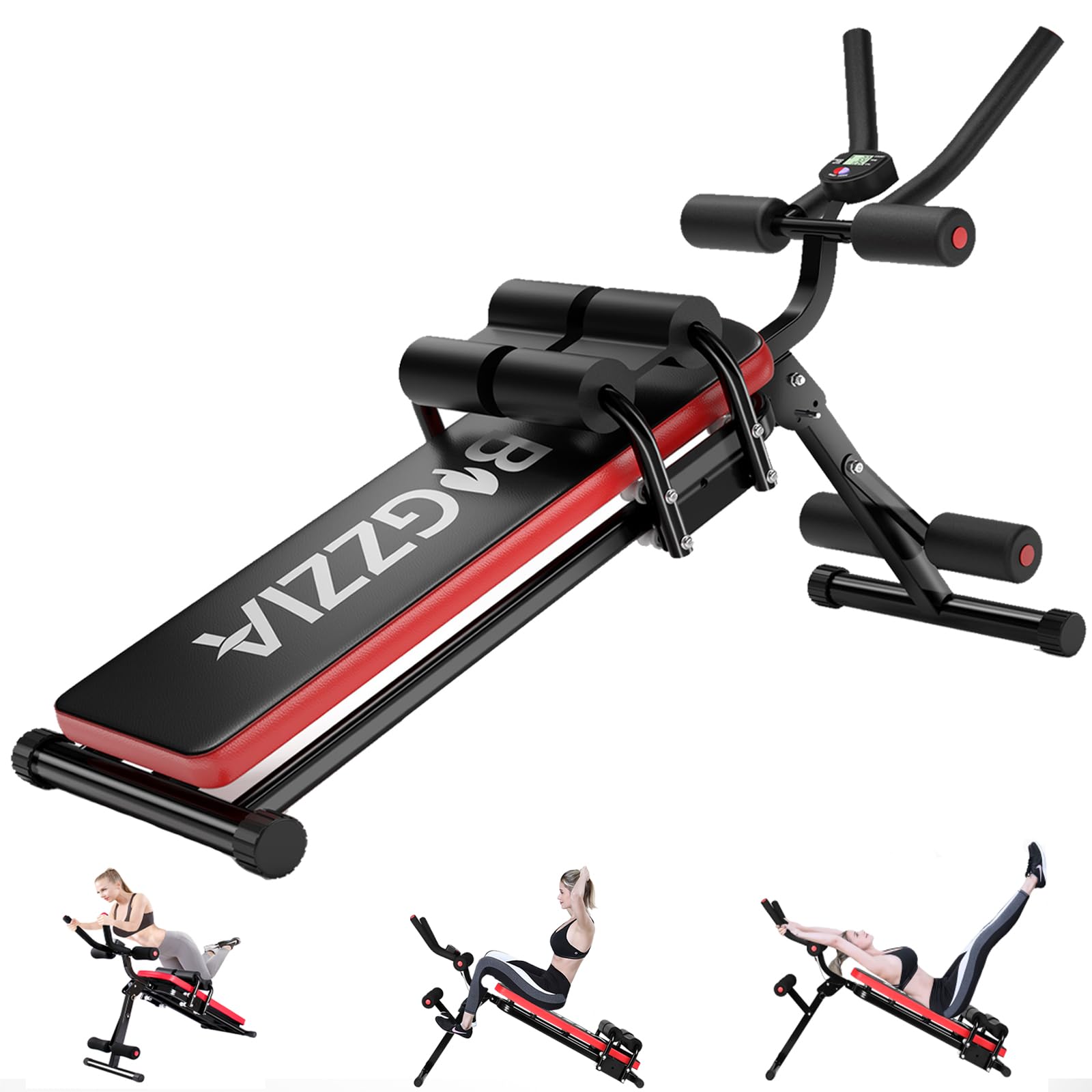
Five modes on one frame is the pitch: sit-ups, push-ups, a leg press, a glider, and a Roman-chair position. We wondered whether spreading the design that thin would leave every mode feeling like a compromise, and mostly it does not. The bench half — the padded backrest, the foam armrests, the leg-raise position at the end — is the part that works.

Three resistance levels come from holes in the plate under the handle, so you can make a sit-up easier or harder without changing your body position. It folds on a locking latch and stores against a wall, and at 12.6 kg it is manageable to move. The printed instructions are small and sparse, so plan on the parts diagram rather than the text.

The glider is the weak mode. The carriage can bind instead of running, the handlebars flex under load, and driving back and forth with your head fixed puts strain where a track machine would not. That is the setting this machine does not serve: if what you want is a smooth, repeatable crunch along a rail, buy a rail.

Where it makes sense is for someone who wants a decline bench first and a core machine second. You get leg raises, sit-ups, and a place to do decline work, plus a glider you will use now and then. At 150 kg capacity it is rated below the 440-pound machines here, so check that number against your own weight before anything else.

Bottom line: Buy it as a bench that also glides: the sit-up and leg-raise positions are the reason to choose it, not the sliding carriage.

How We Tested These Ab Machines

We started by pulling together the models shoppers actually compare—core trainers, ab coasters, and full ab benches—then filtered out anything with vague specs, unstable-looking bases, or a footprint that wouldn’t fit a normal room. We ordered 11 units across the price range and built each one solo, timing assembly and noting whether the instructions matched the hardware in the box.

For six months, we used each machine at least three times a week for 10- to 15-minute sessions. We did standard crunches, oblique twists, and leg raises, counted reps until form slipped, and paid attention to whether the burn landed in the abs or moved into the neck, wrists, or lower back. We also pushed each unit side to side while in use, checked for wobble at the highest resistance, and noted whether the seat, back pad, and handles stayed comfortable through a full set.

Every few weeks we went back over the bolts, welds, padding, and folding joints, looking for loosening, flattening, or creaks. We measured footprints, wheeled or carried each machine between rooms, and stored it upright to see how much floor space it really reclaimed. At the end, we compared what each one cost against how often we reached for it, how solid it felt, and whether the resistance range and attachments actually changed the workout. The machines that made the list earned their place on effectiveness, comfort, stability, durability, and day-to-day convenience—not on a flashy feature list.

How to Choose Ab Machines

Stability comes before features

An ab machine turns your own body into the load, and any rock in the frame pushes that load into your neck and lower back. Look for a wide base, a triangular or dual-rail frame, and feet that grip. A big weight rating is the easiest thing to print on a box and says what the steel is meant to hold, not how still it sits.

Test it before you trust it: ten slow reps will show you whether the base walks across hardwood or stays planted. On a slick floor, a thin mat under the feet solves most of it; on carpet, make sure the frame sits on top of the pile rather than sinking unevenly into it.

Match the weight rating to your body, then leave margin

Ratings in this group run from 150 kg to 440 pounds, and they refer to the user's body weight, not to how much you can lift on the machine. Pick a rating comfortably above your own weight. A frame working near its ceiling flexes more, and flex is what you feel as wobble halfway through a set.

If you are anywhere near the top of a lighter machine's range, the 440-pound models here are the ones to look at. The 330-pound frames are perfectly usable, but they leave little headroom for a heavier user or a household where two people share the machine.

What height and incline settings actually do

More settings is not automatically better, but the two adjustments do different jobs. Incline changes the slope you drive against, which is how you make a rep harder once the movement gets easy. Height changes where your knees and hips sit, which is how you make the machine fit your body.

Two inclines and five heights is enough to take most people from their first set to a genuinely hard one; four inclines gives you a finer ramp between the steps. If you are tall, weight the track length more heavily than the number of settings, because a short rail runs out of travel before your range of motion does.

Padding and the parts that wear out

Pads and rollers fail before the steel does. Knee and elbow foam should be thick enough that a fifteen-minute session does not end because of pressure points, and the carriage should run without grit or binding. A weight rating tells you nothing about the plastic in the slider.

Treat the moving parts as consumables and check what backs them up: the MERACH machines here list a 12-month warranty and the AIRHOP lists a year, which is what you want if a roller or a resistance band is the thing that goes. Replacing a band is cheap; replacing a frame is not.

Assembly, folding, and where it will live

Assembly ranges from none at all, as with the AIRHOP, to about half an hour with an Allen key. Lay the hardware out against the parts list before you start, because a missing bolt will stall the whole job, and check the folding latch as carefully as the frame.

Then be honest about storage. The folding machines here run from 11 to 24 pounds, and a heavier frame is steadier to train on but a two-handed job to move. Measure the gap under the bed or the floor space in the closet before you order, then decide whether you want the machine to disappear or to stay out.

Frequently Asked Questions

Final Verdict

For most people, the MERACH MR-2510 is the machine to buy. It is the steadiest thing we used in this group, it carries a 440-pound rating, and the independent tracks give you two ways to train instead of one.

If the budget is tight or the machine has to tuck behind a door, the MR-2314 does the core job with the same capacity for far less. And if you want a bench more than a track, the Bigzzia covers sit-ups and leg raises well — just do not count on the glide.