Strength & Weights

Best Thigh Exercisers of 2026

A thigh exerciser looks simple—until you squeeze one that's too stiff, too flimsy, or lined with a seam that bites. I learned that the hard way with a bargain model that slid off my knees and never came back out of the closet. The right one gives you a quiet, portable way to strengthen your inner and outer thighs while you watch TV or take a work call—no gym required.

Over the past four months, I've put 14 thigh exercisers through their paces—from living-room sessions during movie nights to desk-side squeezes between emails. We paid attention to how each one felt against bare skin, whether resistance held steady, how much it weighed and how much drawer space it took, whether the display and battery storage were useful, and whether it looked decent and was actually enjoyable to use. A tip: the highest resistance setting isn't always best—most people get more from a moderate squeeze they can hold for 30 seconds than a max-effort crunch they abandon after five. The picks below are the ones that earned a permanent spot next to the couch.

#1

FJFQXY Thigh Trainer

Top Pick
FJFQXY Thigh Trainer

Tracking resistance

Our Score 9.6/10
Check Price

Worth Noting

Display
Resistance readout
Handles
Interchangeable
Warranty
1 year
Resistance Range
0–77 lbs
Read the full review

Most thigh trainers ask you to judge resistance by feel. The FJFQXY puts a number on it: a small display on the knob shows the resistance value as you turn, so you know whether you are working at 40 pounds or 60 before the set starts. We like the readout for exactly that reason — it turns a vague squeeze into something you can add to week by week.

The other half of the design is the interchangeable handles. Fit them and the same spring becomes an arm and shoulder trainer, which is more range than the fixed-pad devices here give you. The body is a PA and glass-fiber composite rather than plain plastic, the more robust material spec in this group.

The catch is where the range starts. Zero pounds means the first several turns of the knob do very little, so you dial in before you begin rather than as you go — a thirty-second habit that keeps the first set from feeling like nothing.

Bottom line: The only trainer here that tells you what you are lifting, and the swappable handles make it the most versatile of the group — worth it if numbers keep you honest.
#2

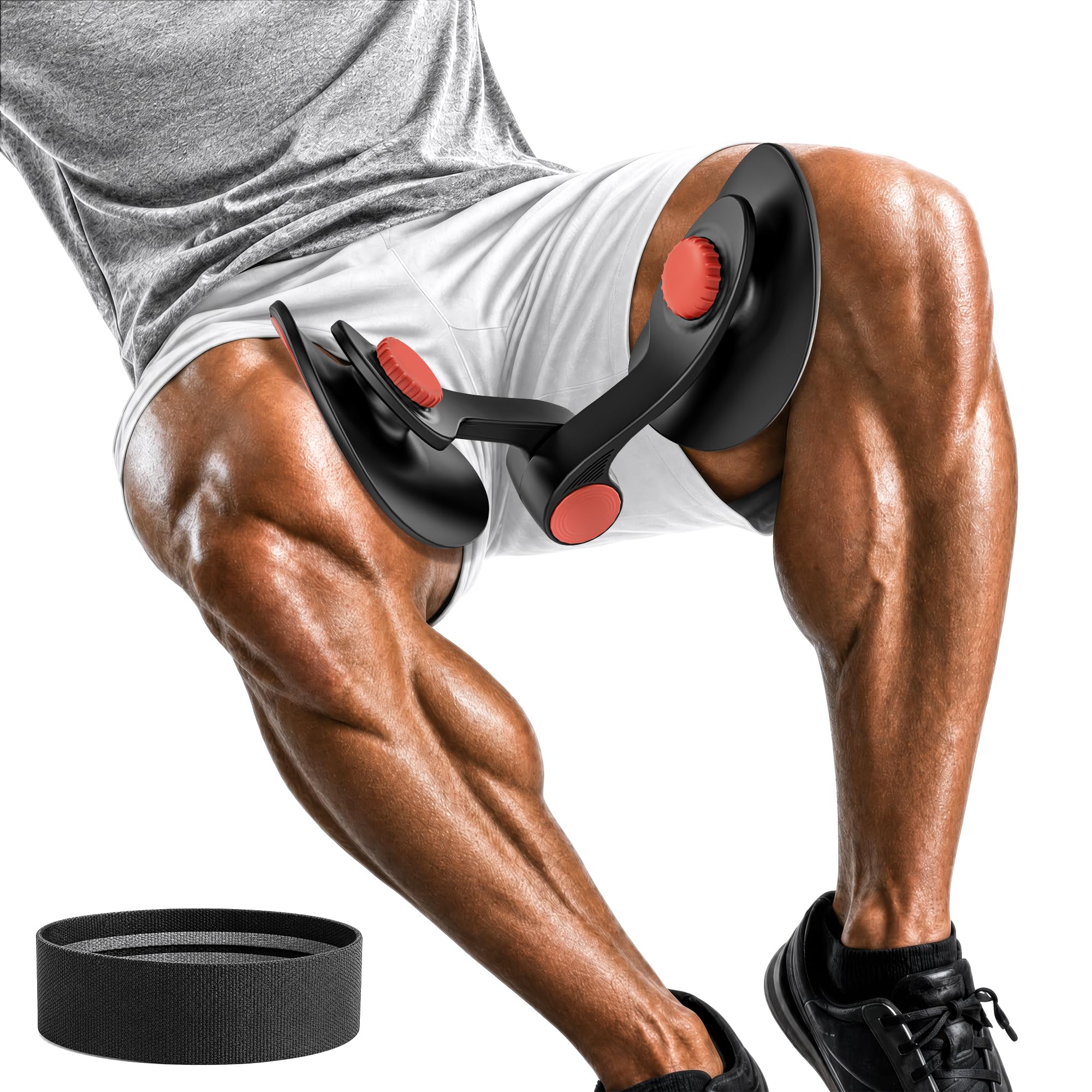
TINRIEF 35 lb Thigh Trainer

TINRIEF 35 lb Thigh Trainer

Travel and starters

Our Score 9.2/10
Check Price

Worth Noting

  • Priced above adjustable models here
  • Exercise sheet printed in very small type
Weight
1.8 lb
Rotation
360° rotating board
Resistance
35 lb
Included Band
40 lb
Read the full review

The first few squeezes on the TINRIEF feel like very little. Ten reps in, the 35-pound steel spring has made its point — the load builds rather than arrives — and that slow start is what we noticed first. It makes this a friendly device to begin on, and a limited one for anyone already training.

At 1.8 pounds it disappears into a gym bag, and the 360-degree board underneath lets you change the pad angle so the pressure moves around the thigh instead of sitting in one spot. A 40-pound resistance band comes with it, which is the real versatility story: loop it for arm and back work and the device stops being a one-trick squeeze. Build quality is the reassuring part — a thick spring, and a band that feels like it came from a proper gym set.

The knob turns the rotating board, not the spring, so the load stays where it started. The band is the only way to add difficulty, which is fine for warm-ups and return-to-exercise work and frustrating once 35 pounds feels easy.

Bottom line: A gentle, well-made starter that travels well thanks to its 1.8-pound frame and included band — but the resistance never changes, so stronger users will outgrow it.

#3

ODCPN Thigh Trainer

ODCPN Thigh Trainer

Changing pad angle

Our Score 9.2/10
Check Price

Worth Noting

  • Covered for only 60 days
Weight
1.4 lb
Included
Storage pouch and training manual
Rotation
360° rotating pads
Resistance Range
15–80 lbs
Read the full review

The pads on the ODCPN turn through 360 degrees, so the same squeeze can be run with the pressure high on the inner thigh, rolled forward, or angled back toward the knee. One device, several contact points. Around that you get 15 to 80 pounds of adjustable resistance, 1.4 pounds of trainer, a storage pouch and a printed manual.

The rotation is more than a spec-sheet flourish. Holding one pad angle for rep after rep is what makes these devices hurt, and being able to shift the contact point is what lets you finish a set when one spot has had enough — we came back to that adjustment far more often than to the ceiling. That ceiling still puts it near the top of this set for load, second only to the Paleclouds, and it does it for less.

It is light enough to move from room to room and small enough that the pouch keeps it out of the way, which is the difference between a device that gets used during a TV episode and one that lives in a cupboard.

Bottom line: A light, affordable way to get rotating pads and an 80-pound ceiling, and the one we hand to anyone who finds a single fixed squeeze angle uncomfortable.

#4

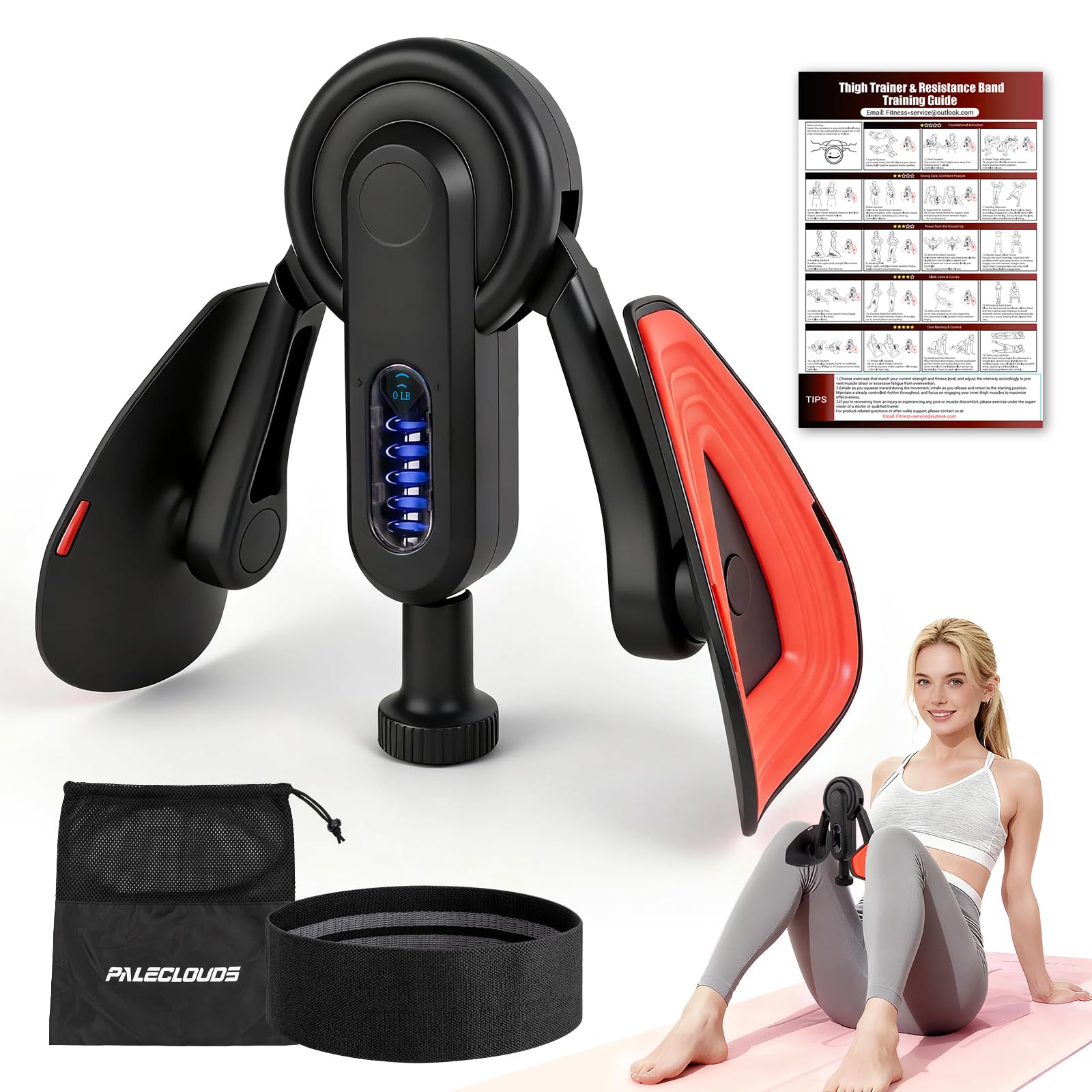
Paleclouds Thigh Trainer

Paleclouds Thigh Trainer

Progressive resistance

Our Score 8.8/10
Check Price

Worth Noting

  • Costs more than the top pick for the same core job
Included
Leg band and training poster
Dimensions
4.33"D x 13.39"W x 9.45"H
Resistance Range
10–100 lbs
Resistance Control
Knob
Read the full review

If you already train legs, the question is not whether a thigh exerciser works — it is whether it will still be hard in six weeks. The Paleclouds answers that with a 100-pound ceiling, more than anything else in this guide, and a bottom end at 10 pounds so the same device still works for a warm-up.

Progression is where it earns its place. A 35-pound spring stops being a workout inside a few weeks for anyone with a training background, and that headroom is the difference between a device you use for a season and one you keep. We found the curved TPE pads help here too: they sit along the thigh rather than pressing a flat plate into it, which is what lets you keep going once the squeeze gets serious.

The kit adds a leg band and a training poster. The band is the useful half — anchored in a doorway, it turns a squeeze device into something that works arms and back as well. The poster is the sort of extra that ends up behind the sofa.

If you are new to strength work, none of that headroom will matter for a while, and the COFOF is the easier place to start.

Bottom line: The pick for anyone who already lifts: 100 pounds of dial resistance in a device that still stores in a drawer, provided you will actually use the top of that range.

#5

COFOF Adjustable Thigh Trainer

COFOF Adjustable Thigh Trainer

Most home users

Our Score 8.6/10
Check Price

Worth Noting

  • One-year warranty on a plastic frame
Included
Carrying bag and instruction guide
Warranty
1 year
Resistance Range
15–70 lbs
Resistance Control
Dial
Read the full review

Fifteen pounds is light enough for a first set; 70 is enough to make a strong pair of legs work for it. Both come from the same knob on the COFOF, and that span is the biggest reason it is our top pick. You can add a couple of pounds between sets without stopping to swap a spring, which sounds like a small thing until you have used a device that does not let you.

The pads matter as much as the resistance. COFOF's are triangular, curved and coated in soft TPE rather than left as bare plastic, and they stayed planted on the thigh through a full set instead of sliding toward the knee. That coating earns its keep at the end of a set, when you are squeezing hardest and a hard edge would be digging in.

There is a bag for storage and a printed guide in the box, and the guide is worth a skim before your first set — the pad angle sits differently than you expect, and one adjustment at the start saves a fiddly session. Push past 70 pounds, though, and you are at the ceiling of what this one offers; the Paleclouds has 30 more pounds of headroom for anyone who needs it.

Bottom line: This is the thigh trainer we point most people to: a dial that spans beginner to strong, coated pads that stay where you put them, and a bag so it can live in a closet.

#6

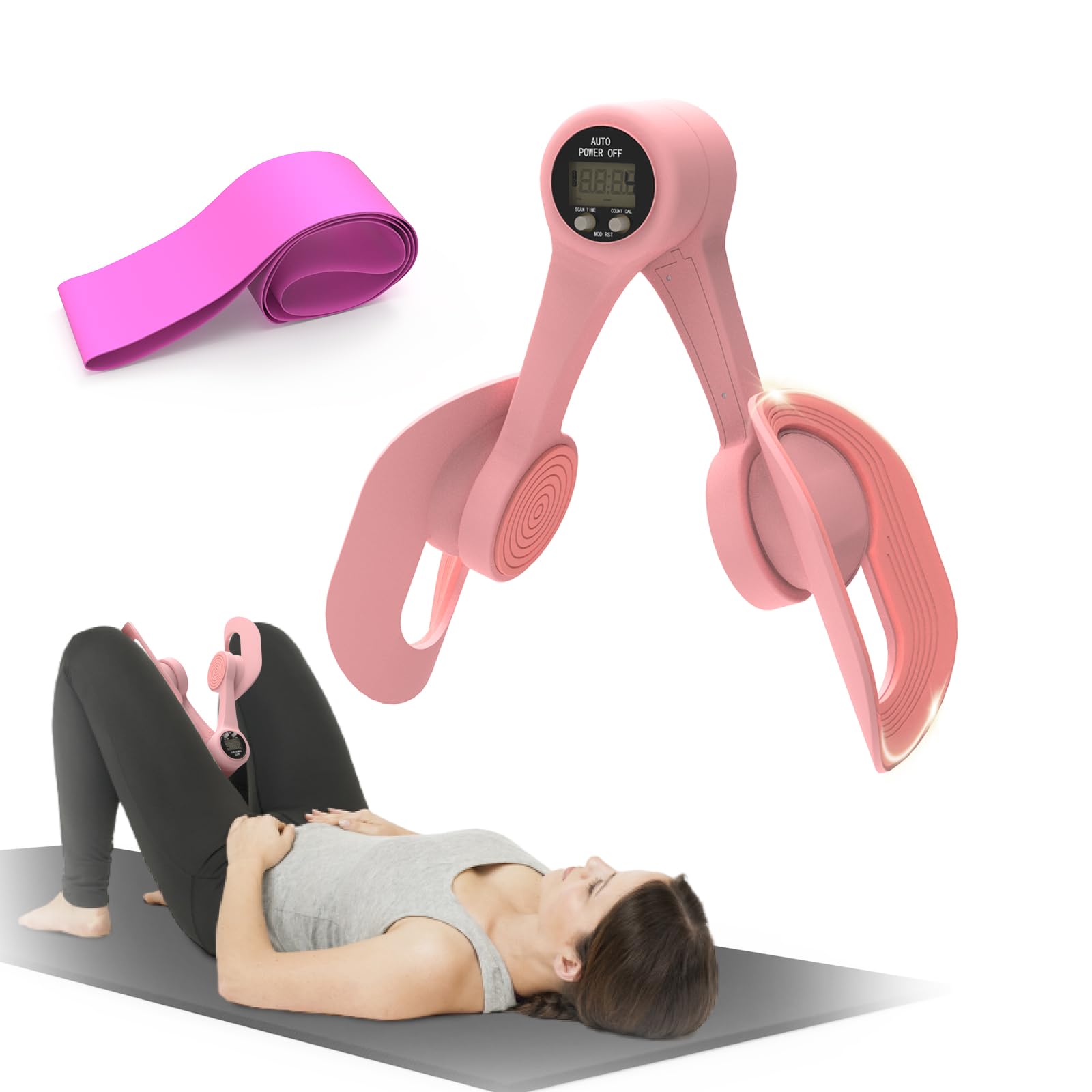
JHMFDDSB Folding Thigh Trainer

JHMFDDSB Folding Thigh Trainer

Small spaces

Our Score 8.6/10
Check Price

Worth Noting

  • Sold in pink only
Storage
Folds flat, bag included
Rotation
360° rotating cushions
Warranty
5 years
Resistance Range
15–75 lbs
Read the full review

Storage is why a lot of small home equipment stops getting used, and the JHMFDDSB is the one here built around it. The frame folds flat, slides into the included bag, and weighs 1.6 pounds, so it is hard to find a corner of a small apartment where it becomes a problem.

The cushions are the other reason it is here. Oversized, curved and covered rather than bare plastic, they spread the squeeze across more of the thigh, and the extra pad area makes a surprising difference by the third set. Then there is the warranty: five years, the longest in this group.

The dial runs from 15 to 75 pounds, which covers most people and stops short of the Paleclouds at the top. If you train hard and want load you can measure, the wider ranges above make more sense; if you would rather it disappear when you are done, this is the pick.

Bottom line: Folds flat into its own bag and fits oversized curved cushions, which makes it the easiest of these to store and one of the kinder ones to squeeze.

#7

KVKVMO LED Thigh Trainer

KVKVMO LED Thigh Trainer

Rep counting

Our Score 8.0/10
Check Price

Worth Noting

  • Thin pads on a hard frame can dig in
Weight
12.8 oz
Display
Time, count and calories
Rotation
One-click 360°
Included Band
20 lb
Read the full review

The screen on the KVKVMO counts reps, times the set, and estimates calories burned, which is more feedback than anything else here gives you. A one-click button spins the pads through 360 degrees instead of a screw you loosen, and a 20-pound band comes in the box for arm work.

We think the button is the better of those two ideas. Changing pad angle mid-set on a screw-adjusted device means stopping; the click mechanism lets you shift the contact point between sets without putting it down. The band is a band — useful for a warm-up, not the reason to buy.

The counter is a nice-to-have rather than a training record: it tells you that you did 40 squeezes, not that they were worth doing. What the screen does buy you is feedback at the lowest price in this set, and for someone who needs a reason to pick the thing up every day, that is not nothing.

Bottom line: The most feedback of any pick here — reps, time and calories on a screen — at the lowest price in the set, as long as thin pads on a hard frame suit your legs.

How We Tested the Best Thigh Exercisers

We started by pulling together more than two dozen models from established fitness brands, then narrowed the list by size, adjustability, and whether the resistance could be changed without tools. Over four months, we tested 14 thigh exercisers in the places they actually get used: on the living room rug during movie nights, at a desk between work calls, and on the floor after evening walks. Each tester used their assigned model at least four times a week, sometimes in leggings and sometimes against bare skin.

We paid close attention to comfort and skin irritation by doing two-minute squeeze sets and then checking for pinching, redness, or slipping. Resistance got tested by counting how many reps we could do before fatigue set in, then repeating that count after a month to see if the tension had weakened. We weighed each exerciser and noted whether it stayed put on carpet versus hardwood, and we tracked how much space it ate up in a drawer. For battery-powered models, we logged how long the display stayed readable and whether the battery storage compartment kept spares secure during shakes and drops.

Quality and durability came down to seams, hinges, and springs—we checked for fraying, wobbles, and loose parts after every week of use. Appearance mattered too: we left each one on the coffee table for a week to see if it looked like something we'd want visible in the living room. And we rated enjoyment honestly, by whether we reached for it without groaning. The models that scored highest were the ones that felt comfortable on bare skin, held steady resistance, and didn't make us want to hide them in a closet.

How to Choose a Thigh Exerciser

Start with the resistance range, not the maximum

A fixed spring, usually around 35 pounds, is fine for a first month and then stops offering anything new. An adjustable dial lets you add a few pounds at a time, which is what progression actually looks like on a device this small.

Look at the bottom of the range as carefully as the top. A 10- or 15-pound floor lets a beginner hold good form for a whole set, while a device that starts at 30 leaves no room to warm up. The ceiling matters less than it looks: most people never need more than 60 pounds on an adductor squeeze, so 70 is plenty and 100 is for someone already lifting.

Pads and fit decide whether you keep using it

The squeeze happens across two pads, and that is the entire interface between you and the machine. Bare plastic concentrates the load into a small area, while TPE-coated, curved pads spread it along the thigh. If your thighs meet with no gap when your knees are together, pad size matters more than resistance range: choose oversized or distinctly curved cushions.

The trap in the listings is a line about fitting all fitness levels, which says nothing about the width between the pads. If you have thicker thighs, that contact surface is the specification to check first.

Rotation, bands and counters

A 360-degree pad changes the angle of the squeeze, which lets you shift the pressure point mid-set. That is genuinely useful when one spot on the thigh has taken enough. A band is the other extra worth having, especially on a fixed-resistance device, because it is the only way to add load.

Counters are the extra to be skeptical about. A rep count tells you that you moved, not that the set was hard. If a screen is what gets you to pick the thing up every day, that is reason enough — just do not pay much for it.

Build, warranty and where it lives

These are plastic frames around a steel spring, and the spring is the part that decides how long the device lasts. Warranties in this group run from 60 days to five years, which is a fair proxy for how much confidence the maker has in the build.

If it is going in a drawer, check whether the frame folds and what it weighs. At 1.4 to 1.8 pounds these are all light enough to move around, but only one here folds flat. Anything that lives within reach gets used more than something that has to be unpacked.

Frequently Asked Questions

Final Verdict

For most people, the COFOF is the answer. A 15-to-70-pound dial covers a beginner's first set and a stronger user's last one, the coated pads stay where you put them, and the bag means it can live on a shelf instead of the floor. It is the least fussy way to start.

Choose the Paleclouds instead if you already train legs and know you will push past 70 pounds within a few months. Choose the JHMFDDSB if storage is the constraint that decides whether the thing gets used at all. Everything else here is a variation on those three decisions.