Strength & Weights

Best Squat Wedges of 2026

A squat wedge is a small piece of gear with one job: raise your heels just enough to let your knees track forward, so you can hit depth without your lower back rounding or your ankles calling it quits. That little lift can make a goblet squat feel smoother, a split squat more stable, and a calf stretch less miserable. The catch is that a bad wedge slides, squishes, or tips under load, and then you are better off squatting flat-footed.

I have used everything from rock-hard plastic pairs to foam wedges that felt like standing on a sponge cake, and the difference shows up in the first set. Over the past four months, my team and I put 14 pairs through home workouts, gym sessions, and stretch sessions on hardwood, rubber mats, and turf. We cared about grip, sturdiness, versatility, and whether the material held its shape; value here is less about a low sticker price and more about surviving daily use. The picks below are the pairs that stayed put and kept their shape.

#1

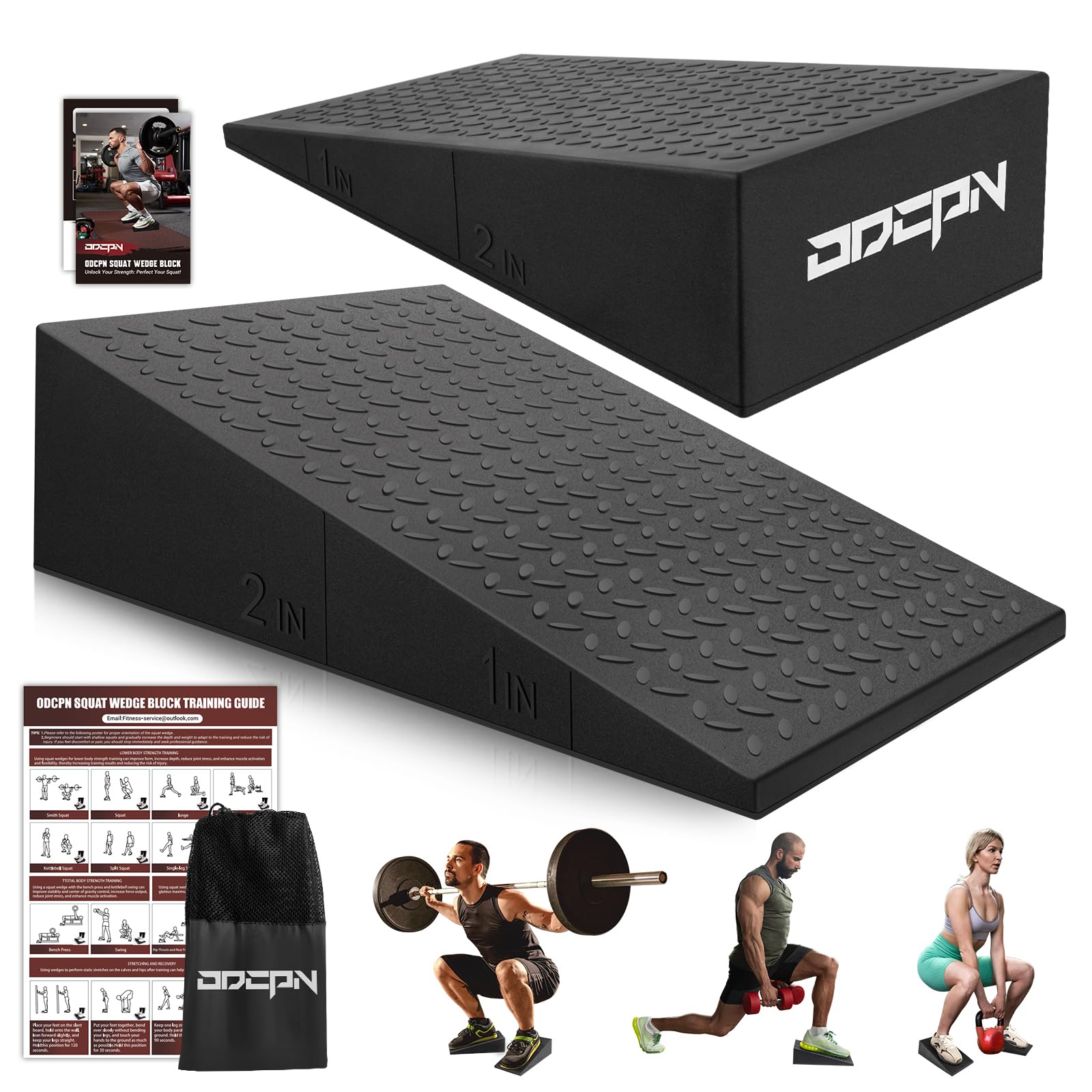
ODCPN Squat Wedge Block

Top Pick
ODCPN Squat Wedge Block

Everyday home squats

Our Score 9.6/10
Check Price

Worth Noting

  • Fixed 15-degree angle, no height adjustment
Set
Two wedges with storage bag and training poster
Incline
15°
Foot Platform
11.8"L x 5.9"W x 3.5"H
Load Capacity
1500 lb
Read the full review

Fifteen degrees is the number that matters here, and it's what both blocks are cut to — enough heel lift to let your knees travel forward over your toes without turning the squat into a different exercise. The blocks are separate, so each one goes wherever your stance wants it. A single board is only as wide as the board; two blocks aren't limited that way, and at 5.9 inches across, each one holds a full foot with room to spare.

Grip is where a wedge earns or loses its place, and this pair gets both halves right: a textured top surface and a base that stays put. Through bodyweight sets and loaded squats on hardwood and on a padded mat, they stayed where we put them. The 1,500-pound rating is a static claim rather than a promise about the surface, but the block itself shows no flex or give underfoot, which is more than we can say for the foam wedges here.

At 3.5 inches at the back it's a proper lift rather than a nudge, and the set arrives with a storage bag and a training poster. The bag is the part we actually use — two loose blocks rattle around a gym bag otherwise, and they're exactly the item that slides under a bench and disappears for a month.

Bottom line: For most home lifters, this is the pair we point to: a true 15-degree angle, a 1,500-pound rating, and grip that holds on the floors people actually train on.
#2

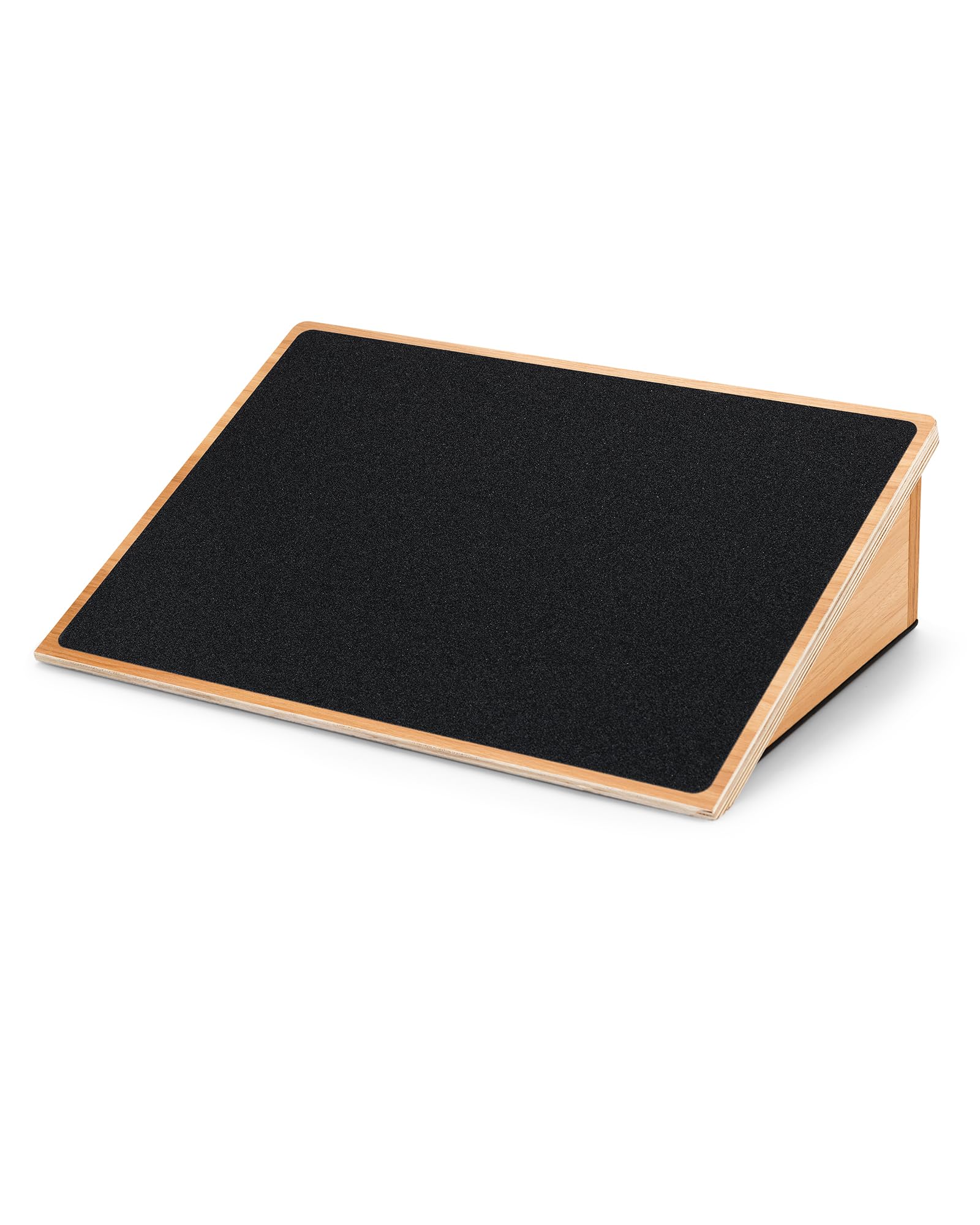
StrongTek Wooden Slant Board

StrongTek Wooden Slant Board

Heavy wide stances

Our Score 9.6/10
Check Price

Worth Noting

  • 7.7 pounds and non-folding
Weight
7.7 lb
Incline
25°
Load Capacity
1000 lb
Platform Width
19.6 inches
Read the full review

Nineteen-point-six inches across is the whole argument for this board. Two small blocks give you a stance; one plank this wide gives you any stance, including a sumo-width one, with both feet on the same piece of hardwood. It weighs 7.7 pounds, and nothing about it shifts when you shuffle your feet between reps.

We think it's the right board for someone squatting heavy in one place — a garage or basement where the wedge lives on the floor. The hardwood plywood and three-point support carry a 1,000-pound rating, and the textured top plus anti-slip base deal with grip in both directions at once. What it isn't is subtle: 25 degrees is a serious heel lift, well past the 15-degree norm and closer to an ATG or calf-stretch angle.

That steepness changes the movement. If you're chasing an upright, quad-dominant squat with the heels down, 25 degrees helps. If you're trying to keep a low-bar competition squat close to its usual shape, it's too much heel and your knees will tell you. It's the one pick here where the angle, not the build, is the deciding factor.

Bottom line: If your stance is wide and the bar is heavy, buy this one: a single hardwood platform that doesn't shift and takes a 1,000-pound load.

#3

Wolf Squat Wedge Block

Wolf Squat Wedge Block

Portable wide platform

Our Score 9.4/10
Check Price

Worth Noting

  • Costs more than the two-block sets here
Weight
1.5 lb
Incline
15°
Load Capacity
1000 lb
Platform Width
26.6 inches
Read the full review

A 26.6-inch platform that weighs a pound and a half is an odd, useful combination. Pick it up with two fingers, carry it to a park or a crowded gym floor, and both feet still land on one continuous 15-degree slope — no lining up two blocks, no gap in the middle, and you can slide your stance wider or narrower without moving anything.

The EVA is dense enough to hold its shape under a loaded bar, and the 1,000-pound rating puts it in the same class as the solid rubber and wood options here. It sits flat, the surface has enough texture for bare feet and rubber-soled shoes, and at 1.5 pounds it's the lightest full-width platform in this group.

What settles it is how a one-piece platform changes a session: you step on, you're at 15 degrees, and you can move your feet without rearranging equipment. That sounds trivial until you're five sets into tempo squats and adjusting your stance every set — then it's the difference between training and fiddling.

Bottom line: Buy it if you train in more than one place: a 15-degree platform wide enough for any stance that you can carry with two fingers.

#4

HarderWill Adjustable Squat Wedge

HarderWill Adjustable Squat Wedge

Gradual angle progression

Our Score 9.2/10
Check Price

Worth Noting

  • Each wedge is only 4.7 inches wide
Material
Rubber
Load Capacity
2000 lb
Height Settings
3
Footprint Per Wedge
7.5"D x 4.7"W x 3.3"H
Read the full review

Three heights from one pair of rubber wedges is the reason to buy these. The sections stack and interlock, so you start with a shallow lift and add a layer when the angle stops feeling like enough — a progression the fixed 15-degree blocks can't give you, and the closest thing here to adjustable heel elevation under a bar.

Rubber is the other half of the argument. These are heavier than the foam picks and they behave like it: the base grips, the interlocking ridges keep a stack from sliding apart, and the 2,000-pound rating is the highest of the adjustable options. Against the EPP sets here, they feel like equipment rather than packaging.

The trade of a stackable design is that it's a stack. At the top height you're standing on pieces that need lining up, and a hurried setup shows it — a few seconds each time once you have the habit, but not the step-on-and-go simplicity of a fixed wedge.

Bottom line: Three stackable heights in dense rubber: the pick for anyone who wants to add heel lift gradually instead of committing to one fixed angle.

#5

Gymkara Cork Squat Wedges

Gymkara Cork Squat Wedges

Barefoot on hardwood

Our Score 9.2/10
Check Price

Worth Noting

  • Cork edges crumble with repeated use
Set
Two wedges with carry bag
Weight
1.6 pounds each
Material
High-density cork
Block Size
9 x 4.7 x 2.6 inches
Read the full review

Cork is the difference you feel first. Barefoot, the surface is warm and slightly giving rather than slick and hard, and it holds a smooth floor in a way the foam and EPP wedges here don't — on a varnished wood floor or a garage slab, that's most of the battle. Each block is 9 by 4.7 inches and 2.6 inches tall, so this is a lower lift and a smaller platform than the full-size pairs.

That combination — low angle, grippy cork, small footprint — makes these the easiest pair to live with, particularly for someone easing back into squats or training barefoot in a small room. They tuck beside a desk, they don't clatter, and the carry bag actually gets used because the pair is light enough to bring along.

Bottom line: Our pick for barefoot training on a slick floor: cork grips where foam slides, and the low lift suits stiff ankles and early squats.

#6

Paterlof Squat Wedge Pair

Paterlof Squat Wedge Pair

Slightly wider stance

Our Score 9.2/10
Check Price

Worth Noting

  • Grip is less sure on smooth floors
Weight
2 lb
Incline
15°
Material
Polymer
Foot Platform
12.2"L x 6.3"W x 3.5"Th
Read the full review

Angle and size land almost exactly where our top pick does: 15 degrees, 12.2 by 6.3 inches at the base, 3.5 inches tall. The difference is in the hand — a stiff polymer with no give when you press a thumb into it, two pounds for the pair, and edges that feel molded rather than cut.

Separate blocks mean separate stance widths, and at 6.3 inches across these are a touch wider than most of the pairs here. If you have broad feet, or you like your heels just outside shoulder width, that extra margin is the sort of thing you notice on the first set and stop thinking about afterwards.

Nothing about the design is fussy. There's no stacking, no adjustment and nothing to assemble — you put them down, you squat, you pick them up. The height matches the full-size 3.5-inch blocks, so the position you get is the standard one rather than a compromise, and the polymer doesn't sag when you load it.

Our read: a capable, unfussy pair with a usefully wide platform, best suited to shoes-on training on a mat. It does everything a 15-degree pair is supposed to do — sets your width, holds your heels at the angle you asked for, and takes up no more room than the rest of the pairs here.

Bottom line: A sturdy 15-degree pair with a slightly wider platform than our top pick, and a sensible choice for shoes-on training on a mat.

#7

Folaps Squat Wedge Block

Folaps Squat Wedge Block

First-time wedge buyers

Our Score 9.2/10
Check Price

Worth Noting

  • Top surface gives little traction under shoes
Set
Two wedges with carry bag and guide
Incline
15°
Foot Platform
12.2"L x 6.1"W x 3.5"Th
Load Capacity
2200 lb
Read the full review

Two thousand two hundred pounds is the highest load rating on this page, and the set arrives with a carry bag and a printed training guide — genuinely useful if heel-elevated work is new to you and you don't know where to put your feet.

The blocks are big: 12.2 by 6.1 inches at the base and 3.5 inches tall, at 15 degrees. Laid out for a squat they take noticeably more floor than the compact pairs, which matters in a small apartment gym and doesn't matter at all in a garage.

Stability underfoot is solid. They don't compress or rock, the pair sits flat, and there's room on each block for a full foot with a bit of margin, so you can shuffle between a narrow and a shoulder-width stance without moving them. We've used them for split squats and calf raises as much as back squats, which is true of every pair here but easier with a platform this size.

Where that leaves us: a well-equipped pair with the highest rating in the group and enough platform for a wide stance. The bag and the guide make it the friendliest first set here, and the size means two people can share it without arguing about foot placement.

Bottom line: The best-equipped first set here — highest load rating, a bag and a guide — and a friendly way into heel-elevated squats.

#8

NOONCRAZY Slant Board Set

NOONCRAZY Slant Board Set

Ankle mobility work

Our Score 9.0/10
Check Price

Worth Noting

  • Slides on smooth wood floors
Angles
5 adjustable
Weight
10.6 oz
Foot Platform
12"L x 6"W x 4.9"Th
Load Capacity
960 lb
Read the full review

Five angles out of one set is more flexibility than anything else here. The wedges stack in combinations, so a shallow stretch and a steep one come in the same purchase, and the whole thing weighs roughly a pound — light enough to live in a desk drawer or a suitcase and come out when your calves are tight.

It's a stretching tool first, and we don't think that's a weakness. The angle range goes deeper than a 15-degree squat wedge, the deep calf stretch is the strongest thing about it, and the blocks are still rated to 960 pounds, so standing on them isn't the issue.

For squat depth under a bar, a dense block is the better buy — you want something that feels like a platform, not a stack. For the tighter problem, ankles that won't let you reach depth in the first place, this does more than a fixed wedge, because you can work the calf and ankle at the same angles you squat at. That's the trade: less platform, more range.

Bottom line: The one we reach for between sets: five stackable angles, about a pound of weight, and a calf stretch deep enough to change your squat.

How We Tested the Best Squat Wedges

We began by gathering wedges in the materials and shapes that show up most often in search results — dense foam, rubber, hard plastic, and a few adjustable designs — and cut anything that looked too narrow, too steep, or too expensive for what it was. That left 14 pairs. Over four months, we used them during warm-ups, goblet squats, split squats, calf raises, and a few push-up variations in a home gym on hardwood and a rubber mat, plus a commercial gym with turf.

Each pair got used under both heels, under one heel, and barefoot as well as in lifting shoes. We noted whether the lift actually bought us a deeper, more upright squat or just made us feel tippy, and we watched whether the wedge slid when we shifted weight forward. We also checked whether the top surface grabbed a shoe sole or let a sock foot skate, and whether the edges curled or flattened after repeated sets. When we loaded heavier goblet and split squats, we checked for flex, wobble, and any change in angle mid-rep.

For quality, we looked at seams, surface texture, matching heights, and whether the material bounced back after compression. Versatility mattered too: a wedge that worked for squats but was useless for calf stretches or split-squat setups lost points. Value came down to whether a cheaper pair held up as well as a pricier one over the full four months — and whether it still looked and felt solid at the end. The ones that made the cut stayed put, kept their shape, and were easy to wipe down and toss in a gym bag.

How to Choose Squat Wedges

Pick the Angle Before Anything Else

Fifteen degrees is the working default, and it's what most of the wedges here are cut to. That's enough lift to free the ankle so your knees can travel forward over your toes, without turning a back squat into a quad-dominant leg press. Steeper boards — 25 degrees and up — belong to ATG work and calf stretching, where a lot of heel drop is the point and you aren't chasing a competition-shaped squat.

If you're unsure, start at 15 degrees and add height later. An adjustable set lets you do that without buying twice, and it's the better route for anyone working through a stiff ankle rather than chasing a personal best next month.

Two Blocks or One Board

Two blocks let you put each foot exactly where you want it, which is why most sets are sold in pairs. The catch is that each block is only as wide as it is — 4.7 inches is tight under a wide shoe, 5.9 is comfortable for most feet, and a 19.6-inch board swallows any stance you can make.

A single wide board also can't come apart mid-set, which is worth something under a heavy bar, and it lets you slide your feet without moving equipment. If you squat sumo or wear a 4E shoe, measure your shoe before you order and buy width over portability.

Grip Decides Whether You Use Them

The top surface and the base do different jobs. The base has to hold the floor: foam and hard EPP skate on varnished wood and behave fine on carpet, while cork, rubber and wood hold almost anywhere. The top has to hold your foot, and a molded diamond pattern is not proof that it will — on some wedges it's decoration.

If you train barefoot on a smooth floor, prioritize cork or rubber, or put a mat under whatever you buy. In shoes, nearly everything here grips.

Material Is a Feel Decision

Foam and EPP are light and cheap and store anywhere; they also feel springy under a bar and can skate. Dense EVA holds its shape while staying around a pound and a half. Rubber is the heaviest and the most planted. Hardwood is the most solid of all and stays where you put it. Cork is warm under bare feet and grips well, but it wears at the corners.

There's no wrong answer here — match the material to how often the wedge travels and how much you want it to feel like equipment rather than an accessory.

What Load Ratings Actually Tell You

A 960-pound rating and a 2,200-pound rating are both far above what any lifter puts through one foot. Treat the number as an indicator of stiffness, not a lifespan: the parts that fail first are the top surface, the grip tape and the edges, none of which a load rating covers.

Buy enough capacity to feel solid under your working weight, then spend your attention on grip and platform size instead.

Frequently Asked Questions

Final Verdict

For most people the ODCPN pair is the answer: a true 15-degree angle, two blocks you set at your own width, and grip that holds on the floors people actually train on.

Go to the StrongTek if you squat heavy in a wide stance and want one platform that never moves, or the HarderWill if you need to add heel lift in steps rather than all at once. Everything else here is a variation on those three choices.