Strength & Weights

Best Workout Sandbags of 2026

A workout sandbag has a built-in contradiction: the thing that makes it worth owning is the thing that makes cheap ones fail. Weight that shifts and sloshes forces your core, grip, and shoulders to work for every rep, which is exactly why lifters and garage-gym regulars keep one around — and exactly why a weak shell, a gritty zipper, or a seam that gives out turns a great training tool into a pile of sand on the floor.

I've been filling sandbags for years, and the first lesson is that the sand matters as much as the bag: kiln-dried play sand stays loose and shifts, while damp all-purpose sand sets up like concrete and turns your bag into a lumpy rock. Over the past six months, my team and I have loaded, shouldered, dragged, and dropped 12 workout sandbags, and the ones worth your money share a few unglamorous traits — a shell that doesn't stretch, a closure you'd trust overhead, and handles stitched where your hands actually land. What follows is what held up, and what I'd happily load up again.

#1

Hyperwear SandBell

Top Pick
Hyperwear SandBell

Indoor slams

Our Score 9.6/10
Check Price

Worth Noting

  • No handles, so carries are out
Fill
Pre-filled USA sand
Weight
10 lb
Shell Material
Neoprene
Read the full review

There is no bag here. The SandBell is a sealed neoprene disc filled with sand — no zipper, no hook-and-loop, no liner, and nothing to spill. That single design decision is why it earns a place on a list of sandbags.

It is the one thing here you can slam on a hardwood floor, a tile patio or a concrete driveway without thinking about the surface. The neoprene absorbs the impact and the sand shifts inside as it lands, so the disc never sits still and every rep is a small fight for control.

Core work is where it shines: dead bugs, anti-rotation holds, and anything where you grip the edge and fight the shift. With no handle, your hands work for every rep, and that grip demand is half the training effect.

It is fixed at 10 pounds in this size and there is no way to add sand — the range runs up to 50, and if 10 gets easy you buy the next one up. That is the cost of a sealed shell: no adjustability, nothing to leak.

It is a specialist tool rather than a full sandbag, and that is why it sits behind the all-rounders. For indoor slams, core work and grip in a small space, it is, we think, the most useful thing here — especially if you train in an apartment above a neighbour.

Bottom line: The indoor slam tool: sealed, floor-safe and impossible to leak, and the best small-space core weight here.
#2

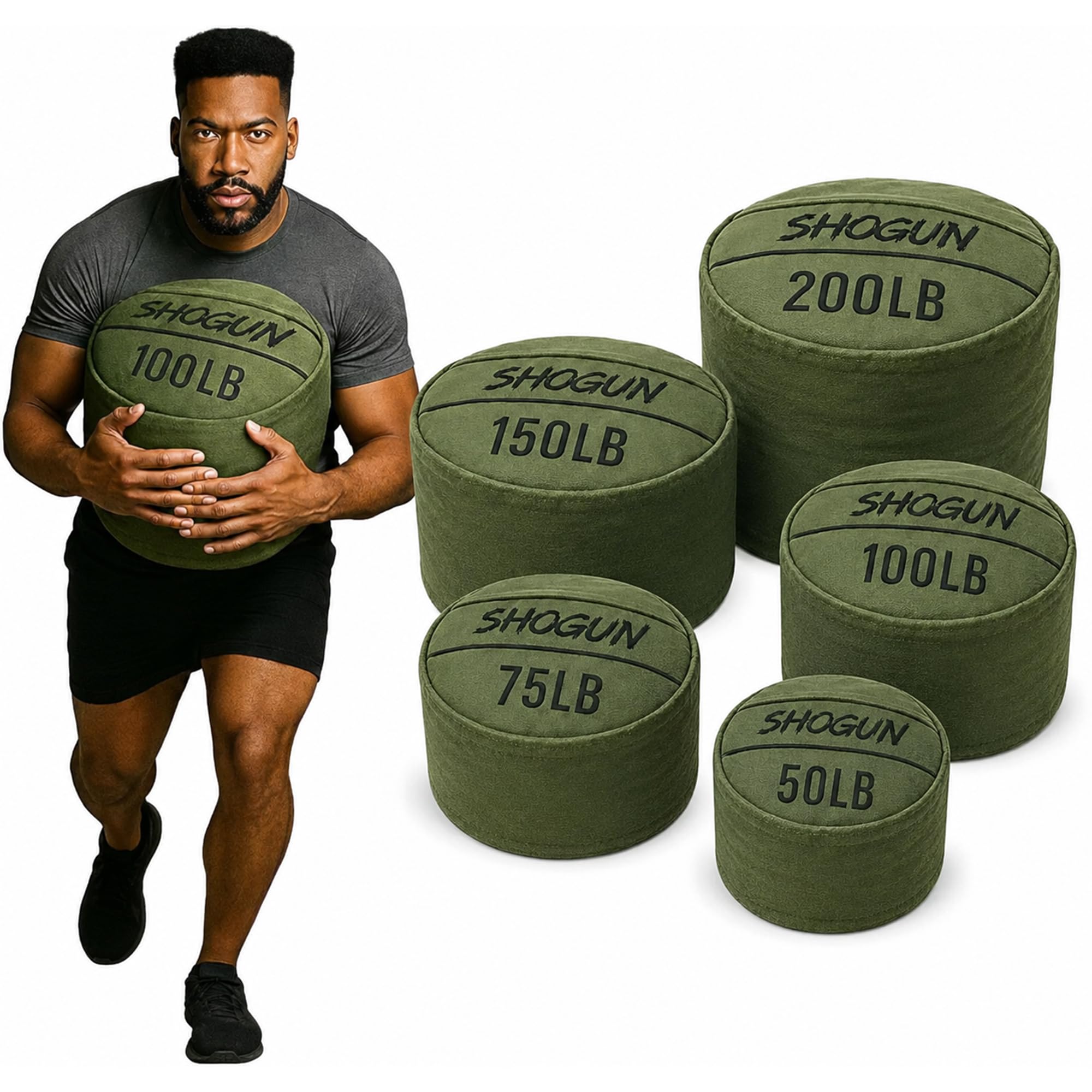
Shogun Workout Sandbag

Shogun Workout Sandbag

Compact sealed loads

Our Score 9.4/10
Check Price

Worth Noting

  • Single 50-pound size in this listing
  • Sand sold separately
Closure
Zipper plus hook-and-loop
Rated Load
50 lb
Shell Fabric
1000D mil-spec
Sand Included
No
Read the full review

Fifty pounds is the working weight most home lifters actually need, and the Shogun is the tightest-built bag we handled at that size. The shell is 1000D mil-spec fabric with triple-stitched seams and YKK zippers, and the fill sits behind an inner zip and a hook-and-loop flap before it ever reaches the outer closure. We filled it, dropped it and shouldered it, and nothing came out.

Packed empty it measures about 12 by 9 inches, so it disappears into a gym locker or a desk drawer between sessions, and filling it takes a funnel, a sack of play sand and some shaking to get the load level. Fifty pounds is also a weight you can press overhead and clean without the bag folding in half on you.

One size is the catch. This listing is the 50-pound bag only, so a lighter starter or a heavier project means a different product. For squats, cleans and carries, though, 50 pounds is enough to be humbling, and the compact shell means it goes in a cupboard rather than owning a corner of the room.

Bottom line: A compact, triple-stitched 50-pounder that keeps every grain of sand inside it — the pick for a one-bag home setup.

#3

IronMind Tough-As-Nails

IronMind Tough-As-Nails

Heavy carries

Our Score 9.4/10
Check Price

Worth Noting

  • No handles, so carries are bear-hug only
  • Premium price for a specialty tool
Bag Size
24 x 36 in
Capacity
300 lb
Fill Options
Sand, rags or straw
Outer Material
Cordura
Read the full review

Three hundred pounds is what the IronMind is built around, and it is not marketing arithmetic: the Cordura shell measures 24 by 36 inches and takes sand, rags or straw depending on how heavy you want it. Two liners come with it, plus a sandbag training course that is genuinely useful if you have never handled a bag that shifts on you mid-rep.

There are no handles, and that is the design rather than a shortcut. You hug it to your chest, shoulder it or drag it, and the load moves the entire time. For carries, over-the-shoulder work and stone-lift style training, that instability is the whole point; for precise pressing, it is not the tool.

We rate it the heavy bag of this group. It is the one here that scales to 300 pounds, the shell takes being dropped while loaded, and you can start it light and add fill as you get stronger without buying anything else. That is a long runway for one purchase.

The costs are real: a premium price, a bag that is awkward to store full, and a liner system that takes more folding and tying than a zippered duffel. None of it matters if the bag lives on the gym floor, which is where a 300-pound bag belongs anyway.

Bottom line: Buy it for heavy carries: it scales to 300 pounds and wears the toughest shell in this group.

#4

Polyfit Classic Sandbag

Polyfit Classic Sandbag

All-round home gym

Our Score 9.2/10
Check Price

Worth Noting

  • Sand must be bought and hauled separately
  • Full medium is 26 inches wide to store
Handles
8
Fill Range
30 to 75 lbs
Sand Included
No
Outer Material
Nylon
Read the full review

Eight handles is the number that matters here, and not because more is automatically better. On the Polyfit they run along the side seams and across both ends, so a deadlift grip, a shoulder carry and a chest press each put your hands where they want to be. That is what turns a weighted sack into a piece of equipment you keep reaching for.

We made it our top pick because it covers the widest range of training without a specialty shape. The medium holds 30 to 75 pounds, the filler bags close with hook-and-loop over double stitching instead of a single zip, and the nylon shell has enough structure to stay put on your shoulder mid-carry. Load it light for pressing drills, top it up for carries — same bag, same session.

It ships empty, as nearly every adjustable bag here does, and the medium wants a full sack of play sand plus a top-up to reach its ceiling. Give the job an evening: pour over a tarp, leave a few inches of slack at the top of each filler bag so the sand can move, and press the closures flat before they go into the shell. Do it properly once and you will not be refilling often.

The trade is width. A full medium measures 26 inches across, which is wider than most duffels and will not slide onto a shelf. If a compact 50-pound bag suits your training better, the Shogun is the one we point to; if you want the broadest weight range with the most grip options, stay here.

Bottom line: For a single sandbag that handles presses, carries and squats at a normal home-gym weight, the Polyfit is the one we recommend.

#5

Elite Sports Workout Sandbag

Elite Sports Workout Sandbag

Light duty training

Our Score 9.2/10
Check Price

Worth Noting

  • 25-pound top weight caps your progression
  • Ships empty, sand not included
Closure
Zipper with double seal
Fill Range
5 to 25 lbs
Shell Fabric
Ballistic nylon
Sand Included
No
Read the full review

Five to 25 pounds is a narrow window, and for a lot of people it is the right one: a first sandbag, a teenager starting strength work, or a light conditioning tool for a small apartment. The shell is ballistic nylon in a duffel shape with web handles and a zipper that closes against a double seal, and empty it weighs so little that it packs into a gym bag.

What we like is the construction at this price. The seams are reinforced, the handles sit where a farmer's carry wants them, and the whole thing feels better made than light bags usually do. Of everything here, this is the one we hand to someone who has never trained with a sandbag.

The catch is the ceiling. Once 25 pounds stops being a challenge there is nowhere to go with this bag, and you buy another one. It ships empty as well, so add a sack of play sand to the order. If you already know you want a working weight above 30 pounds, the Polyfit medium covers 30 to 75 and saves you the second purchase.

Bottom line: A well-made, light sandbag for someone starting out — buy it if 25 pounds is your working weight, not your warm-up.

#6

Meister 50lb Elite Sandbag

Meister 50lb Elite Sandbag

One-stop home kit

Our Score 9.2/10
Check Price

Worth Noting

  • Sand sold separately
  • Bulky to store once filled
Shell
PVC with foam core
Handles
8
Sand Included
No
Included Kettlebells
10, 15 and 20 lbs
Read the full review

Three removable sand kettlebells — 10, 15 and 20 pounds — nest inside this bag, which makes the Meister less a sandbag with extras and more a small home gym in one shell. Pull them out and you have three separate weights for presses, swings and carries; leave them in and the shell gets heavier without you touching sand.

The outer is PVC over a thick foam core, and the effect is a bag that holds its shape instead of slumping into a beanbag after a few sessions. A rigid middle is easier to shoulder and much easier to press, because the load stays where you put it rather than rolling away from you.

The shell has fill lines printed inside so you can hit an exact weight rather than guessing, and the first fill is fiddly — you are loading a structured shell, not a sack — but it is a one-time job. Eight handles, including angled ones, cover the usual grip positions.

This is the pick for someone assembling a home gym who wants the most equipment per purchase, and the wrong one for anyone who wants a floppy bag to slam and throw. The PVC is stiff by design, and we found that stiffness is exactly what makes the presses feel good.

Bottom line: One purchase, four weights: the Meister suits a home gym that wants a sandbag and kettlebells without buying both.

#7

XPRT Fitness Workout Sandbag

XPRT Fitness Workout Sandbag

First sandbag

Our Score 9.2/10
Check Price

Worth Noting

  • Sand sold separately
  • Small shell limits the top weight
Closure
Double-sealed
Handles
7
Shell Fabric
1000D nylon
Sand Included
No
Read the full review

Budget bags usually ask you to give something up, and the XPRT gives up less than most: seven handles, a 1000D nylon shell with cross-stitched thread and a double-sealed closure, for the least money in this group. We came to it expecting a starter bag and found one that takes a shoulder carry without the handles digging in.

Filler bags are included, which is not a given at this end of the range, and adding or removing them is how you set the weight. This listing is the small shell, so treat it as a conditioning and technique tool rather than the bag you build a strength program around.

The filler bags are the part to inspect when it arrives, since they are what keeps sand out of the outer shell. Behind them sits a plain, tough, waterproof nylon with a one-year warranty. It also folds flat when empty, so it stows in a drawer rather than a corner.

Bottom line: The cheapest way into sandbag training here, and it still gives you seven handles and a 1000D shell.

#8

Elite Sports Bulgarian Bag

Elite Sports Bulgarian Bag

Rotational work

Our Score 9.2/10
Check Price

Worth Noting

  • No warranty on this model
  • 17-pound size is the lightest of four
Bag Size
33 x 10 in
Sand Included
No
Outer Material
Cordura
Available Sizes
17, 25, 33 and 45 lbs
Read the full review

A Bulgarian bag is a different animal: 33 inches long and only 10 inches deep, it drapes across your shoulders and swings around your body instead of hanging in front of you like a duffel. The Elite Sports version is Cordura over an inner liner, with handles stitched along its length and at the ends, and it rewards rotational work in a way a square bag cannot.

Swings, spins, good mornings, squats and presses all work, and the bottom grips let you hold it like a lapel for rotational drills and throws. It is the closest thing here to a grappling-specific conditioning tool, and the movement variety is the reason to own one.

We like it as a second bag, not a first. It is good at what it does — the canvas has taken swings and drags without complaint, and the grip options are the best of any bag this shape — but a long bag is a poor choice for heavy carries and for anything where you want the load centred in front of you.

This listing is the 17-pound size, the lightest of four, and it arrives with no sand and no warranty. Worth knowing before you plan a rotation-heavy program around it.

Bottom line: For rotational and grip work, the Bulgarian bag does things a duffel can't — buy it as your second bag, not your only one.

#9

Wolf Tactical Sandbag

Wolf Tactical Sandbag

Heavy bag value

Our Score 9.2/10
Check Price

Worth Noting

  • Rated size overstates what comfortably fits
Rated Size
100 lb
Shell Fabric
1000D coated Cordura
Sand Included
No
Read the full review

The gap between the label and the fill is the first thing to understand. A hundred pounds is the name of this size, but it is a ceiling rather than a fill weight: the shell takes sand, gravel or a mix, and it comes up short of the number with dry play sand. Fill it in stages and stop when the closures meet without strain.

What you get for the trouble is 1000D coated Cordura that feels closer to a truck tarp than a gym bag. The seams are heavy, the fabric is thick, and it has taken drags across rough ground without a tear. There is nothing delicate about it.

It is happiest in the movements a heavy bag suits: bear-hug squats, over-the-shoulder throws, presses and carries. Load it through a heavy stuff sack or a contractor bag rather than pouring sand straight in, and the inside of the shell stays clean and the fill stays put.

The capacity arithmetic is the only real mark against it, and it does not change what the bag is good at. For over-the-shoulder throws and bear-hug squats it is a lot of bag for the money, and the shell will outlast the sand you put in it.

Bottom line: Buy it for the fabric: the shell is as tough as anything here, and the size name is a ceiling rather than a promise.

#10

Yes4All Adjustable Sandbag

Yes4All Adjustable Sandbag

Grip variety

Our Score 8.8/10
Check Price

Worth Noting

  • Sand sold separately
  • Narrow zipper opening makes filling slow
Handles
7
Fill Range
25 to 75 lbs
Inner Bags
2 medium
Shell Fabric
1000D Cordura
Read the full review

Seven handles at different angles is the widest choice of grips here, and on a bag this affordable it is the reason to look twice. They are rubber-wrapped, spaced along the sides and the ends, and they turn a bag you can only bear-hug into one you can clean, press, row and carry by the handful.

The outer is 1000D coated Cordura with box stitching and double-folded edges, and the medium comes with two filler bags inside one shell. The 25-to-75-pound size is the version worth having; the shell is big enough that a full fill sits low and stable instead of bulging.

Sand retention is where the bag asks for care. The inner bags are the weak link — when a seam gives, sand ends up loose in the outer shell — so fill them to about 80 percent, which is what the maker asks for, press the closures flat, and keep grit out of the tracks.

Expect the real fill weight to land under the label. Two full medium liners can weigh in short of 75 pounds, so weigh as you fill if the number matters to your progression rather than trusting the size name.

We still recommend it, with that caveat. For grip variety and a big, tough shell at a low price, nothing here beats it; if you plan to slam a bag on concrete every day, spend more on a sealed design like the Shogun.

Bottom line: Seven grip positions on a tough shell — the versatile carrier to buy if you will treat the filler bags with care.

How We Tested the Best Workout Sandbags

We started by rounding up every bag we could find that was genuinely built for training rather than flood control, then cut the field by shell material, closure type, handle layout, and stated weight range. Price was a tiebreaker, never a reason to keep something — a bag that costs half as much and leaks is not a value. That filtering left us with 12 bags to actually live with.

Each one was filled with the same kiln-dried play sand and used three to four times a week for six months, in a garage, on a driveway, and on a basement floor. The sessions were the real thing: shouldering, cleans, front carries up and down a staircase, drags across concrete, and the throw-and-slam work these bags exist for. Every week we checked seams, handle attachments, and shell fabric for abrasion and stretching, and we weighed each bag to see whether it was quietly shedding fill.

Leakage got its own test. We set each loaded bag on a light-colored towel, shook it, dropped it from shoulder height, and checked the towel afterward. We opened and closed every zipper, hook-and-loop flap, and buckle 50 times with sand already in the bag to see whether grit jammed the closure, then loaded each one to the top of its stated capacity and past it to find the point where it stopped being usable. Size was judged in motion — whether the bag fit between our feet for a clean, whether it slid into a duffel, whether a full load was still something you'd carry across a parking lot. We also timed how quickly we could add or pull weight between sets, since a bag you dread adjusting is a bag that stays at one weight forever.

How to Choose Workout Sandbags

Decide the load before the bag

Adjustable bags spread the load across a range — the Polyfit medium runs 30 to 75 pounds, the Yes4All 25 to 75 — while fixed bags do one weight well, like the Shogun at 50 or the IronMind up to 300. Pick a range with roughly a third more headroom than your current working weight so you are not shopping again in two months.

A sandbag also feels heavier than the number suggests, because the load shifts and your trunk and grip fight for every rep. If you are between sizes, start low and add sand later: you can always add, and a bag that is too heavy for a clean is a bag you stop cleaning.

Handles decide the exercise menu

Six to eight handles, placed along the seams and across both ends, is what lets one bag cover cleans, presses, rows, carries and squats. A handle-free bag like the IronMind is a strongman tool — you hug it, shoulder it and drag it — and you trade precise grips for a load nothing else here matches.

More handles is not automatically better. A handle stitched low on the body can dig into your forearm in a front squat, and a short handle will not take a two-handed grip. Look at the ends first: that is where a shoulder carry and a clean actually want your hands.

Sealing, filling and the capacity trap

Nearly every adjustable bag ships empty, so budget for 50 to 100 pounds of dry play sand and an evening with a funnel and a tarp. Fill the inner liners to roughly 80 percent, which is what most makers ask for, and press each closure flat before it goes into the shell.

The trap is the size name. A bag sold as 100 pounds is describing a ceiling, not what it comfortably holds, and several bags here take noticeably less sand than the label implies. Weigh as you fill and stop when the closure meets without strain, rather than buying all the sand first and forcing the last scoop in.

Shape and where it lives

A duffel shape sits in front of you for squats and cleans, a round or Bulgarian bag swings around the body for rotational work, and a sealed disc is for slams and core. Choose the shape for the movement you actually do, not the one that looks toughest in a photograph.

Then measure the space. A full 75-pound bag runs around 26 inches across and will not slide onto a shelf, and a 300-pound bag belongs on the floor. Empty shells fold flat, so if storage is tight, fill only to the weight you are using this month and keep the spare sand in a bucket.

Frequently Asked Questions

Final Verdict

For most home gyms the Polyfit Classic is the bag to buy: eight well-placed handles, a 30-to-75-pound range and filler bags that seal properly, at a mid-range price. It covers presses, carries and squats without asking you to own two bags.

Change the requirement and the answer changes. If you want one compact bag that holds its sand, the Shogun. If your training is heavy carries, the IronMind. If you are not sure you will stick with sandbag work, the Elite Sports bag costs less and does the same job at light loads.