Strength & Weights

Best Landmine Attachment of 2026

A landmine attachment is the rare home gym upgrade that opens up angled presses, rows, rotations, and split squats without a dedicated machine taking over the floor. The catch: cheap ones rattle in the sleeve, tip when you lean into a press, or put the handle at an awkward height. Fit matters first—if the pivot doesn't sit snugly on a standard Olympic barbell, every rep feels loose. After that, grip, stability, and how much room the base eats up decide whether it stays set up or gets kicked into a corner.

Over eight months, my team and I tested 12 landmine attachments in a garage gym and a basement setup, running them through presses, rows, rotations, and split squats with a loaded barbell. The difference between good and frustrating often comes down to small things—how the hardware assembles, how the collar tightens, whether the base slides on rubber flooring, how the handle feels after 20 reps. Value matters, but not at the cost of solid welds or a smooth pivot. The picks below are the ones I kept reaching for.

#1

Yes4All T-Bar Row Platform

Top Pick
Yes4All T-Bar Row Platform

All-around base

Our Score 9.4/10
Check Price

Worth Noting

  • Bolt pattern won't fit every rack leg
Swivel
360 degrees
Bar Fit
1-inch and 2-inch
Mounting
Floor, wall, or rack
Weight Capacity
880 lb
Read the full review

The 880-pound rating is the first thing that separates the Yes4All platform from the lighter bases here. It's a 3-pound steel plate with a 360-degree swivel, and it can be bolted to the floor, a wall, or a 2-by-2 rack leg. The sleeve accepts both 1-inch standard bars and 2-inch Olympic bars, which matters if you keep a mixed set of bars.

We recommend it first because it gives you a permanent pivot point without a permanent footprint problem: the platform is compact, and once it's mounted, the bar moves through rows, presses, and rotations without the base walking across the floor. The 360-degree swivel is the part we noticed most in use; it lets the bar travel side to side instead of forcing your wrists to fight the arc. The 880-pound capacity also means you won't outgrow it with a normal home-gym load.

Mounting is the part that makes it feel permanent. We like that it can also sit against a wall unmounted for light sessions, but the real value is the bolted-down version. For a garage gym where the landmine will stay put, that predictability is worth more than portability.

Bottom line: For a permanent home-gym landmine station, the Yes4All platform is our default: it mounts solidly, swivels freely, and has the capacity to handle serious loading.

#2

AimiDream V Bar Handle

AimiDream V Bar Handle

Budget V-bar

Our Score 9.4/10
Check Price

Worth Noting

  • No stated warranty on the handle
Grip Size
1.15 inches
Grip Type
Padded
Item Weight
2.2 lb
Weight Capacity
350 lb
Read the full review

The AimiDream is the least expensive V-bar handle here, and it still gives you a 350-pound rating and a 2-inch Olympic sleeve. We like it as a first landmine handle: it clips onto the bar in seconds, the V shape puts your hands in a neutral position, and the padded grips are easier on the wrists than a bare bar.

The 1.15-inch grip diameter is on the smaller side, which suits smaller hands or anyone who prefers a closed grip around a handle. At 2.2 pounds, it's light enough to hang on a hook or toss in a gym bag. The padded surface is comfortable for rows and presses, but it doesn't offer the bite of knurling when your hands are sweaty.

We don't make this the only handle in a serious garage gym. The 350-pound capacity is fine for most accessory work, but the steel frame and padded grips are built for comfort more than maximal loading. For a first V-bar, a travel bag, or a lifter who wants a neutral grip without spending much, it's an easy yes.

Bottom line: The AimiDream earns our budget V-bar nod: it fits 2-inch bars, feels comfortable in the hands, and handles most accessory work without fuss.

#3

MIUONO Landmine Attachment

MIUONO Landmine Attachment

Light landmine work

Our Score 9.4/10
Check Price

Worth Noting

  • 100-pound capacity rules out heavy rows
Swivel
360 degrees
Bar Fit
2-inch Olympic
Item Weight
1.77 lb
Weight Capacity
100 lb
Read the full review

The 100-pound capacity is the number that defines the MIUONO. It's a compact plate-post insert for 2-inch Olympic bars, with a 360-degree swivel and a 9-inch sleeve. The 804-gram steel body is built to sit in a plate or a bar holder.

Setup is as simple as it gets: slide the post through a plate or into a bar holder, drop the bar into the sleeve, and start. The small footprint is the reason to choose it; it stores in a drawer or on a shelf and doesn't need a dedicated corner. We like it for rotational work, low-weight presses, and warm-up sets.

The trade-off is stability. The insert can shift inside a plate during angled pulls, and the light steel doesn't have the planted feel of a floor-mounted base. A snug plate and a stable bar holder help, but it rewards a deliberate setup.

We keep it in the category of compact accessories rather than a primary base. If your landmine work is limited by space, the MIUONO is a neat solution; for a primary base, the Yes4All is the more capable choice.

Bottom line: The MIUONO suits small spaces and light landmine work, but we think the 100-pound rating keeps it out of heavy rowing programs.

#4

HXD-ERGO Portable Landmine Base

HXD-ERGO Portable Landmine Base

Portable training

Our Score 9.2/10
Check Price

Worth Noting

  • 450-pound capacity limits heavy loading
Bar Fit
2-inch Olympic
Item Weight
12.8 oz
Base Material
Rubber
Weight Capacity
450 lb
Read the full review

At 12.8 ounces, the HXD-ERGO is the landmine base you can carry to a friend's garage or move out of the way when the living room returns. It's a rubber puck with a honeycomb base and a 450-pound capacity, and it needs no bolts or rack. We like it most for renters and anyone who trains in a corner they also have to live in.

The no-install design is the whole appeal. Drop it on the floor, slide a 2-inch Olympic bar into the sleeve, and you have a pivot point for rows, presses, and rotations. The rubber base is gentler on wood and rubber mats than a steel plate, and the compact footprint means it stores on a shelf. The trade-off is grip: on smooth tile or polished concrete, it can creep during angled pulls, so a textured mat or a corner is the fix.

The 450-pound rating is still plenty for most home workouts, and the light body makes it the easiest base to live with. For travel, small spaces, and quick setup, this is the one we grab.

Bottom line: The HXD-ERGO is our pick for renters and garage corners: it sets up in seconds, moves easily, and still handles a 450-pound load.

#5

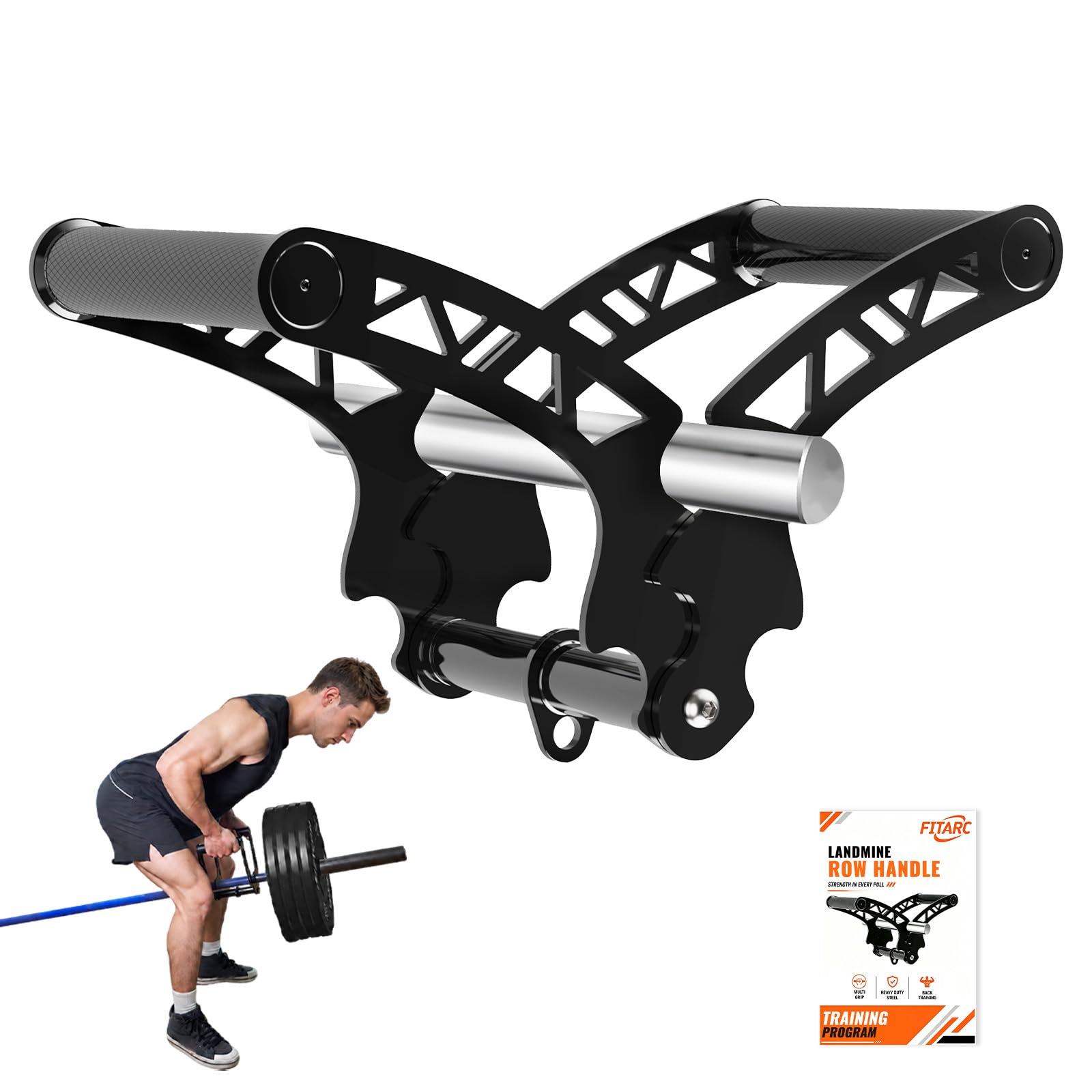
Fitarc Landmine Row Handle

Fitarc Landmine Row Handle

Multi-grip rows

Our Score 9.2/10
Check Price

Worth Noting

  • Does not lock onto the bar
Material
Iron
Grip Type
Knurled
Grip Widths
15.7, 11.8, and 7.8 inches
Item Weight
3 lb
Read the full review

Three grip widths—15.7, 11.8, and 7.8 inches—are the reason to choose the Fitarc handle over a fixed T-bar grip. The frame is all steel, the handles are knurled at 1 inch, and the extended shape keeps the barbell from crowding your chest during rows.

We like it best for rowing because the width changes the feel of the exercise, not just the hand position. A wide grip loads the upper back; the narrow grip lets you pull with a tighter elbow path. The knurling is a real upgrade over padded handles when your hands get sweaty, and the frame stays on the bar between sets so you aren't re-clipping it every time.

We treat this as a row handle first. The extended frame and three widths are built around pulling, and the 3-pound weight makes it easy to hang on the rack. If you want one attachment for both rows and Viking presses, a dedicated press handle is the better second purchase.

Bottom line: Three grip widths make the Fitarc the most versatile row handle here; we like its knurled steel and chest-clearing frame.

#6

Yes4All Viking Press

Yes4All Viking Press

Viking presses

Our Score 9.2/10
Check Price

Worth Noting

  • 15-inch spacing can feel wide for smaller lifters
Bar Fit
2-inch Olympic
Grip Positions
3
Handle Spacing
15 inches
Weight Capacity
300 lb
Read the full review

A Viking press handle lives or dies on hand spacing, and the Yes4All sits at 15 inches between handles. That's wide enough to get your shoulders inside the frame but narrow enough to stay manageable for most lifters. The 7-inch tube slides over a 2-inch Olympic bar, and the three grip positions let you change the angle without changing the attachment.

The frame is heavy-gauge steel with a black coating, and the 300-pound capacity is plenty for pressing and squatting variations. We like the 15-inch gap because it encourages a straight, powerful press instead of a cramped one. The handles are 1 7/8 inches in diameter, so they feel substantial in the hand.

This is the one we reach for when we want a pressing session that feels like a fixed bar. It's also useful for squats and good mornings, but the press is the reason to buy it. The Yes4All is the better default for most pressing work; if you want an even wider stance, the BRTGYM is the specialty choice.

Bottom line: Our choice for most pressing work is the Yes4All Viking Press: a 15-inch span, three grips, and enough steel for serious upper-body work.

#7

BRTGYM Viking Press

BRTGYM Viking Press

Wide-grip presses

Our Score 9.2/10
Check Price

Worth Noting

  • 21-inch span is too wide for smaller lifters
Length
33 inches
Grip Positions
3
Handle Spacing
21 inches
Weight Capacity
300 lb
Read the full review

Twenty-one inches between handles is unusually wide, and that is the whole point of the BRTGYM Viking press frame. It's a 33-inch steel attachment with three grip positions, a 300-pound capacity, and a 2-inch sleeve that slides onto an Olympic bar.

The wide stance suits lifters who feel cramped on narrower Viking handles. Your hands sit outside the shoulders, which can make the press feel more like a strongman implement than a bar. The 1.2-inch grips are comfortable, and the three positions give you room to find a setup that works.

The frame is heavy and takes up more wall space than a row handle, so it's not the thing you leave on the bar between sets. Setup takes a few minutes, and the 33-inch width means you need a clear wall. We see it as a specialty press handle rather than a do-everything attachment.

If broad shoulders and a wider press are what you want, it's the one here that delivers that. The extra room is the reason to choose it over the Yes4All.

Bottom line: We see the BRTGYM as the wide-grip Viking press here: it gives broad-shouldered lifters room to press, provided they have the space and the right setup.

#8

Everstrong T Bar Row

Everstrong T Bar Row

Plate-anchored rows

Our Score 8.8/10
Check Price

Worth Noting

Setup
No-drill plate anchor
Swivel
360 degrees
Bar Fit
2-inch Olympic
Plate Anchor
Two 25-45 pound plates
Read the full review

Before you buy the Everstrong, measure the holes in your plates. This is a plate-anchored T-bar row base that uses two 25-, 35-, or 45-pound plates to hold it down, and it works well when your plates fit. The 360-degree swivel and no-drill setup are the draw.

The idea is clever: stack a pair of plates on the post, slide the bar into the sleeve, and you have a landmine pivot without bolting anything to the floor. It's easier to move than a floor-mounted base and doesn't need a rack. The chrome finish and steel construction feel substantial, and the swivel moves freely through rows and presses.

The fit is the catch. The post is sized for standard 2-inch plate hubs, and some plates—especially bumpers—are too large or too loose to sit securely. We treat it as a buy only after you've checked your own plates; if they fit, it's a useful no-drill option. If they don't, the Yes4All platform or a rubber base is the safer route.

Bottom line: The Everstrong is a useful no-drill base if your plates fit the post, and we like the free swivel and stable loaded footprint.

How We Tested the Best Landmine Attachments

We built the shortlist by scanning home gym forums, retailer reviews, and manufacturer specs, then filtering for attachments that fit a standard Olympic barbell, came with the hardware needed for assembly, and made sense for a home setup rather than a commercial floor. That left 12 units, which we used over eight months in a garage gym and a basement gym. Each one went through the same rotation—landmine presses, single-arm rows, rotational core work, and split squats with a loaded barbell—plus a few sessions where we assembled and disassembled it to see how the hardware held up.

Fit came first. We slid each attachment onto a standard Olympic barbell and checked whether the sleeve clamped without wobble; if it shifted, we noted it. Grip was next: we paid attention to whether the handle was knurled enough to hold with sweaty hands or so aggressive it chewed palms. For stability, we loaded the bar and leaned into presses to see if the base crept across rubber flooring or tipped. Spacing mattered too—we measured how much floor the base claimed and whether it cleared a rack, wall, or bench in a tight corner. Assembly was timed out of the box with the included tools, and we checked welds, powder coat, and pivot play after repeated use.

By the end, we were judging quality by how little we thought about the attachment during a set. The ones that survived eight months of twice-weekly use kept a smooth pivot, a tight collar, and a handle that didn't rotate loose. We also compared versatility—how many exercises each one unlocked without an adapter—and home gym utility, meaning whether it stored out of the way or stayed set up. Value came down to what came in the box: hardware, handle shape, base footprint, and whether it felt like a fair trade for the floor space it claimed. The final picks made the barbell feel like a full training station, not a wobbly add-on.

How to Choose a Landmine Attachment

Choose Your Anchor First

Landmine attachments come in three practical shapes: a floor-, wall-, or rack-mounted steel base; a portable rubber base; and a plate-post insert that uses your weight plates as the anchor. A mounted base gives you the most planted feel and the highest load ratings, but it commits you to a spot. A rubber base is the renters' answer—no drilling, easy to move—but it relies on friction, so smooth tile is its weak point. A plate-post insert splits the difference, provided your plates fit the post.

Start with the room, not the exercise. If you have a rack with a 2-by-2 leg or a clear wall, a mounted base is the strongest long-term buy. If the gym doubles as a garage or living space, a portable base or plate insert makes more sense. Measure the plate hub and the rack leg before ordering; those two dimensions decide more returns than anything else.

Match the Bar and the Load

Most landmine gear is built around either a 1-inch standard bar or a 2-inch Olympic bar, and the difference is not interchangeable. The sleeve diameter has to match your bar, and a long sleeve gives you more room for plates and collars. If you keep both bar types, look for an attachment that explicitly lists both—the Yes4All platform is the one here that does.

Capacity matters, but it is a ceiling, not a target. A 300-pound-rated handle is fine for most pressing and rowing; a 100-pound insert is for light accessory work. Buy for the load you actually plan to move, and leave some headroom for progression. Check the sleeve length too: a short sleeve can run out of room once you add collars and plates.

Pick the Handle for the Movement

T-bar and V-bar handles are for pulling: they give you a neutral or angled grip and keep the bar from crowding your chest. A multi-grip row handle is the most flexible because you can change hand width without changing attachments. Viking press handles are for pressing and squatting variations; the spacing between handles is the key number. A 15-inch span suits most lifters, while a 21-inch span is a specialty fit for broad shoulders.

Grip texture is a personal call. Knurling gives you more bite when your hands are sweaty, while padded grips are easier on the palms but can feel vague under load. If you train in a humid garage, knurling is the safer default; if you use the handle for high-rep accessories, padding is more comfortable. Either way, check that the handle stays on the bar between sets or that you can lock it down.

Leave Room for the Setup

A landmine attachment is small, but the workout is not. A Viking press frame can run more than 30 inches wide, and a floor-mounted base needs clear space for the bar to arc. Before you buy, check the ceiling height for overhead presses and the wall clearance for rotational work. A portable base needs a textured floor or a corner to stay put; a plate insert needs a plate you can dedicate to anchoring.

The best attachment is the one you can set up without rearranging the room. If you have a permanent corner, a mounted base is the least fuss. If you train in a shared space, choose something you can move with one hand. And if you already own a rack, check the leg size before you fall for a base that won't bolt on.

Check the Hardware and Wear Points

Landmine attachments are simple, so the details matter: welds, pivot bolts, locking pins, and sleeve interiors. A rough weld or a loose knob can turn a smooth arc into a wobble. Check that the hardware is included and that the pivot moves freely before you load it. A one-year warranty is a nice signal on a steel base; a handle with no stated warranty is a bigger gamble. Wipe down chalk and store the attachment dry, especially if the finish is chrome or painted steel.

Frequently Asked Questions

Final Verdict

Most home gyms should start with the Yes4All T-Bar Row Platform. It gives you a planted 360-degree pivot, accepts both 1-inch and 2-inch bars, and has the capacity to stay useful as you get stronger.

If you can't drill, the HXD-ERGO is the portable alternative; if you want a single row handle, the Fitarc's three grip widths are the most versatile. Buy the anchor that fits your room first, then add the handle that matches your movement.