Strength & Weights

Best Squat Racks for Home Gyms of 2026

A squat rack is the one piece of home gym equipment you trust with your life. When you unrack a heavy bar and step back, you need the uprights to stay put and the safeties to catch a failed rep—not flex, wobble, or walk across the floor. A good rack also gives you a place to bench, pull up, and store plates, which is why the wrong one can make a garage gym feel cramped and sketchy instead of solid.

I've assembled and lived with seven squat racks over the past ten months, in a garage with a concrete slab and a basement with a low ceiling, and the differences showed up fast. Some went together in an afternoon; others had me cursing mismatched hardware and instructions that assumed a second person. The best ones felt planted during heavy squats and pull-ups, fit the space without swallowing it, and didn't nickel-and-dime me on attachments. The ones that didn't are the reason this list is short.

#1

Sunny Health & Fitness Full-Size Power Rack

Top Pick
Sunny Health & Fitness Full-Size Power Rack

Home gym all-rounder

Our Score 9.4/10
Check Price

Worth Noting

  • Smaller holes limit some attachments
Footprint
38 x 53 x 87 inches
Item Weight
83 lb
Pull-up Bar
8-position angled
J-hook Adjustment
18 positions
Read the full review

The first thing we noticed about the Sunny is how much rack fits into a modest footprint. At 38 x 53 x 87 inches, it gives you a squat station, 18 J-hook positions, safety spotter arms, and an angled pull-up bar without swallowing a garage bay. For a spare bedroom or a corner of a basement, that combination is rare.

We think it's the best all-round choice here for the money. What sold us is the balance: the frame feels substantial at 83 pounds, the adjustment range covers squats, presses, and pull-ups, and the safeties give a solo lifter a place to fail. It is not a heavy-duty cage, so treat it as a home rack rather than a commercial one.

The pull-up bar is the one part we treat gently. It can shift when you re-rack a heavy load, so we keep our pull-ups controlled and treat it as a strict-pull-up bar, not a kipping bar. For most home lifters, though, the trade is sensible: you get a complete station that fits a room you already have. If you need a published high capacity and a wider cage, the Sunny power cage is the step up.

Bottom line: We recommend the Sunny full-size rack as the best default for a home gym: it combines a compact footprint, useful safety arms, and enough adjustment for squats and presses without demanding a full cage.

#2

Sunny Health & Fitness Power Cage

Sunny Health & Fitness Power Cage

Heavy lifting

Our Score 9.4/10
Check Price

Worth Noting

  • Wider 65-inch footprint
  • Costs more than the top pick
Frame
14-gauge steel
Weight
133.4 lb
Max Load
2130 lb
Footprint
50.4 x 65.1 x 82.9 inches
Read the full review

The published 2130-pound combined capacity is the number that separates the Sunny power cage from the half-rack crowd. It is not a promise that you can drop that much from overhead, but it does tell you the frame is built for more than casual load. The 14-gauge steel and 50.4 x 65.1 x 82.9 inch footprint make it a proper cage: you step inside, set the safeties, and lift.

We appreciate the reversible pull-up bar and numbered heights, and the band pegs and plate storage make it easier to keep the rack loaded and stable. The 65-inch width gives a generous walk-in feel for a home cage. Assembly is straightforward, though the frame is heavy enough that a second person makes the uprights easier to manage.

We rank it as the heavy-duty choice because the capacity, frame, and included storage answer the question a stronger lifter asks first. The 14-gauge steel and plate storage make it feel like a long-term purchase rather than a starter rack. If your training is mostly bodyweight and moderate squats, the smaller rack is the easier fit.

Bottom line: The Sunny power cage is our pick for heavier lifters who want a full cage: the published 2130-pound combined capacity and 14-gauge frame give more headroom than the top pick, at a higher price and a wider footprint.

#3

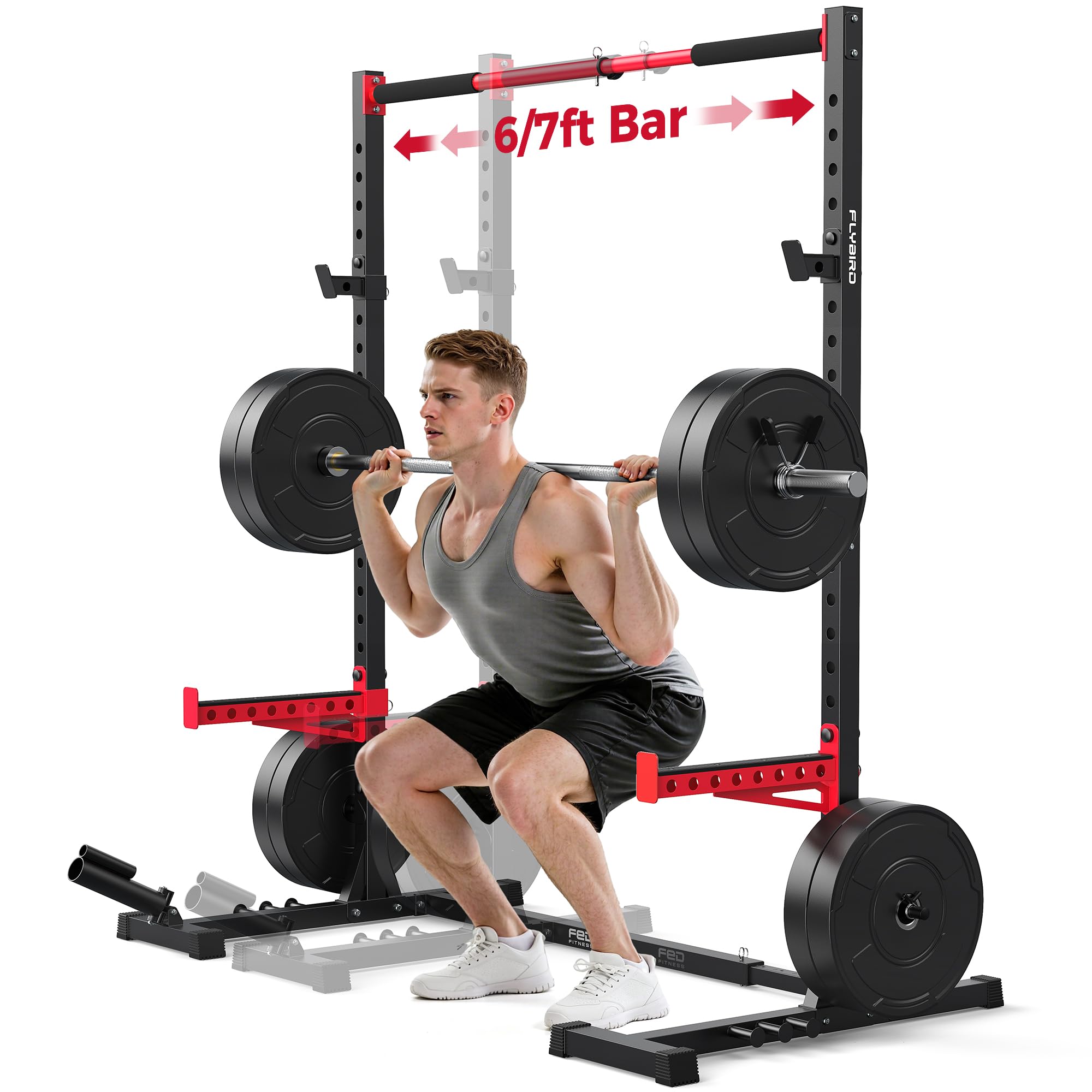
FLYBIRD SR1 Squat Rack

FLYBIRD SR1 Squat Rack

Small spaces

Our Score 9.2/10
Check Price

Worth Noting

  • Half-rack design, not a full cage
Max Load
950 lb
Barbell Fit
6 ft and 7 ft
Safety Arms
16.7 inches
Height Settings
22
Read the full review

The FLYBIRD's adjustable width is the detail that makes it useful in a real room. It fits most 6- and 7-foot barbells, so you can set the uprights around the bar you own instead of buying a new bar to fit the rack. At 42 x 51 x 83 inches, it also stays within the footprint of a small garage bay.

We think it's the best small-space half rack here because it does not treat safety as an afterthought. The 16.7-inch extended safety arms give more catch room than the stubby arms on many compact racks, and 22 height settings let you dial in a squat or bench position. The 950-pound capacity is plenty for a home gym.

The trade is that this is a simpler rack than a full cage. The landmine and band pegs are nice extras rather than the reason to buy, and the pull-up bar is more of a bonus than a training centerpiece. For a garage with a low ceiling or a lifter who already owns a 7-foot bar, those are easy compromises. We kept coming back to the width adjustment because it solves a problem most racks ignore.

Bottom line: We like the FLYBIRD SR1 for anyone squeezing a rack into a small room or using a 7-foot bar: the adjustable width and 950-pound capacity make it more flexible than most half racks here.

#4

Mikolo Folding Wall-Mounted Squat Rack

Mikolo Folding Wall-Mounted Squat Rack

Garage storage

Our Score 9.2/10
Check Price

Worth Noting

Mount
Wall-mounted
Weight
80 lb
Max Load
1000 lb
Uprights
2 x 2 inch 13 gauge
Read the full review

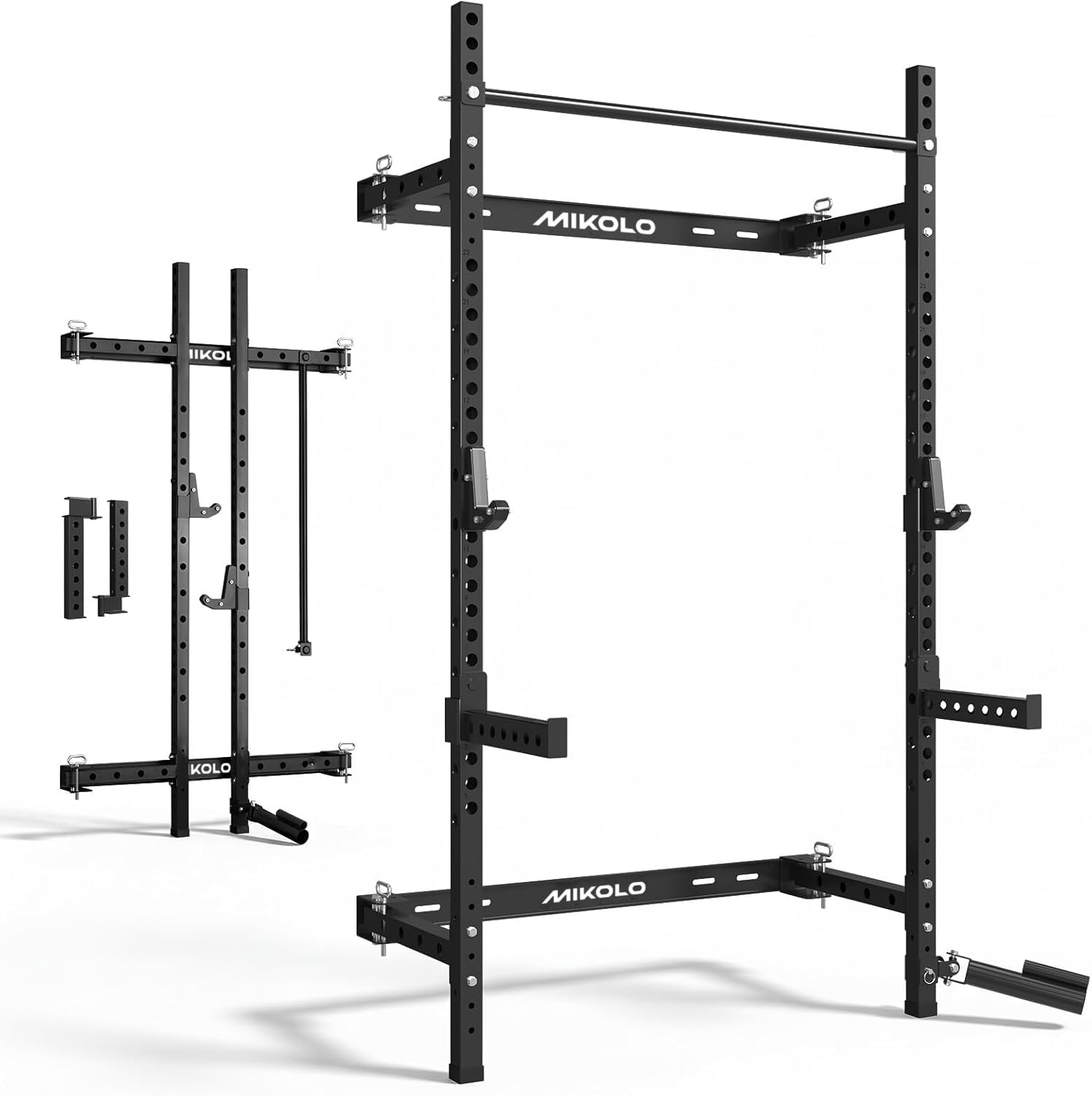
A wall-mounted rack only earns its place if it disappears when the car comes home. The Mikolo does: the 2 x 2 inch 13-gauge uprights fold flat against the wall, and the whole assembly is designed around a stringer and metal studs. In a garage, that is the difference between a rack you use and a rack you trip over.

The 1000-pound capacity and quick-attach pull-up bar make it more than a storage trick. We like that the pull-up bar reaches 89 inches off the ground, which gives a full hang rather than a crouch, and the J-hooks and safety catches are included. The 80-pound frame feels substantial when it is locked open.

Mounting is the part to take seriously. The rack needs a sound wall and proper studs, and the holes in the mounting bracket may not line up with every stud layout. Do not hang this on drywall alone or assume a garage wall is framed where you want it. Check the wall before you order, and plan for two people at install.

We rank it as the best wall-mounted option here because it solves a space problem no freestanding rack can. It is not the right choice for a renter who cannot drill, or for someone who wants to move the rack around the room. For a homeowner with a clear wall and a car to park, the trade is worth it. The wall you choose matters as much as the rack itself.

Bottom line: We choose the Mikolo folding rack when the garage has to do double duty: it folds back to the wall, carries a 1000-pound rating, and turns unused wall space into a squat station.

#5

ULTRA FUEGO Power Cage

ULTRA FUEGO Power Cage

Cable workouts

Our Score 9.2/10
Check Price

Worth Noting

  • Narrow 47-inch walk-in width
Max Load
1000 lb
Uprights
50 x 50 mm
Footprint
63 x 47 x 82.7 inches
Cable System
Lat pulldown
Read the full review

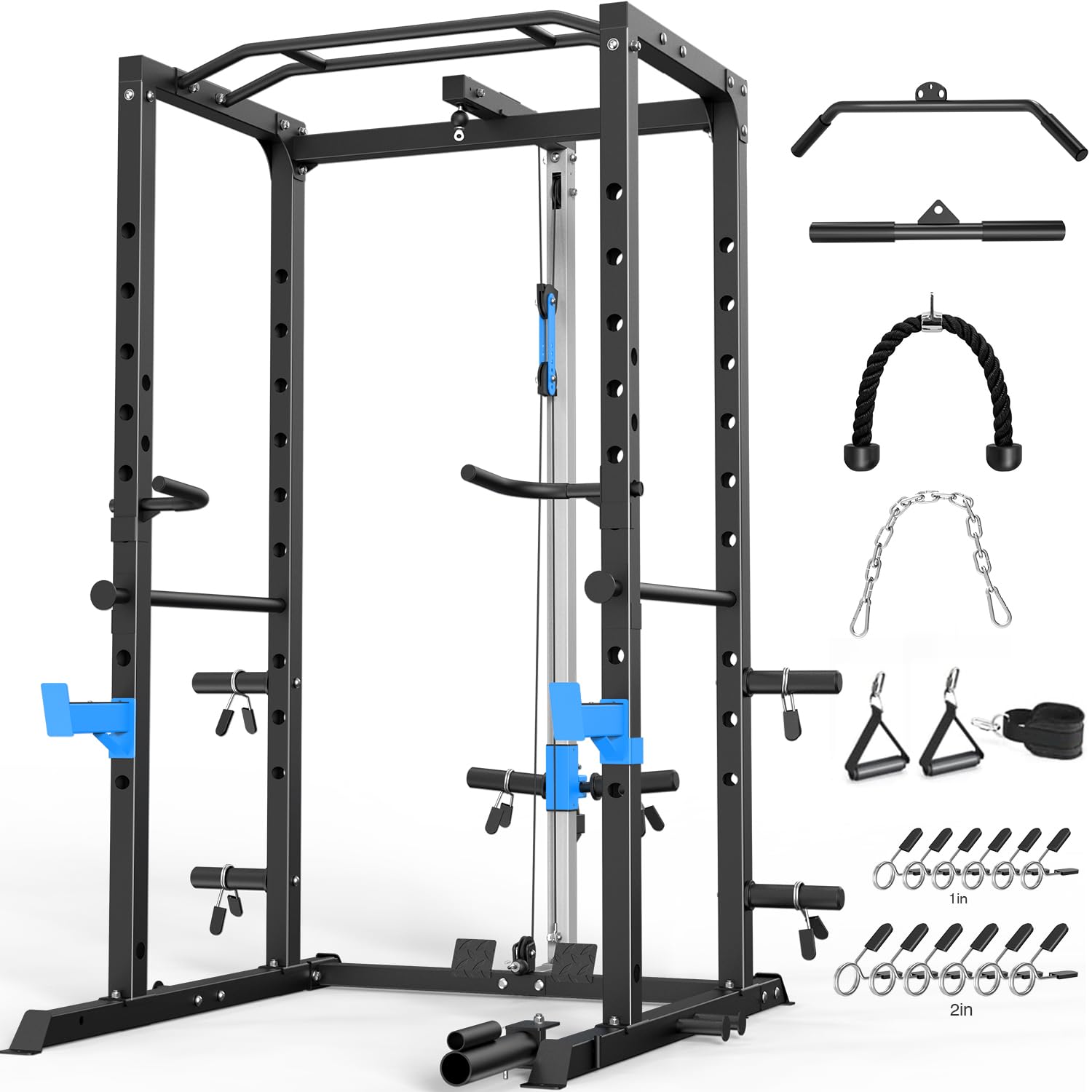
The ULTRA FUEGO arrives with the kind of accessory list that usually means a second machine: a lat pulldown pulley, landmine, dip handles, J-hooks, and safety bars, all inside a 63 x 47 x 82.7 inch cage. That footprint fits a tighter wall than the Sunny cage, which is useful in a garage where every inch counts.

We like the way the cable system changes the rack from a squat station into a full workout space. Lat pulldowns, rows, and landmine presses are the exercises that keep a home gym interesting after the novelty of squats wears off, and having them on the same frame saves floor space. The 1000-pound capacity is strong for the class.

Stability is the caveat. The cage can wobble during pull-ups, and the safety bars feel less secure unless the rack is weighted or bolted down. We treat that as setup, not a dealbreaker: load the plate storage, check the floor, and anchor it if you plan to pull hard. If you want a simple squat rack, this is more machine than you need; if you want one frame for barbell and cable work, it earns the space.

Bottom line: We rate the ULTRA FUEGO as the all-in-one pick: the pulley, landmine, and dip handles add real variety to a 1000-pound cage, provided you keep the frame stable.

#6

papababe 800 lb Squat Rack

papababe 800 lb Squat Rack

Budget setups

Our Score 9.2/10
Check Price

Worth Noting

  • Two-piece uprights need careful alignment
Max Load
800 lb
Uprights
2 x 2 inch 13 gauge
Footprint
47 x 48 x 82 inches
J-hook Positions
26
Read the full review

The papababe is the budget rack we keep recommending because it does not feel like a toy. The 2 x 2 inch 13-gauge uprights carry an 800-pound rating, and the 26 J-hook positions give you more height choices than several pricier racks. At 47 x 48 x 82 inches, it fits a single-car garage bay without becoming the whole room.

We like the built-in multi-grip pull-up bar and the safety bars, and the frame is simple enough to assemble with basic tools. The uprights are two-piece on some versions, so line up the joints before you tighten everything; a rack that goes together slightly out of square will wobble no matter how strong the steel is.

The trade is refinement. The finish is basic, the J-hooks are not the smoothest, and this is not a cage for heavy drop sets. For a first home gym or a budget build, those are fair compromises. We rank it below the Sunny racks on long-term polish, but above the cheap stands for anyone who wants a full cage and safeties.

Bottom line: The papababe rack earns our budget recommendation: it gives you a full cage, 26 J-hook positions, and a pull-up bar, with the expected trade in finish and refinement.

#7

CANPA Adjustable Squat Rack

CANPA Adjustable Squat Rack

Low ceilings

Our Score 9.0/10
Check Price

Worth Noting

Frame
H-shaped steel
Max Load
600 lb
Width Range
35.1 to 41.8 inches
Height Range
50 to 57 inches
Read the full review

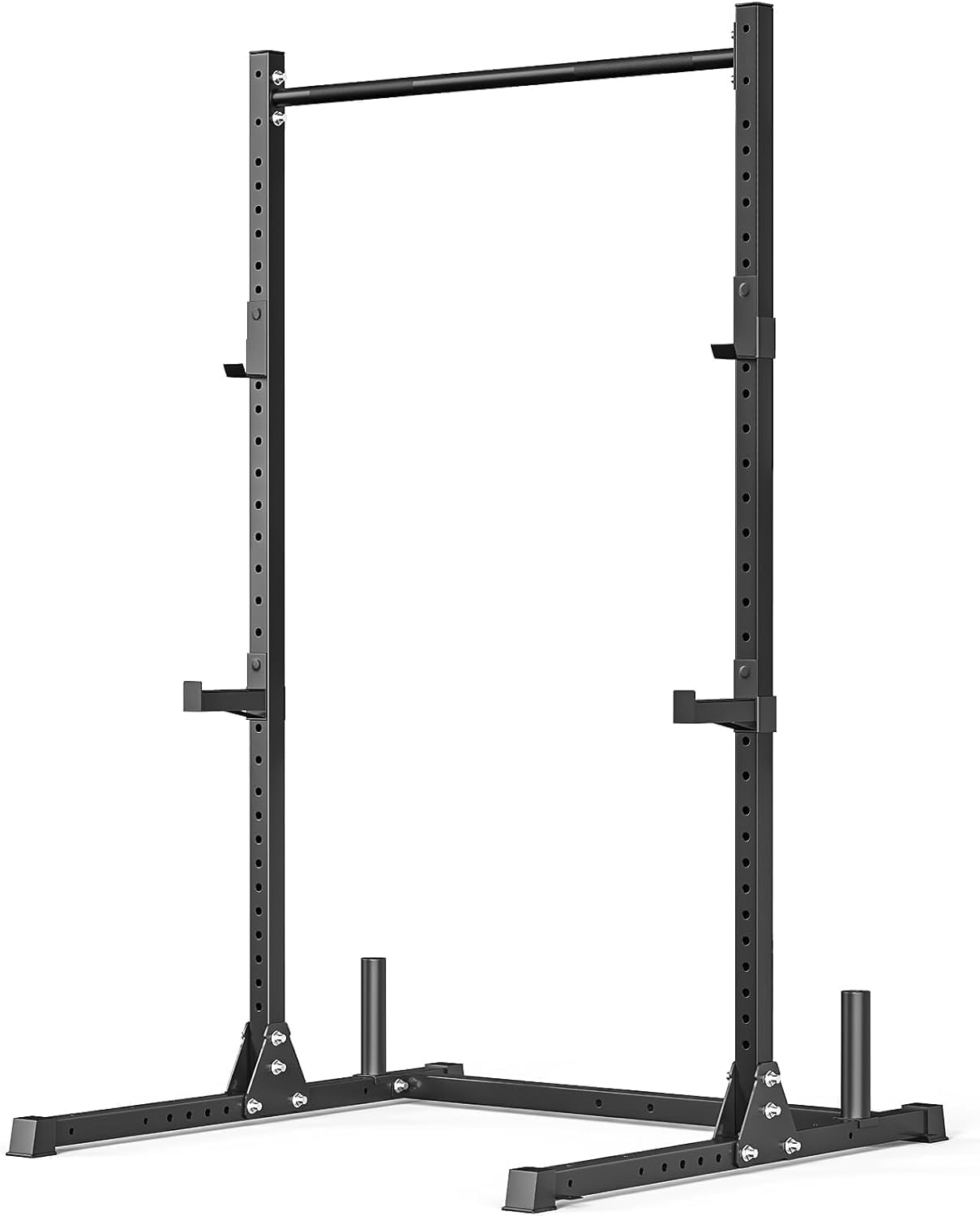
The CANPA's 50-to-57-inch height range is the reason to look at it. In a basement with a low joist or a spare room with a sloped ceiling, a full 83-inch rack may not fit; this stand does, and the width adjusts from 35.1 to 41.8 inches to suit different bars.

The 600-pound capacity and H-shaped base are sensible for a compact stand, and the 2 x 2 inch steel gives it more presence than the cheapest portable pairs. We like the barbell storage racks, too: they keep the bar off the floor in a tight space.

What it does not give you is a proper set of safety arms. The spotter rests are short and sit high for bench work, so a failed squat has less room to land safely. That does not make it a bad rack; it makes it a rack for controlled lifts, lighter loads, or a lifter with a spotter.

We rank it as a niche pick for low ceilings and adjustable width, not as the default. If you train alone and squat near your limit, spend more for a rack with real safeties. If your ceiling rules out everything else, the CANPA at least gets you under the bar.

Bottom line: The CANPA is a good fit for a low basement or a lifter who needs adjustable width, but we recommend it for controlled barbell work rather than heavy solo squats because it lacks proper safety arms.

#8

SPORTSROYALS Power Cage

SPORTSROYALS Power Cage

All-in-one training

Our Score 9.0/10
Check Price

Worth Noting

  • Heavy 150-pound frame
  • Takes up a 59.6-inch square footprint
Weight
150 lb
Max Load
1200 lb
Uprights
50 x 50 mm
Footprint
59.6 x 59.6 x 82.6 inches
Read the full review

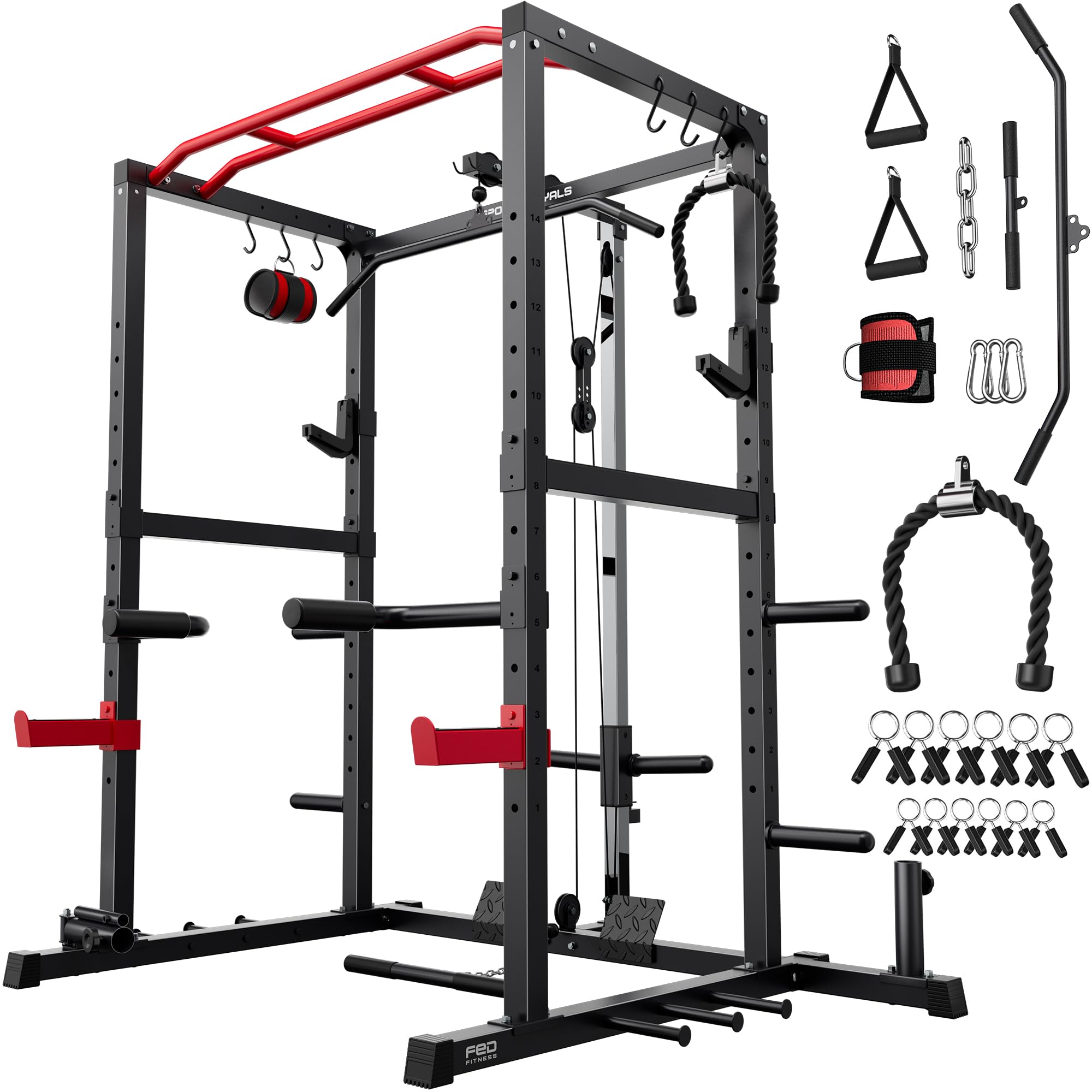
At 150 pounds, the SPORTSROYALS is the heaviest rack in this group, and that weight is the first thing you notice. It is a 1200-pound cage with a lat pulldown, landmine, dip bars, and enough attachments to replace several machines. We think it makes sense for a garage gym that wants variety without adding a second cable tower.

The 50 x 50 mm steel frame gives it a solid stance, and the plate storage and band pegs help keep it organized. The pulley system is the draw: it runs smoothly enough for lat pulldowns and rows, and the landmine opens up presses and rows that a bare squat rack cannot do.

Stability is the compromise. The rack can wiggle during bar dips and some pull-up work, and the cable is the part we watch over time. Adding plates to the storage pegs helps, but this is not a set-and-forget cage for a heavy lifter who trains alone at maximum loads.

We keep it as a specialist pick rather than the default because the ULTRA FUEGO does the all-in-one job with a lower price and a more compact footprint, while the Sunny cage is the safer heavy-duty choice. Choose the SPORTSROYALS if the attachment list is the whole point and you have the floor space to anchor it. The attachments are the reason to pick it, but the floor space is the reason to measure twice.

Bottom line: The SPORTSROYALS is for the lifter who wants the longest attachment list here: a 1200-pound cage with lat pulldown, landmine, and dip stations, as long as you can live with some wobble and a heavy frame.

How We Chose and Tested the Best Squat Racks

We started with a shortlist of racks that could realistically live in a home gym—free-standing and bolt-down models, half racks and full cages—then filtered by footprint, ceiling height, stated weight capacity, and whether the pull-up bar and safeties were included. Over ten months, we assembled seven of them ourselves in a garage and a basement, timing each build and noting where the instructions lost us. We paid attention to weld quality, hardware bags, and whether the rack felt solid before we ever loaded a bar.

Once built, each rack went through the same routine: squats with a progressively loaded bar, bench presses inside the uprights, and pull-ups at wide and neutral grips. We deliberately failed reps onto the safeties to see how they caught the bar, and we watched for side-to-side walk when re-racking off-center. We checked stated weight capacity against the gauge of steel and the hardware, then looked for flex in the pull-up bar and any creaking at the joints.

We lived with each rack for the full ten months, noting paint chips, rust at welded seams, and bolts that loosened after repeated sessions. We measured the actual footprint and ceiling clearance, and we noted whether a rack needed to be bolted to a concrete floor—important if you rent or share a finished room. To judge value, we compared what came in the box against the total cost, not just the rack itself. The racks that held up were the ones we kept coming back to.

How to Choose Squat Racks for Home Gyms

Measure the ceiling and the bar path first

A rack can fit the floor and still be wrong for the room. Start with height: the Sunny full-size rack is 87 inches tall, so a low basement may need a squat stand or a wall-mounted rack instead. Add the bar path and your own reach for pull-ups. Leave enough side clearance to load plates without hitting a wall, and check that a folded rack like the Mikolo still leaves room to park. Measure twice; a rack that clears by an inch is still a rack you will curse every session.

Pick the shape around your training

Full cages give you a walk-in space and safeties on both sides; half racks save floor space and work well for squats and presses; portable stands are the easiest to store but usually give up safety arms and stability. We reach for a full cage when someone trains alone and lifts near their limit, and a half rack when the room is tight. The FLYBIRD is the half-rack example here; the CANPA is the stand.

Treat capacity as a starting point

Published capacity tells you what the manufacturer is willing to rate, not how the rack feels under a heavy bar. A 2130-pound combined rating on the Sunny cage is meaningful, but so are the 14-gauge steel, the width of the base, and whether you anchor it. A light stand with a high number can still walk across the floor. Add plates to storage or bolt the rack down if it moves; stability is part of the setup, not an upgrade.

Check adjustability and barbell fit

J-hook positions matter more than the raw count if the spacing leaves you pressing from your toes. Look for a range that covers your squat and bench heights, and check the hole size if you plan to add attachments; the Sunny full-size rack uses smaller holes that limit some aftermarket parts. Barbell width is the other fit issue: the FLYBIRD adjusts for 6- and 7-foot bars, while fixed-width racks may not.

Plan the assembly and the anchor

Assembly is where a good rack becomes a chore. Two people make the uprights easier to line up, and a socket set beats the included wrench on most of these. Wall-mounted racks need a sound wall and studs, not drywall anchors; the Mikolo is the obvious example. Leave the bolts slightly loose until the frame is square, then tighten. If you are renting, choose a freestanding rack you can move.

Frequently Asked Questions

Final Verdict

Start with the Sunny full-size power rack if you want the best all-round home setup. It gives you a compact footprint, useful safeties, and enough adjustment for squats, presses, and pull-ups without the floor space of a full cage. If you lift heavier and want a published high capacity, the Sunny power cage is the step up. If the room is the constraint, the FLYBIRD SR1 fits a 7-foot bar in a smaller footprint, and the Mikolo is the one to choose when the rack has to fold back against the wall.