Strength & Weights

Best Adjustable Squat Racks for Home Gyms of 2026

A squat rack has one job: make you forget it's there. The moment an upright shifts while you're re-racking a heavy bar, the whole room feels less like a gym and more like a warning. The right adjustable rack gives you a stable place to squat, press, and pull without permanently taking over a garage or spare room, and it should feel just as solid empty as it does loaded. That's the bar we set for seven adjustable squat racks over nine months.

I've built enough home gym equipment to know that “adjustable” can mean clever engineering or a box of bolts and a prayer. Assembly ranged from a solo afternoon to a two-person weekend, and that difference told us a lot about construction and value before we ever loaded the bar. The spec sheet lists weight capacity; it doesn't tell you whether the rack walks across the floor when you re-rack, or whether the pull-up bar flexes. The picks below are the ones that felt genuinely versatile, not just adjustable on paper.

#1

Sunny SF-XF9931 Power Rack

Top Pick
Sunny SF-XF9931 Power Rack

Most home gyms

Our Score 9.4/10
Check Price

Worth Noting

  • Holes are smaller than standard, so most aftermarket J-hooks won't fit
Pull-up Bar
8 angled positions
Unit Weight
83 lb
Assembled Size
38 x 53 x 87 inches
J-hook Positions
18
Read the full review

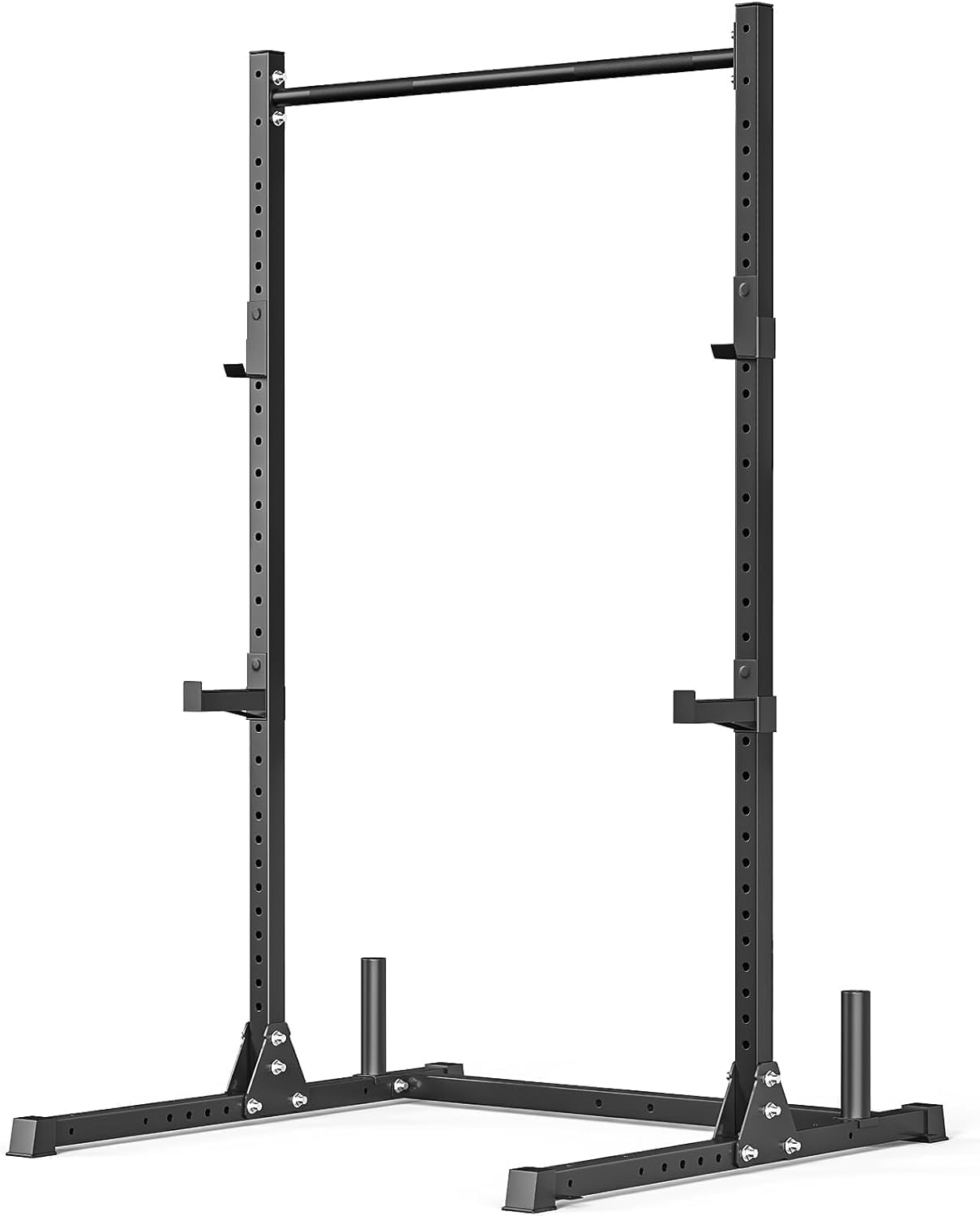
Sunny's full-size power rack is the one we send most people to, and the reason is coverage: squats, bench press, overhead press and pull-ups all happen inside the same 53-inch-wide frame. Eighteen J-hook positions per upright give a real height range, the safety spotter arms lock into place rather than perch on a pin, and the angled pull-up bar offers eight grips. It's 87 inches tall, so it isn't a folding stand — but it fits a spare bedroom better than a full cage has any right to.

The adjustment range is where this earns its keep. Eighteen positions is enough to set the J-hooks at squat height and drop them for a bench press without running out of holes in between, which is the failure mode of cheaper stands. At 83 pounds the frame doesn't skate when you rack a bar, and the locking arms mean a failed rep stops on steel instead of your chest.

Two things to know. The pull-up crossmember is the soft spot: it holds fine for pull-ups, but a hard re-rack can set it moving, and bolting the feet down stops that. And Sunny doesn't publish a maximum load — the one number we most wanted and didn't get. If you're moving serious weight rather than home-gym weight, a rack that states its ceiling, like the FLYBIRD, is the safer buy.

Assembly is better than the price suggests. The steps are numbered to match the bags of hardware, the wrenches are in the box, and the frame squares up without shimming. Get a second pair of hands to stand the uprights, snug every bolt with the rack upright, then leave it alone. Budget for a bench that fits inside the 38-inch depth and you're set.

Bottom line: We send most home lifters here: a full cage with locking spotter arms, enough J-hook positions for squats and bench, and a footprint that still fits a spare room.
#2

FLYBIRD SR1 Squat Rack

FLYBIRD SR1 Squat Rack

Short-bar setups

Our Score 9.2/10
Check Price

Worth Noting

Barbell Fit
6 ft and 7 ft
Safety Arms
16.7 inches
Height Settings
22
Weight Capacity
950 lb
Read the full review

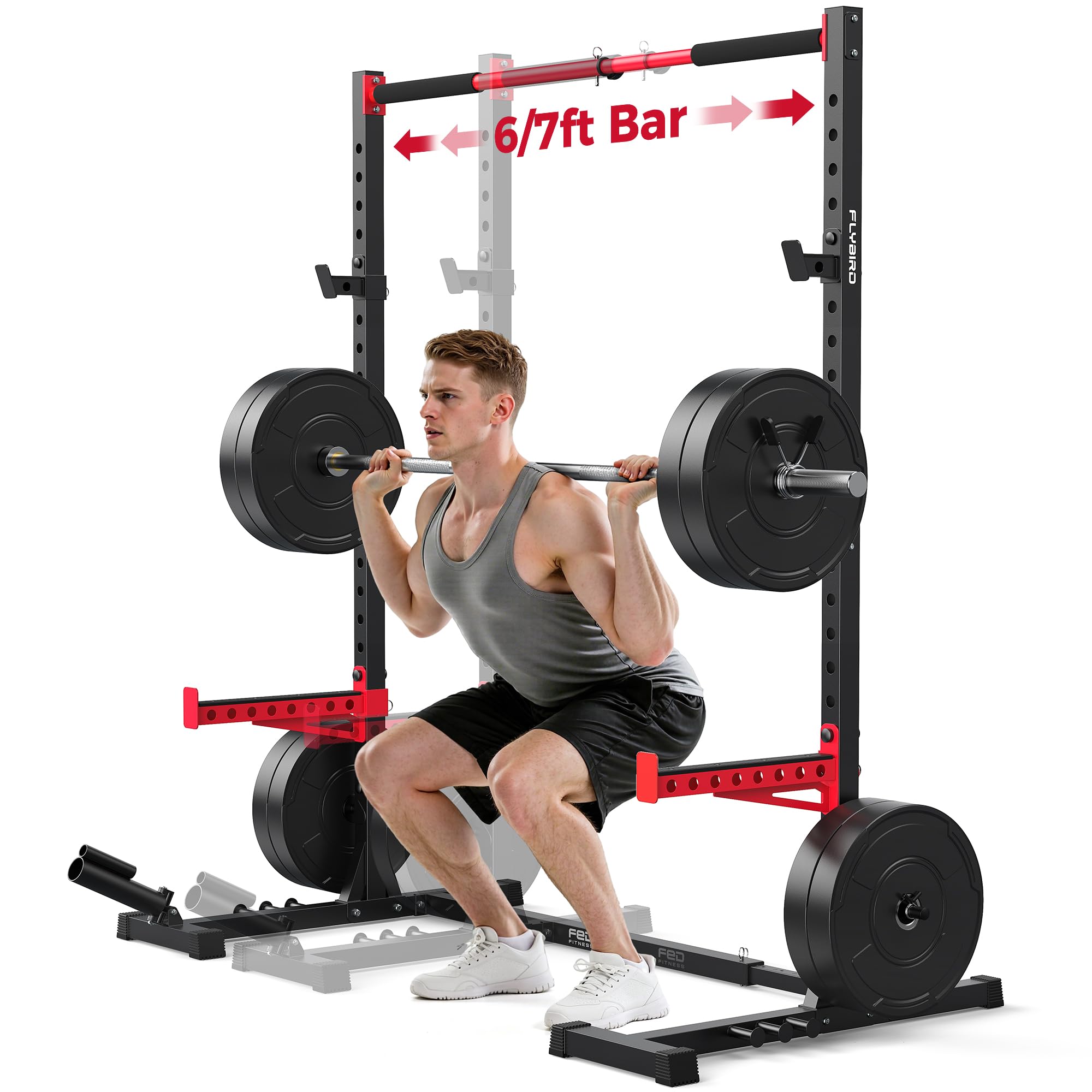
Adjustable width is what earns the FLYBIRD its place, and it's why this is our pick for anyone who owns a 6-foot bar. The uprights are drilled to take a 6-foot or a 7-foot barbell, so you set the rack to the bar you already have instead of buying a longer bar to fit the rack. Plenty of home gyms are built around a short bar for exactly that reason, and most racks quietly refuse to accommodate one.

The rest of the spec is unusually complete for the money. Twenty-two height positions on 1-inch spacing is the finest adjustment in this group; the safety arms are 16.7 inches deep, a bigger catch area than the stubby arms on most stands; and there's a landmine, six band pegs and a foam-padded pull-up bar in the box. A 950-pound rating and a 68-pound frame round it out — heavy enough to stay put, light enough to shift on your own.

It's a half rack, not a cage: the safety arms reach forward to catch a drop, but there's no second pair of uprights in front of you. The 950-pound figure is the maker's claim, so treat it as headroom rather than a target. The detail we appreciate most is the 1-inch holes, which accept standard attachments — the Sunny's smaller holes don't — so J-cups, a landmine arm or a dip bar are easy to add later.

Bottom line: Our pick if you own a 6-foot bar, want finer height steps, or need a stated load ceiling — the most adjustable rack in this group.

#3

papababe 800LB Power Rack

papababe 800LB Power Rack

Budget cage

Our Score 9.2/10
Check Price

Worth Noting

  • Spotter arms are short for heavy solo squatting
Unit Weight
61 lb
J-hook Holes
26
Assembled Size
47 x 48 x 82 inches
Weight Capacity
800 lb
Read the full review

The pull-up bar is the detail that separates this one from every other budget rack here. It's a multi-grip bar with a 1.25-inch diameter, so you can move between wide, neutral and close positions without bolting anything on — on a rack this inexpensive, the pull-up bar is usually the first thing the maker cuts.

Underneath it is a proper cage: 2x2 13-gauge steel, 26 J-hook holes per side, four bolt holes in every foot, and an 800-pound rating. Twenty-six holes is the most positions in this group, and it matters more than it sounds — the finer the steps, the closer you can put the catches to the bottom of a bench press. It stands 82 inches tall and weighs 61 pounds, so plan for ceiling clearance and a helper at assembly.

What you give up is margin. The frame is light for a cage: it stands still for normal training, but it isn't a bolted-down commercial rig, and if you're near the top of that 800-pound claim you should use the bolt holes in the feet. The uprights also arrive in sections that bolt together, so take your time squaring them before you tighten anything.

For a first home gym covering squats, benches and pull-ups, this is a lot of rack for the outlay, and the 26 adjustment holes mean you won't outgrow the heights in a hurry. It's not the rack for someone already squatting near its ceiling — that lifter needs more frame.

Bottom line: Buy this one when the budget is tight but you want a real cage; we think 26 J-hook holes make it the easiest rack here to dial in.

#4

JX FITNESS JX-855 Squat Rack

JX FITNESS JX-855 Squat Rack

Low basements

Our Score 9.0/10
Check Price

Worth Noting

  • Only five height settings, so the steps are coarse
Width Range
25 to 40 inches
Height Range
41 to 57 inches
Assembled Size
48 x 44 x 60 inches
Weight Capacity
660 lb
Read the full review

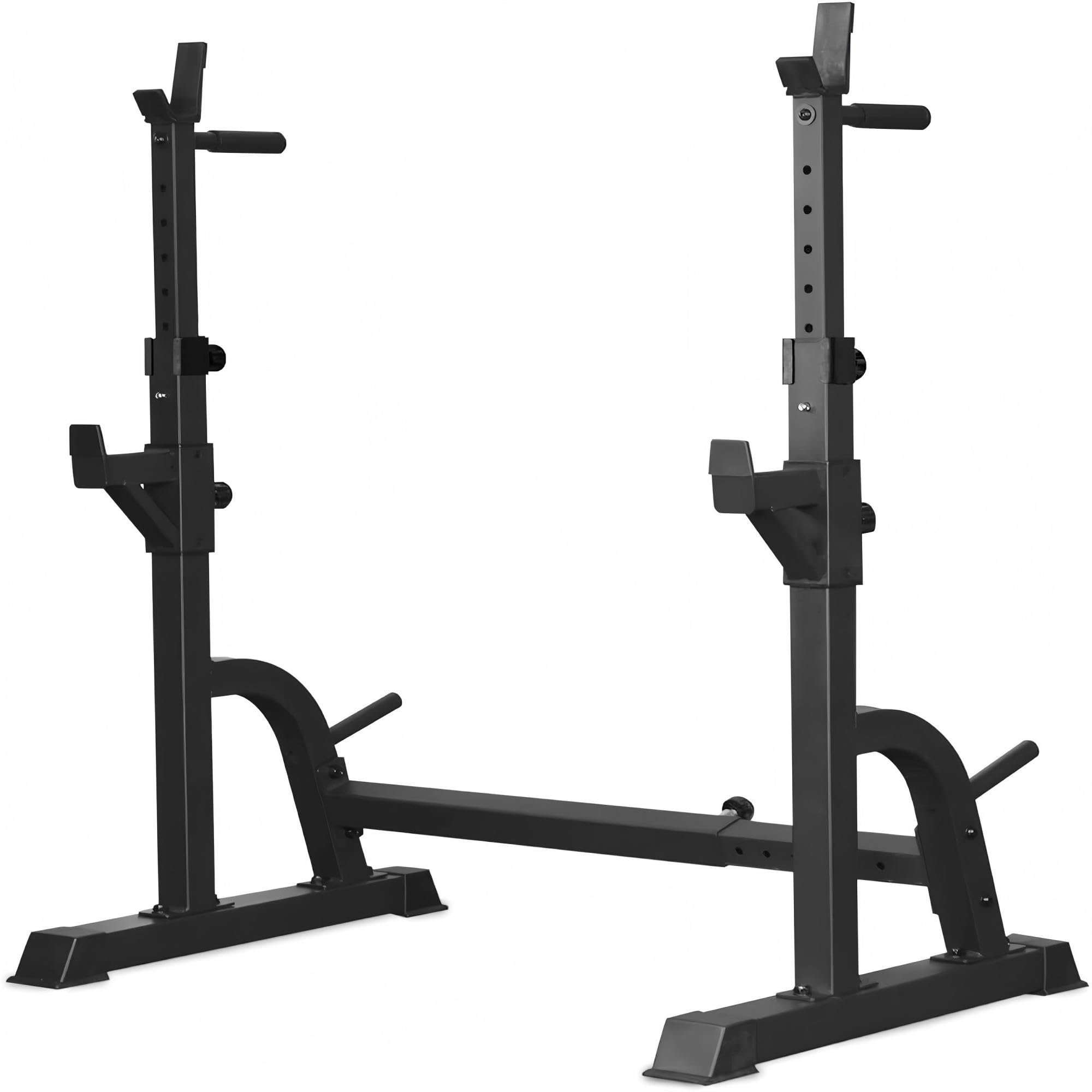
If your training space has a 7-foot ceiling, most of this list is out. The JX-855 stands about five feet tall, which puts it under basement joists and the low side of a sloped garage ceiling, and it still racks a bar for squats, benches and presses.

The frame is an H-shape, which keeps the feet out of your stance instead of running a crossmember behind your heels, and the whole thing breaks down for storage between sessions. Five height levels run from 41 to 57 inches and four width settings run from 25 to 40, so it takes a short bar as readily as an Olympic one. The claim is 660 pounds, with pegs on the frame for plates.

The catch is the ceiling it creates for you. The brackets top out at 57 inches, which is comfortable for a shorter lifter and tight for anyone much over 5-foot-8 — the bench press position in particular ends up lower than taller lifters want. If you're 5-foot-10 with a low basement, measure where your bar sits at the bottom of a squat before you order, because this rack can't go higher.

What you do get is a rack that fits where nothing else here will, and for an apartment or a low basement that's the whole ballgame. Treat the height as the deciding number rather than the capacity: if 57 inches works for your squat and your bench, this is a sturdy, quiet frame that won't dominate the room.

Bottom line: If your basement ceiling rules out an 83-inch rack, this is the one we point you to — just don't buy it if you're tall.

#5

CANPA 800LB Power Rack

CANPA 800LB Power Rack

Plate storage

Our Score 9.0/10
Check Price

Worth Noting

  • Uprights sit close, crowding a wide-grip bench press
  • Lowering the main frame takes patience
Pull-up Bar
Multi-grip
Weight Capacity
800 lb
Support Arm Holes
17
Main Frame Heights
6
Read the full review

Plate storage is the quietly great feature here. A bar at the back of the frame holds your Olympic plates off the floor, which in a small room is the difference between a gym and an obstacle course. Add the multi-grip pull-up bar, the 800-pound rating and 17 adjustment holes in the support arms, and you have a cage that does more than hold a barbell.

We rate it the best-equipped cage here on storage and pull-up variety, and near the top of this group on stated capacity. The catch is width: the uprights sit close together, and bench pressers with a wide grip can find the posts crowding their hands at the bottom of a rep. If your bench press already feels cramped inside a rack, this one makes it worse.

The frame itself is a set-once proposition: dial in your squat and bench heights, tighten everything down, and leave it. For a basement gym where the bar mostly gets squatted and pressed, the plate storage and the multi-grip bar earn their floor space, and the pull-up grips give you more variety than a straight crossmember would.

Bottom line: We choose this one when plate storage and a multi-grip pull-up bar matter more than bench-press room; measure your bench against the uprights first.

#6

CAP FM-CS7000F Power Rack Stand

CAP FM-CS7000F Power Rack Stand

First rack

Our Score 9.0/10
Check Price

Worth Noting

  • Upright welds are the first thing to check on arrival
  • J-hooks and mounting holes can need persuasion
Pull-up Bar
Built-in
Unit Weight
54 lb
Assembled Size
45.67 x 50.79 x 85.43 inches
Weight Capacity
500 lb
Read the full review

Load a bar, rack it, and watch the feet. This stand is 85 inches tall and only 54 pounds, so a hard re-rack will slide it on a smooth floor unless you give it something to sit on — which is exactly what the weight storage posts are for. A couple of plates on them and most of that movement stops.

What you get is a full-height rack stand with a built-in pull-up bar, double-gusseted uprights, J-cup catches and a powder coat that survives a garage. It's built from 11- and 12-gauge steel with industrial zinc hardware, and the footprint is small enough for a single-car garage bay without taking the whole bay. Assembly is one of the things it does well.

As a first rack for a garage or a spare room, we think it earns its place: full height, a pull-up bar, plate storage, and enough left in the budget for a bench. Where it stops is heavy, frequent lifting — the recommended maximum is 500 pounds on a 54-pound frame, and that is not a lot of margin. A dedicated squatter is better served by the Sunny or the FLYBIRD.

Bottom line: We think it's a fine first rack for moderate loads, though anyone chasing a heavy squat should put the money into a sturdier frame.

#7

BARWING Adjustable Squat Rack

BARWING Adjustable Squat Rack

Wide adjustment

Our Score 8.8/10
Check Price

Worth Noting

  • Load rating contradicts itself: 1,250 lb claimed, 350 lb listed
Adjustment
Pop pins and locking knobs
Unit Weight
45.6 lb
Width Range
29 to 49 inches
Height Range
34 to 58 inches
Read the full review

There are two capacity figures on this rack's page and they disagree by a factor of more than three, so we treat the load rating as unverified and plan on the lower number. That lower figure is still enough for most home lifters, but it's nowhere near the headline. Buy this rack for its adjustment range, and don't load it like a 1,250-pound rack until the seller picks a number.

What it does have is range. Height adjusts from 34 to 58 inches and width from 29 to 49, both on pop pins and locking knobs rather than loose bolts, and there's plate storage on the frame. The 34-inch low setting is the interesting part: it takes bench press and rack pulls down to a height most stands here can't reach, which matters if you're short or you're pressing off a low bench.

The width range is the widest here — 29 to 49 inches takes a short bar or a full 7-footer — and for a household where two very differently sized people share one rack, that's worth real money. That's why it's on this list. Just keep your working weight modest and check every knob and pin before each session until you know how it behaves.

Bottom line: We like the adjustment range but not the paperwork: buy it for the width, and treat its load rating as unproven.

#8

F2C Adjustable Squat Stands

F2C Adjustable Squat Stands

Portable storage

Our Score 8.6/10
Check Price

Worth Noting

  • Base welds are the weak point to check
  • Two free stands can drift out of line mid-set
Unit Weight
18.5 lb
Safety Spotters
13 positions
Weight Capacity
550 lb
Footprint Per Stand
20.1 x 17.7 inches
Read the full review

A pair of independent stands does something no cage in this group can: it comes apart. Slide the two halves against the wall, or into a closet, and the room goes back to being a room. If your training space doubles as living space, that's not a small thing — and it's the whole argument for buying two stands instead of one frame.

It's also the least expensive route into barbell squats and bench press here, and it doesn't pretend otherwise. Each stand carries 13-position safety spotters, the H-base has thick rubber pads that hold on concrete, tile and vinyl, and the claimed capacity is 550 pounds. We rate it the best cheap entry in this set, provided you're honest about the loads you'll put on it — at 18.5 pounds a stand, this is equipment that moves.

Set it up carefully and it behaves. Keep the base bolts loose until both stands are square and level on the floor, then tighten everything down; that one step does more for stability than any accessory you can add. On a level surface with the bolts snug, most of the side-to-side movement goes away, and the stands stay where you put them.

Bottom line: We recommend the F2C pair for a first setup in a room that has to double as something else — movable, storable, and honest about its load ceiling.

How We Tested These Adjustable Squat Racks

We started by narrowing a long list of adjustable squat racks to models with genuinely useful adjustment—uprights that move in small increments, safeties that can be set at squat depth, and footprints that could plausibly live in a garage or spare room. We filtered out racks with vague weight ratings, skimpy hardware, or assembly instructions that looked like an afterthought, and compared what came in the box—J-cups, safeties, pull-up bars, attachments—against the asking price. That left seven racks, which we built and used for nine months.

Assembly was the first real test. I timed each build solo where possible and noted when a second person was genuinely needed; I counted every washer and checked whether holes lined up without persuasion. Once upright, we inspected welds, powder coat, and hardware, then loaded each rack with progressively heavier squats, presses, and re-racks. We watched for uprights that swayed, feet that lifted, or frames that creaked under a loaded bar—the difference between a rack that feels sturdy and one that merely holds weight. We didn't test to failure, but we noted whether the stated capacity felt believable given the steel gauge, bracing, and hardware.

Over nine months, the racks lived in garages and spare rooms, not a lab. We squatted in them twice a week, benched and pressed inside and outside the uprights, and used the pull-up bars and attachments as intended. We measured footprint and ceiling clearance, checked whether the safeties caught a failed rep at the right height, and noted how easily the J-cups moved between squat and bench heights. We also looked for loosening bolts, scratched finish, and any wobble that showed up after months of re-racking. The racks that held up were the ones that stayed quiet and planted, adjusted without a fight, and fit the space they were asked to live in.

How to Choose Adjustable Squat Racks for Home Gyms

Height range matters more than the number of holes

Adjustability only counts if it covers both lifts. You need the J-hooks high enough for the bottom of your squat and low enough for a bench press, and on a full-size rack those two heights can sit 20 inches apart. Count the range first and the number of positions second: eight holes spread across a foot beat sixteen holes crowded into six inches.

Measure where the bar sits at the bottom of your squat and where the catches need to be for bench press, then check both numbers against the rack's stated bracket range. If the low number isn't covered, the rack can't bench — no amount of extra holes fixes that.

Match the width to your bar and your bench

Two width questions settle most of these purchases. The first is bar length: a 6-foot bar needs a narrower stance than a 7-foot Olympic bar, and only some racks adjust far enough to take both — the FLYBIRD and the BARWING are built around exactly that problem.

The second is the bench press. A rack narrow enough for a small room can leave your hands crowded against the uprights at the bottom of a press. Measure your bench, measure your grip, and compare both with the space between the posts before you order.

Buy the safety arms, not just the frame

Safety arms are the reason to spend rack money instead of stand money. Length is the spec that matters: a longer arm gives you a bigger landing zone and lets you set the catch lower, so a missed rep drops onto steel rather than rolling off the end.

Set them an inch or two below the bottom of your lift — low enough that you complete every rep, high enough that a failed one never reaches your chest. If you squat and bench alone, this is the feature worth paying for.

Ceiling, floor, and how much room it really needs

Most full racks here stand 82 to 87 inches tall, and pull-ups need headroom above that. An 8-foot ceiling is comfortable; a 7-foot basement rules out everything except a short rack like the JX, which trades squat height for fit.

Then look down. Concrete and rubber matting are ideal, carpet lets a rack walk, and an upper wood floor concentrates the rack, the plates and you onto a few square feet. Measure the ceiling before the footprint — a rack that won't stand up can't be made to fit.

What a load rating is worth

Treat a stated capacity as a ceiling, not a target, and read the frame weight alongside it: a 45-pound rack claiming 1,250 pounds is telling you something. Where a page lists two different figures, plan on the lower one.

None of these needs bolting down for ordinary home training, but if you lift near the top of the rating, or you train alone, use the bolt holes in the feet. That single step does more for stability than any accessory you bolt to the uprights.

Frequently Asked Questions

Final Verdict

Most people should buy the Sunny. It covers squats, bench press, presses and pull-ups in one frame, its spotter arms lock rather than perch, and it has the deepest record of hard use of anything here.

Two exceptions. If you own a 6-foot bar, or you want 1-inch holes that accept standard attachments, the FLYBIRD is the better buy and costs less. And if your ceiling is under about seven feet, the JX is the rack that fits — provided you're not tall.