Strength & Weights

Best Smith Machines for a Home Gym of 2026

A Smith machine is a barbell locked to a vertical track: you unrack it with a twist of the wrist, and the rail catches the bar if you fail a rep. That single design decision explains why a cheap unit feels like a carnival ride and a good one feels like a spotter who never tires. The rails have to be truly parallel, the hooks have to catch the instant you rotate, and the frame has to sit dead flat on a garage floor that is almost never level. Get those three right and you can squat, press, and row heavy alone at home.

I've lifted on machines slapped together in an afternoon and on ones that felt machined, and the difference never shows up in the first set. Over eight months we assembled and lifted on six Smith machines, from budget frames to near-commercial builds. Something new buyers rarely weigh: footprint matters as much as weight rating — an inch too deep and you've bought an expensive towel rack. These are the ones that earned their square footage.

#1

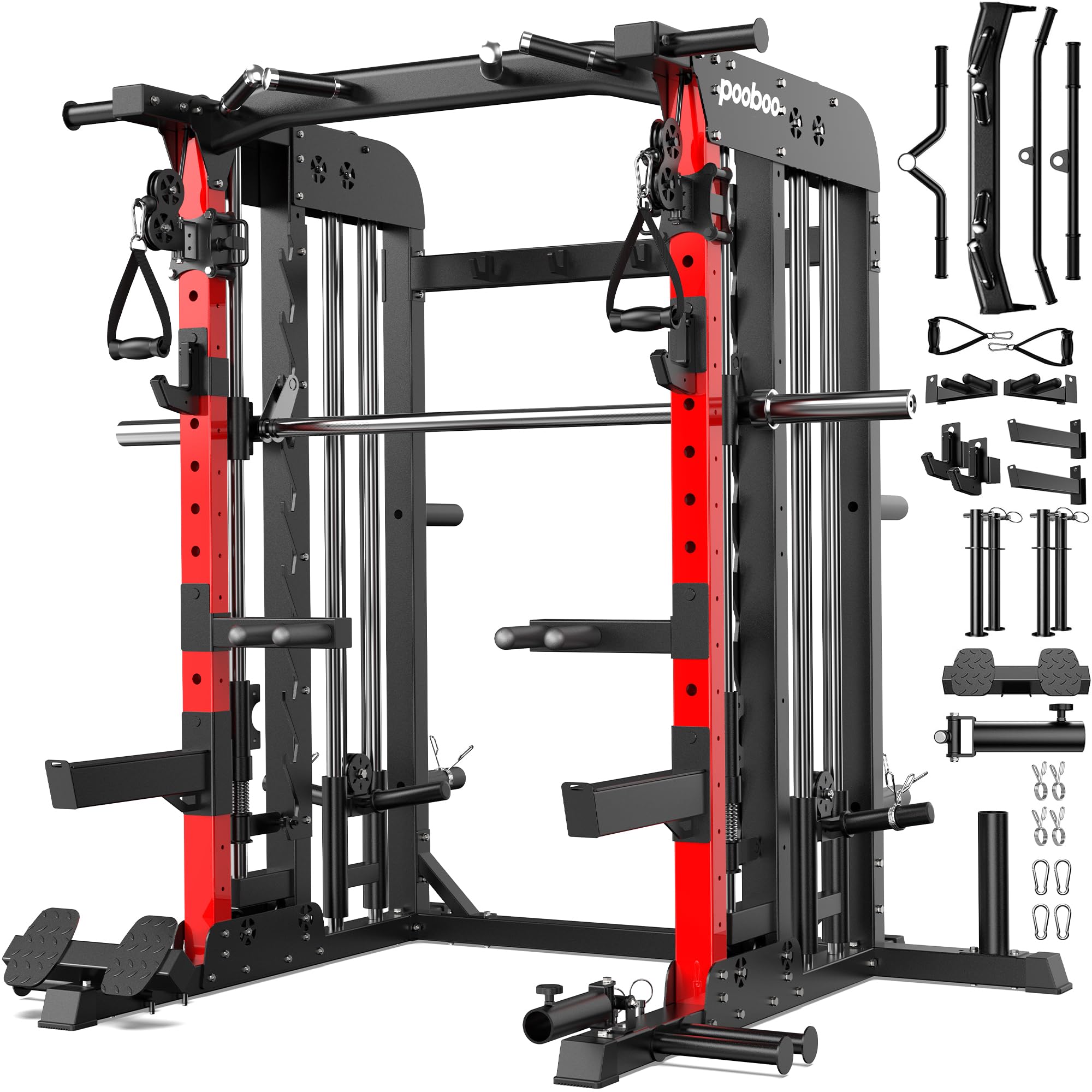
pooboo P43 Smith Machine

Top Pick
pooboo P43 Smith Machine

First Smith machine

Our Score 9.8/10
Check Price

Worth Noting

  • Cable system tops out at 1,000 lb
Max Load
2000 lb
Dimensions
62.9"D x 43.3"W x 82.6"H
Unit Weight
417 lb
Cable Rating
1,000 pounds
Read the full review

The measurement that matters here is 43.3 inches — the frame's width. That's what lets a full power cage with a Smith bar, two cable stations, and a lat pulldown sit against a garage wall instead of owning the bay. Depth is 62.9 inches and height 82.6, so the room still has to work, but floor space is where most home gym plans die, and this is the machine that survives one.

It's our top pick because it gets the three things that decide whether a home Smith machine is worth owning: a bar that tracks, a frame that doesn't walk, and cables worth pulling. The frame is rated to 2,000 pounds, but the number we cared about more is the 417 pounds the unit itself weighs — mass is what keeps a cage planted when you rack a heavy squat. The pulley system runs bearing pulleys and PU-coated wire rope, which is exactly where cheaper all-in-ones cut corners.

The accessory list runs past twenty pieces, and not all of it is essential, but the safety spotter arms and the lat pulldown bar are the things most people end up buying separately. Assembly is a Saturday job with two people; the manual leans on pictures, and the order it takes generally makes sense.

Two things to check before ordering. The P43-Pro variant adds lat training handles, so confirm which version you're getting. And plan the ceiling as carefully as the floor — at 82.6 inches tall, this cage leaves little headroom under a low garage door for overhead work.

Bottom line: We recommend it as the default home Smith machine: a planted 417-pound frame, bearing pulleys, and spotter arms in the box, without the price of the dual-stack machines.

#2

RitFit Smith Machine Power Rack

RitFit Smith Machine Power Rack

Compact budget setup

Our Score 9.2/10
Check Price

Worth Noting

  • No cable crossover station
  • Lowest rated capacity in this group
Style
Half rack with lat pulldown
Included
Landmine, barbell, plate pegs
Max Load
1000 lb
Steel Wall
2 mm
Read the full review

There's no cable crossover on this one, and that's the honest place to start. The RitFit is a half Smith machine with a lat pulldown, a landmine, a barbell, and plate storage pegs — a simpler answer to the same question, and the least expensive way into a guided bar that we recommend here.

What it covers for the money surprised us more than the spec sheet suggests. The frame uses 2mm steel walls with a 1,000-pound rating, the Smith bar is the center of the machine rather than an attachment bolted to the side, and the lat pulldown means you aren't limited to pressing and squatting. It's the machine for a spare bedroom or a single-car garage where a 60-inch-deep cage ends the project before it starts.

The trade is plain once you've used both kinds. No functional trainer means no cable flyes, no cross-body work, and none of the long list of crossover exercises — and if you train for general strength at home rather than chasing a big total, that list is worth less than the floor space it costs.

Assembly is the least painful in this group; the frame goes up quickly and the instructions hold together, which counts for a lot if you've never built a rack before. Plan on one helper for the uprights and an afternoon for the rest.

Bottom line: Our budget pick for a spare room: a Smith bar, lat pulldown, and landmine in a frame that fits where a full cage won't.

#3

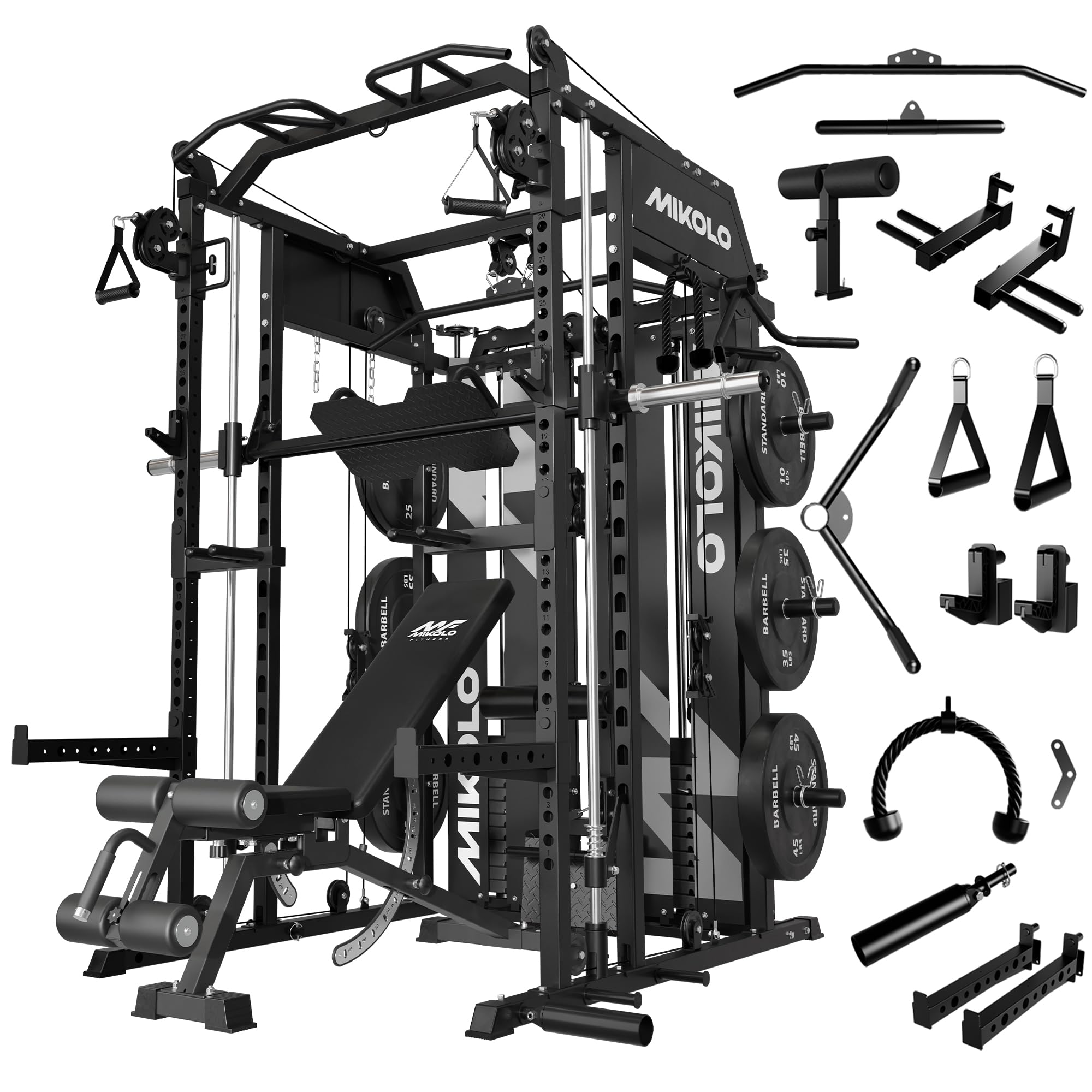
Mikolo SM02 Smith Machine

Mikolo SM02 Smith Machine

Two lifters at once

Our Score 9.0/10
Check Price

Worth Noting

  • Ships in several packages, sometimes days apart
Uprights
2" x 2" steel
Dimensions
68"D x 56"W x 87"H
Pulley Ratio
2:1
Weight Stacks
128 lb per side
Read the full review

Two 128-pound weight stacks, one on each side, and a 2:1 pulley ratio: the SM02 is built for two people to train at once without touching a plate. If you and a partner lift together, that single design decision reshapes a session — no loading and unloading between sets, no waiting for the cable station.

The 2:1 ratio is the trade-off to understand before you buy. It halves the resistance at the handle and doubles the cable travel, which gives you long, smooth pulls for lat work, rows, and face pulls. We think that's a fair trade for accessory volume and a bad one if you want to grind out heavy cable presses, because 128 pounds on the stack is roughly half that in your hands.

Around that sits a serious frame: 2-by-2-inch steel with reinforced joints, a 68-by-56-inch footprint standing 87 inches tall, a bench in the box, and a 15-degree elevated cable path for the lat pulldown and seated row that keeps the pull clear of the uprights. The two-year warranty is the longest standard coverage in this group, matched only by the pooboo.

Assembly is where it loses ground. The frame goes together correctly if you follow the video, but the printed steps aren't always in the order the build wants, and this isn't a job to start on a weeknight. You're paying for the stacks, the bench, and the two-person convenience; if one person trains at a time, the pooboo does the same work for considerably less.

Bottom line: Worth the premium if two people train together — the dual 128-pound stacks and a 2:1 pull make it a two-person gym in one footprint.

#4

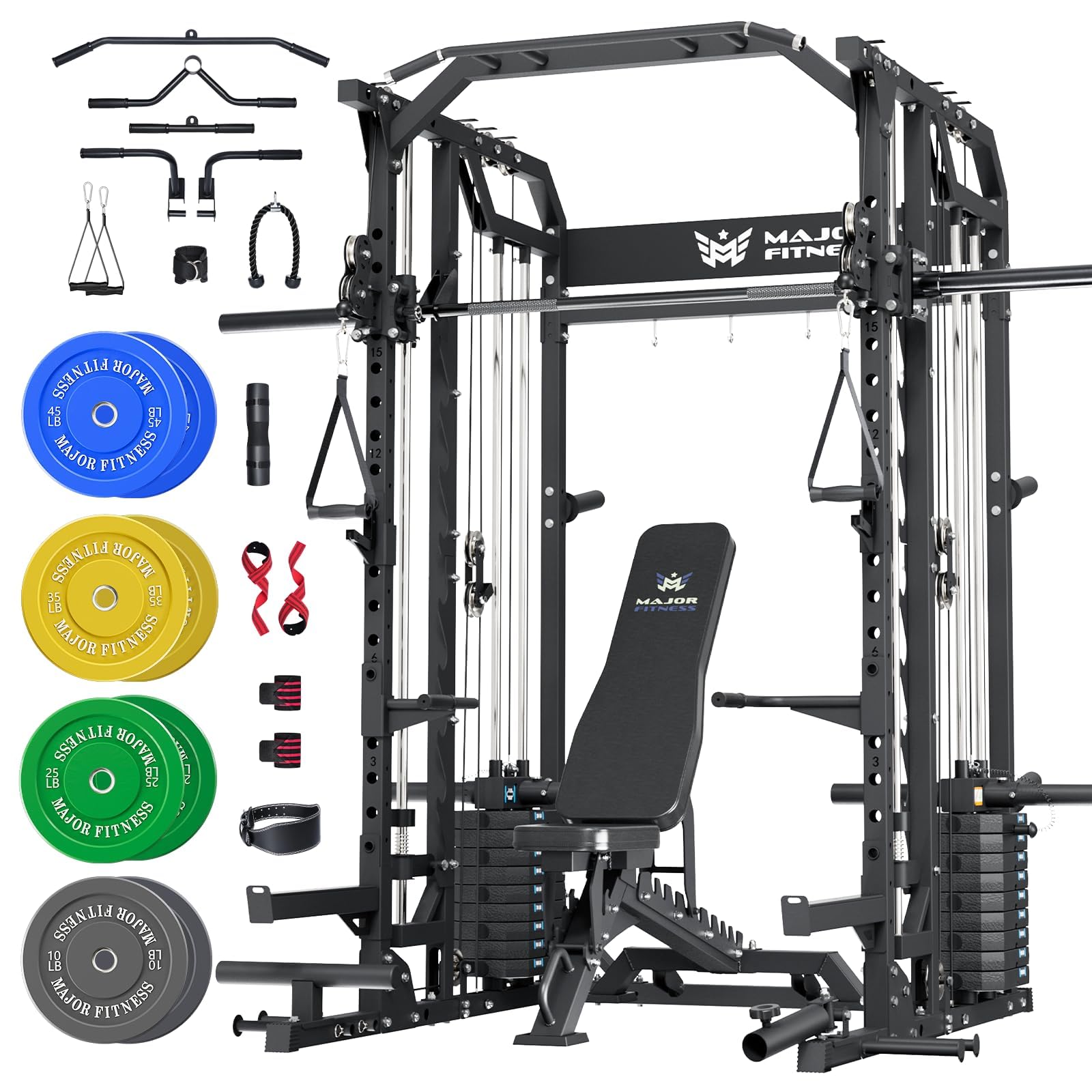
Major Fitness Drone2 Smith Machine

Major Fitness Drone2 Smith Machine

Heavy cable work

Our Score 9.0/10
Check Price

Worth Noting

  • Written warranty runs one year
Included
Dip handles, T-bar, weight bar
Max Load
2000 lb
Uprights
2" x 2" commercial steel
Pulley Ratio
1:1
Read the full review

Where the Mikolo halves the load with a 2:1 ratio, the Drone2 runs 1:1 — a hundred pounds on the stack is a hundred pounds at the handle. For slow, heavy cable work, pressdowns you actually want to grind, rows that should feel like rows, that's the more satisfying pull. It's also a big part of why this machine sits near the top of the price range.

The rest of it is built to match. Two-by-two-inch commercial-grade steel uprights, aluminum pulleys, and a stated 2,000-pound capacity put it in the same class as anything here, and the accessory set — dip handles, a T-bar, a weight bar, cable attachments — covers the stations most people add one at a time.

Major Fitness advertises lifetime after-sales support, the strongest after-purchase promise in this group, and that's the kind of thing we weigh heavily on a machine you plan to keep for years. The machine itself is full-size, so get the assembled footprint from the seller before you commit a wall — this isn't a corner rack.

The build runs a methodical afternoon for two people and goes together cleanly if you leave the bolts finger-tight until the frame is square. Nothing about the process is unusual for a rack this size; it just isn't a one-person, one-hour job.

Bottom line: The pick for lifters whose cable work is the main event: a 1:1 ratio that puts the full stack in your hands, on commercial-steel uprights.

#5

Royal Fitness Smith Machine

Royal Fitness Smith Machine

Value cable crossover

Our Score 9.0/10
Check Price

Worth Noting

  • Needs a long wall at 78.7 inches wide
Max Load
1,900 pounds
Dimensions
64.1"D x 78.7"W x 87.4"H
Plate Storage
4 holders
Pulley Heights
28 settings
Read the full review

A full cage with a Smith bar, two independent pulleys on 28 height settings, and storage for four plate loads, priced at the bottom of the midrange — this is the listing that usually has a catch. Here the catch is space, not function.

The frame carries a 1,900-pound rating, comfortably past what most people will ever load, and the bar runs on chrome-plated rails with a lock that engages as you set it down. We appreciated the storage more than the spec sheet suggests: four weight plate holders, a barbell post, and four hooks that keep attachments off the floor instead of in a pile in the corner.

Cables are where the compromise lands. The pulleys are independent and the height range is genuinely useful for crossover work, but the glide isn't always even side to side, and it typically improves once you lubricate the guide rod. If heavy, high-volume cable work is central to your training, the extra money for a pooboo or a Mikolo buys a noticeably nicer pull.

We keep coming back to the value: a 1,900-pound frame, independent pulleys across 28 settings, and storage that keeps the floor clear. If you have the wall, this is the full cage that leaves money in the budget for plates.

Bottom line: The most machine for the money here, as long as you have the wall space and can live with cables that need lubricating.

#6

SunHome S4 Pro Smith Machine

SunHome S4 Pro Smith Machine

Starting from nothing

Our Score 8.8/10
Check Price

Worth Noting

  • Smith bar can feel loose in the track
  • Assembly instructions are largely pictures
Dimensions
72"D x 60"W x 90"H
Weight Stack
120 lb
Included Bench
Adjustable
Included Plates
230 lb Olympic set
Read the full review

A 230-pound Olympic plate set, an adjustable bench, and a 120-pound selectorized weight stack arrive with the frame. The S4 Pro is the only machine here that gets you lifting without a second order, and that changes what the price actually buys.

The hardware behind it is respectable: 2mm commercial steel square tube, a rolling-bearing pulley design rather than a plain slider, and a 72-by-60-inch footprint standing 90 inches tall. Check the ceiling before anything else. The second check is whether a 120-pound stack covers the cable work you do, because it's built for accessory volume rather than heavy lat pulldowns.

The Smith bar is the part to learn. The hooks reward a deliberate, unhurried rerack rather than a quick shrug of the wrist — and the end of a hard set is exactly when you have the least patience. Set the safety spotter arms where you want them, then practice the lock with an empty bar until it's automatic. We think that drill is the difference between a machine you trust and one you avoid on heavy days.

As a package it's aimed at someone furnishing a gym from nothing: plates, bench, stack, cage, one delivery, one build. If you already own a barbell and plates, you're paying for hardware you don't need, and the money is better spent on a machine with a nicer bar feel.

Bottom line: Buy it if you want one delivery to include the plates and the bench; budget time to learn the bar hooks before you load heavy.

#7

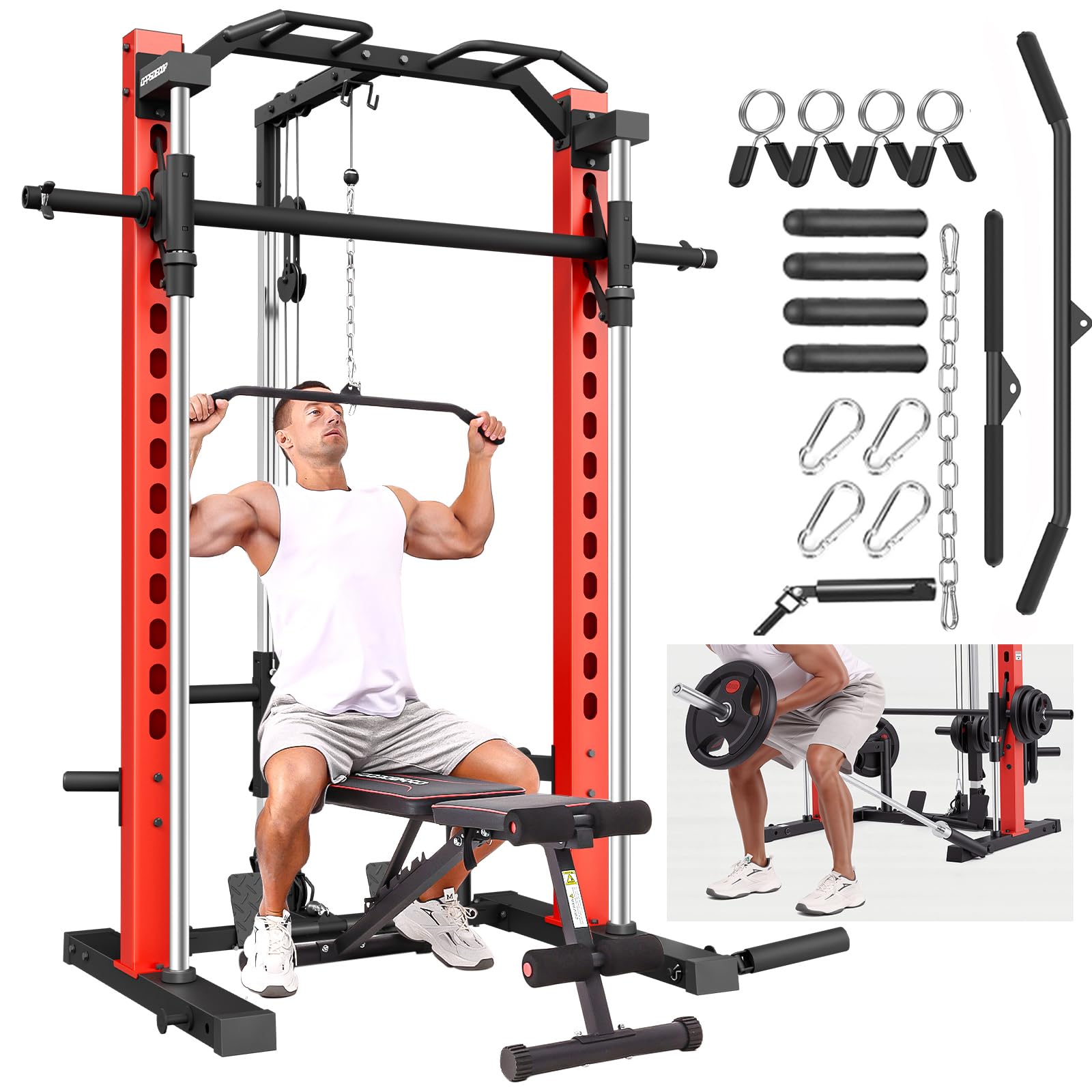
OPPSDECOR All-in-One Smith Machine

OPPSDECOR All-in-One Smith Machine

Small spaces

Our Score 8.8/10
Check Price

Worth Noting

  • Light hardware needs regular checking
  • Second-lowest rated capacity here
Storage
Folds away
Max Load
1400 lb
Dimensions
51.97"D x 70.47"W x 86.22"H
Read the full review

It folds. That's why the OPPSDECOR earns a place at all: a Smith machine with dual pulleys, a lat pulldown, and a landmine that can be stowed against a wall in a room that has to be something else the rest of the day.

At 1,400 pounds it carries the second-lowest rated capacity in this group, above only the RitFit half rack, and it's built to a price in ways you can feel. We treat it as a starter machine: fine at moderate loads, not what you want under a very heavy squat. Within that brief it does real work — the dual pulleys and landmine cover a wide spread of exercises, the storage keeps plates off the floor, and folding it away between sessions is a feature rather than a gimmick.

Two things to know before you load it up. The frame can shift under a heavy squat if it isn't sitting level and loaded evenly, so set it on a solid floor and check it before each heavy session rather than treating 1,400 pounds as a target. And the hardware is the thin part: check the bolts after the first few sessions and again every month or so.

The instructions are better than average at this end of the market, and one patient person can build it in an afternoon. If you're renting, short on space, or testing whether training at home will stick, this is the low-risk entry. If you already know it will, spend once and buy the pooboo.

Bottom line: The low-risk way to try home strength training: it folds away, costs the least here, and is honest about being a starter machine.

How We Tested Six Smith Machines Over Eight Months

The shortlist started as a spreadsheet: every machine we could find with a full-length barbell, a rated capacity of at least 600 pounds, and adjustable safeties, then filtered by footprint, warranty length, and price. Six made it through, spanning the price bands a home lifter actually shops.

Each one was assembled by a single person first, stopwatch running and tools laid out, with a second pair of hands only when the instructions called for it. We followed the manual page by page and wrote down every diagram that didn't match the hardware bag, every step that needed a tool the box didn't include, and how long it took from unboxing to first rep. Once a machine was standing, we set it on a garage floor that slopes toward the door, loaded the bar, and pushed the top of the uprights to see how much the frame walked.

Then came the training: eight months of squats, overhead presses, rows, and hip thrusts, including deliberate failed reps where we rolled the bar into the safeties. We noted how the bar traveled — whether it glided the whole way up or bound near the top of the rail, whether the hooks caught on the first wrist roll or needed a second attempt, and how much noise the whole thing made at 6 a.m. with kids asleep upstairs. Over the long haul we checked bolts for loosening, looked for rust at the welds and grooves worn into the chrome, and marked where the powder coat rubbed thin.

Versatility was judged by counting what each machine could actually do beyond a back squat — landmine work, lat pulldowns, pull-ups, floor presses — and whether the safeties dropped low enough and rose high enough for a tall lifter. Value came last: we weighed price against frame gauge, attachment count, and warranty rather than against the sticker alone.

How to Choose Smith Machines for a Home Gym

Measure the room before the machine

The full cages in this group stand between roughly 82 and 90 inches tall, which is taller than most people picture and taller than some garage door tracks allow once the door is up. Measure from the floor to the lowest obstruction rather than to the ceiling, and add headroom for anything you do standing. Then plan the working envelope: clear floor on both sides to load plates, and space behind you to step back with a bar. A listing's "compact" usually describes the frame, not the room you actually train in.

The bar matters more than the attachments

A Smith bar runs on fixed rails, so the whole feel of the machine comes down to how it tracks and how it locks. Linear bearings and twin hooks give you a bar that slides straight and catches with a short, deliberate rotation; a bar with play in the track feels loose at exactly the wrong moment. You can't test that online, so read for how the hooks engage and whether they can be reached from a low position, and plan on practicing the lock with an empty bar before your first heavy set.

Pulley ratio is the number nobody asks about

A 2:1 cable system halves the resistance at the handle and doubles the travel; a 1:1 system gives you the full stack. Neither is better in the abstract. The 2:1 pull is smoother and kinder for high-rep accessory work, while 1:1 is what you want if cable rows and presses are part of your heavy training. Ask which ratio a machine uses before you compare stack sizes, because a 200-pound stack at 2:1 is a 100-pound stack in your hands.

Plate-loaded or selectorized

A built-in weight stack costs more and eats floor space, but it changes how a session flows: no loading plates between sets, and with two independent stacks, two people can work at once. Plate-loaded stations are cheaper, let you add weight past the stack, and are what you find at the value end of this group. Buy the stack if you train circuits or lift with someone; buy plate-loaded if the difference is better spent on plates and a bench.

Plan the build day

Every machine here arrives in several boxes and takes hours, not minutes. Build it where it will live rather than assembling it elsewhere and walking it into place, keep the bolts finger-tight until the frame is square, and line up a second person for the uprights. Put something under the feet if it stands on a finished floor, and leave room to tip the frame upright — that's the moment when a low ceiling stops being theoretical.

Frequently Asked Questions

Final Verdict

Buy the pooboo P43 unless a specific requirement pushes you elsewhere. It's the machine that gets the fundamentals right — a 417-pound frame that stays planted, bearing pulleys, a bar that tracks, and spotter arms in the box — and it does it in the middle of the price range rather than at the top.

If two people train together, the Mikolo's dual stacks are the reason to spend more. If you have a spare bedroom instead of a garage and no use for a crossover, the RitFit half rack does the same core job for less.