Strength & Weights

Best Cable Machines for Home Gym of 2026

A cable machine's whole job is to hold tension on a muscle through the entire arc of a movement, which is why a cable fly feels nothing like a dumbbell one. What separates two home units is rarely the frame itself — it's the pulley setup, the footprint, and whether a weight stack is included, none of which you can judge from a product photo. Get those right and you stop waiting in line for the cable crossover at a commercial gym and start training in your own garage on your own schedule.

Over the past nine months, my team and I assembled and trained on six machines, and the differences showed up long before we touched a handle — usually around hour three of assembly. One thing a first-time buyer won't find on the spec sheet: a machine rated for 200 pounds per side can still rock during a heavy lat pulldown if the base is narrow or the feet aren't level, so sturdiness matters more than the headline weight rating. The picks below are the ones that stayed planted, went together without a fight, and earned the floor space they take up.

#1

Body-Solid PFT100 Crossover

Top Pick
Body-Solid PFT100 Crossover

Dedicated gym rooms

Our Score 9.2/10
Check Price

Worth Noting

  • Needs 62 inches of width and a dedicated wall
Warranty
10 years frame, 1 year parts
Footprint
42.3"L x 62.6"W x 83"H
Resistance
Dual independent weight stacks
Machine Weight
476 lb
Read the full review

This is the premium pick, and the only machine here with two fully independent stacks. That single fact changes the training: each arm loads on its own, so a one-arm row or a single-arm press gets exactly the resistance you set, with no shared pulley dragging the other handle along. If isolateral work matters to your program, this is the reason to spend.

The frame is the other reason. It measures 42.3 by 62.6 by 83 inches and weighs 476 pounds, with an electrostatically applied powder coat, a 10-year frame warranty and a single year on parts. Once it's standing, it doesn't move. The pulleys are the smoothest in this set, and the glide stays quiet when you pull hard.

You pay for it in space and in a long afternoon with an Allen key: 62 inches of width means a dedicated wall, and the crate isn't something you carry upstairs alone. What you get back is the machine most likely to still be the center of a home gym a decade from now. If the room already exists and the budget is real, this is the one we choose.

Bottom line: The real cable crossover of this group: two independent stacks, true isolateral movement and a 476-pound frame, for a dedicated room and a serious budget.
#2

Goimu LS01 Lat Tower

Goimu LS01 Lat Tower

Tight corners

Our Score 9.2/10
Check Price

Worth Noting

  • No weight stack
  • Seat adjusts in only three fixed steps
Max Load
800 lb
Stations
High pulley, low row, ab crunch
Footprint
3.12 sq ft
Dimensions
59"D x 23.43"W x 83.46"H
Read the full review

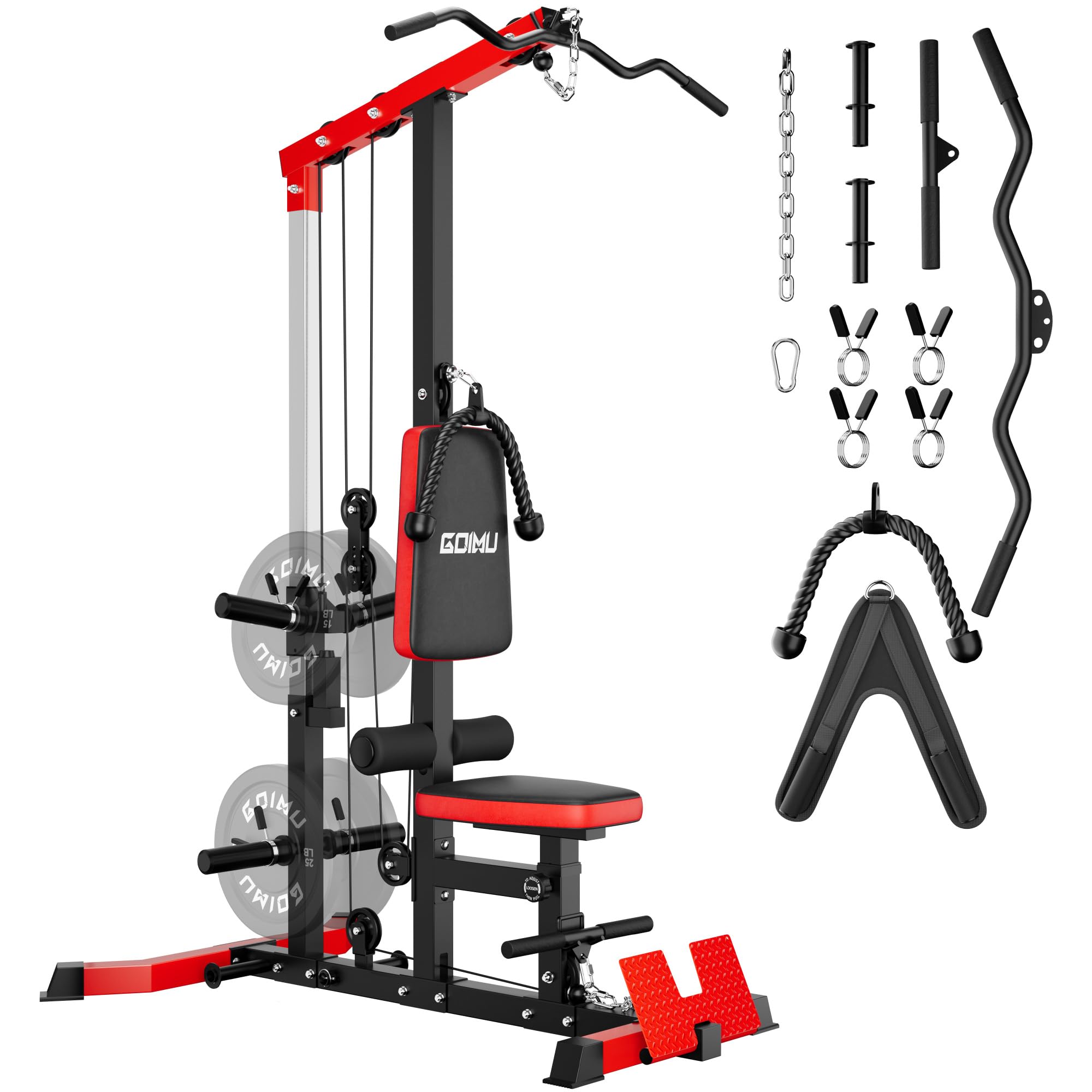
Three square feet is the number that makes the LS01 worth a look. It stands 23.4 inches wide and 83.5 inches tall, so it goes in a corner, beside a rack, or in the gap between the car and the garage wall. Measure your ceiling first — 83.5 inches is more than a lot of basements allow.

What that footprint buys is a high pulley, a low row and an ab crunch station, plus a lat bar, a cable bar and a tricep rope in the box. The frame is 2mm steel tubing rated to 800 pounds, and there's no weight stack — you supply the plates, which is how a tower this size gets that rating without stack money built into it.

If your plates are already in the garage, that trade makes sense: pulldowns, seated rows, curls and tricep work off one upright, with a three-position padded seat that puts your thighs under the hold-down properly rather than approximately. Two things we noticed. The seat adjusts in three fixed steps instead of sliding, and the leg hold-down could use one more hole for taller users.

Bottom line: The least floor space you can spend on a real lat pulldown and low row: three square feet, 800 pounds of headroom, and plates you already own doing the work.

#3

LFJ LAT Pulldown Pulley System

LFJ LAT Pulldown Pulley System

First cable kit

Our Score 9.2/10
Check Price

Worth Noting

  • Clips and adjustable loop slip under heavier loads
  • 100 kg rating is the lowest in this group
Cable
2 m adjustable
Included
Pulley, three carabiners, rope, strap, loading pin
Max Load
220.5 lb
Plate Fit
1 in standard and 2 in Olympic
Read the full review

In the box: one pulley, a two-metre adjustable steel cable, three carabiners, a 27-inch tricep rope, a nylon strap loop and a loading pin. That's the whole system, and it's the least expensive way into cable training in this roundup.

The loading pin takes both 1-inch standard and 2-inch Olympic plates, which matters if your plates are a mixed collection, and the strap loop hangs the pulley from a beam, a pull-up bar or a rack crossmember without drilling anything. The cable is rated to 100 kilograms — the lowest figure here — so treat it as a light-to-moderate tool.

We see it as a try-before-you-commit purchase. Hang it, run a month of pulldowns and pushdowns, and you'll know whether cable work belongs in your routine before spending tower money. Just don't push it: the adjustable loop and the clips are the parts that let go once you load past about 70 pounds, and that's where the savings stop being a bargain.

Bottom line: The least expensive way to find out whether cable work suits your training: a pulley, an adjustable cable and a pin that takes any plate.

#4

Mikolo HGS Pro Home Gym

Mikolo HGS Pro Home Gym

Small home gyms

Our Score 9.0/10
Check Price

Worth Noting

  • Fixed seat and low press arms cramp taller users
  • Assembly runs to an afternoon with two people
Stations
10-in-1
Footprint
75"D x 36.3"W x 80"H
Weight Stack
154 lbs (12 levels)
Frame Warranty
Lifetime frame, 1 year parts
Read the full review

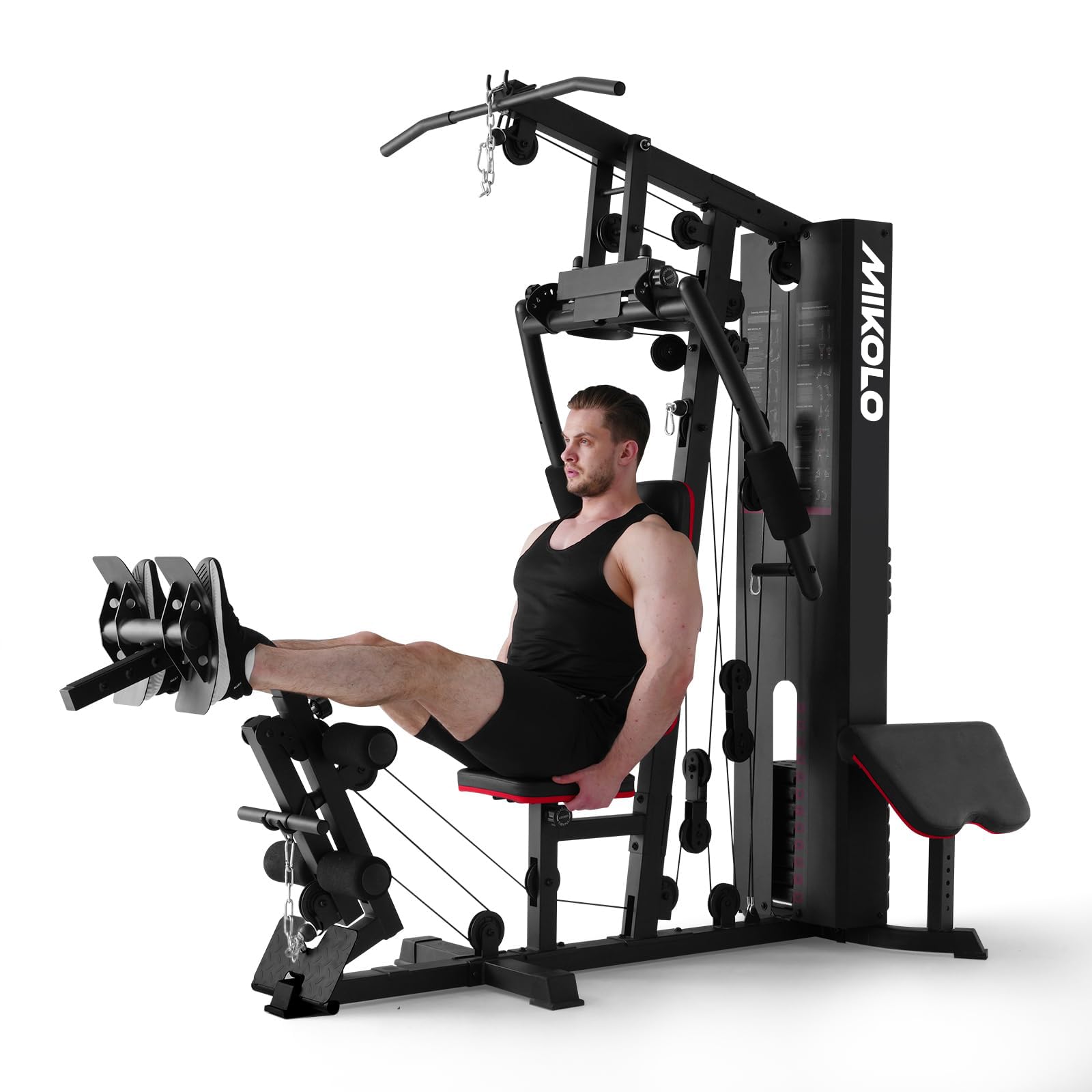
The first thing we check on a home cable machine is how the resistance changes. On the HGS Pro it's a pin through a 154-pound stack in twelve steps, so going from a heavy lat pulldown straight into a set of face pulls is one hand movement. That sounds like a small thing until you've spent an evening sliding plates onto a loading pin between sets.

That convenience explains why it's the machine we point most people to. The frame is 36.3 inches wide, 75 deep and 80 high, which is spare-bedroom territory rather than garage-only, and the stations run well past cables: pec fly, chest press, lat pulldown, low and mid row, leg extension, leg press, preacher curl, calf and core work all draw on the same stack. The preacher pad and leg press attachment come off when you don't need them, and a steel sheet guards the stack so plates can't wander off the pegs mid-set.

Build quality is where a home machine usually gets caught out, and this one holds up: 14-gauge steel, a lifetime frame warranty with a year on components, and a bearing in the cable bar that takes some of the wrist twist out of pressing movements. We also appreciate that Mikolo includes access to an assembly video — the printed directions are the usual pictogram puzzle, and the video is simply faster.

The limit is the stack. At 154 pounds, a lifter with a genuinely strong pull will run out of resistance on lat pulldowns inside a year or two, and that's the point where Body-Solid's dual-stack crossover becomes the honest recommendation. For the rest of us, this is the best mix of exercise coverage, footprint and spend in the group.

Bottom line: The one we point most people to: ten stations, a 154-pound stack and an 80-inch frame that fits a spare room, so cable work comes without loading a plate.

#5

Mikolo M-G3 Wall Mount

Mikolo M-G3 Wall Mount

Garage walls

Our Score 9.0/10
Check Price

Worth Noting

  • Requires masonry or solid framing
  • Cable flys can run short of range at the top
Cable
2,200 lb tensile strength
Max Load
400 lb
Dimensions
26.9"D x 25.6"W x 82"H
Pulley Positions
19 heights
Read the full review

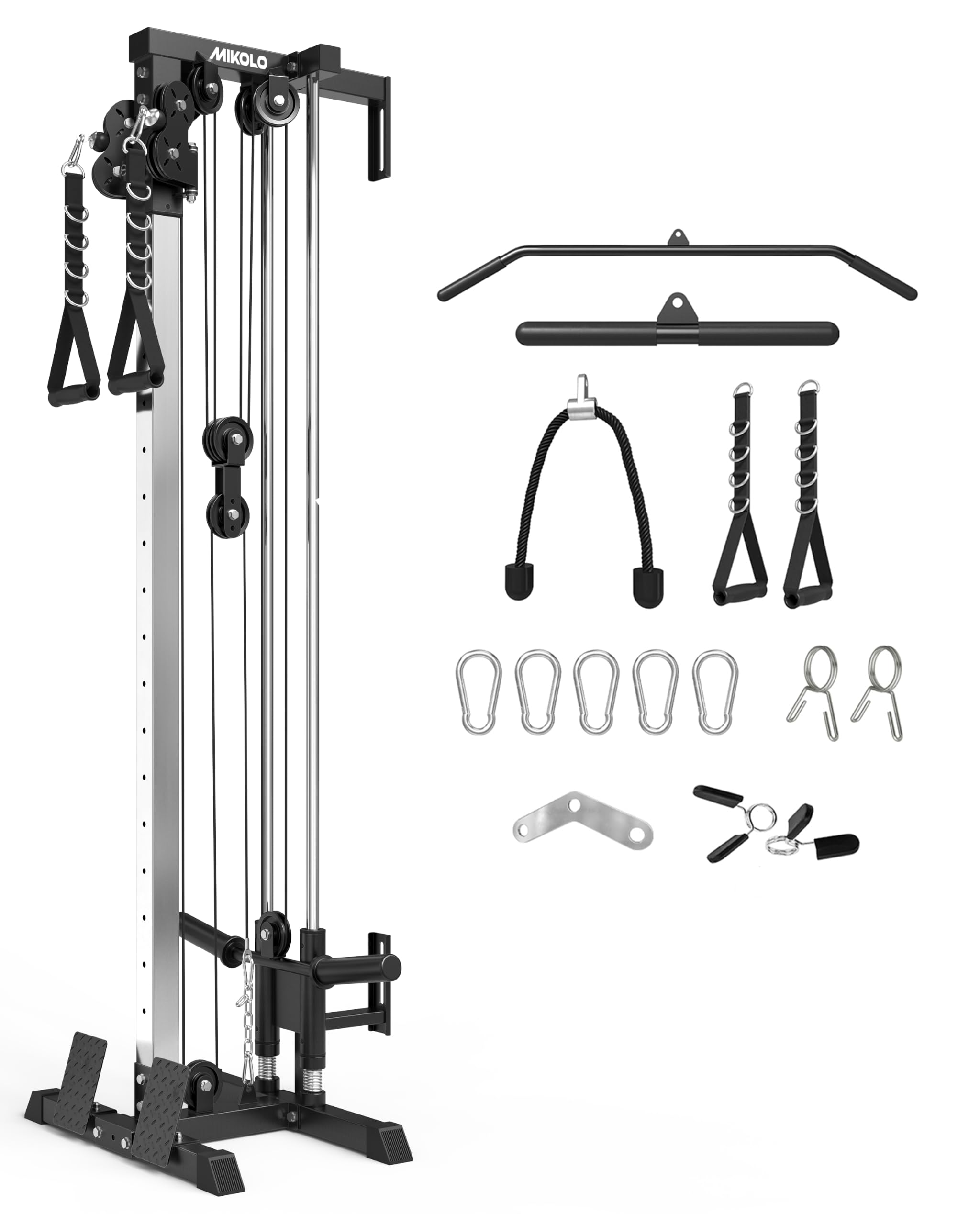
Everything about a wall-mounted station depends on the wall. Bolted into masonry or solid framing, the M-G3 is immovable and uses 25 inches of floor; bolted into drywall with ordinary anchors, it's a problem waiting to happen. Sort out the mounting point before you order, and if you rent, this isn't your machine.

Given a sound wall, it's the best value in this set for cable training specifically. Two adjustable pulleys run through 19 height positions, so high-to-low crossovers, face pulls and low rows all come off the same upright. The footboard is the detail we appreciate most — it turns a wall unit into a proper seated row station — and the 10-degree weight pegs keep plates from sliding between sets.

The cable is nylon-coated with a 2,200-pound tensile rating, the frame is 14-gauge steel, and the warranty covers two years with an eight-month component replacement window. Smoothness needs a little help along the way: the pulleys are plastic, and ten minutes with a silicone lubricant on the slides makes a visible difference to the pull.

Bottom line: If your garage wall is sound and your floor space isn't, this is the pick: 19 pulley heights, a row footboard and 400 pounds of capacity in 25 inches.

#6

FitBeast Pulley System

FitBeast Pulley System

Rack owners

Our Score 9.0/10
Check Price

Worth Noting

  • Carabiners and pulley bearings are the weak link at heavy loads
Cables
70 in and 90 in
Max Load
330 lb
Warranty
2 years
Included Handles
Rope, single handle, lat bar
Read the full review

If there's already a power rack, a pull-up bar or a beam in your garage, this is the simplest useful thing you can add to it. The loading pin takes your plates, the two cables — 70 and 90 inches — run over a pulley that swivels a full turn so the rope doesn't twist, and the box includes a tricep rope, a single handle and an adjustable lat bar. That's pulldowns, pushdowns, curls and rows without buying anything else.

We rate it for what it is: a 330-pound-rated kit that behaves at sensible loads and gets vague near the top of that number. The carabiners and the pulley bearings are the parts to watch, and if you plan to train heavy, budget for better hardware or step up to one of the towers here. The two-year warranty is the longest of the pulley kits in this group, which tells you something about the loads it's meant for.

Bottom line: The best cheap upgrade for a rack you already own: two cable lengths, three handles and a 330-pound rating — just keep the loads sensible.

#7

SincMill SCM-1148L Home Gym

SincMill SCM-1148L Home Gym

Leg day at home

Our Score 8.8/10
Check Price

Worth Noting

  • Snug for taller and broader users
  • 148-pound stack limits very strong lifters
Included
Leg press pedal, curl pad, ankle straps, chain
Warranty
10 years
Dimensions
69"D x 40.7"W x 80"H
Weight Stack
148 lb
Read the full review

The leg press pedal is what separates this one from the other all-in-ones here. It's a platform at the base of the frame you push against between cable sets, and with the curl pad fitted you can run a session that covers legs and arms without giving up the machine's cable stations.

The rest is a 148-pound stack with quick-release latches on the attachments, so swapping from a lat bar to a rope or a single handle takes seconds instead of a hunt for a carabiner. The exercise list is long, and the ones that matter — pulldown, row, chest press, curl, leg press — are built as real stations rather than a strap looped over a bar.

At 69 by 40.7 by 80 inches it sits in a single garage bay without swallowing it, and the frame carries a 10-year warranty. Assembly is the weak spot: the hardware arrives across several boxes and the instructions assume patience. That's true of the whole category, and this machine is no exception.

Our read: this is the pick for someone who wants one machine to cover a whole session, legs included, and who is willing to spend a weekend getting there. The leg press pedal is not a replacement for a rack and a barbell, but for the floor it uses, few machines cover more of a weekly routine.

Bottom line: The all-in-one for someone who wants legs in the same circuit: a leg press pedal, a 148-pound stack and a 10-year warranty in a single garage bay.

How We Tested (and Assembled) Six Cable Machines

We started with a shortlist of about 30 machines from the major home fitness brands and narrowed it by footprint, ceiling clearance, cable ratio, whether a weight stack was included, and price per usable station. Anything that required a second person just to stand the frame up, or more than roughly 8 feet of ceiling height, was set aside — most of us are fitting these into a garage or a spare bedroom. That left six units, which we built and trained on for nine months.

Every machine was assembled by one person, stopwatch running. We laid out the hardware first, counted it against the parts list, then followed the printed instructions step by step, noting where a diagram was missing or a step quietly assumed a helper. We logged leftover bolts, the moments we had to call someone in anyway, and how long it took before the frame felt solid enough to load.

Then we used them the way a home gym actually gets used: early mornings before work, late nights after the house went quiet, one session a day, five days a week. Lat pulldowns, seated rows, crossovers, triceps pushdowns, and face pulls, loaded light and loaded to the top of the stack, watching for rocking, side-to-side swing, and cables that jumped a pulley. Testers from 5-foot-2 to 6-foot-4 checked whether the highest pulley was reachable without a step stool and whether the lowest handle position worked for a standing row.

Once a month we re-checked bolt torque, looked for fraying at the cable ends and wear on the upholstery, and ran each pulley trolley through its full range to see if it still moved cleanly. We also weighed what each machine could actually do against what it cost — how many usable stations per square foot — since a modest tower you can fit beats a loaded dual stack you can't.

How to Choose Cable Machines for Home Gym

Weight stack or weight plates

A selectorized stack is the reason to buy a machine rather than a kit: pull the pin and you're heavier by one step, with one hand. The trade is a ceiling. The mid-priced all-in-ones here top out between 148 and 154 pounds, which is plenty for curls, rows and crossovers but tight for a strong lifter's lat pulldown.

Plate-loaded towers and pulley kits cost less per pound of resistance and grow as your plate collection does, but you handle plates between sets. If you train drop sets and supersets, pay for the stack. If you already own a few hundred pounds of plates and change loads slowly, a tower or a kit is the smarter spend.

Measure height before you measure anything else

Most of these stand 80 to 83.5 inches tall, which is taller than plenty of basement ceilings and uncomfortably close to a garage door track. When a listing calls a machine compact, it's talking about floor space, not height — that's the trap.

Then think about reach. Fixed seats and low press arms are the recurring complaint on compact all-in-ones, and pulley height positions are what let one wall unit serve both a 5-foot-4 and a 6-foot-2 user. Measure floor to ceiling, then floor to your overhead reach, and check the highest pulley setting clears it.

Wall-mounted or freestanding

A wall-mounted station gives you cable work for roughly two feet of floor, which is often the difference between having a gym and not having one in a single-car garage. The catch is the wall: masonry, or framing that can take a moving load — not plasterboard and toggle bolts.

If you rent, or the only free wall backs onto a bedroom, a freestanding tower is the honest answer. Decide this before you compare anything else, because it removes half the list.

Pulleys, cables and what wears out first

Pulley material is where budget machines hide their savings. Plastic pulleys work fine, but they want silicone lubricant on the slides to stay smooth and they're the first part you'll replace. Cable ratings and working loads are different numbers — a 2,200-pound tensile cable is not a 2,200-pound working load.

On pulley kits, the carabiners and clips are the usual weak link. Budget for a set of replacement pulleys and a couple of rated carabiners; it's a small outlay that turns a cheap kit into something you trust under load.

How many stations you'll actually use

Four movements justify the purchase for most people: lat pulldown, seated row, a curl or pushdown, and some form of fly or crossover. Everything past that — preacher curl, leg press, ab crunch, calf — is a bonus worth having only if it's on your program.

Two adjustable pulleys on a wall unit cover more of the useful range than five fixed stations that each do one thing. Count the movements you'll do weekly, not the ones printed on the frame.

Frequently Asked Questions

Final Verdict

Buy the Mikolo HGS Pro if you want one machine that covers a whole upper-body session with a pin rather than a plate tree, and you can give it a spare room with a ceiling over 80 inches. If the room is bigger and the budget is real, Body-Solid's dual-stack crossover is the last cable machine you'll shop for.

And if all you have is a corner, the Goimu LS01 handles the two movements that matter most — pulldowns and rows — for a fraction of what the machines cost.