Strength & Weights

Best Home Gym Pulley Systems of 2026

A home gym pulley system is the closest thing to a cable machine: a pair of pulleys, a cable, and an anchor turn a rack, beam, or sturdy door into lat pulldowns, rows, face pulls, and triceps work. The appeal is simple—cable exercises in a space you already have—but the differences are not. A cheap unit can swing sideways when you pull, run out of cable halfway through a lift, or start feeling rough after a few weeks; a good one disappears into your setup and works.

I’ve rigged these in a low-ceiling basement and on a garage rack, and the pattern is consistent: the best systems are quick to set up solo, fit the anchors people actually have, and feel stable under load. Over eight months, we tested 12 pulley systems, judging value by included hardware, checking how smoothly each cable ran at working heights, and noting whether the hardware still felt tight after repeated sessions. The picks below earn their space, not just the longest parts list.

#1

Concho Weight Pulley System

Top Pick
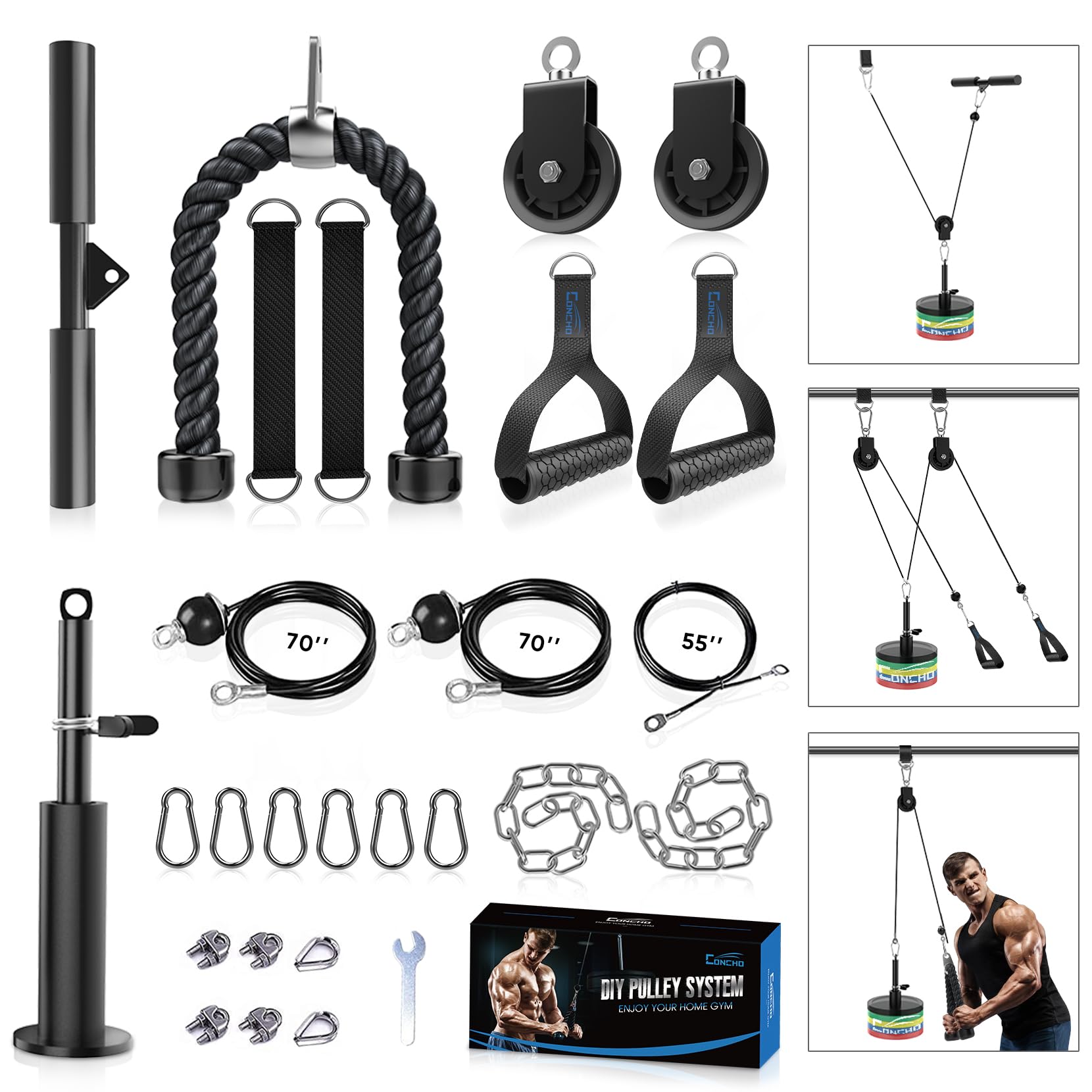
Concho Weight Pulley System

All-around home gym

Our Score 9.4/10
Check Price

Worth Noting

  • Crossover work needs two anchor points
Included
Three detachable handles
Max Load
350 lb
Pulley Setup
Dual
Cable Lengths
70 in, 70 in, 55 in plus chains
Read the full review

Three cable lengths, two pulleys, and a 350 lb rating make the Concho kit the most flexible system in this group. We like that combination because it lets you set up a high lat pulldown, a lower row, and a cable crossover without buying extra cable. The 12-inch loading pin is another detail we appreciate: it gives Olympic plates more room to stack before the top plate crowds the pulley.

The dual-pulley layout is the real reason it earns our top spot. With two independent straps, you can mount one above each side of a rack and get a more natural chest-fly or crossover movement than a single center pulley allows. A single pulley still handles triceps and lat pulldowns, but the second pulley turns this into a more complete upper-body station. Three detachable handles cover the common movements without a trip to the accessory bin.

This is still an attachment, not a cable machine. It depends on a secure rack, beam, or pull-up bar, and the straps need a quick check before each session. The pulleys run smoothly, and the plates stay reasonably settled when we keep the pin centered and the reps controlled. The 350 lb rating is the highest here, so heavier lifters have headroom. For most home gyms, this is the one we recommend first.

Bottom line: We recommend the Concho kit for most home gyms because its dual pulleys, three cable lengths, and 350 lb rating cover more exercises with less fiddling.

#2

SERTT Home Gym Pulley System

SERTT Home Gym Pulley System

Heavy loading

Our Score 9.2/10
Check Price

Worth Noting

  • Premium price for the capacity
  • More setup time than single-pulley kits
Max Load
330 lb
Mounting
Racks, bars, beams
Item Weight
11.3 lb
Pulley Setup
Dual
Read the full review

At the top of the price range, the SERTT kit justifies the extra spend with a heavier build and a 330 lb rating. At 5.13 kg, it is the heaviest system here, and that mass is reassuring when you are stacking plates. The stainless-steel and alloy components feel more substantial than the budget kits, and the dual pulleys are the centerpiece.

The dual-pulley layout gives you more mounting options than a single strap, and the 330 lb capacity covers heavy lat pulldowns and rows. The kit includes multiple bars, ropes, and straps, so you can switch from a wide lat pull to a triceps press without hunting for parts. We like that the straps can go around a power rack, pull-up bar, or beam; it is a true add-on rather than a dedicated machine.

The trade-off is setup fuss. Two pulleys and a larger accessory set take more time to rig than a single-pulley kit, and you need two solid anchor points to get the most from it. The higher price also puts it above the Concho, which is more flexible on cable length. The extra mass is the point: this kit feels like it will shrug off a hard session, provided your rack can take two straps.

Bottom line: Choose the SERTT kit if you regularly load close to 300 lb and want a heavier, dual-pulley build that feels more substantial than the budget kits.

#3

Mikolo LAT and Lift Pulley System

Mikolo LAT and Lift Pulley System

Pull-up bars

Our Score 9.2/10
Check Price

Worth Noting

  • 90-inch cable can be unwieldy on low anchors
  • Lower capacity than the heavy-duty picks
Included
Detachable handles, loading pin
Max Load
280 lb
Pulley Setup
Single
Cable Lengths
70 in and 90 in
Read the full review

At 2.85 kg, the Mikolo kit is the lightest package here, and that makes it the easiest to hang from a pull-up bar. We like it for a small garage gym because you can thread the loading pin through a plate, clip on a handle, and be pulling in a few minutes. The single pulley keeps the setup simple, and the detachable handles swap without tools.

Two cable lengths are the practical hook: the 70-inch cable suits a low bar or rack, while the 90-inch cable gives you more reach for overhead work. That is the setup we prefer for a pull-up bar, because you can leave the shorter cable rigged and swap to the longer one only when you need it. The two connection modes let you switch between a direct pull and a more free-moving setup, and for lat pulldowns, curls, and triceps work, it covers the basics without a dedicated tower.

The long cable is also the main annoyance. On a low pull-up bar, the 90-inch option can leave a lot of tail to manage, and the 280 lb capacity is below the heavy-duty picks here. We treat the cable and buckle as wear parts and check them before loading; that caution is why it sits below our top pick. It remains a good choice if you already have a bar and want a compact way to add cable work.

Bottom line: The Mikolo kit is a smart pick for a pull-up bar and a small space, as long as your working weight stays under its 280 lb limit.

#4

FASPUP Pulley System for Home Gym

FASPUP Pulley System for Home Gym

Tight budgets

Our Score 9.2/10
Check Price

Worth Noting

  • Single pulley limits crossover work
  • No lat bar included
Included
Tricep rope, three carabiners
Max Load
300 lb
Item Weight
3.84 lb
Pulley Setup
Single
Read the full review

The FASPUP single-pulley kit is the least expensive way into cable training here, and it still includes the parts most people actually use. You get a stainless pulley, a steel cable, a loading pin, hanging straps, a tricep rope, and three carabiners. It weighs 1.74 kg, so it disappears into a bag or a shelf when you are done.

We like it for a small apartment setup or a travel bag because there is no bar to store and the single strap fits around a pull-up bar, beam, or rack upright. The 300 lb rating is higher than the Mikolo's 280 lb and well above what most people need for triceps and curls. The trade-off is range: one cable and one pulley limit you to a straight pull, so crossovers and independent arm work are out.

The included tricep rope is a useful touch at this price, and the carabiners let you swap in your own handles. The kit gives you one cable, so check your anchor height before you commit; a low bar may leave excess cable, and a high beam may not give you enough reach. For a first kit or a second setup for travel, it is a smart minimal choice.

Bottom line: The FASPUP single-pulley kit is the one to grab on a tight budget or for travel, provided you can live without crossover work.

#5

LFJ LAT Pull Down Pulley System

LFJ LAT Pull Down Pulley System

Mixed plate sets

Our Score 9.2/10
Check Price

Worth Noting

  • 100 kg capacity is the lowest here
  • Weight can swing on fast reps
Included
Tricep rope, loading pin
Max Load
220.5 lb
Plate Fit
1 in and 2 in
Cable Length
2 m adjustable
Read the full review

The LFJ kit is the one we reach for when the weight plates are a mix of standard and Olympic sizes. Its loading pin is designed to fit both 1-inch and 2-inch plates, which is a small detail that saves you from buying a second pin or leaving half your plates on the rack. That flexibility is rare at this price.

The rest is deliberately basic: a single pulley, a 2-meter adjustable steel cable, three carabiners, a tricep rope, and a nylon strap. The 2-meter cable gives you more adjustability than a fixed-length kit, and the 100 kg rating is enough for lat pulldowns, curls, and pressdowns. We like the simplicity for a garage gym where the pulley stays on one beam.

It is not the smoothest or most stable single-pulley kit here. The weight can swing on faster reps, and the adjustable loop and clips are the parts to inspect before each session. The 100 kg capacity is also the lowest in this group, so heavy lifters should look at the Concho or SERTT. For mixed plates and a modest load, it remains a practical, no-frills pick.

Bottom line: Buy the LFJ kit if your plates are a mix of standard and Olympic sizes and your lifts stay within its 100 kg rating.

#6

FitBeast Pulley System Gym

FitBeast Pulley System Gym

First home gym

Our Score 9.0/10
Check Price

Worth Noting

  • Single pulley limits crossover work
Included
Rope, handle, lat bar
Max Load
330 lb
Warranty
2 years
Cable Lengths
70 in and 90 in
Read the full review

A two-year warranty is unusual in this category, and it is the first reason we point beginners toward the FitBeast kit. The rest of the package is familiar: a single 360-degree pulley, 70-inch and 90-inch cables, and three handles including a lat bar and tricep rope. For a first home setup, that is enough to cover pulldowns, rows, curls, and pressdowns without adding a machine.

The 330 lb rating gives you room to grow, and the extra-long loading pin makes it easier to stack Olympic plates. We like the six-strand steel cable for peace of mind, though the carabiners and pulley bearings are the parts to watch on any kit at this price. That combination of capacity and a two-year warranty is why it earns a place for a first home gym.

Where it falls short is refinement. It is a single-pulley system, so you cannot set up a true cable crossover, and the included handles are more basic than the ones on the Concho and SERTT kits. The 360-degree pulley rotates with the handle, which helps keep the cable from twisting during curls and face pulls. If you want crossover range or a premium feel, look higher; if you want coverage and backup, this is the sensible first kit.

Bottom line: For a first home gym, the FitBeast kit pairs a useful 330 lb capacity with a two-year warranty and enough handles to cover the basics.

#7

FASPUP Cable Weight Pulley System

FASPUP Cable Weight Pulley System

Multi-point rigs

Our Score 9.0/10
Check Price

Worth Noting

  • No bar or tricep rope included
  • Long cable needs planned routing
Included
Two handles, five carabiners
Max Load
300 lb
Cable Length
4 m
Pulley Setup
Three
Read the full review

If you want to build a cable crossover on a power rack, the FASPUP three-pulley kit gives you more mounting points for less than a dedicated machine. The box includes three pulleys, a 4-meter steel cable, two handles, two hanging straps, five carabiners, and an extension pin. That is a builder's kit rather than a complete lat-pulldown package: there is no bar or tricep rope, so you supply the handles you already like.

We like the flexibility of three pulleys. You can run one high for a lat pulldown, one low for rows, and a third at shoulder height for face pulls or flies, all from the same cable and a set of carabiners. The 300 lb rating is solid for a home setup, and the 4-meter cable gives you room to route between anchor points.

The catch is that you need to plan the layout. Three pulleys and a long cable can create more friction and more clutter than a single strap, and the lack of a bar or rope means the final cost depends on what you already own. It is not the pick for someone who wants to unbox and train in five minutes.

For a DIY rack owner who enjoys tuning a setup, it is a useful, affordable way to add multi-point cable work. We recommend it as a second kit or a crossover project, not as the only pulley system in a starter gym. The three mounting points are the reason to choose it over the single-pulley FASPUP kit.

Bottom line: The three-pulley FASPUP kit is for a rack owner who wants to build a multi-point cable station and already owns a bar or rope.

How We Tested Home Gym Pulley Systems

We started by building a shortlist from specs and owner feedback, filtering for anchor type, claimed cable length, pulley material, load rating, and what hardware came in the box. We ruled out systems that only worked with one rack size, needed permanent ceiling drilling, or looked undersized for regular pulling. That left 12 pulley systems, which we tested for eight months in garage gyms, a low-ceiling basement, and a spare bedroom with a door anchor.

In each space, I timed setup from opening the box to the first set—solo, without a second pair of hands—and noted whether the straps, carabiners, and anchors fit a power rack, ceiling beam, or standard door. We marked the cable at full extension and measured usable length from anchor to handle at high and low pulley positions, then ran lat pulldowns, rows, face pulls, and triceps pushdowns with plates and kettlebells. During every pull, we watched for side-to-side swing, cable jump, and whether the pulley housing stayed square under load.

Value came down to what the kit included and how little we had to improvise; versatility meant moving between high, mid, and low exercises without re-rigging the whole system. After repeated sessions, we inspected cables for fraying, straps for stretching, carabiners for deformation, and pulleys for rough spots or wobble. The systems that held up were the ones that stayed smooth, stable, and quick to adjust—not just the ones with the longest spec sheet.

How to Choose Home Gym Pulley Systems

Start with your anchor and cable length

A pulley system is only as good as the point you hang it from. A power rack gives you two uprights and plenty of height; a pull-up bar is simple but often low; a ceiling beam needs a strap that fits and a fixing rated for the load. Measure from the anchor down to where your hands work before you choose. A 90-inch cable on a low bar leaves a long tail, while a short cable on a high beam can cut your range short. Multiple cable lengths, as on the Concho kit, are worth paying for if your anchor height changes.

Decide how many pulleys you need

One pulley is enough for lat pulldowns, curls, pressdowns, and rows: the cable runs straight from the anchor to the handle. Two pulleys matter when you want a cable crossover, independent arms, or a straighter pull from each side of a rack. They need two anchor points and take longer to rig. Check the description carefully, because dual cable can mean two cables rather than two pulleys. If you train in a shared space and want the fastest setup, stay with one pulley; if you have a wide rack and want more variety, the extra pulley earns its keep.

Match the load rating to your lifting

A 220 lb rating covers a lot of arm and shoulder work, but heavy lat pulldowns and rows can push past that. The kits here range from 100 kg to 350 lb, and the difference matters most if you train close to the top of the stack. Also check the loading pin: some fit both 1-inch and 2-inch plates, while others are built around one size. The rating is for the whole system, so respect it even if your plates can hold more. If you are unsure, buy more capacity than you need today; it is cheaper than replacing a failed kit.

Inspect the weak links

Pulleys get the attention, but the cable, carabiners, straps, and stitching do the holding. Look for a sheathed steel cable, a loading pin that seats plates securely, and carabiners you can replace if they wear. Any kit can develop play at the clips, so check them before each session and keep the cable path clear. A longer warranty, like the two-year coverage on the FitBeast kit, is useful if you want backup, but it does not replace inspection. This is also where a cheaper kit can cost more over time.

Plan for storage and setup

Compact in a listing usually means the shipping box is small, not that the assembled system disappears. A single-pulley kit with a strap and a short cable is the easiest to take down and store; a dual-pulley kit with two straps and a long cable wants a permanent home on a rack. If you train in a living space, measure the packed weight and decide where the straps will live. The FASPUP single-pulley kit is light enough to bag, while the three-pulley FASPUP kit is better left on a dedicated rack. Choose the setup you will actually leave ready to use.

Frequently Asked Questions

Final Verdict

Most home gyms should start with the Concho kit. Its 350 lb rating gives you headroom, the two pulleys open up crossovers and independent arm work, and the three cable lengths make it easier to fit a rack or bar without fighting excess cable. The SERTT kit is the better choice if you regularly load close to 300 lb and want a heavier build; the FASPUP single-pulley kit is the sensible minimal option for a tight budget or a travel bag. Buy for your anchor and your working load, and the rest of the decision gets simple.