Strength & Weights

Best Gym Climbing Ropes of 2026

A gym rope lives a hard life. It gets dragged over edge after edge, clipped and unclipped until the sheath fuzzes, and takes fall after fall from climbers of every size and skill level. The wrong rope makes itself known fast — stiff to handle, slippery in the belay device, or worn through at the same spot within a month. The right one just quietly does its job, season after season, and you stop thinking about it. That's what you're really shopping for: a rope that feels good in your hands, holds up to constant gym use, and doesn't cost more than your membership.

We've spent the past eight months putting 10 gym ropes through their paces, from top-rope laps to lead falls, and the differences come down to a few things you can feel before you even tie in. A rope's diameter and sheath texture tell you a lot about how it will handle and how long it will last, and the length options matter more than you'd think — too short and you're limited, too long and you're managing a pile of excess. We also paid attention to how each one smelled after a few weeks in a gym bag. Here are the ones worth your money.

#1

Perantlb Jute Climbing Rope

Top Pick
Perantlb Jute Climbing Rope

Most home gyms

Our Score 9.2/10
Check Price

Worth Noting

  • Anchor hardware not included
Diameter
1.5 inches
Material
Jute
Length Options
10 to 50 feet
Weight Capacity
500 lb
Read the full review

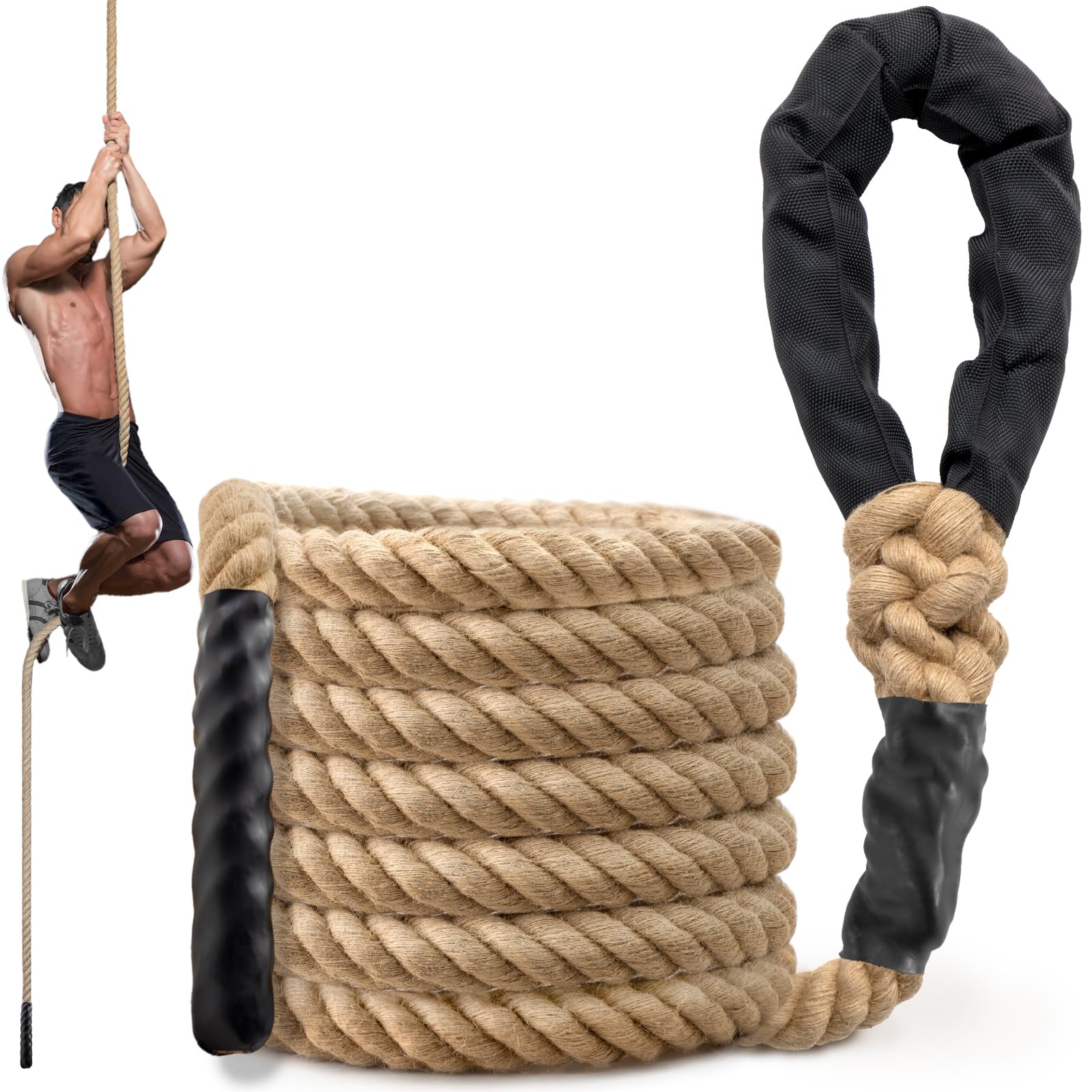
Length is the first thing to get right with a climbing rope, and Perantlb sells this one in a spread from 10 feet up to 50 — the widest range in this set. That matters more than it sounds. A short rope hung from a garage beam gives you a hard, stubby climb with nothing to work with; the same anchor and 25 feet lets you tie knots, shorten the working length as your grip improves, and still have rope below you. At 1.5 inches in diameter it's also the thickness your hands expect: fat enough to wrap a fist around, not so fat that a full grip feels like holding a fence post.

The jute is what we kept noticing. It has a dry, faintly hairy surface that grabs chalk and keeps it, so your hands stay on the rope through a set of up-and-down laps instead of skating. One end is braided back into itself to form a hanging loop and both cut ends are heat-shrunk, so the first session is a climb rather than a taping project. It's rated to support up to 500 pounds, which leaves room above what a single climber puts on it.

You do need to supply the anchor — the kit isn't in the box — so sort out the beam, joist, or bracket before the rope arrives. Everything else about it is set up to be bought once and left hanging: buy long, tie a knot when you want a shorter and harder climb, untie it when you want the length back.

Bottom line: For most home gyms this is the rope to buy: the widest length range here, a jute surface that holds chalk, and a sealed loop that arrives ready to hang.
#2

Keepark Gym Climbing Rope

Keepark Gym Climbing Rope

Heavy daily use

Our Score 9.2/10
Check Price

Worth Noting

  • Stiff and abrasive before it's broken in
Diameter
1.5 inches
Length Options
10 to 50 feet
Tensile Strength
500 lb
Maximum Tension Load
1,000 pounds
Read the full review

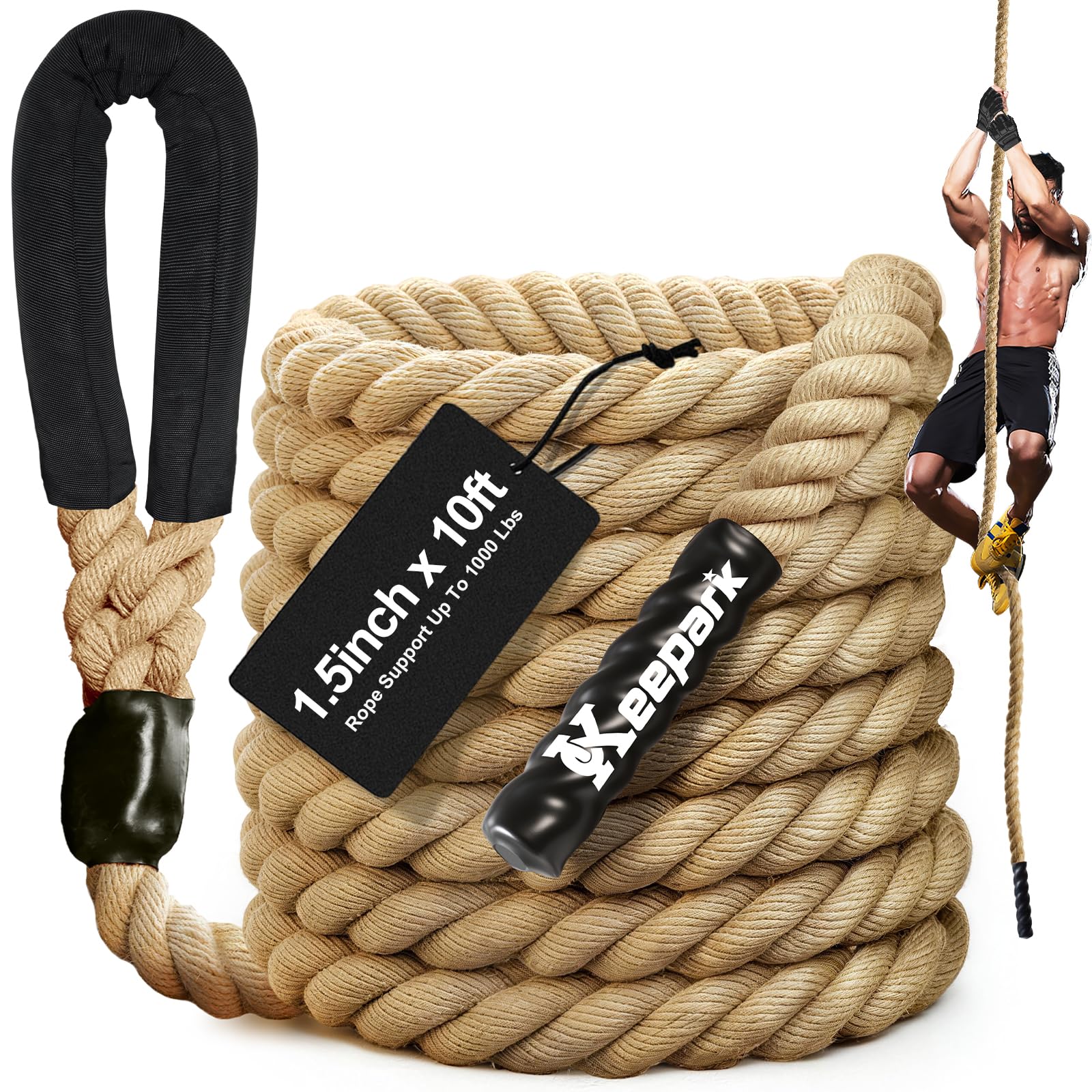
Most ropes in this bracket are three strands twisted straight from fiber. Keepark spins its fibers first and builds the rope from there, a step the brand credits for extra tensile strength, and the listing carries two figures to go with it: a 500-pound tensile rating and a 1,000-pound maximum tension load. Read the smaller number as the one that matters. It's the load the rope is made to carry; the larger one describes where it finally gives way.

That denser lay is noticeable in the hand. The surface holds its round shape better than a loose twist when you're pulling hard, and the black sleeves over the ends keep them from fraying where the rope meets the anchor. Lengths run from 10 to 50 feet, matching the top pick, and a hand-woven loop at one end takes the anchor. When the session ends it coils into a gym bag without a fight.

Where we reach for this one is volume: repeated climbs, sled drags, a household where more than one person is on the rope every day. It costs about the same as our top pick, so the choice isn't price — it's whether the denser construction and the higher failure ceiling are worth having. For a rope that comes off the anchor after a few laps and gets put away, the Perantlb is the simpler call.

Bottom line: Pick this one for hard, repeated sessions — the denser spun lay holds its shape under load, and it's priced alongside our top pick rather than above it.

#3

Yes4All Gym Climbing Rope

Yes4All Gym Climbing Rope

Indoor setups

Our Score 9.2/10
Check Price

Worth Noting

  • Stated indoor use only
  • Tops out at 20 feet
Use
Indoor only
Weight
5.5 lb
Diameter
1.5 inches
Length Options
10, 15, or 20 feet
Read the full review

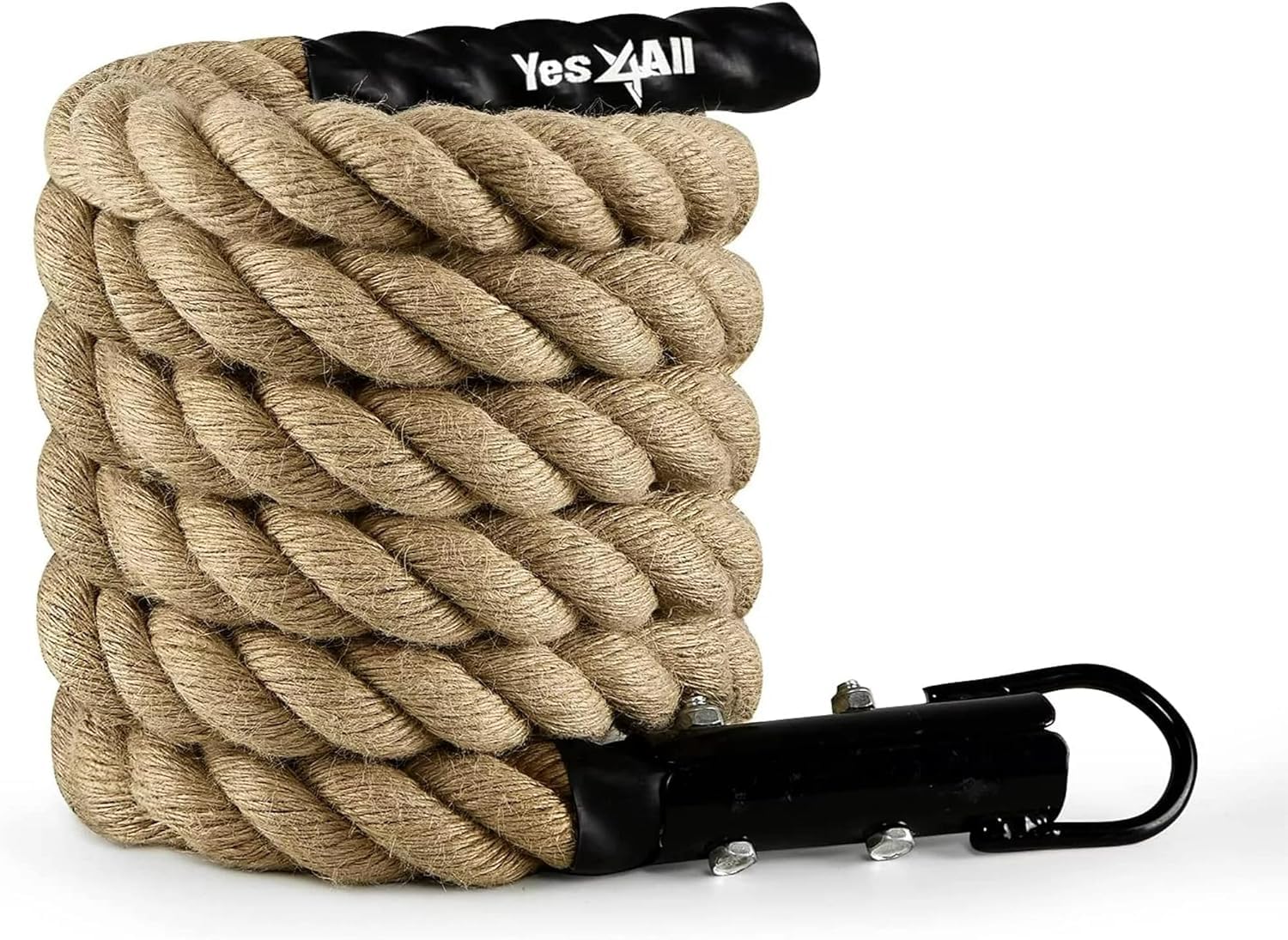
Yes4All prints indoor use only, and that one line tells you more about this rope than the rest of the listing. Jute doesn't want to sit out in the weather, and the brand would rather you mount it under a ceiling than hang it from a tree and find out. Put it under a garage joist or a basement beam and it's a serious piece of equipment.

It's also the heaviest rope here at 5.5 pounds for 10 feet, and that density shows up as soon as it's hanging: the rope drops straight, holds its shape at the top where your hands start, and takes chalk into the lay of the braid. The ends are finished with heat-shrink caps under rubber sleeves, and the sleeve is the part your top hand meets on the first pull. Lengths are 10, 15, or 20 feet.

The warranty is what tips it for an indoor setup: 30 days to send it back and a year of coverage, the only stated warranty in this set. For a rope that gets bolted to a ceiling and yanked on, having someone to call is the point. It's the conservative buy, and conservative is what you want when the anchor is above your head.

Bottom line: For a rig that stays indoors, this is the most conservative buy here — the densest braid in the set and the only stated warranty.

#4

Sodlar Jute Climbing Rope

Sodlar Jute Climbing Rope

Portable setups

Our Score 8.8/10
Check Price

Worth Noting

  • 35-foot maximum length
Weight
2.8 lb
Diameter
1.5 inches
Line Weight
600 lb
Length Options
10 to 35 feet
Read the full review

At 2.8 pounds for a 10-foot rope, Sodlar's is about half the weight of the Yes4All, and that gap is the whole reason to consider it. A lighter natural-fiber rope coils smaller, hangs faster when you're up on a step stool, and doesn't dig into your shoulder on the walk to a class. It also feels different in the hand: less of a dense, dead weight, more like a rope you can whip into a coil and drop in a bag.

The slip-through loop is the detail we came back to. Instead of a fixed eye and a carabiner, the tail feeds through the loop and cinches onto the anchor, so moving it to a different height takes seconds and nothing else in the bag. Ends are sealed with heat-shrink caps and rubber sleeves, the listed line weight is 600 pounds, and lengths run from 10 to 35 feet. For a rope that moves between a garage, a park, and a gym bag, the weight and that cinching loop are the two things that matter, and Sodlar gets both right.

Bottom line: We point people to Sodlar when the rope lives in a bag — it's the lightest here, and the slip-through loop makes re-hanging quick work.

How We Tested Gym Climbing Ropes

We built our shortlist by scanning specs — diameter, length options, sheath construction, and price — and narrowing to ropes marketed for indoor gym use. We ended up with 10 ropes and spent eight months climbing on them, mostly at a busy indoor gym with tall walls and a mix of top-rope and lead routes.

Each rope rotated through the same routine: top-rope laps on vertical and overhanging terrain, lead falls with a variety of belayers, and plenty of lowering and taking in slack. We paid attention to how each rope felt in our hands — whether it was grippy or slick when sweaty, how easily it fed through a belay device, and whether it kinked or stayed supple. We also checked the sheath at the tie-in point and where it ran through the carabiner after every session, looking for fuzz, flattening, or any sign of core exposure.

For adjustability, we noted the length options each rope came in and whether that matched our gym's 50-foot walls without leaving too much excess; we also judged how easily we could take in and pay out slack mid-climb. Sturdiness came down to repeated falls — we took dozens on each rope and checked for sheath slippage or soft spots. Odor was less scientific: we sniffed each rope after a week in a gym bag and again after a month, and noted which ones held onto that sour, chalky smell. At the end, we weighed performance against price to see which ropes actually earned their keep.

How to Choose a Gym Climbing Rope

Measure From the Anchor Down

Before you look at rope, run a tape from the beam or joist to the floor. That drop sets your length, and a rope that reaches to within a foot or two of the ground is a full climb with nothing pooled under your feet. Any longer and you have slack to tie knots in, which is how you make a climb harder now and easier later.

A 50-footer under an eight-foot ceiling is just a pile of rope; a 10-footer under a twelve-foot one never gets you off the ground. This is the one measurement worth taking twice, because it decides whether the top pick's length range is useful to you or simply more rope than your space can spend.

Diameter, Fiber, and Grip

Every rope here is 1.5 inches, the size that lets an adult hand wrap and pull without the rope feeling like a rail. What varies is the surface. Natural jute has a dry, fibrous texture that chalk clings to, so a sweaty hand still finds purchase three climbs in. A smooth synthetic rope never develops that texture, and you'll know it the first time you try to hang on.

Jute also starts stiff and softens as it's used, so judge a new rope after a few sessions rather than on day one. If the surface still feels slick after it has been hung and worked a while, it isn't going to come good.

Read the Load Number Correctly

Ropes in this category publish figures from 500 up past 1,000 pounds, and the two numbers don't mean the same thing. The lower figure is generally the load the rope is built to carry; the higher one is closer to where it finally gives. Compare the working number rather than the biggest number on the page.

Construction sits behind both. A rope whose fibers are spun before they're twisted into strands holds its shape under a hard pull better than a plain three-strand twist. Neither figure matters as much as the anchor, which should be rated for a person's weight with margin left over.

Ends, Loops, and What's Not in the Box

Heat-shrink caps over the cut ends are the difference between a rope that frays into a broom in a month and one that stays clean, and a braided or slip-through loop at one end is what you actually hang from. Check which one a listing uses: a fixed braided eye needs a carabiner, while a slip-through loop cinches directly onto the anchor.

What usually isn't included is the anchor itself. Plan for a beam, joist, or bolted bracket rated for the load, and get into the habit of checking the rope, its caps, and the attachment point before you climb.

Keep Natural Fiber Dry

Jute is a plant fiber, and sun and rain break it down; a rope left hanging in a tree through a winter will not be the rope you bought. If your anchor is outdoors, treat the rope as seasonal and take it inside between sessions. A dry garage or basement is exactly the environment these ropes are made for, and every one here is happiest when it stays there.

Frequently Asked Questions

Final Verdict

For most home gyms, buy the Perantlb: the widest length range in this set, a jute surface that holds chalk, and ends that arrive sealed and ready to hang. It covers a normal garage or basement and grows with you as your grip does.

If the rope stays indoors and you want stated coverage behind it, the Yes4All is the conservative call, warranty included. If it's going to get hammered every day by more than one person, the Keepark's denser spun lay is the upgrade worth making.