Strength & Weights

Best Slam Balls of 2026

A slam ball earns its name only if it refuses to bounce back. That dead thud is the whole point: you can throw it at the floor with everything you have, and it stays put instead of ricocheting toward your shins. The tricky part is that two balls stamped with the same weight can feel completely different once the sand inside settles, shifts, or packs too loose.

We spent three months throwing a dozen slam balls at garage concrete, basement rubber mats, and a driveway, and the best ones shared a few traits: they kept their weight distribution after repeated slams, held onto sweaty hands instead of turning slick, and didn't collect grit like a lint roller. I expected the heaviest to win; instead, the picks that worked best were versatile enough for slams, squats, and carries, stored neatly in a home gym, and felt worth the money after the scuffs set in. The picks below are the ones that survived all that.

#1

Yes4All Slam Ball

Top Pick
Yes4All Slam Ball

All-round daily slams

Our Score 9.4/10
Check Price

Worth Noting

  • Weight ladder stops at 40 pounds
Weight
20 lb
Diameter
9.75 in
Warranty
1 year
Weight Options
10 to 40 lb
Read the full review

Twenty pounds inside a 9.75-inch shell makes a big, easy-to-hold ball, and that combination is why we recommend this one first. Both hands wrap around it without a stretch, so overhead slams, chest passes and Russian twists all start from a secure grip rather than a scramble. It's the ball we reach for when we want to work hard without thinking about the equipment.

The raised panels are the useful part. They give you a hold from almost any angle — a corner of the ball works nearly as well as the middle — which matters when you're collecting it off the floor between reps. That grip has a cost: the tiles are rougher than the smooth rubber on most medicine balls, and after a long set of slams bare hands notice. Keep gloves nearby or chalk up and it stops being an issue.

The weight ladder runs from 10 to 40 pounds, wider than most of the balls here, so you can add a heavier one later without changing brands or losing a grip you know. The sand-filled PVC shell drops where it lands and stays there instead of chasing you across the garage. A year of warranty is mid-pack in this group — short of the lifetime coverage on the ProsourceFit, more than the Rage offers.

Where it stops is 40 pounds. If heavy slams at 50 are the center of your training, that's a different ball. For everyone else — a garage, a corner of a gym, one piece of kit that has to handle slams, squats and twists — this is the one that earns its floor space.

Bottom line: We recommend the 20-pound version as the default slam ball: it fills both hands, takes daily punishment, and the range climbs to 40 pounds.

#2

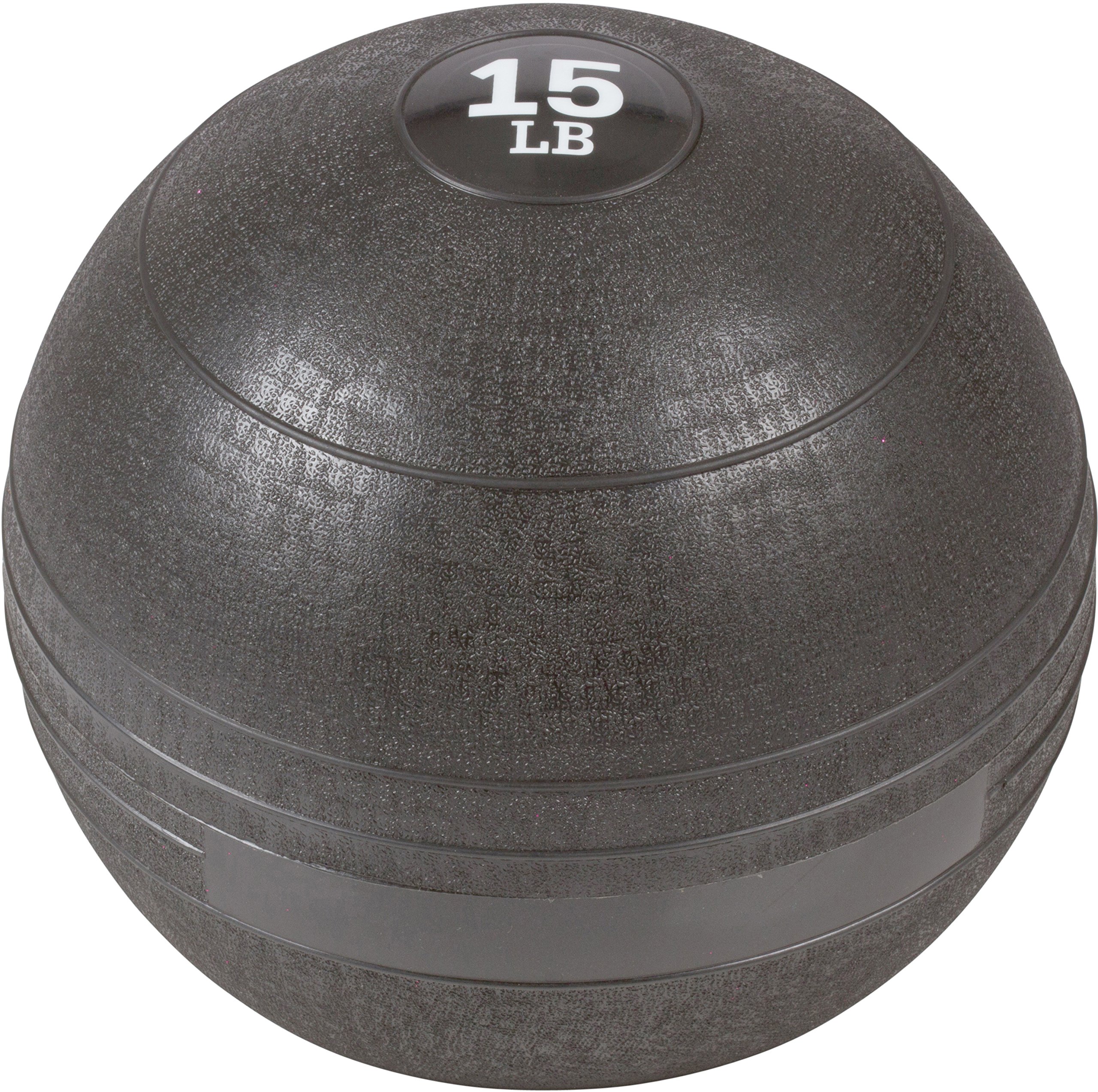
ProsourceFit Slam Ball

ProsourceFit Slam Ball

Sweaty gym sessions

Our Score 9.4/10
Check Price

Worth Noting

  • Sand shifts side to side inside the shell
Grip
Tire-tread surface
Weight
15 lb
Warranty
Limited lifetime
Weight Options
5 to 50 lb
Read the full review

The surface of this ball is a tire tread, and it's the detail that makes it worth owning. The grooves channel sweat and chalk away from your palms, so the last set of a session doesn't end with the ball on the floor and you staring at your hands.

Straight out of the box the rubber is a little slick, which surprised us; a few hard sessions scuff it up and the grip arrives properly. The tread isn't gentle, either — it's the roughest surface on this list against bare hands. For high-volume slams, gloves are the difference between finishing the set and quitting it, and the payoff is a ball you can throw wet.

The range is the widest in this group, 5 to 50 pounds, and the limited lifetime warranty is the best coverage on the page. We also rate the dead, no-bounce drop: in a small space, a ball that stays where it lands is a safer training partner than one that comes back at you. Fifteen pounds is a sensible middle for most people, and one ladder means a partner can share the line with you.

Bottom line: Our pick for wet hands: the tire tread holds when PVC gets slick, and it's the only ball here with a lifetime warranty.

#3

Trademark Innovations Slam Ball

Trademark Innovations Slam Ball

Group circuits

Our Score 9.4/10
Check Price

Worth Noting

Shell
PVC with sand fill
Weight
15 lb
Diameter
9 in
Warranty
1 year
Read the full review

Fifteen pounds for less than any other ball here — that's the pitch, and it's a real one. The shell is 9 inches of sand-filled PVC, and it drops dead instead of bouncing away, which is the whole point of the design.

Where it gives ground is the surface. Plain PVC with no tread pattern is the trade you make at this price, and a sweaty grip goes before anything else does, so pack chalk or gloves. What it does have is a year of warranty and a plainness that makes it easy to hand to somebody else — a class or a fitness group can buy several without wincing.

The 15 pounds itself is a good working weight for slams, squats and twists, and it stays where it lands, so a shared session doesn't turn into a chase. We think of it as the ball you buy two of, rather than the one you baby.

Bottom line: The budget 15-pounder: we recommend it for circuits and shared sessions where one ball has to serve several people.

#4

STRPRETTY Basic Slam Ball

STRPRETTY Basic Slam Ball

Small hands, small rooms

Our Score 9.4/10
Check Price

Worth Noting

  • Weight range only spans 8 to 12 pounds
Grip
Deep grooved tread
Weight
10 lb
Diameter
7.8 in
Weight Options
8 to 12 lb
Read the full review

The tread on this one is the most aggressive of the small balls here — deep grooves cut across a 7.8-inch shell, and your fingers sit down in them instead of skating over the top. In a fast set of slams that's the difference between the ball going where you threw it and the ball going somewhere else.

Ten pounds at that diameter is dense. It's harder to wrap two hands around than the 9.75-inch Yes4All, so it suits one-hand work, twists and smaller hands more than big two-handed overhead slams. The surface is rough on bare fingers — a couple of sets in, gloves stop feeling optional.

The line only runs 8, 10 and 12 pounds, a narrow ladder you'll climb quickly if you train hard. As a compact, apartment-friendly ball for technique work and fast circuits, though, the grip does a lot of the arguing.

Bottom line: A compact, grippy 10-pounder we like for small hands and small rooms, as long as you don't need the weight range of the bigger names.

#5

Rage Fitness Slam Ball

Rage Fitness Slam Ball

Heavy power work

Our Score 9.2/10
Check Price

Worth Noting

  • 30-day warranty is the shortest here
  • Dense 50-pound ball is hard to catch
Shell
Rubber with air valve
Weight
50 lb
Diameter
9.1 in
Warranty
30 days
Read the full review

Fifty pounds changes what a slam ball is for. At that weight you're not doing high-rep conditioning anymore; you're doing short, ugly sets with a long walk back. The shell is 9.1 inches, so the ball is dense — there isn't much to wrap your hands around relative to what it weighs.

The construction is different from the PVC balls here. It's rubber, with an air valve, so you can add or bleed air to change how firm the ball feels: softer for catching, firmer for a dead drop. That's a genuinely useful bit of tuning we haven't seen elsewhere in this set, and the textured surface keeps its hold on a wet ball.

What you're paying for is the shell and the valve. If heavy slams are a fixed part of your week and you've already retired a cheaper ball, this is the upgrade that makes sense. If you're assembling a first home setup, it's a lot of money for one implement — and you'd get more training out of a mid-weight ball plus a pair of dumbbells.

Bottom line: Fifty pounds of rubber with a valve to tune firmness, and we think it's the right ball only if heavy slams sit at the center of your training.

#6

Amazon Basics Slam Ball

Amazon Basics Slam Ball

First home ball

Our Score 9.2/10
Check Price

Worth Noting

  • Shell has more give than stiffer PVC
Grip
Textured non-slip surface
Shell
PVC with sand fill
Weight
10 lb
Diameter
7.87 in
Read the full review

This is the ball we point first-time buyers to, and the reason is the size. Ten pounds in a 7.87-inch shell is dense and compact, so it disappears onto a shelf or into a duffel between sessions. If your training space is the corner of a living room, that footprint matters as much as the weight.

The soft-touch texture holds a grip well and is gentler on the palms than the treaded balls. Ten pounds is honest in the hand — enough to learn the hip hinge, the catch and the timing of the drop without the ball setting a pace you can't hold. It's among the least expensive balls here, and it doesn't feel like a placeholder.

Against the rest of this list it gives up heavier options, and gains the smallest footprint and one of the lowest prices. For an apartment lifter, or anyone testing whether they'll stick with slamming before spending more, that's the right trade.

Bottom line: We point first-time buyers here: a compact 10-pound ball that costs less than most of this group and doesn't feel like a compromise.

#7

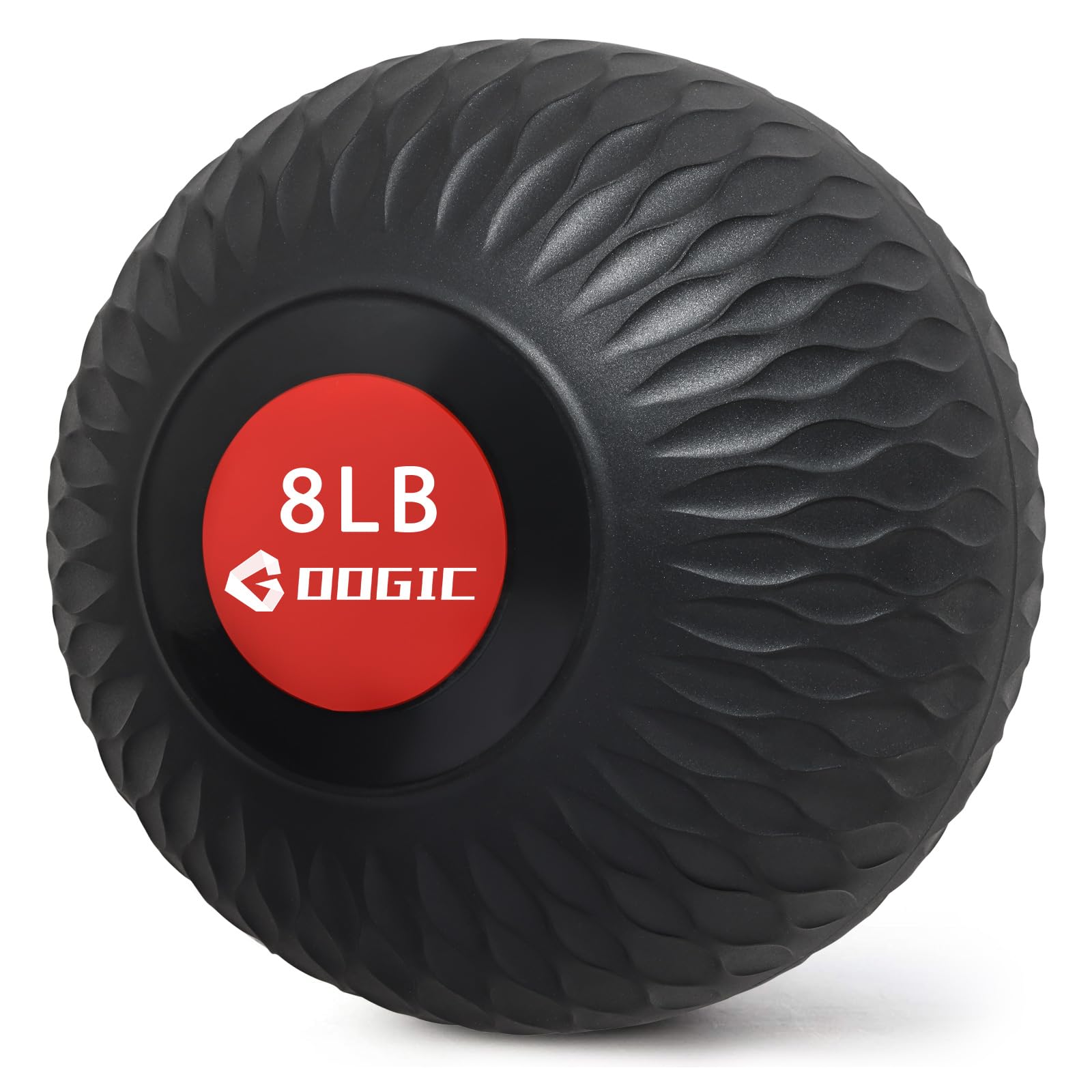
GOOGIC Slam Ball

GOOGIC Slam Ball

Light warm-up work

Our Score 9.2/10
Check Price

Worth Noting

  • Eight pounds limits how hard you can train
Grip
Molded tread
Shell
PVC with sand fill
Weight
8 lb
Diameter
7.8 in
Read the full review

Eight pounds is the light end of this group, and it changes the job. You can throw this ball for a long time without your shoulders complaining, which makes it useful for warm-up sets, footwork drills and teaching someone the catch without asking much of them.

The shell is 7.8 inches with a molded tread, and the grip is the best part of it: small enough for one hand, textured enough to hold when your palms are wet. For a ball this light, that texture is the difference between a toy and a training tool.

Colors are the other small pleasure — five of them, which sounds trivial until you're hunting for the ball that rolled under a bench. It has taken repeated drops onto a garage floor with the shell still intact, and it sits in the middle of this group on price rather than at the bottom.

Our view: buy it alongside a heavier ball, not instead of one. As the one you pick up first on a cold morning, or the one you hand to a friend learning the movement, it earns its spot.

Bottom line: We see this as a second ball: eight pounds is for warm-ups and technique, not the heavy work the rest of this group is built for.

#8

Fitvids Slam Ball

Fitvids Slam Ball

Beginners and rehab

Our Score 8.8/10
Check Price

Worth Noting

  • Sand bag inside shifts the load off-center
Weight
6 lb
Diameter
9 in
Warranty
2 years
Read the full review

Six pounds in a 9-inch shell makes for a big, light ball, and that's a useful thing to own. It's easy to catch with two hands, forgiving if your timing is off, and it lets you rehearse the slam or a two-person toss without wrecking yourself.

The surface is one of the grippier shells at this weight — we got a confident hold even with damp palms — and it came through repeated drops onto concrete with the outer layer intact. For a light ball aimed at beginners, that's more than the price suggests.

The thing to know before you buy is what it isn't. It's sold as a medicine, slam and wall ball, and it does not rebound: throw it at a wall expecting it back and it drops straight to the floor. That's correct behavior for slamming and wrong for wall-ball drills, so buy it for the floor, not the wall.

Where it fits: a beginner's first ball, a rehab room, or two people tossing one back and forth. If you're chasing a hard conditioning session, the weight runs out before the workout does.

Bottom line: We recommend it for beginners, rehab and partner drills: a big, grippy ball at 6 pounds that simply isn't built for heavy slams.

How We Chose and Tested the Best Slam Balls

To build the shortlist, I read through customer reviews and spec sheets, compared shell materials, diameters, and listed weights, and filtered out anything with vague weight tolerances or a price that didn't match its construction. That left 12 slam balls, which my team and I used for three months in a garage gym, on a basement rubber floor, and on a concrete driveway. We worked them into regular strength sessions rather than handling them once and calling it a day.

We weighed every ball on a kitchen scale before the first slam and again at the end, then dropped each from waist height onto concrete to see how much bounce it returned. With dry hands and then chalky, sweaty ones, we noted whether the texture bit back or turned slick, and whether the surface picked up grit from the driveway. After every few sessions, I stood each ball on end for 24 hours and then rolled it under my palms to feel whether the sand had settled or packed unevenly. We also squeezed the shell to judge sand tightness, checked seams for splits or leakage, and ran each ball through slams, squats, carries, and wall-ball-style circuits.

At the end, we compared scuffs, seam wear, and grip loss against what each ball cost, because a cheap ball that survives a month isn't a bargain. The ones that earned a recommendation stayed predictable in weight and fill, kept their texture after cleaning, and made sense in a home gym rather than only on a commercial floor.

How to Choose Slam Balls

Start With the Weight You Can Throw

Slamming is a throwing movement, so the useful test is different from picking a dumbbell. Take the ball overhead with both hands and bring it down hard ten times. If your form holds for all ten, that is your working weight; if the last three are a struggle, drop down.

Most people land around 20 pounds, which is where our top pick sits. Conditioned lifters move up through 25, 30 and 40; the 6-to-12-pound balls are for warm-ups, technique work and rehab. A ball you can barely lift is a ball that stays in the corner.

Diameter Changes the Grip as Much as the Weight

Two 20-pound balls can feel completely different in your hands. A 9.75-inch shell spreads your hands and gives you something to catch; a dense little ball like the 7.87-inch Amazon Basics packs the same load into a smaller package that is harder to hold and much easier to store.

Bigger diameters suit two-handed overhead work and partner drills. Smaller ones suit one-hand twists, grip work and small rooms. If you have smaller hands or plan to catch the ball, favour the larger shell for the weight.

Tread, Ridges and What They Do to Your Hands

Tread patterns, like the tire-style surface on the ProsourceFit or the deep grooves on the STRPRETTY, channel sweat away from the palm. Raised panels, as on our top pick, give you a hold from almost any angle instead. Both work, and both are rougher than smooth rubber on a long set.

Gloves or chalk are cheap insurance. One surprise worth knowing: a brand-new treaded ball can feel slicker than a worn one until the surface scuffs.

Sand Fill, Dead Weight and the No-Bounce Rule

These balls are filled with sand, which is exactly what stops them bouncing and rolling away from you. The fill moves inside the shell; you will hear it, and on twists and catches you will feel it settle. That is normal for the design rather than a fault, though it is why some balls feel deader than others on angled slams.

The bigger adjustment is the drop. A slam ball hits the floor and stays there. If you want a ball that comes back off a wall, you want a wall ball, and no amount of practice will teach this one to rebound.

Shells, Seams and Warranty

PVC is the norm. Rubber, as on the Rage, is the tougher and pricier option, and its air valve lets you tune how firm the ball feels. Whatever the material, the failure to watch for is the seam: a ball that leaves a trail of sand across the floor is finished.

Coverage varies more than it should, from a lifetime on the ProsourceFit to 30 days on the Rage. Match the warranty to how hard you plan to throw, and put a mat under your slam spot to get more life out of any of them.

Frequently Asked Questions

Final Verdict

The Yes4All 20-pounder is the ball we point most people to: it fills both hands, survives a garage floor, and the range runs up to 40 pounds. If your hands sweat through every session, the ProsourceFit's tire tread and lifetime warranty make it the better buy. And if heavy slams are the program rather than a finisher, the Rage 50 is the only ball here built for that load.