Strength & Weights

Best Pull Up Bars of 2026

A pull-up bar is the cheapest strength tool you can own, and the only one that hangs your entire bodyweight on a doorframe you may not be allowed to drill into. That's the real tension: the doorway has to fit, the hooks have to hold, and your hands have to stay put — and a bar that misses any one of those turns a five-minute workout into a home repair project. The right one makes all of that disappear, so the only thing you're thinking about is the next rep.

Over the past six months, my team and I put 14 bars through daily use — press-fit doorway models, screw-in wall mounts, and a couple that live in a rack — and the gaps between them were wider than I expected. Here's what first-time buyers get wrong: a doorway bar is only as good as the trim it presses against, so measure both the opening and the trim depth before you fall for a load rating. The ones that earned a permanent spot in my hallway are below.

#1

AmazeFan Pull Up Bar

Top Pick
AmazeFan Pull Up Bar

Most home doorways

Our Score 9.2/10
Check Price

Worth Noting

  • Silicone pads can scuff painted trim
Hook Span
21.65 inches
Mount Type
Doorway, no drilling
Item Weight
8.5 lb
Maximum Weight
400 lb
Read the full review

The AmazeFan is heavy in a way that tells you something before you have hung it: 8.5 pounds of steel, close to twice what a basic lever bar weighs, and it settles onto the door frame with none of the sway you get from lighter tube. That is why we name it the default doorway bar here. It arrives in one piece, hooks over the frame in a single motion, and the 400-pound rating is backed by steel that does not bow when you load it.

Fit is the part to settle before you buy. The two hooks sit 21.65 inches apart, an intentionally short span that lets the bar hang in a corner doorway where wider bars will not, but it also means a narrow closet frame is simply out of range. The silicone pads that press against your casing are a genuine improvement on foam — they stay firm instead of compressing into something slick.

It folds down against the frame when it is not in use, which is the difference between a bar you leave up and one you bother to take down, and the angled ends let your wrists sit in a natural line. The neutral handles are the ones we kept coming back to: they are angled enough that a long dead hang stops feeling like a wrist stretch.

Bottom line: We recommend the AmazeFan as the default doorway bar: it arrives assembled, hooks on in one motion, and 400 pounds of steel sits on the frame without a wobble.

#2

Ultimate Body Press Ceiling Bar

Ultimate Body Press Ceiling Bar

Dedicated home gym

Our Score 9.2/10
Check Price

Worth Noting

  • Premium price for a ceiling bar
  • Suited to roughly eight-foot ceilings
Bar Length
48 inches
Riser Height
14 inches
Joist Spacing
16 or 24 inches
Maximum Weight
450 lb
Read the full review

The most expensive bar here is also the only one that turns a ceiling into a proper training station. A 48-inch straight bar on 14-inch risers, through-bolted to square-tube steel, spanning 16- or 24-inch joists on center, and rated to 450 pounds. It is white powder coat and black hardware, and it looks like part of the building once it is up.

The through-bolt is the detail that matters. Long bars bolted at two points tend to rotate as you pull, and Ultimate Body Press runs the bolt through the bar rather than clamping around it, which is about as close to a fixed bar as a bolt-on gets. Set your plate spacing carefully before you drill, because the bar can still turn between the mounts if they are not parallel.

The bar itself is bare powder-coated steel with a slight texture. It grips well dry and gets slick once your hands are warm, so chalk, tape, or a pair of grips is worth having. At this width there is room to hang rings inside the plates without them crowding a pull-up.

For a room that is already a gym, this is the bar we build around: nothing to fold, nothing to wedge, nothing to take down before guests arrive. The premium is real and it buys the one thing the cheaper permanent mounts cannot match — a 48-inch span at 450 pounds.

Bottom line: For a dedicated gym with exposed joists, we build around this one: a 48-inch bar at 450 pounds that never needs to come down.

#3

SELEWARE Welded Pull Up Bar

SELEWARE Welded Pull Up Bar

Band-assisted training

Our Score 9.2/10
Check Price

Worth Noting

  • No padded grip; bare powder-coated bar
Bar Length
36 inches
Mount Type
Wall or joist
Band Anchors
Two carabiners at each end
Maximum Weight
500 lb
Read the full review

Two carabiners at each end of the bar: it is a small addition, and it is the reason the SELEWARE is in this guide. Clip a band in for assisted pull-ups or hang rings for rows without wrapping anything around a padded handle. The bar is 36 inches of 4mm alloy steel, powder-coated, and rated to 500 pounds.

The frame uses a triangular gusset design, welded rather than bolted, and the welds are clean all the way round — the kind of construction that does not announce itself until you are hanging off it. It mounts to wall studs or a joist, which makes it the option for a garage wall where a doorway bar has nothing to grab.

The included lag bolts are short for going through drywall into a stud, so pick up longer ones if your wall is finished. Bare framing is the easier install, and it is worth planning the height around your reach rather than the stud spacing.

We keep it here for the band work. If your training is pull-ups and chin-ups and nothing else, a cheaper joist bar does the same job. If you want a wall bar that doubles as an anchor for bands and rings, this is the only one in the guide that is ready out of the box.

Bottom line: We like the SELEWARE best for band and ring work: carabiner ends, clean welds, and a 500-pound rating nothing else here matches.

#4

Maximiza Screw-In Bar

Maximiza Screw-In Bar

Permanent doorway setup

Our Score 9.0/10
Check Price

Worth Noting

  • Leaves small screw holes in the door trim
  • Foam grips wear through with regular use
Mount Type
Screw-in door frame
Maximum Weight
300 lb
Mounts Included
3 sets
Fits Door Frames
27 to 39 inches
Read the full review

The Maximiza starts with an admission: it wants screw holes in your door trim. Two steel brackets go into the wood, the chrome bar drops into them, and a lock ring stops the bar spinning as you pull. What that buys is a load path that runs straight into the frame instead of depending on friction, and once the clamps are tight there is nothing to seat, re-seat, or think about mid-set.

We think that is the right trade for anyone with one doorway they can dedicate to training. The 300-pound rating reads low next to the ceiling bars, but a bolted anchor at 300 pounds is a different proposition from a wedged one at 440, and the sturdiness is the whole point. It is the bar we hand to someone who has had a lever bar shift on them.

It fits solid wood frames between 27 and 39 inches, needs trim at least an inch thick, and ships with three sets of mounts so you can move it to another doorway later. The chrome bar has no texture to speak of, so chalk or a towel helps once your hands warm up — a small thing, but it is the difference between a long set and a short one.

Bottom line: We point anyone who can drill here: a bolted 300-pound anchor is steadier than a wedged bar rated higher.

#5

Iron Gym Pull-Up Bar

Iron Gym Pull-Up Bar

Mixed bodyweight work

Our Score 9.0/10
Check Price

Worth Noting

  • Needs flat trim in a standard width range
  • Foam grips tear with regular use
Mount Type
Doorway, no screws
Item Weight
4.7 lb
Grip Positions
3
Maximum Weight
300 lb
Read the full review

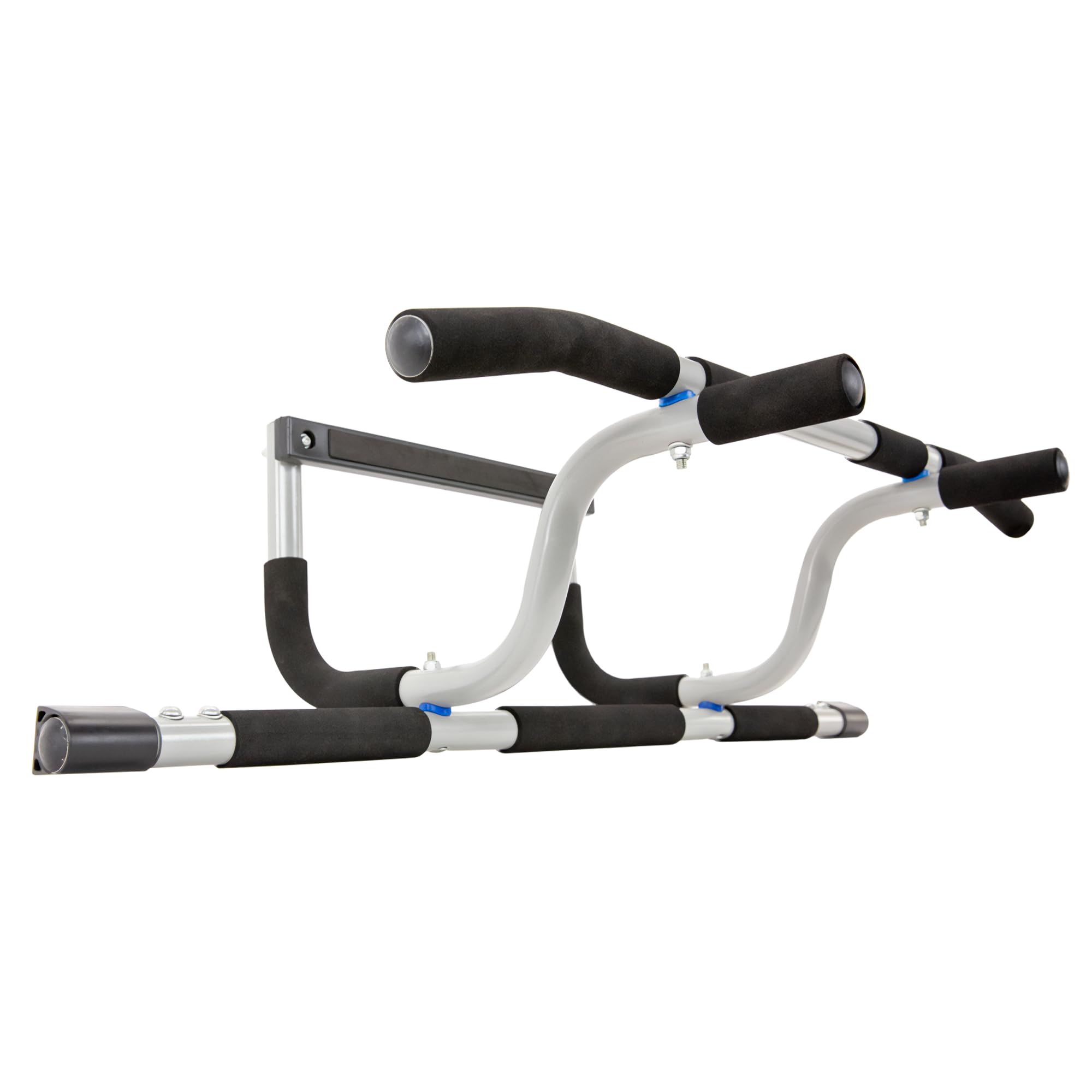
Push-ups, sit-ups, dips: the Iron Gym has always been less a pull-up bar than a doorway gym, and the frame that hangs over your trim flips onto the floor to become a pair of handles for everything else. Three grip positions on the bar itself, narrow, wide, and neutral, cover the pull-up side of the job.

At 4.7 pounds it is the lightest thing here, and that is exactly why it goes up and comes down in seconds and hangs out of the way between sessions. The clip that seats it in the door frame is simple and it works: the bar rests on the frame and pulls tighter as your weight comes on rather than levering itself out.

The floor positions are what keep it in the conversation — no other doorway bar here doubles as a push-up stand — and for a small apartment with one good door, that is a lot of training from something you can hang on a hook. It is a second bar rather than a main one for us, but at this price it earns the space it takes up.

Bottom line: We keep the Iron Gym on the list for its floor work: pull-ups, push-ups, and sit-ups from one bar that hangs on a hook when you are done.

#6

Fitarc Joist Mount Bar

Fitarc Joist Mount Bar

Basement and garage

Our Score 9.0/10
Check Price

Worth Noting

  • Needs exposed joists, not a finished ceiling
  • No adjustability in mounting height
Bar Width
42.5 inches
Fits Beams
8 to 9 feet
Mount Type
Joist or ceiling
Maximum Weight
440 lb
Read the full review

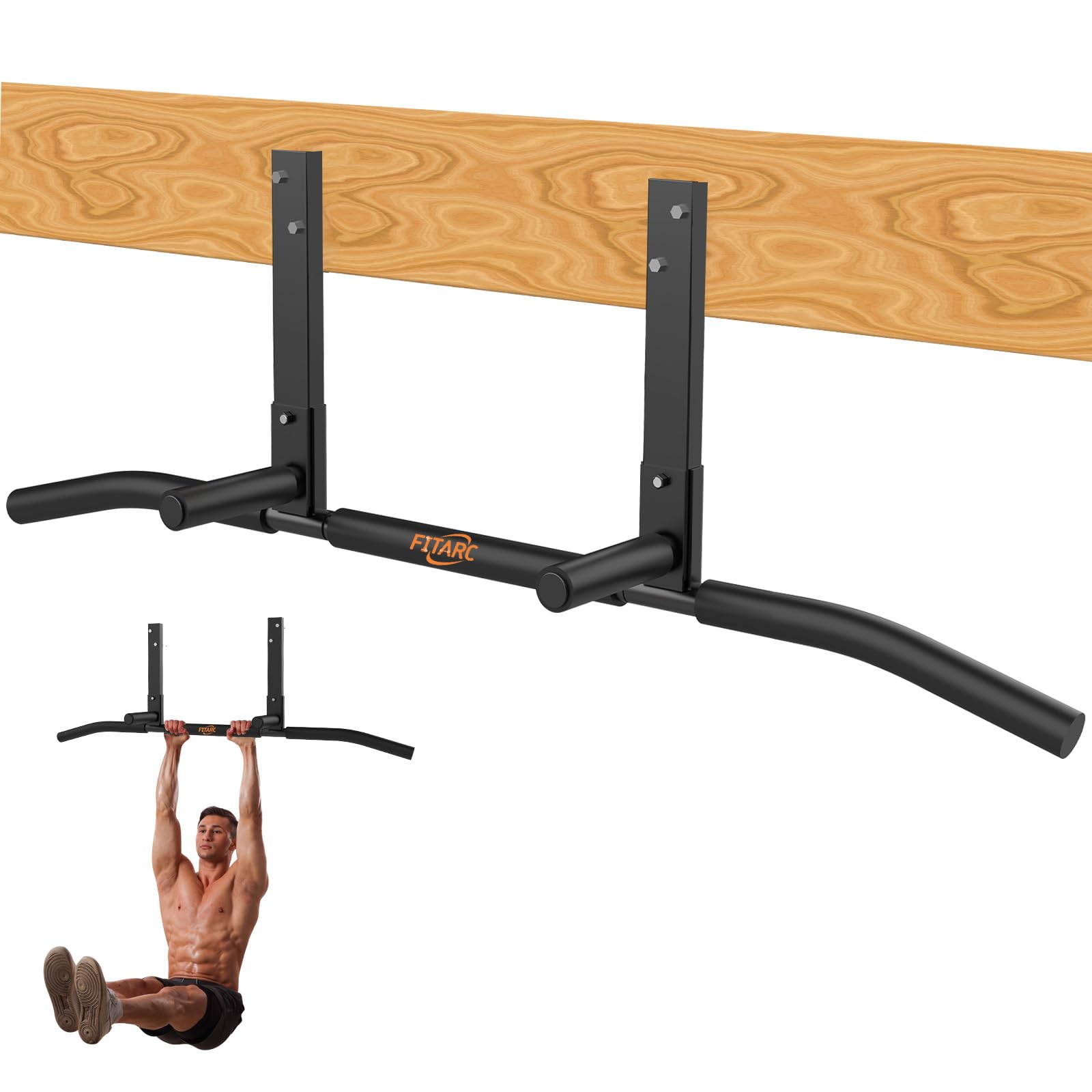
This one only makes sense in a specific room: a basement, garage, or unfinished space with exposed wooden joists and 8 to 9 feet of beam height. Bolt it up and you get a 42.5-inch bar with four padded grips, rated to 440 pounds, hanging from structure instead of from door trim. No wedge to seat, no paint to protect, nothing to take down.

In that room, we think it is the best value here. The dual-support steel frame does not flex, the height is whatever your ceiling gives you, and most people end up with more clearance than a doorway bar offers. It is also the least expensive route to a genuinely permanent pull-up station.

Installation takes a drill, four lag screws, and a second pair of hands for the first minute. The included hex bolts are the weak point of the kit — chase the threads and start them by hand before you drive anything, and keep a spare set nearby if your joists are old and hard.

Bottom line: We think the Fitarc is the best value in this guide for a basement or garage with exposed joists: 440 pounds bolted to structure, no trim to protect.

#7

Ultimate Body Press XL

Ultimate Body Press XL

Taller lifters

Our Score 8.8/10
Check Price

Worth Noting

  • Premium price for a doorway bar
  • Lower weight rating than the joist and ceiling bars
Item Weight
10.2 lb
Doorway Depth
6 inches
Maximum Weight
300 lb
Raised Bar Height
1 inch above trim
Read the full review

If you are around six feet and have hung from a standard doorway bar, you know the problem: at the bottom of a dead hang your knees are folded and your feet are still on the floor. The Ultimate Body Press XL fixes that with geometry. Its bar sits an inch above the door trim and ten inches out from the wall, so you get a full hang without tucking. That raised plane is why we point taller lifters here before any other doorway bar, and it justifies the price on its own.

The rest is competent rather than exceptional: 300 pounds of capacity, just over ten pounds of steel, grip positions covering wide, neutral, and underhand, and expandable ends that let it sit in a range of doorway widths. It goes together with bolts and washers rather than clipping on, so budget more than the two minutes a lever bar takes, and check the plastic spacers as you assemble — a cracked one is the thing to catch before you load the bar.

Depth is what catches people. Ultimate Body Press asks for about six inches measured from trim face to trim face, and a thick craftsman-style casing can put your doorway outside that. Measure before you order, because a bar that will not seat is a bar you will be boxing back up.

Bottom line: For anyone tall enough that a normal doorway bar leaves their knees bent, we think the XL is the fix: a raised bar that buys a genuine full hang.

#8

Ally Peaks Pull Up Bar

Ally Peaks Pull Up Bar

Tight budgets

Our Score 8.8/10
Check Price

Worth Noting

  • Fits only 24 to 32 inch doorways
  • Can work loose on frames near its width limit
Item Weight
4.03 lb
Doorway Depth
4.7 to 8.27 inches
Fits Doorways
24 to 32 inches
Maximum Weight
440 lb
Read the full review

The Ally Peaks is the cheapest bar in this group and does not pretend otherwise. A 1.7mm steel frame, silicone frame contacts in place of the usual foam blocks, a claimed 440-pound capacity, and a design that hangs on the door frame with no tools at all.

The range is where you need to pay attention: it fits doorways 24 to 32 inches wide with a depth of 4.7 to 8.27 inches, which is narrower than most of the bars here and rules out a wide cased opening. Measure the clear width before you order, because there is no extension in the box and no adjustment past the ends.

Set up inside that range on a solid frame, it hangs and holds for ordinary pull-up and chin-up work, and the silicone pads are kinder to painted trim than the foam blocks on other bars. It is the one we suggest to someone furnishing a first apartment gym, where the bar has to come down and go in a closet when guests stay.

Bottom line: We steer budget-first buyers to the Ally Peaks, provided their doorway measures inside 24 to 32 inches — nothing here costs less for a working bar.

What Six Months of Daily Pull-Ups Taught Us

We started with a shortlist of about 40 bars — every style that surfaces when you search, from press-fit doorway bars to screw-in wall mounts and rack attachments — and cut anything with a vague or missing weight rating, hardware that wasn't in the box, or a mounting design that only works if a stud happens to sit dead center in your doorway. That left 14. Each was unboxed and assembled solo, using only the tools included, and I timed it from box-open to first hang.

Fit came first, because that's where most returns begin: we measured the opening and the trim depth in three doorways of different sizes, installed each bar, and noted whether it sat flush or bottomed out against the casing. With every bar locked in, I did strict pull-ups, chin-ups, and a set of kipping reps, then hung a loaded duffel bag from the center for ten minutes to watch for flex or rotation. After each removal we ran a hand along the frame and photographed the trim to catch scuffs, compression marks, or cracks.

Grip got its own pass — bare hands, chalked hands, and hands deliberately slicked with sweat — and I noted which bars spun, which knurling chewed my palms, and which foam went slick within a few weeks. Across six months of daily use and repeated take-downs, we tracked loosening screws, rattling joints, worn coating, and whether the instructions were clear enough for one person with a single drill to manage alone. Value came down to a simple question: did the hardware and the build feel like more than the box suggested?

How to Choose Pull Up Bars

Measure the doorway before anything else

Two numbers decide whether a doorway bar works: the clear width between the door casing, and the depth from the face of one piece of trim to the other. A standard interior doorway runs around 30 to 32 inches wide, which lands inside most ranges, but a closet door or a cased opening can fall outside. The Ally Peaks tops out around 32 inches; the Maximiza runs to 39.

Depth is the number people forget. Deep decorative casing can push a doorway past what a bar will clamp, and the Ultimate Body Press XL wants roughly six inches of it. If the trim is loose, split, or the frame is hollow, no pressure bar has anything solid to bite, and you should look at a wall or ceiling mount instead.

Pick the mounting method, then the bar

There are three real choices here. A lever bar hangs over the frame with no tools and no holes, which suits anyone who moves it between doorways and only works as well as the trim does. A screw-in doorway bar trades two small holes for a fixed anchor that never wedges or rotates. A wall, joist, or ceiling bar is the most solid of the three, and it needs exposed framing and a drill.

If you rent, that order probably answers the question for you. If you own the place and have one doorway you can give over to training, the fixed options are the ones you stop thinking about.

What a weight rating does and does not tell you

Ratings across these bars run from 300 to 500 pounds, and the bar itself is almost never the weak link. What fails is the mounting: a frame that gives, trim that crumbles, a wedge that was never seated. Treat the number as a floor rather than a promise, and spend your attention on where the load goes.

Solid wood holds a lag bolt. Hollow jambs and drywall anchors do not. Push down hard on the top of your door opening before you order anything — if the trim moves, the bar will move with it.

Height decides who can actually use it

A doorway bar sits near the top of the casing, which is fine until you are tall enough that your feet touch the floor at the bottom of a dead hang. If that is you, look for a bar that raises the plane: the Ultimate Body Press XL lifts its bar an inch above the trim and ten inches off the wall, which is enough to change the movement.

Ceiling mounts solve the same problem with risers. Fourteen inches of riser puts the bar high enough that an eight-foot ceiling works in your favor instead of against you.

Plan for what it leaves behind

Silicone pads mark less than foam blocks, screw-in mounts leave holes you can fill and paint, and a lever bar resting against drywall above the casing can dent it. A strip of cloth or a scrap of rubber under the contact points is cheap insurance.

Whichever route you take, inspect the trim after the first week. That is when pads compress, brackets settle, and any movement shows up — and it is far easier to fix then than after a season of pull-ups.

Frequently Asked Questions

Final Verdict

Start with the AmazeFan. It arrives in one piece, seats on the frame without a wobble, and its 400-pound rating is backed by steel heavy enough to mean it. Measure your doorway first — the hook span is fixed, and no amount of padding rescues a bar that will not hang.

If you can put screw holes in one door frame and give that doorway over to training, the Maximiza is the better long-term buy: a bolted anchor that never wedges or rotates. And if you are tall enough that your feet touch the floor at the bottom of a hang, neither one solves it — get the Ultimate Body Press XL.