Strength & Weights

Best Free-Standing Pull-Up Bars of 2026

A freestanding pull-up bar promises the no-drill dream: a sturdy frame you can set up anywhere and train on whenever you want. The reality is that some of them wobble when you pull, take an afternoon to assemble, or claim so much floor space that you question the trade-off. But the best ones feel planted, go together in under an hour, and earn their footprint. They give you a place for pull-ups, chin-ups, hanging leg raises, and band work without putting a single hole in your wall.

Over the past six months, we've tested seven freestanding pull-up bars — assembling each one, checking every bolt and bracket against the instructions, and living with them for daily workouts. We did pull-ups, chin-ups, and hanging leg raises on every bar, and noted which ones stayed solid and which ones made us cut sets short. The bars that earned their price tag got the basics right: a wide, heavy base, clear instructions, a footprint that fits a real room, and a bar that didn't flex under bodyweight. Here's what made the cut.

#1

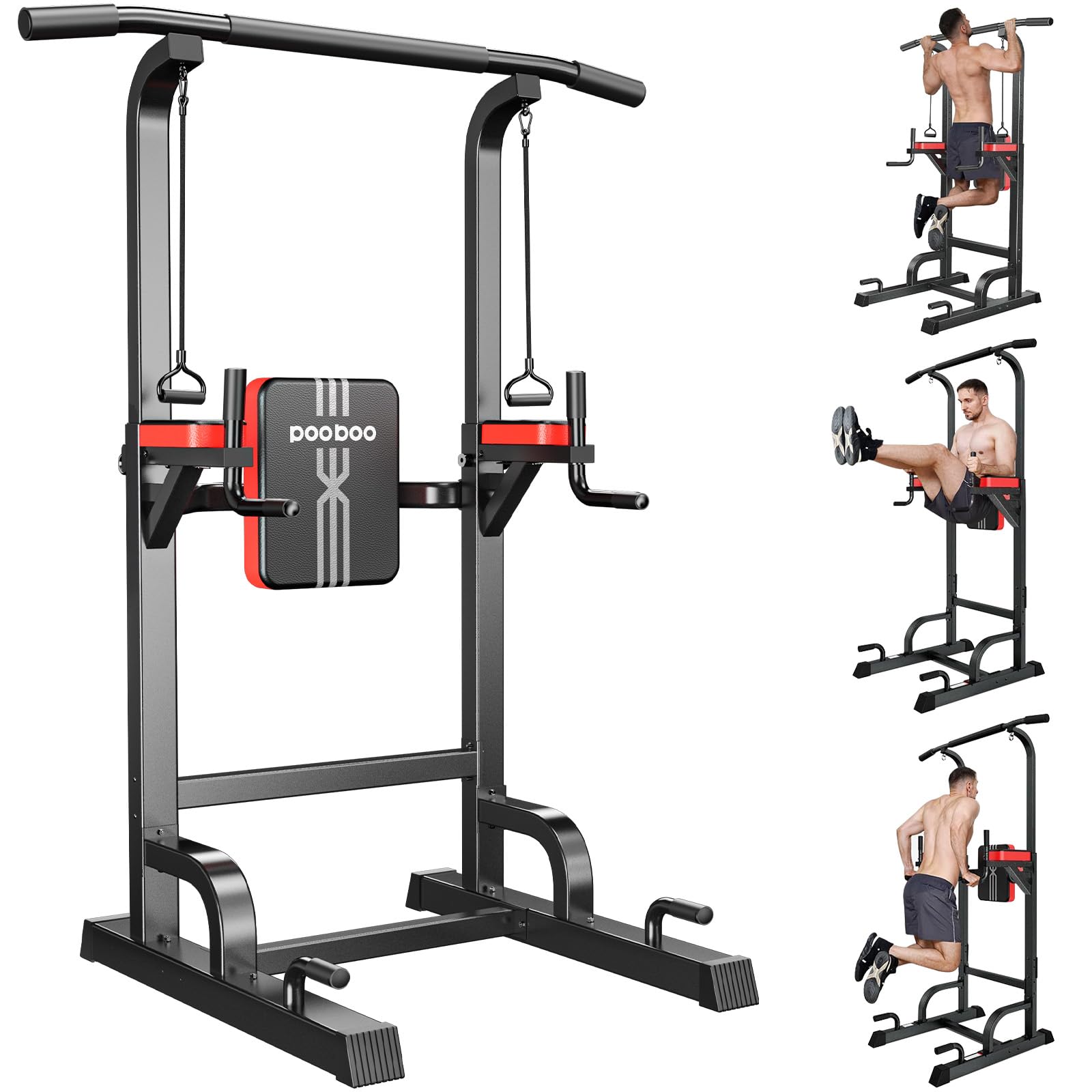
Pooboo Power Tower

Top Pick
Pooboo Power Tower

Stable daily training

Our Score 9.6/10
Check Price

Worth Noting

  • Takes up a wide 43.5-inch corner
Item Weight
60 lb
Height Settings
11 levels, 71.4" to 84.9"
Item Dimensions
41.49"L x 43.5"W x 84.9"H
Weight Capacity
440 lb
Read the full review

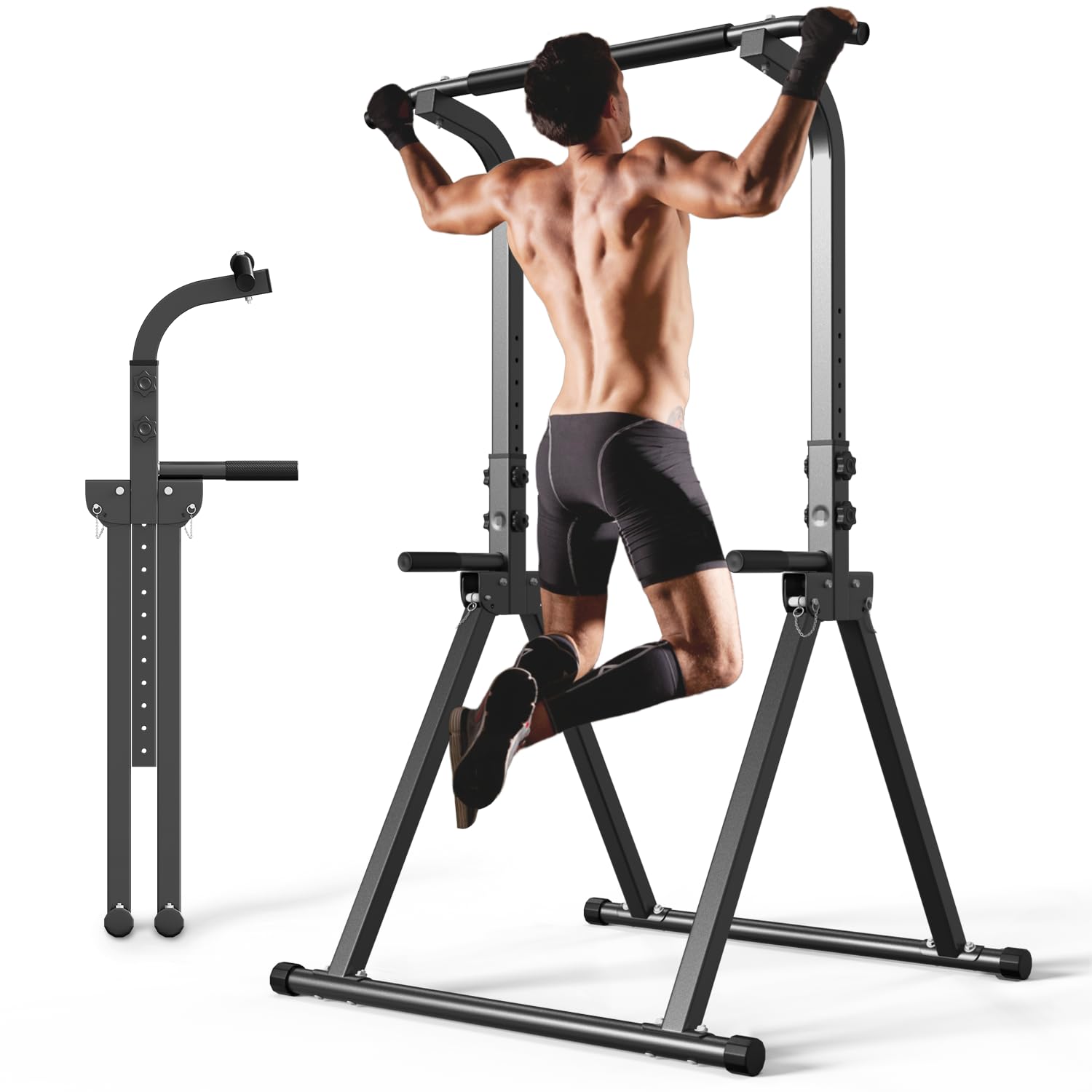
The 41.73-inch extended H-base and 440-pound rating are the first things we check on a free-standing tower, and they are why the Pooboo feels planted in a way the narrower budget stands do not. The 60-pound frame adds heft without making the tower impossible to shift, and the 11 height settings run from 71.4 to 84.9 inches, which gave our taller testers room for a full dead hang. We also appreciated the safety locknuts and the 12-month warranty, small details that make a permanent gym corner easier to live with.

That combination is why it is our top pick: the base is wider than most here, the steel feels substantial, and the height range covers both pull-ups and dips without asking you to compromise. The 41.73-inch base is the decisive number, because it puts more distance between the uprights and the floor contact points; we found the tower stayed composed through controlled pull-ups and dips rather than walking across the mat. If you have the floor space, this is the tower we recommend first.

The one number to check before ordering is the 71.4-inch minimum height. It is fine for most adults, but shorter users and low ceilings will lose some settings, and taller users get the most from the range. We liked that the adjustment mechanism is straightforward and that the 12-month warranty backs a frame this heavy. The Pooboo is not the cheapest tower here, but it is the one we trust for regular training.

Bottom line: Buy this one if you want the most stable tower here for regular pull-ups and dips; its wide H-base and 440-pound rating make it the default for a serious home gym.
#2

YYJO Foldable Power Tower

YYJO Foldable Power Tower

Folding storage

Our Score 9.0/10
Check Price

Worth Noting

  • Open footprint is 51.2 inches wide
Frame
1.2mm steel tube
Height Settings
11 levels, 68.9" to 82.68"
Item Dimensions
33.5"L x 51.2"W x 68.9"H
Weight Capacity
350 lb
Read the full review

The foldable triangular frame is the whole reason to consider the YYJO: it collapses into a smaller footprint than the fixed towers here, so a spare bedroom or garage can go back to being something else after your workout. We folded it after a session and moved it into a corner; that is not a move we can make with the 40-inch-wide stations. The 350-pound rating and 11 height settings mean the folding hardware is not the whole story.

The 1.2mm steel tube and triangular base give it a sturdier feel than the folding label suggests. The height range runs from 68.9 to 82.68 inches, and the adjustment knob is simple to work with one hand. We liked the 24-inch interior width for pull-ups and hanging knee raises.

Assembly is manageable for one person, and the folded package tucks into a corner. The top height is the limitation for very tall users; at 82.68 inches, a full dead hang can leave less clearance than a taller tower. The fold mechanism is the part that usually worries us with a folding tower, but this one felt secure in use.

What sold us is the combination of foldability and enough stability for controlled training. It is our pick for a living room or garage that has to serve another purpose, and it earns that spot without asking you to drop to a flimsy frame. If you have the open floor width and do not need the tallest bar here, it is the most livable tower in the group.

Bottom line: If your gym has to disappear after a workout, this is the one: it folds into a smaller footprint and still rates 350 pounds with 11 height settings.

#3

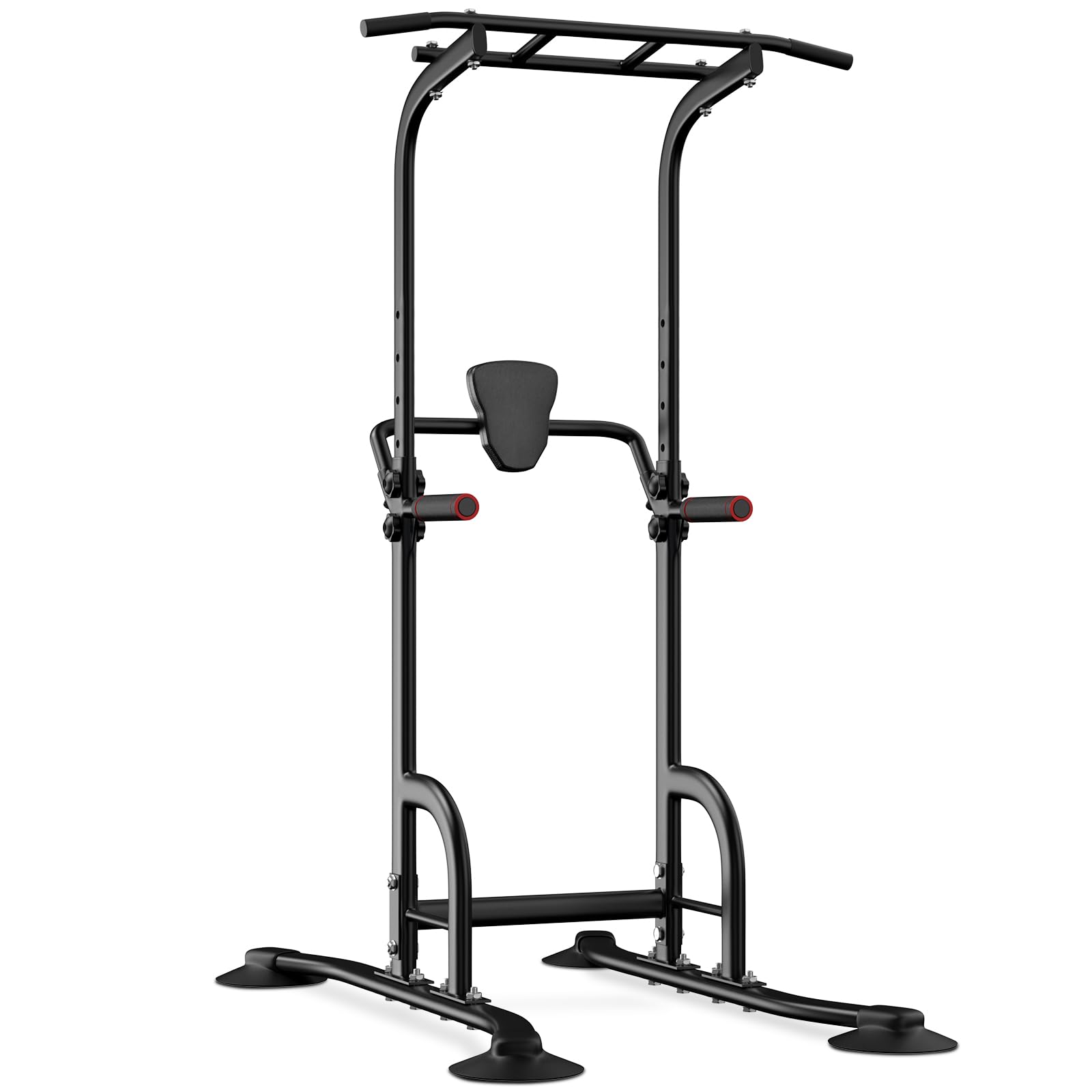
DONIUZ Power Tower

DONIUZ Power Tower

Compact rooms

Our Score 9.0/10
Check Price

Worth Noting

  • Top section moves during hard pull-ups
Height Settings
8 levels, 70.07" to 82.7"
Item Dimensions
30"L x 33"W x 83"H
Weight Capacity
330 lb
Read the full review

The 30-by-33-inch footprint is the first thing we noticed about the DONIUZ; it is one of the smallest working stances here, and that is the point of the design. We could walk around it in a spare bedroom, and the white finish looks less like gym equipment than the black towers. The eight height settings run from 70.07 to 82.7 inches, so it covers average-height users without demanding a vaulted ceiling.

The 330-pound rating and alloy-steel frame are modest next to the 440-pound picks, but they are honest for a compact tower. The widened, splayed base and larger suction cups help with floor contact, and the multi-grip top bar gives you wide, neutral, and close positions without adding attachments. We found the adjustment easy to work with, and the padded backrest is a useful addition for dips and knee raises.

It is our compact-room pick because it balances a small stance with enough height for everyday training. It rewards controlled reps rather than kipping, and the lighter frame is easier to move when you need the floor back. If you want a tower that disappears into a bedroom and you do not need a 400-pound rating, the DONIUZ is a sensible choice.

Bottom line: A compact, affordable tower for lighter users: the 30-by-33-inch footprint fits small rooms, and the 330-pound rating covers basic pull-ups and dips.

#4

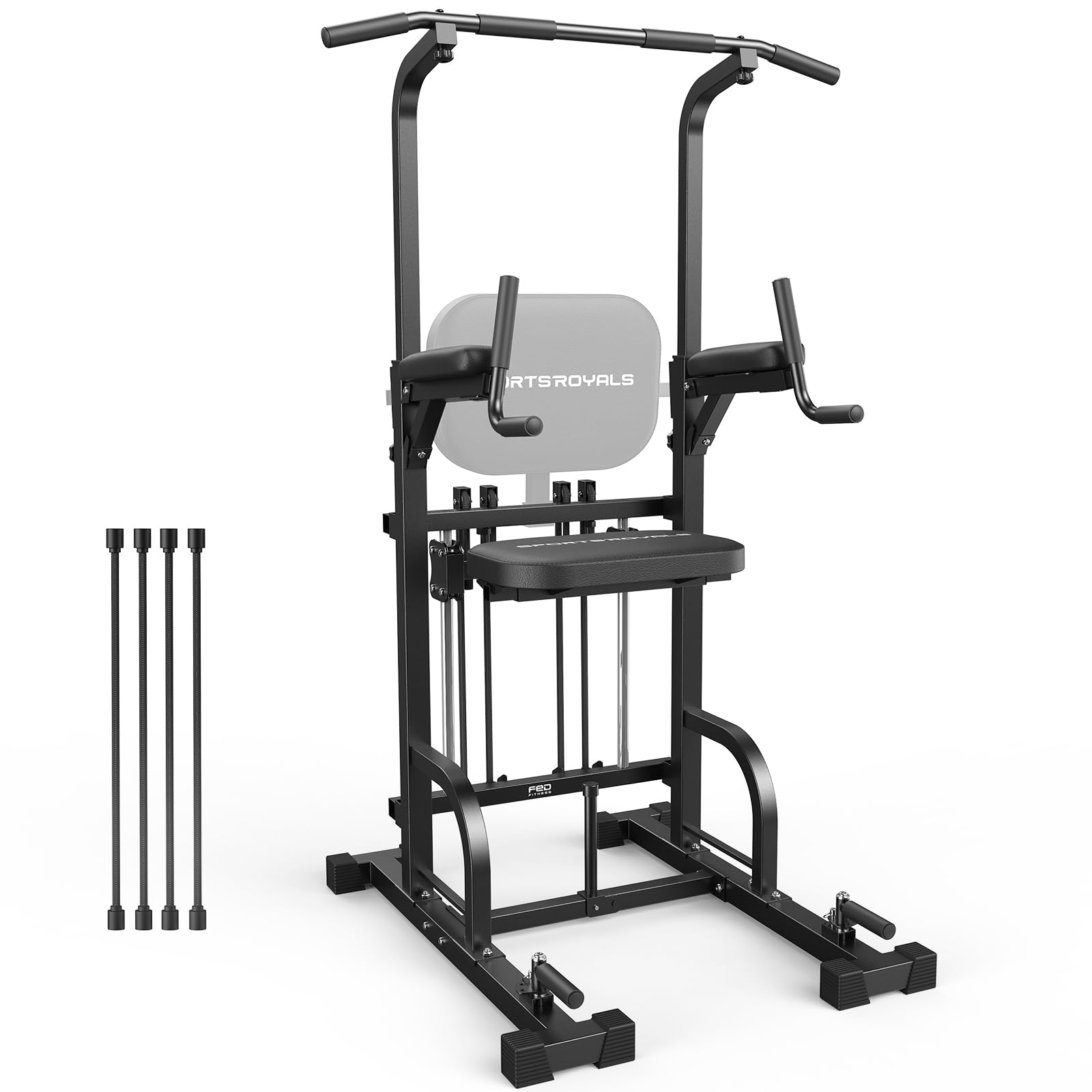
Sportsroyals Power Tower

Sportsroyals Power Tower

Assisted beginners

Our Score 8.8/10
Check Price

Worth Noting

  • Elbow pads are short for taller users
  • Hardware can arrive incomplete
Item Weight
63 lb
Height Settings
6 levels, 64.56" to 87.01"
Item Dimensions
41.2"L x 39.7"W x 87.01"H
Weight Capacity
440 lb
Read the full review

The high-density sponge assisted pad is what makes the Sportsroyals the beginner pick in this group: it gives you a place to brace and take weight off the bottom of a pull-up, and the included resistance band adds another layer of help. We appreciated that the pad is not an afterthought bolted to the frame; it is part of the station, so you can use it for assisted pull-ups, dips, and knee raises without rigging anything. For anyone working toward a first strict pull-up, that is a more useful feature than another grip position.

The frame is rated to 440 pounds and sits on a 39.7-inch H-shaped base, with six height settings from 64.56 to 87.01 inches. We found the 63-pound frame heavy enough to feel serious but still movable with two people, and the lower starting height makes it easier to share with shorter users. The 39.7-inch base is not the widest here, so fast or swinging reps can rock the tower; controlled tempo is the better fit.

Assembly is straightforward, though the manual can be less clear than the hardware, and we sort the bolts before starting. The frame and pad wipe down easily, and the resistance band stores on the tower. Those are small complaints against a station that gives beginners a real path to unassisted reps.

Bottom line: This is the tower we point beginners to: the assisted pad and resistance band make a first pull-up feel possible, and the 440-pound frame has room to grow.

#5

Z ZHICHI Pull-Up Dip Station

Z ZHICHI Pull-Up Dip Station

Tight budgets

Our Score 8.8/10
Check Price

Worth Noting

  • Not sized for users over 6-foot-3
Item Weight
33.5 lb
Height Settings
6 levels
Item Dimensions
33"L x 40.1"W x 78.7"H
Weight Capacity
330 lb
Read the full review

At the lowest price in this roundup, the Z ZHICHI asks you to give up some width and height range, not the stability that matters most. The 40.9-by-30.1-inch base is wider than several pricier towers, and the carbon-steel frame has a 1.2mm wall thickness that feels purposeful rather than tinny. We found it stayed planted for controlled pull-ups and dips, and the 33.5-pound frame is light enough to move alone when the room needs to serve another purpose.

The six height settings and 330-pound rating are the practical limits. The adjustment is simple, and the 78.7-inch top height is fine for average-height users. The dip bars also sit close to the frame, so wide dips feel cramped; narrow-grip work and knee raises are more comfortable. Those are the compromises that come with the low price.

What makes it our budget pick is not that it is cheap; it is that the money goes into the base and frame rather than extras. We liked the compact 33-by-40.1-inch footprint for a garage corner, and the assembly is manageable for one person with the included tools. If you want a stable basic tower without paying for assisted pads or folding hardware, this is the value choice.

Bottom line: The best budget choice in this group: it keeps the money in the base and frame, with a stable 40.9-inch stance for basic pull-ups and dips.

#6

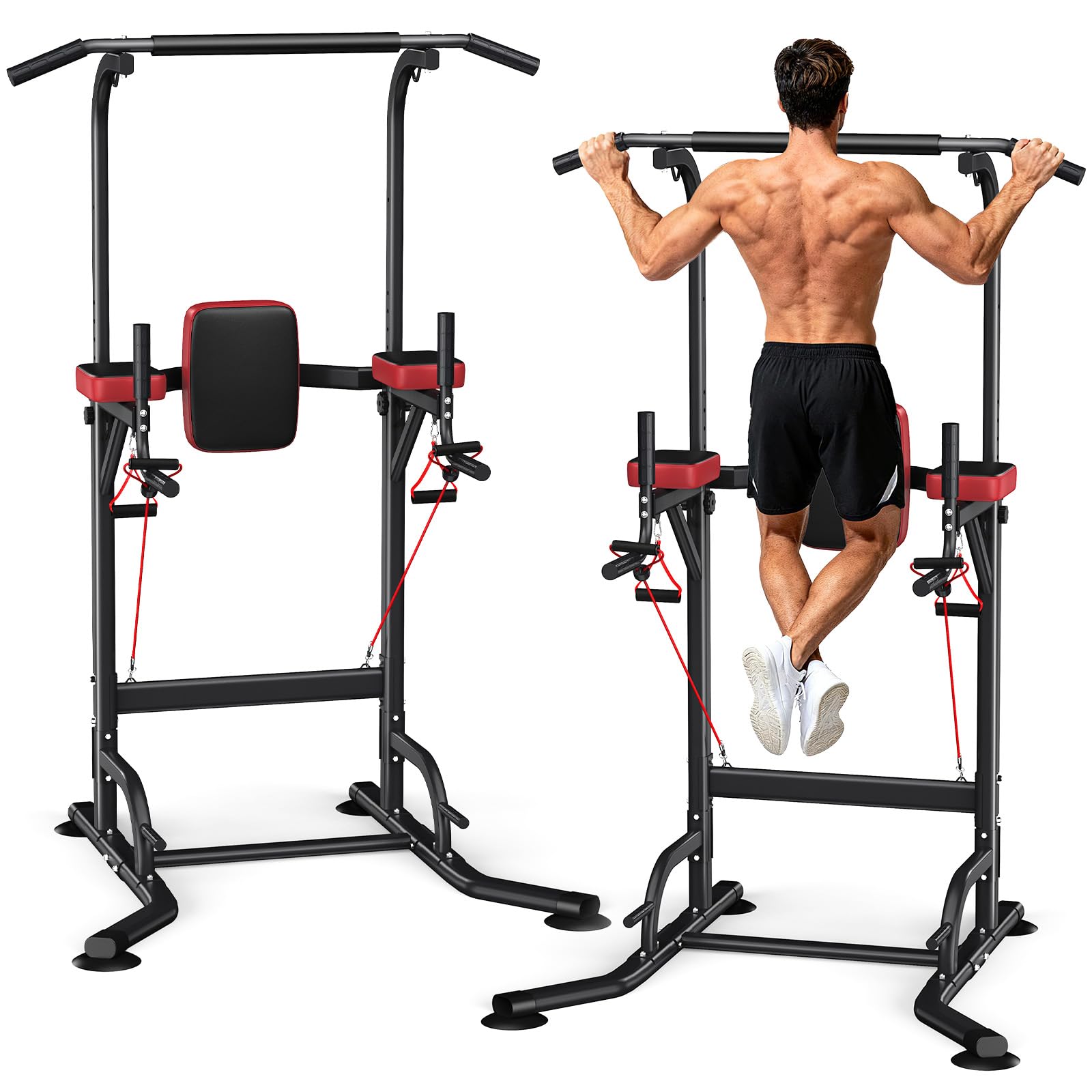
RELIFE Power Tower

RELIFE Power Tower

Narrow rooms

Our Score 8.8/10
Check Price

Worth Noting

  • Can feel shaky during fast dips
Height Settings
9 levels
Item Dimensions
34"L x 26.4"W x 83"H
Weight Capacity
400 lb
Armrest Settings
3 levels
Read the full review

The 26.4-inch width is the reason this RELIFE made the list: it slips between a car and a wall or into a narrow spare-room corner where the 40-inch-wide towers will not go. We found the 34-inch depth and compact stance easy to place, and the 400-pound rating means the smaller footprint does not come with a lighter-duty frame. The four suction cups and safety locknuts are the details that help it stay put on a smooth garage floor.

It is our tight-space pick because the narrow base does not force you into a lightweight toy. The nine height settings and three armrest positions cover different users, and the back pad and elbow pads make dips and knee raises more comfortable than the bare frames here. We liked that the two pull-up grips let you switch between a standard and reverse grip without moving the tower.

The back pad is the part we keep an eye on; it can wear through with heavy use. That is not a reason to avoid the tower for a tight room, but it is not the one we choose for the heaviest daily dip sessions. The four suction cups also need a clean, flat floor to do their job.

Bottom line: A smart pick for a narrow room: the 26.4-inch width slips into tight spaces, and the 400-pound rating and nine height settings cover most home workouts.

#7

Dskeuzeew Power Tower

Dskeuzeew Power Tower

Height range

Our Score 8.8/10
Check Price

Worth Noting

  • Included bands can snap
  • Hardware can arrive incomplete
Dip Settings
6 positions
Height Settings
13 positions, 72" to 87.8"
Item Dimensions
36.6"L x 40.15"W x 87.8"H
Weight Capacity
450 lb
Read the full review

The 13-position height range is the most granular in this group, and it is why we recommend it as the height-range pick: it runs from 72 to 87.8 inches, so tall users can get a full dead hang and shorter users can drop it for dips and knee raises. The 450-pound rating is the highest here, just above the 440-pound Pooboo and Sportsroyals, and the 40.15-inch-wide H-base gives the frame a planted stance. We liked having six dip positions rather than a single fixed setting.

The 36.6-inch depth and 40.15-inch width make it a permanent station rather than a fold-away tower. The high-density foam and PU leather pads are comfortable for dips, and the multiple grip positions on the pull-up bar are easy to find. We found the suction cups useful on a smooth garage floor, though they need a clean surface to hold.

The frame itself is the strength, with a 450-pound rating and enough height adjustment to serve a tall household. The multiple grip positions and dip settings give it more range than the budget towers. If you need the tallest range here, the Dskeuzeew is a strong choice.

Bottom line: The height range is the reason to look here: 13 positions, the highest top setting in this group, and a 450-pound rating, though the included bands are the weak link.

#8

BangTong&Li Power Tower

BangTong&Li Power Tower

Grip variety

Our Score 8.6/10
Check Price

Worth Noting

  • Backrest limits pull-up clearance
Item Weight
39.1 lb
Grip Options
Multi-grip pull-up bar
Height Settings
6 levels, 74.8" to 82.68"
Weight Capacity
330 lb
Read the full review

The multi-grip bar is what sets this BangTong&Li apart: the wide, neutral, and close positions let you change your pull without changing equipment, and the backrest makes dips and knee raises more comfortable than a bare frame. We liked having the push-up bars integrated into the base, so the station covers more than pull-ups. The 29.13-inch width is narrow enough for a small room, and the 330-pound rating is standard for this price tier.

The six height settings run from 74.8 to 82.68 inches, and the adjustment is a simple two-screw job you can do by hand. Assembly is one of the easier jobs in this group, with labeled parts and the tools included. We found the 17.74 kg frame light enough to shift alone, which makes it easier to vacuum around or move to a new spot.

The trade-off is clearance. The 82.68-inch top height is not the place to look for a deep dead hang, and the 29.13-inch width is snug for broad-shouldered users. Those limits are easier to accept if you mainly want dips, knee raises, and grip changes rather than a pure pull-up station.

It earns its place as a grip-variety pick, not as the best pure pull-up tower. The multiple hand positions are genuinely useful for breaking up plateaus, and the backrest adds support for accessory work. If your priority is a compact station with options, this is a smart buy; if you are tall and pull-ups are the main event, choose a tower with more clearance.

Bottom line: The multi-grip bar is the draw here: you get wide, neutral, and close positions, plus a backrest, though the bar sits close for tall pull-ups.

How We Tested Freestanding Pull-Up Bars

We began by researching the most widely sold freestanding pull-up bars, then filtered out any model that drew repeated complaints about wobble, missing hardware, or instructions that read like a riddle. That left seven bars, which we assembled and used for six months in garages, living rooms, and spare bedrooms. Before building each one, we laid out every bolt, washer, and bracket to confirm nothing was missing. We timed assembly solo with the included tools, and noted whether the instructions actually matched the steps and whether the hardware was labeled clearly.

Once a bar was up, it stayed in place for the full six months so we could judge it like a real piece of furniture. We did pull-ups, chin-ups, and hanging leg raises on every bar, watching for side-to-side sway, front-to-back rocking, and any lift in the base during kipping or muscle-up attempts. We measured the footprint and ceiling clearance, because a bar that fits your space is as important as one that fits your body. We also tried every grip position and attachment each model offered, and noted whether the bar diameter and knurling felt comfortable on bare hands and chalked hands.

At the end of the six months, we checked welds, steel gauge, and powder coating for scratches, rust, or loosening. We compared what each bar cost against how stable it felt, how much floor space it ate, and how well it handled daily workouts. A bar that wobbled or flexed under a hard pull didn't get a pass just because it was cheap or easy to assemble. The ones that scored highest did all the basics well — and a few extras, like multiple grip widths or a built-in dip station, helped them stand out.

How to Choose a Free-Standing Pull-Up Bar

Start With Stability, Not Features

A power tower is a lever, and the floor contact is where that lever either holds or walks. Look for a base that extends well in front of and behind the uprights, a frame heavy enough not to skitter, and feet or suction cups that sit flat on your floor. The Pooboo's 41.73-inch H-base and the Z ZHICHI's 40.9-inch base are the kind of dimensions that matter more than an extra grip position. Set the tower on a level surface; a slight slope will show up as a rock at the top of a pull-up.

Match Height to Your Body and Ceiling

Height adjustment is not just about fitting the user; it is about fitting the room. Measure your standing reach and the ceiling, then check the tower's lowest and highest settings. A low starting height helps shorter users and assisted work, while a tall top setting gives tall users a full dead hang. The trap is assuming a tall tower fits a low ceiling just because the bar adjusts: the uprights and pull-up clearance still need room. The Z ZHICHI's own listing points users over 6-foot-3 to a larger station, which is a useful reminder to check the stated user limit, not just the number of settings.

Measure the Open Footprint, Not the Folded Claim

A tower needs a working footprint, not just a storage footprint. The YYJO folds, but it still opens to 51.2 inches wide; the RELIFE is the narrowest here at 26.4 inches, which is why it suits a tight room. Measure the floor area with the unit open, add room for your legs and a mat, and check that the ceiling clearance works at the highest setting you will use. If the tower has to come out and go away after every session, a folding design earns its keep; if it can stay put, a fixed frame usually gives you more stability for the money.

Check the Weight Rating and Hardware

The weight rating is a ceiling, not a target. Choose a tower rated above your body weight with some margin, especially if you plan to add a weighted vest or use resistance bands. The ratings here range from 330 to 450 pounds, and the difference matters most for heavy users and dynamic dips. Missing hardware can stop an assembly cold, so sort the bolts and washers against the parts list before you start. Tighten everything, then re-check the joints after the first few sessions. A locknut or a second pass with a wrench is worth more than a fancy pad.

Decide How Much Versatility You Need

Dip bars, a backrest, an assisted pad, and multiple grips all add value if you will use them. The Sportsroyals assisted pad is the most beginner-friendly feature here, while the BangTong&Li's multi-grip bar suits someone who wants to change hand positions without a second station. The trade-off is clearance: a backrest that supports dips can sit close to your back during pull-ups, and a wide multi-grip bar can feel cramped in a narrow room. Buy for the exercises you actually do, not the longest attachment list.

Frequently Asked Questions

Final Verdict

The Pooboo is the tower we recommend first. Its 41.73-inch extended H-base, 440-pound rating, and 11 height settings make it the most stable all-around choice for regular pull-ups and dips, and the 12-month warranty adds peace of mind. If you are working toward a first pull-up, the Sportsroyals assisted pad is the better fit; if your room is the constraint, the RELIFE's narrow width or the YYJO's folding frame solves a problem the Pooboo cannot. Start with the space and the height you have, then choose the tower that matches.