Strength & Weights

Best Power Racks with Lat Pulldowns of 2026

The first time you miss a squat inside a power rack, you want to hear the safeties catch, not the whole frame shift. That moment is why I care less about flashy attachments and more about stability, weight capacity, and how a rack behaves when the bar gets heavy. A good power rack with a lat pull-down gives you a place to squat, press, and row at home, plus a cable station for lat work, face pulls, and shoulder-friendly accessories. It fixes the central home-gym problem: training alone without wondering whether your setup will hold.

Over eight months, my team and I assembled and lived with six racks in a tight garage gym, paying attention to the things that annoy you later: instructions that assume a second person, frames that creak during rack pulls, cables that stutter on slow lat pull-downs, and whether you can move the thing without help. Value is how much of that list a rack gets right before you add plates. The picks below are the ones we’d trust for solo sessions and the long haul.

#1

pooboo P43 Power Cage

Top Pick
pooboo P43 Power Cage

Premium setups

Our Score 9.8/10
Check Price

Worth Noting

Height
82.6"
Footprint
62.9"D x 43.3"W
Unit Weight
417 lb
Weight Capacity
2000 lb
Read the full review

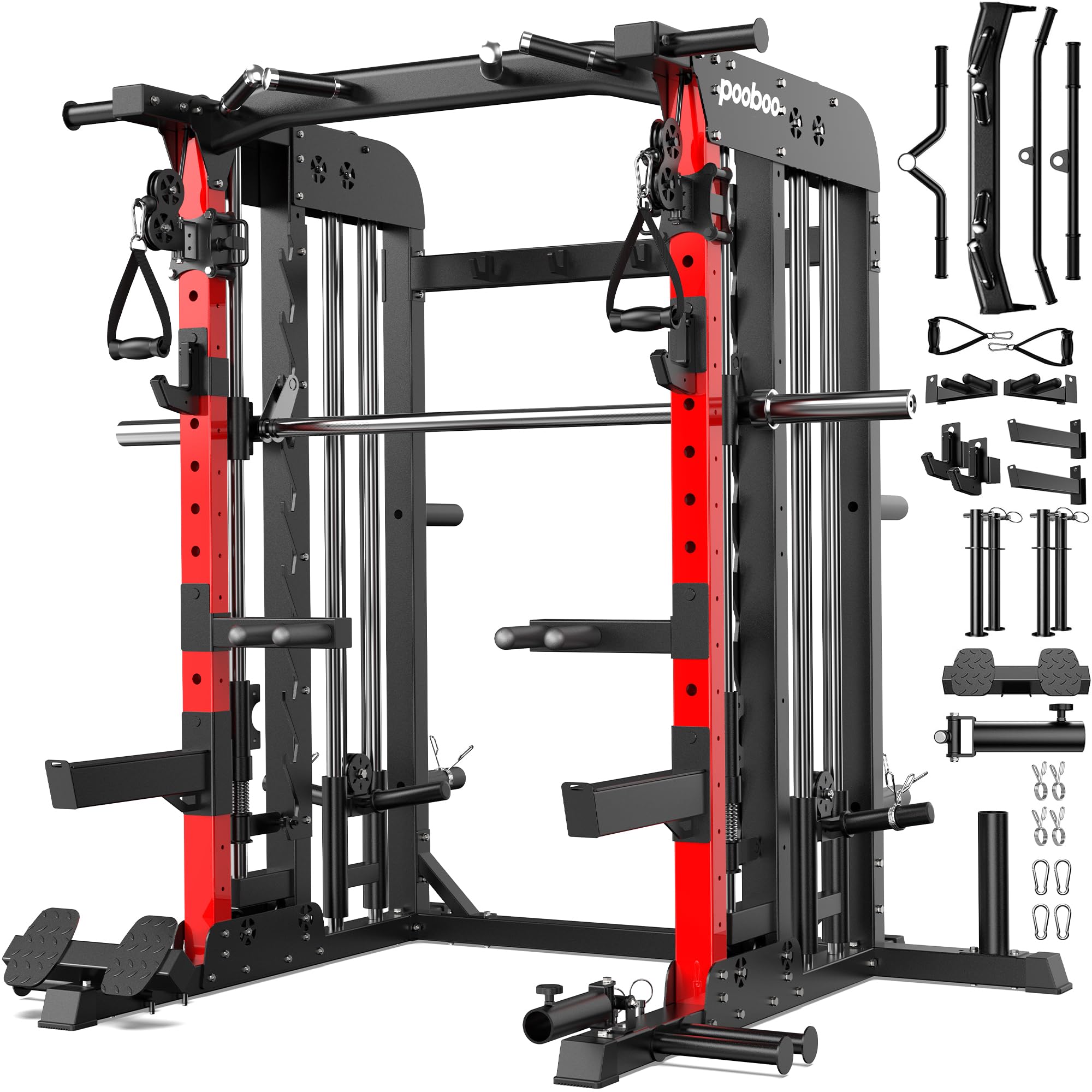
The P43 is the rack in this group that feels closest to a commercial gym once it's standing. At 417 pounds, most of that weight is in the frame, and you feel it when you set the uprights and tighten the bolts. The payoff is a 2,000-pound rating and a cage that stays quiet during pull-ups and heavy cable work. This is not a rack you move around the garage on a whim.

The cable system uses bearing pulleys and PU-coated wire rope, and the 2,000-pound figure is the frame's rating, not a free pass to load the cable with anything you like. We like the dual-pulley crossover arrangement because it lets you train both sides independently, and the included lat bar, row handle, dip bars, and J-hooks cover the basics without a second order. The 62.9-by-43.3-inch footprint is narrower than it looks in photos, but the 82.6-inch height still needs real ceiling clearance.

The build is the main event, and so is the logistics. Two people should plan on a full afternoon, and you'll want to build it where it will live because moving 417 pounds after assembly is miserable. The reward is a stable, well-damped rack that doesn't rattle when you drop a load on the safety arms. We recommend it to someone who wants one serious machine and is willing to give it a permanent corner.

Bottom line: We recommend the P43 when you want a near-commercial feel and don't mind a heavy two-person build; its 2,000-lb frame and 20-plus attachments are the draw.
#2

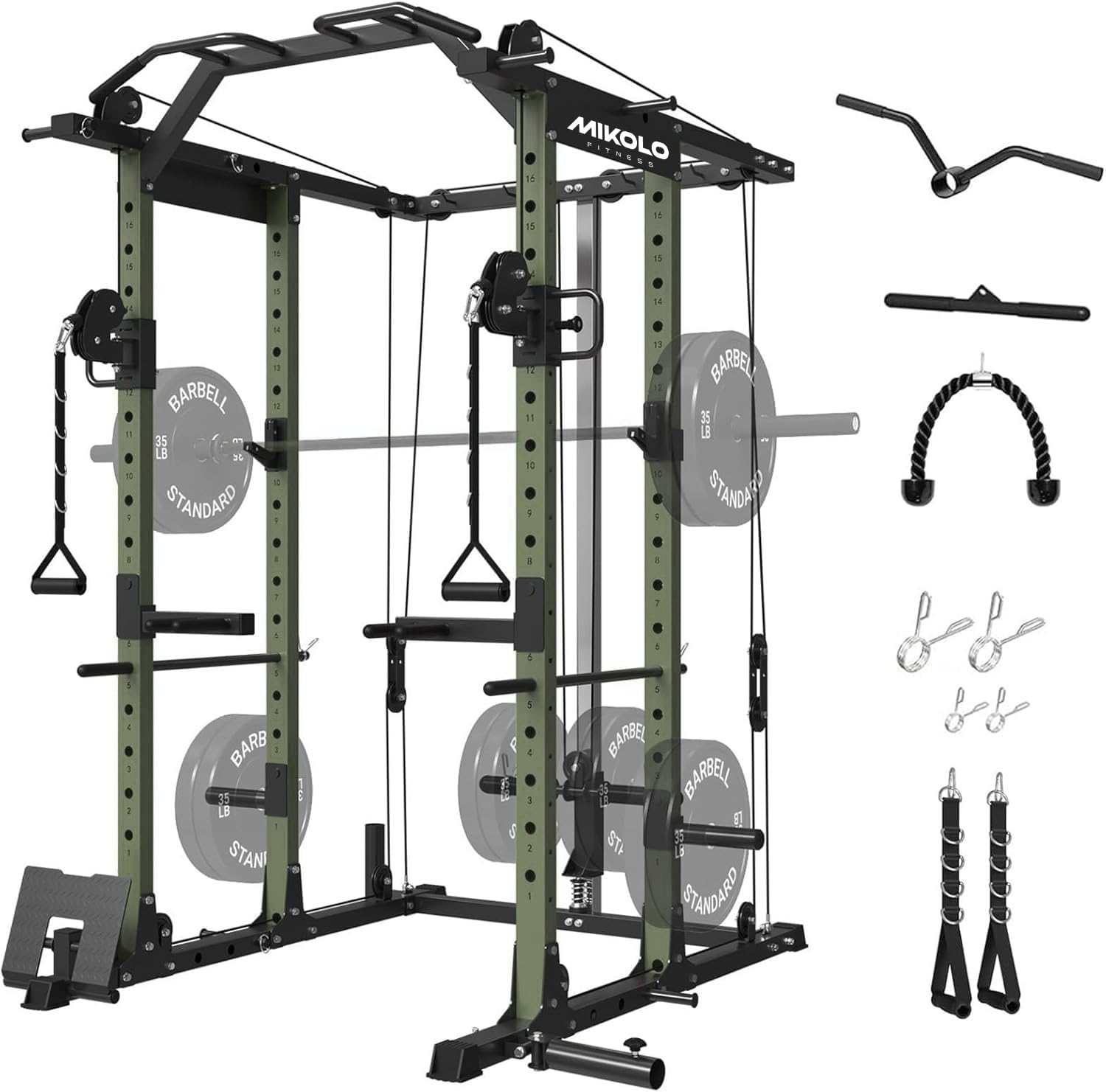
Mikolo K6 Power Cage

Mikolo K6 Power Cage

Most home gyms

Our Score 9.4/10
Check Price

Worth Noting

  • Lower weight ceiling than 2,000-lb picks
Height
86.4"
Footprint
67"D x 56.5"W
Cable System
2:1 low row; lat pulldown
Weight Capacity
1500 lb
Read the full review

The K6's low-row station is the detail that makes it feel more complete than a bare cage. It runs a 2:1 ratio and includes a footplate, so rows feel smooth and you have something to brace against. The lat pulldown gives you the vertical pull the search is asking for, and the four-post cage lets you squat inside the uprights with the spotter arms set where you need them. We like that combination because it covers the two cable movements most home lifters use without adding a separate machine.

The footprint is 67 by 56.5 inches, and it stands 86.4 inches tall. That's not tiny, but it uses vertical space well: plate storage and attachments live on the frame instead of on the floor. We noticed the five band-peg holes on each side of the top and bottom rails, which let you set bands and the landmine where they don't fight your stance. The green finish is a nice change from the usual black, too.

Assembly is the main chore. The frame goes together with the usual array of bolts, and a second person helps get the uprights square before you tighten everything. The cable run is the part to check twice: a straight path and a little lubrication make the difference between a smooth pull and a gritty one. We keep coming back to the K6 because it feels like a full gym without asking for a full room.

Bottom line: We recommend the K6 to most home gyms because it pairs a true cage and a smooth lat pulldown with a footprint that still leaves room to train.

#3

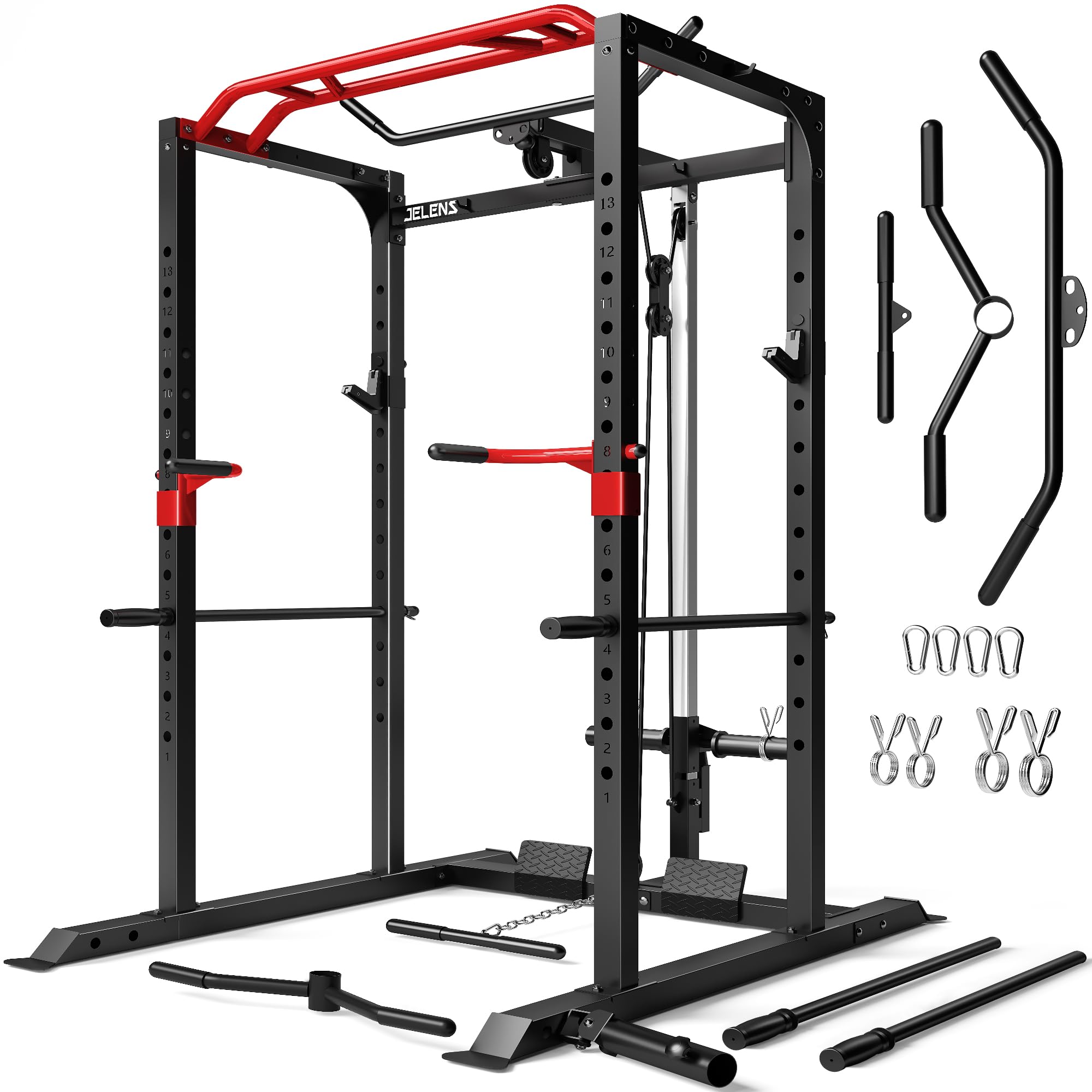
JELENS S11 Power Cage

JELENS S11 Power Cage

Small rooms

Our Score 9.2/10
Check Price

Worth Noting

  • Narrow interior limits wide-stance work
Height
82.6"
Uprights
50 x 50 mm steel
Footprint
57.5"D x 44.5"W
Weight Capacity
2000 lb
Read the full review

The S11's best trick is fitting a full cage and cable station into about 12.5 square feet. At 57.5 inches deep and 82.6 inches tall, it slots into a spare bedroom or a narrow garage bay where a wider rack would crowd the car. The 2,000-pound rating is the headline, but the compact footprint is the reason we recommend it for tight rooms.

The 50-by-50-millimeter steel frame feels solid once assembled, and the cable system uses steel shaft pulleys and a polished cable run. We like the included landmine, dip handles, and lat bar; they turn a small rack into a fuller gym without adding floor space. The cable moves smoothly through lat pulldowns and rows, and the up-and-down pulley path is simple to understand when you're setting the height.

Assembly is the main compromise. The pieces are manageable, but the instructions are easier to follow after you lay everything out, and the build goes faster with a second pair of hands. Once built, the S11 feels sturdier than its footprint suggests. We keep it on our shortlist because it solves the room problem first and the training problem second—and in a small home gym, that's the right order.

Bottom line: The S11 is our pick for tight rooms: it squeezes a 2,000-lb-rated cage and smooth cable run into about 12.5 square feet.

#4

YOLEO Power Cage

YOLEO Power Cage

All-in-one value

Our Score 9.2/10
Check Price

Worth Noting

  • Bench adds assembly and storage demands
Uprights
2 x 2 in steel
Pulley System
Dual 2:1
Included Bench
Yes
Weight Capacity
1600 lb
Read the full review

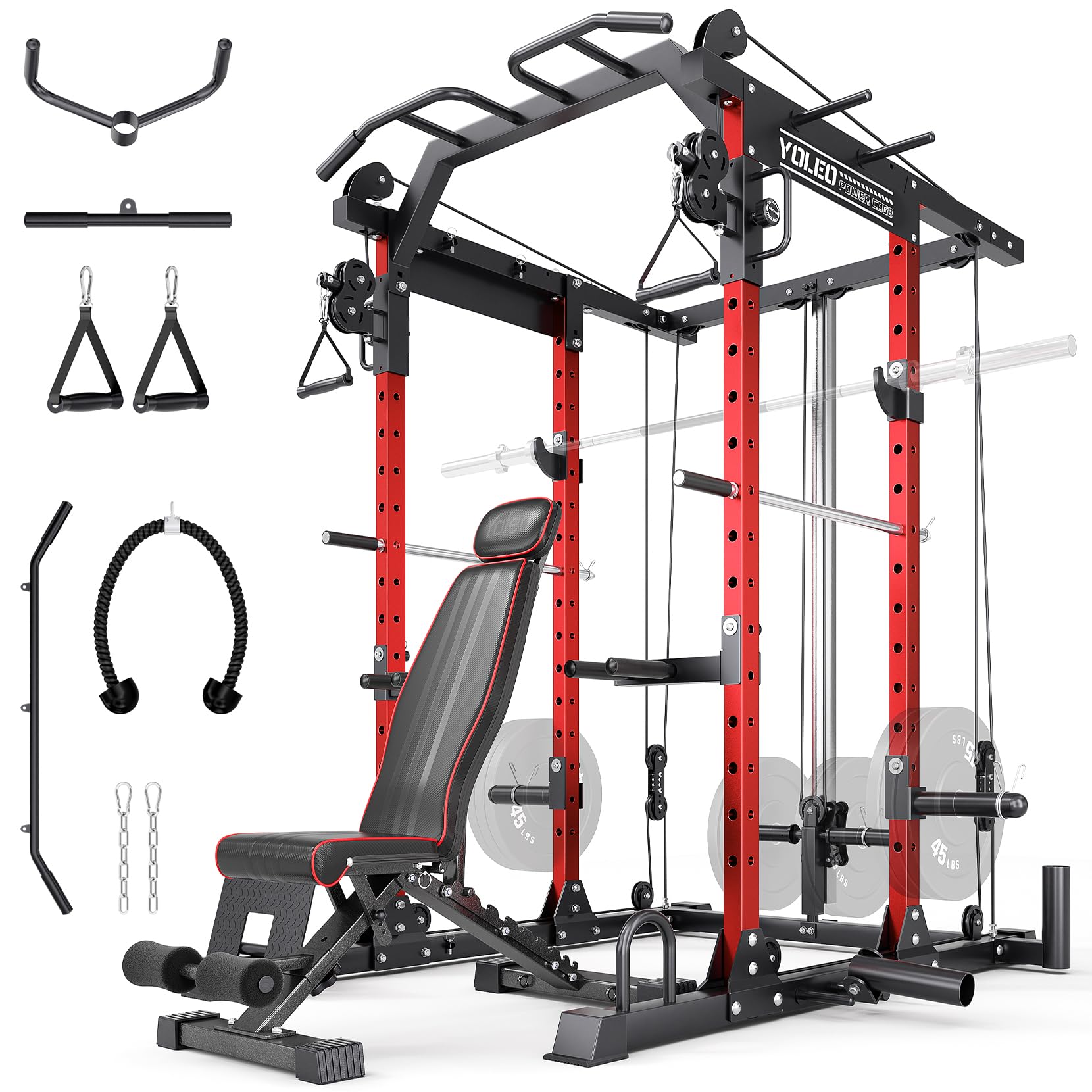
The YOLEO package starts with the bench. It arrives with a commercial-style bench alongside the cage, which is unusual at this end of the list and makes the first week of training feel complete. If you're building a gym from nothing, that's one less order and one less compatibility question.

The cage itself is a 9-in-1 design with 2-by-2-inch steel uprights, a 1,600-pound rating, and a dual-pulley system running a 2:1 ratio. The included T-bar, lat bar, tricep rope, cable bar, and handles cover the main cable movements, and the frame has storage built in so plates and handles don't end up on the floor.

The 2:1 ratio gives a smooth, lighter-feeling pull, which suits lat pulldowns and high-rep accessory work. If you want a heavy, direct 1:1 pull, this isn't the cable feel you're after. The YOLEO is tuned for smoothness and package value rather than a raw cable feel.

We see it as the starter package for someone who needs a bench and a cable rack in one purchase. If you already own a bench, the K6 is the cleaner buy; if you don't, the YOLEO covers more of the checklist at once. That's the reason it stays on our list.

Bottom line: The YOLEO is the value all-in-one we recommend when you also need a bench; its 1,600-lb cage, dual pulleys, and included bench cover a lot of ground.

#5

Major Fitness F22 Power Rack

Major Fitness F22 Power Rack

Heavy lifters

Our Score 9.0/10
Check Price

Worth Noting

  • Heavy frame needs two movers
Height
82.5"
Footprint
68.9"D x 55.5"W
Pulley System
Independent dual 2:1
Weight Capacity
1600 lb
Read the full review

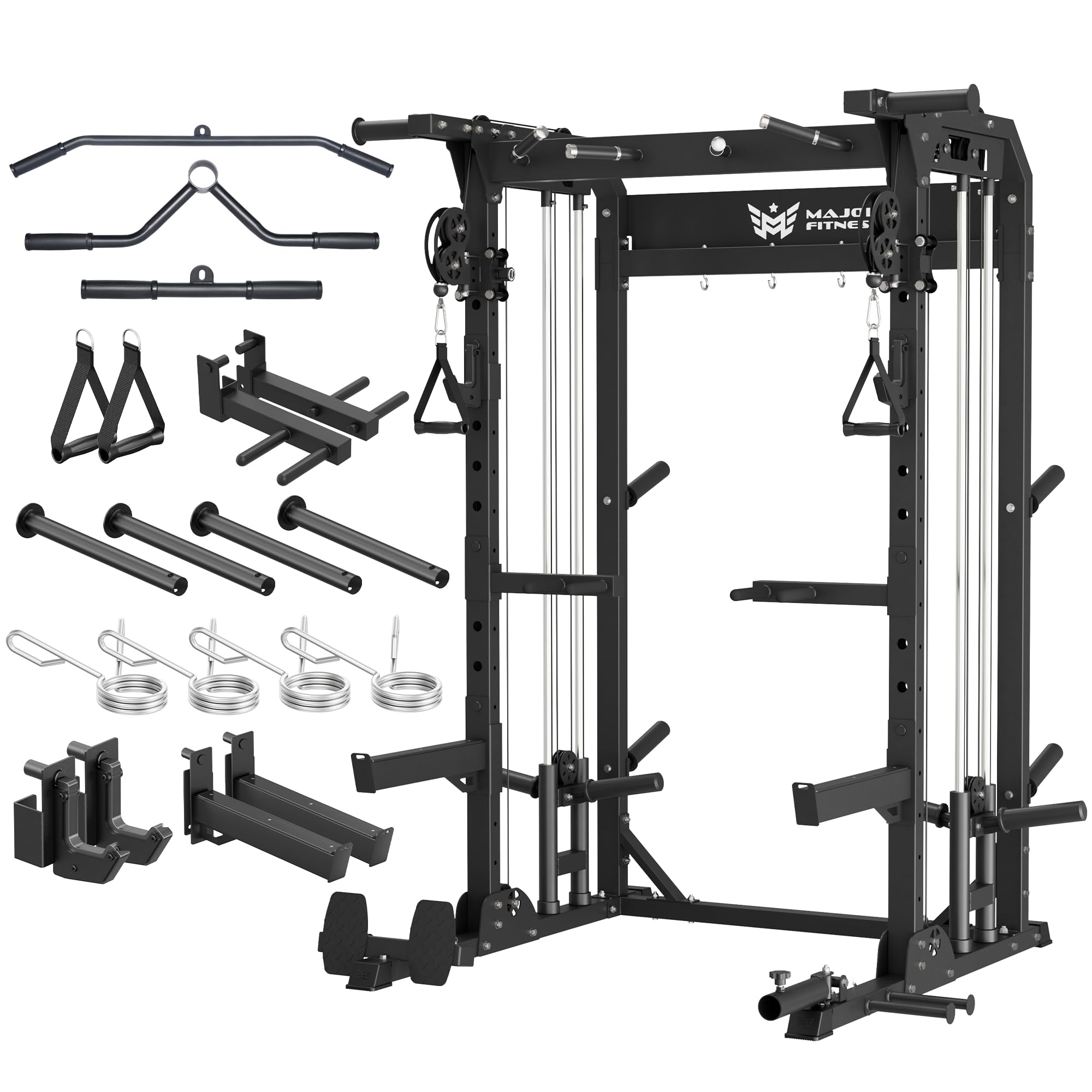
Two separate cable runs are the F22's party trick. Each side has its own 2:1 pulley, so one person can set a high cable for triceps while the other sets a low cable for rows, or you can superset without swapping attachments. We think that's the clearest reason to spend more than a basic cage: it turns the rack into two stations, not one.

The frame is 2-by-3-inch 14-gauge steel with a 1,600-pound static rating, and the dual-triangle base spreads the load across the floor. At 243 pounds, it feels planted once it's built, and we didn't notice the sway that lighter racks can develop during weighted pull-ups. The footprint is 68.9 by 55.5 inches with an 82.5-inch height, so it's a garage-sized cage rather than a corner filler.

Assembly is a half-day project, and the pulley alignment is the part we watched most closely. The cable travel is smooth when the lines run true and the weight is balanced side to side; a lopsided load makes any cable machine feel worse. The included J-hooks, safety arms, foot pedals, landmine, dip bars, and lat bar mean you can start training without a second order. It's a lot of rack for the money, as long as you have the ceiling height.

Bottom line: Choose the F22 if you lift heavy and want independent dual cables; its 1,600-lb frame and two-user pulley setup are why it tops our heavy-duty shortlist.

#6

Sportsroyals RK2 Power Cage

Sportsroyals RK2 Power Cage

First home gym

Our Score 9.0/10
Check Price

Worth Noting

  • Single cable run limits crossover work
  • 59.6-inch square footprint needs room
Height
82.6"
Footprint
59.6"D x 59.6"W
Cable System
Upper and lower pulleys
Weight Capacity
1200 lb
Read the full review

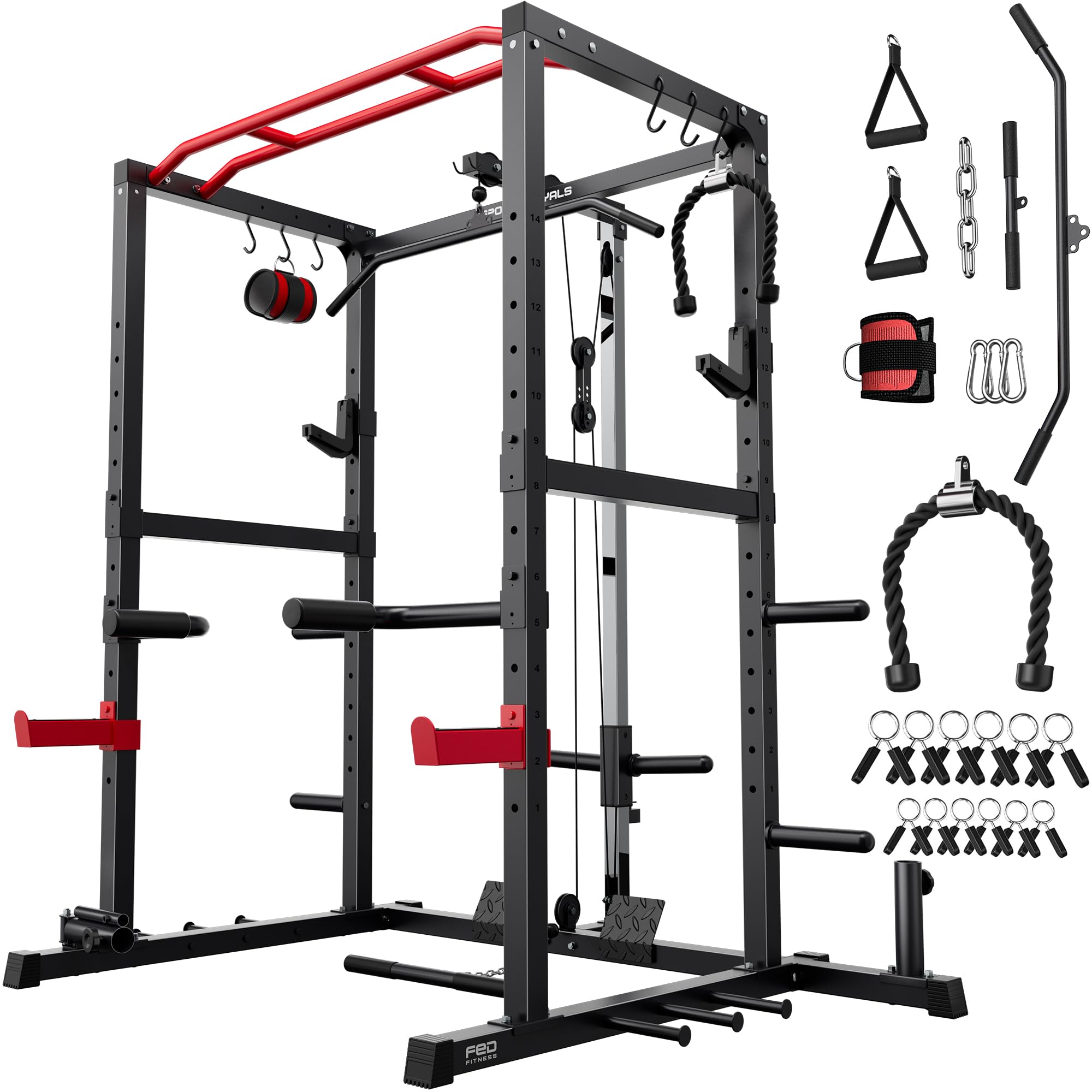
The RK2 is the rack we point to when the budget is the first constraint. It still gives you a full power cage, an upper and lower pulley system, a lat bar, a rowing bar, dip stands, a landmine, and enough storage to keep plates off the floor. The 1,200-pound frame won't suit a 500-pound squatter, but it covers the everyday lifting that most home gyms actually see.

What we appreciate most is how organized the build is. The hardware comes bagged by assembly step, and the 14 height levels give you room to set the J-hooks and safety arms without hunting for a usable hole. The 59.6-inch square footprint gives you a stable stance for bench and squat work, and the 82.6-inch height is manageable in a garage with a standard ceiling.

The cable system handles lat pulldowns, rows, and triceps work without fuss, and the pulley runs smoothly enough for high-rep sets. On a smooth garage floor, we noticed the rack can shift slightly when you pull hard, so anchor it or load the storage pegs before you go heavy. That one habit makes the RK2 feel much more planted than its weight suggests.

Bottom line: We point budget buyers to the RK2 because it delivers a full rack, lat pulldown, and a deep accessory set for the least money here.

#7

Mikolo Folding Squat Rack

Mikolo Folding Squat Rack

Garage corners

Our Score 8.8/10
Check Price

Worth Noting

  • 1,000-lb capacity is at the low end here
Height
86"
Open Footprint
68"W x 30"D
Weight Capacity
1000 lb
Folded Footprint
3 sq ft
Read the full review

The Mikolo folding rack is the answer for a garage that has to do double duty. It opens to a 68-by-30-inch working footprint and folds to about 3 square feet against the wall, so the car can come back in after your session. The 2-by-2-inch 14-gauge steel and reinforced wall mounts give it a solid feel when the installation is done right. This is a rack you build around a wall, not a freestanding cage you can push into a corner.

The wall attachment is the whole ballgame. Mikolo uses reinforced screw-in wall mounts and four adjustable ground feet, and the rack depends on that connection for stability. If you can't anchor into studs or a proper stringer, this is not the rack for you. We also like the detachable pull-up bar and the 15 height positions on the single-handed pulleys; they make the folding format feel like a real rack rather than a compromise.

The cable run is where the folding design shows its limits. The pulleys can feel draggy unless the lines are routed cleanly and lubricated, and the 1:1 ratio gives you a heavier, more direct pull than the 2:1 racks here. That's not a dealbreaker for lat pulldowns and rows, but it's the difference between a rack you love using and one you tolerate. For a small garage, the trade is still worth it.

Bottom line: For a garage that has to park a car, the Mikolo folding rack is the one we choose: it folds to 3 square feet and still gives you a lat pulldown and cage.

#8

RitFit BPC06 Smith Machine

RitFit BPC06 Smith Machine

Smith-style squats

Our Score 8.8/10
Check Price

Worth Noting

  • 1,000-lb capacity limits heavy lifters
Height
82"
Footprint
44"D x 45.3"W
Included Pieces
13 accessories
Weight Capacity
1000 lb
Read the full review

The BPC06 leads with its guided Smith bar. The bar runs on linear bearing straps inside a half-rack frame, so squats, presses, and rows follow a fixed path while the open front leaves room to step in and out. We like that for solo training: you get the confidence of a fixed bar without a full cage wrapping around you.

The triangular base is the stability story. It widens the footprint without making the rack feel like a box, and the 44-by-45.3-inch base is one of the smallest here. RitFit includes 13 pieces—J-hooks, safety arms, a landmine, storage tubes, and band pegs—so the rack arrives ready for more than Smith squats. We appreciate that the Smith bar and cable system are bundled; buying them separately usually costs more and eats more floor space.

The cable system is best for lat pulldowns, rows, and accessory work. It runs smoothly enough for high-rep sets, and the half-rack design makes it easy to reach the handles without climbing around uprights. The fixed bar is the trade: it guides you, which is great for solo safety, but it won't build the same balance as a free barbell.

For a compact home gym, that's a fair exchange. The BPC06 gives you a Smith machine, a lat pulldown, and a small footprint in one package. We recommend it to the lifter who wants guided squats and cable work in a tight room, not to someone who needs a full free-bar cage.

Bottom line: The BPC06 suits a solo lifter who wants Smith-machine squats and a lat pulldown in a compact half rack without paying full-cage money.

How We Chose and Tested These Power Racks

I started by reading specs and owner reviews, then ruled out racks that hid the lat pull-down behind a costly add-on, exceeded the footprint I could fit, or listed a weight capacity that felt thin for the frame. Six made the cut, and each one lived in the same tight garage gym for the full eight months—a space where the ceiling is low and the floor space is spoken for. The goal was not to find the most loaded package; it was to find racks that made sense once you factored in safeties, J-cups, and the cable station.

I assembled every rack myself first, then repeated the process with a second person where the manual called for it, timing each stage and noting where the instructions went vague or the hardware bag came up short. I checked welds, paint, and the fit of the J-cups and safeties; a rack that looked fine in photos sometimes had a wobbly upright or a pull-down carriage that needed shimming.

During workouts, I squatted, pressed, and racked the bar inside each rack, loaded plates onto the safeties, and used the lat pull-down for slow controlled reps and quick accessory sets. I deliberately racked a heavy bar off-center, pulled against band pegs, and watched for frame walk, creaks, and any flex in the uprights; on the cable, I noted whether the carriage started smoothly or jerked at the top. To test mobility, I rolled or dragged each rack across the floor and reset the feet. Value came last: did the standard package include the pieces you actually need, or did the price creep up with every add-on?

How to Choose a Power Rack with a Lat Pulldown

Start With the Cable, Not the Cage

A lat pulldown is only useful if the cable runs cleanly and the resistance feels right. A 1:1 pulley gives a heavier, more direct pull; a 2:1 system feels lighter and smoother but needs more plate for the same resistance. Independent dual pulleys let two people train at once or let you set one side high and one low. If you only do lat pulldowns and rows, a single upper-and-lower run is enough; if you want crossovers and supersets, pay for independent sides. The Major Fitness F22 is the clearest example of independent dual pulleys here, while the Mikolo K6 uses a 2:1 low row that feels smooth for solo work.

Measure Height and Footprint First

Rack height matters as much as footprint. The racks here run from about 82 to 86 inches tall, and you need clearance above the pull-up bar for your head. A low garage ceiling can rule out a full cage even if the base fits. Also measure the swing of the Smith bar and the space you need to load plates. Compact usually refers to the base, not the height, so write down all three dimensions and tape the footprint on the floor before ordering.

Match Frame Capacity to Your Lifting

A 1,000-pound rack is fine for most home lifters; 1,500 to 2,000 pounds buys more steel and a heavier feel, which matters if you squat and pull heavy or want a rack that stays quiet under load. But the headline number is usually a static frame rating, not a cable rating. Look for the upright size and thickness, the base design, and whether the rack can be anchored. The 2-by-3-inch steel on the Major Fitness F22 and the 417-pound frame of the pooboo P43 are built for heavier use; the 1,000-pound RitFit BPC06 is a compact Smith machine first.

Plan for Assembly and Anchoring

Every rack here is a project. Clear a full afternoon, sort the hardware by step, and recruit a second person for anything tall or heavy. Anchoring is not optional on a smooth floor: bolt the rack down or load the storage pegs before you pull hard. Wall-mounted folding racks depend on solid framing, so check for studs or add a stringer. If you rent or can't drill, choose a freestanding rack and anchor it with weight instead.

Count the Attachments You'll Actually Use

A long accessory list is not the same as a useful one. J-hooks, safety arms, a lat bar, and a landmine cover most home training; dip bars and foot pedals are nice if you'll use them. Storage matters more than another handle, because plates on the floor make a small gym feel smaller. The Sportsroyals RK2 is generous here, with six plate pegs and a deep attachment set, while the K6 keeps things tidy with band-peg holes and on-frame storage.

Frequently Asked Questions

Final Verdict

For most home gyms, the Mikolo K6 is the rack we recommend: a true cage, a 2:1 low-row station, and a lat pulldown in a footprint that still leaves room to train.

If you lift heavy and want two independent cable stations, the Major Fitness F22 is the upgrade. If the garage has to park a car, the Mikolo folding rack earns its wall space. Start with the K6 unless one of those constraints clearly applies.