Strength & Weights

Best Parallettes of 2026

A pair of parallettes should take pressure off your wrists and put it into your lats, shoulders, and core — that's the whole point. But the wrong pair can wobble mid-L-sit, spin under a sweaty palm, or sit so high off the floor that your handstand practice feels like a balancing act on stilts. I've used them for home workouts on hardwood and carpet, and the differences come down to how solidly they lock together, how the grip feels when your hands are damp, and whether the height actually suits your wrist angle.

Over the past eight months, my team and I put 12 pairs through handstand holds, L-sits, push-ups, and dips in a living room, a garage gym, and a local park. We assembled each one from the box, checked whether the joints stayed tight after repeated use, and paid attention to value — not just the sticker, but whether the bars felt like they'd outlast the cheap foam pads. A good pair disappears under your hands; the ones below are the ones that did.

#1

Lebert Parallettes

Top Pick
Lebert Parallettes

Dips and L-sits

Our Score 9.6/10
Check Price

Worth Noting

  • Requires assembly before first use
  • 400 lb rating trails higher-capacity steel bars
Height
12 in
Bar Length
25 in
Item Weight
5 lb
Weight Capacity
400 lb
Read the full review

The Lebert bars are the pair we reach for when a workout has to cover more than push-ups. The 12-inch height is the reason: it gives enough clearance for dips and L-sits, and the 25-inch rails leave room to set your hands wider than the compact wooden bars here. That combination makes them the most complete default in this group.

Stability is the other thing that sold us. The base spreads to 16 inches, and the feet sit flat instead of perching on small pads, so the bars feel planted when you shift your weight forward. On a smooth garage floor, we check that the rubber feet are clean before loading them; a little dust is enough to make any parallel bar skate.

The neoprene grips are comfortable and easy to find a hand position on, though they don't have the dry, chalk-friendly feel of bare wood. If you sweat heavily, keep a towel nearby. The trade-off is worth it for the wider range of exercises the taller frame opens up.

We also like the locking washers on the assembly hardware. They're the kind of detail that keeps a bolted bar from loosening session after session, and they make the Lebert feel more thought-through than a simple tube frame. For a home gym where one pair has to do everything, that matters.

Bottom line: For a single pair that handles push-ups, dips, L-sits, and handstands, the Lebert bars are our pick — roomy, planted, and built with hardware that stays tight.

#2

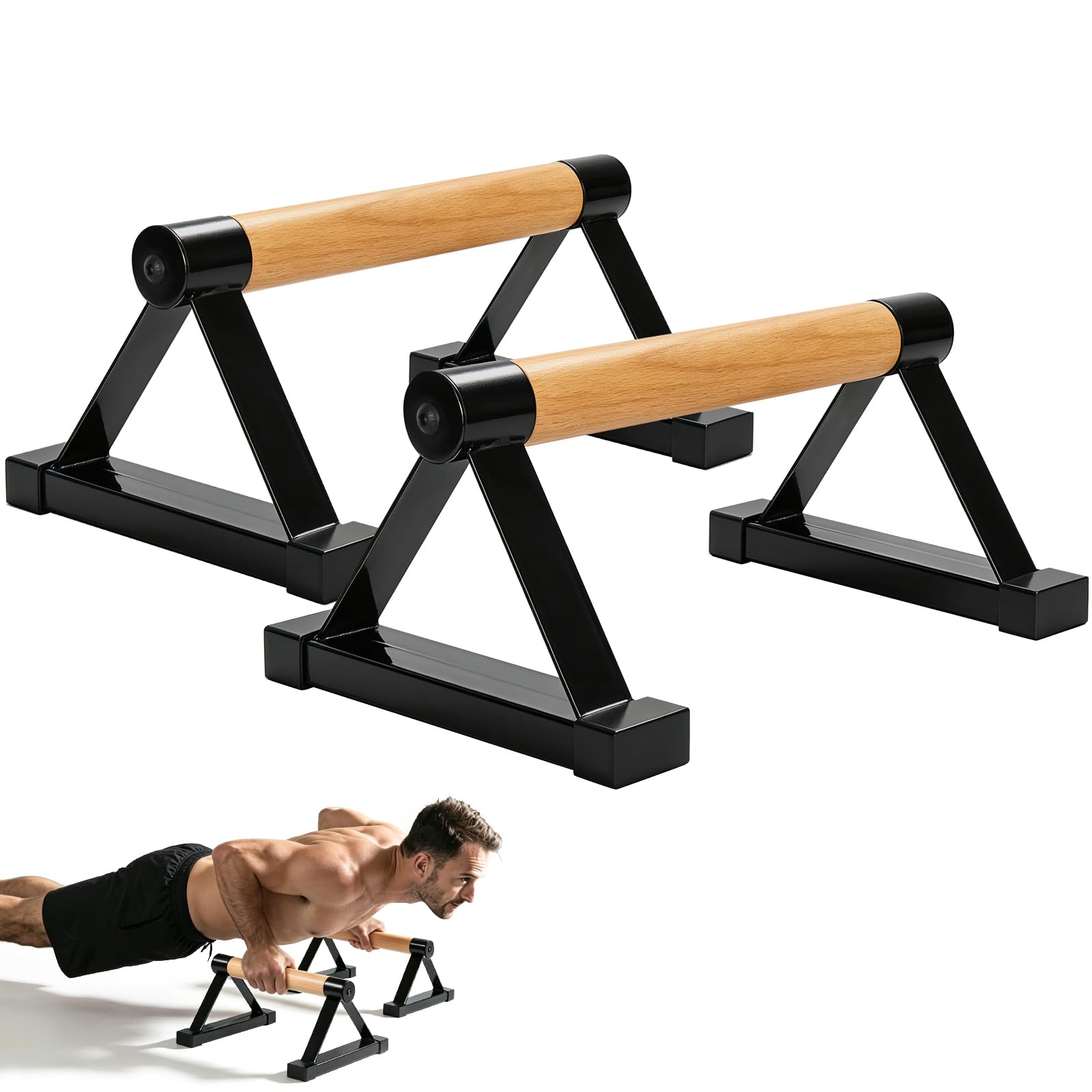
Woodpower PowerBars

Woodpower PowerBars

Push-ups and handstands

Our Score 9.6/10
Check Price

Worth Noting

  • Short 9.1-inch rails limit wide hands
  • Not tall enough for dip work
Height
3.9 in
Bar Length
9.1 in
Item Weight
2.9 lb
Weight Capacity
550 lb
Read the full review

Bare beech is the first thing you notice about the PowerBars, and it changes the feel of a push-up session. The handles are dry and slightly warm in the hand, not slick or squishy, and they stay that way as your palms heat up. The low 3.9-inch height puts your chest closer to the floor, which is exactly what you want for deep push-ups and handstand work.

What we like most is how much stability the small frame buys. The silicone pads sit flat on hardwood, and the 550-pound rating is far more than most home users need. At 2.9 pounds, the pair is easy to carry from room to room or tuck into a bag, and the low height keeps the bars out of the way when you set them down.

The finish is another small pleasure: the beech handles wipe clean and don't collect the sweat smell that foam can. We keep a towel nearby on humid days, mostly because wood grip depends on dry hands. The 5.5-inch base width is a better clue to stability than the tube diameter, and it's why these feel settled despite the low profile.

Bottom line: For low wooden bars that feel dry in the hands and stay put, the PowerBars are our pick — light, stable, and made for push-ups and handstands.

#3

airogym Wood Parallettes

airogym Wood Parallettes

Mid-height push-ups

Our Score 9.6/10
Check Price

Worth Noting

  • Not tall enough for dip work
Height
5.9 in
Bar Length
13.4 in
Item Weight
5.5 lb
Weight Capacity
600 lb
Read the full review

Five-point-nine inches is the number that makes the airogym pair interesting. It's taller than the little wooden bars, shorter than the 10- and 12-inch models, and close to the height many people settle into for L-sit holds without a big jump up. The wooden handles sit in a steel frame, so you get a dry grip without trusting an all-wood build.

That middle height is the sweet spot for a small home setup. The 600-pound rating is more than enough for most users, and the 8.9-inch base gives it a broader stance than the compact wood bars. We found the beech handles comfortable for push-ups and handstand holds, and the 5.5-pound pair is easy to move but not so light that it slides around.

The 13.4-inch rails are the one place it asks you to compromise: they suit a shoulder-width grip but leave less room for very wide hand positions. Assembly is simple, and the steel bracket adds a reassuring weight to the frame. If you want wood feel with more clearance than a low bar, this is the pair.

Bottom line: If you want a compact wooden bar with a little more height, the airogym pair is the sweet spot — dry-gripping, broad-based, and easy to store.

#4

Vita Vibe Large Parallettes

Vita Vibe Large Parallettes

Permanent home gym

Our Score 9.6/10
Check Price

Worth Noting

  • 13-pound set is a hassle to move
Set
Pair
Material
Wood
Bar Length
24 in
Item Weight
13 lb
Read the full review

The Vita Vibe set is the premium, furniture-grade option here. The 24-inch rails are long even by the standards of this group, and the natural wood finish looks more at home in a living space than the black steel frames. This is a pair you leave out, not one you fold away after every session.

The wood dowels feel smooth and substantial, and the metal braces keep the frame from flexing. The 13-pound set is heavy enough to stay put when you shift your weight, which is the point of a large wooden parallette.

Assembly is manageable, and the bars feel solid once the braces are tight. The rubber feet are the part to watch: they need a clean, smooth floor to stay planted, and a dusty garage can make any bar skate. Keep them wiped and the Vita Vibe feels as steady as its weight suggests.

What justifies the premium for us is the combination of length, finish, and heft. The 24-inch rails give wide-hand push-ups and L-sits room to breathe, and the wood stays comfortable without foam. For a permanent home-gym spot where looks matter as much as stability, this is the set we recommend.

Bottom line: If you want a long, substantial wooden parallette for a permanent home-gym spot, the Vita Vibe set is the premium choice — smooth, stable, and roomy.

#5

AmazeFan Parallettes

AmazeFan Parallettes

Budget L-sits

Our Score 9.4/10
Check Price

Worth Noting

  • Foam grips get slick with heavy sweat
Handle
Foam
Height
10 in
Bar Length
16.6 in
Item Weight
3.5 lb
Read the full review

The AmazeFan bars are the budget pair we point to when someone wants a taller bar without paying for a premium frame. The 10-inch height is the headline: tall enough for L-sit practice and handstand progressions, but shorter and less intimidating than the 12-inch models here.

The 16.6-inch rails are a useful length for push-ups, and the steel frame feels more substantial than the price suggests. At 3.5 pounds, the pair is easy to move from room to room, and the feet rotate to compensate for an uneven floor. That last detail is easy to miss in the listing, but it's the reason these feel more settled in a garage than a fixed-foot bar.

We think the adjustable feet are the feature that makes the AmazeFan worth choosing over the cheapest flat-footed bars. The foam grips are comfortable for push-ups, and assembly is straightforward; the bars break down small enough to store against a wall.

The 10-inch height is the smart compromise for a first parallette: enough clearance for L-sits, not so much that handstands feel like a leap. The frame won't match a premium steel bar for finish, but it gives a beginner room to grow without a big commitment.

Bottom line: The AmazeFan bars are the best budget route to a taller parallette — light, stable for the money, and easy to move around.

#6

TABEKE 12-Inch Parallettes

TABEKE 12-Inch Parallettes

Budget 12-inch bar

Our Score 9.4/10
Check Price

Worth Noting

  • Foam handles won't stay as dry as wood
Height
12 in
Bar Length
18 in
Item Weight
8.8 lb
Weight Capacity
660 lb
Read the full review

The TABEKE bars deliver the 12-inch working height of our top pick in a shorter frame. If the Lebert's 25-inch span is more bar than your space allows, this is the pair to look at. The 18-inch rails still leave room for push-ups and L-sits, and the frame is rated to 660 pounds.

The steel feels dense and planted, and the adjustable feet help on a garage floor that isn't perfectly level. At 8.8 pounds, it's heavier than the wooden bars but still easy to move with two hands. The full-coverage foam handles give you plenty of grip space, which is a comfort win for larger hands.

Assembly is quick, but the bolts need to be fully snug. That's the difference between a bar that sits still and one that rocks when you shift your weight. Tighten everything evenly before the first session, and the frame settles down.

What tips it for us is the combination of 12-inch clearance and a 660-pound rating in a footprint that fits a small room. The shorter rails are the trade-off: very wide hand positions feel cramped. For dips, L-sits, and handstands in a tight space, it's a lot of bar for the money.

Bottom line: The TABEKE bars are the value route to a 12-inch parallette — tall enough for L-sits and dips, with a stout frame and simple setup.

#7

Seleware Wood Push-Up Bars

Seleware Wood Push-Up Bars

Wide-hand floor work

Our Score 9.4/10
Check Price

Worth Noting

  • Wood grip can feel slick with heavy sweat
Height
4 in
Bar Length
15.7 in
Item Weight
3.5 lb
Weight Capacity
600 lb
Read the full review

Most low wooden bars here stop around 9 to 12 inches; the Seleware pair runs 15.7 inches, and that extra length changes how much you can move your hands. It's still a 4-inch-high bar, so think floor work rather than dips, but the longer rail gives push-ups and L-sit practice a more natural hand spread.

The steel bracket and triangular end supports give it a wider footprint than the simple T-foot wooden bars, and the 600-pound rating is reassuring. At 3.5 pounds, it's light enough to move, but the long rails make it feel more like a fixed piece of equipment than a travel bar. The non-slip mats under the feet are a better touch than bare metal.

The beech handles are smooth and easy to wipe down, and the grip is comfortable for push-ups and planche leans. For wide-hand floor work, that 15.7-inch length is the reason to choose it over the shorter wooden picks. The triangular braces are the detail that makes the length work; without them, a long low bar would feel tippy at the ends.

Bottom line: For a low bar with room to move your hands, the Seleware pair is our pick — long, strong, and more stable than its compact footprint suggests.

#8

Cali Sports Wood Parallettes

Cali Sports Wood Parallettes

No-assembly floor work

Our Score 9.2/10
Check Price

Worth Noting

  • 330 lb capacity is the lowest here
Height
3.9 in
Bar Length
11.8 in
Item Weight
3.3 lb
Weight Capacity
330 lb
Read the full review

The Cali Sports pair is the one that skips the hex-key stage. It arrives ready to use, with glued joints and security screws holding the wooden frame in line, and that no-assembly promise is more than a convenience: it means there are no bolts to recheck before a handstand. For a wooden bar that lives in a corner and comes out often, that's our no-fuss pick.

The wide base and full-length rubber strips are the reason it feels more planted than its low 3.9-inch height suggests. On hardwood, the whole rail sits on rubber instead of four small feet, so the bar resists skating when you lean forward. The 11.8-inch rails give a little more hand room than the shortest wooden bars without turning the pair into a storage problem.

The included wrist wraps are a useful extra, though they aren't the reason to choose the bars. The beech handles have a smooth, dry feel that suits push-ups and handstand holds, and the 3.3-pound pair is easy to move. The 5.9-inch base width is compact enough for a small apartment but wide enough to feel stable.

Bottom line: For a wooden parallette you can unbox and use, the Cali Sports pair is our no-fuss choice — wide-based, ready to go, and comfortable underhand.

How We Tested 12 Pairs of Parallettes

We started by pulling together every pair we could find that was actually available, then narrowed the list by reading through specs and customer reviews for repeated complaints about wobbling, stripped threads, slick grips, and confusing assembly. We filtered out anything with vague height or base-width measurements, and we prioritized pairs that came with clear instructions and replacement parts. That left us with 12 pairs to test over eight months.

Testing happened where people actually train: my living room floor, a garage gym with rubber mats, and a local park with uneven concrete. For each pair, I timed how long assembly took solo and then checked the joints after a week of daily handstand holds, L-sits, pike presses, push-ups, and dips. I noted whether the bars shifted on hardwood, sank into carpet, or skated across concrete, and whether the base felt wide enough during slow, controlled reps. Grip got tested with dry hands, chalked hands, and hands I'd deliberately dampened — if a pair spun during a sweaty push-up set, it went on the maybe pile.

Wrist support came down to angle and height: I paid attention to whether my wrists stayed neutral in a push-up position or felt cranked back, and whether the grip diameter let me hold on without clawing. I also weighed each pair and noted how much floor space it claimed when stored, because a pair that's a hassle to pull out doesn't get used. Value got the last word: a pair didn't need to be the cheapest, but it had to feel tight, stable, and well-finished after eight months of near-daily use. The picks below are the ones that passed all of that.

How to Choose Parallettes

Height and Rail Length Set the Exercise Menu

A four-inch bar is a push-up and handstand tool; a nine- to twelve-inch bar adds L-sit and dip clearance. That difference matters more than finish. If you want one pair for everything, start at 12 inches and a rail long enough for your hand width — our Lebert pick runs 25 inches, while the TABEKE pair covers the same height in 18. Low wooden bars like the PowerBars are more compact and closer to the floor, which suits push-ups and handstands but not dips. Measure your hand position and decide whether dips are part of your training before you buy.

Stability Is a Base-and-Feet Question

Look at the footprint, not just the tube thickness. A wide base and full-length rubber strips on the Cali Sports pair, or the silicone pads on the PowerBars, keep a bar from skating when you lean forward. On a dusty garage floor, wipe the feet before each session; grit defeats even good rubber. Thick carpet is the other trap because it lets a small foot sink and rock. Put a plywood board under the bars if the floor is soft. We prefer a slightly wider base to a narrower one that needs a perfect floor.

Handles: Wood, Foam, and Sweat

Wood is the grip most people prefer for calisthenics because it stays dry and gets better with use; foam and neoprene feel softer at first but can turn slick when you sweat. The PowerBars and Cali Sports use bare beech, while the Lebert and TABEKE use foam. None is wrong; match it to your hands. If you train hard and sweat heavily, wood plus a towel or chalk is the safer bet. If you want cushioning for push-ups and don't mind wiping the grips, foam is fine.

Load Rating, Assembly, and Where It Lives

Check the stated weight capacity and assembly before you fall for a frame. Most picks here are rated from 330 to 660 pounds; the number is a ceiling, not a recommendation, and you should stay well inside it. Bolted bars need the hardware snug — a loose bolt is what makes a parallette rock. If the bars will live in a closet, weight matters: the PowerBars are 2.9 pounds, while the Vita Vibe set is 13. If they stay set up, buy for stability and ignore the carry weight.

Frequently Asked Questions

Final Verdict

For most home setups, the Lebert Parallettes are the pair we recommend: the 12-inch height and 25-inch rails cover push-ups, dips, L-sits, and handstands, and the wide base feels planted without a permanent gym footprint. If you only want low wooden bars for push-ups and handstands, the Woodpower PowerBars are lighter, drier in the hands, and easier to stash. The TABEKE pair is the budget route to the same 12-inch clearance when the Lebert's length is more than your space allows.