Strength & Weights

Best Lat Pulldown Machines for Home Gyms of 2026

Few home gym upgrades deliver the same back-day satisfaction as a lat pulldown machine. It lets you train pulldowns, rows, and accessory work without driving to a gym, but the category has a built-in tradeoff: the sturdy machines that feel smooth under load are also the ones that take up real floor space and demand careful assembly. I learned that the hard way in a spare-room setup where a wobbly frame made every rep feel like a negotiation.

Over the past nine months, my team and I assembled and trained on eight lat pulldown machines, from compact cable stations to plate-loaded units, paying close attention to how they fit a home gym and what you actually get for the money. The pattern was clear: the best ones felt planted during heavy sets, ran without a hitch, and came with instructions that didn't leave us guessing. The picks below are the ones I'd happily keep using.

#1

Goimu LS01 Lat Pulldown

Top Pick
Goimu LS01 Lat Pulldown

All-around home gym

Our Score 9.2/10
Check Price

Worth Noting

  • Needs nearly seven feet of ceiling
Width
23.43 in
Height
83.46 in
Capacity
800 lb
Seat Positions
3 heights
Read the full review

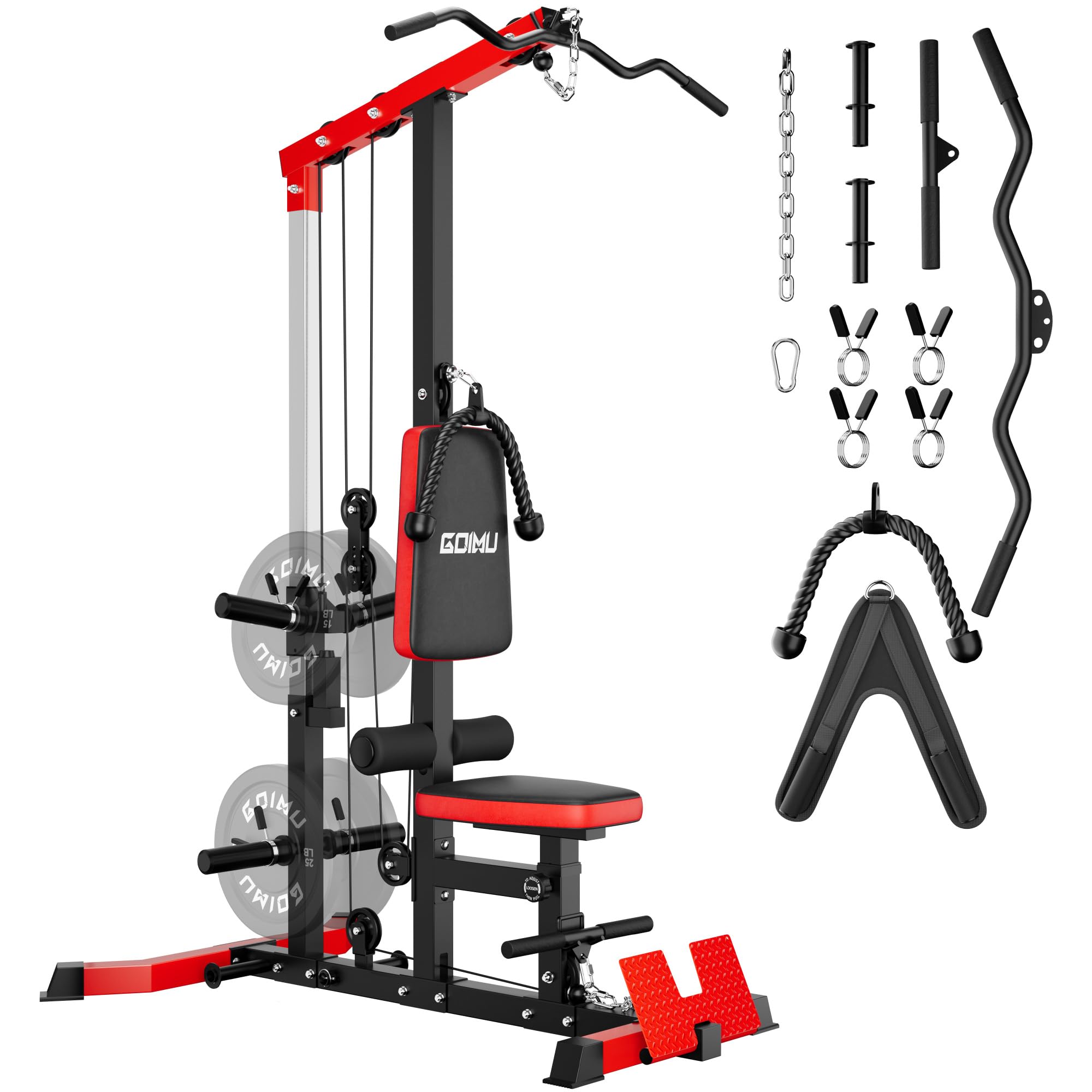
The Goimu LS01 earns the top spot because it gets the two things most home-gym buyers need right: a high pulley for lat pulldowns and a low pulley for rows, with an 800-lb rating that is the highest in this group. The 23.43-inch width makes it one of the narrowest full-height frames here, so it slips into a garage bay or spare-room corner more easily than the wider towers. We also like the three-height seat, which gives shorter and taller users a better chance of finding a stable pulling position.

The package is unusually complete for the money: a lat bar, cable bar, tricep rope, and ab-crunch attachment are included, so you are not hunting for a second order before your first workout. The 80-lb frame feels substantial enough to stay put during lat work, but it is still a two-person move into a tight corner. We appreciate that the 2mm steel tubing and 1-year warranty are stated clearly; those are the details that tell you what kind of machine you are buying.

The LS01 is the one we recommend first for a balanced home gym because it covers the two main cable movements without demanding a dedicated machine area. If you want a plate-loaded feel and can anchor the frame, the Titan is the step up; if you are working with standard 1-inch plates, the Powerline makes more sense. For everyone else, this is the default.

Bottom line: We recommend the Goimu LS01 as the default home lat tower: it pairs an 800-lb rating and high/low pulleys with a narrow frame, and the three-height seat helps it fit more users.

#2

Titan Fitness Plate-Loaded Lat Tower

Titan Fitness Plate-Loaded Lat Tower

Heavy plate loading

Our Score 9.0/10
Check Price

Worth Noting

  • Recommended to be bolted to the floor
Capacity
400 lb
Footprint
47 x 57 in
Frame Weight
120 lb
Loadable Sleeves
13 in
Read the full review

The Titan plate-loaded lat tower starts with a 120-lb frame, 13 inches of loadable sleeve, and a 400-lb rating. It has both a lat pulldown and a low row station, plus thigh pads with four positions. The design is deliberately simple: you load plates, sit down, and pull.

That simplicity is why we recommend it for a serious home gym. The plate-loaded resistance feels direct, and the heavier frame gives the tower a planted feel that the lighter cable machines here do not match. We also appreciate the 13-inch sleeves, which leave room for several plates without feeling cramped. It is the pick for someone who wants a focused upper-body machine and already owns Olympic plates.

The 47-inch width takes more wall space than the Goimu, and the 120-lb frame is a two-person move. For a garage gym with a dedicated spot, that bulk buys a machine that feels more like a gym fixture than the lighter picks here. If you need to fold something away after each session, this is not that machine.

Bottom line: We recommend the Titan plate-loaded tower for a dedicated garage gym: its 120-lb frame and 13-inch sleeves give heavy lifters a stable, direct pull, provided you can anchor it.

#3

Yes4All Lat Pulldown Machine

Yes4All Lat Pulldown Machine

Shared home gyms

Our Score 9.0/10
Check Price

Worth Noting

  • Lower 500-lb rating than the top pick
Height
76.5 in
Capacity
500 lb
Included
Lat bar, clamps, spare cable
Seat And Knee Levels
4 each
Read the full review

Four separate seat heights and four knee-pad positions are the reason the Yes4All lat pulldown stays on our list for a shared home gym. That range lets two people of different heights use the same machine without folding a towel under the seat or fighting the thigh pad. The rest of the package is sensible: a 500-lb rating, high and low pulleys, a lat bar, and an extra pulley cable.

We also like the 76.5-inch height, which is easier to fit under a basement ceiling than the taller Goimu. The 500-lb capacity sits between the budget machines and the plate-loaded Titan, and the high-low pulley layout covers pulldowns, rows, curls, and tricep work. For a household with different-sized users, the adjustment range is the feature that matters.

The Yes4All earns its place when four-level seat and knee adjustment is the thing you need. It is the one we point to when two or three people share the same machine, and for a family gym, that adjustability is worth more than bragging rights.

Bottom line: We recommend the Yes4All for a shared home gym: four seat and knee settings plus a 500-lb rating let different-sized users train on one machine without constant compromise.

#4

Powerline PLM180X Lat Machine

Powerline PLM180X Lat Machine

Standard plate sets

Our Score 8.4/10
Check Price

Worth Noting

  • 250-lb capacity limits heavy lifters
  • Assembly relies on a schematic, not instructions
Height
81 in
Capacity
250 lb
Warranty
10 years
Plate Compatibility
1 in standard; 2 in with adapter
Read the full review

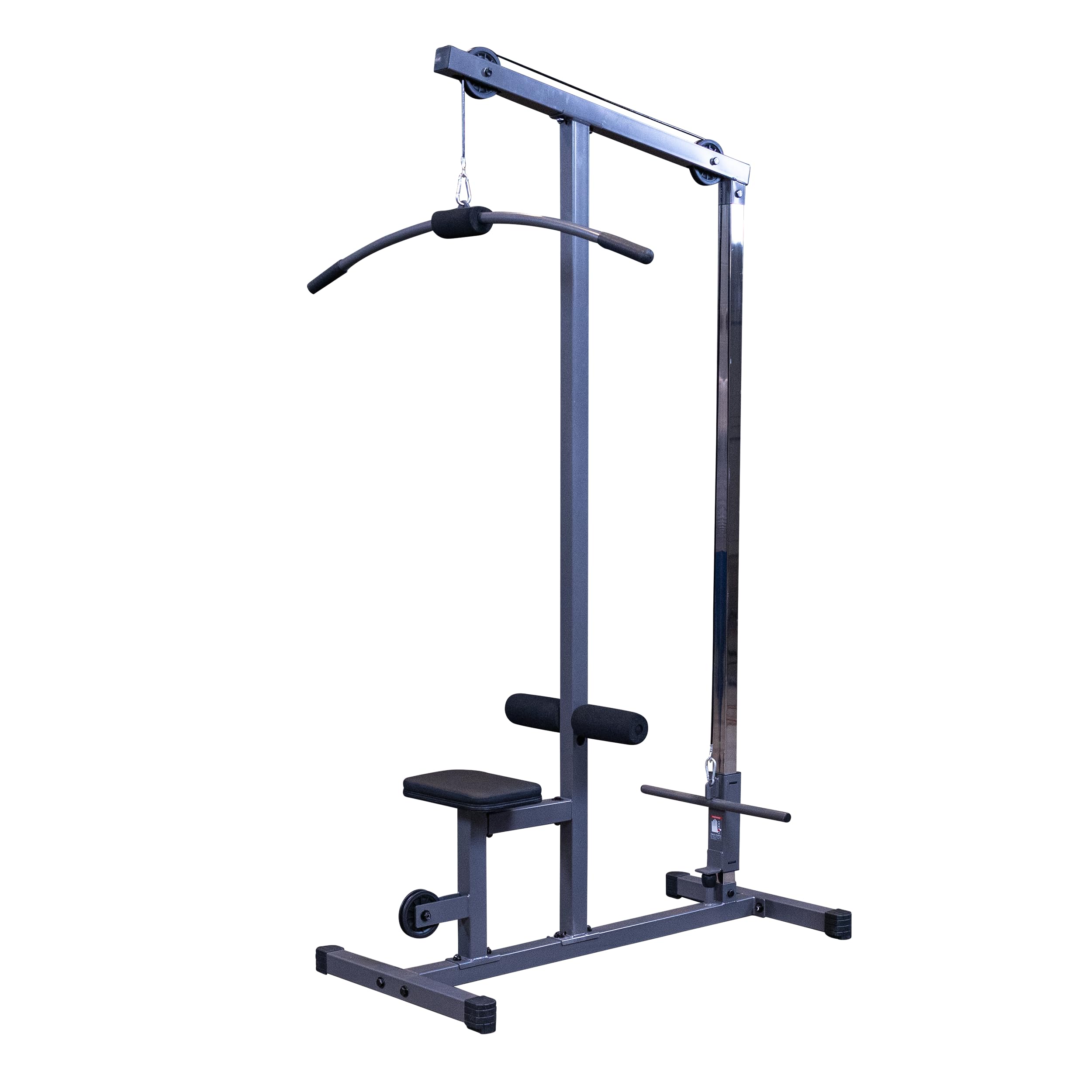
A 10-year warranty is the first thing that stands out on the Powerline PLM180X, and it is the reason we keep it in the conversation for a long-term home gym. The frame is 81 inches tall and 48 inches square, with dual-position foam rollers and a simple cable path. It takes standard 1-inch plates, with an upgrade path to 2-inch Olympic plates, so it is a natural fit if you already own a set of standard weights.

The included lat bar and low row bar mean you can train both movements out of the box, and the simple pulley layout is easy to understand and to inspect. We appreciate that nothing is hidden behind a plastic shroud; you can see the cable run and check it as part of your routine. That openness is part of the long-term appeal.

We recommend the Powerline for the home gym that is built around standard plates and a long ownership horizon. The 10-year warranty is the longest here, and the 48-inch square footprint is predictable to place. If your plates are Olympic, the Titan or Goimu makes more sense. For a standard-plate setup that will stay put, this is the sensible long-term choice.

Bottom line: We recommend the Powerline for a home gym built around standard 1-inch plates: the 10-year warranty and included lat and row bars make it a practical long-term buy.

#5

TOUSAINS CR63 Foldable Cable Machine

TOUSAINS CR63 Foldable Cable Machine

Low ceilings

Our Score 8.4/10
Check Price

Worth Noting

  • Whole-machine 400-lb limit
Height
62.99 in
Loading
Two dumbbells or 1 in and 2 in plates
Capacity
400 lb
Folded Footprint
2.92 sq ft
Read the full review

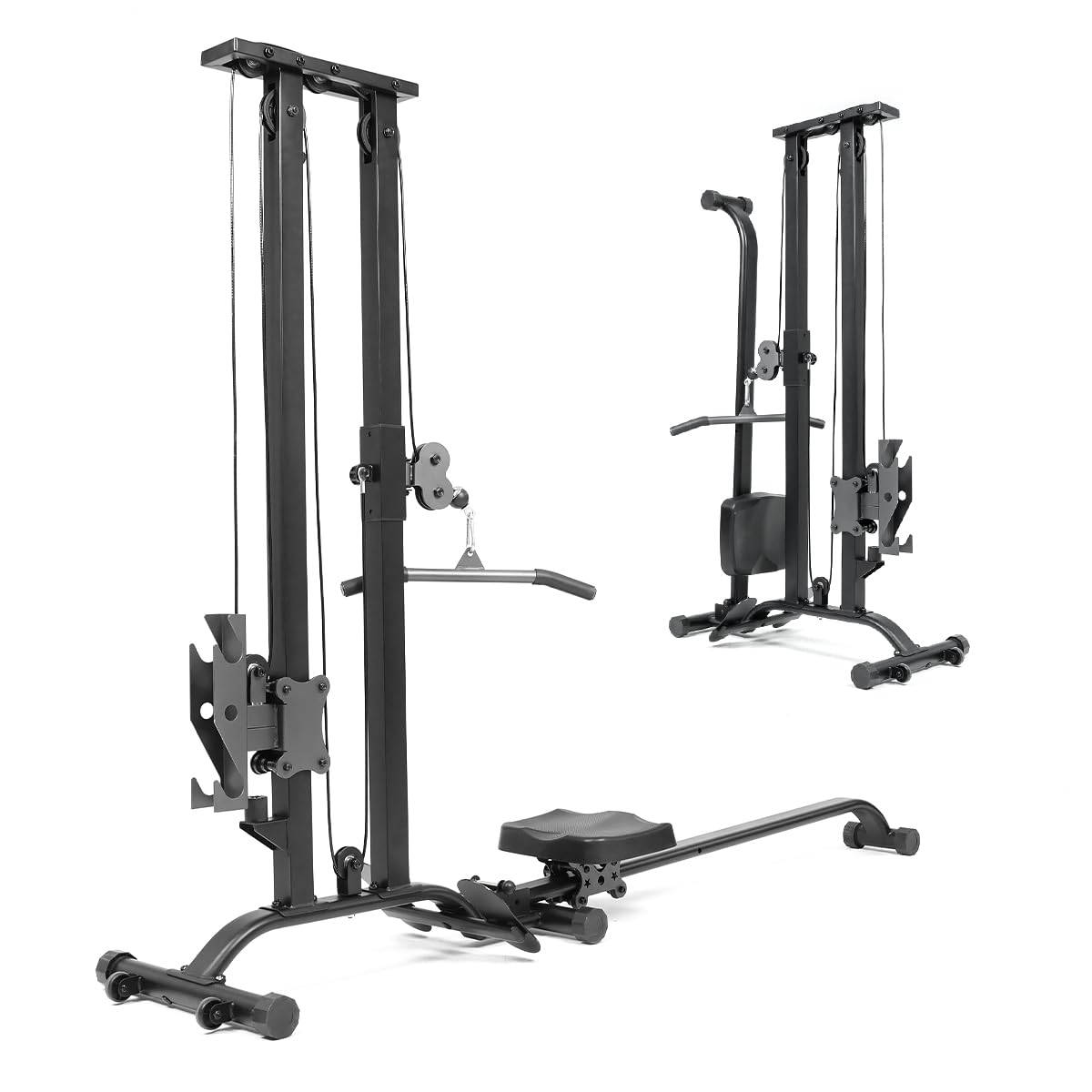
The TOUSAINS is 62.99 inches tall, so it fits under a standard seven-foot ceiling with room to spare, and it folds to about the size of a suitcase. That makes it a different kind of lat pulldown from the full-height towers: the frame is short, the footprint collapses to 2.92 sq ft, and it loads two dumbbells at once or standard 1-inch and 2-inch plates.

We recommend it for the apartment or spare room where ceiling height is the deciding constraint. The foldable frame is the feature that earns its place: you can set it against a wall between sessions and still have a dedicated lat pulldown and row station when you train. We also appreciate that the loading pins take dumbbells as well as plates, which makes it easier to start with the weights you already own.

The trade-off is the short frame. At 62.99 inches, it does not give a tall user the long lat stretch of a full-height tower. If you are much over six feet, measure your seated reach before ordering. For a low-ceiling room where a full tower will not fit, it is the compromise that keeps you training.

Bottom line: We recommend the TOUSAINS for a low-ceiling apartment or spare room: it folds to 2.92 sq ft and stands 62.99 inches tall, though taller users should expect a shorter pull.

How We Tested Lat Pulldown Machines

We built a shortlist by scanning current lat pulldown models, then filtering for footprint, weight capacity, mechanism type, and price so the group covered compact cable stations and larger plate-loaded rigs alike. We landed on eight machines and spent nine months using them in a garage gym and a spare-room setup, with several people cycling through pull days, rows, and accessory work.

Assembly came first. We timed how long each build took with one person, read the manual step by step, and noted where instructions were vague, hardware was easy to mix up, or a second set of hands was truly needed. Once built, we checked quality at the welds, joints, upholstery, and pulleys, then loaded each machine for heavy pulldowns and pulled from different angles to see whether the frame stayed planted or the feet lifted.

For smooth movement, we paid attention to whether the cable glided evenly or hitched, whether the seat and thigh pad held us in place, and how the lifting mechanism felt under slow, controlled reps versus quick sets. Cable durability got its own scrutiny: after repeated sessions we inspected for fraying, stretching, and rubbing at the pulleys. We also compared what each machine delivered against its price and asked the practical home-gym question—could it fit and function without dominating the room? The machines that scored best were the ones we stopped thinking about mid-set.

How to Choose Lat Pulldown Machines for Home Gyms

Start With Ceiling Height and Open Footprint

The first measurement is ceiling height, not price. A full tower can run from about 63 to 85 inches tall, and the tallest models leave almost no clearance under a seven-foot ceiling. Measure the open machine, not the folded footprint: the TOUSAINS folds to 2.92 sq ft, but it still needs room to unfold and for you to sit and pull. Also check the width at the base and whether the low pulley sits where you can row without hitting a wall. If the room is short, choose the low-ceiling model and accept the shorter pull.

Match the Resistance to the Plates You Own

Plate-loaded towers are the simplest and usually the most durable, but they only make sense if you already own the right plates. Standard 1-inch plates suit the Powerline; the Titan's 13-inch sleeves are built for Olympic plates, and some machines can take either size with an adapter. The Goimu's 800-lb rating gives the most headroom here, but check what the number actually rates: a whole-machine limit and a plate-load limit are not the same thing. If you do not own plates yet, budget for them before you choose the tower.

Adjust the Seat and Thigh Pads to Your Frame

Seat height decides whether a lat pulldown feels like a back exercise or a shoulder shrug. You want the seat set so your arms start long and your knees stay locked under the thigh pad; if the pad is too low, your body lifts, and if the top pulley is too short, you lose the stretch at the top. Three seat positions, as on the Goimu, cover most households; four seat and four knee positions, as on the Yes4All, are the better choice when several people share the machine. Check the thigh pad before you check the weight capacity.

Plan for Stability, Assembly, and Warranty

A lighter tower can walk or lift during low-row and curl work, especially if the frame is not anchored. If the machine will live in one spot, a floor-bolted plate-loaded tower is the most stable answer; if you rent or need to move it, choose a freestanding design and keep the base weighted. Assembly is the other ownership cost: some machines come with clear step-by-step instructions, while others rely on a schematic. Read the whole schematic before you start and keep the warranty paperwork.

Frequently Asked Questions

Final Verdict

The Goimu LS01 is the lat pulldown we recommend first for most home gyms: it has the high and low pulleys, the 800-lb rating, and the narrow frame that make a standalone tower worth the space. If you want a plate-loaded machine that feels planted and you can anchor it, the Titan is the better fit; if you are working with standard 1-inch plates, choose the Powerline. For a low ceiling, the TOUSAINS folds smaller, but accept the shorter pull.