Strength & Weights

Best Back Extension Machines for Home Gyms of 2026

A back extension machine is a hinge, a pad, and a frame: your hips stay pinned while your upper body levers up and down. That's either the most efficient way to train your lower back at home or the quickest way to tweak it, depending on whether the frame stays put. Photos don't tell you if the steel flexes, if the hip pad lands at your height, or how long assembly takes. What a good one fixes is repetition — with a bench in the corner, you'll do extensions on a Tuesday night instead of driving to the gym.

I've bought gym gear that seemed fine until month three. We assembled, adjusted, and lived with seven back extension machines over eight months, and a few things separated them: where the hip pad hit, how much the base walked under a hard set, and whether they earned the floor space. The picks below run from corner-tucking frames to full adjustable benches, so start with how much floor you can honestly spare.

#1

XDDIAS Roman Chair

Top Pick
XDDIAS Roman Chair

Custom fit

Our Score 9.2/10
Check Price

Worth Noting

  • Large footprint for a home gym
Footprint
59.6"D x 19.7"W x 49.8"H
Positions
11 pad heights, 8 backrest, 3 seat, 4 foot hook, 2 handle widths, 2 pad widths
Item Weight
47.4 lb
Weight Capacity
1,000 pounds
Read the full review

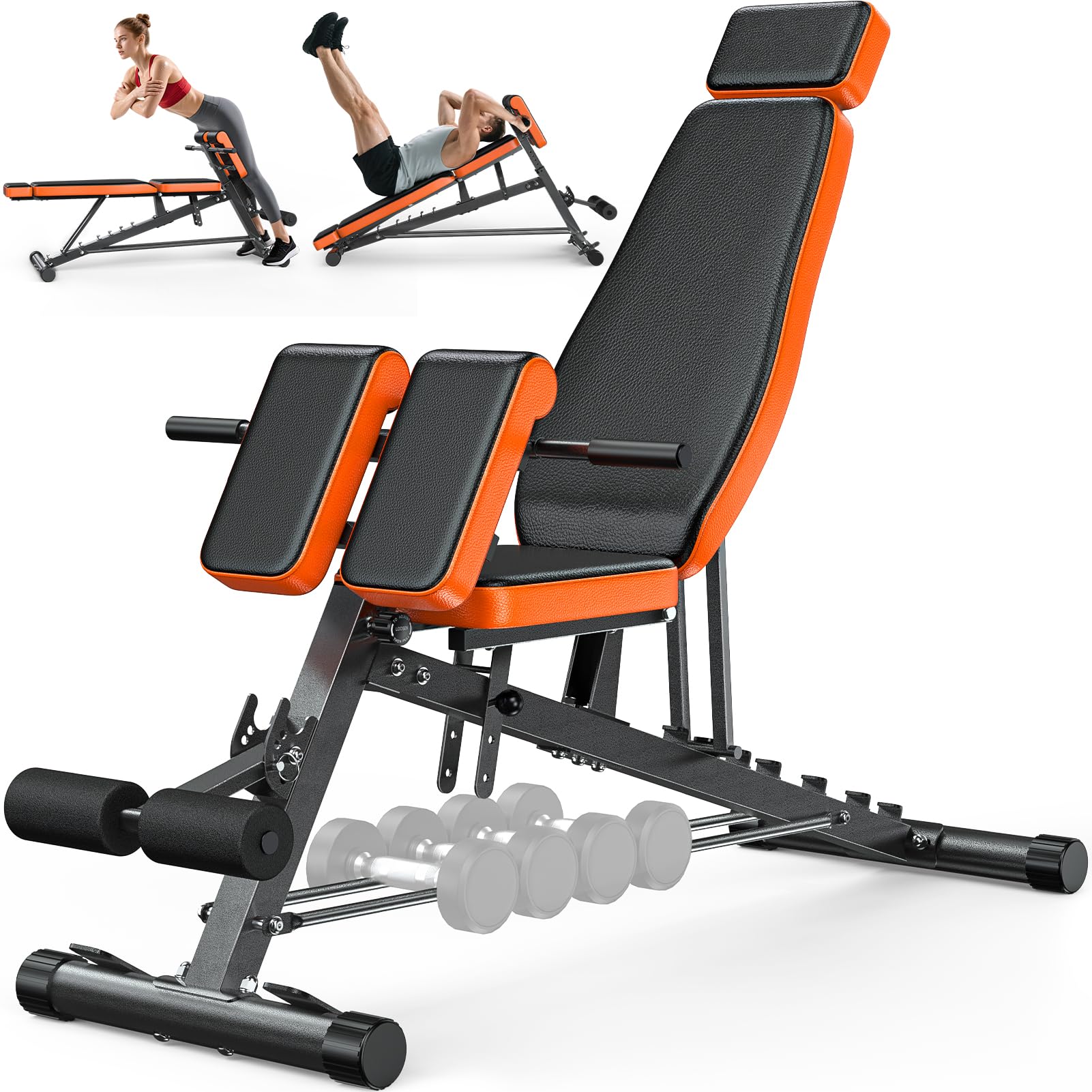
Width adjustment is the feature that sets the XDDIAS apart. Most back-extension stations give you one fixed pair of support pads; this one lets you narrow or widen both the pad and the handles, which changes how the load sits across your lower back, glutes, and obliques. We like that kind of control because fit is where a Roman chair either works or does not.

The rest of the package is just as adjustable: 11 support-pad heights, 8 backrest angles, 3 seat positions, and 4 foot-hook heights, plus a 47-inch head support designed for users up to 6 feet 6 inches. The 1,000-pound rating and 47.4-pound frame put it in the same heavy-duty class as the top pick. We noticed the narrower pad setting right away: it is useful for extensions, but it can feel narrow for bench pressing.

That narrow channel is the whole point for back work, but it is also the caveat for a lifter who wants one bench for heavy pressing. The XDDIAS is a serious adjustable bench and a Roman chair, not a wide competition bench. If your priority is a custom fit for extensions and you also want incline and decline work, this is the most flexible option here.

Bottom line: For a lifter who wants a Roman chair and a full adjustable bench with width adjustments, this is the most customizable pick here.

#2

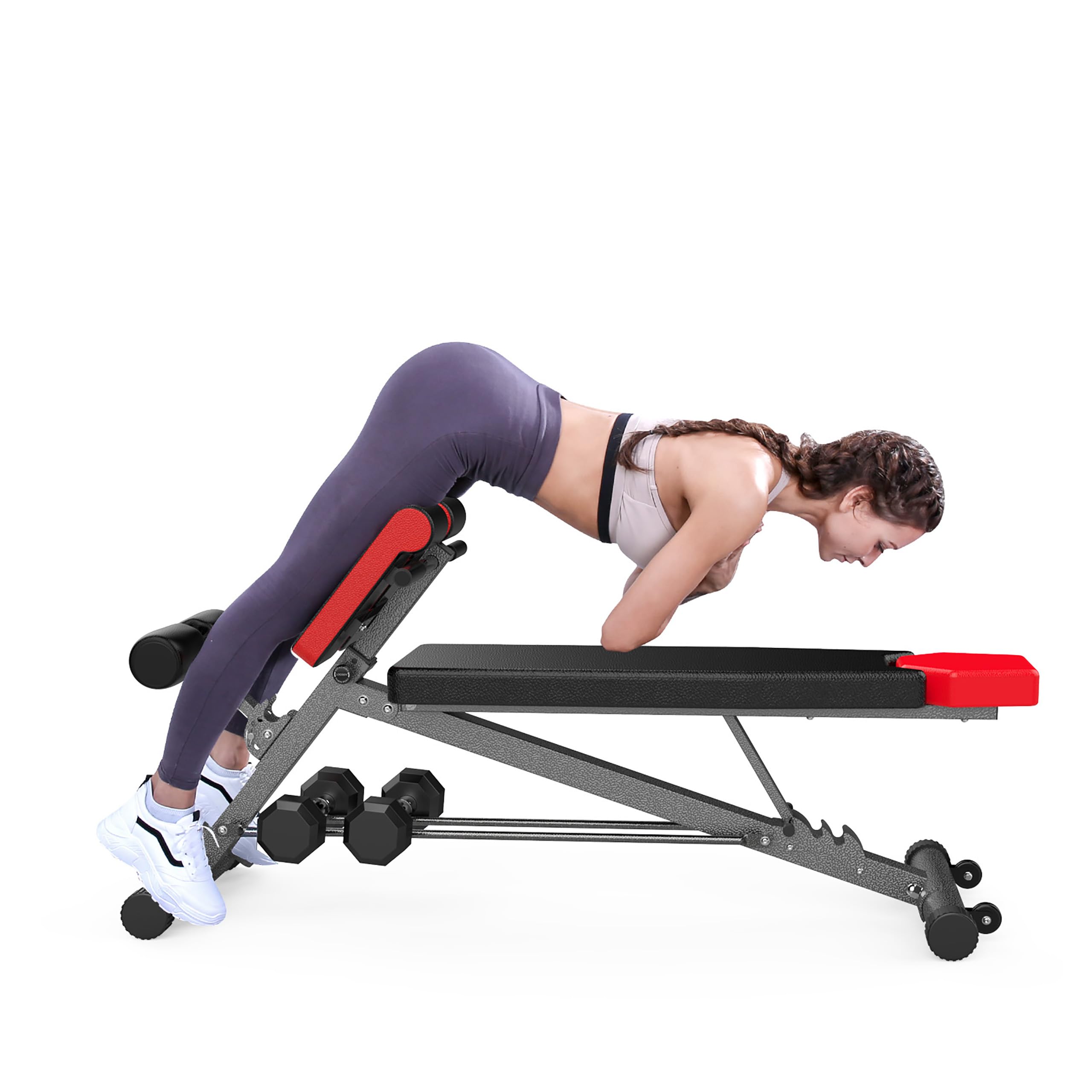
Finer Form FID Bench and Roman Chair

Finer Form FID Bench and Roman Chair

Full home gym

Our Score 9.0/10
Check Price

Worth Noting

  • Heavy and does not fold away
Footprint
62"D x 20"W x 30.25"H
Positions
8 backrest, 3 seat, 8 support pad, 4 calf
Item Weight
46.3 lb
Weight Capacity
1,000 pounds
Read the full review

Back-extension stations are usually one-trick machines, but the Finer Form FID bench earns its floor space twice. It works as a Roman chair and as an adjustable flat, incline, and decline bench, and the 1,000-pound rating is backed by a frame that feels substantial when you settle into position. What convinced us to make it the top pick is the adjustment range: 8 backrest positions, 3 seat positions, 8 support-pad heights, and 4 calf positions let you line up the hip pad instead of folding yourself around a fixed station.

That matters because a back extension is a fit exercise as much as a strength exercise. The pad has to sit below the hip crease, the ankles have to lock you in, and the torso has to hinge without catching on the seat. The Finer Form gives you more places to solve that than the dedicated benches here, so it suits households with more than one user. We also appreciated that the same bench handles chest presses and rows; it replaces a second piece of equipment rather than competing with it.

The frame is the other reason it rose to the top. At 21 kg, it has enough mass to feel planted when you shift your hips back, and the 20-inch stance gives you a stable base to load against. That is a different experience from a light folding chair, and it is why this is the bench we choose when you want one station to do more than one job.

Bottom line: Our top pick for a home gym that wants one adjustable bench to handle back extensions, pressing, and rows without adding a second machine.

#3

Teeter DEX II

Teeter DEX II

Back decompression

Our Score 8.8/10
Check Price

Worth Noting

  • Heavy at 60 pounds
  • Lap cushion comfort varies
Footprint
41"D x 29"W x 45"H
Item Weight
60 lb
Weight Capacity
350 lb
Inversion Posture
90/90 hip-supported
Read the full review

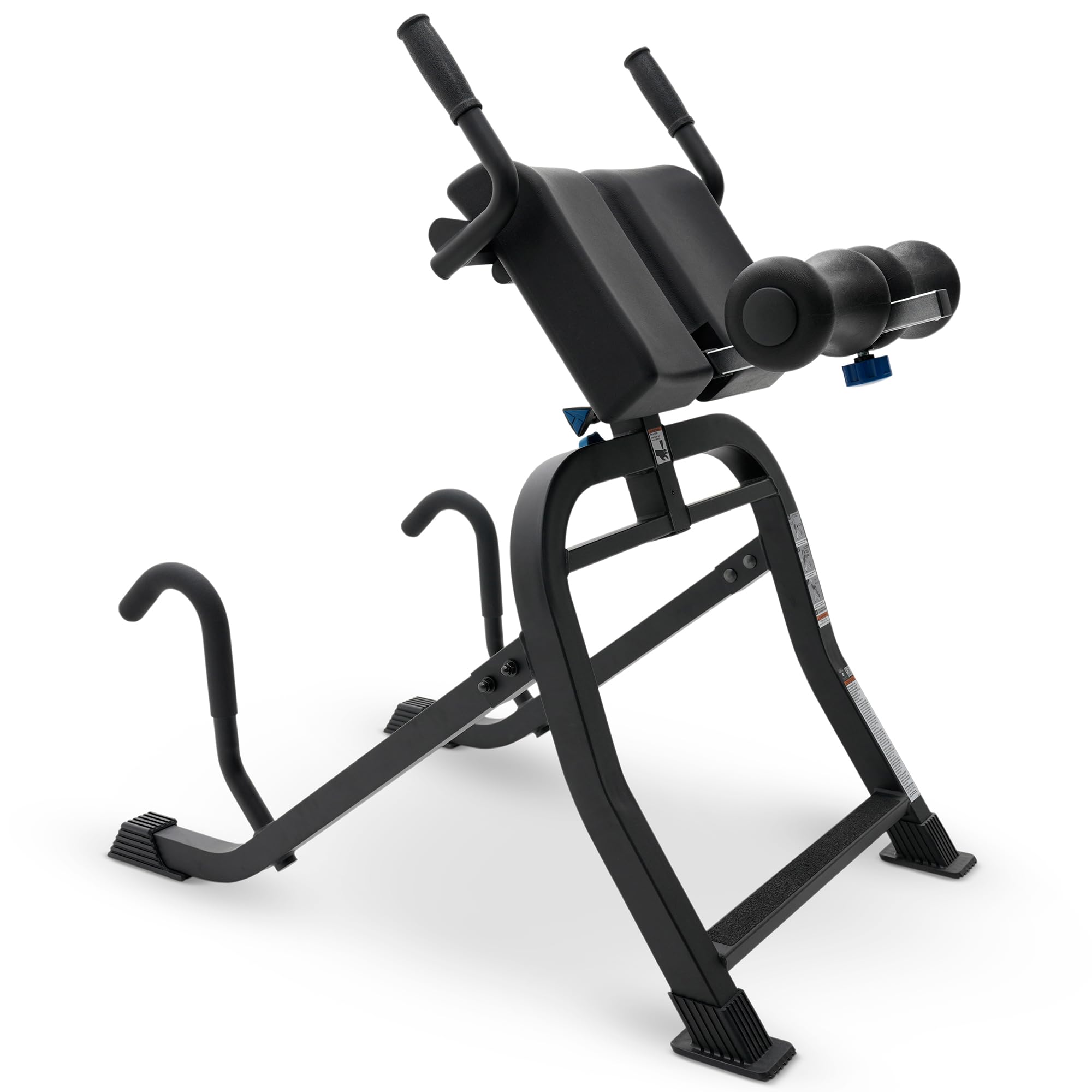
The Teeter DEX II is the pick for someone who wants more than a Roman chair. It combines a hip-supported inversion position with a back-extension station, so you can decompress and then train without buying two machines. The 90/90 hip-supported posture is the key: you rotate forward with your hips carrying the load instead of hanging from your ankles.

We were struck by how much the design changes the feel of a session. The contoured lap cushion and lower handles give you a place to control the rotation, and the 350-pound rating and 60-pound frame make it feel like a permanent piece of equipment rather than a folding accessory. The trade-off is that it takes up a 41 by 29-inch footprint and asks for a dedicated spot.

The DEX II is not the right first back-extension machine for every home gym; it is a premium tool for a buyer who specifically wants inversion and decompression alongside extensions. If you only want to train the posterior chain, a simpler Roman chair does that with less fuss. For the person who wants decompression as much as extension, the Teeter is the one we choose.

Bottom line: Worth it for a buyer who wants hip-supported decompression and back extensions in one premium station, not just a basic Roman chair.

#4

Finer Form Adjustable Bench and Roman Chair

Finer Form Adjustable Bench and Roman Chair

Value multi-function

Our Score 8.8/10
Check Price

Worth Noting

  • Instructions can be unclear
  • Adjuster can arrive misaligned
Footprint
60.5"D x 19.75"W x 16.5"H
Item Weight
38 lb
Weight Capacity
660 lb
Back Extension Levels
8
Read the full review

The original Finer Form bench is the value route to the same multi-function idea as our top pick. It has 8 back-extension levels, a flat-to-decline range, and a 660-pound rating, all in a 38-pound frame. We like it for a home gym that wants one bench for rows, presses, and extensions without stepping up to the heavier FID model.

The lower weight is both the appeal and the catch. At 38 pounds, it is easier to move around a small room than the 21 kg Finer Form, but it also gives up some of the planted feel when you load it heavily. The 60.5-inch length gives you room to lie back for presses, and the 8 back-extension levels are enough to change the emphasis without turning setup into a project.

The simple adjustment set is another difference. You do not get the same number of support-pad positions as the top pick, so a household with very different body types may have to compromise. The trade-off is easier setup and a lower weight to move, which matters if the bench doubles as a pressing station in a small room.

Where this bench earns its place is the mixed routine: a set of extensions, then rows, then presses, without moving to another machine. It is not the last word in stiffness or fit, but it is the one we point to when the budget and the floor space are both finite.

Bottom line: A good lower-cost multi-function bench for moderate loads, though it gives up some of the top pick's capacity and adjustment range.

#5

FITKS360 Hyper Back Extension Roman Chair

FITKS360 Hyper Back Extension Roman Chair

High-capacity folding

Our Score 8.8/10
Check Price

Worth Noting

  • Hardware can arrive missing or loose
Foldable
Yes
Positions
8 height, 5 angle
Item Weight
30.8 lb
Weight Capacity
440 lb
Read the full review

A 440-pound rating on a folding Roman chair is unusual, and that is why the FITKS360 caught our attention. It uses a 30.8-pound frame, folds flat, and still offers 8 height positions and 5 angle settings. For a small home gym with a heavier lifter, that combination is the reason it earns a place here.

The angle adjustment is the useful part: changing the bench angle shifts the work between the lower back, glutes, and hamstrings, and five settings give you more range than a fixed-angle chair. The 43 by 26-inch footprint is stable enough for a folding design, and the 19-inch height keeps the station low.

The folding mechanism is the part we treat with care, because a hinge that makes storage easy is also the joint that has to lock every time. If you want a high-capacity chair that tucks away, this is the one to shortlist; if you want the most proven frame here, the top pick is the safer call.

Bottom line: A high-capacity folding Roman chair for small gyms, with the caveat that you should inspect the hardware on arrival.

#6

Marcy Adjustable Hyper Extension Bench

Marcy Adjustable Hyper Extension Bench

Dedicated back work

Our Score 8.6/10
Check Price

Worth Noting

  • Fit runs short for taller users
  • Padding may feel thin
Footprint
27.5"D x 43.5"W x 37.5"H
Item Weight
42 lb
Leg Support
Adjustable two-foam holders
Weight Capacity
308 lb
Read the full review

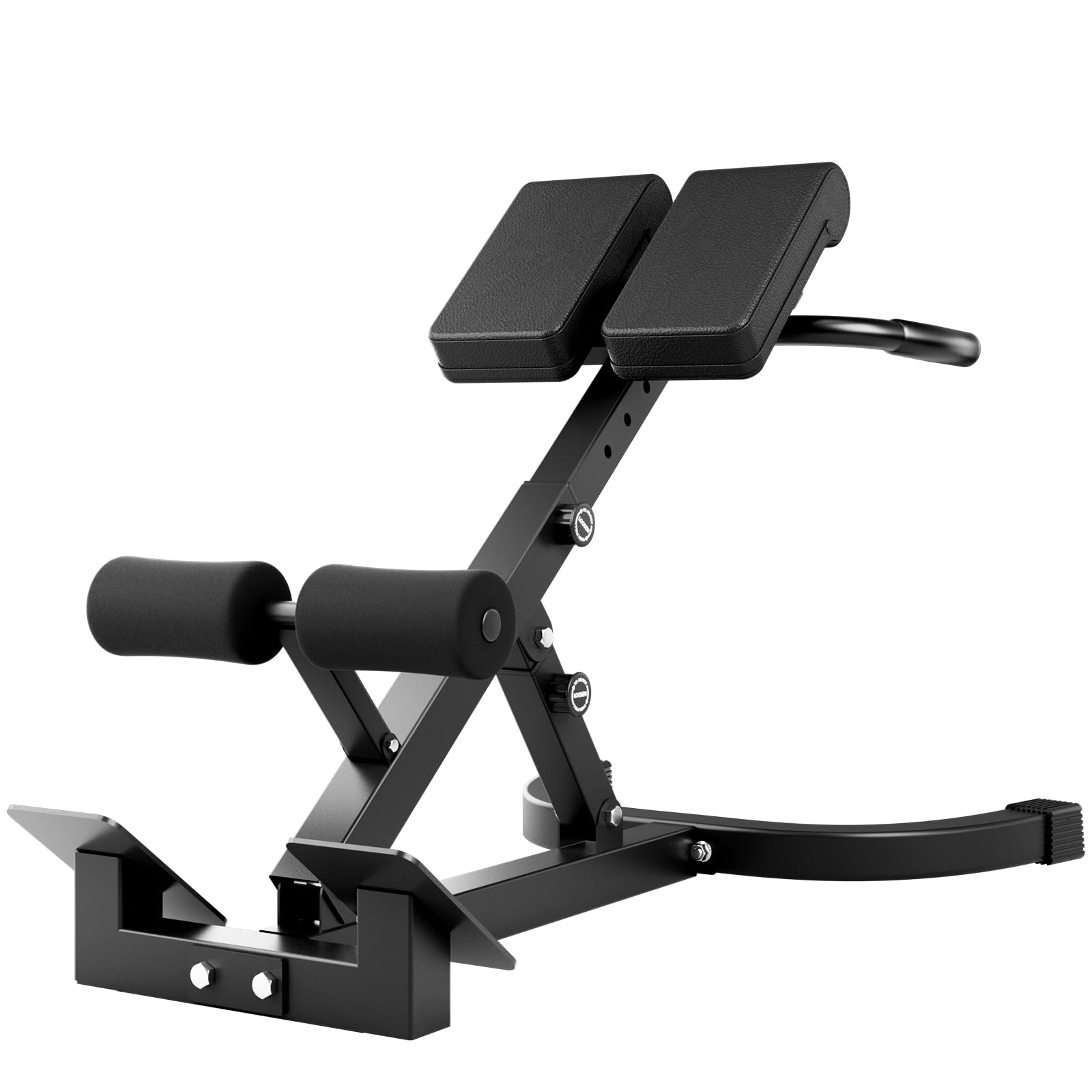
The Marcy is the least complicated machine here, and that is its appeal. A 42-pound steel frame, a 308-pound rating, and a single 45-degree station leave little to fiddle with. We like that directness: you set the leg holders, get your hips on the pad, and train. The 43.5-inch-wide base gives it a planted stance, and the back support is the strongest of the dedicated chairs in this group.

The hyperextension angle is the classic one, and that makes it easy to feel the glutes and hamstrings working rather than fighting the equipment. The padded handles give you a place to stabilize, and the two-foam leg holders adjust to different leg lengths. We also found the wide frame gives you room to turn around for sit-ups, which adds a little value if you want one station for back and abs.

What the Marcy does not give you is a lot of adjustment. It is a station for the classic extension movement, and it is happiest when it stays out in a dedicated spot. If you want a machine that does one thing well and does not ask for a manual, this is the one we point to before the multi-function benches.

Bottom line: A classic hyperextension bench for buyers who want a planted, dedicated station and do not need it to fold into a closet.

#7

LifePro SculptTrainer Roman Chair

LifePro SculptTrainer Roman Chair

Small spaces

Our Score 0.0/10
Check Price

Worth Noting

  • Folding base can need re-leveling
Foldable
Yes
Item Weight
19.8 lb
Weight Capacity
330 lb
Height Positions
10
Read the full review

A Roman chair that folds flat is a different kind of purchase. The LifePro SculptTrainer is a dedicated back-extension station, not a full weight bench, but it weighs 19.8 pounds and folds down so you can slide it under a bed or stand it against a wall. We like the honesty of the design: it does one job, and it gets out of the way.

The padded ankle rollers, hip pad, and handles make it easy to settle in for extensions, side bends, or incline push-ups. The 38.2 by 22.2-inch footprint is compact without feeling like a toy, and the 10 height positions give you a real chance of matching the pad to your hips. We paid close attention to the folding joint because that is where a storable chair either earns trust or loses it.

What keeps this from being a universal pick is the light frame. It is a bodyweight-first machine, and that is the job it does well. For a spare room and a moderate routine, the SculptTrainer is the one we reach for because it disappears when the workout ends.

Bottom line: A smart buy for a small home gym: it folds flat, weighs about 20 pounds, and handles back extensions without taking over a room.

How We Tested Back Extension Machines (and What Held Up)

We started with every back extension machine we could find that listed a weight capacity and a height range, then cut anything that wouldn't clear a standard doorway or that topped out under 250 pounds. Seven made the cut, and we've lived with them for eight months.

Assembly came first, done solo with only the included instructions and a socket set, timer running. We noted where the diagrams didn't match the hardware and how much of the build really needed a second pair of hands. Each machine got measured at its footprint and at its folded position, then walked through a doorway to see if it went where people claimed it would.

Then the real work: three sets of 12 to 15 extensions, four mornings a week, in a basement gym and a spare-room corner. Testers of different heights checked whether the hip pad landed at the crease instead of above or below it, and whether the ankle rollers held or bent under a heavy set. We shifted weight side to side mid-rep to see if a foot lifted off the floor, and noted where padding pressed into the hip bones.

Every few weeks a wrench went over every bolt to see what had loosened, and we looked for paint chips, wobble at the welds, and foam starting to crack. Value came down to whether the adjustments people actually use justified the price: a bare frame that fits you beats a loaded bench that doesn't.

How to Choose a Back Extension Machine

Start With Stability and Weight Capacity

Back extensions are a low-load movement for many people, but the machine still has to resist sideways movement when you shift your hips. Look for a wide base, a frame that does not flex at the adjuster, and a weight rating with margin above the user's body weight. A 250-pound rating can be fine for a light household; it is not the right choice for a 240-pound lifter. The top pick's 1,000-pound frame and the LifePro's 330-pound rating sit at different ends of that decision.

Fit Is More Than Height

The hip pad should sit just below the crease of your hip so you can hinge without the pad digging into your stomach. Height ranges matter, but so do support-pad width and foot-roller position. A split pad gives you room for side bends and better clearance; a single pad can feel more supportive for straight extensions. If two people share the machine, prioritize adjustments you can change quickly. The XDDIAS's two pad widths and the Finer Form's 8 support-pad positions are the kind of range that solves this.

Dedicated Station or Multi-Function Bench?

A dedicated Roman chair is smaller, simpler, and usually quicker to get into position. A multi-function bench adds pressing, rows, and incline work, but it takes up more floor space and can compromise the pad shape for extensions. If you already have a bench, buy the dedicated chair. If you are building a home gym from scratch, the Finer Form FID bench replaces two purchases. The Marcy is the dedicated option to keep out; the Finer Form is the one to leave set up.

Storage, Assembly, and Comfort

Folding matters if the machine shares a room with a car or a couch. A 19.8-pound chair that folds flat is easy to move; a 60-pound inversion station is a permanent commitment. Assembly is also part of ownership: check that the box has all hardware before you start, and tighten the frame in stages so the base sits level. Padding is personal, but a split pad and rounded ankle rollers are usually kinder on the hips and shins than a single flat pad.

Frequently Asked Questions

Final Verdict

The Finer Form FID bench is our default because it gives you a real Roman chair and a serious adjustable bench in one frame, with a 1,000-pound rating and enough pad positions to fit different bodies. If you need to fold the machine away after every session, the LifePro is the better buy; if you want a single-purpose station and do not care about bench work, the Marcy is the more direct choice. Start with the job your room can support.