Strength & Weights

Best Functional Trainers for a Home Gym of 2026

A functional trainer is two adjustable cable columns and a weight stack — which sounds simple until you realize it replaces a rack of single-purpose machines with one footprint against a wall. That's the appeal: chest flies, lat pulldowns, rows, and triceps pushdowns without leaving the same patch of floor. What it fixes is the commute, the crowded cable area at the gym, and the workout you skip because getting there ate the hour. What it doesn't fix is a bad cable.

I've kept a functional trainer in my garage for three years, and the gap between a good one and a cheap one shows up around rep ten, not rep one. Over the past nine months, my team and I assembled, loaded, and lived with six machines, from compact single-stack units to full double-column rigs. What first-time buyers miss: published stack weight matters less than how the cable feels at 10 pounds, where warm-ups and rehab work live. The six picks below are the ones I'd bolt to my own wall again.

#1

Body-Solid Powerline PFT100

Top Pick
Body-Solid Powerline PFT100

Heavy lifters

Our Score 9.2/10
Check Price

Worth Noting

  • 62.6-inch frame needs a dedicated wall
Footprint
62.6"W x 42.3"D
Resistance
210 lb max
Weight Stacks
Two, independent
Frame Warranty
10 years
Read the full review

The Powerline PFT100 is the machine here for someone who actually loads a trainer up. Body-Solid fits two independent weight stacks rather than one shared stack, so each arm pulls its own resistance and a single-arm row doesn't drag the other handle with it. For isolateral pressing, unilateral work and anything where you want to feel one side working against the other, that changes the exercise rather than just the convenience of it.

At 62.6 inches across, the extra-wide mainframe is the other half of the argument. Flies and crossovers start with the cables genuinely apart, and the pulley housings glide quietly through the rep without the rattle you half expect from a crossover at this level. We paid close attention to that glide under load, and it held.

The build is 476 pounds of powder-coated steel with ten years of warranty on the frame — the number we care about most on a machine this size, because it is going to sit in one spot for a decade. The pulley routing is the slow part of the build; lay the parts out in order and it goes faster.

Bottom line: Two independent stacks and the widest cable spread of the stack machines: this is the trainer for a lifter who wants to train heavy at home and has the wall for it.

#2

Inspire Fitness FTX

Inspire Fitness FTX

Small studios

Our Score 9.2/10
Check Price

Worth Noting

  • 165 lb stacks limit heavy lat work
Footprint
40"W x 54"D
Unit Weight
544 lb
Weight Stacks
Two 165 lb
Included Attachments
Four
Read the full review

A stack-based functional trainer usually asks for a garage. The FTX doesn't: at 40 inches wide and 54 deep it slides into the corner of a small studio and still gives you two selectorized stacks, so going from a warm-up to a working set is a pin move rather than a plate shuffle.

The extras are where the FTX earns its keep. There's a shelf for a phone or tablet, a rack that keeps the attachments off the floor, and four of them in the box — a tricep rope, two D handles, a dual-hook curl bar and a chin/dip belt — along with three months of the Centr training app. The dip belt is the unusual inclusion, and it turns the machine into somewhere to do weighted pull-ups as well as presses.

What surprised us is how little the compact frame costs you in feel. The pulley travel is smooth, the weight changes are instant, and the whole thing reads as a commercial machine rather than a home one. Where it does bite is spread: 40 inches across is not a crossover, so flys finish closer to your chest than they would on the Powerline. It is also the most expensive pick here — the one we hesitated over on price, before the corner-footprint argument won us back.

Bottom line: The functional trainer for a small room and a serious budget: two real stacks, four attachments and a corner footprint, as long as 165 pounds a side covers your lifting.

#3

DONOW DN-5011 Cable Crossover

DONOW DN-5011 Cable Crossover

Wide cable work

Our Score 9.2/10
Check Price

Worth Noting

  • Low-pulley resistance is a fraction of the loaded weight
Footprint
79.7"W x 56"D
Pull-up Bar
Included
Frame Weight
Over 250 lb
Pulley Positions
16
Read the full review

Seventy-nine inches of cable spread is the number that makes the DN-5011 worth a look. It is the widest machine here, wide enough that a cable fly starts with your arms genuinely apart instead of pinched in front of your face, and if your training leans on crossovers, rear-delt work and rotational movements, that width is doing real work every session.

It is also the only freestanding pick here with a pull-up bar, and with 16 positions on independent pulleys plus a lat bar and stirrup handles on rolling bearings, it covers the high-to-low range without a wall anchor. Watch the assembly video before you start — the cable routing is the part that slowed us down, and the machine arrives in three boxes, so clear a stretch of floor and an afternoon.

The frame is over 250 pounds of steel, and we appreciated that it stays planted when you pull hard: no walking, no wobble at the top of a crossover. As a chest-and-shoulders station with a pull-up bar attached to it, it makes a case a wall-mounted unit can't match in a spare room or a garage.

Bottom line: Buy it for the cable spread and the pull-up bar, at a freestanding price the stack machines can't touch — as long as your heavy pulling happens elsewhere.

#4

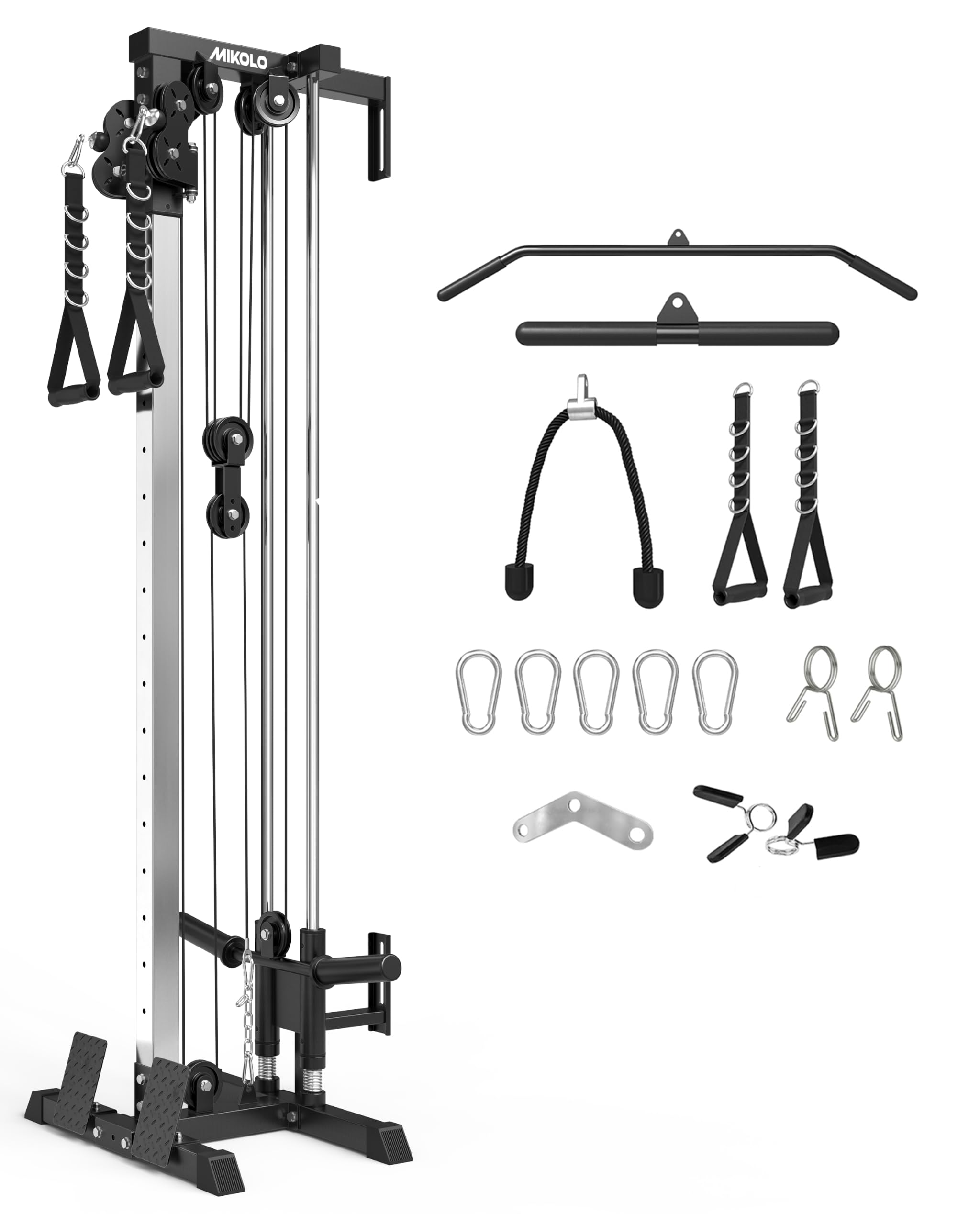
Mikolo M-G3 Cable Station

Mikolo M-G3 Cable Station

Most home gyms

Our Score 9.0/10
Check Price

Worth Noting

  • No weight stack; you supply the plates
Footprint
25.6"W x 26.9"D
Max Weight
400 lb
Pulley Positions
19
Seated Row Footboard
Included
Read the full review

The detail that sold us on the Mikolo M-G3 is the footboard. Wall-mounted stations usually hand you a low pulley and leave you bracing a foot against the wall to row; Mikolo builds out a wide plate you can plant both feet on, which turns the bottom of the machine into a proper seated row and lets you lean into the pull instead of fighting for balance. On a frame that stands a little over two feet off the wall, that is a lot of back work recovered.

Nineteen pulley positions is what makes this the pick for most home gyms: high enough for lat pulldowns and face pulls, low enough for chops and rows, and quick enough to change between sets. The 400-pound rating is the highest of the wall-mounted machines here, and the two pulleys run independently, so a single-arm press doesn't drag the other handle across your chest. The weight pegs are angled upward so plates sit without slipping, and detachable sleeves let the machine take either 1-inch or 2-inch plates.

We found setup straightforward — the frame goes up in a few large pieces and the cable routing is laid out in order. The only thing to watch long term is the carriage: it runs on guide rails, and a dry rail is what turns a smooth pull into a sticky one.

The catch is the wall. This isn't a machine you move house to house, and it wants solid anchoring — plan on masonry or a properly braced stud bay before you order, and measure the ceiling, because the frame stands 82 inches tall. If either of those rules you out, a freestanding trainer is the honest answer.

Bottom line: For most home gyms this is the functional trainer worth buying: nineteen pulley heights, a 400-pound rating and a footboard that makes low rows worth doing, on one wall.

#5

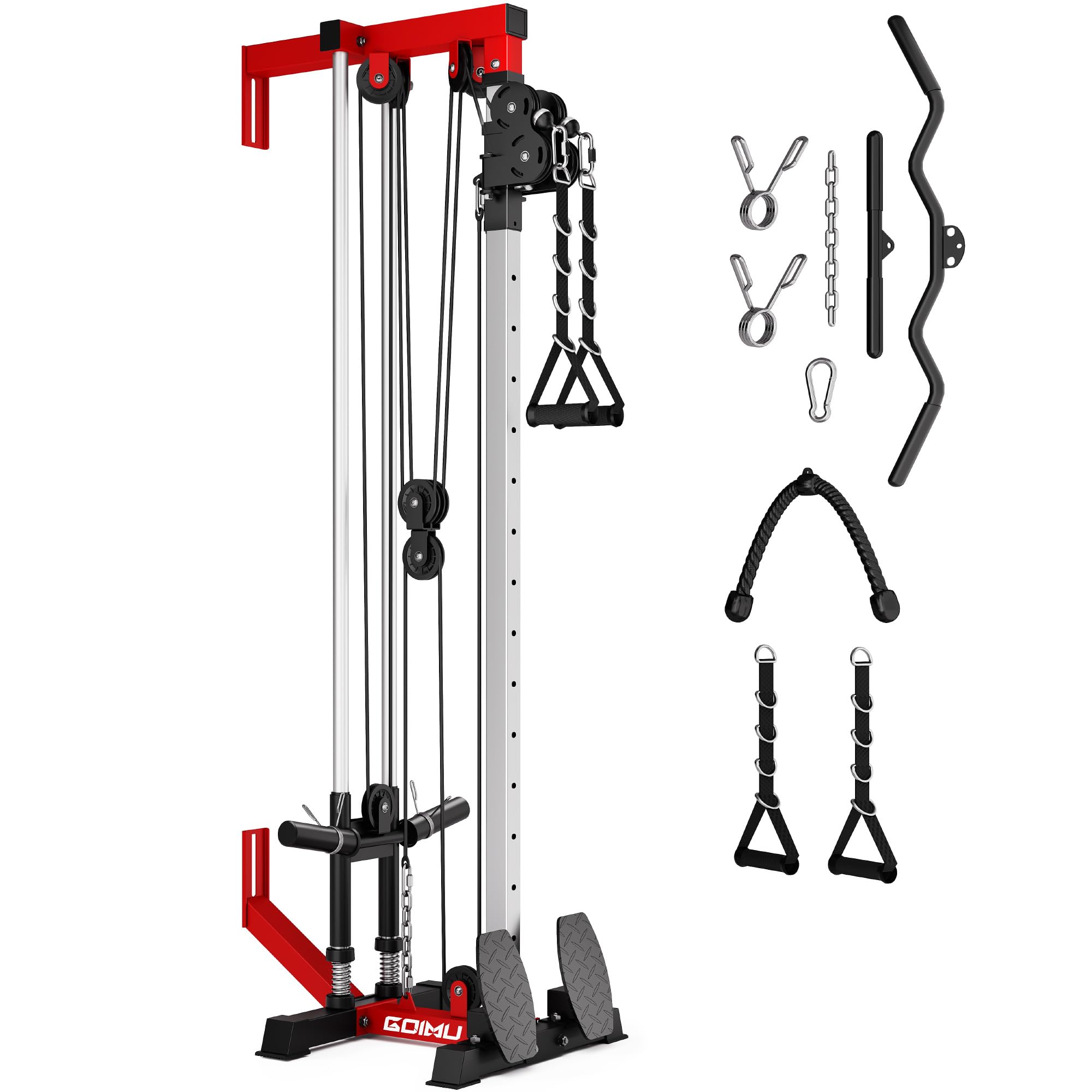
Goimu WM1 Cable Station

Goimu WM1 Cable Station

Tight budgets

Our Score 9.0/10
Check Price

Worth Noting

  • 300 lb rating is below the Mikolo's 400 lb
Footprint
24.8"W x 28.1"D
Max Weight
300 lb
Pulley Ratios
1:1 and 2:1
Pulley Positions
17
Read the full review

The WM1 asks one thing before it gives you anything: a solid wall. Goimu specifies concrete or masonry for the mount, and everything about the machine rests on that anchor — bolted properly it is stable enough to load hard; on anything less, it isn't a machine to load at all. Renters and drywall-only rooms should stop here.

Get that right and the WM1 is the best value in this group. Seventeen pulley positions cover high pulls through low chops, and the cable adaptor flips the pulleys between a 1:1 and a 2:1 ratio — the 2:1 setting roughly halves the resistance, which is the setting we reach for on drop sets, warm-ups and teaching someone a new movement before loading them up.

The 78.7-inch frame is the shortest of these, which is welcome under a low basement ceiling, and the box includes a T bar, lat bar, rope and a pair of handles — enough to run pulldowns, rows, triceps and face pulls from the first session. Nothing about it feels improvised. For a first cable machine against a garage wall, that is the whole job.

Bottom line: A full cable station for the price of a decent barbell set, provided you have concrete or masonry to bolt it to and don't need the highest rating here.

How We Tested Six Functional Trainers

We started with a dozen machines and cut the list to six using specs you can check before you buy: footprint, stack style, pulley height range, and whether basic movements required a proprietary attachment. The six that arrived were a mix of single-stack and double-column designs, from compact units built for a spare room to near-commercial rigs.

Each arrived in boxes we weighed and walked through a 32-inch doorway before anything got bolted together. We assembled every machine twice where we could, once alone and once with a second person, timing both and following the instructions page by page, noting the first step that assumed a tool we didn't own and the one that genuinely needed two sets of hands. Three went into a garage on concrete, two onto carpet in a spare bedroom, and one into a basement where we measured ceiling clearance before attempting an overhead pull.

Loaded to the top plate, each machine ran the same circuit: cable rows, lat pulldowns, chest flies, triceps pushdowns, and split squats with the pulleys at ankle height. We watched for a cable jumping its track on a fast pull, timed how much the columns leaned during a heavy row, and felt how hard you had to pull to get the stack moving from a dead stop, since the difference between smooth and notchy is most obvious at the lightest settings. Handles got swapped mid-set to time the changeover, and pulleys moved one notch at a time to find where the range ran out.

Only then did we compare price against stack weight, warranty length, and the attachments in the box, because a decent handle set can close the gap between two machines. The ones still bolted down months later are the ones that made the list.

How to Choose Functional Trainers for a Home Gym

Wall-Mounted or Freestanding

Wall-mounted stations such as the Mikolo M-G3 and Goimu WM1 hang in a couple of square feet of wall and still give you a high and a low pulley, which is why they're the value play here. Freestanding machines take floor space instead, but they don't depend on what's behind them and they move with you.

The trap is the word compact. In a listing it describes how the machine fits, not how it installs — a wall station needs concrete, masonry or a properly braced stud bay, and a rental may rule one out entirely. Decide what your wall can take before you compare anything else.

Pulley Travel and Cable Spread

The number of positions matters less than the range they cover. You want the top pulley at or above head height for pulldowns and face pulls, and the bottom one below the knee for rows, chops and lifts. The machines here run from 16 to 19 positions, and any of them spans that.

Frame width is the other half of the story. The DONOW's 79.7-inch frame starts a fly with the cables genuinely apart; the wall stations at around 25 inches can't, and they suit unilateral work and presses better than a wide chest fly. Width is a chest-and-shoulders advantage; narrow is a space advantage.

Weight Stacks or Plates

A selectorized stack — two 165-pound stacks on the Inspire FTX, two independent ones on the Powerline — turns a weight change into a pin move, which is what you want mid-superset. The ceiling is fixed, though, and a strong lifter reaches it on lat pulldowns and low rows.

Plate-loaded stations cost far less and grow with the plates you already own, but every change is a plate change and you need the plates. One thing the ratings won't tell you: a pulley reduction can make a heavily rated machine feel light at the low position, so check the bottom end before you plan heavy rows on it.

Assembly, Delivery, and Ceiling Height

These machines stand between 78.7 and 83 inches tall, so measure the ceiling and the route to the room before anything ships. Delivery is the other surprise: the stack machines arrive on a pallet at 476 to 544 pounds, the DONOW comes in three boxes, and a wall station still needs a second pair of hands to hang the frame.

Budget a couple of hours for two people, and watch the assembly video if there is one — cable routing is where builds stall. None of this is beyond a handy beginner, but none of it is a twenty-minute job either.

Frequently Asked Questions

Final Verdict

The Mikolo M-G3 is the functional trainer we point most people to. It covers the whole job — high pulley, low pulley, independent arms, and a footboard that makes rows worth doing — on a couple of square feet of wall, for a fraction of what a stack machine costs.

If your wall won't take an anchor, the freestanding DONOW is the alternative, and its 79-inch spread is the widest here. If you train heavy and want pin-selectable stacks, the Powerline PFT100 is the one to save for.