Strength & Weights

Best Fractional Plates for Barbells of 2026

The smallest jump on the bar is often the one that stalls a program. Most gyms give you 2.5-pound pairs at best, which means a lifter chasing a 5-pound PR can spend weeks stuck on a weight that is only a fraction too heavy. Fractional plates fix that by letting you add half a pound, a pound, or two, so progress stays gradual instead of turning into a gamble. I keep a set in my gym bag for that reason—not because I love extra clutter, but because microloading has rescued more of my upper-body sessions than any program.

Over the past four months, my team and I tested 14 sets, loading them on barbell sleeves, checking claimed weights on a digital scale, and letting them rattle around in gym bags between sessions. Some looked sharp new but chipped within weeks; others were so snug they fought the sleeve. The keepers were accurate, comfortable to handle, finished well enough to survive real training, and worth the money. The picks below are the ones that stood up to that everyday use.

#1

Micro Gainz Calibrated Plates

Top Pick
Micro Gainz Calibrated Plates

Precision micro-loading

Our Score 9.8/10
Check Price

Worth Noting

  • Priciest full-range set in this group
Pieces
8
Carry Bag
Included
Set Weight
5 lb
Calibration
+/- 5 grams
Read the full review

Plus or minus five grams is the tolerance Micro Gainz states for these plates, and it's the number that separates them from everything else in this group. Eight plates, five pounds in total, sintered steel under a colored powder coat, made in the USA. Nothing else here publishes a tolerance at all.

The calibration is the headline, but the finish is what we keep noticing. The powder coat is the most durable of the sets here — it's the one finish in this group that isn't paint waiting to chip — and the plates feel dense and cleanly finished in the hand, with no burrs at the inner ring. They seat on 2-inch Olympic sleeves and EZ curl bars without rattle.

The bag matters more than it sounds like it should. Eight small plates are exactly the sort of thing that ends up scattered across a gym floor, and the pouch keeps them together on the way to the rack. What you pay for is tolerance, finish and a US-made plate rather than more weight, which makes this the most expensive full-range set in the group — a lifter who just needs to break a plateau at home gets the same range from the 44SPORT set.

Bottom line: For lifters who want plates measured to a stated tolerance and a finish that survives a gym bag, this is the set we recommend.

#2

44SPORT Olympic Fractional Plates

44SPORT Olympic Fractional Plates

All-round micro-loading

Our Score 9.6/10
Check Price

Worth Noting

  • Painted finish chips with bag wear
Set Weight
5 lb
Sleeve Fit
2-inch Olympic
Carry Pouch
Included
Plate Range
Two each of 1/4, 1/2, 3/4 and 1 lb
Read the full review

Eight plates, two each at a quarter, half, three-quarters and one pound, with a zip pouch and the smallest outlay of any full-range set here. That combination is why the 44SPORT set is the one we point most lifters to. Between them the plates add anywhere from half a pound to five pounds to a bar, so a single pouch covers a first stalled bench press and a lifter chasing a one-pound PR on a deadlift.

Fit is what makes or breaks a fractional set, because these plates are thin and a center hole that runs tight turns a ten-second change into a wrestling match. Ours slid onto 2-inch Olympic sleeves and sat flat, with no filing and no rocking under the collar, and the weights are printed and color-filled so you can grab a pair without reading a scale.

The pouch is the detail we didn't expect to care about, and now it's the reason this set travels. Eight loose plates in a gym bag is a mess; in one pouch they're a single grab, and the whole thing disappears into a side pocket. Where the set gives ground is finish and calibration — the Micro Gainz plates are measured to a stated tolerance and coated to match, and that's what the extra money buys. For everyone else, the range, the fit and the pouch are the whole story.

Bottom line: The set we tell most lifters to buy: a complete quarter-to-pound ladder that fits an Olympic bar cleanly and comes with somewhere to keep it.

#3

EVERYMATE Change Plates 17.5 lb Set

EVERYMATE Change Plates 17.5 lb Set

Weightlifting jumps

Our Score 9.6/10
Check Price

Worth Noting

  • Smallest jump is 2.5 lb on the bar
Coating
Rubber over steel core
Set Weight
17.5 lb
Sleeve Fit
2-inch Olympic
Plate Range
1.25, 2.5 and 5 lb in pairs
Read the full review

Olympic weightlifting doesn't move in five-pound steps, and change plates are how you bridge the gap between a 2.5 lb pair and the next jump up. EVERYMATE's set covers 1.25, 2.5 and 5 lb in pairs — 17.5 lb of plates — with a steel core wrapped in rubber, which is the right build for a platform: the coating keeps the plates off the floor's finish, and the steel holds its shape under a dropped bar.

Three sizes in one set means the color coding does real work here, more than it does on a five-pound set. Bright bands and printed numbers save the double-check on each side of the bar when you're working through singles on a clock, and the fit on a 2-inch sleeve is clean and square.

The heft is the honest trade-off. Seventeen and a half pounds is a shelf item, not something you drop in a tote on the way to a commercial gym. If the set lives on a platform or a rack at home, that costs you nothing, and the rubber coating is what you're paying for.

Bottom line: Buy this if your gym jumps from 2.5 to 5 lb and you want rubber-coated change plates that won't chew a platform; it isn't a half-pound micro set.

#4

Trademark Innovations Fractional Plates

Trademark Innovations Fractional Plates

Barbells and pins

Our Score 9.6/10
Check Price

Worth Noting

  • Paint chips off the edges over time
Markings
Weight imprinted on each plate
Warranty
1 year
Center Hole
2 inch
Plate Range
Two each of 1/4, 1/2, 3/4 and 1 lb
Read the full review

The 2-inch center hole on these does more than sit on a barbell. It slips onto the 2-inch loading pins on plate-loaded machines and cable stacks as readily as a sleeve, which is a second job most fractional plates can't take on — a hole a hair tight for a bar is useless on a pin. Eight plates, two each at a quarter, half, three-quarters and one pound, each carrying its weight imprinted on the face.

The imprinting is the detail we ended up appreciating most. Color gets you close at a glance, but a number stamped into the plate settles it, and it doesn't fade under a gym's lights or disappear in a crowded rack. There's also a one-year manufacturer defect warranty behind the set, rare enough in this category to be worth noting.

Fit is the other reason these made the list. They seat on Olympic bars without slop or filing and come off just as easily, which matters when you're changing plates between every set. In the middle of the group on price and identical in range to the two cheaper eight-piece sets, they earn their spot on the pin fit, the stamped numbers and the warranty.

Bottom line: Worth the small step up in price if your fractional plates will also load machine pins, and the only set here with a warranty behind it.

#5

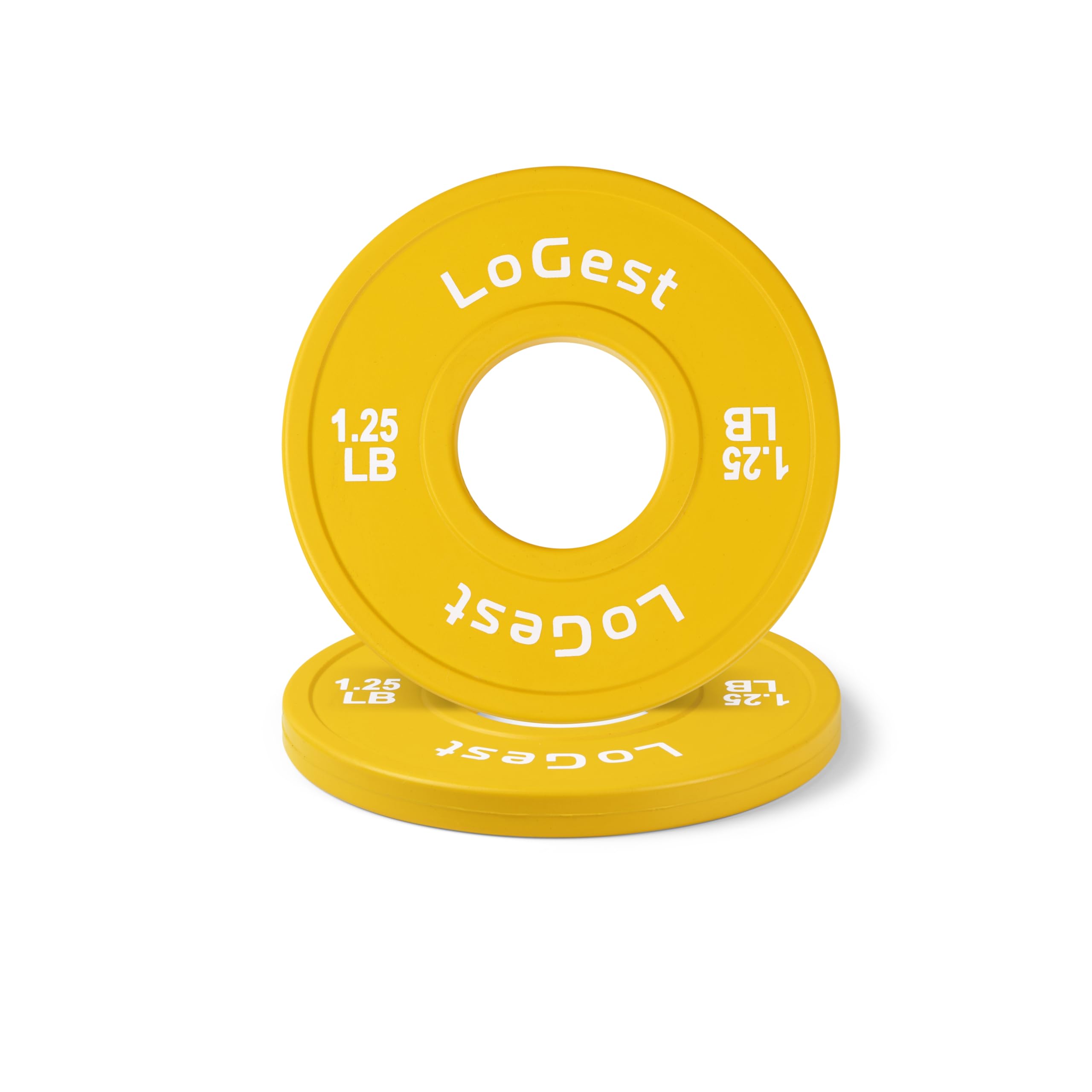
LoGest 1.25 lb Change Plate Pair

LoGest 1.25 lb Change Plate Pair

Topping up 1.25s

Our Score 9.4/10
Check Price

Worth Noting

  • One size only
Color
Yellow
Pieces
2
Sleeve Fit
Olympic bars
Plate Range
1.25 lb pair
Read the full review

One pair, one size: 1.25 lb each, which is a 2.5 lb jump once both are on the bar. That's not micro-loading and this pair shouldn't be bought as though it were — but it solves a specific problem, and it costs less than any other entry here.

The problem is the jump most gyms hand you. A pair of 2.5 lb plates is a five-pound step, and on upper-body lifts that step is where progress stops; a pair of 1.25s halves it. The bright yellow is a practical touch too — these are small enough to vanish, and a color nobody else's iron wears makes them easy to spot and reclaim at the end of a session.

What you don't get is a ladder. Two plates is two plates, and building a full set one pair at a time costs more than buying eight at once. As a top-up for a bag that already carries micro plates, though, this is the sensible buy — and if you're new to fractional loading and want to find out whether it helps before committing, one pair is enough to learn that.

Bottom line: The cheapest way to halve a five-pound gym jump, and a sensible top-up for a bag that already carries micro plates.

#6

EVERYMATE Steel Fractional Plate Set

EVERYMATE Steel Fractional Plate Set

Budget color coding

Our Score 9.2/10
Check Price

Worth Noting

  • Paint chips and peels, then rusts
Pieces
8
Material
Color-coded alloy steel
Set Weight
5 lb
Plate Range
Two each of 0.25, 0.5, 0.75 and 1 lb
Read the full review

Close to the bottom of the price range and still a full ladder: eight plates, quarter-pound steps up to a pound, five pounds total, each size in its own bright color with the weight printed on the face. Nothing here is fancy, and nothing here is trying to be.

What it gets right is the boring part. The plates are solid alloy steel, they sit flat on a sleeve, and the colors make them easy to pick out of a pile — which is the actual daily use of a fractional set, not the weight tolerance. Five pounds total means the whole set disappears into a gym bag, and at this price you can leave a pair in the car without thinking about it.

It ranks below the Micro Gainz and the rubber-coated EVERYMATE change plates on finish, and that's the honest placing. Buy it as a first fractional set for a home gym on a budget, or as a second set for a garage rack where looks don't matter — the range and the color coding do the job the expensive sets do.

Bottom line: A full quarter-to-pound ladder near the bottom of the price range here, and the clearest color coding of any set in this group.

How We Tested Fractional Plates

We started by gathering more than 40 fractional plate sets sold in pairs and small kits, then narrowed the field by hole size, claimed weight increments, material, finish, and price per plate. We cut anything with vague weight claims or a hole diameter that did not match a standard barbell sleeve. That left 14 sets, which we used for four months across garage gyms, a basement rack, and a couple of commercial gyms.

Every plate went onto a digital kitchen scale before it touched a barbell; we recorded the difference between claimed and actual weight and rechecked after weeks of use. We slid each plate onto a standard Olympic sleeve and a thinner training bar, noting whether it dropped on cleanly, wobbled, or needed force. In training, we used them for press, bench, and squat microloading, paying attention to whether the smaller diameter made them awkward to load or easy to lose on a crowded rack.

Durability got its own less gentle treatment: plates went into gym bags with chalk, keys, and collars, got stacked on garage floors, and were handled with sweaty hands session after session. We checked painted and coated surfaces for chips, scratching, and rust at the edges, and we watched whether stamped numbers stayed readable. We also compared what each set cost per usable increment; a pretty finish did not count for much if the weight was off or the paint failed in a month.

How to Choose Fractional Plates for Barbells

Start with the smallest jump, not the biggest set

A quarter-pound plate is a half-pound jump once there's one on each side, and that's the number that matters. The eight-piece sets here run quarter-pound steps up to a pound, which gives you five pounds of total range; a pair of 1.25 lb plates gives you 2.5 lb steps and nothing finer. Decide which of those two gaps you're actually missing and buy for it.

In practice most lifters never touch the three-quarter-pound plates, and plenty of strong ones only ever load the halves and quarters. A full set is still usually cheaper than assembling one pair at a time, so treat the extra sizes as a bonus rather than a reason to spend more.

The center hole decides more than the plate weight

Fractional plates are thin, so a 2-inch hole that runs slightly tight will hang on a sleeve, especially one with chalk or a burr on it. Standard Olympic sleeves measure 2 inches; most home bars, dumbbells and older standard bars are 1 inch, and a plate drilled for one won't work on the other. Check the number, not the word "Olympic" in the title.

The same hole has to clear the 2-inch loading pins on plate-loaded machines and cable stacks if you want that second job — a plate that's snug on a bar is usually useless on a pin.

Paint, powder coat or rubber

Most budget plates are painted steel, and paint is what fails first: edges and the inner ring chip, and bare steel rusts in a humid garage. Powder coating holds up better and costs more; rubber over a steel core is what you want if the plates will meet a platform, a floor or a bar you care about, at the price of bulk.

None of this changes the number on the plate. If your gym is dry and the plates live on a rack, painted steel is a perfectly fair way to save money.

Calibration only matters if you train in percentages

A stated tolerance of a few grams is a real difference, but it does nothing for a linear progression where you're adding a pound a week. It earns its money when you work off percentages of a competition max, or you're loading for someone whose next meet is close.

Otherwise buy range and fit, and put the difference into a second pair of plates you'll actually use.

Think about where the set lives

Five pounds of plates in a pouch is a gym-bag item. Seventeen pounds of change plates is a shelf. If you train at a commercial gym, a pouch is worth paying for and the small set wins; if you lift in a garage, spend the money on range and finish instead.

Compare total set weight rather than individual plate weight — that's the number you'll be carrying.

Frequently Asked Questions

Final Verdict

Start with the 44SPORT eight-piece set. It covers quarter-pound steps up to a pound, fits a 2-inch bar cleanly, and travels in its own pouch for less than any other full-range set here — that's the whole job, done.

If you want a stated tolerance and a finish that outlasts a gym bag, the Micro Gainz set is the upgrade worth making. And if your problem is Olympic-lifting jumps rather than half-pound ones, the EVERYMATE change plates are the right tool instead.