Strength & Weights

Best Chest Expanders of 2026

A chest expander only earns its spot in your bag if it doesn't snap, slip, or chew up your palms. The promise is simple: press, pull, and row anywhere, no rack required. What it fixes is the gap between wanting to train and having twenty minutes on a hotel room floor — a real upper-body session in something the size of a water bottle.

I've kept one in my gym bag for years, but the differences between models are not subtle. Over four months, my team and I put 14 chest expanders through home workouts, park sessions, and more than a few cramped hotel rooms. The ones that held up shared a few things: handles that stayed grippy when sweaty, clips that didn't creep, and bands that felt the same on rep 50 as rep five. Cheap hardware is the tell — a flimsy carabiner or a stitched seam that starts to fray tells you everything before the band ever breaks. Below are the ones worth your money.

#1

FLYBIRD 3-in-1 Twister

Top Pick
FLYBIRD 3-in-1 Twister

Travel and storage

Our Score 9.4/10
Check Price

Worth Noting

  • Premium kit includes pieces you may not use
Resistance
22–440 lb hydraulic
Item Weight
6 lb
Handle Positions
12
Resistance Levels
15
Read the full review

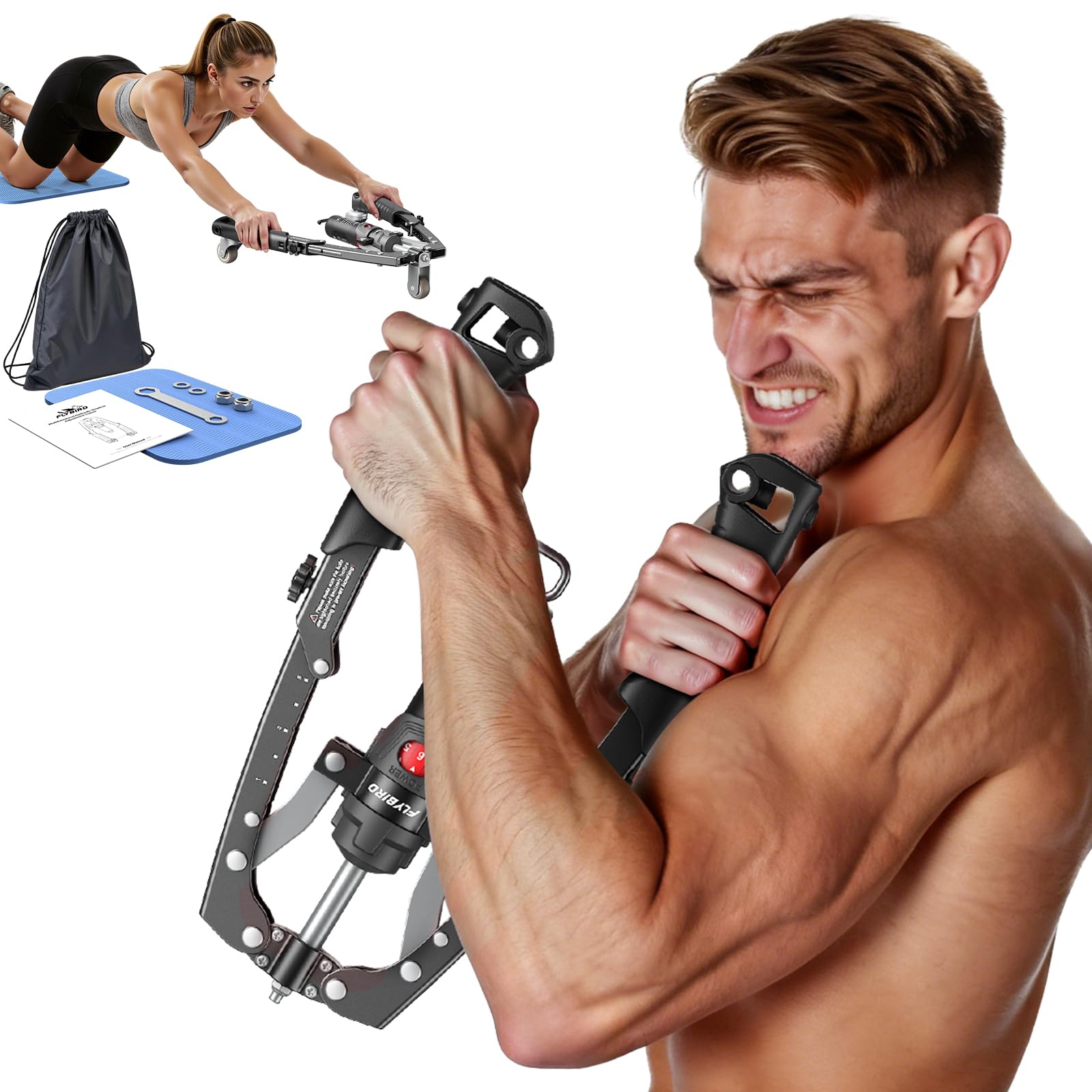
The FLYBIRD's pitch is a complete travel kit: the twister, a backpack, a pad, and a 3-in-1 design that adds an ab roller and band hooks. That is more stuff than most people need at home, but it changes the calculus if the trainer has to go in a car or a suitcase.

At 2.72 kg, it is light enough to carry in the included pack, and the 15-level hydraulic cylinder runs from 22 to 440 pounds. The handles slide through 12 positions, which is the best fit range here for different arm spans. The motion is smooth and controlled, and the lock bars make it easy to store flat between sessions.

We were impressed by how much of the home-gym experience it packs into one case, but the extra pieces are only worth it if you will use them. The ab wheel and band hooks turn it into a small circuit; if you only want chest presses, you are paying for a kit you may ignore. We also noticed a squeak can develop in the moving parts, so a little oil and a quick check of the washers are worth keeping in the routine.

We recommend the FLYBIRD for the person who wants one case for travel, apartment workouts, and floor work, and who will use the extra pieces. For a pure chest press at home, the WAKISA gives you the same hydraulic range with less bulk.

Bottom line: We pack the FLYBIRD when the trainer has to travel: it brings a 15-level hydraulic press, a backpack, and an ab-wheel kit.
#2

WAKISA 3-in-1 Twister

WAKISA 3-in-1 Twister

Shared home gym

Our Score 9.2/10
Check Price

Worth Noting

  • Extra ab-wheel kit is unnecessary for press-only users
Included
3 ab wheels, knee pad
Resistance
22–440 lb hydraulic
Item Weight
5.84 lb
Resistance Levels
15
Read the full review

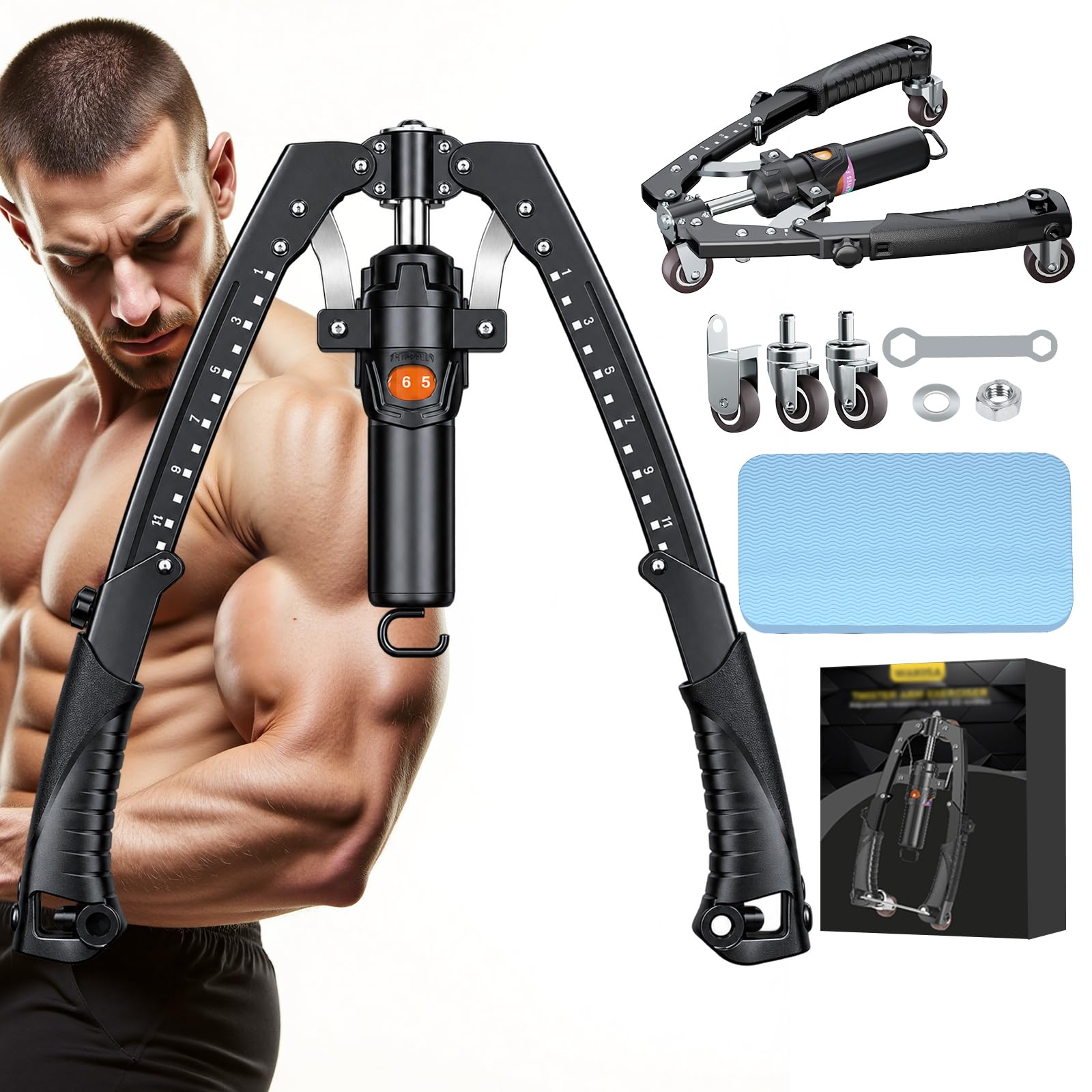
Of the hydraulic twisters here, the WAKISA is the one we recommend first for a shared home setup. It combines 15 resistance levels from 22 to 440 pounds, sliding handles that fit different arm lengths, and a 3-in-1 kit that swaps between chest presses and an ab-wheel setup.

The 2.65 kg frame feels substantial without becoming a hassle to move, and the triangular center and double-layer steel tubes kept the motion stable during pressing. We liked the hydraulic cylinder's controlled return; it doesn't snap back like a spring bar. The arm-length adjustment is the detail that makes it a family tool rather than a one-person gadget—shorter and taller users can set the same resistance without changing their hand position. A rear buckle locks the folded arms, so it stores more neatly than a loose spring bar.

The ab wheels and band hooks are not why we choose it, but they add a second reason to keep it out. If you only want a chest press, the kit is extra bulk; if you want one tool for quick upper-body sessions and floor work, it earns the space. The resistance knob turns through small enough steps to find a working set without jumping to the top. The ab wheel is the bonus; the sliding handles and 15-step dial are the reason it stays out.

Bottom line: The WAKISA is our top pick for most homes: a broad 22–440 lb hydraulic range, adjustable arms, and a stable press in one kit.

#3

Abahub Twister Arm Exerciser

Abahub Twister Arm Exerciser

Small spaces

Our Score 9.2/10
Check Price

Worth Noting

  • Slide adjustment can be fussy
  • Top-end resistance feels lighter than the dial
Warranty
2 years
Resistance
22–440 lb hydraulic
Closed Size
11.4 x 6.2 in
Item Weight
4.4 lb
Read the full review

The Abahub's best trick is disappearing. With the arms at the shortest setting, it closes to roughly 11.4 by 6.2 inches, so it tucks beside a couch or into a drawer in a way the wheeled kits do not.

We liked it as a simple apartment press: 22 to 440 pounds on a knob, a 4.4-pound carbon-steel frame, and no ab wheels or band hooks to manage. The handles are comfortable and the motion is smooth, and the 2-year warranty is a useful vote of confidence for a hydraulic tool. The closed shape is also easier to pack than a long spring bar.

That makes it a good fit for someone who wants a compact hydraulic trainer and will adjust it once, not constantly. If you need quick changes between users or a more precise resistance scale, the WAKISA and Lifepro are easier to live with. We kept the Abahub on the list because it does the basic job well in very little space.

Bottom line: We like the Abahub for small spaces: its compact frame packs a 22–440 lb hydraulic press without the wheel kit.

#4

JHMFDDSB Twister Arm Trainer

JHMFDDSB Twister Arm Trainer

First spring trainer

Our Score 9.2/10
Check Price

Worth Noting

  • 120 lb ceiling limits heavy pressers
  • Forearm contact can become uncomfortable
Resistance
30–120 lb spring
Item Weight
5.4 lb
Spring Bars
4 bars
Resistance Levels
6
Read the full review

The JHMFDDSB is a four-bar spring trainer that turns those bars into six resistance combinations. It arrives with two handles, four springs, an instruction manual, and a training poster.

The bars are wrapped in elastic leather covers, which is a sensible safety touch on a spring tool, and the whole thing collapses to about 26 inches for storage. The foam handles are comfortable for short sets, and the 5.4-pound weight makes it feel less toy-like than the price suggests. The six settings are easy to understand: you change the bar combination rather than turning a dial.

We recommend it as a first spring trainer or a backup for travel, not as the main tool for someone who already moves heavy weight. The spring feel is simple and direct, and it is easy to store when the set is over. The included poster is more useful than it sounds: it gives a beginner a routine instead of a pile of springs.

Bottom line: We point beginners to the JHMFDDSB for its six spring settings and low entry cost.

#5

Core Prodigy Python Power Twister

Core Prodigy Python Power Twister

Simple chest burn

Our Score 9.0/10
Check Price

Worth Noting

  • Fixed 45–110 lb range lacks fine adjustment
  • Low end may be too stiff for beginners
Handle
Fixed rubber grip
Length
28 in
Resistance
45–110 lb spring
Item Weight
3.6 lb
Read the full review

The Core Prodigy Python Power Twister is a single fixed spring bar, and that simplicity is the point. There's no knob, no cylinder, and no battery—just a 45-to-110-pound carbon-steel bar with rubber grips.

We liked it most as a no-fuss finisher: grab the handles, bend, hold, release. The fixed tension means you can't dial it down for a warm-up, so it suits someone who already knows they can move that spring; beginners may find even the low end stubborn. The grip-position trick changes leverage, but it is not a substitute for a proper adjustable trainer.

What it does better than the hydraulic units is stay out of the way. At 3.6 pounds and 28 inches long, it leans in a closet corner or travels in a car without a case. We kept it nearby for short sets while watching TV, and the lack of setup is why it stayed in the rotation. The rubber grips are comfortable enough for high reps, and the bare steel bar has no fluid to leak or battery to replace. Give it enough elbow room; the bar wants a wide arc, not a tucked-in press.

Bottom line: We keep the Core Prodigy for simple, repeatable upper-body sets; it is the fixed spring bar to choose when you don't want a resistance dial.

#6

Lifepro ShredForce

Lifepro ShredForce

Tracking quick sets

Our Score 9.0/10
Check Price

Worth Noting

  • Durability is the weak point over time
Resistance
22–440 lb hydraulic
Folded Size
16.93 x 6.30 x 1.97 in
Item Weight
5.1 lb
Resistance Levels
10
Read the full review

Lifepro's ShredForce puts a small rep counter on a hydraulic twister, and that little screen changes how the tool fits into a busy day. Instead of guessing whether you did two sets or three, you can see the count and move on.

The rest is a compact hydraulic unit with 10 resistance levels from 22 to 440 pounds, a folded footprint of about 17 by 6 by 2 inches, and a 5.1-pound build. It presses smoothly and stores flat, which makes it one of the easiest picks here to keep beside a desk or couch. At 5.1 pounds, it has enough mass to feel steady in a press without becoming a chore to move. The PU grips are comfortable enough for longer sets, though the fixed handles won't adjust to different arm lengths.

We recommend it for someone who likes short, logged sessions more than gadget-heavy workouts. The counter is genuinely useful, and the compact fold makes it the easiest one here to keep in a drawer. The lock bars are a small detail we appreciated: they keep the arms from unfolding when you toss it in a bag.

Bottom line: For compact, logged sessions, we like the ShredForce: the rep counter and flat fold make short workouts easier to start and finish.

#7

NOONCRAZY Twister Arm Trainer

NOONCRAZY Twister Arm Trainer

Budget progression

Our Score 9.0/10
Check Price

Worth Noting

  • 120 lb ceiling limits strong users
  • Only four resistance steps
Handle
Foam
Resistance
30–120 lb spring
Spring Bars
4 bars
Resistance Levels
4
Read the full review

The NOONCRAZY is the budget spring trainer we point to first when someone wants to try a chest expander without committing much. It uses four spring bars to create a 30-to-120-pound range across four settings, and the two-stage adjustment lets you add resistance as you get stronger.

Spring bars have a different feel from hydraulic units: the first inch is the hard part, then the bar gives. The lowest setting is stiff enough that a complete beginner should test it carefully before making it a daily tool, and a slow, controlled return makes the release easier to manage. The foam forearm contact is not as forgiving as the padded handles on the pricier picks; a thin towel or long sleeves can take the edge off longer sets.

The 120-pound ceiling is the real limit: strong users will outgrow it, and the four settings leave gaps compared with a hydraulic dial. For a beginner or a second trainer for travel, though, it does the job with very little fuss. The included poster is basic but gives you a starting circuit. We kept it as the one to hand to someone who asks, 'What should I try first?'

Bottom line: The NOONCRAZY is our budget spring pick: four progression steps, a simple setup, and a ceiling that suits beginners.

#8

LEJIEYIN Twister Arm Trainer

LEJIEYIN Twister Arm Trainer

Visible progression

Our Score 8.8/10
Check Price

Worth Noting

  • Durability can suffer over time
Display
LED
Resistance
Hydraulic, up to 440 lb
Item Weight
5.18 lb
Resistance Levels
20
Read the full review

The LEJIEYIN's LED display and 20-level resistance dial make it look more like a piece of gym equipment than a simple spring bar. That is the appeal: you can see the setting, turn the knob, and work through a lot of small resistance steps.

The hydraulic action is smooth, and the 440-pound maximum gives strong users more headroom than the spring models. The frame uses a triangular center with reinforcing rivets, and the PU handles are shaped for a secure grip. At 2.35 kg, it is easy to move between rooms or pack in a bag.

The dial can be difficult to set precisely, so turn it slowly and test the resistance before each set. The LED display is a nice touch, but it does not change the workout. The frame feels solid in the hands, and the 20 steps make it easier to add a little load rather than jumping to the next big setting.

We recommend it for someone who likes visible progression and does not mind a more electronic-looking tool. If you want the simplest, most durable hydraulic press, the WAKISA or Abahub is the safer call; the LEJIEYIN earns its place when the 20-step dial is the feature you will actually use.

Bottom line: If you want to see your resistance setting, the LEJIEYIN is the one we pick: 20 steps and an LED display on a compact hydraulic frame.

How We Tested Chest Expanders

We started by pulling together more than 40 options — spring-style and band-style — and narrowed them by checking what the resistance actually measured, how the handles were attached, and whether replacement parts were available. We cut anything with a fixed, non-adjustable tension or hardware that looked like it came from a keychain. That left 14 expanders, which we used for four months.

Each one lived in a gym bag, a living room corner, and a carry-on. We anchored them to door frames, looped them around porch posts, and used them barefoot on hotel carpet. During every set we noted whether the band stretched smoothly or fought back in jerks, whether the handles twisted or stayed square in the palm, and whether the stitching or clips showed wear after a week of daily use.

Comfort got its own check: we did 30-rep sets with sweaty hands and noted where the grip dug in or slipped. We listened for creaking springs and bands rubbing against anchors — noise matters more than you'd think in an apartment. We also weighed each one in its pouch and timed setup from bag to first rep, because an expander that takes two minutes to rig is one you'll stop carrying.

By the end, we'd stretched each band to its claimed limit dozens of times and checked for nicks, fraying, and stretched-out clips. The ones that survived didn't necessarily cost the most; they were the ones with honest resistance ratings and hardware you could replace. We'll keep using them and update this list if anything fails.

How to Choose Chest Expanders

Hydraulic or Spring: Pick the Feel First

Hydraulic twisters use a sealed cylinder and a knob, so the resistance changes in small steps and the return is controlled. Spring bars store energy in the steel and give it back quickly; they are simpler and cheaper, but the first inch can be stiff and the release is less forgiving. We reach for hydraulic when we want to dial in a precise set, and for spring when we want a tool with no seals or fluid to worry about.

The Low Setting Matters More Than the Max

A 30-pound spring can feel harder than a 30-pound hydraulic setting because you have to overcome the initial bend. Look for a trainer with several easy steps below your working range, not just a big top number. If you are new, a 30-to-120-pound spring set or a 22-to-440-pound hydraulic unit with 10 or more levels gives you room to progress. The first rep should feel controlled, not like a test of survival.

Check the Frame and the Contact Points

The frame is where a chest expander earns or loses our trust. Look for a reinforced center, double-layer steel tubes, and rivets that stay tight; a triangular brace is a common way to add stability. The grips and forearm pads matter too, because foam that presses into your arm can end a set before your chest does. If an arm bends, a spring cover cracks, or a fitting loosens, stop using the device and contact the seller.

Fit It to Your Space and Your Body

Measure the folded length before you buy if the trainer will live in a drawer or under a couch. A compact hydraulic unit can close to about a foot long, while a fixed spring bar may run 28 inches and need a closet corner. Adjustable handles are worth paying for if more than one person will use it; otherwise, a fixed grip is simpler. Weight matters for travel, but a heavier frame can also feel more stable in a hard press.

Decide Whether You Want a Kit or a Single Tool

Ab wheels, band hooks, backpacks, and rep counters add value only if they match the way you train. A 3-in-1 kit can replace a couple of small accessories, but it also gives you more pieces to store and check. A single-purpose twister is easier to keep handy and harder to outgrow if the resistance range is right. We prefer the simpler tool for a first purchase unless travel or floor work is already part of your routine.

Frequently Asked Questions

Final Verdict

Most people should start with the WAKISA 3-in-1. It has the widest useful resistance range here, adjustable arm length for shared use, and a stable hydraulic press; the ab-wheel kit is a bonus rather than the reason to buy.

If you want a fixed spring bar with no setup, choose the Core Prodigy. If you need a travel kit and will use the extra pieces, the FLYBIRD is the better fit.