Strength & Weights

Best Cable Crossover Machines for Home Gyms of 2026

A cable crossover is the closest thing a home gym has to a universal machine: flyes, face pulls, pressdowns, and rows all come off the same two handles, and few things take up that little floor space while doing that much. The catch is that a crossover is only as good as its worst bolt. A frame that rocks, a pulley that stutters mid-rep, or a manual that doesn't match the hardware in the box can turn an exciting purchase into a weekend you'd rather forget. Get those right and one machine quietly replaces three.

I've assembled enough gym equipment to assume the instructions will disappoint me, and I've learned that a crossover's two sides have to feel identical — plenty don't. Over eight months my team built and trained on six machines, from compact single-column setups to full commercial-style crossovers, and the gaps showed up fast. One thing first-time buyers rarely think about: measure your ceiling and the span between the columns before you measure the floor. The picks below are the ones still tight after eight months.

#1

XMARK XM-7626

Top Pick
XMARK XM-7626

Full home gyms

Our Score 9.6/10
Check Price

Worth Noting

  • Premium price
Dimensions
83 H x 65 W x 43.5 D in
Pull-up Bar
Angled and straight
Weight Stacks
Two 200 lb
Pulley Heights
12 to 75 in
Read the full review

Two 200-pound stacks, 19 pulley heights spanning 12 to 75 inches, and a 65-inch frame: the XM-7626 is the machine here that gives you a full cable crossover rather than a compact tower with a long exercise list. The two stacks work independently, so one arm can pull without dragging the other side along.

That independence is what earns it our top pick. Cable flys, single-arm rows, and rotational work all need the pulleys to move freely and sit far enough apart to create a useful line of pull; this frame has the width and the height range to do it. The 2:1 pulley ratio also means the 200-pound stacks feel lighter at the handle, which is useful for high-rep work and long cable travel, though it is not the machine for someone chasing a very heavy cable press.

The attachment kit is more complete than most: a triceps rope, long and short bars, hand straps, long strap handles, and ankle straps. We also appreciate the angled and straight pull-up bar, which turns the crossover into a more complete upper-body station. At 83 inches tall, it fits most basements and garages, and the tapered corner layout keeps the usable footprint tighter than the 65-inch width suggests.

The catch is commitment. This is an 800-pound machine that wants a permanent corner, and assembly is a project rather than an afternoon favor. If you rent, move often, or need to fold something away, the wall-mounted alternatives make more sense. If you have the space, the XM-7626 is the closest thing here to the crossover you use at a gym.

Bottom line: Our top pick for a dedicated home crossover: the independent 200-pound stacks, wide pulley spread, and 19 height settings cover serious cable work, as long as you can give it a permanent corner.

#2

Inspire Fitness FTX

Inspire Fitness FTX

Small home gyms

Our Score 9.2/10
Check Price

Worth Noting

  • Premium price
  • Narrower fly path than full-size
Storage
Device shelf and rack
Dimensions
82 H x 40 W x 54 D in
Accessories
Four included
Weight Stacks
Two 165 lb
Read the full review

The FTX is the compact functional trainer we point to when a full crossover will not fit: its 40-inch width slips into a spare bedroom or studio, but the two 165-pound stacks and sliding pulleys still give you real cable resistance. We recommend it for a home gym that needs to stay in one room rather than take over the garage.

The smaller frame is the trade-off. A 40-inch stance shortens the path of a cable fly compared with the 65-inch XMARK, so the stretch at the bottom of the movement is less pronounced. For pressing, rows, and unilateral work, that matters little; for a wide, chest-opening fly, you will notice it. The machine is still 82 inches tall and 54 inches deep, so measure the corner before you commit.

We like the extras more than we expected to. There is a shelf for a phone or tablet, a built-in rack for attachments, and four included pieces: a triceps rope, two D handles, a dual-hook curl bar, and a chin/dip belt. The three-month Centr subscription adds guided workouts, but the machine stands on its own without it. The 544-pound build is substantial enough to feel planted, and it rewards a careful two-person assembly.

Bottom line: Our compact freestanding pick: it fits a spare room and still offers two 165-pound stacks, smooth pulleys, and useful accessories, provided you can live with a tighter fly path.

#3

Body-Solid Powerline PFT100

Body-Solid Powerline PFT100

Full-size value

Our Score 9.2/10
Check Price

Worth Noting

  • 210-lb maximum recommendation
  • Assembly directions are weak
Dimensions
83 H x 62.6 W x 42.3 D in
Weight Stacks
Dual independent
Frame Warranty
10 years
Machine Weight
476 lb
Read the full review

The Powerline PFT100 makes the case for a full-size crossover without flagship money: a 62.6-inch frame, dual independent stacks, and a 10-year frame warranty. It is not as refined as the XMARK, but it gives you the wide pulley spread that compact trainers cannot.

The 83-inch height and 42.3-inch depth are manageable in a garage, while the 476-pound frame has enough mass to stay settled during rows and flys. The dual independent stacks are the important part; isolateral movements work properly, and the 10-year frame warranty is a strong promise for a home machine. What the specification does not make obvious is the per-stack weight, so confirm that figure against your lifts before ordering.

We recommend the PFT100 to someone who wants a wide crossover and does not need the XMARK's extra stack capacity. The 210-pound maximum recommendation puts a ceiling on heavy cable work, and the assembly directions are not the hand-holding kind. If your routine is built around moderate cable loads and you have a helper for setup, it is the value choice in this group.

Bottom line: Our value pick for a full-size frame: the PFT100 gives you a 62.6-inch crossover and independent stacks for far less than the flagship, though the 210-pound maximum limits heavy cable work.

#4

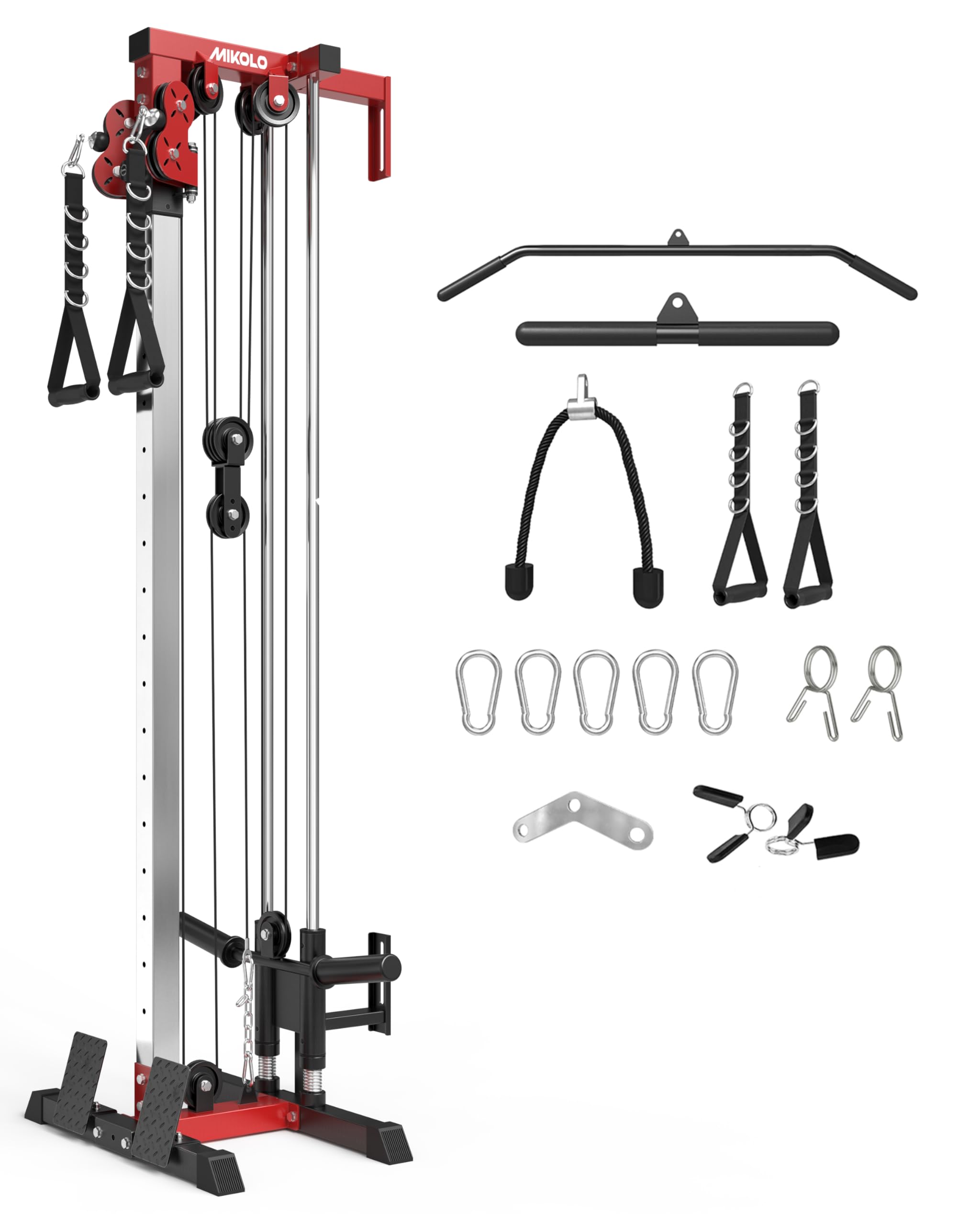
Mikolo M-G3

Mikolo M-G3

Tight wall space

Our Score 9.0/10
Check Price

Worth Noting

  • Narrow fly path
  • Requires your own weight plates
Warranty
2 years
Dimensions
82 H x 26.9 W x 25.6 D in
Resistance
400 lb
Pulley Positions
19/27
Read the full review

The M-G3 is a wall-mounted cable station, not a floor-standing crossover, and that changes what it is good for. It bolts to a wall, stands 82 inches tall, and fits a 26.9-inch-wide slot; the dual pulleys adjust through 19 height positions and the frame is rated to 400 pounds.

We like the details aimed at a small home gym: a large footboard for seated rows, weight pegs angled upward by 10 degrees to keep plates from sliding, and detachable sleeves that let you use 1-inch or 2-inch plates. The included lat bar, cable bar, and triceps rope cover the basics, and the two-year warranty is reassuring for a wall-mounted unit.

The catch is the narrow frame. With the pulleys this close together, you cannot get the wide hand path of a true cable crossover; flys feel cramped, and the machine is better for unilateral work, rows, pulldowns, and accessory exercises. We recommend it for a garage or basement where floor space is the binding constraint. If cable flys are central to your training, choose a full-size crossover instead.

The wall requirement is not trivial: it needs a solid mounting surface and a permanent spot. In exchange, it clears the floor almost completely, which is the reason to consider it. For someone training in a shared garage, that trade is often worth more than another hundred pounds of resistance.

Bottom line: A well-equipped wall-mounted station for a tight garage gym: it handles rows, pulldowns, and unilateral work with a 400-pound rating, but it is not a true wide crossover.

#5

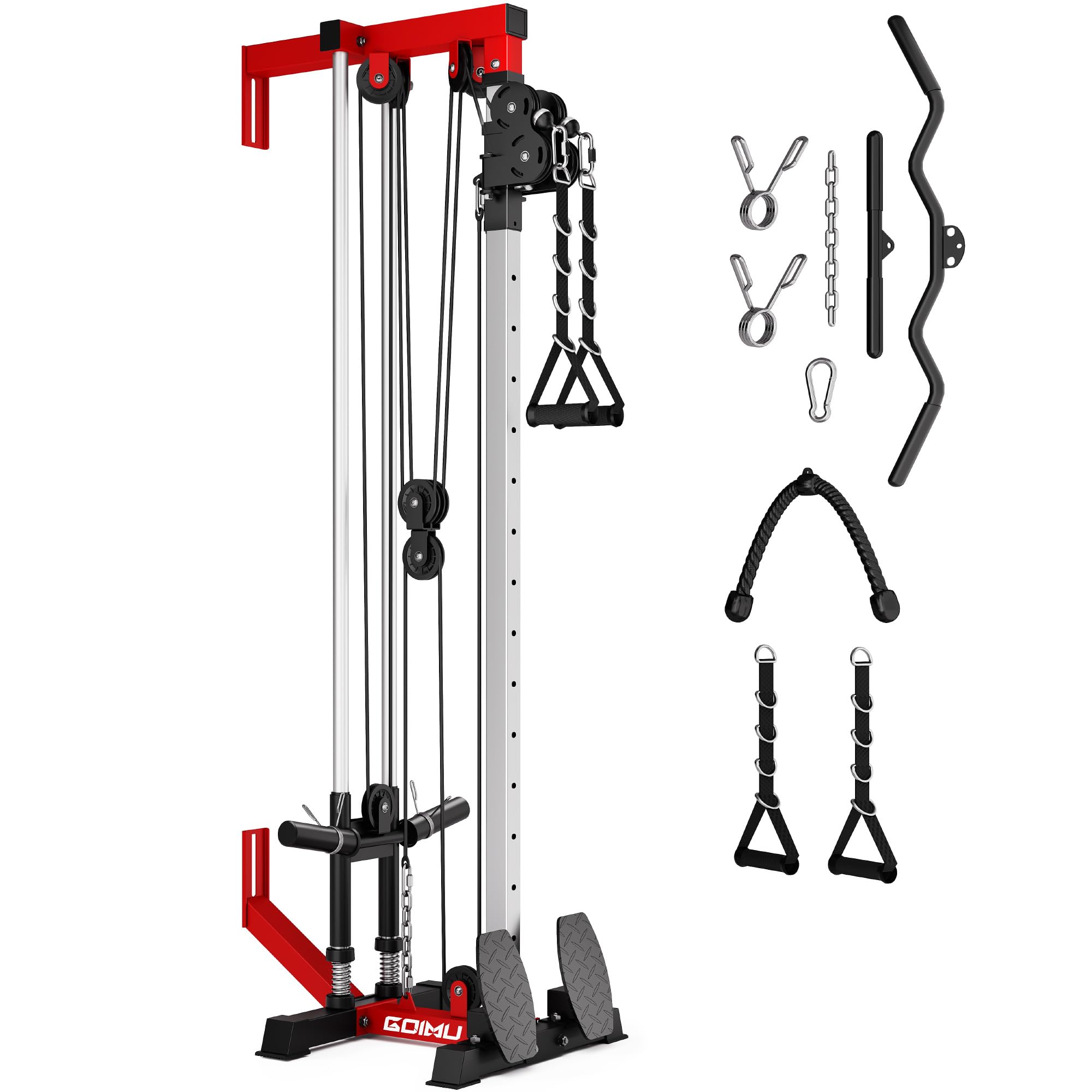
Goimu WM1

Goimu WM1

Small garage gyms

Our Score 9.0/10
Check Price

Worth Noting

  • Requires concrete or masonry wall
  • Narrow crossover path
Dimensions
78.74 H x 24.8 W x 28.11 D in
Resistance
300 lb
Pulley Ratio
1:1 and 2:1
Pulley Positions
17
Read the full review

The WM1's best trick is a pulley adapter that switches between a 1:1 ratio for heavier lifts and a 2:1 ratio for lighter, longer-travel work. That is a useful feature on a wall-mounted station, and it is why we recommend this one for a tight garage gym where a full crossover is out of the question.

At 24.8 inches wide and 78.74 inches tall, it takes up very little floor space, and the 300-pound maximum keeps it in the home-gym class. The 17 pulley positions cover high, mid, and low work. The narrow frame is the same compromise as every wall-mounted station here: rows, pulldowns, and unilateral work feel natural, but a wide cable fly does not.

The 81.4-pound unit needs a solid wall—concrete or masonry is the specified surface—so renter-friendly drywall mounting is not the plan. The included T bar, lat pull bar, triceps rope, and dual handle grip get you started, and the two-year warranty is reasonable for the price. We like the ratio switch most because it lets one machine cover both heavier pulldowns and long, light flys, even if the fly path stays narrow.

Bottom line: A smart budget wall station for a very small garage gym: the 1:1 and 2:1 ratio switch adds range, but the 300-pound ceiling and narrow frame keep it in accessory-work territory.

#6

Valor Fitness BD-61

Valor Fitness BD-61

Plate owners

Our Score 8.8/10
Check Price

Worth Noting

  • Requires your own weight plates
  • Narrower fly path than full-size
Dimensions
81 H x 50 W x 56 D in
Resistance
Up to 200 lb
Pulley Positions
17
Plate Compatibility
1 in and 2 in
Read the full review

Plate-loaded resistance is the BD-61's defining choice. You hang your own plates on the carriage instead of paying for a pair of weight stacks, which keeps the machine simpler and lets you use the plates you already own. The payoff is a 200-pound resistance ceiling and a 50-inch-wide frame with 17 pulley positions.

We recommend it for a lighter, higher-rep cable routine: flys, face pulls, triceps work, and rows where 200 pounds is plenty. The 1-inch and 2-inch adapter sleeves are a practical touch because most home gyms end up with a mix of plate types. If you already own Olympic plates, this is the least wasteful way into a cable crossover.

The trade-offs are real. The 50-inch width gives you a narrower fly path than the 62- and 65-inch machines here, and the instructions are the kind that make a two-hour build take longer. The pull-up bar and floor-mounting hardware are welcome, but this is still a machine for someone who does not mind tinkering. The cable action is not as polished as the premium options, so keep the guide rods clean and the bolts snug.

Bottom line: Our plate-loaded pick: the BD-61 is a smart choice if you already own plates and train in the 200-pound range, though the narrow frame and rough instructions ask for patience.

#7

Body-Solid Best Fitness PCCO90X

Body-Solid Best Fitness PCCO90X

Wide budget setup

Our Score 8.8/10
Check Price

Worth Noting

  • 133-lb resistance ceiling
  • Instructions are thin
Dimensions
82 H x 112 W x 39 D in
Resistance
133 lb
Frame Warranty
10 years
Machine Weight
118 lb
Read the full review

The first number that stands out on the Best Fitness PCCO90X is 112 inches—the widest frame here. The second is 118 pounds, which is remarkably light for a full-size crossover. Together they describe a budget machine built around a wide hand path rather than a heavy stack.

That width is useful for cable flys and crossovers; the pulleys sit far apart, so the movement feels more like a gym crossover than a compact tower. The trade-off is floor space: you need a long wall, and the 82-inch height still needs a room that can take it. The 133-pound resistance ceiling is the real limit. For lateral raises, rear-delt work, and high-rep flys, it is enough. For heavy lat pulldowns or pressing, it is not.

The 10-year frame warranty is a strong point at this end of the set, and the simple frame is easier to move than the 476- and 800-pound machines. We do not expect the same polished cable feel as the premium picks; this is a machine you adjust, lubricate, and keep an eye on. The instructions are also thin, so give yourself time and a helper.

We recommend the PCCO90X to a home lifter who wants a wide crossover for volume work and does not need a big stack. If your program depends on heavy cable rows or presses, spend more for the XMARK or the PFT100. If your priority is a wide frame at the lowest cost, this is the one.

Bottom line: Our budget full-size pick: the PCCO90X gives you a 112-inch crossover for high-rep cable work, but the 133-pound ceiling and thin instructions keep it out of heavy-lifting plans.

How We Tested the Best Cable Crossover Machines

We started with roughly 30 machines sold in the U.S. and cut the list by specs that change how a crossover actually feels: footprint and ceiling height, cable rating, stack size, whether the pulleys adjust through a real range of motion, and what comes in the box versus what costs extra. We only kept machines whose steel and hardware looked like they belonged at that price. That left six, which we built and used for eight months.

Assembly came first, because it's where these machines live or die. We timed every build twice, once solo and once with two people, and noted whether the instructions matched the hardware bag, whether bolts were labeled in any useful way, and how much of a first session got eaten by setup. Two took an afternoon; one took two evenings and a phone call.

Then we trained on them. Sessions happened on a sloped garage slab and under a low basement joist, weekday mornings before work and again at night with a partner pulling the opposite handle. We cycled the pulleys slowly under light load and listened for squeal, ran the stack to feel where a cable caught, and checked how high and low the adjustable pulleys actually traveled before trying flyes, face pulls, and low-to-high chops at both extremes. To judge stability we loaded heavy and rowed hard to see whether the frame walked across the floor.

Durability got checked rather than assumed. At one month and again at six we went around each frame with a wrench, looked for fraying where the cable bends at the pulley, and inspected the guide rods for wear. At the end we weighed what each machine could do against what it cost, including attachments we had to buy separately to make it useful.

How to Choose Cable Crossover Machines for Home Gyms

Measure the room before the stack

Full-size crossovers here run from about 62 to 112 inches wide and 78 to 84 inches tall, so the first job is finding a wall long enough for the pulley spread you want. Leave clearance at both ends for handles and a bench, and check the ceiling above the top pulley. Wall-mounted units like the Goimu WM1 and Mikolo M-G3 cut the floor footprint to roughly a 25-inch-wide slot, but they need a solid structural wall—concrete or masonry in the Goimu's case—and they cannot match a full crossover's hand path.

Decide between stacks, plates, and a compact tower

Dual weight stacks are the most convenient: you change resistance with a pin and the two sides work independently. Plate-loaded machines like the Valor BD-61 cost less up front but require a set of 1-inch or 2-inch plates and time to load them. A compact wall station can be plate-loaded too, with a lower resistance ceiling. Match the resistance to your actual exercises: 133 pounds is fine for lateral raises and high-rep flys, not for heavy pulldowns. Check per-side capacity, not just the total.

Pulley travel and crossover width

Pulley height range matters as much as the number of positions: 12 to 75 inches covers low rows through high face pulls, while 17 or 19 settings give you enough stops in between. For cable flys specifically, width is the specification that decides whether the movement feels right. A 65-inch frame creates a useful stretch; a 25-inch wall tower keeps your hands close together. If flys are the reason you are buying, choose a full-size frame or a compact freestanding trainer with a wider stance.

Plan for assembly and anchoring

Assembly is the part buyers underestimate. A full-size crossover arrives as a crate of steel, bolts, and cables; set aside a full afternoon and line up a second person. Wall-mounted units like the Goimu and Mikolo need a suitable structural wall—Goimu specifies concrete or masonry—and the mounting hardware that comes with the unit. If you cannot identify a load-bearing wall, choose a freestanding model. Check the frame bolts after the first few sessions; a loose frame is easier to catch early.

Frequently Asked Questions

Final Verdict

The XMARK XM-7626 is the machine we recommend first for a dedicated home gym. Its two independent 200-pound stacks, 65-inch frame, and 19 pulley heights give you the wide, adjustable cable path that makes a crossover worth owning, and it is built to stay put.

If your room cannot spare that footprint, the Inspire FTX is the compact freestanding alternative; if you are mounting to a wall, the Mikolo M-G3 is a narrow station for rows and accessory work, not a full crossover replacement.