Home Gym

Best Wall Mounted Pull Up Bars of 2026

A pull up bar is one of the few pieces of home gym equipment that has to earn your trust before it earns your money. Four bolts, a stud finder, and twenty minutes with a drill stand between you and hanging your whole bodyweight, and the gap between a bar that feels welded to the house and one that creaks under your chin comes down to construction, hardware, and how honestly the maker describes what it will mount to. Get it right and the bar disappears into your routine: off the doorframe, out of your sightline, solid enough that you stop thinking about it.

We've had 11 of them bolted up for eight months — to garage studs, a basement block wall, and one stubborn plaster wall — and the pattern is hard to miss. The pull-up is the easy part; the mounting is the product. A beautiful knurl means nothing next to undersized lag bolts, and the best multi-grip design in the world won't help if the hole spacing misses your studs. The picks below are the ones we'd drill into our own walls a second time.

#1

OneTwoFit Pull Up Station

Top Pick
OneTwoFit Pull Up Station

All-round home gym

Our Score 9.2/10
Check Price

Worth Noting

  • Concrete or brick wall only; drywall and hollow block are out
  • 37-inch width leaves less wide-grip room than the 48- and 52-inch bars here
Stations
Pull-up, dip, leg raise
Footprint
37.4"W x 30.3"H
Weight Capacity
440 lb
Mounting Surface
Concrete or brick
Read the full review

A single pull-up bar gives you one movement. This station gives you four — pull-ups, chin-ups, dips and leg raises — on a frame that measures 37.4 inches wide and 30.3 inches tall, so it asks for about as much wall as a bookshelf. The steel is rated to 440 pounds, and the bar carries wide, neutral and close grips across its span.

That breadth is why it is our default recommendation. Dips and leg raises are the movements people actually keep doing once the pull-up honeymoon ends, and having them on the same four bolts means no second machine and no floor space given up. The padded backrest and arm pads are what turn the frame into a leg-raise station rather than a bar with extra steel hanging off it, and the grip layout covers back work and arm work without a swap. Set against a plain 48-inch bar, it is more training in less room.

Two things to settle before you drill. The wall must be solid concrete or brick; drywall, plaster and hollow block are ruled out by the maker. And the anchors in the box are the part worth upgrading, with four masonry anchors or lag screws sized to your wall doing the real work. Do that and the frame stays where you put it, level and quiet. Skip it and no weight rating on any box will rescue the installation.

Bottom line: If you want one wall to cover pull-ups, dips and leg raises, this is the station we point people toward — provided you have solid masonry and better anchors than the box supplies.

#2

LIONSCOOL Pulley Pull Up Bar

LIONSCOOL Pulley Pull Up Bar

Cable and pulley work

Our Score 9.2/10
Check Price

Worth Noting

  • Heaviest unit here at 30 pounds; hanging it is a two-person job
Extras
Cable pulley system and handles
Bar Width
48 inches
Item Weight
30 lb
Weight Capacity
450 lb
Read the full review

Two swivel pulleys and a pair of handles hang from a 48-inch multi-grip bar, which makes this the only pick here that turns a wall into a cable station. The steel frame is rated to 450 pounds, and the pulley blocks mount to the same structure as the bar rather than to a separate bracket.

What that buys you is the pulling volume a bar alone cannot give: lat pulldowns at a weight you choose, face pulls, pressdowns, single-arm rows. A cable tower takes a footprint in the room; these pulleys take none, which is the whole argument for paying more here than for a plain bar. The grip positions along the 48-inch span are useful in their own right, so the pulleys are a bonus rather than a gimmick bolted to a weak bar.

It is the premium pick, and we think it earns the step up for anyone who would otherwise buy a second machine. The pulleys run smoothly and the handles are comfortable in the hand. Just plan the install: at 30 pounds it is the heaviest unit on this page, and holding it plumb while you mark four holes is far easier with a second person on the far end.

Bottom line: The only pick here that gives you cable work as well as a bar — worth the step up if the alternative is buying a separate tower for pulling volume.

#3

SELEWARE 48-Inch Pull Up Bar

SELEWARE 48-Inch Pull Up Bar

48-inch stud bays

Our Score 9.2/10
Check Price

Worth Noting

  • Mounting holes are fixed at 48-inch spacing
Extras
Two round hangers
Bar Width
48 inches
Steel Thickness
4 mm
Weight Capacity
500 lb
Read the full review

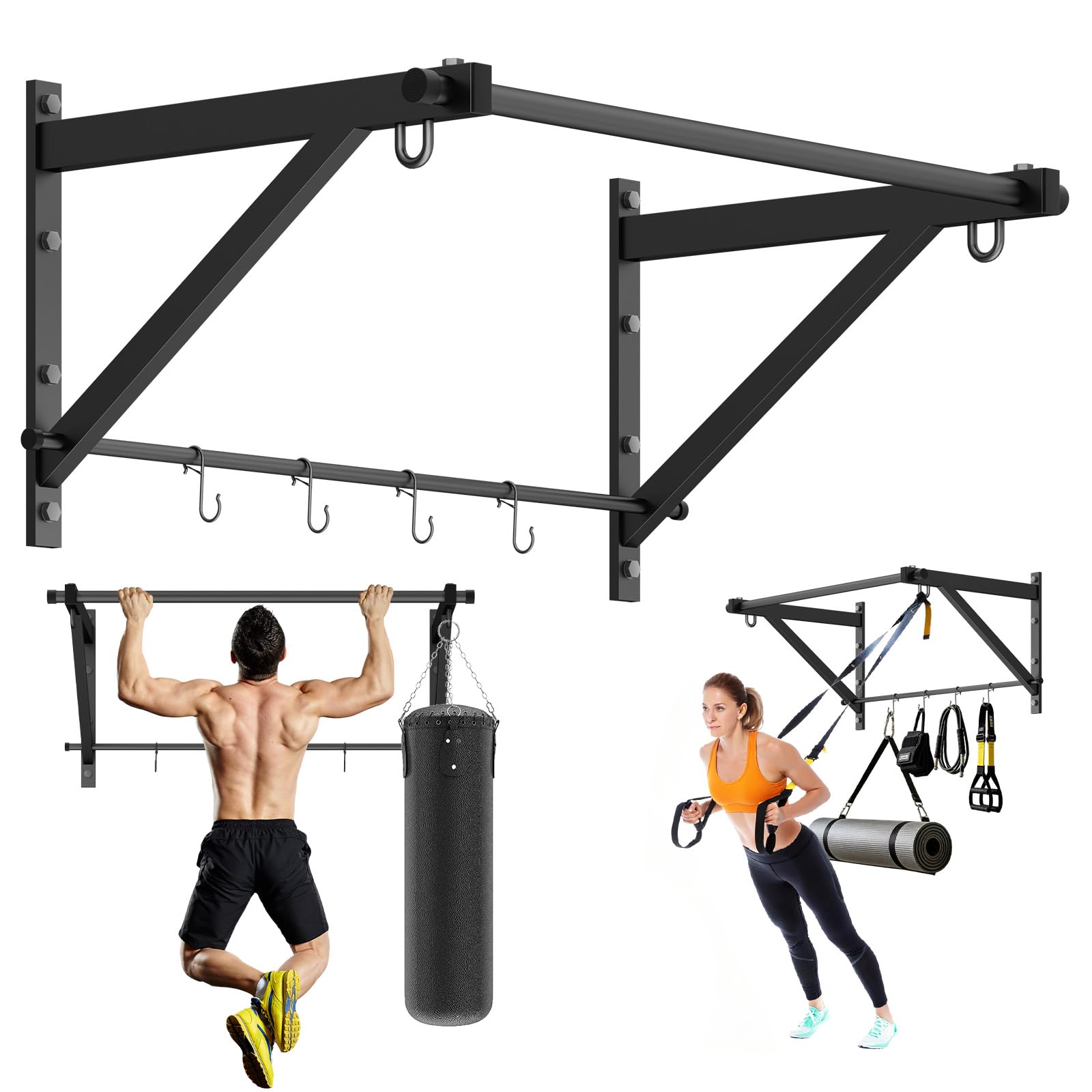
Four millimeters of alloy steel, fully welded into a 48-inch bar, rated to 500 pounds, with a round anchor at each end. That is the whole pitch, and it is a good one: this is the closest thing on the page to the bar bolted to a commercial wall. The width is not an accident — 48 inches is what fits three 16-inch stud bays, so the ends land where the framing already is.

It is near the top of this set for outright rigidity, and the hangers are what make it more than a bar: a heavy bag, suspension straps or a set of rings all have somewhere to live without a second bracket. One thing to know before you order — the finish is smooth powder coat rather than knurled steel, so chalk or a wrap earns its place once your hands get damp. That is a preference rather than a defect, and it is kinder to palm skin on high-rep sets.

What it will not do is meet you halfway. There is no dip station, no folding mechanism and no adjustment; it is a bar, mounted once, used for years. If your training is pull-ups, chin-ups, hanging leg raises and bag work, that is exactly the right trade. If you want to press between two pads, one of the stations here serves you better.

Bottom line: Buy this if you want a bar and not a station: 4 mm steel, a 500-pound rating and two hangers, as long as your framing is already where the holes are.

#4

Luckyone Pull Up Station

Luckyone Pull Up Station

Dips and hanging

Our Score 9.2/10
Check Price

Worth Noting

  • Instructions rely on diagrams and skip mounting guidance
Extras
Four steel hooks
Footprint
37.4"W x 30.3"H
Weight Capacity
440 lb
Mounting Surface
Concrete, brick or tile
Read the full review

Start with the instructions. They cover assembly and lean on diagrams rather than text, which is fine for the brackets and less fine for the step where you work out which way the lower hooks face — get that wrong and the elbow pads foul the frame when you hang the unit. Budget an hour, a stud finder and a hammer drill, and treat the sheet as a parts diagram.

The unit itself is the familiar multifunction station: a 37.4 by 30.3-inch frame rated to 440 pounds, with a multi-grip pull-up bar up top, dip horns at the sides, padded back and arm rests, and four steel hooks along the frame. Eight masonry anchors come in the box for concrete, brick or solid tile, and hollow brick is explicitly off the list.

The four hooks are the detail worth singling out. They sit away from the pull-up grips, so a heavy bag or a set of straps can hang while the bar stays usable — rare on a station at this size, and the reason this one earns a place rather than being a duplicate. Sturdiness on the frame itself is not in question once it is bolted down properly.

It is a straightforward alternative if the hooks and dip station are what you will actually use. The frame is dimensionally identical to the top pick's, 37.4 by 30.3 inches, which says something about how much of this category shares tooling — the difference between them is the paperwork and the priority you place on hanging gear.

Bottom line: A capable dip-and-hang station with four useful hooks; buy it for the hardware on the frame, not for the paper in the box.

#5

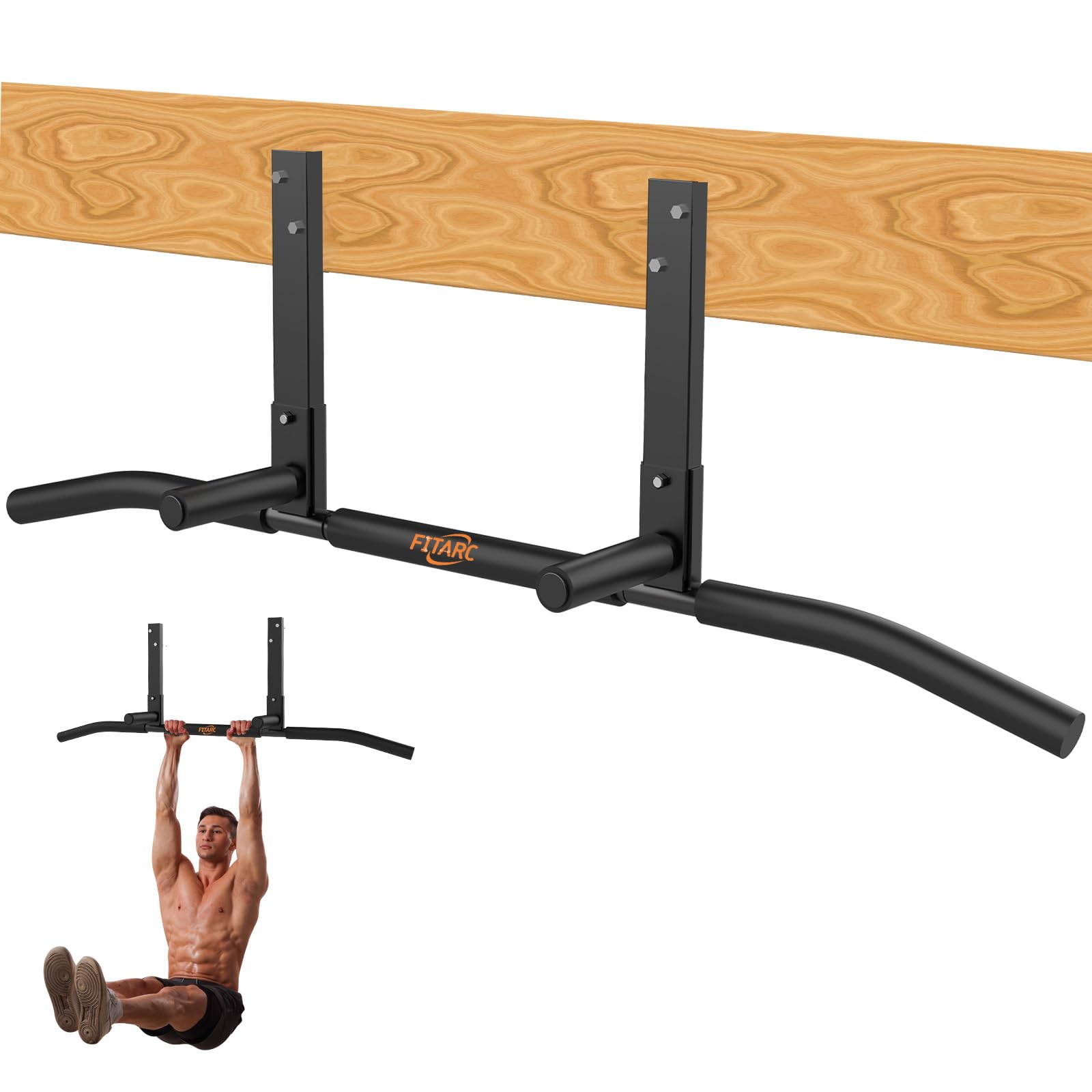
Fitarc Joist Mount Pull Up Bar

Fitarc Joist Mount Pull Up Bar

Basements and garages

Our Score 9.0/10
Check Price

Worth Noting

  • Needs exposed joists overhead; finished ceilings are out
Grip
Four foam-padded handles
Frame Size
42.5"W x 12.9"H
Mount Type
Overhead joists
Weight Capacity
440 lb
Read the full review

This one hangs from overhead joists instead of a wall. Four lag screws into a beam, a 42.5-inch dual-support steel frame and four foam-padded grips, rated to 440 pounds and built for beams between 8 and 9 feet. In an unfinished basement it is the least fussy installation on the page, because there is no wall to clear and no stud height to argue with.

Mounted overhead, it solves a problem the wall bars cannot: nothing juts into the room at chest height, and nothing to walk around. The foam handles are the comfortable kind for high-rep sets, and the grip positions are laid out wide enough that a shoulder-width pull-up feels natural rather than cramped.

Two practical notes. The hex bolts in the box are the soft spot of the package, and swapping them for a set of your own lag screws before the first install saves stripped heads and a stuck bit halfway into a beam. And this is an indoor unit in practice: the foam grips and the paint are what give out first if it lives in a garage with the weather coming in, so cover it or expect to replace grips.

Bottom line: The budget answer for a basement or garage with exposed beams — nothing touches the wall, and the bar itself is as solid as anything here.

#6

Jusgym Adjustable Wall Bar

Jusgym Adjustable Wall Bar

Small rooms

Our Score 8.8/10
Check Price

Worth Noting

  • Straight center grip is too narrow for comfortable wide work
Extras
Dual steel rings
Bar Thickness
1.27 inches
Weight Capacity
500 lb
Wall-to-bar Depth
19" or 27"
Read the full review

The shallower a wall bar sits, the sooner your knees meet the plaster on neutral-grip pull-ups, and several bars here sit 14 inches out or less. Jusgym builds the choice into the frame — you set it at 19 or 27 inches before it goes up — and that is why this is the one we point at for a tight room or a tall lifter.

The rest of the specification backs it up. The bar is 1.27 inches thick and rated to 500 pounds, at the top of this group, and the dual steel rings at either end take resistance bands, gymnastic rings or a heavy bag. Multi-grip positions run wide and neutral, so one bar covers more of a back session than the shape suggests, and the powder coat has held up on the units we have handled.

Two things worth knowing. The straight center section is pinched where the crossbar joins, so wide-grip work gets narrow in a hurry — the neutral handles are the better default on this bar. And the supplied hardware is the weak point of the package; take inventory of the lag screws and washers before you drill, because a missing bag costs you an afternoon. Give the welds where the handles meet the frame a look before the first set, too.

Bottom line: The bar to buy when the room is short on space or the lifter is tall: two standoff settings do more for your knees than any grip layout.

#7

HANDBODE 52-Inch Pull Up Bar

HANDBODE 52-Inch Pull Up Bar

Wide-grip training

Our Score 8.8/10
Check Price

Worth Noting

  • Both depth settings are shallower than the deepest bars here
Extras
Two band hooks
Bar Width
52 inches
Weight Capacity
500 lb
Wall-to-bar Depth
13.8" or 21.6"
Read the full review

Fifty-two inches of bar makes this the widest pick on the page, and width is the whole reason to consider it: a wide-grip pull-up with your hands properly outside your shoulders changes which muscles take the load. It is rated to 500 pounds on an iron frame, ships with two hooks for bands or a sandbag, and carries a powder coat the maker rates for indoor and outdoor use.

The frame sets at either 13.8 or 21.6 inches from the wall, which is comfortable for strict pull-ups and gives you room to loop bands without your knuckles meeting the plaster. Fit deserves more thought than usual here, because 52 inches of bar looks considerably larger in a spare bedroom than it does in a product photo — check your clear wall width before you commit to the spot.

Where it gives ground is depth. Both settings are shallower than the Jusgym's 27-inch option and the ZHNSYDN's 27.95-inch standoff, so if you are tall, or your knees have met the wall before, those extra inches will matter more to you than the extra width. For a shorter lifter with wall to spare, this is a lot of bar for one bracket.

Bottom line: The widest bar here, and the one to buy if a true wide grip matters more to you than standing further off the wall.

#8

ZHNSYDN Wall Mount Pull Up Bar

ZHNSYDN Wall Mount Pull Up Bar

Deep wall clearance

Our Score 8.2/10
Check Price

Worth Noting

  • 35-inch bar rules out serious wide-grip work
Bar Width
35 inches
Bar Thickness
1.27 inches
Weight Capacity
500 lb
Wall-to-bar Depth
27.95 inches
Read the full review

A small bubble level ships in the box with this one, and that tells you something about how the install is meant to go: four holes, one bracket, and a bar you want plumb before it is loaded. It is a tiny inclusion that removes the usual excuse for skipping the check, and it is the kind of detail that suggests someone thought about the person holding the drill.

The frame is a reinforced triangle bracket with no hinges or folding parts, rated to 500 pounds on a 1.27-inch bar running 35 inches across. The number that matters is the standoff: 27.95 inches from the wall, the deepest here by a hair, and more than twice what the shallowest bars on the page offer.

Depth is what your knees want, and it also opens up hanging work — bands, rings, a bag — without your hands fouling the wall on the way up. There are hooks for accessories, mounting hardware in the box for solid wood, concrete or brick, and a fixed structure that has nothing to work loose over time.

The trade is width. Thirty-five inches of bar covers chin-ups, neutral-grip work and hanging accessories; it does not give you a genuine wide grip, and if wide-grip pull-ups are the point of the purchase, one of the 48-inch bars serves you better. If they are not, this is the deepest standoff on the page with a 500-pound rating behind it.

Bottom line: Buy it for clearance: nearly 28 inches of standoff and a 500-pound rating make it the tall-lifter pick, provided you can live with a narrow bar.

How We Tested 11 Wall Mounted Pull Up Bars

We started with about 40 wall mounted bars and cut anything that didn't publish a hole spacing, a load rating, or the fastener type in the box. That left 11 — single-bar, multi-grip, and pull-up/dip combos — favoring welded steel over bolted-together tube and skipping models whose hardware bags gave no clue what they were meant to screw into. Value got tracked as we went: a real mounting template, correct lag bolts, and a warranty worth reading counted for more than a matte black finish.

Every bar went up the same way: stud finder, then a solo install with a drill, level, and tape measure, timed from unboxing to the first hang. We noted whether the paper template matched the real holes, whether the supplied anchors suited the wall the instructions named, and how many fasteners bit into wood instead of drywall. Two bars needed a second set of hands; one shipped with concrete anchors and nothing else.

Before trusting anything, we loaded each bar with a 50-pound sandbag and watched the mounting plate for movement. Then came the real thing — pull-ups, chin-ups, hanging leg raises, and some deliberately ugly kipping, at 6 a.m. before work and again after dinner — checking for flex at the plate, creaks, paint cracking around the bolts, and any shift at the wall. Bolts got re-torqued at one week and again at one month to see which hardware worked itself loose.

Grip was tested bare-handed, chalked, and sweaty, with a tape measure on bar diameter and notes on whether the knurl, powder coat, or foam held under load or chewed up our palms. Eight months in, we looked for rust at the welds, flaking chrome, and foam that had rolled loose.

How to Choose Wall Mounted Pull Up Bars

Match the Bar to What Is Behind the Drywall

Three surfaces carry these bars: poured concrete, solid brick, and wood studs or joists. Drywall on its own carries nothing, and hollow block crumbles around an anchor. If your studs sit where you want the bar, a stud-mounted bar with your own lag screws is the simplest and strongest installation you can do.

If the studs are not where you need them, screw a length of 2x6 or a plywood backer across two or three studs and mount to that, so the fasteners still reach framing. The multifunction stations here, including the OneTwoFit and the Luckyone, are explicit about masonry only, so read that line before you order rather than after.

How Far the Bar Stands Off the Wall

Depth is the specification shoppers skip and then regret. A bar that sits close to the wall is fine for strict pull-ups and awkward for neutral-grip work, because your knees arrive before your lats do. The bars here run from under 14 inches to nearly 28, and the deep end is what tall lifters and ring work want.

Take the deeper setting if you can spare the floor space in front of the wall: the Jusgym's 27-inch option and the ZHNSYDN's 27.95-inch standoff are the roomiest here, and the difference against a 14-inch bar is obvious the first time you hang from it.

Treat the Weight Rating as a System, Not a Number

The ratings here run from 440 to 500 pounds, and every one of them assumes the wall and the fasteners are as good as the frame. A 500-pound bar on four short drywall anchors is not a 500-pound bar. Match the fastener to the surface — lag screws into studs, wedge anchors into concrete — and size it for the load you are putting through it.

If your bodyweight plus gear lands within about 50 pounds of a rating, take the higher-rated bar. The margin is cheap insurance, and the ratings on this page are only meaningful once the mounting is right.

Width and Grip Layout Follow Your Framing

Bar width is partly a training choice and partly a carpentry one. A 48-inch bar lines up with three 16-inch stud bays, which is why so many of these are 48 inches wide, while a 52-inch bar gives you a wider grip but asks for more clear wall. Narrower 35- to 37-inch bars fit a small room and still cover chin-ups and neutral-grip work; they just cut your wide-grip options.

On grip surface, knurled steel bites and smooth powder coat is kinder to your hands until they sweat. If you go smooth, chalk or a wrap costs little and fixes the problem.

Decide Whether You Want a Station or Just a Bar

Dip horns, leg-raise pads, pulley blocks and hanging hooks all add capability, and they add depth, wall height and installation work. A dip station needs clear wall below the bar for your body to drop between the horns, and enough ceiling overhead that your head clears at the top of the movement.

A pulley bar such as the LIONSCOOL replaces a cable tower but brings cables, pulleys and handles to store. If you only ever do pull-ups, a plain bar is simpler, easier to mount well, and the one that stays tight for years.

Frequently Asked Questions

Final Verdict

Buy the OneTwoFit. One patch of wall gets you pull-ups, chin-ups, dips and leg raises on a 440-pound frame, which covers more training than any single bar here. Get the wall and the fasteners right and the rest is upkeep.

Change the pick when the space changes. If your knees keep finding the plaster, the Jusgym's 27-inch setting buys the clearance. If the bar is going under exposed joists in a basement or garage, the Fitarc hangs from the structure and never touches a wall.