Home Gym

Best Fans for Garage Gyms of 2026

A garage gym is a great deal — until July. Concrete holds heat, the door stays closed, and by the second set of squats the air feels thick and used. A good fan moves sweat off your skin, pushes stale air out of the corner, and makes the space usable in the heat. The wrong one is either too loud to think over or so weak you forget it’s running.

Over the past four months, I’ve tested 12 fans in my garage gym — through early morning sessions, humid afternoons, and dusty deadlift days. We measured how much air reached the rack and bench, listened for noise where you stand between sets, and tried every remote with sweaty hands. The best garage gym fan isn’t the one with the biggest CFM number; it’s the one that moves air where you train and doesn’t make you want to turn it off. The picks below cover quiet operation, wall mounting, strong oscillation, and the best value for the airflow you get.

#1

DEWALT DCE512B Jobsite Fan

Top Pick
DEWALT DCE512B Jobsite Fan

Cordless use

Our Score 9.6/10
Check Price

Worth Noting

  • Sold tool only; batteries and charger extra
  • Runtime depends on the pack you own
Weight
6 lb
Airflow
650 CFM
Power Source
20V battery (tool only)
Ingress Rating
IP54
Read the full review

The case for cordless is a garage with one outlet, and it is behind the snowblower. Six pounds with a hook on the base means this fan hangs from a rafter, sits on a shelf, or goes out to the driveway for a session in the sun, and none of that needs an extension cord or a free circuit.

For something that fits in a nine-inch cube it moves real air: 650 CFM on the listing, a three-speed dial rather than a row of buttons, and a blade and shroud shaped to throw a focused column. Aimed at a bench from six feet it is more than enough, and the IP54 rating means dust and splashes off a wet floor are not a problem.

Whether it is worth it comes down to your battery shelf. It ships as tool only — no pack, no charger — so the fan is the inexpensive part and the batteries are the purchase. If you already run 20V MAX tools, this is the most useful fan here for a garage gym that spills outdoors. If you don't, the total is more than any corded fan on this list and you are buying into a platform.

Two practical notes. Rated runtime is about four and a half hours, and that figure moves a lot with the pack you own and the speed you run, so a small pack on high is a different afternoon than a big one on low. And at 65 dB it is loud on high, which is the setting you will want in July.

Bottom line: The one to buy if your garage has a single outlet in the wrong corner, or if half your sessions spill onto the driveway, and you already own 20V packs.

#2

Lasko U15617 Pivoting Blower

Lasko U15617 Pivoting Blower

Close-range aiming

Our Score 9.4/10
Check Price

Worth Noting

  • 375 CFM is modest next to the 20-inch fans
  • Only a one-year limited warranty
Weight
12 lb
Airflow
375 CFM
Noise Level
57.6 dB
Onboard Outlets
Two 120V
Read the full review

Fourteen and a half inches is the number that matters here. That is how tall this blower stands, which puts the outlet at the height of a bike's front wheel or the rail of a flat bench — the two places a garage-gym fan is actually pointed. Set it a few feet in front of the bars, tip the head up, and the air lands on your chest instead of your shins.

The head pivots and holds wherever you leave it, and that joint is why we reach for this one when a session moves between a rack, a bench, and a bike: it takes a nudge to re-aim. The trade-off is volume. At 375 CFM it moves about two-thirds of what the Vacmaster does, there is no remote, so changing speed means walking over to the dial, and it costs more than the full-size floor fans that make up its real competition.

What makes it more than a blower is the wiring. Two grounded 120V outlets sit on the housing, so the fan doubles as the socket you were going to need for a phone charger or a work light, and the 10-foot cord reaches the wall from the middle of the bay. A circuit breaker with a reset button is built in, which you appreciate the first time something trips mid-set.

The caution is the motor. Alongside fans that have run for a decade, there are units that quit in their first year, and the warranty is a one-year limited one. Buy it somewhere with an easy return window and give the grille a blow-out every few months.

Bottom line: The blower we choose when the air has to land on a chest rather than a room: short enough to sit at bench and bike height, with outlets built in.

#3

Vacmaster AM201R Aero

Vacmaster AM201R Aero

Overall cooling

Our Score 9.2/10
Check Price

Worth Noting

  • Throws a narrow stream that has to be aimed
  • Corded only; no battery option
Airflow
550 CFM
Noise Level
61 dB
Remote Range
32 ft
Aiming Angles
0°, 45°, 90°
Read the full review

The remote is what earns this fan the top spot. Strapped to a bike's top tube, it takes a thumb to go from a light breeze to full blast between intervals, and the 32-foot range means the fan can sit across the garage where the air actually reaches you rather than at your feet. Nothing else here lets you change speed without breaking position.

The air is where it needs to be, too. The blower is rated at 550 CFM with a 32 mph stream at the nozzle, which is a different thing from the wide wash of a 20-inch floor fan: it throws a column you can park on your chest from six or eight feet away. In a closed two-car garage that column is the difference between a session and a sauna. At 61 dB it is rated noisier than the Lasko blower and quieter than the DEWALT, and that is roughly how it sorted out for us: motor and air noise you can talk over.

Aiming is set at three stops — flat, 45 degrees, and 90. That is less fluid than a pivoting blower, and for the first week we kept wanting a position in between. In practice you find the stop that lines up with the rack or the bike and leave it, and the 13-inch body means you can shift the whole unit a foot to the left instead.

Two things to know before you buy. It is corded, with no battery option, and the remote is the part most likely to disappoint: units arrive with a dead coin cell, and some remotes stop responding after a few months. The dial on the housing still runs all three speeds, so a failed remote costs you convenience rather than the fan. The two-year warranty is the longest of any fan here, which counts for something on a motor running in a dusty garage.

Bottom line: For a garage gym this is the fan we point people to first: 550 CFM you can redirect with a thumb, from a body small enough to tuck beside the rack.

#4

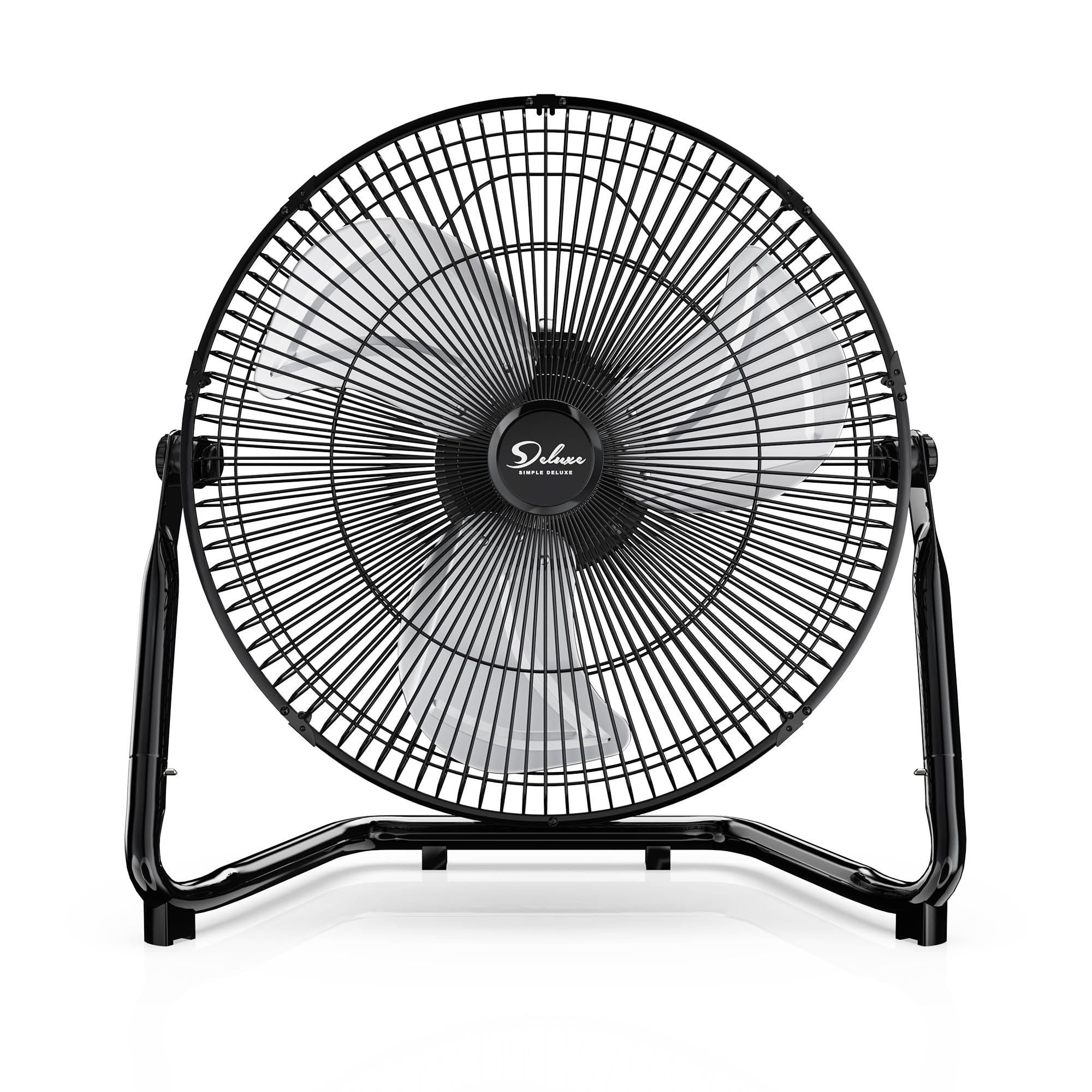
Simple Deluxe 20-Inch Floor Fan

Simple Deluxe 20-Inch Floor Fan

Whole-bay airflow

Our Score 9.2/10
Check Price

Worth Noting

  • Loud enough on high to need headphones
  • Takes a 23-inch corner of floor
Blade
20 in aluminum
Weight
11.7 lb
Airflow
4,650 CFM
Wattage
130 W
Read the full review

Value is the whole case, and it is a strong one: a 20-inch fan with aluminum blades and an all-metal housing for noticeably less than the compact blowers. The listing claims 4,650 CFM, a number to treat with suspicion on any fan this size, but the air coming off those blades at 130 watts is not subtle. Parked at the back wall and aimed down the bay, it keeps a two-car garage moving.

We have used it as the brute of the group. On high it is a wind tunnel, and the noise is the price of that: this is a fan for a detached garage or a pair of headphones, not one you set beside a desk. On low it is civil enough to leave running while you load a bar, and the three-speed rotary dial is easy to find by feel.

The build is what keeps it out of the disposable category: three aluminum blades on a metal hub, a cradle base that sits flat, and a handle that balances the 11.7 pounds so it can be moved one-handed. Assembly takes a minute and no tools. Worth knowing that the 20-inch blade sits inside a 23-inch frame, so it claims a real corner of floor in a room where floor is already contested.

Bottom line: The fan we hand someone who wants maximum air for the money and doesn't care how it sounds: aluminum blades, metal housing, a genuine wind tunnel.

#5

Hurricane Pro 20-Inch

Hurricane Pro 20-Inch

Large garages

Our Score 9.2/10
Check Price

Worth Noting

  • Pull chain sits at the motor, not at hand height
  • Heavy at 14.2 pounds and loud on high
Blade
20 in aluminum
Weight
14.2 lb
Airflow
5,300 CFM
Fan Speed
1,450 rpm
Read the full review

Fourteen pounds on a tube base with rubber feet: this is the fan in the group that feels like shop equipment rather than an appliance. The housing and blades are aluminum, the finish is powder-coated, and the whole thing is built to be dragged around a workshop rather than carried up a flight of stairs.

For a double bay with the door open, that heft buys the thing you actually need, which is volume. The listed 5,300 CFM at 1,450 rpm is the highest figure here and it behaves like it: on high, aimed down the length of the garage rather than at your face, it turns the whole space over. Aimed at a bench from six feet it is too much, and it is loud enough that you think about where you put it before you switch it on.

The controls are the old-fashioned kind, a pull chain on the motor housing and a tilt adjustment at the yoke, and that chain is the one design detail we minded. Reaching behind a running 20-inch fan to change speed mid-set is not something you will do often, so you pick a speed and stay there. The six-foot cord is short for a big bay, so plan on an outlet near where the fan lives.

Bottom line: For a big bay with the door open, this is the volume pick: the most airflow here on an all-metal body that expects to be shoved around a shop floor.

#6

Commercial Cool 16-Inch

Commercial Cool 16-Inch

Tight spaces

Our Score 9.2/10
Check Price

Worth Noting

  • Speed control is on the rear of the housing
  • Five-foot cord limits where it can sit
Blade
16 in
Speeds
3
Weight
5.5 lb
Wattage
52 W
Read the full review

Sixteen inches is the whole argument. A smaller rotor throws a narrower column than the 20-inch fans here, which is a limitation right up until you remember what a garage gym fan is for: putting air on one person, not cooling the room. In a single-car bay, or a two-car bay where you train in one corner, that narrower column is enough.

At 5.5 pounds it is the easiest fan here to move one-handed, and it tucks against a wall, under a bench, or between the rack's uprights without eating floor you need. Fifty-two watts is the lightest draw of any plug-in fan in this group, which matters when the fan shares a circuit with a treadmill or a garage fridge.

We liked it most as half of a pair: one 16-inch unit at the rack and one at the bike, because two small columns you can aim beat one big fan you keep repositioning. Two of these cost about what one blower does, and two 52-watt fans on one circuit will not trouble a 15-amp breaker. The tilt joint wants a re-tighten after you move it, so set the angle once and leave it.

Bottom line: A small-garage and second-fan pick: light enough to move with one hand and modest enough on power that two of them share a circuit without complaint.

#7

Lasko Wind Machine 3300

Lasko Wind Machine 3300

Air circulation

Our Score 8.8/10
Check Price

Worth Noting

  • Weakest durability showing among these fans
  • Two-prong fused plug rather than a grounded cord
Blade
20 in
Weight
9.3 lb
Airflow
1,985 CFM
Wattage
107 W
Read the full review

A Wind Machine doesn't try to blast a spot; it stirs a room. Five blades in a 20-inch ring, 1,985 CFM at 107 watts, and a pivoting head — the point is to stop the air in a closed garage from stratifying into a hot layer at the ceiling and a cool one at the floor.

In a garage gym that is a specific job. On a hot afternoon we set it low, tilted up, and let it roll the bay over while a session ran; it kept the air from going stale without the punishing face-blast of a floor fan on high. Pointed straight at a bench it is less satisfying than the blowers, because the airflow is wide and soft rather than concentrated.

The practical bits are decent: 9.3 pounds with a big carry handle, a rotary three-speed dial you can work with a wrist, and a pivoting head that stays where you tip it.

What holds it back is life expectancy. Of the fans here this one has the weakest durability showing, with failures clustered around the control knob and the bearings, and the plug is Lasko's two-prong fused Blue Plug rather than a grounded three-prong cord. We treat it as a fan to run for a session and switch off, not one to leave cycling all day in a dusty bay.

Bottom line: A circulator rather than a blaster: buy it to keep closed-bay air from going stale, not to put a hard column on your chest mid-set.

#8

Hurricane Classic 20-Inch Box Fan

Hurricane Classic 20-Inch Box Fan

Ventilation

Our Score 8.8/10
Check Price

Worth Noting

  • Plastic frame and handle crack if dropped
  • Wide, soft output rather than a directed blast
Depth
3.5 in
Weight
7 lb
Airflow
2,400 CFM
Wattage
55 W
Read the full review

A box fan in a garage gym is not there to cool you; it is there to empty the room. Propped in an open garage door or a side window and pointed out, it pulls hot, chalky, rubber-and-oil air out of the bay in a way no floor fan can, and it does it on 55 watts.

At seven pounds and three and a half inches deep it goes where the big fans cannot: a window sill, a door frame, the gap behind a shelf. Three speeds on push buttons, 2,400 CFM on the listing, and a plastic housing light enough to carry by the handle one-handed. Set behind you on a hot evening it does a passable impression of a breeze; set in the door and pointed out, it works.

The limitation is direction. A box fan pushes a wide, soft wall of air rather than a column, so from ten feet it feels like weather rather than a fan, and the plastic frame and handle will crack if it goes off a shelf onto concrete.

Where it earns its place is as the second fan: a blower on your chest, this one in the doorway clearing the air behind you. If your garage has a window facing away from the afternoon sun, that pairing does more for a July session than any single fan here.

Bottom line: Not the fan that cools you — the fan that empties the room, and at seven pounds and 55 watts it earns its place as the second one in a hot garage.

How We Tested Garage Gym Fans

We started with a shortlist of 30 fans — shop fans, wall-mount circulators, floor fans with remotes, and a few drum-style blowers — then narrowed it by CFM ratings, mounting options, noise specs, and price. Twelve made the cut. Each one lived in my garage gym for four months, through early-spring mornings and the sticky end of summer.

Testing happened where the fans actually work: beside the squat rack, behind the bench, and at the deadlift platform. I ran each at low, medium, and high during the same workout — warm-up, three sets of squats, a finisher — and used a handheld anemometer at 6 and 10 feet to see how much air reached my face and chest. I noted whether the airflow felt wide and steady or narrow and choppy, and whether it dried sweat between sets.

Noise got checked with a decibel app at the rack and from the driveway, since a fan that howls through an open garage door is a problem for early workouts. I operated every remote with sweaty hands, from across the garage and through the rack uprights, and tested tilt, oscillation, height, and wall-mount options by moving each fan between stations. After four months of concrete dust and humidity, I looked for rattles, loose grills, and motors that started to whine. Value came down to what the extras cost — a remote and solid mount are worth more than a flashy display.

How to Choose a Fan for a Garage Gym

Blower or floor fan

The two shapes solve different problems. A blower — the Vacmaster, the Lasko U15617, the DEWALT — throws a narrow, fast column and is the right choice for a rack, a bench, or a bike, where the air has to land on a torso from six or eight feet away. A 20-inch floor fan moves far more air in a wide wash, which is what a big bay with the door open needs.

The CFM figure on the box is measured at the fan face with nothing in the way. A 4,650 CFM floor fan aimed at the ceiling does less for you than a 375 CFM blower aimed at your chest, so decide where the air has to arrive before you compare numbers.

Noise and the number behind it

A decibel rating only means something if you know the speed and distance it was taken at, and most listings don't say. The fans here run from the high 50s on the quietest blower to the high 60s on the jobsite fan, and nearly every fan is far louder on high than its single number suggests.

Decide first whether you stream a class or take calls in the garage. If a microphone matters, a blower rated in the high 50s is the safer bet and you give up airflow to get it. If the garage is detached and your neighbors are far away, buy the air.

Motors, dust, and how long it lasts

Garages are the hardest environment a fan meets: dust, sawdust, temperature swings, and a motor running in still air. Metal housings and aluminum blades survive knocks that crack plastic, but the parts that actually fail are electrical — switches, bearings, motors.

Blow the grille and motor housing out every few months, move the fan out of the dust cloud when you sweep or sand, and treat the warranty as part of the price. One year is the standard here; the Vacmaster's two years is the exception and worth noticing.

Outlets, cords, and watts

Almost every fan here draws between 50 and 150 watts, roughly a couple of light bulbs, so the fan is rarely what trips a breaker. Placement is the real problem. A five-foot cord on a fan that wants to sit mid-bay means an extension cord, and a long thin one is the wrong place to economize on a 150-watt motor.

Blowers with onboard outlets solve it the other way, turning the fan into the power strip. If your garage has one outlet and it is already spoken for, the DEWALT's battery is the only answer in this group.

Floor space is gym space

A rack, a bench, a bike, and a car all want the same concrete. A 20-inch floor fan eats a 23-inch square; a blower the size of a milk crate slides under a bench or beside an upright; the 16-inch Commercial Cool goes almost anywhere. Measure the gap between your rack's uprights before you pick.

If floor is genuinely tight, a box fan in the window plus a blower at the rack gives you two jobs from less footprint than one big fan. It also gives you a way to empty the bay of hot air without aiming anything at yourself.

Frequently Asked Questions

Final Verdict

Start with the Vacmaster AM201R. Its remote is the difference between a fan you use and a fan you fight: 550 CFM you can redirect from the bars, in a body small enough to tuck beside the rack, backed by the longest warranty here.

If your bay is big enough that you are moving volume rather than cooling a person, the Hurricane Pro's airflow and metal build are worth the weight. If the garage has no spare outlet, the DEWALT is the only one here that solves it.