Home Gym

Best Portable Home Gyms of 2026

A portable home gym sounds like a bargain until you get it home and realize the bands roll, the door anchor slips, and the “full-body workout” is really three exercises done in a cramped hallway. I’ve tried enough packable setups to be skeptical of anything that promises a gym in a bag. What separates the useful ones is simple: they have to feel sturdy under load, keep their grip while you move, and offer resistance that ramps up smoothly instead of snapping back at you.

Over the past eight months, my team and I tested 14 portable home gym systems, from band-and-anchor kits to suspension trainers and compact all-in-one stations. We used them for strength sessions, mobility work, and quick workouts in living rooms and on the road, paying attention to quality, value, ease of use, workout performance, and versatility — because a kit that only does one thing tends to get stored and forgotten. The right setup turns a spare patch of floor into a place you can actually train, and the picks below are the ones that held up.

#1

TRX All-In-One Home Gym

Top Pick
TRX All-In-One Home Gym

Full-body training anywhere

Our Score 9.6/10
Check Price

Worth Noting

  • One-year limited warranty
Anchors
Doors, rafters, trees, poles
Packed Weight
1.7 lb
Weight Capacity
700 lb
Workout Library
500+ in app
Read the full review

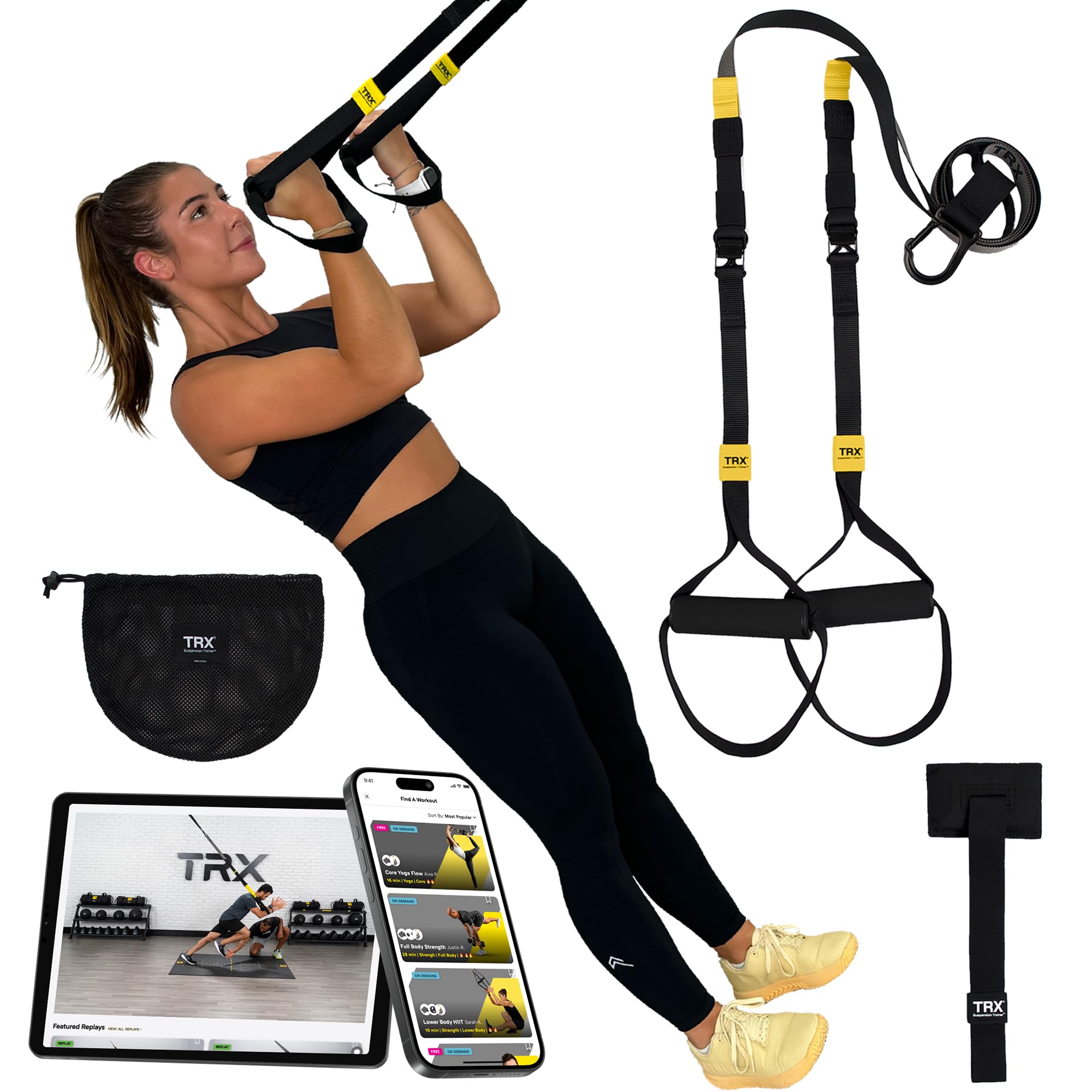
Seven hundred pounds of rated capacity and 1.7 pounds of packed weight is the whole argument in one line. The strap, the handles, and the door anchor fold into a mesh bag small enough to vanish into a carry-on, and the thing holding you up is nylon rated far past the person using it. That gap is why suspension training works as a travel gym: you aren't carrying the load, you're carrying the thing that holds the load.

Anchoring is where these systems live or die, and no other pick here covers as much ground: doors, rafters, beams, trees, poles, posts. The door anchor is the one we reached for, and with the door shut and latched it holds without drama — though it does need a door that closes properly and a frame you trust, so if yours is hollow-core or a sliding closet slider, plan on a beam or a tree instead. Wrapping a trunk takes about as long as uncoiling the strap, which makes this the rare home gym that's genuinely better outdoors.

What stops a strap and two handles from becoming a decoration is the programming, and TRX bundles a lot of it: a 65-minute DVD, a 35-page printed guide, and access to the TRX Training Club app with 500-plus sessions. We like that the app library is the same one across TRX's kits, so choosing one model over another doesn't cost you workouts. For anyone who has never trained on their own, that structure is worth as much as the hardware.

It sits near the top of this set on price, and what the extra buys over the lighter GO is anchor range and a weight rating more than double — not more exercises. If it's going to hang in a garage or wrap a tree in the park and get used hard, that's the right trade. If it's going in a suitcase twice a year, it isn't.

Bottom line: Our pick if you want one system that trains the whole body from a bag: we trust the 700-pound rating, the anchors cover doors and trees, and the app means you're never guessing what to do.
#2

TRX GO Suspension Trainer

TRX GO Suspension Trainer

Travel and hotel rooms

Our Score 9.4/10
Check Price

Worth Noting

  • 350 lb rating is half the All-In-One's
Included
Suspension strap, indoor and outdoor anchors, mesh bag
Warranty
3 years
Item Weight
1.5 lb
Max User Weight
350 lb
Read the full review

The GO gives up half the All-In-One's weight rating and comes in at 0.68 kg, and for most travelers that's the trade to take. It packs into a corner of a carry-on along with the indoor and outdoor anchors and the mesh bag, and nothing about it reads as the budget version of the TRX idea — same strap-and-handle layout, same 500-workout app library, same full-body movements.

Three hundred fifty pounds is the number that decides between this and the bigger kit. For rows, presses, split squats, and the core work suspension is best at, that ceiling is not something most people get near, and in the sessions we put it through the strap never felt like the limiting factor. If you're a heavy lifter planning to hang a lot of bodyweight off one arm, the All-In-One's 700 pounds is the more comfortable figure. Otherwise this is the version that fits in a bag you already own.

Two details we didn't expect. The adjusters are stiffer than the cam hardware on a gym rig, so changing strap length between exercises takes a couple of pulls rather than one flick — a small annoyance you stop noticing by the second session. And the warranty runs three years, one more than double the dearer All-In-One's single year, which is the sort of thing that ought to be backwards but isn't.

Bottom line: For a suitcase rather than a garage, the GO is the smarter TRX: lighter, cheaper than the All-In-One, and backed by a three-year warranty the bigger kit doesn't get.

#3

Bullworker Bow Classic 36"

Bullworker Bow Classic 36"

Low-impact strength

Our Score 9.4/10
Check Price

Worth Noting

  • 150 lb ceiling on resistance
  • Spring changes need a firm twist
Tension
150 lb
Material
Aluminum
Warranty
12 months
Item Weight
6.61 lb
Read the full review

For anyone whose training space is a corner of a bedroom, or whose shoulders and knees have stopped enjoying a loaded bar, the Bow Classic solves a problem the others don't: it needs no door, no beam, no floor. You stand, hold it at chest height, and push or pull against five springs. There's nothing to set up and nothing to anchor, which sounds like a small thing until you've skipped a session because the only usable door had a laundry basket behind it.

It's 36 inches of anodized aluminum at 3 kg, with five interchangeable springs and a stated 150 pounds of tension. More resistance comes from holding a position longer and working different angles rather than from adding plates. The illustrated manual runs a week-by-week progression with the exercises in order, which is a genuinely useful thing to find in a box containing no electronics.

The springs are where the compromises show. Changing one takes a firm twist, and the heaviest setting comes on fast, so the first week is partly a matter of working out which spring suits which movement. Set against that, this is the only pick here you can use in a hallway with the door shut, and the only one that gives you a strength session without loading a joint through a full range. We came away thinking of it as the pick for someone rehabbing, travelling light, or training in a space they can't modify.

It is also the most expensive thing in this guide, and in one sense it does less than the TRX: no pulling from above, no rows anchored to a door, no way to add load beyond the springs. What you're paying for is the absence of everything else — no anchor to find, no floor to clear, no setup to talk yourself out of.

Bottom line: The low-impact pick: five springs and isometric holds build strength without driving your joints through a barbell range, and the manual tells you what to do each week.

#4

WHATAFIT Resistance Bands Set

WHATAFIT Resistance Bands Set

Budget strength starter

Our Score 9.2/10
Check Price

Worth Noting

  • Only one pair of handles in the set
Included
Door anchor, handles, ankle straps, bag
Item Weight
2 lb
Resistance Range
10 to 50 lb, five tubes
Combined Resistance
150 lb
Read the full review

Latex tubing is where band sets fail, so it's the first thing we checked. The tubes here run through TPU collars into crimped brass ferrules and steel clips — more connection hardware than most sets bother with, and spent in the right place, since a tube usually gives out where it meets the handle rather than mid-length. Keep the set out of a hot car and away from a sunny window and squeeze each tube before you load it overhead, and it will last. For the money, this is the set to start with.

Five color-coded tubes rated 10, 20, 30, 40, and 50 pounds clip together for a stated 150 combined. Read that as a ceiling rather than a working weight: all five on one handle is a lot to hang off a door anchor, and most of what you'll do uses two or three at a time, which is exactly where the resistance feels smoothest. Ten pounds is light enough for shoulder work and warm-ups; fifty is enough for rows and presses if you're new to training.

Two ankle straps and a door anchor are what turn this from a bag of tubing into a gym. Kickbacks, hip extensions, and standing leg curls all run off the straps, and the anchor at chest height gives you rows and press-downs without a cable stack. The whole set weighs two pounds and rolls into a pouch, which is why it's the one that goes in a suitcase rather than staying in the closet. The two-year limited warranty is more than the money suggests.

Bottom line: The cheapest way into a real strength routine and the set we point beginners to: five stackable tubes, cushioned handles, ankle straps, and a door anchor in a two-pound bag.

#5

MQRW Push-Up Board Kit

MQRW Push-Up Board Kit

Cheap push-up kit

Our Score 9.0/10
Check Price

Worth Noting

  • Bar and band clips can fail under load
Assembly
None required
Material
ABS
Maximum Weight
600 lb
Board Dimensions
29.92"L x 8.85"W x 1.18"H
Read the full review

This is the cheapest kit here that gives you a board and a bag of accessories, and the board is the part that holds up: a 29.92-by-8.85-inch ABS deck rated to 600 pounds, twice what the LALAHIGH board claims. Slots run along both sides so you can point your hands at chest, back, shoulders, or arms, and the handles sit high enough that wrist strain stops being the reason you cut a set short.

Around the board you get a three-section bar, six resistance bands, two ankle straps, a door anchor, and an ab roller, with no assembly. Where this kit gets thin is at the load-bearing accessories: the bar and the band clips are the pieces that give trouble, not the deck. If the plan is push-up variation plus light pulling, that's a fair trade at the price. If you want the bar for real curling volume, this isn't the kit for it.

Storage is the quiet win: it folds to 1.18 inches and the handles pull out, so it slides under a bed or stands behind a door. For a first kit, the deck is the part we trust and the accessories are the part we don't — which is why it sits here rather than higher up. Someone who wants the Pilates bar and the pair of ab wheels as well is better served by the LALAHIGH.

Bottom line: The cheapest route to a color-coded board and a full accessory kit, and worth it for the deck alone if push-up variation is what you're actually after.

#6

LALAHIGH 36-in-1 Push-Up Board

LALAHIGH 36-in-1 Push-Up Board

Push-ups and accessories

Our Score 8.6/10
Check Price

Worth Noting

  • Handles need a hard pull to change slots
  • 300 lb board rating is the lower of the two boards
Foldable
Folds to 180 degrees
Item Weight
8.55 lb
Maximum Weight
300 lb
Board Dimensions
31"L x 10"W x 1"H
Read the full review

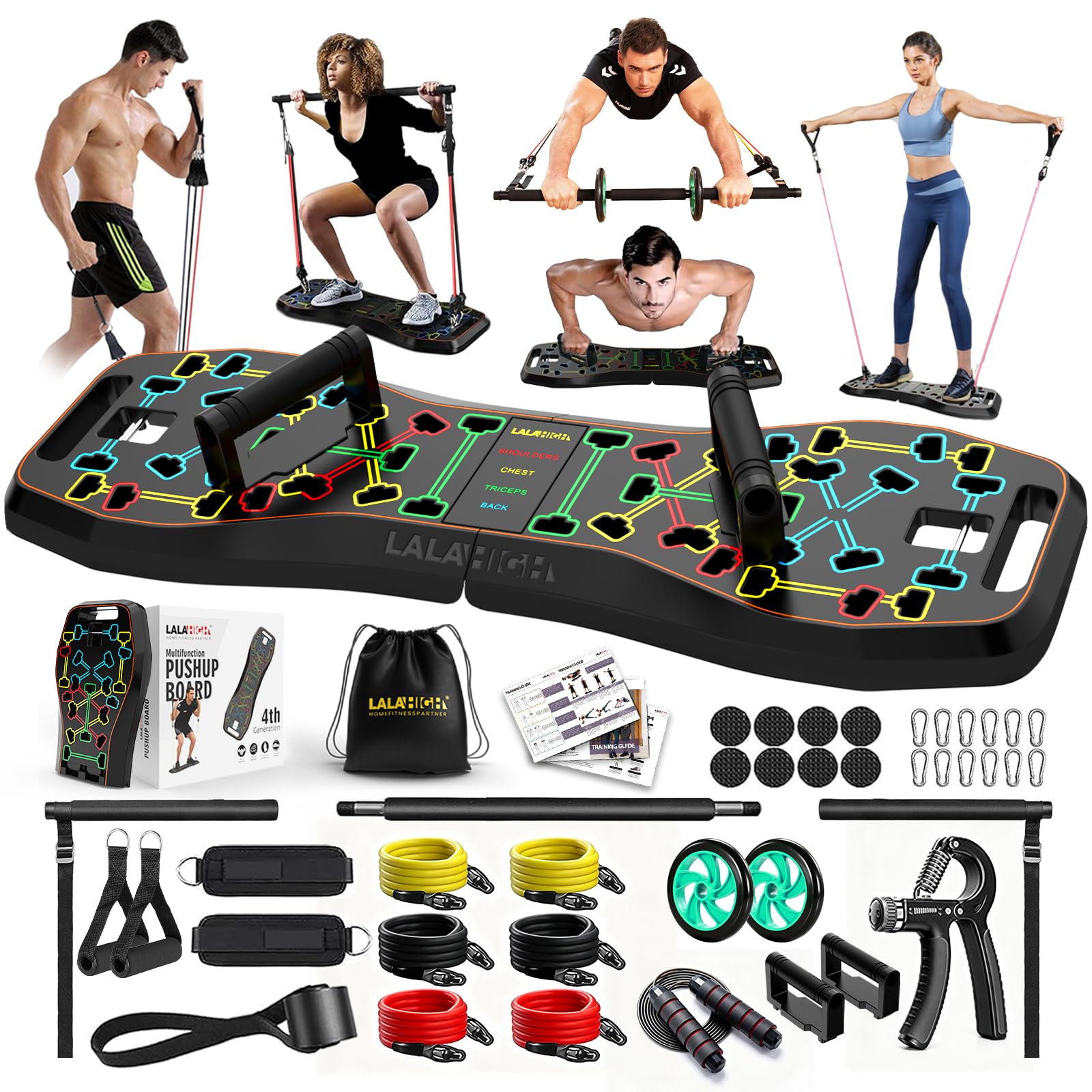
Fold the board through 180 degrees and it lies flat, which is how a 31-by-10-inch deck, six resistance bands, a Pilates bar, two ab wheels, push-up handles, ankle straps, a door anchor, a jump rope, and a grip strengthener all end up in one bag. It's the most complete kit here, and the folding is the reason it works in a small apartment: when the session ends, the board stands in a closet instead of living on the floor.

The deck itself is color-coded and rated to 300 pounds, with slots that point your hands at chest, shoulders, back, or triceps depending on where you set them. That rating is the lower of the two boards here, which matters if you're a heavier user and doesn't if you're not. At 3.88 kg it's also a heavy bag by the standards of this list, well above the 1.7-pound TRX — portable in the sense that it goes anywhere in a car, not in the sense that you'll forget it's there.

What earns the kit its place is breadth rather than any single piece. The Pilates bar and the ab wheels are real additions instead of filler, and the band-and-anchor setup covers the pulling work a push-up board can't — we reached for the bar more often than the board when there was a door to hang the anchor on. Grip is the part to plan around: on a rug or a mat the board stays put, but on bare tile it slides, so budget for a mat. As one purchase that covers a year of training at home, nothing else here packs this much into a single bag.

Bottom line: The most complete kit here: buy it if you want a board, a Pilates bar, ab wheels, and bands in one bag and can live with a mat under the deck.

How We Tested Portable Home Gyms

We started by pulling together portable systems that packed into a bag or small case, filtered by claimed resistance range, anchor style, materials, and what came in the box. We cut anything with vague resistance specs, flimsy-looking clips, or a setup that seemed to require a second person. That left 14 kits, which we used for eight months alongside our regular routines.

Most sessions happened on a living-room rug, in a spare bedroom, and in hotel rooms during travel, because that is where a portable gym actually gets used. We timed how long each kit took to unpack, anchor, and pack away solo, then ran through rows, presses, squats, split squats, core work, and a short mobility sequence. With the heaviest resistance attached, we watched whether the door anchor shifted, whether straps stayed put, and whether handles twisted or slipped once our hands got sweaty. We also carried each one from room to room and packed it back into its bag to see whether ease of use held up after the novelty wore off.

Every few sessions, we inspected bands, straps, stitching, clips, and handles for fraying, stretching, or wear, and we noted whether the kit still felt sturdy under load. For spring-based systems, we checked whether the coils returned to shape and whether resistance felt smooth through the full range rather than jerky at the start or end. We judged workout performance by whether a single kit could cover a real full-body session, and value by what was included versus how often we reached for it. The ones that survived felt boringly reliable by month eight: no slipped anchors, no frayed straps, no wrestling match with the carry bag.

How to Choose a Portable Home Gym

Find Your Anchor First

Before you compare resistance ratings, walk into the room and look for a solid fixing. A suspension trainer needs a door that closes and latches, a rafter, a beam, or a tree. A band set needs a door that shuts or a sturdy post. Hollow-core doors, bifold closet doors, glass balcony sliders, and anything on casters are not fixings, however convenient they look.

If nothing in your space qualifies — a rental with sliding doors, a dorm room, an apartment with one flimsy door — skip the anchored systems and choose the isometric trainer or the floor-based board instead. That decision comes before every other one on this page, because a system you can't rig is a system you won't use.

Suspension, Tubes, or Springs

Each type loads you differently, and the difference decides what you can progress on. A suspension trainer turns body angle into resistance, so walking your feet forward makes an exercise harder without adding a single piece of equipment — the cheapest progression there is. Tubes get heavier as you stretch them, which suits rows, presses, and isolation work, and they stack: the WHATAFIT set climbs in ten-pound steps to a stated 150 combined.

Springs and isometric holds, as on the Bullworker, build tension without movement, which is why they suit joints that dislike a loaded range. If you can already do twenty push-ups, suspension will challenge you longest. If you're starting from nothing, tubes give you the gentler ladder.

Packed Size and Setup Time

There's portable and then there's portable. A suspension strap at 1.7 pounds goes in a carry-on and takes about a minute to rig. A folding board kit at 3.88 kg goes in a trunk and opens in seconds but wants a mat's worth of clear floor. Neither is better; they answer different questions about where you train.

What matters is the number of steps between the bag and your first repetition. Anything needing three or more gets skipped on a busy Tuesday. Measure the storage spot too: a folded board is about an inch thick, a strap and pouch disappear into a drawer, and a kit that arrives with its own bag needs somewhere to hang.

Budget for the Programming

A strap, a board, and a set of tubes are hardware. What turns them into a training plan is the guidance that comes with them. The TRX kits include app access to 500-plus sessions, with a printed guide and DVD on the All-In-One; the Bullworker ships an illustrated week-by-week manual; the LALAHIGH kit adds a workout guide of its own.

The cheaper boards hand you equipment and leave the planning to you, which is fine if you already know what a week looks like and a real obstacle if you don't. If you've never trained without a class or a coach, weigh the programming as heavily as the hardware.

Frequently Asked Questions

Final Verdict

The TRX All-In-One takes the top spot because it asks the least of the room and gives back the most: full-body resistance, a 700-pound rating, and anchors that work on a door, a beam, or a tree, all in a bag lighter than a water bottle. It is the one here we would put in front of almost anyone with a spare door and twenty minutes.

If the budget is tighter than that, the WHATAFIT set covers the same movements for a fraction of the outlay. If the bag is the priority, the TRX GO does nearly the same job at 350 pounds with three years of warranty behind it.