Home Gym

Best Multi Station Home Gyms of 2026

The fantasy of a multi station home gym is a full weight room in one footprint. The reality, as anyone who has wrestled a crate of steel into a garage knows, involves a weekend of assembly, a manual that skips a page, and a cable tower that may wobble when you pull hard. A good one replaces the gym commute and the crowded squat rack; a bad one becomes an expensive towel rack. Over the past 10 months, I assembled and lived with six of these machines, from compact cable setups to full functional trainers, and the gap between them came down to patient engineering—not station count.

What surprised me was how much the small stuff mattered: whether a seat clicked into place without pinching, whether the pulley height adjusted with one hand, and whether the instructions assumed a second person or an engineering degree. We put each machine through daily workouts—morning lat pulldowns, evening leg presses, weekend sessions with my partner, who is eight inches shorter than me—and noted where cables rubbed, frames creaked, and which stations earned their footprint. The six picks below are the ones that held up.

#1

SunHome 925

Top Pick
SunHome 925

Partner workouts

Our Score 9.2/10
Check Price

Worth Noting

  • Fixed seat height and backrest
  • One-year warranty only
Warranty
1 year
Footprint
96.85"D x 55.12"W x 86.61"H
Weight Stacks
Two 138 lb
Exercise Combinations
100+
Read the full review

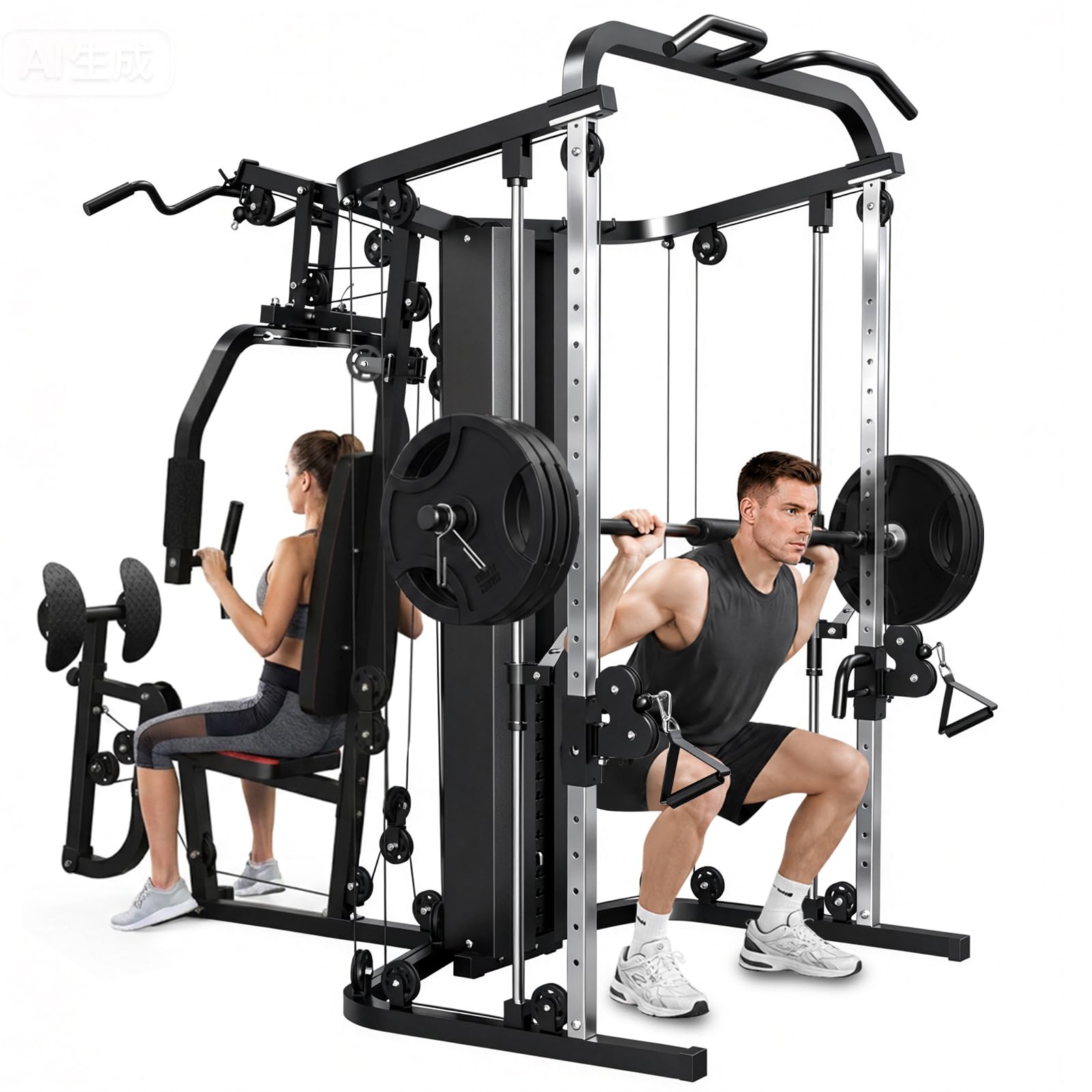
A second weight stack changes what a home gym is for. The SunHome carries a 138-pound stack on each side, fully independent, so two people train at the same time without one of them waiting on the other's set — the difference between owning a machine and owning a gym.

The frame is 2-by-2-inch commercial-gauge steel, and the listing claims more than a hundred exercise combinations across the two sides: press work on one, cables on the other, upper and lower body running simultaneously. It's also the best-reviewed machine in this group, with the sturdiness and value marks to match, and assembly is reported as straightforward in a category where it usually isn't.

The problem is the seat. Neither the seat height nor the backrest adjusts, and that lands differently depending on your build: a 6-foot-1 lifter runs out of cable travel, a 5-foot-2 lifter can't make the leg press work at all. Average-height users are fine, which makes this a machine to buy for a couple of similar builds rather than a household of outliers. The one-year warranty is also the shortest coverage in this group, and on a machine at this price that's a real consideration.

Bottom line: The practical way to get two independent stacks: two people train at once without sharing a pin. Buy it only if both users are close to average height.
#2

Mikolo HGS Pro

Mikolo HGS Pro

Narrow rooms

Our Score 9.0/10
Check Price

Worth Noting

  • Seat adjusts up and down only
  • Middle pulley travel runs short
Stations
10-in-1
Warranty
Lifetime frame, 1 year parts
Footprint
75"D x 36.3"W x 80"H
Weight Stack
154 lbs (12 levels)
Read the full review

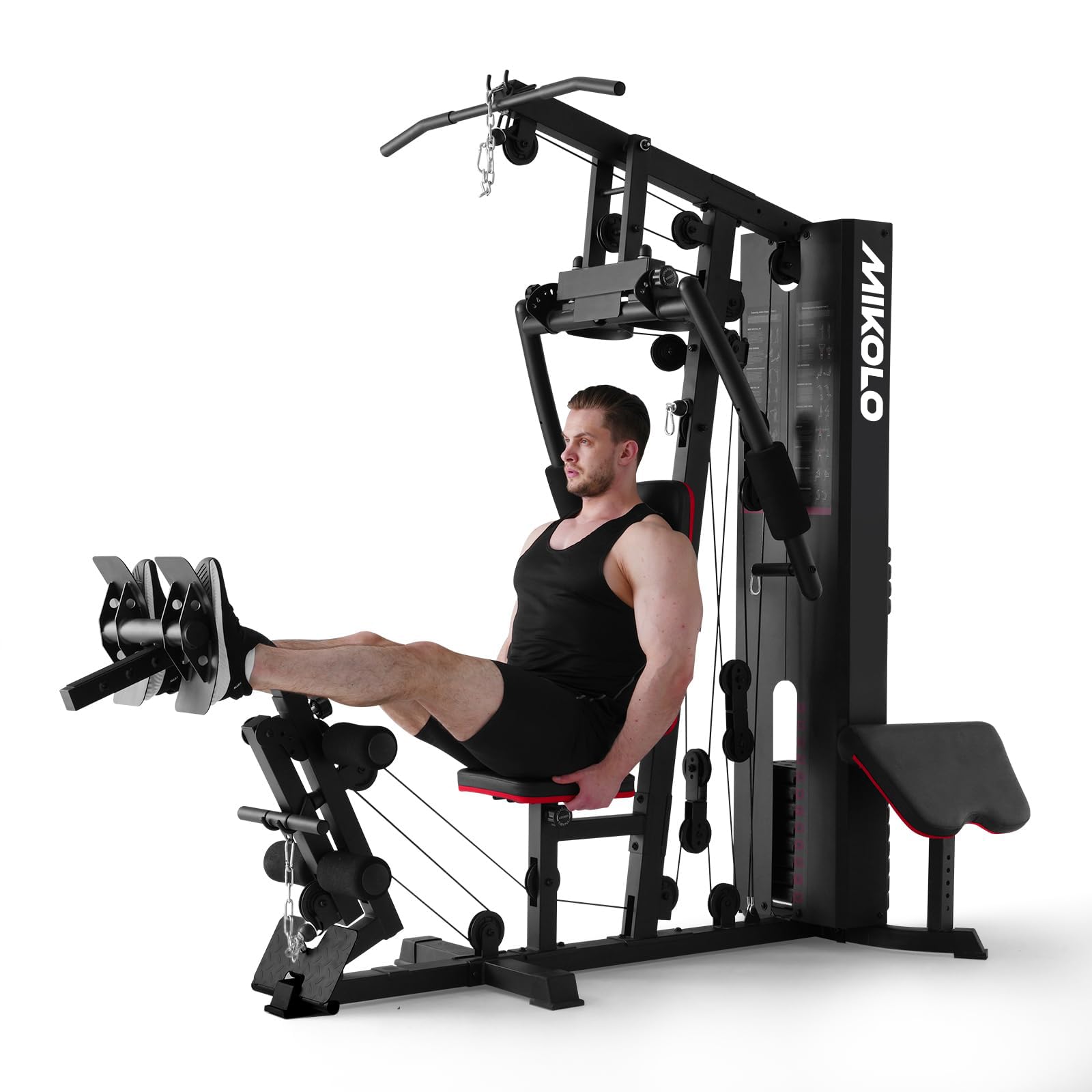
Ten stations in a 36.3-inch-wide frame is the trick the Mikolo pulls off. That's the narrowest tower here, narrow enough for the end of a hallway or a slice of basement wall, and the station list reads like a commercial machine's: pec fly, lat pulldown, low row, chest press, leg extension, leg press, preacher curl, core, calf and seated row.

You pay for the width in depth — 75 inches out from the wall, more than the SincMill needs — and in steel mass rather than stations, at roughly 300 pounds for the whole thing. What the money buys instead is a 154-pound stack in 12 levels, fine enough to add load in sensible steps, a bearing in the cable bar that keeps the pull smooth on the wrist, and preacher and leg press fittings that come off when you want the frame out of the way.

The leg press rewards average proportions; very short and very tall users each end up compromising somewhere, and that's the main thing to weigh before ordering. Otherwise the ownership details are strong: a lifetime frame warranty with a year on components, hardware labelled by step, and an assembly video that carries the parts of the manual that thin out.

Bottom line: Our pick when floor space is the constraint: ten stations, a 154-pound stack and a lifetime frame warranty in a 36.3-inch-wide frame. Check the 75-inch depth before you commit.

#3

Sportsroyals HPM02

Sportsroyals HPM02

Mixed-height users

Our Score 9.0/10
Check Price

Worth Noting

  • 51-inch width needs a longer wall
  • 150 lb stack caps stronger lifters
Warranty
Lifetime frame, 2 years parts
Exercises
35+
Footprint
75"D x 51"W x 81"H
Weight Stack
150 lbs (11+1 levels)
Read the full review

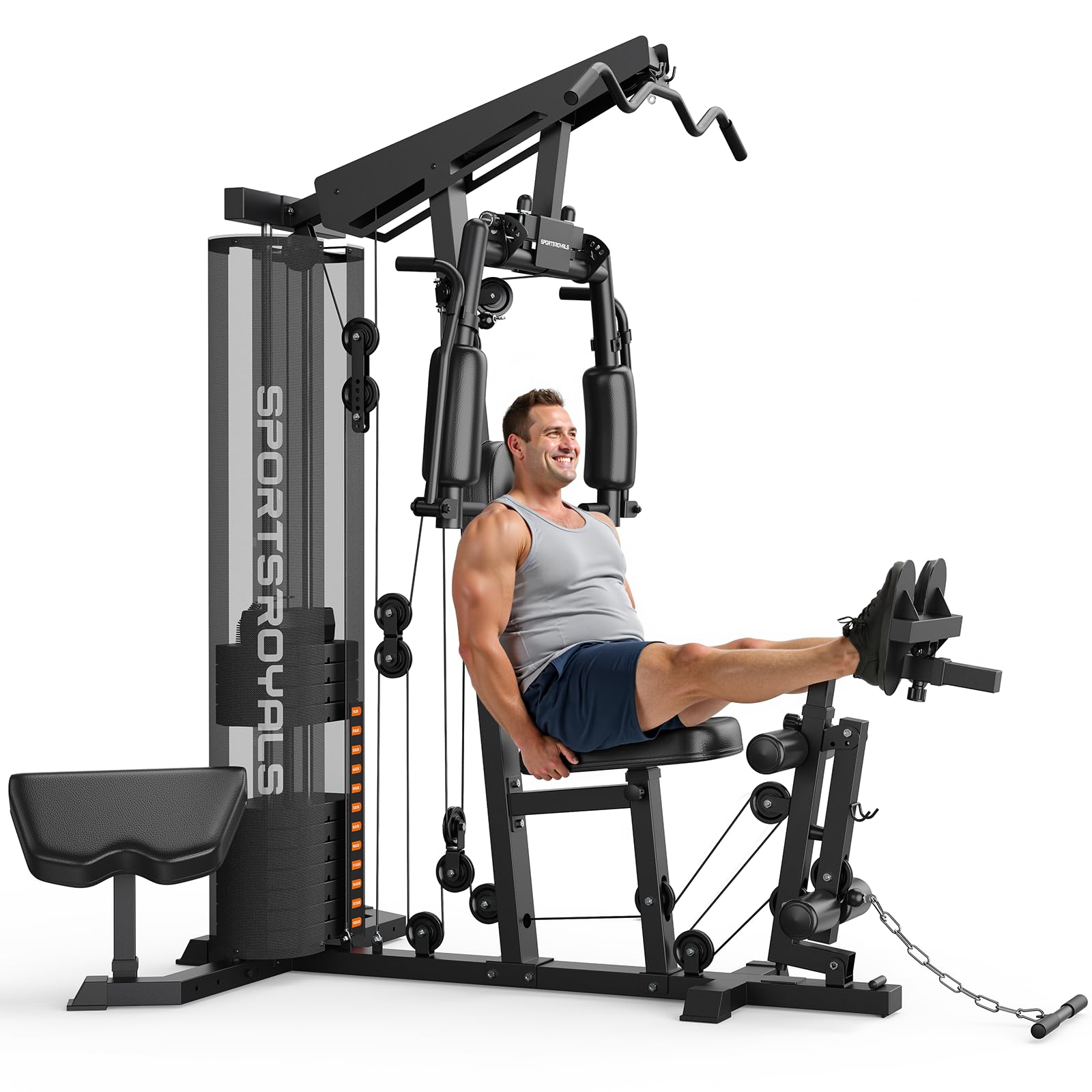
The complaint we keep running into with these machines is fit: a press arm that sits right for one person in the house and wrong for everyone else. Sportsroyals goes straight at that with the hardware, which is rarer than it should be.

Five-position butterfly arms, a four-position seat and a leg press footplate that moves for both height and front-to-back distance add up to more adjustment than anything else in this group, and they're the reason a 5-foot-3 user and a 6-foot user can share one frame. The structure is 70 by 50mm steel with 2mm walls on a wide H-base, the stack runs 150 pounds across 11-plus-one levels, and the station count goes past 35 exercises once the leg extension and preacher pads are counted — both of which stow when they're not in use.

We think it's the smart buy for a household of different-sized people, and it lands in the same price neighborhood as the machines around it. What holds it back is time: this is one of the newer designs here, so there's less of a long-term record to lean on than the Marcy and Body-Solid frames carry. The lifetime frame and two-year component warranty soften that considerably.

Bottom line: The most adjustable machine here and the easiest to share between a tall lifter and a short one. Buy it if two differently built people will use the same stack.

#4

SincMill SCM-1148L

SincMill SCM-1148L

All-round home lifting

Our Score 8.8/10
Check Price

Worth Noting

  • Leg press stroke runs short
  • Several boxes and thin printed directions
Warranty
10 years
Footprint
69"D x 40.7"W x 80"H
Weight Stack
148 lb
Leg Press Pedal
Included
Read the full review

Forty and a half inches is the number that decides where this machine lives. The SincMill's frame is 40.7 inches across and 69 inches deep, narrow enough to sit against a garage wall with room to walk past it and shallow enough that a car still fits alongside. That footprint is why it's our pick for most homes; the rest of the package holds up the same way.

The stack is 148 pounds and runs on four quick-release latches, so moving from lat pulldown to low row to the leg press pedal takes seconds rather than a re-rig. That leg press is the station most machines this size leave out, and it's what makes the SincMill a full-body machine rather than an upper-body one. The box also carries a curl pad, ankle straps, one-hand bars and a chain, and behind it all sits a 10-year warranty — the longest here short of Body-Solid's lifetime coverage.

Where it asks you to compromise is fit at the extremes. Average builds settle in comfortably; anyone much past six feet will feel the frame crowding the pulldown and the press arms, and the Sportsroyals is the better answer for those households. Everyone else gets a machine that covers the whole body in a footprint small enough to leave the garage a garage.

Bottom line: The best all-rounder here for most homes: a 148-pound stack, a working leg press and a 40.7-inch footprint that leaves the garage usable. Buy it unless you're well over six feet.

#5

Body-Solid EXM2500LPS

Body-Solid EXM2500LPS

Buy-once ownership

Our Score 8.8/10
Check Price

Worth Noting

  • Illustrated directions with almost no text
  • Two-person build, no shortcuts
Stations
6
Warranty
In-home lifetime
Footprint
83"D x 79"W x 89"H
Weight Stack
210 lb
Read the full review

The premium here buys steel, bearings and a warranty that doesn't expire. The EXM2500LPS is built from 2-by-4-inch 12-gauge steel with sealed bearings, and six stations share one 210-pound stack through a no-cable-change design — you move the pin and the handle, not the cable.

For a machine that has to absorb years of daily use, this is the one we point to. The stack covers everything short of a serious strength athlete, the leg press is a proper sled rather than a pedal tacked onto the frame, and the in-home lifetime warranty covers the frame and all parts rather than quietly excluding the things that wear. It weighs 571 pounds, and it feels like it.

The cost is space and patience. It stands 89 inches tall and takes 83 by 79 inches of floor, so a basement with a low beam or a soffit is out before you start — against an eight-foot ceiling you have roughly seven inches of headroom over the pulldown, and a ceiling fan is right out. Plan the delivery route before it arrives, because this is not a machine you shift on your own once it's built.

Bottom line: The buy-once pick: commercial-grade steel, a 210-pound stack, a real leg press and an in-home lifetime warranty. Worth it if the room is big enough and the plan is never to shop for another one.

#6

Body-Solid EXM3000LPS

Body-Solid EXM3000LPS

Two-stack training

Our Score 8.8/10
Check Price

Worth Noting

  • Very large 90-by-82-inch footprint
  • Multi-evening build from picture directions
Stations
7
Warranty
In-home lifetime
Footprint
90"D x 82"W x 83"H
Weight Stacks
Two 210 lb
Read the full review

The second stack is the whole point. The EXM3000LPS carries two 210-pound stacks on a seven-station frame, so two people train at once without sharing a selector pin, and the no-cable-change design means neither of them is re-rigging between movements.

Body-Solid's construction is the heaviest here, with commercial ratings behind the pulleys and an in-home warranty that runs for life on the frame and parts. The station list is the fullest in this group: multi-press, leg press and calf press, pec station, lat pulldown and high pulley, ab crunch and mid pulley, leg extension and leg curl, seated row and low pulley.

It is also a piece of equipment you plan a room around, at 90 inches deep and 82 wide once built, arriving in multiple boxes with picture-only directions. Two people and a long weekend is the realistic estimate, and the manual will not hold your hand through the cable routing.

For a household where two people train together most days and the floor space already exists, this is the last machine you buy. For everyone else the single-stack EXM2500LPS does the same work for a good deal less, and the only thing you give up is the second person's independence.

Bottom line: The endgame machine if two people train most days and the room already exists. Everyone else gets the same work done with the single-stack Body-Solid for far less.

#7

Marcy MWM988

Marcy MWM988

First home gym

Our Score 8.8/10
Check Price

Worth Noting

  • Butterfly and curl strokes run short
  • Instructions are mostly diagrams
Curl Pad
Removable
Warranty
2 year limited
Dimensions
68"W x 78"H
Weight Stack
150 lb
Read the full review

Dual-action press arms are the pitch, and they're the catch too. The Marcy's press arms swing for chest press and then rotate into a butterfly movement, but the butterfly travel is short enough that the fly never quite completes — the same limit shows up on the preacher curl, where the pad is comfortable but the range ends early.

Everything else is sound for the money. The 150-pound stack moves in 10-pound steps, the curl pad lifts off when you want it out of the way, and the frame stands 78 inches tall and 68 inches wide with a two-year limited warranty behind it. Lat pulldowns, rows, leg extensions and press work all feel like a machine that costs what this one does, and it has the owner base of a long-running design rather than a new entrant.

As a first machine for someone who wants a circuit at home and won't miss the fly, it earns its place — the footprint is small, the stations are the ones people actually use, and the price leaves room for dumbbells. If the butterfly matters to your program, spend more and buy a machine that swings through a full arc.

Bottom line: A good first multi-station gym: a 150-pound stack in ten-pound steps, a removable curl pad and a compact frame. Skip it if the butterfly movement is on your list.

#8

Goplus Multifunction Home Gym

Goplus Multifunction Home Gym

Tight budgets

Our Score 8.4/10
Check Price

Worth Noting

  • 100-pound stack limits progression
  • Seat runs short for taller users
Pulleys
12
Footprint
50"D x 39"W x 82"H
Weight Stack
100 lb
Max Weight Rating
330 lb
Read the full review

This is the smallest machine here by a wide margin: 50 inches deep, 39 wide and 82 tall, on a 180-pound frame. It is also the lightest stack in the group, at 100 pounds.

For a beginner, a lighter lifter, or a teenager in a spare bedroom, that math works out fine. Twelve pulleys run a high and a low cable, there's a four-roll leg developer and a dual-function press arm, and the stack is ten 10-pound plates you can pull and replace in seconds. It covers the basics of a circuit without turning a room into a gym.

One thing to know before ordering: the base is light enough that heavy low-pulley work can lift the front end. Plant a foot on the frame or weight the base for rows and the problem goes away — a workaround rather than a dealbreaker at this size, but you should know it exists before the first set of tricep pushdowns.

For the money it's a fair first step, and the 330-pound weight rating is honest about who it's for. It isn't a machine to grow into: anyone already pulling most of a 100-pound stack on lat pulldowns should start with one of the 148-to-150-pound machines here and save the upgrade.

Bottom line: The cheapest way into a multi-station machine, and fine for light circuit training in a small room. Buy it as a starter, not as a forever gym.

How We Chose and Tested Multi Station Home Gyms

We started with a shortlist of 14 multi station gyms from established home-fitness brands, filtering by footprint, weight-stack capacity, station count, and whether replacement cables and pads were easy to source. That left six machines, which we assembled and lived with for 10 months in a garage gym, a finished basement, and a spare bedroom—the three places these actually end up.

Each arrived in multiple boxes, so I timed solo assembly, noted every step where the manual skipped a washer or assumed a second set of hands, and flagged any instruction that sent me back to the hardware bag. Once built, we used them like a home gym: full-body workouts three mornings a week, evening sessions from my partner, and mid-set switches between stations to see how smoothly the seat and pulley adjustments moved.

We loaded the stacks to their top plates for lat pulldowns and rows, watched for frame sway and cable rub, and checked whether each station let us move through a full range of motion without pinching or slipping. We also measured the actual footprint after assembly—not the spec sheet—because a few inches matter in a garage.

After 10 months, we inspected welds, upholstery seams, and cable wear, then compared how often each station got used against how much floor space it consumed. The best machines were not the ones with the most stations; they were the ones whose stations we reached for without thinking.

How to Choose Multi Station Home Gyms

Measure the wall, the depth and the ceiling

Footprints in this group run from 50 to 97 inches deep, 36 to 82 inches wide and 78 to 89 inches tall, which is a bigger spread than the station lists suggest. Compact in a listing means it fits against a wall, not that it is small in every direction: the narrowest machine here is also one of the deepest at 75 inches.

Measure the run of wall you have, the distance it can come out into the room, and the ceiling at that exact spot rather than the room's average. A lat pulldown needs clearance above the bar, and an 89-inch frame under a low beam or a ceiling fan is a problem no adjustment fixes.

The stack sets your ceiling

Selectorized stacks here run 100 to 210 pounds, and the stack you buy is the resistance you are stuck with. A 148-to-154 pound stack covers most recreational lifters for years; 100 pounds is a starter stack that a reasonably strong adult will outgrow on lat pulldowns within a season.

Check the increments as well as the total. Ten-pound steps are workable; finer levels let you add load gradually instead of jumping. If you already pull most of a 100-pound stack, skip the budget machines entirely and start at 148.

Range of motion separates these machines

The complaint we hear most often about compact frames is a movement that stops short: a pec fly that never crosses the midline, a leg press with a few inches of travel, a preacher curl that ends early. It is worth more than an extra station, because a movement you cannot complete trains nothing.

Adjustment is what protects you. A sliding seat, multi-position butterfly arms and a footplate that moves in two directions are what let a 5-foot-3 lifter and a 6-foot lifter get full travel from the same frame. If two differently built people share the machine, buy adjustment before you buy station count.

Count the stations you will actually use

Ten stations on paper often means eight you use. Leg press and a proper lat pulldown earn their space; so do a low row and a leg developer. A preacher curl pad that lifts off is genuinely useful on a frame that has to double as a corner of the garage.

Our test is simple: list the movements in your current routine, then check that the machine completes each one through a full stroke. Anything else on the list is a bonus, not a reason to pay more.

Assembly, warranty and what wears out first

Picture-only manuals are the norm here, so budget an evening and a second pair of hands, and watch the assembly video before you open the hardware bags. Nobody assembles one of these alone without regretting it at the pulley stage.

Warranties vary more than they should. Frame coverage runs from a couple of years to lifetime, but cables and upholstery are the parts that actually wear, and they are often covered for a shorter period. Read that line before you decide which machine is the better value.

Frequently Asked Questions

Final Verdict

For most homes, buy the SincMill. A 40.7-inch-wide frame, a 148-pound stack on quick-release latches, a leg press pedal and a 10-year warranty cover full-body training without eating the garage, and it costs less than several machines here that do less.

Two changes move the decision. If the wall you have is narrow but the room is deep, the Mikolo packs ten stations into 36.3 inches. If two people will train together at the same time, the SunHome's second stack is worth the premium — provided both of you fit its fixed seat.