Home Gym

Best Garage Heaters of 2026

A garage is the one room the furnace forgot. It's where winter projects go to die — a workbench too cold to stand at, a car that never quite thaws, a shelf kit waiting for April. A garage heater fixes that, but only if it suits the space: a small plug-in unit that warms the spot where you stand is a different animal from a ceiling-mounted one built for a three-car bay. I spent five months of cold mornings with 11 of them, and the pattern held every time — the winner is never the most powerful heater, it's the one matched to your square footage and your wiring.

The wiring part surprises first-time buyers. Most garages run on a 15- or 20-amp circuit, and plenty of the strongest heaters want a dedicated 240-volt line, which is an electrician's bill before it's a heater bill. That's why installation and value counted as heavily in my notes as raw heat output, and why heating speed turned out to matter more than any spec sheet suggests. The picks below run from plug-in units for a one-car garage to ceiling-mounted ones that can carry a whole bay.

#1

Mr. Heater Big Buddy 18,000 BTU

Top Pick
Mr. Heater Big Buddy 18,000 BTU

Portable spot heat

Our Score 9.2/10
Check Price

Worth Noting

  • Radiant heat only warms what it faces
  • 1-pound bottles burn out fast; fan needs batteries
Weight
14.1 lb
Coverage
450 sq ft
Settings
Low, medium, high
Heat Output
18,000 BTU
Read the full review

No wiring, no gas line, no electrician. The Big Buddy takes two 1-pound propane cylinders or, with a hose, a 20-pound tank, and gives you three settings — 4,000, 9,000, or 18,000 BTU — with a battery-powered fan pushing air off the radiant panel. It's rated for indoor and outdoor use and shuts off if it's knocked over.

Radiant heat is the thing to understand before you buy. It warms what it faces, so pointing it at your chest while you work under a hood is exactly the right use, and expecting it to bring a 40-degree garage with concrete walls up to room temperature is not. Five minutes in front of it feels considerably better than five minutes away from it, and on low, a pair of 20-pound tanks on the optional hose is rated at 216 hours.

Where it earns its shelf space is the exception case: a power cut, a garage with no circuit, a cabin, a deer blind. We've carried ours to places a cord wouldn't reach. Just budget for the fuel — 1-pound bottles are the expensive way to run it and don't last a cold night, so the hose and a 20-pound tank is the setup that makes sense. The fan takes batteries, and it goes through them.

Bottom line: We keep one on the shelf for the garage with no circuit and the night the power goes out; it warms you, not the room.
#2

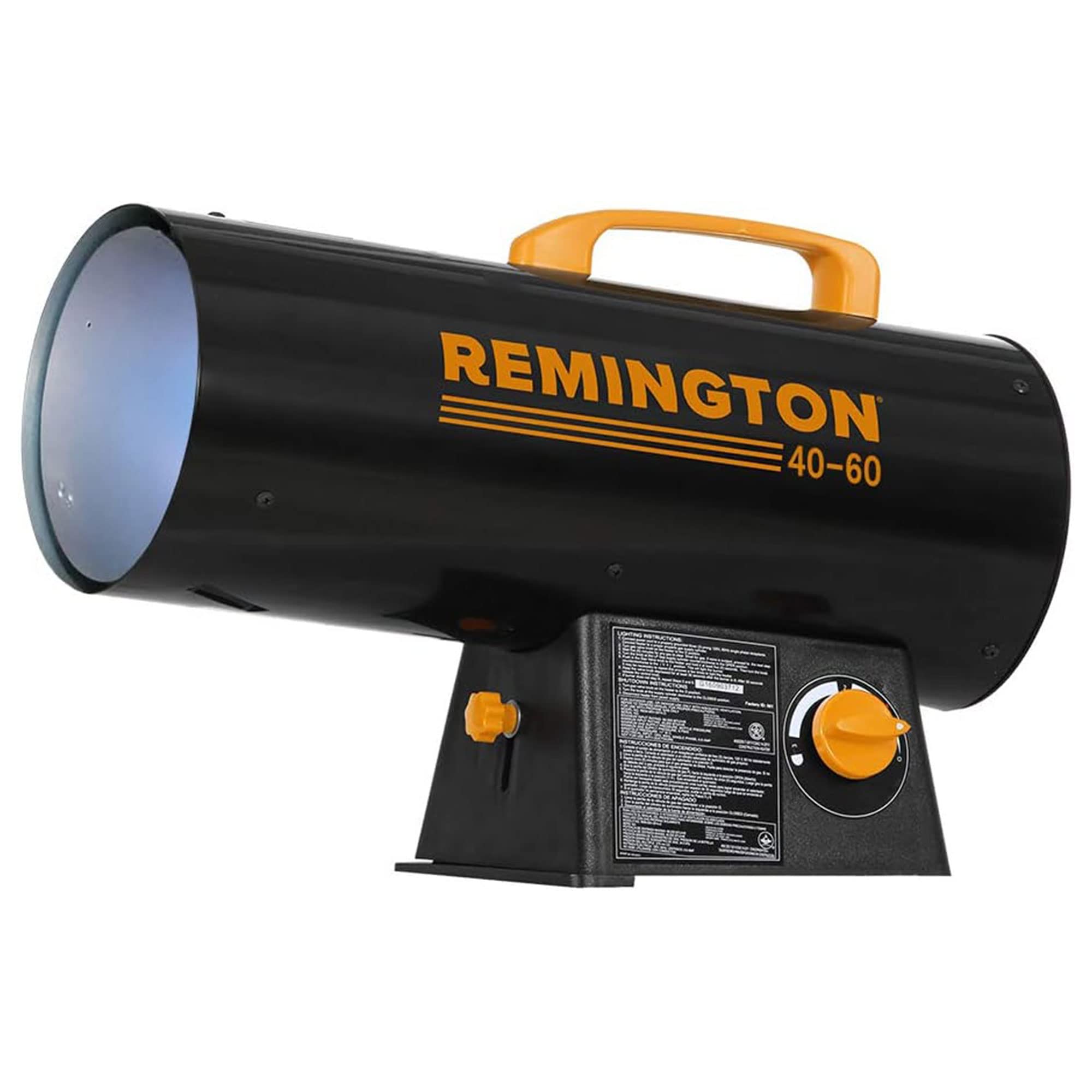
Remington 60,000 BTU Propane Heater

Remington 60,000 BTU Propane Heater

Ventilated workspaces

Our Score 9.0/10
Check Price

Worth Noting

  • Outdoor or ventilated use only
  • Loud fan and a short power cord
Fuel
Liquid propane, 20 lb tank
Weight
11 lb
Coverage
1,500 sq ft
Heat Output
60,000 BTU
Read the full review

Sixty thousand BTU from an 11-pound box, running on a 20-pound propane tank, with a ten-foot hose and regulator in the carton and electronic ignition so there's no match-and-hold routine. The Remington doesn't try to hold a building at temperature. It puts a wall of hot air where you're standing.

It's rated for outdoor use, and that's the part people skip past. Forced-air propane pushes combustion products into the space it's heating, so this belongs in a garage with the door up, on a job site, or in a barn with air moving through it — never in a sealed garage with the door down. The high-limit shutoff and thermocouple protect the flame, not the air you're breathing.

With that understood, it's a useful thing to own. The heat is immediate and directional, the variable valve lets you back it off once the edge is off the cold, and it weighs so little that carrying it to the driveway takes one hand. Two irritations: the fan is loud enough that you raise your voice near it, and the ignition needs a 120-volt outlet with a cord that doesn't reach far. For a detached garage you heat only while you're working in it, that's a fair trade.

Bottom line: We bring this out when the door is open and the job is cold: 60,000 BTUs, eleven pounds, and no pretense of heating a sealed garage.

#3

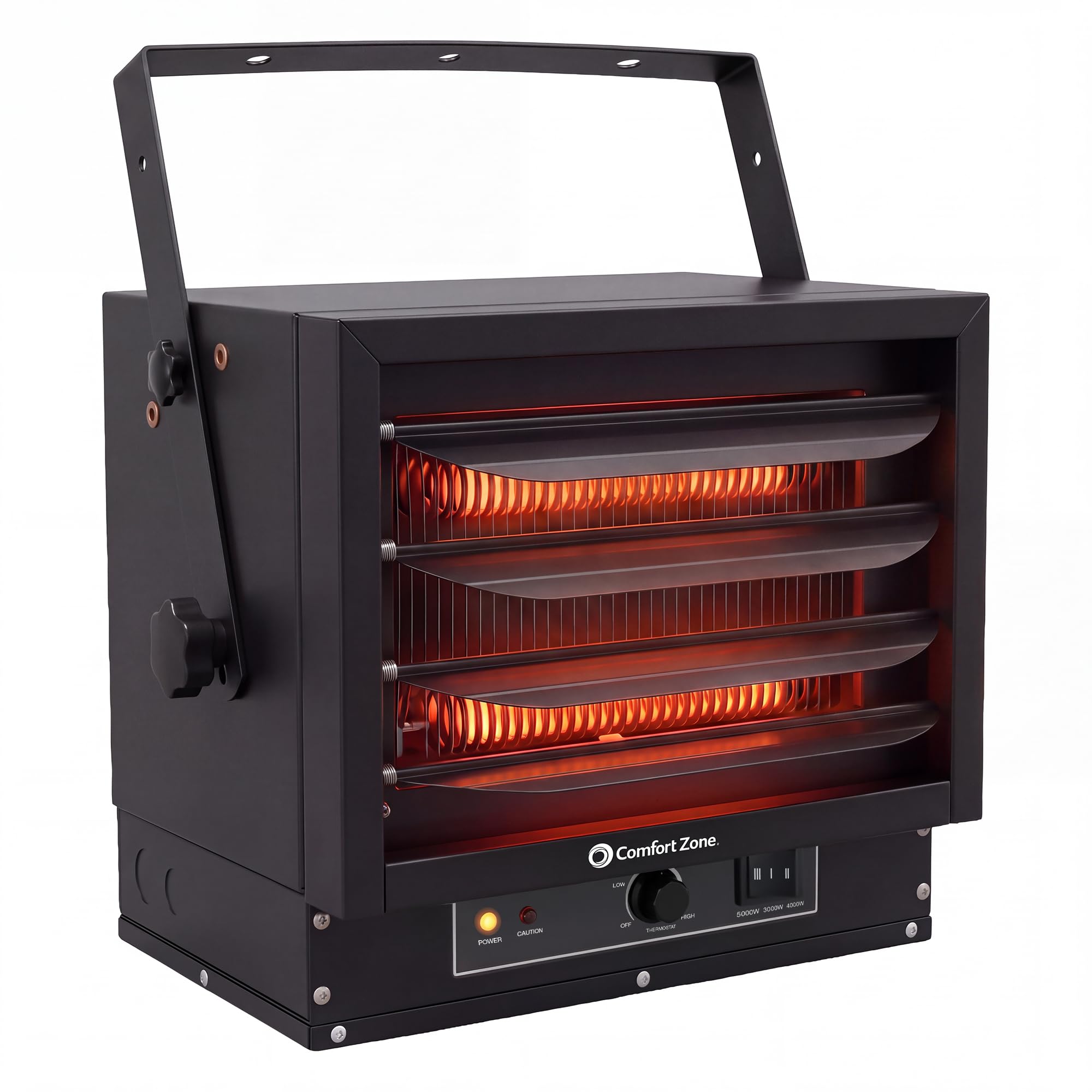
Comfort Zone CZ230ER 7,500W Garage Heater

Comfort Zone CZ230ER 7,500W Garage Heater

Two-car garages

Our Score 8.8/10
Check Price

Worth Noting

  • Needs a dedicated 240-volt, 40-amp circuit
  • Ceiling mount only, no wall option
Power
240 V, 31.25 A
Controls
Digital thermostat, remote, 12-hour timer
Coverage
1,250 sq ft
Heat Output
25,600 BTU
Read the full review

The best thing about this heater is that you stop thinking about it. A digital thermostat holds anywhere from 45 to 95 degrees, there are four heat settings behind it, and a 12-hour timer and remote mean the shop can be warm before you unlock the door. We set ours to a low hold and let it run, which beats the ritual of standing in a cold garage waiting for the feeling to come back into your hands.

The output backs that up. Seven thousand five hundred watts works out to 25,600 BTU, rated for up to 1,250 square feet, pushed through louvers you can angle down at a bench or out across the floor. It's 21.4 pounds, so one person on a stepladder can manage, though a second set of hands makes the lift easier. What it isn't is plug-and-play: 240 volts at 31.25 amps means a dedicated 40-amp circuit.

One quirk is worth knowing before you mount it. The thermostat sensor sits inside the heater, reading air that has just come off the element rather than the air at your feet, so plan on setting it a few degrees above the number you actually want and adjusting from there. And keep the fan and control board in mind, since those are the parts that fail on hardwired units — run it hard while the return window is open rather than discovering a problem in February.

Bottom line: This is the one we hang in a two-car garage: set the thermostat, walk away, and let the timer warm the shop before you get out there.

#4

Mr. Heater 50,000 BTU Unit Heater

Mr. Heater 50,000 BTU Unit Heater

Large gas-heated shops

Our Score 8.8/10
Check Price

Worth Noting

  • Requires a 10-foot ceiling and 8 feet of clearance
  • Gas line and venting needed before use
Fuel
Natural gas; propane conversion kit included
Coverage
1,667 sq ft
Clearance
10 ft ceiling, 8 ft to floor
Heat Output
50,000 BTU
Read the full review

Ten feet of ceiling, and eight feet of clearance from the bottom of the heater to the floor. Those two numbers decide whether this heater is even an option, and in a typical attached garage with an eight-foot lid, it isn't. In a pole building, a barn, or a shop with a high bay, it's the most heater on this list.

Where it fits, it's very good. Fifty thousand BTU covers roughly 1,667 square feet — about a three-car garage — and it runs on natural gas, with a propane conversion kit in the carton. It'll take a standard 24-volt thermostat or a Wi-Fi one, so you can control it from the house, and the mounting brackets work flipped, which means the vent can exit on either side to suit your ceiling. Forced air moves the heat instead of radiating at whatever stands in front of it, so the far corner comes up too.

It's 60 pounds, so plan on a lift or a helper, and budget for the gas line and the venting before it ever runs — this is a combustion appliance, not something you plug in. The blower and control board are what cause trouble over time, and a blown fuse on the control board is the usual first suspect when one quits. For a big shop that already has gas, none of that outweighs heating the whole building.

Bottom line: We think it's the right answer for exactly one buyer: a big, high-ceilinged shop that already has gas.

#5

Comfort Zone CZ220BK 5,000W Garage Heater

Comfort Zone CZ220BK 5,000W Garage Heater

Budget ceiling heat

Our Score 8.8/10
Check Price

Worth Noting

  • Knob thermostat with no timer or remote
  • Not enough output for a large, drafty garage
Power
240 V, 20.9 A
Coverage
1,000 sq ft
Heat Output
17,065 BTU
Heat Settings
3
Read the full review

Five thousand watts, 17,065 BTU, 1,000 square feet, and 20.9 amps at 240 volts. That last figure is what makes this heater worth a second look: it runs on a 30-amp circuit, and a spare 30-amp double-pole breaker is a much easier thing to find in a residential panel than the 40-amp one the 7,500-watt units need. In a one-car garage or a well-insulated two-car, 17,065 BTU takes a cold shop to working temperature and holds it.

What you give up is control. The thermostat is a dual knob instead of a digital setpoint, there's no timer and no remote, and you choose among three heat settings rather than dialing in a temperature. We found the adjustable bracket and louvers do the same directional work as the bigger units — point the air at a bench and leave it. The heavy-gauge steel body feels like a shop fixture rather than an appliance, and at 20.4 pounds it hangs easily on one ladder. If your panel only has 30 amps to give, this is the heater that fits the building you actually have.

Bottom line: Our pick if the panel has a spare 30-amp breaker and the garage is one or two cars — it gives up the timer, not the heat.

#6

Dr. Infrared DR-975 7,500W Shop Heater

Dr. Infrared DR-975 7,500W Shop Heater

Accurate thermostat control

Our Score 8.6/10
Check Price

Worth Noting

  • Fan noise is noticeable in a quiet shop
  • No cord included; hardwires with 8-gauge copper
Power
240 V, 31.25 A
Coverage
800 sq ft
Thermostat
Remote controlled
Heat Output
7,500 W
Read the full review

Every ceiling-mounted heater has the same quiet flaw: the thermostat sits near the ceiling, where the air is warmest, so the unit decides the room is finished before the floor is. The DR-975 gets around it by putting the thermostat in the remote, which means you can leave it on a bench at the height you actually work at and let the heater chase that reading. Among the hardwired electric units here, it's the control design we trust most.

The rest is sensible. Seven thousand five hundred watts, with a 4,700-watt setting for smaller spaces, five louvers, a fully enclosed motor, a timer, and a choice of wall or ceiling mount — useful if your ceiling is too low for a hanging unit. It's UL and CUL listed, which matters more in a garage than in a living room, and at 26 pounds one person can hang it.

It's the noisiest of the hardwired picks. The fan moves a serious volume of air and you hear it, a steady rush that disappears behind a radio and grates if you're doing quiet work at a bench. Its 800-square-foot coverage claim is also the most conservative of the 7,500-watt units here. Neither point touches the thermostat advantage that earned it a place.

Bottom line: We trust its thermostat more than any other here, because it measures the air where you're standing instead of up at the ceiling.

#7

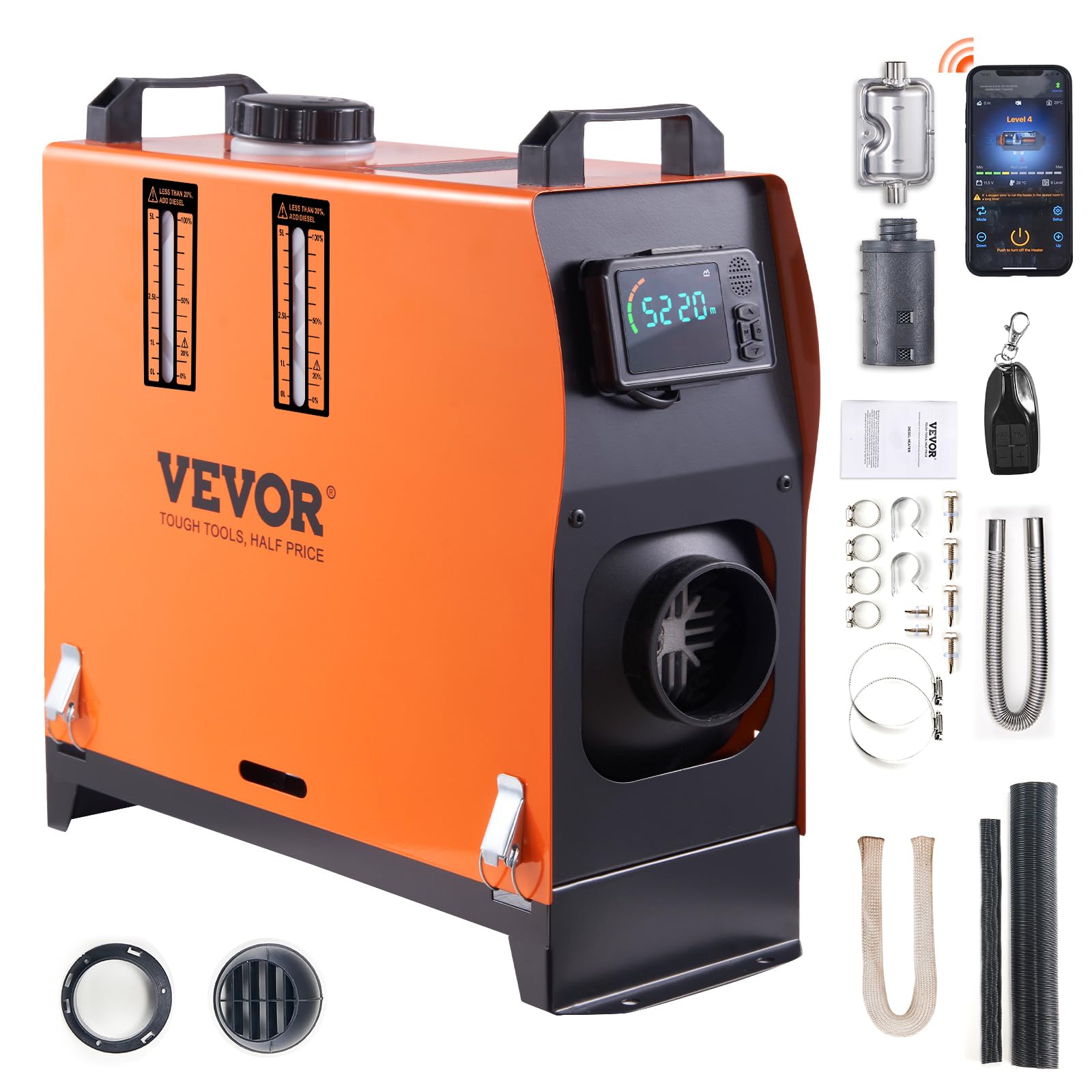
VEVOR 8KW Diesel Heater

VEVOR 8KW Diesel Heater

Off-grid garages

Our Score 8.6/10
Check Price

Worth Noting

  • Exhaust must be routed outside through a wall or floor
  • Audible fuel-pump tick and some diesel smell
Fuel
Diesel, 12 V
Control
Bluetooth app
Heat Output
8 kW
Altitude Compensation
Up to 18,045 ft
Read the full review

Diesel changes the problem. This one needs no 240-volt circuit, no gas line, no propane bottle — just 12 volts and a tank of fuel, at roughly a gallon a night. It also compensates automatically for altitude up to 18,045 feet, which most shops will never need and a shop at 6,000 feet absolutely will.

What it isn't is a plug-in appliance. The exhaust has to go outside through a wall or floor, the fuel line and pump need routing, and the combustion air comes from outside too, so plan an afternoon, a hole saw, and a permanent spot for it. Done properly, it's the best answer here for a detached garage with no service, a shipping container, a greenhouse, or a trailer — anywhere pulling a circuit costs more than the heater does.

Two things you'll notice daily. The fuel pump ticks — a metered click that carries through a wall — and there can be a faint diesel smell around the unit even after several tanks. Both are the price of running on fuel you carry rather than fuel that's piped in. These are also simpler machines than the hardwired electrics, so run a full tank through yours before you cut the exhaust hole and commit to a location.

Bottom line: We recommend it for a garage with no power at all: it asks for 12 volts and a fuel can, not a circuit.

How We Tested the Best Garage Heaters

We started by pulling every model we could find that was actually rated for garage use and readily available, then filtered on BTU output, voltage and amperage requirements, mounting type, and price. Anything that needed a dedicated circuit got flagged up front, since that changes the real cost of ownership. That left 11 heaters, from small plug-in space heaters to hardwired ceiling units, and we ran them through five months, roughly November through March.

Each one went into a drafty two-car garage with an uninsulated door and a workbench at the far end from the outlet. We used them the way you would: a 6 a.m. warm-up before the commute, Saturday afternoons at the bench with a saw running, evening sessions in a gym corner someone claimed with a mat and a kettlebell. We parked three thermometers at floor, bench, and head height and logged the temperature rise at 15, 30, and 60 minutes, plus how long until you could take your jacket off. We also walked the perimeter to see whether the far corner warmed or just the blast zone near the unit, and stood three feet away mid-phone-call to judge noise.

Longer-term notes covered the things a store demo can't show. Thermostat models ran for weeks at a time so we could see whether the setpoint held or the garage swung several degrees either side of it, and we tracked how long remote batteries lasted across the season. We mounted each unit solo and timed it, measured cord lengths, and noted what hardware came in the box. Dust, sawdust, and a season of grime sat on every surface by March, which gave us a decent read on durability, and we watched whether a heater tripped the breaker when a table saw shared the circuit. Finally, we weighed price against how much of the garage each unit genuinely brought up to temperature.

How to Choose a Garage Heater

Start With the Circuit, Not the BTU Rating

A 240-volt garage heater is not a plug-in appliance. The 5,000-watt Comfort Zone draws about 21 amps and wants a 30-amp circuit; the 7,500-watt units draw about 31 and want a 40. Before you shop, open the panel and look for spare double-pole breakers. A two-pole 30 is the easiest thing to find in a house, and it decides your ceiling before you've compared a single heater.

If the panel has nothing to give, a new circuit is an electrician's job and usually a permit, which is exactly the point where propane starts making financial sense. Note also that hardwired units generally arrive without a cord — the wiring is part of the project, not something you sort out the night it gets cold.

What Square-Footage Ratings Are Worth

Two 7,500-watt heaters in this guide claim 800 and 1,250 square feet. Identical wattage, different marketing, which tells you coverage ratings aren't standardized — treat them as a starting range rather than a specification.

Insulation, ceiling height, and how often the door opens decide more than the chart does. An uninsulated detached garage with a high ceiling may need the next size up; a tight two-car garage you only hold at 45 or 50 degrees may get by with less. Buy for the working temperature you want to keep, not the one you'd like on the coldest night of the year.

Ceiling Height, Clearance, and Where the Heat Goes

Hanging a heater from the ceiling keeps the floor clear and drops warm air onto the space below, but the mounting rules are real: the 50,000-BTU Mr. Heater wants a 10-foot ceiling and eight feet of clearance from the base of the unit to the floor. In a standard eight-foot attached garage, that rules it out entirely.

Low garages do better with a wall mount or a low-profile ceiling unit with adjustable louvers you can aim at a bench. Plan for sound as well, because a forced-air heater is a fan running in a hard room — fine with a radio on, tiresome without one. The fan is also the part that tends to fail first, so give any new heater a long run while it's still returnable.

The Thermostat Matters More Than the Wattage

Digital beats analog for fine control, but where the sensor sits beats both. A thermostat built into the heater reads air at the heater, which runs warmer than the floor, so you end up setting it several degrees above the temperature you actually want. A remote sensor or a wall thermostat — the Mr. Heater runs on a standard 24-volt one — closes that gap.

A timer and a remote sound like conveniences until you've used them. Being able to bring a shop up to temperature from the house, or hold it at 45 degrees overnight, is the difference between a heater you use and one you stop bothering with by January.

Ventilation, Propane, and Carbon Monoxide

Combustion heaters split into two groups. Forced-air propane like the Remington is outdoor-rated: it pushes combustion products into the space it heats, so it belongs in a garage with the door up or on a job site. Radiant propane like the Big Buddy is rated for indoor use and shuts off if it's tipped, but it still wants a window cracked while it runs.

Electric heaters produce no carbon monoxide, but they need clearance from anything flammable and a circuit sized to their nameplate amps. Whatever you run, a carbon monoxide alarm on the garage wall costs little and settles the question.

Frequently Asked Questions

Final Verdict

For most garages with a spare 240-volt circuit, get the Comfort Zone CZ230ER. It has the output for a two-car garage, a thermostat that holds a real temperature, and a timer that means the shop is warm before you are.

If the panel only has 30 amps to give, the CZ220BK does the same job with a knob instead of a screen and loses nothing that matters in a one-car garage. And if there's no circuit to spare at all, go propane: the Big Buddy for the bench you stand at, the Remington when the door stays open.