Home Gym

Best Interlocking Gym Flooring Tiles of 2026

A loaded barbell doesn't care what's under it. Within a month of putting a rack in my garage, the concrete had two new divots and the foam mat I'd thrown down had crept three inches toward the door. Interlocking tiles solve both problems at once: they lock into a floor you can size to the room, they lift out when you move, and they're kind under bare feet. What they don't all do is stay put, hold up under weight, or stop smelling like a tire fire.

Thickness is the number everyone shops by, and it's only half the story. An inch of soft foam is wonderful for yoga and floor work, but set a squat stand on it and you'll feel it squish; a thin, dense tile protects the slab while your knees file a complaint. Over the past seven months, my team and I have laid 12 sets over concrete, carpet, and hardwood, and the ones worth keeping shared the same traits — seams that stayed shut, a surface that gripped whether hands were chalky or damp, and edges that didn't curl. The picks below are the sets that survived.

#1

American Floor Mats Fit-Lock

Top Pick
American Floor Mats Fit-Lock

Barbell work

Our Score 9.4/10
Check Price

Worth Noting

  • Priciest coverage per square foot here
  • 24 square feet per set is a small patch
Edges
Corner and border tiles
Coverage
24 sq ft (6 tiles)
Thickness
3/8 in
Construction
Solid rubber
Read the full review

Per square foot, this is the most expensive floor in the roundup, and for one kind of buyer that is the entire argument. Fit-Lock tiles are solid 3/8-inch rubber — no foam core, no thin rubber veneer — cut 24 inches square and molded so the tabs pull tight. Six tiles give you a 4-by-6 patch that reads as a single piece once it is down.

We keep coming back to these for anyone putting a rack or a deadlift setup on the floor. Foam compresses under a loaded barbell and stays compressed; rubber does not. The slab also sits flat without adhesive, so a basement corner gets a permanent-looking floor in an afternoon, and the set includes the corner and border tiles needed for a clean edge instead of a ragged one.

Plan for the install. The tiles are heavy and stiff and go together with a rubber mallet rather than by hand, so buy the mallet with the tiles. New rubber smells like new rubber — the scent fades, but air the pieces flat for a few days first. Damp-mopping or vacuuming is the whole maintenance routine, and there are no foam crumbs to chase.

Budget the coverage honestly, because one set is 24 square feet and a 10-by-10 corner takes four of them. That is the trade: this is the floor you buy once for the weights, not the one you buy for a yoga corner.

Bottom line: Buy it if a barbell comes down on your floor; solid rubber is the only material here that shrugs off rack feet and dropped plates, and it looks the part.

#2

ProsourceFit 1-Inch Puzzle Mat

ProsourceFit 1-Inch Puzzle Mat

Floor work

Our Score 9.4/10
Check Price

Worth Noting

  • Dents under racks and heavy dumbbells
  • Creeps on smooth concrete
Edges
12 border strips
Coverage
24 sq ft (6 tiles)
Thickness
1 in
Construction
EVA foam
Read the full review

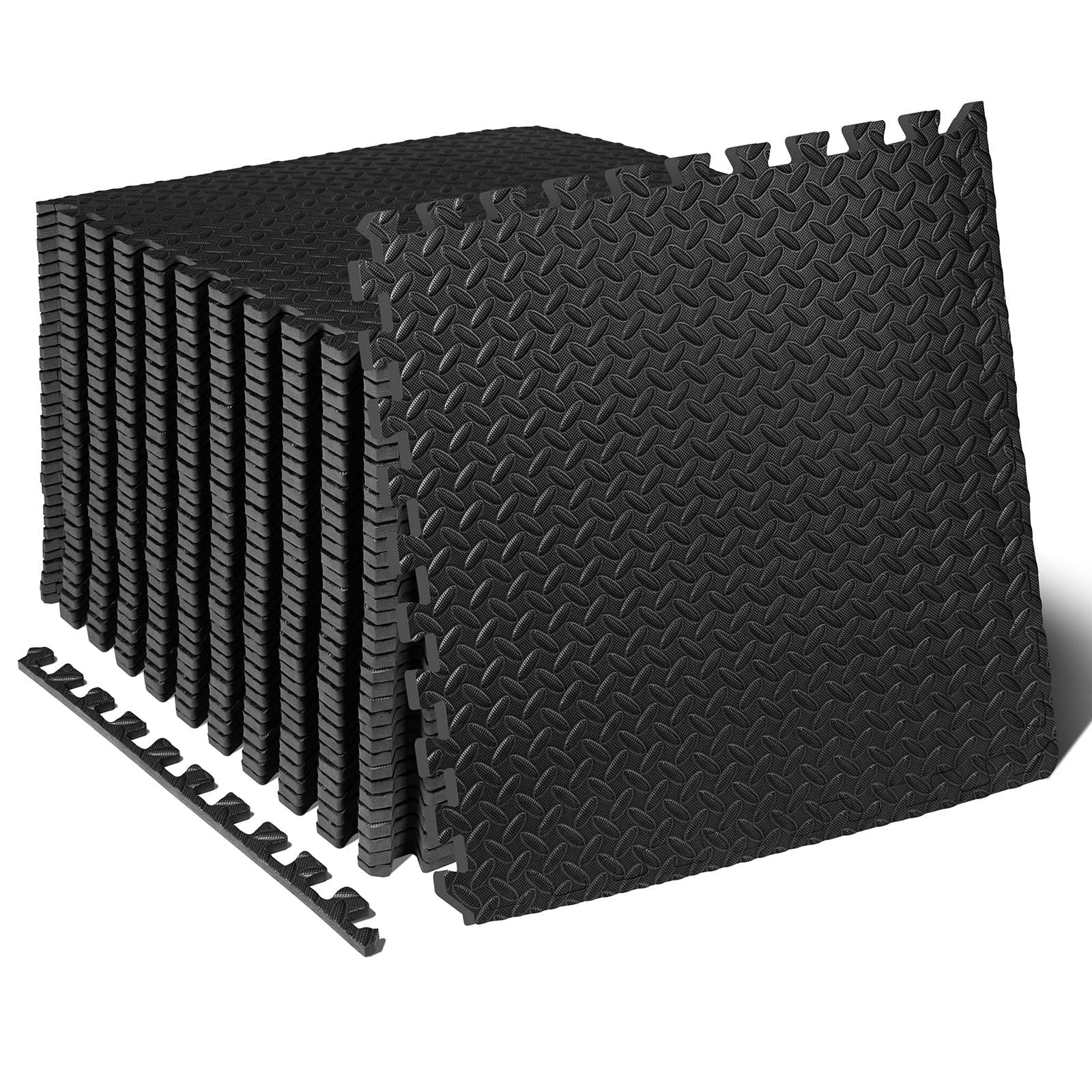
An inch of foam is the wrong floor for a squat rack and the right one for nearly everything else. ProsourceFit's thickest tile is the plushest surface in this group — deep enough that knees, elbows, and a tailbone stop arguing with a concrete slab — which is why we point to it for mat work, stretching, and a room where kids tumble on the same floor.

Six tiles cover 24 square feet, set up in about five minutes, and come apart just as fast, so a spare room can go back to being a spare room. The textured face has some tooth to it and the border strips finish the outer edge. Under nine pounds for the set, it is easy to carry to the basement and back.

Where it loses ground is load. Put a rack or one loaded dumbbell on a single spot and the foam takes a set — the maker says as much about compression under heavy equipment, and those dents are the reason we do not hand this to someone building a lifting gym. Movement is the other thing to watch: on a sealed concrete floor these tiles creep, so run the border strips against a wall or tape the perimeter.

Held to floor work, it is the most comfortable square footage here, and the water-resistant surface wipes clean after a sweaty session without shedding crumbs. Treat it as a training mat that covers a room, and it earns its place.

Bottom line: We point people here for mat work, stretching, and floor-based training; just keep a rack off a floor this soft.

#3

ZENY 3/4-Inch Foam Tiles

ZENY 3/4-Inch Foam Tiles

Spare-room gyms

Our Score 9.4/10
Check Price

Worth Noting

  • Foam compresses under heavy equipment
  • Tiles can slide on smooth floors
Edges
Removable borders
Coverage
96 sq ft (24 tiles)
Thickness
3/4 in
Construction
EVA foam
Read the full review

Ninety-six square feet is a spare room, an 8-by-12 stretch of garage, or a basement corner that suddenly becomes a gym. ZENY gets there with 24 tiles at three-quarter-inch thick — the same thickness as our budget pick, in a bundle four times the size. The reason this one exists is that most people would rather place one order than four and end up with mismatched shades.

The foam is firm underfoot and forgiving on knees, and the textured face holds a bench, a bike, or a kettlebell cluster steady enough to train on. It is water-resistant and wipe-clean, and it takes the echo out of a bare basement, which is a bigger quality-of-life difference than it sounds.

The border pieces are removable, which is more useful than it sounds: run the field wall to wall, cut the last row, then clip the finished edge back on where the floor stops. Cutting goes fast with a utility knife and a straightedge, and the offcuts make decent pads for under a bench.

We rank it behind the 144-square-foot bundle only because that one covers more ground in a single order. For a normal spare room, this is the better fit and the better value, and it is the set we hand to someone laying a floor in an afternoon and getting back to training.

Bottom line: For a spare room or a one-car garage, this is the bundle we reach for: 96 square feet of three-quarter-inch foam in a single order.

#4

AIRHOP Rubber-Top Gym Tiles

AIRHOP Rubber-Top Gym Tiles

Weighted gyms

Our Score 9.2/10
Check Price

Worth Noting

  • Corner tabs can take a second try
  • 48 square feet will not cover a big garage
Coverage
48 sq ft (12 tiles)
Thickness
0.56 in
Tile Size
24 x 24 in
Construction
Rubber over EVA foam
Read the full review

Walk into a garage with these down and you would not guess it started as bare concrete. AIRHOP's tiles are one of the two rubber-topped sets here, pairing a recycled rubber wear layer with a high-density EVA core, and at 0.56 inch thick they land between the thin foam puzzle mats and the floppy one-inch stuff. We recommend them to the reader whose gym has actual weight in it — a rack, a bench, dumbbells — because that rubber skin is what stops a loaded bench from pressing four permanent dents into the foam.

Underfoot, the difference shows up fast. The tiles are dense enough to deaden the clang of a dropped dumbbell and firm enough that you are not sinking in mid-set, and the oversized interlocking tabs keep the seams closed when you shift side to side. What we noticed most is how little the floor moves: the set runs about 29 pounds, and that mass plus the rubber face is why it does not skate across a sealed slab the way a plain foam tile will.

The catch is the corner tabs, which do not always seat on the first push — work from one corner outward and check each row before moving on. And 48 square feet is 12 tiles, an 8-by-6 patch: enough for a rack and a bench, not a two-car garage. If the room is bigger, buy two boxes rather than stretching one.

Give them a night outdoors before installation. The rubber has a smell out of the box that fades once the tiles air, and doing that before they are locked down saves you from living with it for a week.

Bottom line: We recommend this one for a home gym with real weight in it: the rubber face takes a rack or a bench without denting, and the tiles stay where you put them.

#5

ProsourceFit 144 Sq Ft Puzzle Mat

ProsourceFit 144 Sq Ft Puzzle Mat

Whole-room coverage

Our Score 9.2/10
Check Price

Worth Noting

  • Slides on sealed concrete unless anchored
Coverage
144 sq ft (36 tiles)
Warranty
Limited lifetime
Thickness
1/2 in
Construction
EVA foam
Read the full review

Most sets here are 24 square feet — a mat, really. This one is 36 tiles and 144 square feet, a 12-by-12 floor that turns a whole room into a training space. If you have been pricing out four six-tile bundles to cover a garage, this is the shortcut.

We recommend it for the big empty room: a basement, a converted garage, a studio. The half-inch foam is firm rather than plush, so a bench, a bike, or a kettlebell cluster sits on it without the tiles pancaking, and it still protects the concrete or tile underneath. It reads as a floor rather than a mat, which is the point of buying 36 tiles instead of six.

Plan the layout before you open the box. Cutting a tile with a utility knife against a straightedge is quick work and the end borders make the outside edge look finished, but seams that land in the middle of a walking path work open. Run full tiles to the walls, put the cuts in a corner, and keep the field one continuous sheet rather than several islands.

What it will not do is absorb a dropped barbell. Half an inch of foam is cushioning, not impact protection, and if the bar comes down you want solid rubber underneath. For kettlebells, a bench, a rower, and mat work, this floor handles the whole room in one order.

Bottom line: Buy it when the room is the project: 144 square feet in a single box, firm enough for kettlebells and benches, and one order instead of four.

#6

BalanceFrom 3/4-Inch Puzzle Mat

BalanceFrom 3/4-Inch Puzzle Mat

First home gyms

Our Score 9.2/10
Check Price

Worth Noting

  • Tiles creep on sealed concrete
  • Foam compresses under rack feet
Coverage
24 sq ft (6 tiles)
Warranty
2-year
Thickness
3/4 in
Construction
EVA foam
Read the full review

Three-quarters of an inch is the number that matters here. BalanceFrom's tiles are thicker than the half-inch sets that otherwise dominate this price range, and the extra foam shows up exactly where you want it: under a knee, under a hip, under a kid who falls over. Six tiles cover 24 square feet, with 12 border strips to finish the edge.

We treat it as the default budget buy. The foam is dense rather than spongy, so a bench or a stationary bike sits on it without the tiles turning to pancakes, and the surface gives socks something to grab. Assembly is genuinely a five-minute job, and at six pounds the box goes up a stairwell in one armload.

The surface is worth a mention too: textured enough to stop a sock from skating, flat enough to wipe down with a damp cloth, and it does not trap chalk or dust the way a deep tread pattern does. If the floor doubles as a playroom between sessions, that matters more than any figure on the box.

The two-year warranty is longer than most of the foam sets here offer, and that is a fair signal of how the maker expects the tiles to hold up over a few winters in a garage.

Bottom line: We hand this to anyone furnishing a first home gym on a tight budget: three-quarter-inch foam, tool-free assembly, and borders in the box.

#7

CAP Interlocking Foam Mat

CAP Interlocking Foam Mat

Small setups

Our Score 9.2/10
Check Price

Worth Noting

  • Firm half-inch is thin for floor work
  • 30-day warranty is short
Surface
Diamond texture
Coverage
24 sq ft (6 tiles)
Warranty
30-day
Thickness
1/2 in
Read the full review

This is the cheapest way into a padded floor here, and the box is honest about what that buys: six 24-inch tiles, half an inch thick, with a diamond texture and finishing strips, covering 24 square feet. That is a rack footprint, a bench area, or the strip of floor in front of a TV. It is not a room.

Half an inch of high-density EVA is firm and light — four and a half pounds for the set — so it goes down in minutes and comes up just as fast when the floor is needed for something else. The diamond pattern gives socks and bare feet something to grip, the surface is water-resistant, and it wipes clean without shedding crumbs.

Edges are where cheap foam usually shows itself, and these come with strips that clip on and stay on, so the outer boundary looks deliberate rather than ragged. The tiles line up without a lip once the tabs are fully seated, and a utility knife handles any cut around a post.

We rank it below BalanceFrom's three-quarter-inch set, which costs a little more and gives you visibly more foam for it. Buy this one for a small space, a rental, or a trial run at interlocking flooring, and step up if you find yourself training on it every day.

Bottom line: For a bench area or a first small setup, this is the cheapest way to try interlocking flooring without much risk.

#8

SUPERJARE Rubber-Top Gym Flooring

SUPERJARE Rubber-Top Gym Flooring

Speckled finish

Our Score 9.0/10
Check Price

Worth Noting

  • Rubber face can lift at the edges
  • Strong rubber smell out of the box
Coverage
48 sq ft (12 tiles)
Thickness
0.56 in
Tile Size
24 x 24 in
Construction
EPDM rubber over EVA
Read the full review

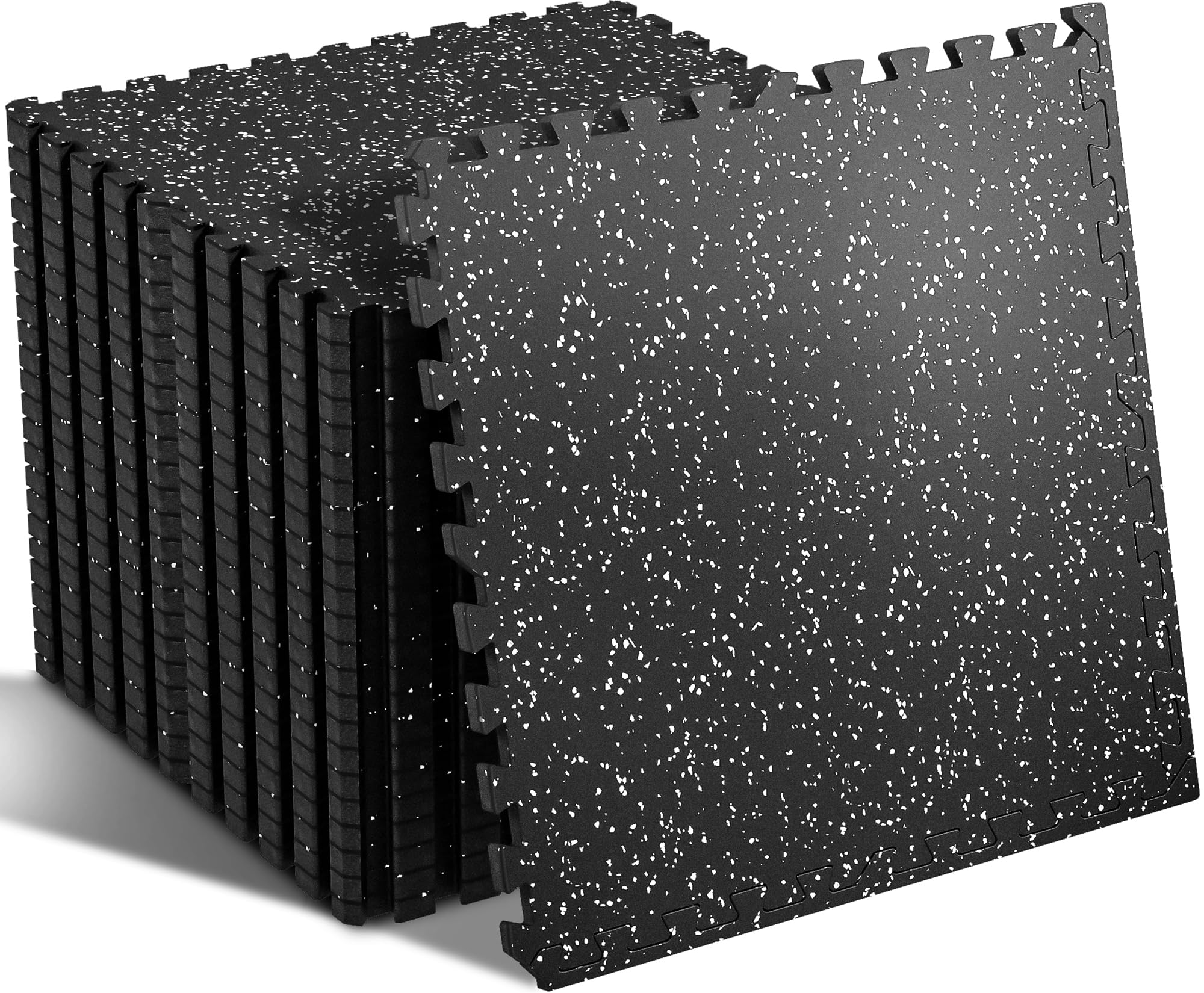
SUPERJARE and our top pick are the same idea from two companies: a rubber wear layer bonded to a foam core, 24-inch tiles, 0.56 inch thick, 12 to a box. Side by side in a listing, the specs will not settle it for you. What separates them on the floor is the face — SUPERJARE's is a black-and-grey speckle that hides dust and tire marks better than flat black.

Installation follows the same script. The tabs snap together, the pieces cut with a utility knife, and the whole 48-square-foot set lays out well inside an hour. The foam core takes the sting out of a hard floor and mutes a dropped dumbbell, and the rubber face gives you something to push off during lunges and landmine work.

Where we part company with it is the top layer. This is the set in this group where the rubber face is the part that gives out, lifting at the edges and peeling where a bench or a foot drags across it. That is not every set, but it is the pattern worth knowing before this goes into a busy garage. Keep sliding equipment off it and the surface lasts longer.

The value case is thinner than it looks, since it costs about what our top pick does without the same record behind it. Choose it for the speckle, or for a room where a flat black floor would look like a mistake.

Bottom line: It is the same dual-layer design as our top pick in a speckled finish, and we recommend it when that look is what you want for the room.

How We Tested Interlocking Gym Flooring Tiles

Our shortlist started with research: we gathered every interlocking set we could find that covered at least 24 square feet per box, used a consistent tile size, and was sold for training rather than as playroom foam. Sets where the coverage math didn't work, or where you couldn't buy enough tiles to cover a standard lifting area, came off the list. That left 12 sets, which we laid over seven months in garages on bare concrete, a basement over old carpet, and a spare bedroom over hardwood.

Assembly came first. I timed each set solo with a stopwatch, noted whether the puzzle edges clicked together by hand or needed a rubber mallet, and checked back a week later to see whether seams had opened or the whole floor had crept toward the door after being walked on and having a bench pushed across it. Then we loaded them: a squat stand with a bar on it, a 45-pound plate dropped from waist height, and bench feet parked in the same spot for weeks.

Grip got tested three ways — bare feet, socks, and chalky hands — and we noted whether the surface turned slick once it was damp with sweat. Odor was a sniff test out of the box, then again at 24 and 72 hours, with the strongest-smelling tiles set up in a closed basement room to see whether the smell faded or settled in. We put calipers to every tile, since more than one set labeled 3/4 inch measured closer to 5/8.

Durability ran the length of the test. We watched for compression dents under the rack and bench, corners curling at the room's edge, and wear where feet pivot most. We also priced every set per square foot, because coverage varies wildly from box to box and the cheapest-looking option is rarely the cheapest floor.

How to Choose Interlocking Gym Flooring Tiles

Pick the Material Before Anything Else

Three materials show up in this category and they are not interchangeable. EVA foam is the cushioned, inexpensive option: kind to knees and elbows, easy to cut, and soft enough that a loaded rack presses dents into it. A rubber-topped tile bonds a thin rubber wear layer to a foam core, which gets you grip and a surface that takes a bench without giving up the cushion underneath. Solid rubber is the heavy option: it will not compress, it will not slide, and it costs the most.

Match the material to the workout. Foam for mat work and stretching, rubber-topped for a mixed gym with a bench, dumbbells, and a bike, solid rubber for anything that involves a bar coming down.

Choose Thickness by What You Drop

Half an inch is a firm floor: fine under a bench, a bike, or bodyweight work, thin enough that a knee on concrete still feels like concrete after a while. Three-quarter inch is where most home gyms land, with enough give to kneel on and enough density to stand equipment on. A full inch is the plushest and the least suited to load, because the deeper the foam, the more permanently it takes a set under a rack foot.

Buy the thickness for the workout rather than the biggest number on the box. If you split your time between floor work and weights, a rubber-topped tile in the half-inch range splits the difference better than either extreme.

Do the Coverage Math in Square Feet

Every 24-inch tile is 4 square feet, so a 10-by-10-foot area needs 25 tiles and a 12-by-12 needs 36. Sets are sold in 6, 12, 24, and 36 counts and rarely divide evenly into a real room, so buy about 10 percent more than the math says and use the extra for cuts along the walls. The 36-tile set here covers 144 square feet, which is a 12-by-12 floor with a little left over.

Check what finishes the edge, too. Border strips turn a field of tiles into a floor, and one large box usually beats two smaller ones that may arrive in slightly different shades.

Plan for Grip, Because Foam Moves

Sliding is the single most common complaint about foam tile, and it almost always starts at the underside. On sealed concrete or a finished hardwood, a foam field creeps when you push off it, and seams open where your feet land. The fixes are structural rather than clever: run border pieces tight against a wall, tape the perimeter with double-sided carpet tape, or cover the room wall to wall so there is nowhere for the floor to travel.

Rubber and rubber-topped tiles stay put with far less fuss, and that is a large part of what the extra money buys.

Frequently Asked Questions

Final Verdict

Almost every home gym comes down to one question: is there weight on this floor? If there is, the AIRHOP tiles are the pick. The rubber face takes a rack and a bench without denting, the tiles hold their place, and the whole floor still goes down in an afternoon.

If your workout happens on the floor rather than over it, ProsourceFit's one-inch tile is more comfortable and costs less, and it is the one we point to for stretching, mat work, and a room that doubles as a playroom.