Home Gym

Best Home Gym Flooring of 2026

The first time a loaded barbell came down on my spare-room floor, the thud traveled through the whole house and left a dent I still look at. A good gym floor swallows that hit, keeps your feet planted under a squat, and protects whatever's underneath, whether that's concrete, carpet, or the neighbor's ceiling. The catch is that most of what's sold as gym flooring is either too soft to keep a rack steady or so hard and slick that it's worse than bare concrete.

Over the past eight months, my team and I laid down 11 options, including interlocking rubber tiles, rolled rubber, and foam puzzle mats, in a basement corner, a garage bay, and a spare bedroom. A few settled in immediately and never shifted; others crept apart mid-set or dented where a dumbbell landed. What I learned is that thickness gets all the marketing attention, but density and fit are what decide whether a floor survives a deadlift. The picks below cover the whole range, from a yoga-and-kettlebells corner to a full rack setup.

#1

ProsourceFit Weaved Puzzle Mat

Top Pick
ProsourceFit Weaved Puzzle Mat

Floor-based workouts

Our Score 9.4/10
Check Price

Worth Noting

  • Tiles creep on smooth concrete
Tiles
18 tiles
Coverage
72 sq ft
Material
Textured EVA foam
Thickness
1 in
Read the full review

An inch of foam changes what floor work feels like. On a half-inch tile you can find the slab through a knee; an inch puts a soft stop in the way first. That's what makes the 1-inch ProsourceFit the set that makes sense when the workout is burpees, jump rope, and a lot of time on the ground rather than a loaded bar.

Eighteen tiles at 24 inches square give 72 square feet — a six-by-twelve strip or a nine-by-eight square, depending on how you lay it. The woven texture adds a little bite for bare feet and for a mat that would otherwise slide, and assembly is the same puzzle routine as everything else here. What's different is how much deeper the cushion goes.

Where it stops being the right answer is load. An inch of EVA is soft by design, and rack feet and a loaded barbell press dents into it that don't come back out. If a squat stand is part of the plan, one of the rubber-faced sets is the better floor, and no amount of thickness makes foam into a platform.

For a mat-based gym — kettlebells, bodyweight circuits, yoga, a child tumbling in the same room — the extra inch earns its keep. It's among the pricier sets here, and it's still the one we recommend to anyone whose training happens below waist height.

Bottom line: We recommend the 1-inch set to anyone whose workout happens on the floor: it's the plushest surface here, and the extra depth is worth the loss of stiffness.

#2

BalanceFrom Puzzle Exercise Mat

BalanceFrom Puzzle Exercise Mat

All-around home gyms

Our Score 9.2/10
Check Price

Worth Noting

  • Tiles can pop apart during fast lateral work
Coverage
48 sq ft
Material
EVA foam
Thickness
0.5 in
Tile Size
24 x 24 in
Read the full review

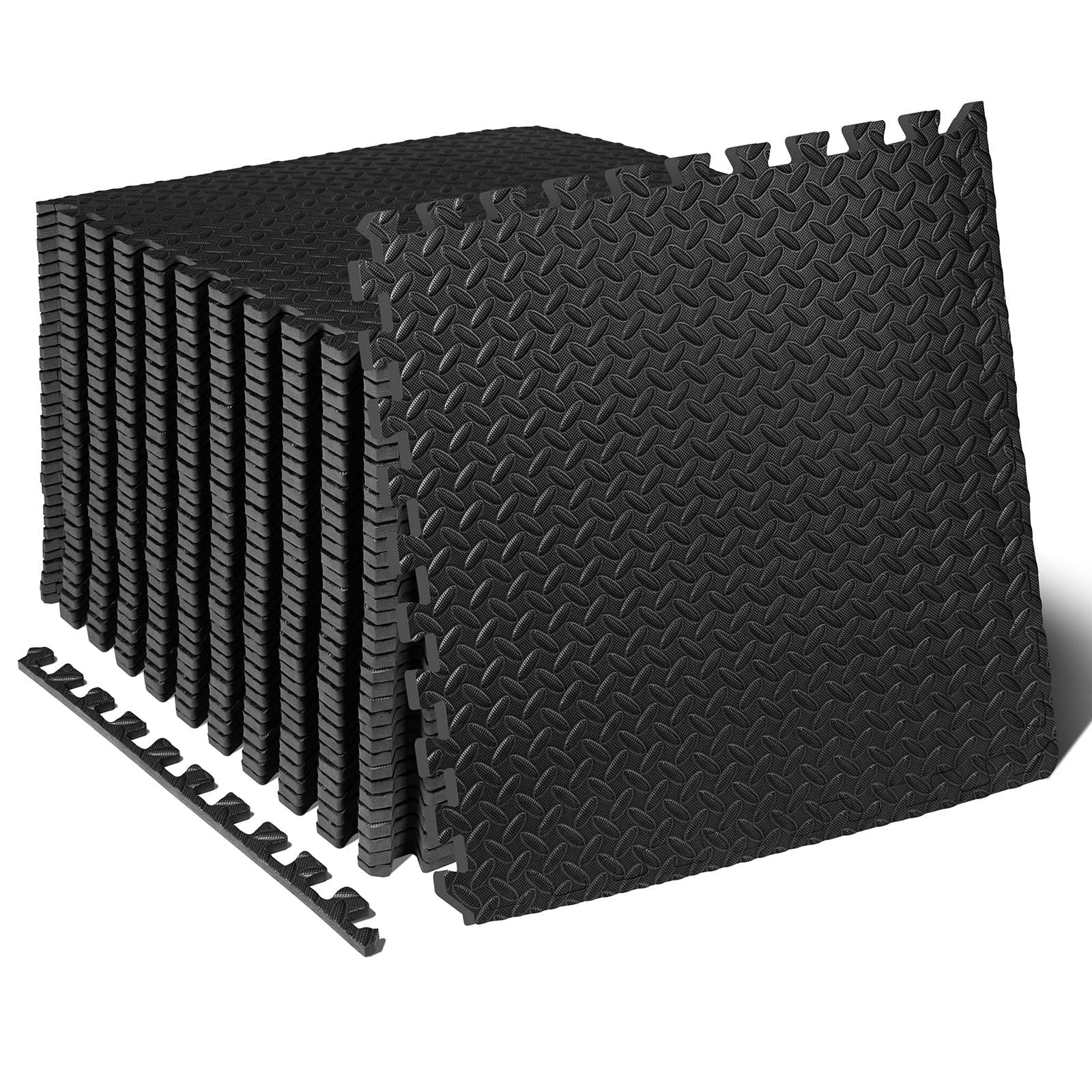
Twelve tiles sounds like a small box until you do the arithmetic. Each 24-inch tile covers 4 square feet, so one set lays down 48 square feet — a six-by-eight working area that takes a rack, a bench, and the strip of floor you stand on to load plates. That math is why this is our top pick: most home gyms need the working footprint covered, not the whole garage, and no set here covers that footprint for less.

The foam is half an inch of high-density EVA, which is the thickness we keep coming back to for a home gym. It's firm enough that a bench sits level and dense enough to kneel on between sets, and the 24 border strips in the box are the detail we appreciated most — they cap the outer edge with a ramped finish, so the floor ends in a proper edge instead of a row of exposed tabs.

Socks are the catch. EVA collects dust and turns slick underfoot, and this set is no different; shoes for lifting, a yoga mat over the top for floor work, and a weekly sweep solve most of it. Plan the layout before you open the box, too — 12 tiles divide neatly into three by four, and the border strips only work along outside edges.

Bottom line: For a corner gym with a rack and a bench, we think this is the smartest buy: 48 square feet of dense foam, border strips included, for the least money of any set that covers real working space.

#3

ProsourceFit Puzzle Mat 144 sq ft

ProsourceFit Puzzle Mat 144 sq ft

Full-room coverage

Our Score 9.2/10
Check Price

Worth Noting

  • Slick under socks and bare feet
  • Black finish shows footprints and dust
Tiles
36 tiles
Coverage
144 sq ft
Thickness
0.5 in
Tile Size
24 x 24 in
Read the full review

Thirty-six tiles at 24 inches square comes to 144 square feet — a 12-by-12 floor, which is a full bay of a two-car garage or nearly all of a single-car one. If the plan is to floor the room rather than carve out a corner of it, this is the set that finishes the job in one order instead of three.

Laying it is the easy part. The tiles click together, the 36 border pieces tidy the perimeter, and a utility knife gets you around a door frame or a support post in a few minutes. The seams are where it gives ground: with a loaded rack standing on the floor, joints can part and leave a gap. Spreading the load under each rack foot with a plate or a scrap of mat is the practical fix, and it's the one we suggest before you lay the field.

Black hides nothing, so footprints and chalk dust show and a damp cloth becomes part of the routine; that's cosmetic and easy to live with. What matters more is how much floor the outlay buys — this is the least expensive way here to cover a full room, and the tiles come up as fast as they go down if you ever move.

Bottom line: Buy this one if the room is the project: 144 square feet in a single order, borders included, and enough tiles to cut around posts without running short.

#4

AIRHOP Rubber-Top Gym Mats

AIRHOP Rubber-Top Gym Mats

Heavy free weights

Our Score 9.2/10
Check Price

Worth Noting

  • The priciest flooring in this group
  • New-rubber odor needs days to clear
Tiles
24 tiles
Coverage
96 sq ft
Material
Rubber over EVA
Thickness
0.56 in
Read the full review

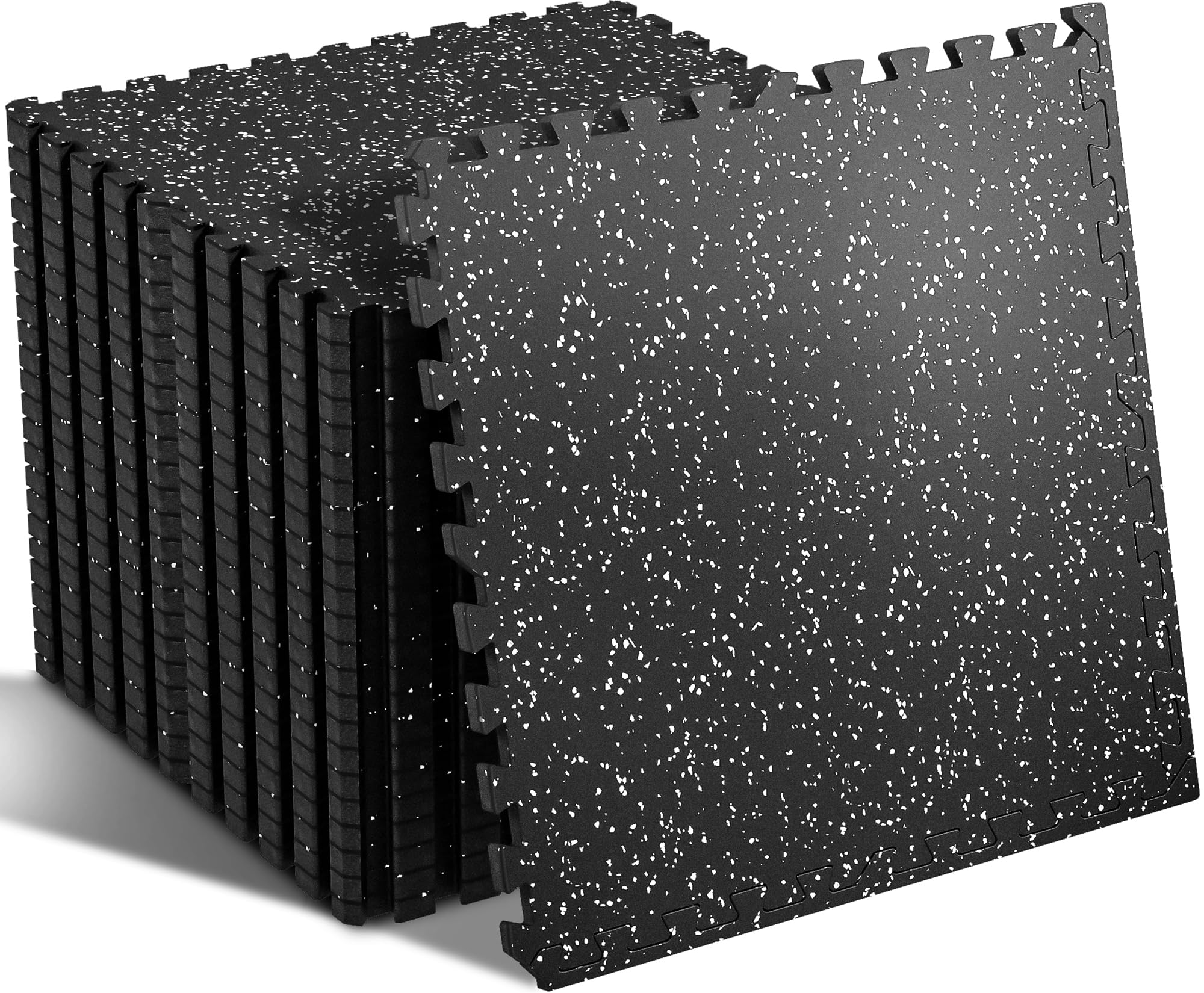
A dumbbell dropped from waist height is the test that splits these products in two. Bare EVA foam takes the hit as a gouge or a crater; a rubber-faced tile shrugs it off. This is one of two rubber-topped sets here and much the more substantial of them, and it's the flooring we point to when the room will hold real iron.

The build is a recycled rubber wear layer bonded to high-density EVA, 24 tiles at 24 inches square and 0.56 inch thick, covering 96 square feet as an eight-by-twelve floor. The locking tabs are larger than the plain foam sets use, which is what you want when a bar comes down and the whole assembly tries to shift with the impact. The box runs about 56 pounds, so bring a second pair of hands if the gym is upstairs.

What the extra layer buys is a floor that behaves like a floor: dense underfoot, quiet under a dropped bar, stable enough that a bench doesn't walk between sets. On square footage alone the foam sets win; you're paying here for the rubber face. On a floor that will see dumbbells every session, this is the one that stops being a consumable.

Bottom line: Our pick for a garage gym with real iron in it: rubber-faced tiles that take dropped weight and rack feet without gouging, in a 96-square-foot set.

#5

CAP Interlocking Puzzle Mat

CAP Interlocking Puzzle Mat

Tight spaces

Our Score 9.2/10
Check Price

Worth Noting

  • Only 24 sq ft of coverage
  • Foam dents and cracks under equipment
Tiles
6 tiles
Coverage
24 sq ft
Thickness
0.5 in
Tile Size
24 x 24 in
Read the full review

Twenty-four square feet is a six-by-four patch — the footprint of a bike, a rower, or the strip of floor beside a bed where you stretch in the morning. That's the whole point of this six-tile set: it's the smallest commitment here, and for an apartment or a shared room that's the right amount of floor.

The tiles are half an inch of EVA with a diamond texture the flat-faced sets don't have, and the pack includes finishing strips so the outer edge looks deliberate rather than unfinished. They cut cleanly with a utility knife, which matters when you're fitting them between a wall and a wardrobe and can't afford a half-inch of slop.

It's also the easiest of these to live with in a small place: six tiles stack in a closet when the room has to go back to being a bedroom, and laying them takes about as long as unrolling a mat. As a first floor for someone who isn't sure how much space they'll use, that flexibility is the reason to start here rather than with a room-sized order.

Bottom line: We keep this one for the small jobs — a single machine or an apartment corner — where 24 square feet is exactly enough and stores in a closet.

#6

AIRHOP Extra Thick Foam Mats

AIRHOP Extra Thick Foam Mats

Cushioned floor work

Our Score 9.2/10
Check Price

Worth Noting

Tiles
12 tiles
Coverage
48 sq ft
Thickness
0.79 in
Edging Pieces
24 pieces
Read the full review

At 0.79 inch this sits between the half-inch sets and the full inch, and it's the only tile here with two faces — grey on one side, black on the other — so a room can go light or dark without a different order. Twelve tiles cover 48 square feet with 24 edging pieces in the box.

Cushion that deep has a cost, and it's stability. The surface gives underfoot, which is lovely for stretching and less lovely when you're balancing on one leg; you can feel your feet sink into it slightly. For a floor-work corner, a playroom that doubles as a gym, or a garage where the training is bodyweight and kettlebells, the depth is worth the trade.

The density is what separates it from cheap foam: it takes weight without bottoming out and wipes clean with a damp cloth after a sweaty session. Buy it for comfort, not for load, and lay the grey side up if the room gets a lot of daylight.

Bottom line: We rate this the comfort pick of the foam sets: close to an inch of give underfoot, two colors in one tile, and no pretense of holding up a rack.

#7

SUPERJARE Rubber-Top Gym Flooring

SUPERJARE Rubber-Top Gym Flooring

Smaller rubber floor

Our Score 9.0/10
Check Price

Worth Noting

  • Top wear layer can peel at seams
  • Tiles slide on smooth floors
Tiles
12 tiles
Coverage
48 sq ft
Material
EPDM rubber over EVA
Thickness
0.56 in
Read the full review

Take the rubber-topped idea, halve the coverage, and cut the outlay, and you have this set: 12 tiles, 48 square feet, and a speckled black-and-grey surface that reads more like gym flooring than like a play mat.

The construction is the same sandwich as the larger rubber sets — an EPDM rubber wear layer over high-density EVA — at 0.56 inch, with two detachable edge pieces per tile so any outer edge can be finished. It's comfortable underfoot, firm enough for a bench, and it goes together as quickly as the plain foam tiles. The rubber here is a thin wear layer over foam rather than a solid rubber tile, and it feels that way when you handle it.

Where it makes sense is a spare bedroom, a basement corner, or a room where the heaviest thing is a bench and a pair of dumbbells you set down rather than drop. For that buyer the difference in coverage against the 96-square-foot set is the only thing that matters, and this one leaves the budget for the equipment.

Bottom line: We see this as the spare-room rubber floor: half the coverage of the big set, most of the protection, and a much smaller commitment.

How We Picked and Tested the Best Home Gym Flooring

Each floor here started on a shortlist of roughly 30 products, which we narrowed by material, thickness, tile-versus-roll format, and price per square foot. We bought 11 and installed every one ourselves, then lived with them for eight months in a basement corner, a garage bay, and a spare bedroom. Right out of the box, we noted which ones smelled like a tire store for a week and which aired out overnight.

Installation came first: I laid each option solo in a 10-by-10 footprint, timed it, counted how many pieces needed trimming at the wall, and checked whether seams sat flush or caught a thumbnail. Then came grip, with squats, lunges, and kettlebell swings in socks and in shoes, on a dry floor and again after a sweaty session. On the floors that could take it, I set a squat rack and a bench on top and pushed against them to see whether the surface rocked or the tiles crept apart.

Durability got the least gentle treatment. We dropped dumbbells from waist height, dragged a bench across the seams, and slid a treadmill into place, then watched for dents, cracks, and curled edges over the following weeks. We also figured cost per square foot after trimming waste, since a cheaper tile that needs 15 percent extra isn't cheaper at all. Everything is still down, and we'll keep updating as it wears.

How to Choose the Right Home Gym Flooring

Match the surface to the load

Bare EVA foam is the right floor for bodyweight circuits, kettlebells, cardio machines, and yoga. It cushions landings and protects whatever is underneath. A rubber-faced tile adds a wear layer that resists scuffs and gouges from dumbbells and rack feet, and it's what we point to once free weights live in the room.

The trap is assuming a rubber top turns foam into a lifting platform. It's still foam underneath — fine for a bench and a set of dumbbells you set down, not for dropping a loaded bar from overhead. If that's the training, budget for a proper platform instead of more tiles.

Count tiles, not the number in the title

Every 24-inch tile covers 4 square feet, so 12 tiles is 48 square feet, 24 tiles is 96, and 36 tiles is 144. The 12.6-inch tiles in the cheapest sets run about 1.1 square feet each, which means an 18-piece box covers under 20 square feet — a fraction of what '18 pieces' sounds like.

Measure the footprint of the rack or machine, add roughly two feet on the sides you load from, and buy against that number. It's cheaper to add a second set of the same model later than to floor the room twice.

Thickness: half an inch is the default for a reason

Half an inch is where most home gyms land: enough cushion to kneel on and to take the chill off a concrete slab, firm enough that a bench stays level. Thinner 0.4-inch tiles work as a topper over a floor you're protecting, not as the floor itself.

Going to 0.79 inch or a full inch buys real comfort for floor work and costs stability, because deep foam gives underfoot and dents under rack feet. If you lift standing up, stay near half an inch or choose a rubber-topped tile.

Grip, dust, and the sock problem

Grip is the weak spot on every foam floor here: EVA turns slick once dust settles on it, and socks make it worse. Carpet is the hardest surface of all, because the tiles creep as well as slide.

Sweep or vacuum weekly, wear shoes for anything with lateral movement, and tape the perimeter with double-sided carpet tape when the set sits on a smooth floor. A yoga mat over the tiles solves barefoot floor work.

Edges, cutting, and the smell

Border strips are the difference between a finished floor and a pile of tiles, so check that the set includes them and that the corner pieces are in the box. A sharp utility knife cuts tiles around posts and door frames, and cut edges belong against a wall where nothing catches on them.

Rubber-faced sets can arrive smelling strongly of rubber. A few days aired out in the garage before the room goes into daily use is the fix; foam tiles usually settle faster.

Frequently Asked Questions

Final Verdict

Our default is the BalanceFrom set: 48 square feet of dense half-inch foam that takes a rack, a bench, and the floor you stand on to load plates, with border strips in the box and the lowest outlay here for coverage that actually works. Sweep it, wear shoes, and it does the job for years.

Flooring the whole bay changes the answer — the ProsourceFit 144 gets there in one order. If dumbbells and rack feet are part of the plan, the AIRHOP rubber-top is the floor you stop worrying about.