Home Gym

Best Home Gym Storage of 2026

A home gym has a way of outgrowing its corner. What starts as a pair of dumbbells and a mat becomes a nest of kettlebells, bands, and a bench that never goes back where it belongs, until the floor you cleared for training is the floor you tiptoe across. A good rack, cart, or wall system fixes that in one move: it holds the weight you actually own, fits the space you actually have, and stays solid when you drop a plate into the slot.

I train in a converted garage where a car still has to park at night, so I judge storage by whether it survives being loaded five days a week. We assembled and filled 12 racks, carts, and organizers over the past seven months, and the ones that held up got the boring details right: hardware that stayed tight, slots sized for real plates, and no wobble when a kettlebell came down hard. Assembly is the sleeper issue, too. A unit that needs two people and a whole afternoon is one you'll quietly stop loading, and the picks below are the ones still standing in my garage.

#1

Marcy DBR-86 Dumbbell Rack

Top Pick
Marcy DBR-86 Dumbbell Rack

Dumbbell collections

Our Score 9.6/10
Check Price

Worth Noting

  • Dumbbells only, with no hooks or shelf for other gear
Tiers
3, angled
Dimensions
24.75"D x 37"W x 33"H
Storage Type
Dumbbell rack
Weight Capacity
1,000 lb
Read the full review

Thirty-seven inches wide and thirty-three tall, the DBR-86 takes about as much wall as a small bookcase and holds a dumbbell collection you'd otherwise be stepping over. The three tiers are angled, so a pair comes toward you instead of lifting straight up off a flat shelf, and the 1,000-pound rating is the highest here alongside the Amazon Basics rack. For a home gym built around dumbbells, this is the rack we point people to first.

Fit is where it needs a tape measure. The cradles suit hex heads in the middle of the range, but a 50-pound pair can sit proud of the cradle and 2- and 3-pound neoprene pairs can be too short to reach both sides. Measure across the head of your largest pair before you order; if your set runs from tiny to huge, the adjustable Amazon Basics rack is the safer shape.

The frame is 43 pounds of welded steel with a powder coat that shrugs off knocks from a cast-iron head, and rubberized feet keep it off a hardwood floor without sliding. Assembly is a bolt-and-Allen-key job, and the sequence in the instructions is worth following. Move it before you load it: empty, it's a one-person lift; full, it isn't.

Bottom line: This is the dumbbell rack we trust with a real collection: three angled tiers, a 1,000-pound frame, and a 37-inch footprint that fits a garage wall.

#2

JNIHEEP Barbell Wall Hanger

JNIHEEP Barbell Wall Hanger

Barbell storage

Our Score 9.6/10
Check Price

Worth Noting

  • Needs solid framing or rated anchors for a loaded bar
Bar Fit
Bars under 33mm
Included
2 carabiners
Dimensions
16.14"L x 5.9"W x 2.36"H
Storage Type
Barbell wall hanger
Read the full review

Hanging a bar is the best space trade in a small home gym, and this bracket does it for less than almost anything else here. A bar stood on end takes about a square foot of corner and nothing else; leaning it against a wall takes the same space and risks it coming down. Two prongs hold it vertically, the listing puts them at bars under 33mm, which covers a standard Olympic bar and a thinner curl bar, and the rubber pads mean a coated finish doesn't get chewed up by the hook.

The caveat is the wall, not the steel. The fasteners in the bag are the weak link, so swap them for hardware rated for your wall and snug the bracket down flat rather than over-tightening one end. Two carabiners come in the box for a lifting belt or a set of bands, though a bar is what this is really for. Mount it lower than you think: lifting a bar down off a chest-height hook is easier to control than lowering one from overhead.

Bottom line: A barbell should hang rather than lean, and this bracket is the simplest way we've seen to make that happen here: one wall, one pad, and the floor is yours again.

#3

Mythinglogic Home Gym Rack

Mythinglogic Home Gym Rack

Whole-gym clutter

Our Score 9.4/10
Check Price

Worth Noting

  • 220-pound capacity won't cover a full dumbbell set
Mobility
Locking casters
Dimensions
15.7"D x 30.5"W x 34.3"H
Storage Type
Mixed gear cart
Weight Capacity
220 lb
Read the full review

Home gym clutter is rarely one kind of thing. It's a mat that won't stay rolled, a foam roller in the corner, bands on a doorknob and four pairs of dumbbells under the bench. The M721 is built for that mix rather than one part of it: three open mesh shelves, a side cradle for a mat or roller, hooks down the sides and a small basket, all on casters.

We recommend it to most people for one reason: the shelves are flat and open, so they take a kettlebell, a yoga block, a set of bands or a pair of hex dumbbells without caring which. Loading it was the point at which our test space stopped looking like an accident. Being able to see every piece at a glance changes how often the gear gets used — a closed bin on the floor hides exactly the same equipment and gets opened far less.

The 220-pound rating is the number to respect. That's several pairs of dumbbells plus your accessories, not a full 5-to-50 set, and the heavier weights belong on the bottom shelf where they also stop the cart feeling top-heavy when it moves. If your collection is mostly iron, a dedicated rack is the better buy.

The casters are the detail we appreciated most and the one that needs a caveat. Two of the four lock, so the cart parks firmly against a wall, and on a hard floor it moves with a fingertip. Assembly is straightforward but order-sensitive: read the whole sheet first, because the side rails and the shelf edges have to go on in sequence.

Bottom line: We recommend this to most home gyms: one cart holds the mat, the bands, the roller and a few pairs of dumbbells, then rolls out of the way when you're done.

#4

Amazon Basics Weight Plate Tree

Amazon Basics Weight Plate Tree

Olympic plate storage

Our Score 9.4/10
Check Price

Worth Noting

  • 300-pound rating falls short of a large bumper set
Plate Fit
2-inch Olympic
Dimensions
17.72"D x 24.8"W x 34.65"H
Storage Type
Weight plate tree
Weight Capacity
300 lb
Read the full review

Plates are the worst thing to leave on the floor: heavy, round, and usually stacked against a wall where a toe eventually finds them. This tree stands them vertically on five spokes, takes 2-inch Olympic plates, and does it in a footprint of 17.7 by 24.8 inches.

What we appreciated is how little drama there is to it. Plates hang with the labels facing out, you can see at a glance what's missing from the bar, and the whole thing goes together with the hardware in the box. It's the only plate tree here, and for a garage with a stack of iron in the corner it solves that one problem completely.

Full-size bumpers hang without fouling each other, which isn't true of every tree, and the heaviest plates belong on the spokes nearest the base so the whole thing stays planted on a slab. At just under 15 pounds empty it's easy to move into place before you load it, and effectively immovable after.

Bottom line: We keep this on the shortlist for anyone with Olympic plates on the floor: 300 pounds of capacity, five spokes, and a footprint smaller than a chair.

#5

Josmimic 4-Tier Dumbbell Rack

Josmimic 4-Tier Dumbbell Rack

Small spaces

Our Score 9.4/10
Check Price

Worth Noting

  • Cradles only suit light dumbbells, not heavy hex pairs
Tiers
4
Dimensions
3.58"D x 12.99"W x 16.93"H
Storage Type
Dumbbell rack
Weight Capacity
154.3 lb
Read the full review

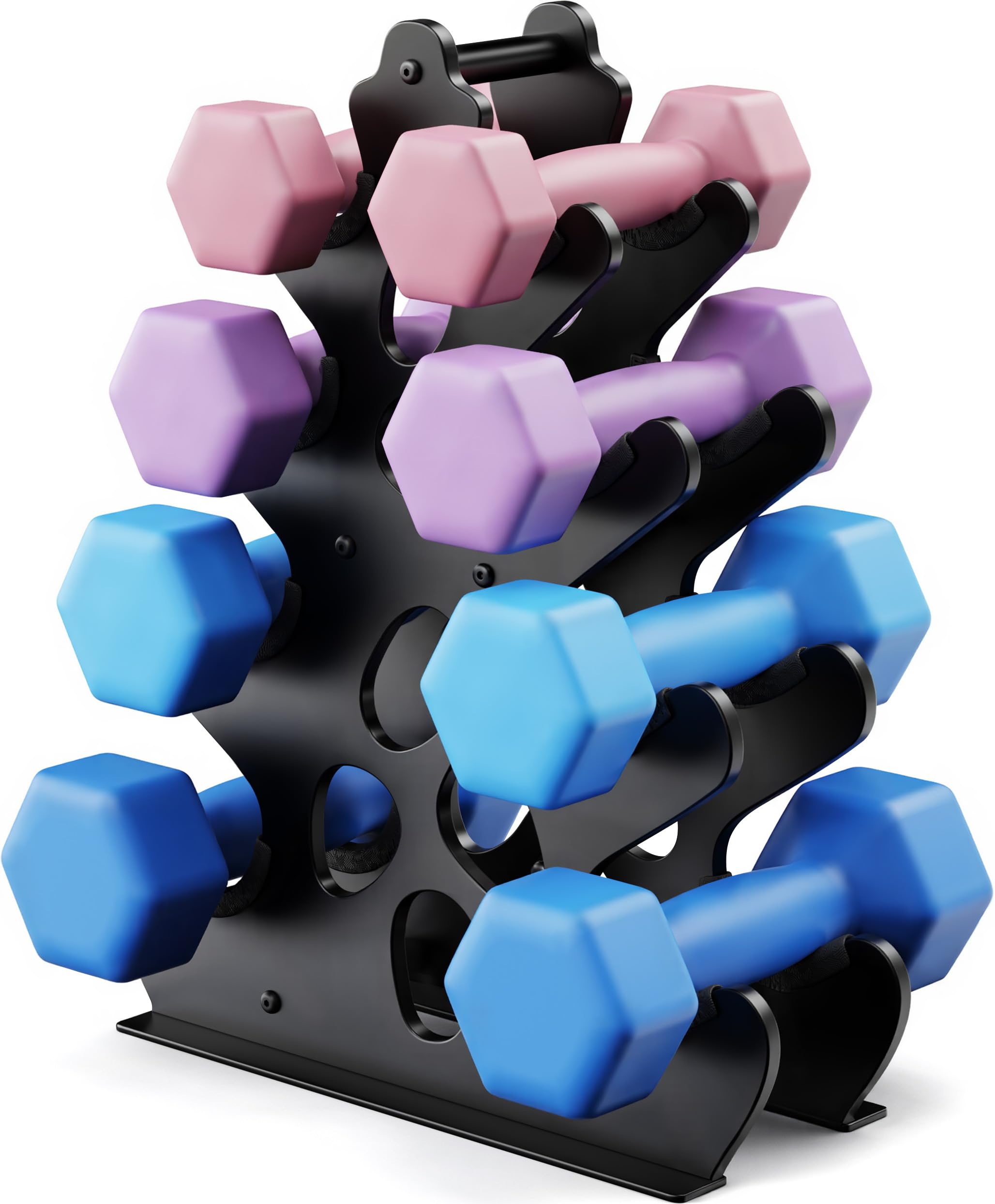
Small is the point. The Josmimic stands 17 inches tall and 13 wide, weighs 7 pounds, and puts four tiers of light dumbbells into a corner you'd otherwise waste.

The cradles have rubber edges, which matters more than it sounds when your dumbbells are neoprene-covered and the alternative is a pile on the floor. The A-frame leans back so the weights sit at an angle and come out cleanly, and the whole thing lifts with one hand when you want to vacuum under it.

What it won't take is a serious set. The 70-kilogram rating is generous for what the cradles actually fit, and the shallow tiers mean a big hex head perches rather than sits. Treat this as a rack for the 3-to-15-pound range and it does its job.

For a light set in a tight room we think it's the neatest solution here, and the easiest to live with, because the footprint is small enough to keep in the room where you actually train instead of exiling the gear to a garage. Keep it to a light gym and it earns its corner.

Bottom line: We suggest this for the neoprene pairs you use every day: the smallest footprint here, light enough to move one-handed, and not built for heavy hex dumbbells.

#6

PLKOW Dumbbell Rack with Wheels

PLKOW Dumbbell Rack with Wheels

Large mixed setups

Our Score 9.2/10
Check Price

Worth Noting

  • Tier racks sized for dumbbells up to about 25 lb
Dimensions
15.8"D x 41.5"W x 37"H
Storage Type
Mixed gear cart
Storage Spots
9
Weight Capacity
350 lb
Read the full review

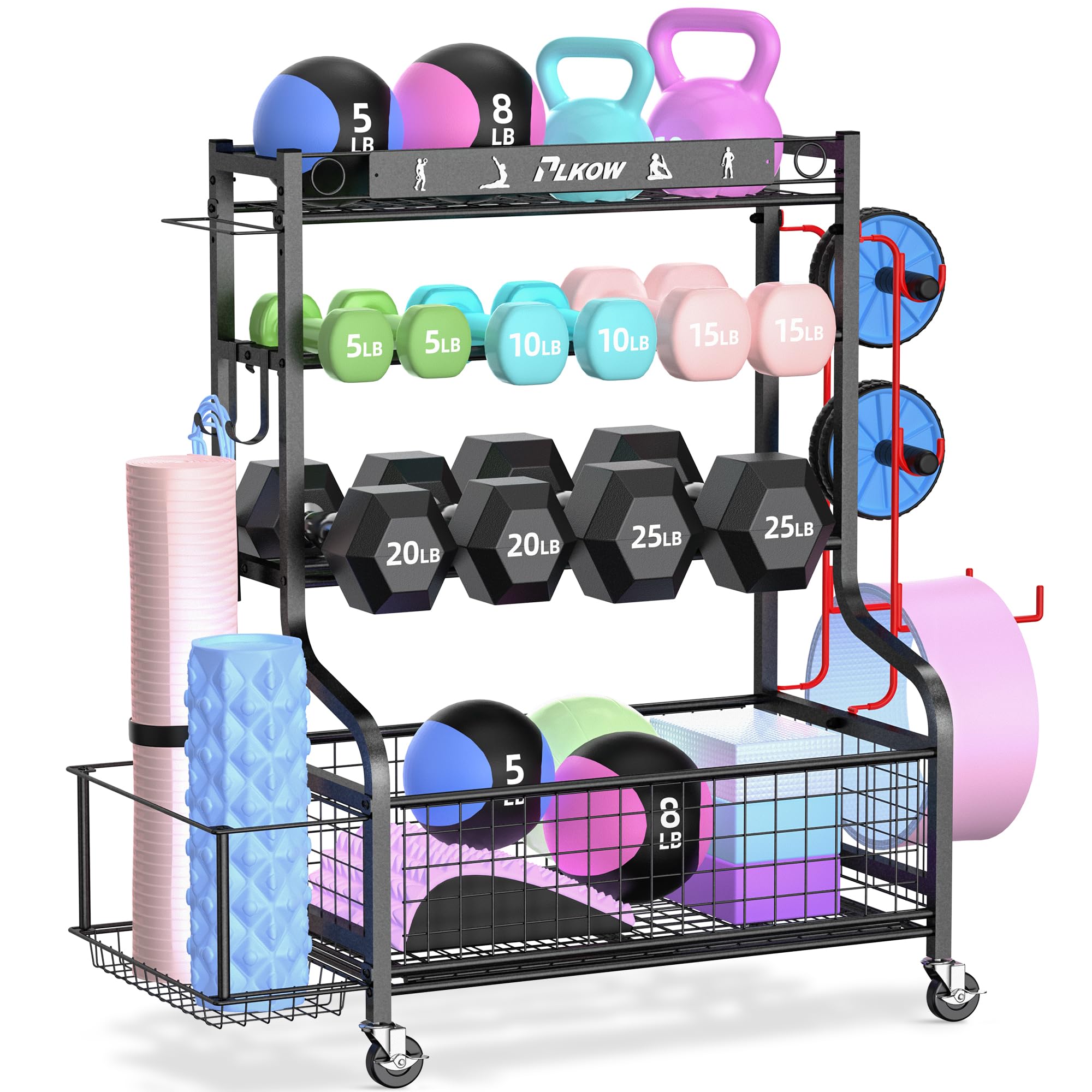
Forty-one and a half inches long and under 16 inches deep, the PLKOW is shaped like a bench for your gear: it runs along a wall instead of sticking out into the room. Three tiers of dumbbell racks take the iron, a side basket swallows a mat and a foam roller, and the hooks pick up bands and a towel.

Dumbbells and kettlebells both sit on these tiers, unlike the cradle racks where a round kettlebell belly has nothing to settle into. The 350-pound rating is the highest of the carts here, and the nine storage points mean the accessories stop competing with the weights for space.

The four casters, two with brakes, are the practical difference between this and a fixed rack: lock them and it behaves like furniture, release them and the whole gym moves to the middle of the garage. Assembly is a one-person job with instructions that read clearly, and the frame feels solid once it's square, so tighten the bolts when it's standing rather than while it's on its side.

We came away thinking the extra width and the capacity are what you're buying. If the collection keeps growing, the PLKOW absorbs it without a second piece of furniture; if you're storing one mat and three pairs of dumbbells, the extra foot of frame is wall you didn't need to use.

Bottom line: This is our pick when the collection outgrows a cart: 350 pounds of capacity, nine storage points, and a long, shallow frame that hugs a garage wall.

#7

Bikoney Yoga Mat Holder

Bikoney Yoga Mat Holder

Mats and bands

Our Score 9.2/10
Check Price

Worth Noting

  • Light-duty: thin metal and a small shelf
Hooks
4
Shelves
1 floating shelf
Dimensions
2.76"D x 8.39"W x 17.24"H
Storage Type
Wall mat rack
Read the full review

This is the most decorative thing here and the least substantial. A carbonized-wood shelf sits on top, four hooks hang below it, and a rolled mat drops into the bracket underneath: 17 inches tall in total, screwed flat to a wall. In a spare room it reads as shelving; in a garage it reads as the place the mat lives.

The job it does well is the gear that has no home on a weight rack: a mat, a foam roller, a strap, a block on the shelf. What it won't do is hold weight. This is thin metal and a small wood shelf, and the honest load is a mat and a couple of accessories; a kettlebell or a pair of dumbbells is the wrong job for it. Hung into a stud it's stable, while on drywall anchors alone it can pull away.

Installation is a two-hole job with the hardware in the box, though the instructions are the weakest part of the package and the bracket has to be level before the shelf goes on. Hang it at shoulder height so a mat slides in without going overhead, and put it where the mat actually gets used rather than across the room for tidiness.

Bottom line: Our pick for the soft gear a weight rack can't hold — mats, rollers, bands — as long as you have a wall and a drill.

#8

Amazon Basics 3-Tier Dumbbell Rack

Amazon Basics 3-Tier Dumbbell Rack

Mixed dumbbell sizes

Our Score 9.0/10
Check Price

Worth Noting

  • Tier clearance still tight for dumbbells over about 25 lb
Dimensions
19.09"D x 37.2"W x 31.1"H
Storage Type
Dumbbell rack
Tier Spacing
Adjustable
Weight Capacity
1,000 lb
Read the full review

The Marcy rack fixes its tier gaps; this one lets you move them. Each of the three shelves bolts at a different height, so you can open clearance for long hex heads at the bottom and close it up for short pairs at the top. That adjustment is the whole reason to choose it over the Marcy.

The rest is familiar: a 37.2-inch frame, a 1,000-pound rating, non-slip caps on the feet and a 31.1-inch height that keeps the top tier within easy reach when you're mid-set. At just over 40 pounds it's a one-person build, and the bolt count is small enough that assembly isn't the reason to avoid it.

Adjustable spacing changes the gap, not the clearance. Set the tier heights before the first load, because re-bolting a rack full of iron is the annoying version of a short job. Beyond that, this is the rack for a collection that grew one pair at a time rather than arriving as a matched set.

Bottom line: We point mismatched dumbbell sets here: the tiers move to fit what you own, which makes it the more flexible buy if your pairs came from three different brands.

How We Tested Home Gym Storage

We started by collecting every format we could find, from floor racks and rolling carts to wall-mounted rails, corner shelves, and modular systems, then cut the list by stated weight rating, published footprint, price, and whether mounting hardware came in the box. That took roughly 40 candidates down to 12 units we bought ourselves and built from scratch. Testing ran for seven months.

Assembly came first. Each unit was built solo using only the tools it shipped with, timed, and noted whenever a step clearly needed a second set of hands. We counted every bolt and anchor and checked whether what was included actually matched the wall type in a real garage, since a rack that arrives with drywall plugs and ends up on concrete is a problem you find out about at the worst possible moment. Each unit then went to live in one of three spots, a working garage gym, a spare bedroom, and a low-ceilinged basement corner, through ordinary training weeks.

We loaded them the way people actually load them: dumbbells pulled out one-handed mid-set, kettlebells set down hard, bumper plates slid in without squaring up the edges. Each unit was filled to its stated capacity and then a little past it to see what gave. We leaned and shook every loaded rack to watch for sway, measured how far it stood off the wall and whether a car door or a folding bench still cleared it, and checked slot spacing against the real diameter of our plates rather than the spec sheet. For value, we weighed the price against a plywood-and-pegboard build that would do the same job.

How to Choose the Right Home Gym Storage

Start With What's Actually on the Floor

Four kinds of gear want four different shapes. Dumbbells want cradles or angled tiers so a pair comes toward you; weight plates want a tree with 2-inch horns; a barbell wants a wall bracket that holds it vertically; mats, bands and rollers want flat shelves or hooks. A mixed cart takes the soft gear and the light dumbbells in one footprint, while a dedicated rack does its single job better than any cart can.

The usual mistake is buying for the gear that's out and forgetting the gear in the closet. Count every pair and every plate before you pick a capacity, because a rack that's full on the first day has already stopped being storage.

Check the Fit, Not Just the Capacity

A 1,000-pound rating tells you what the frame will hold, not whether your dumbbells will sit in it. Cradles are shaped around the middle of the hex-dumbbell range: 50-pound heads can sit proud of the cradle, and 2- and 3-pound neoprene pairs can be too short to reach both sides. Measure across the head of your largest pair and the length of your smallest, then look for adjustable tier spacing if those two numbers are far apart.

Clearance is the other half of fit. A dumbbell taller than the gap between tiers fouls the shelf above, which is the practical ceiling on most three-tier racks. Set the tier heights before you load anything; adjusting a loaded rack is a job you don't want to do twice.

Floor Space or Wall Space

Floor racks cost two to three square feet and need clearance in front to swing a dumbbell out. Wall brackets cost nothing on the floor but put the load into your wall, which means studs or rated anchors. Casters sit in the middle: a cart rolls out for a workout and back against the wall after it.

Watch the dimensions rather than the word compact. A 41-inch cart needs a long free wall, and a rack that stands at bench height hides nothing behind it. Measure the wall length, the installed height and the swing room, not just the footprint.

Assembly and Where the Weight Sits

None of these are difficult builds, but most go wrong in the same place: tightening every bolt while the frame is still lying on its side. Assemble it loose, stand it where it will live, check that it sits flat, then tighten in a diagonal pattern. A rack that rocks on a garage slab will rock no matter how hard you torque it, so shim a foot rather than over-tightening the frame.

Then load from the bottom up. Heavy plates go on the spokes nearest the base, heavy dumbbells on the lowest tier, and light accessories up top where you can reach them. It's not only about balance: a top-heavy rack is the one that walks across the floor when you pull a pair out.

Frequently Asked Questions

Final Verdict

Buy the Mythinglogic M721 if your gym is a mix of things — a mat, bands, a kettlebell and a few pairs of dumbbells — because one cart handles all of it and rolls away when you're done. If the floor is covered in dumbbells and nothing else, the Marcy is the sturdier rack and takes a 1,000-pound set without flinching.

And if a barbell is leaning in a corner, add the JNIHEEP hanger. It's the only pick here that gets a bar off the floor entirely.