Home Gym

Best Rubber Gym Flooring for Home Gyms of 2026

Rubber gym flooring is a Goldilocks problem. Go too soft and your squat rack rocks on it, your feet sink under a heavy bar, and the whole platform feels like it's swallowing you. Go too thin and a dropped dumbbell leaves a permanent dent in the concrete underneath. The right floor sits in between: dense enough to stay planted, thick enough to protect the slab and your joints, grippy enough that a lunge doesn't turn into a slide. And it has to pass the test nobody puts in the listing — whether it stinks up a spare room for a week.

I've laid this stuff in a garage, a basement, and a spare bedroom I regretted for a week. Over the past eight months, my team and I put 12 rubber floors through daily lifting, dropped weights, and one very patient downstairs neighbor. The ones worth buying had no lingering smell, tight seams, and a surface that gripped through sweaty sets. Each one below earned its price per square foot, and I'd lay any of them down again.

#1

American Floor Mats Fit-Lock Tiles

Top Pick
American Floor Mats Fit-Lock Tiles

Racks and benches

Our Score 9.4/10
Check Price

Worth Noting

  • Only 16 square feet per set
Coverage
16 sq ft (4 tiles)
Thickness
3/8 in
Tile Size
24 x 24 in
Construction
Solid rubber
Read the full review

Where our top pick is a rubber skin bonded to foam, these tiles are solid rubber through and through — 3/8 inch of it, 24 inches square, with no bond between layers to fail. That is the difference a loaded rack cares about.

We think this is the tile to buy when heavy equipment is the point. The pieces pull together tight enough to want a rubber mallet rather than a palm, and once seated the seams read as one continuous slab. It does not dent under a squat rack, it does not slide when you walk across it, and there is no foam layer to compress under a bench leg.

The set is built to be finished rather than trimmed: center, border and corner tiles let you close off an edge cleanly when the floor stops mid-room. The rubber does smell when the carton opens; it fades over several days, and a fan in the room shortens that.

Bottom line: If a rack or a heavy bench lives on the floor, we point you here: solid 3/8-inch rubber that will not delaminate, sold in small sets you add to.
#2

American Floor Mats 4x8 Roll

American Floor Mats 4x8 Roll

Seamless floor coverage

Our Score 9.4/10
Check Price

Worth Noting

  • Noticeable rubber smell for the first days
Coverage
32 sq ft
Material
Solid rubber
Roll Size
4 x 8 ft
Thickness
3/8 in
Read the full review

A roll answers the one thing tiles cannot: there is no seam in the middle of the floor. This one arrives as a single 4-by-8 sheet of 3/8-inch solid black rubber, 32 square feet with nothing to catch a bar, a bare foot or a vacuum wheel.

It has weight to it, which is the point — the sheet lies flat almost as soon as it is unrolled and stays where you put it without glue. Trimming is a knife job: mark the line, hold a straight edge against it and cut with a fresh blade. The factory edge is not always square, so trim your first course rather than trusting it against a wall, and take the offcut into the corner.

For a garage where the floor runs wall to wall, this is our pick of the rolls here. Three-eighths of an inch is enough to sit under a rack and a bench without feeling like a mat, one piece means one job instead of a hundred joints, and the surface sweeps clean in seconds.

Bottom line: The pick when the floor has to be one continuous surface: a 4-by-8 sheet of 3/8-inch solid rubber that lies flat with no adhesive.

#3

AIRHOP Rubber-Top Tiles

AIRHOP Rubber-Top Tiles

Full home gyms

Our Score 9.2/10
Check Price

Worth Noting

  • Noticeable rubber odor out of the box
Coverage
96 sq ft (24 tiles)
Thickness
0.56 in
Tile Size
24 x 24 in
Construction
Rubber top over EVA foam
Read the full review

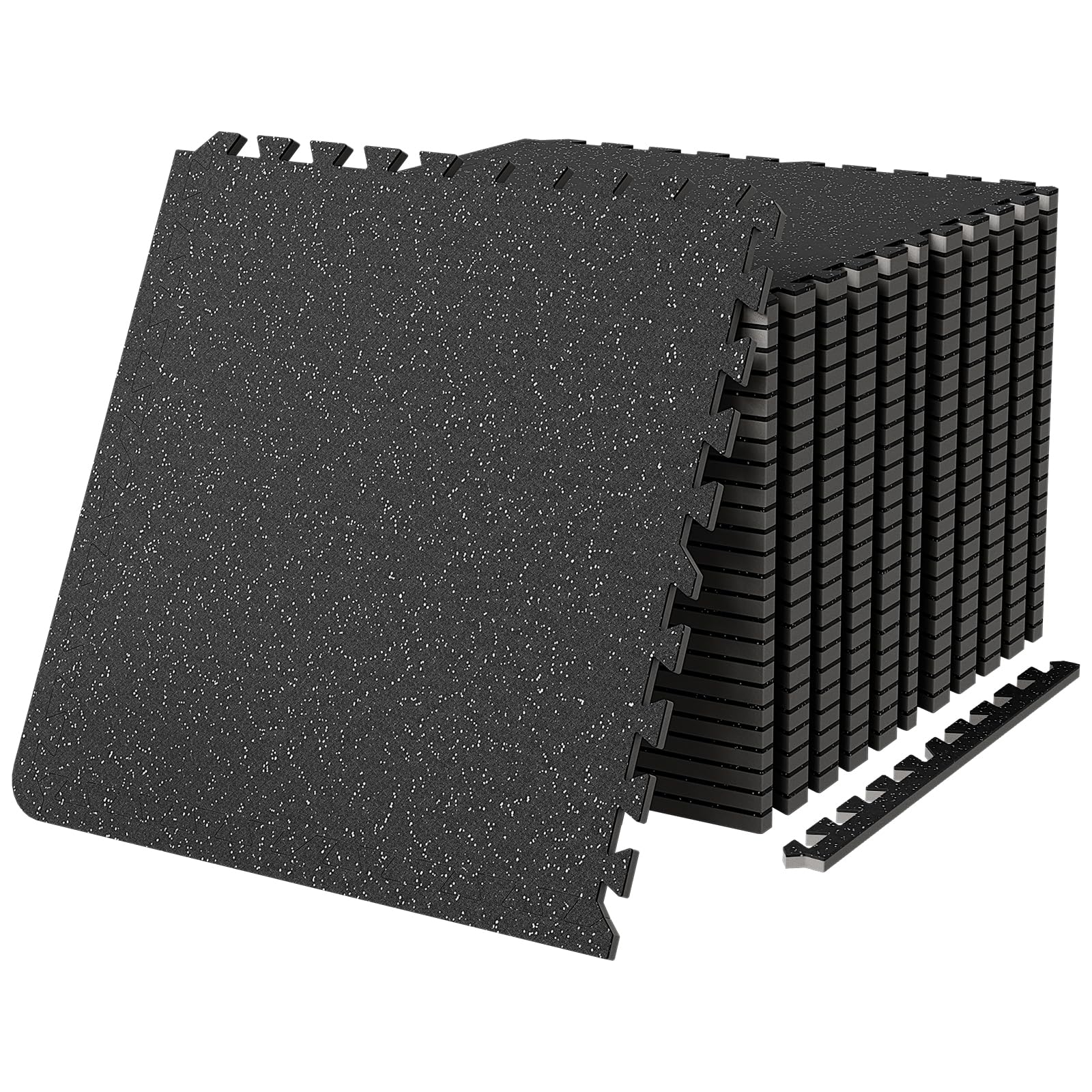
One box covers 96 square feet — 24 tiles at 24 inches each, an 8-by-12 footprint — which is more floor than most people clear for a rack, a bench and a stretch mat. That single number is why we hand this set to most people first: one order floors a whole spare room, and the tiles go down in an afternoon without adhesive.

The build is a recycled rubber top bonded to a high-density EVA foam core, 0.56 inch in total. What sold us is how firm it feels — nothing like the squishy play mats it superficially resembles. A bench sits level, feet do not sink, and the foam underneath swallows a surprising amount of the thump and rattle that normally travels into the room below.

Two things to know before you order. The tabs only close cleanly when every tile is seated flat and facing the same way; rush the layout and you get seams that sit proud of the surface and catch a bare foot. And this is a rubber skin rather than a slab — for a platform taking dropped loaded bars, a solid rubber tile is the better tool, and the Fit-Lock set is where we point that buyer.

Bottom line: Our default for a home gym: 96 square feet in one box, firm underfoot and quick to lay — the right buy unless you are dropping loaded bars onto it.

#4

Rubber King Interlocking Tiles

Rubber King Interlocking Tiles

Apartments and studios

Our Score 9.0/10
Check Price

Worth Noting

  • 23.5 square feet per pack is a small area
Coverage
23.5 sq ft (10 tiles)
Thickness
6 mm
Tile Size
19 x 19 in
Indoor Air
FloorScore certified
Read the full review

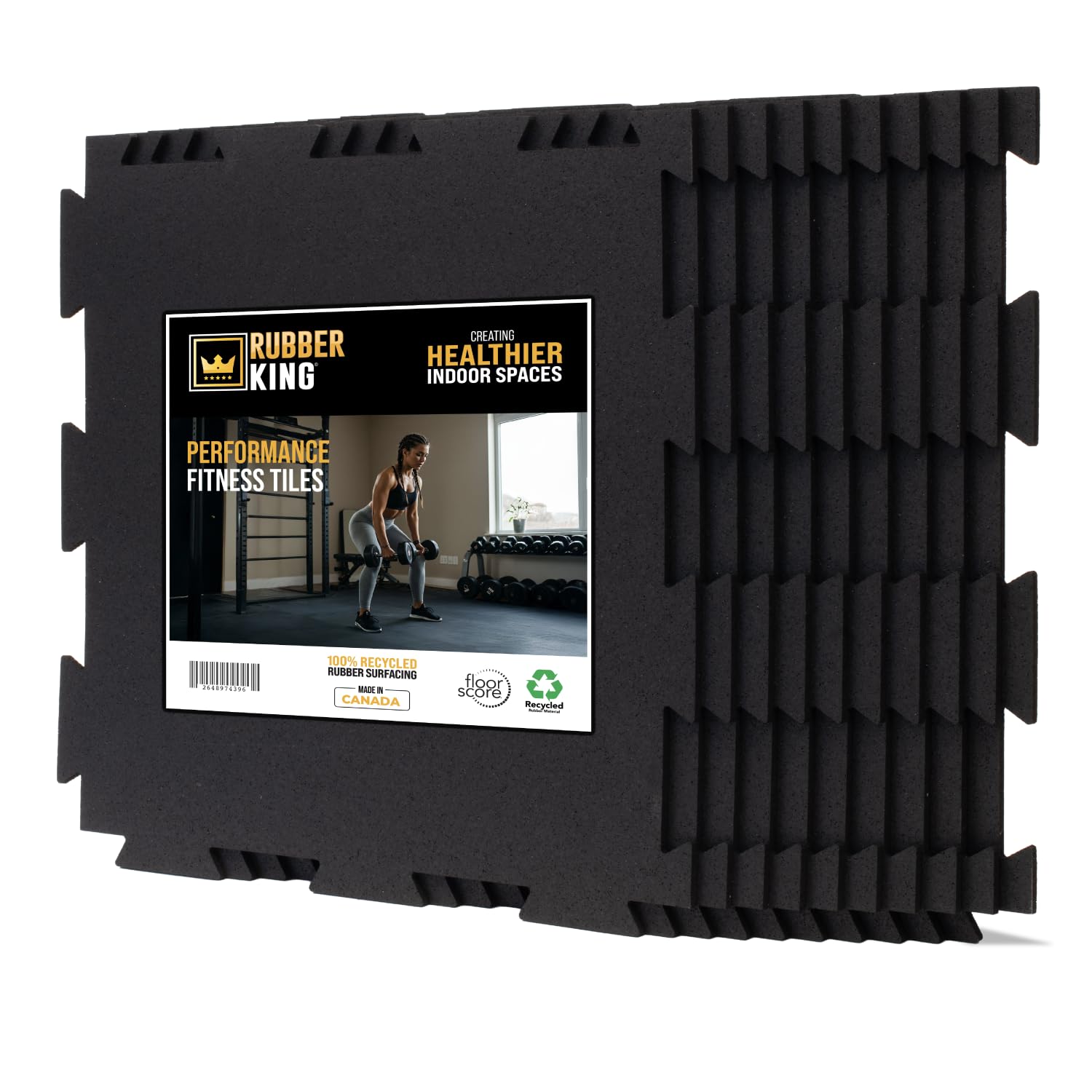
If the floor is going into a spare bedroom or a basement studio with one small window, this is the set we point to first. The tiles are 100% recycled rubber, certified to FloorScore for indoor air quality, and covered by a five-year limited warranty — the only floor here carrying a third-party indoor-air certification.

Ten tiles at 19 inches cover 23.5 square feet, so it is a pack you buy several of rather than one. Assembly is a genuinely simple puzzle, and the thing that decides whether the joints close is orientation: lay every tile facing the same direction and the tabs line up; mix them and the seams sit uneven. Get that right and the floor reads as continuous.

The surface is hard and barely cushioned, which is exactly what makes it durable and exactly why it is not a lifting platform. Yoga, dumbbells, a bench, a bike: all comfortable. Dropped weight is not its job. It is also thin enough to trim with a utility knife at a doorway, and the 5-year warranty is the longest backing in this group.

Bottom line: The one we suggest for a spare bedroom or studio: certified low-odor recycled tiles that lock tight, as long as nothing heavy gets dropped.

#5

Rubber-Cal Elephant Bark Roll

Rubber-Cal Elephant Bark Roll

Garages and patios

Our Score 9.0/10
Check Price

Worth Noting

  • Rubber smell lingers for a few weeks
Coverage
32 sq ft
Material
Recycled rubber
Roll Size
4 x 8 ft
Thickness
3/16 in
Read the full review

This is the least expensive way onto a rubber floor in this group, and it is the one we suggest when the job is protecting a slab rather than building a lifting platform.

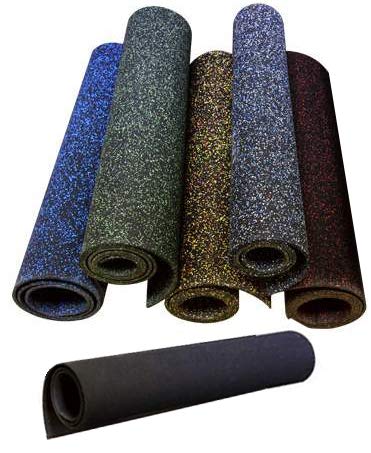
It is a 4-by-8 sheet of 3/16-inch recycled rubber, 32 square feet, rated for UV and water exposure and sold in six colors — which is why it turns up on patios and garage aprons as often as in gyms. The material is dense and does not curl at the corners, so it lies down and stays down.

Cutting is easier than the thickness suggests: a sharp box cutter and a straight edge get through it, and heavy scissors work for short trims. It sweeps clean, mops with mild detergent, and does not shred under a treadmill or a bike.

Where it lands for us is a floor protector, not a drop zone. Three-sixteenths of an inch will take a bench, a rower or a spin bike without complaint, but a dropped dumbbell gets very little between it and the concrete. Buy it for that job and it is excellent value; buy it for Olympic lifts and you will be disappointed.

Bottom line: The value roll we keep recommending: recycled rubber that protects a slab, sweeps clean and takes a treadmill without complaint.

#6

SUPERJARE 12-Tile Gym Floor

SUPERJARE 12-Tile Gym Floor

Budget starter gyms

Our Score 9.0/10
Check Price

Worth Noting

  • Top layer can peel from the foam
  • Tiles can slide and lift at the seams
Coverage
48 sq ft (12 tiles)
Thickness
0.56 in
Tile Size
24 x 24 in
Construction
Rubber top over EVA foam
Read the full review

Twelve tiles at 24 inches make 48 square feet — a 6-by-8 area, enough for a bench and a rack footprint but not for a whole garage. Each tile carries two detachable edges so the perimeter can finish flush against a wall.

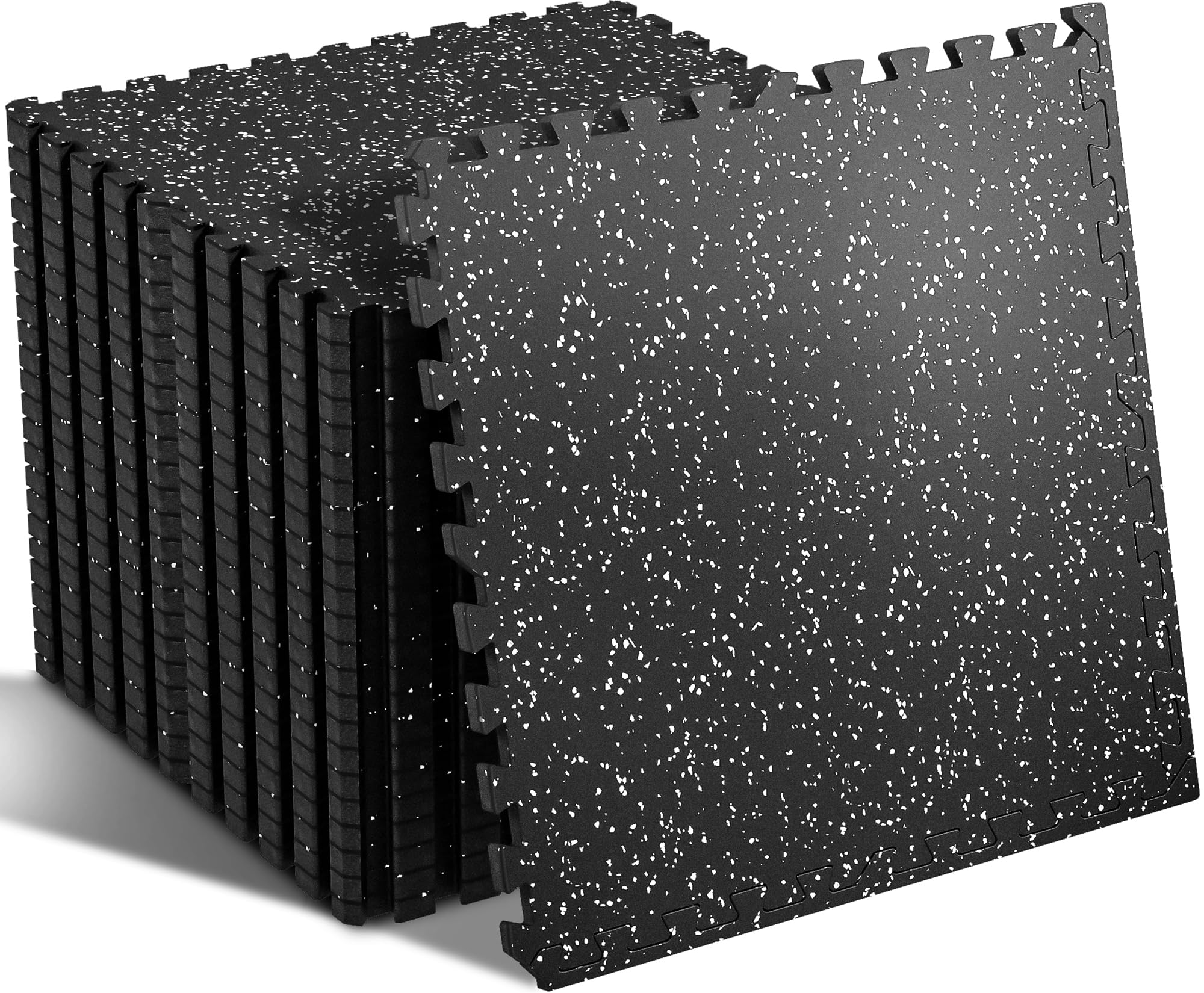
Underfoot it is soft, and that is the appeal. Stretching, floor work, a bench session and a treadmill all feel better on this than on bare concrete, and the speckled black-and-grey pattern hides scuffs and dust between sweeps. The pieces click together by hand; no mallet needed.

What you are standing on is a thin rubber skin over EVA foam, so the cushion comes from the foam and the wear surface is the top layer. It is a floor for dumbbells and bodyweight work. A barbell dropped from overhead belongs on solid rubber.

For a first home gym in a spare bedroom, we think it is a fair buy — 48 square feet for well under the full-room sets, and it looks better than the outlay suggests. Go in knowing it is a starter floor rather than a forever one and you will not be disappointed.

Bottom line: A fair-priced starter floor for a small room, best kept to dumbbells, benches and bodyweight work rather than dropped weight.

#7

VEVOR 25-Tile Gym Floor

VEVOR 25-Tile Gym Floor

Large rooms

Our Score 8.8/10
Check Price

Worth Noting

  • Rubber top can peel from the foam
  • Sold only as a 100 square foot set
Coverage
100 sq ft (25 tiles)
Thickness
0.56 in
Tile Size
25 x 25 in
Construction
Rubber top over EVA foam
Read the full review

Twenty-five tiles at 25 inches, plus 50 border pieces, adds up to 100 square feet — the largest single-box floor in this group, and enough to do a two-car garage bay properly.

We think it is the sensible second choice to our top pick when the room is bigger. It uses the same rubber-over-EVA construction at 0.56 inch, and it feels good over bare concrete — walkable in socks, firm under a bench, and quick to click together with no glue. If you are flooring 100 square feet and want one delivery, this does the job.

Small things we noticed: bench feet leave dents that fade over time rather than springing back immediately, so slide heavy pieces instead of dragging them. The border strips matter more than they look — they are what stop the perimeter reading as unfinished where the tabs meet a wall.

Bottom line: A sensible second choice for a bigger room: the most coverage in one box, with the caveat that the rubber top can peel where tiles flex.

#8

Mohawk Home Stall Mat

Mohawk Home Stall Mat

Spot protection

Our Score 8.6/10
Check Price

Worth Noting

  • 12 square feet only, so it is a spot mat
  • Diamond texture traps dust and pet hair
Size
3 x 4 ft
Surface
Diamond texture
Coverage
12 sq ft
Thickness
1/2 in
Read the full review

Half an inch of recycled rubber in a 3-by-4 sheet, with a diamond tread on one face and a high/low non-slip backing on the other. It arrives as a single mat, so there is no layout to plan and nothing to interlock.

Density is what makes it work. A treadmill, a bench, a bike or a crate sits on it without the feet sinking, and half an inch takes the thump out of a machine on a wooden floor. The backing grips, the mat stays where it is put, and outdoors it hoses off and air-dries.

We use it as the spot fix: one machine, one mat, done. Underfoot it is firm rather than cushioned, which suits a treadmill or a bench and less so a stretching session, and it is at its best in a garage or a barn where nobody is lying on it.

Bottom line: We use it as a spot mat: half an inch of dense recycled rubber under one bench or treadmill, not as a room floor.

How We Tested 12 Rubber Floors in Real Home Gyms

Forty-odd listings turned into a shortlist fast. Anything under a quarter inch was out, since that's barely anything between a dropped dumbbell and the slab, and so was anything sold only in rolls one person can't wrestle up a stairwell. That left interlocking tiles and mats in true rubber — crumb, rolled, and a couple of foam-backed hybrids — ranging from budget to are-you-sure. Twelve made the cut, and we bought every one at retail.

We laid them in three real spaces: a garage where the barbell lives, a basement corner with a rack, and a spare room holding a bike and a treadmill. Each floor got cut around a floor drain and a door frame with a utility knife and a straightedge, and we noted whether the edge sliced clean or crumbled into crumbs. Then we walked on them in socks, barefoot, and in lifting shoes, because grip reads differently in all three.

Durability got the ugly test: a 45-pound plate dropped from waist height, twice, followed by a look at what the surface did over the next few days. We measured actual thickness with calipers against the listed spec, because a three-eighths tile isn't always three-eighths. Odor was judged the way you'd live it — unrolled in a closed room, checked at 24 hours, again at 72, and once more after a week with the fan off. Grip, cushioning, and appearance came out of ordinary sessions: sweaty hands on lunges, jump landings, a rack dragged across a seam, and a hard look at scuffs and curling edges eight months in.

At the end we weighed cost per square foot against how each floor looked and felt on its last day of testing, which is where a few cheap options came apart — literally, at the seams.

How to Choose the Right Rubber Gym Flooring for Home Gyms

Solid Rubber or Rubber Over Foam

Solid rubber — tiles like the Fit-Lock set, or a roll like the Elephant Bark — resists point loads. A rack foot, a bench leg or a dropped dumbbell sits on material with nowhere to compress, and there is no bond between layers to fail. Rubber-topped foam tiles trade some of that for comfort: the foam absorbs impact and vibration, so the room is quieter and standing on concrete stops hurting.

We think the split is simple. If your training involves dropping a loaded bar, buy solid rubber. If it involves a bench, dumbbells, a treadmill and floor work, a foam-backed tile is more pleasant to live on and covers more area for the money.

The Coverage Math in One Order

Boxes sell by tile count, and the counts here run from 4 tiles to 25 — 16 to 100 square feet. Measure the room, then add a margin for the pieces you cut at walls and doorways, because offcuts from the edge of a layout rarely fit anywhere else.

Watch what the tile size includes. The interlocking tabs count toward the listed dimension, so the flat face you stand on is smaller, and a set covers a little less than the arithmetic suggests. Tile widths differ too — 19, 24 and 25 inches all appear here — so check the coverage figure rather than the tile count alone.

Thickness Decides What You Drop

At 3/16 inch a roll protects the floor underneath and little else; at 6 mm a tile adds grip and a clean surface for yoga and dumbbells. Around 3/8 inch of solid rubber is the point where a rack and a bench stop leaving marks, and a half-inch spot mat handles one heavy machine.

More is not automatically better. A rack's feet concentrate load and a soft core lets them settle, which is why a squat rack belongs on solid rubber rather than on the thickest foam-backed tile here. Match the thickness to the heaviest thing that will sit on the floor, not to the average.

The Smell Is Part of the Purchase

Recycled rubber off-gasses, and a sealed room full of new tiles will tell you so. Before installation, stand the tiles on edge in a garage or on a patio for a few days, and unroll a roll outdoors if the weather allows. A certified low-odor tile such as the Rubber King set is the answer if the floor is going into a bedroom or a basement studio with one small window.

Plan the wait rather than fighting it. The room should be usable — not scentless — before the rack goes in, and a fan moving air through an open window does more than any spray.

Edges, Cuts and the Last Foot

A roll is one piece to lay and a knife job to finish: mark the line, clamp a straight edge and cut with a fresh blade. Factory edges are not always square, so trim the first course rather than trusting it against a wall.

Tiles are easier at the perimeter. Sets that include center, border and corner pieces give you a finished edge without cutting, which is worth having if the mat will be visible from the rest of the room. Either way, cut generously and trim again — a gap at the wall is easier to fix than a short piece.

Frequently Asked Questions

Final Verdict

Most home gyms should start with the AIRHOP tiles. One order covers 96 square feet, the surface is firm enough that a bench sits level, and the whole floor goes down in an afternoon without adhesive — that combination is why it is our pick.

The exception is a floor built around a loaded bar. If you are dropping weight or parking a rack on it, spend the extra on the Fit-Lock solid rubber tiles and accept that 16 square feet arrives per set. For a garage that has to run wall to wall, the 4-by-8 roll gets you there without a single joint.