Cardio Machines

Best Vertical Climbers of 2026

A vertical climber is a deceptively simple machine: two handles, two pedals, and one rail that has to hold still while your entire body weight swings up and down on it. The difference between a good one and a bad one hides in the things a listing photo can't show — the gauge of the steel, the width of the base, how much play is built into the joints. Get those right and 20 minutes feels like an actual workout. Get them wrong and you've bought a squeaking metronome that ends up folded in a closet.

I've had a climber parked by a bedroom window for the better part of a year, and my team has spent six months living with nine of them, from budget folders to heavy steel frames. The thing first-time buyers don't expect: stride length and handle reach matter more than how many resistance settings a machine claims, because if the geometry doesn't fit your body, no amount of adjustment rescues the workout. The nine below are the ones we'd happily keep.

#1

Stamina Cardio Climber

Top Pick
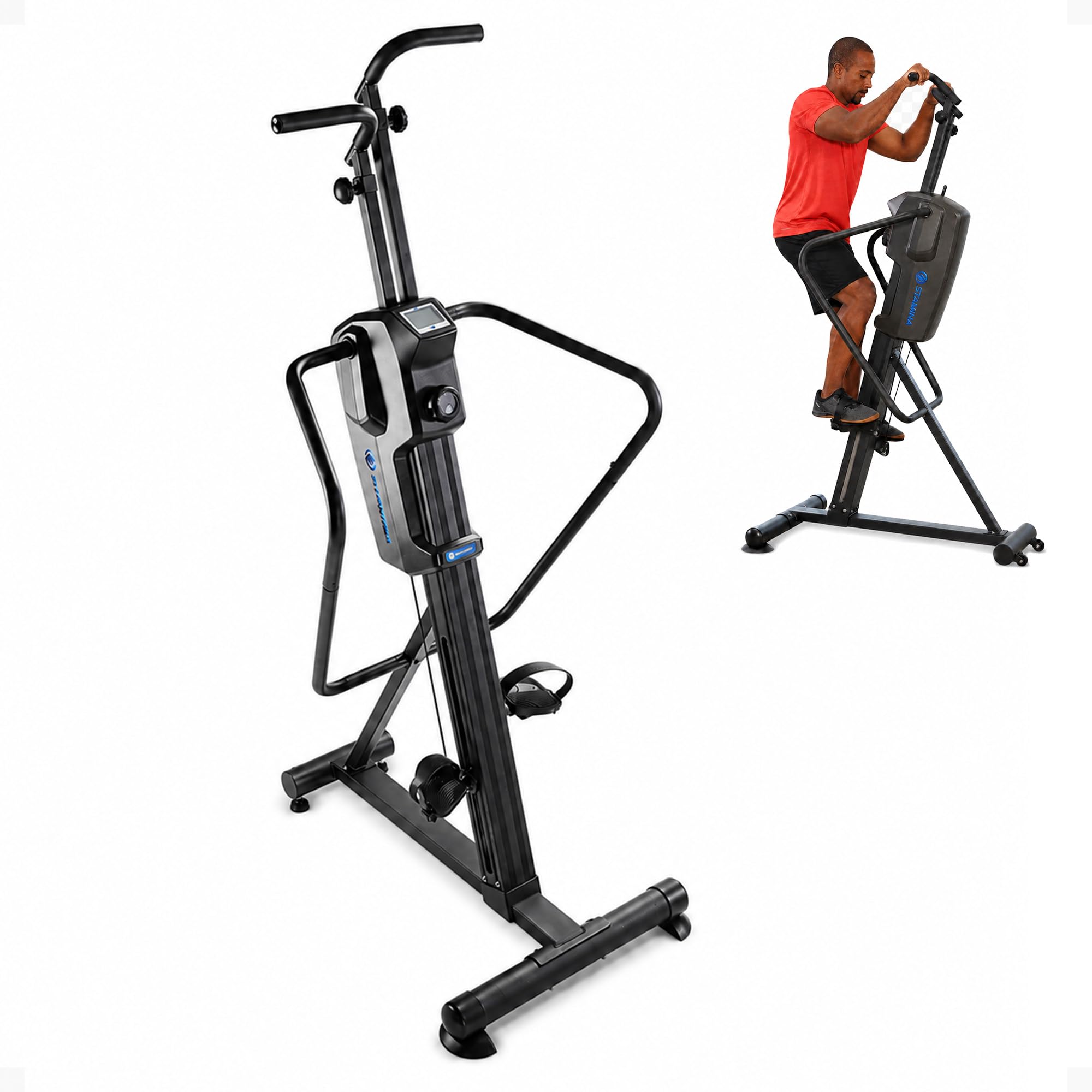
Stamina Cardio Climber

Full-body training

Our Score 8.4/10
Check Price

Worth Noting

  • Premium price
Storage
Wheels
Handlebars
Two sets
Resistance
8 magnetic levels
Weight Capacity
300 lb
Read the full review

The eight magnetic resistance levels are what make the Stamina Cardio Climber the most adjustable machine here. They let us add load without turning every session into a sprint, and that is the difference between a climber we use for steady cardio and one we avoid on easy days. We also appreciated the two handlebar sets: changing grip shifts which parts of the upper body feel the work, and it keeps longer sessions from becoming a grip contest.

The climbing motion is low-impact, and the textured pedals and padded grips make the machine feel planted underfoot. The wheels are useful when you want to roll it against the wall, though this is still a heavy machine that wants a dedicated corner rather than a closet. The müüv app adds guided coaching if you like structure; we treated it as a bonus, not the reason to buy.

What earns it the top spot is the combination of resistance and grip options with a 300-pound capacity and a five-year frame warranty. The Body-Solid is the simpler choice if you want to spend less. For most home gyms, though, the ability to change intensity without changing pace is the feature that keeps the machine useful.

Bottom line: We recommend the Stamina Cardio Climber for most home gyms: its eight resistance levels and two handlebar positions make it the most versatile full-body climber here.

#2

Body-Solid Climber

Body-Solid Climber

Higher weight limit

Our Score 8.0/10
Check Price

Worth Noting

  • Basic console without app coaching
Display
Time, distance, calories
Machine Weight
48.5 lb
Weight Capacity
330 lb
Assembled Dimensions
37 x 25 x 85 in
Read the full review

The Body-Solid Climber is the full-size machine we point to when capacity and simplicity matter more than workout gadgets. Its 85-inch frame gives you a standing climb, and the 330-pound weight limit is the highest here. The 37-by-25-inch footprint is narrower than the height suggests, so it can fit along a wall, but the 48.5-pound frame is not something you move for every session.

We found the bodyweight-driven motion easy to settle into, and the adjustable height helps you find a comfortable reach. The wide non-slip foot platform is a practical touch: it gives you room to place your feet without watching every step. The climbing action rewards rhythm more than resistance changes, which is fine if you want a simple machine but less flexible than the Stamina's eight magnetic levels.

Where it wins is value and capacity. It gives bigger or heavier users more headroom than the Stamina, and it does it for less money. We do not treat it as a compact stowable machine; it wants a dedicated spot. If that is your setup and you do not need resistance levels, it is the straightforward choice.

Bottom line: We see the Body-Solid Climber as the value choice for heavier users: a full-size 85-inch frame and a 330-pound limit for less money, with a basic console.

How We Tested the Best Vertical Climbers

We pulled every vertical climber we could find that shipped with a real warranty, a stated weight limit, and a footprint that would fit in a normal room, then cut the list to nine machines spread across the price range, from folding budget models to heavier steel-frame versions. Each one lived in a tester's home for six months rather than in a gym, so it got used the way you'd actually use it: 20-minute sessions before work, longer interval days on weekends, and plenty of folding, unfolding, and dragging across carpet.

Assembly came first. We built each climber alone, timed it, checked whether the hardware matched the instruction sheet, and noted whether one person could stand the frame upright without help. Then we rode them — full-stride intervals, slow controlled climbs, and the sloppy quick steps you take when you're tired — watching for rail flex, base lift, and any rocking on a hardwood floor. A decibel reading was logged during a steady climb, along with whether we could hear the machine over a TV in the next room.

Adjustability got checked by testers from 5-foot-2 to 6-foot-3, who reset handle height and pedal position between turns and reported how positive the locking pins felt once seated. For durability, we re-tightened every bolt at the one-month and three-month marks, watched for worn pedals, chipped coating, and stretched cables, and logged anything that loosened on its own. We also compared heart rate across identical sessions to see whether each machine's stride let us reach full extension, and judged value by what still felt solid at the three-month mark rather than by sticker price.

How to Choose Vertical Climbers

Measure the Ceiling Before the Footprint

Full-size climbers are tall: the Body-Solid is 85 inches from floor to top, and its footprint is 37 by 25 inches. Measure floor-to-ceiling before you order, and add a little margin for your head and for the top of the climbing stroke. A standard 8-foot ceiling leaves about 11 inches above an 85-inch frame, but a basement joist or ceiling fan can take that away. If the only spot is under a low soffit, a compact stepper is a different purchase, not a vertical-climber compromise.

Choose Resistance If You Want to Change Intensity Without Sprinting

A bodyweight climber makes you work by going faster or stepping harder. That is fine for short, hard cardio, but a resistance system lets you add load while keeping the same rhythm. The Stamina's eight magnetic levels are the clearest example here: they give you a way to move between easy, steady, and hard sessions without turning every workout into a sprint. If you mostly want brief, intense efforts, bodyweight can be enough. If you want endurance work or a machine several people can share, pay for resistance.

Look at the Handles and Pedals, Not Just the Frame

The handles decide whether the climber feels full-body or just leg-day with a handrail. Moving handles bring the arms and core into the climb; fixed balance bars mostly keep you upright. Look for a handle height that lets your shoulders relax and pedals wide enough that your feet do not hang off. The Stamina's two handlebar sets let you change grip, while the Body-Solid uses a wide non-slip platform and adjustable height. Those details matter more after ten minutes than any console feature.

Treat the Weight Limit and Warranty as Hard Data

The maximum user weight is a hard limit, not a suggestion: our picks are rated 300 and 330 pounds. Above that, keep looking. A long frame warranty is worth more than a colorful console because the joints and pivot points take the stress. The Stamina backs its frame for five years but its parts for 90 days, so know what is covered before you buy. Check bolts after the first few sessions and again every few months; a tall machine that starts clicking is telling you something.

Keep the Console in Perspective

Time, distance, calories, and a phone holder are enough for most people. Guided app coaching can help if you like being told what to do, but it should not be the deciding feature. The Stamina includes müüv coaching; the Body-Solid keeps a basic display. Choose the frame and resistance you want first, then treat the electronics as a bonus. A machine with the right climb and a plain screen beats a busy screen on a frame you do not enjoy using.

Frequently Asked Questions

Final Verdict

The Stamina Cardio Climber is our top pick because it gives you more ways to adjust the work: eight magnetic resistance levels, two handlebar positions, and a five-year frame warranty. It costs more, and that is the honest trade-off. The Body-Solid Climber is the better buy for a heavier user or a tighter budget—its 330-pound limit and full-size frame are real advantages—but it is the simpler machine, with a basic console and fewer workout options. Choose the Stamina if you want to train at different intensities; choose the Body-Solid if capacity and price decide it.