Cardio Machines

Best Spin Bikes of 2026

A spin bike that rocks and squeaks through a standing climb is worse than no bike at all—you stop trusting it, then you stop riding it. What you want is a machine that stays planted when you sprint out of the saddle, runs quiet enough for a 6 a.m. ride in a small apartment, and adjusts to fit everyone in the house. The seat matters more than the spec sheet suggests: a narrow saddle that feels fine for ten minutes can make a 45-minute class feel like punishment. The right bike fixes all of that and holds up without constant tinkering.

I've ridden indoors for years, and over the past eight months my team and I have lived with seven spin bikes. We assembled each one ourselves, rode through sweaty intervals and steady sessions, and noted the details that emerge later—seat comfort, belt noise, loose bolts. Value isn't the lowest sticker price; it's the bike you don't have to replace in a year. The picks below are the ones we kept coming back to.

#1

Schwinn IC4 Indoor Cycling Bike

Top Pick
Schwinn IC4 Indoor Cycling Bike

App-based spin classes

Our Score 9.0/10
Check Price

Worth Noting

  • Hard, thin stock saddle
  • Basic console for the price
Resistance
100 magnetic levels
App Pairing
Bluetooth with Peloton and Zwift
Bike Weight
112 lb
Max User Weight
330 lb
Read the full review

The first thing we noticed about the IC4 wasn't a feature — it was momentum. At 112 pounds with a heavy flywheel, it keeps the pedals turning through the dead spot at the bottom of the stroke, and the lighter bikes here feel choppier by comparison. That's what earns it the top spot: it behaves like a studio bike rather than a cardio machine with pedals bolted on.

The specifications back that up. There are 100 micro-adjustable magnetic resistance levels, so an instructor's call of '40 to 50' actually means something; the belt drive is quiet enough to ride before anyone else is awake; and the pedals flip to take either clip-in shoes or trainers. Bluetooth pairing with Peloton and Zwift held up the way it should, and the warranty — ten years on the frame, three on parts, one on labor — is the longest in this set.

Two things we minded. The saddle is hard and thin, and the console is the oldest-feeling part of the bike: pairing holds, but you'll do your real reading on the tablet you mount above it. The IC4 is also heavy enough that moving it is a two-person job, so decide which room it lives in before it goes upstairs.

Bottom line: We recommend the IC4 to anyone who wants studio-style riding at home and will pair it with a class app; it's the most convincing spin bike in this set.

#2

CHAOKE 520A Exercise Bike

CHAOKE 520A Exercise Bike

Quiet daily cardio

Our Score 9.0/10
Check Price

Worth Noting

  • Console and plastics feel cheap
Resistance
100 magnetic levels
Bike Weight
48 lb
Rider Height
4.7 to 6.1 feet
Max User Weight
300 lb
Read the full review

Assembly is where the 520A made its first impression. Most of the bike arrives already built, and the parts that don't are bagged and labeled by step, so the job is short and hard to get wrong. Nothing else at this price went together as cleanly.

Once it was set up, what we kept coming back to is how little noise it makes. A belt drive and magnetic resistance mean there's no pad rubbing and no whirr under the pedals, and 100 levels let you nudge resistance in small steps instead of jumping between gears. The 48-pound frame doesn't wander when you stand to climb. We think it's the best value in this set: it does the quiet, stable, finely adjustable version of the job for a fraction of the premium bike's price, and what you give up is flywheel momentum, not function.

Fit runs from 4.7 to 6.1 feet with a 300-pound limit, which covers most households, though very tall riders will want a longer frame. The saddle is the one part that undercuts the price: an hour in, we were shuffling around, and a replacement is the first upgrade most riders will want to make.

Bottom line: Our value pick: the 520A delivers a quiet, stable, finely adjustable ride for a fraction of the studio bike's price, and only the console feels cheap.

#3

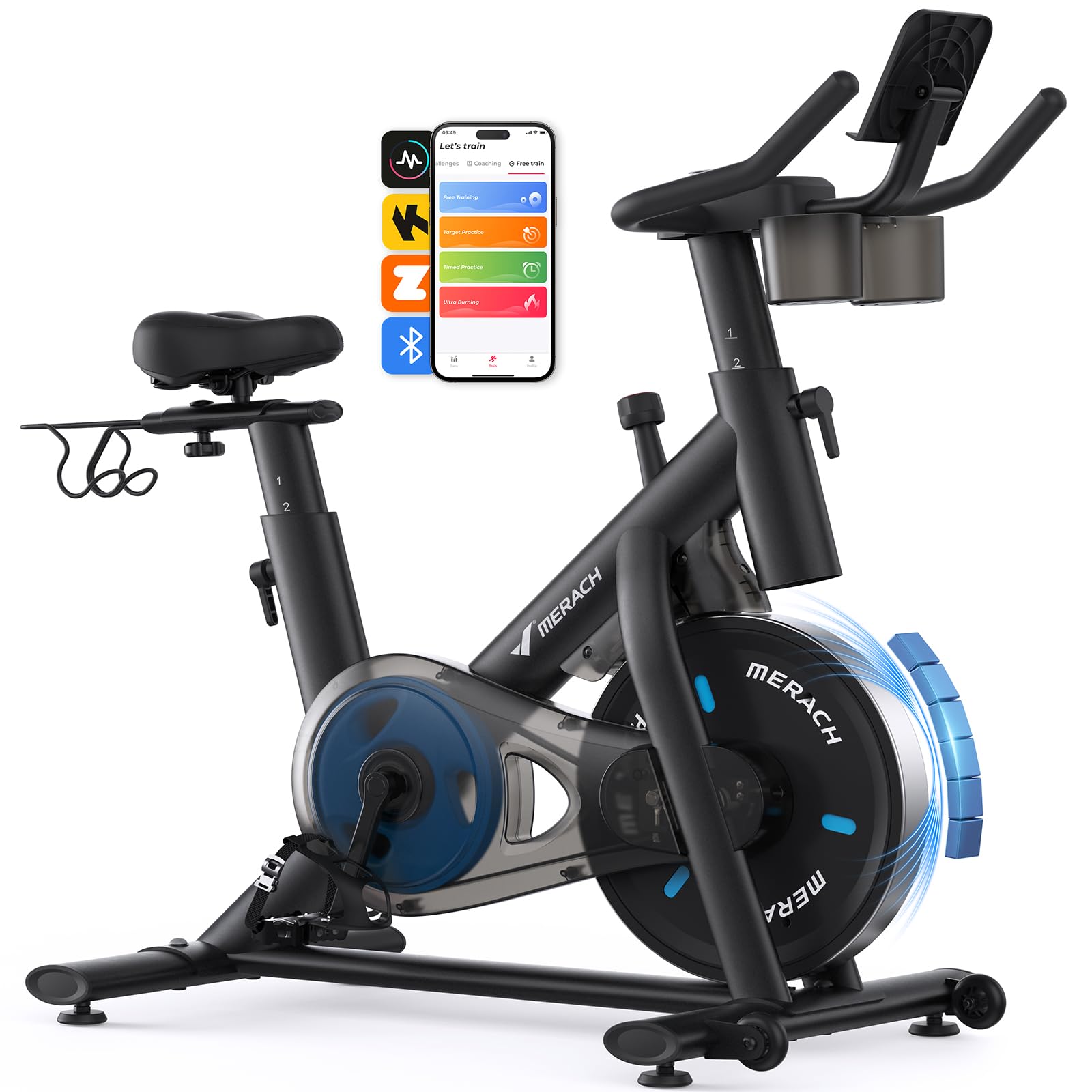
MERACH S26 Exercise Bike

MERACH S26 Exercise Bike

Guided home workouts

Our Score 9.0/10
Check Price

Worth Noting

  • Firm, narrow saddle
Resistance
Magnetic, 8 levels
Bike Weight
62 lb
Rider Height
4'8" to 6'2"
Max User Weight
300 lb
Read the full review

Merach built the S26 around its own app, and that's the right way to read this bike: a training tool that happens to have pedals, rather than a stripped-down replica of a studio bike. Pick a workout and the app tracks your metrics live while the bike stays quiet underneath you.

Underneath is a well-sorted machine. The 62-pound steel frame sits still when you stand to climb, the belt drive is quiet enough for a shared apartment, and the fit range from 4'8" to 6'2" covers most households. Assembly is straightforward, and the whole bike reads as more expensive than its price tier.

Our reservation is how the resistance is parceled out. The listing counts eight levels where the Schwinn and the CHAOKE offer a hundred, so in a class that calls out a specific number you'll be approximating rather than matching. As an app-guided bike, though, we think it earns its midrange place; as a class replica, the finer-grained bikes are worth the step up.

Bottom line: We recommend the S26 to app-guided riders who want a quiet, planted frame, provided they can live with coarse resistance steps and a firm saddle.

#4

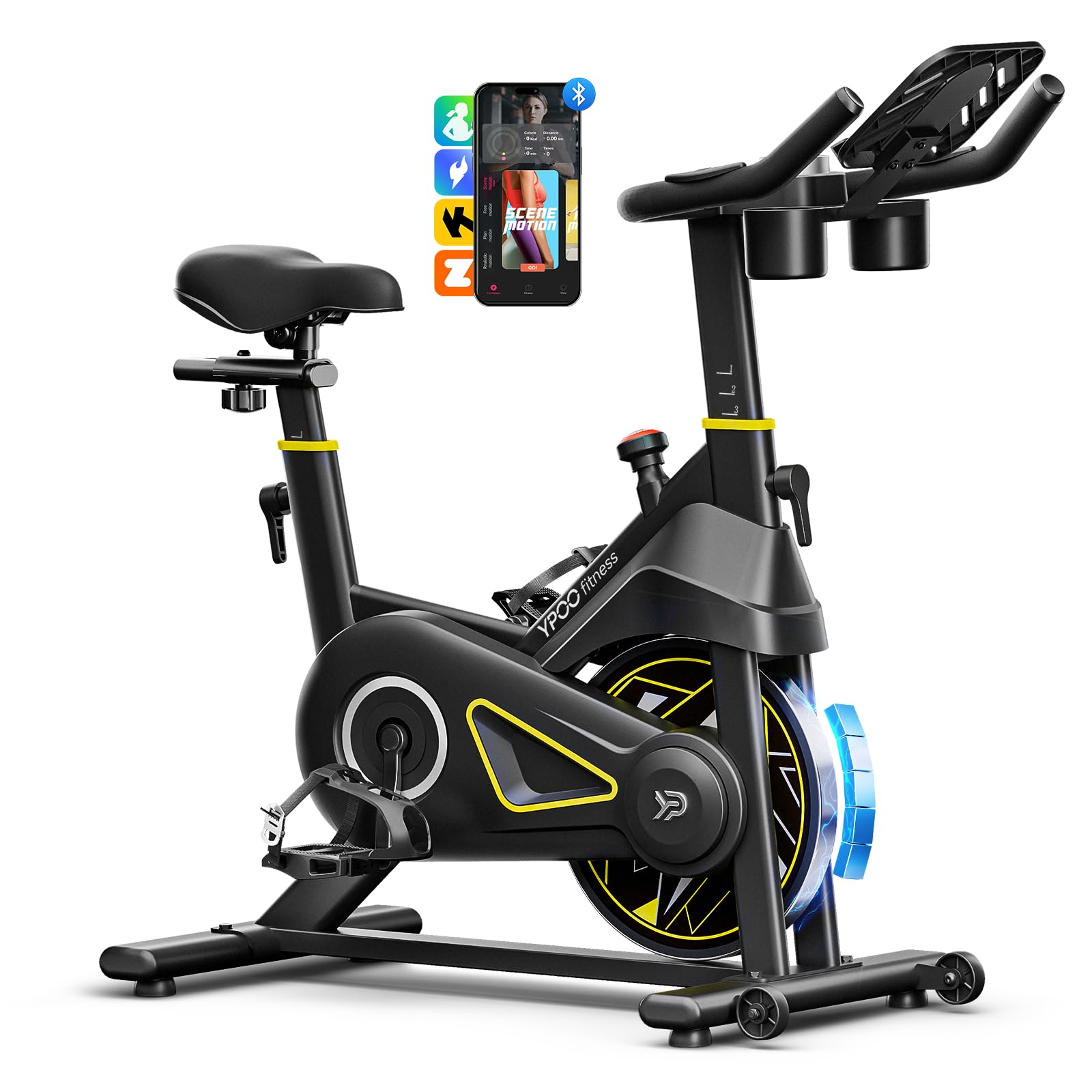
YPOO BC710 Exercise Bike

YPOO BC710 Exercise Bike

Small-space riders

Our Score 9.0/10
Check Price

Worth Noting

  • Console failures inside the first few months
  • Narrow saddle
Resistance
16 magnetic levels
Bike Weight
44 lb
Rider Height
4'8" to 6'1"
Max User Weight
300 lb
Read the full review

Eighty percent pre-assembled sounds like marketing until the box arrives. What's left on the BC710 is handlebars, pedals, console and a handful of bolts, and the job is short enough that you're riding the same afternoon. In a category where assembly is the first real hurdle, that counts for something.

What we appreciated more once it was set up is the footprint: 32.9 by 19.3 inches and 44 pounds, the easiest bike here to tuck into a corner of a bedroom and roll out for a session. The ride is quiet and steady — 16 magnetic levels, a 300-pound limit, a fit range of 4'8" to 6'1" — and for a small-space rider we think that trade beats a heavier flywheel.

The weak point is the electronics. Consoles have quit inside the first few months, which turns a working bike into an annoying one; keep the warranty paperwork where you can find it, and don't rely on the display for anything a watch or a tablet can tell you.

Bottom line: We like the BC710 for apartments and spare rooms: it goes together fast, rolls out of the way, and rides quietly, as long as you accept the console as the weak link.

#5

SLUNSE 509A Exercise Bike

SLUNSE 509A Exercise Bike

Budget home cardio

Our Score 8.8/10
Check Price

Worth Noting

  • Basic plastics around console and knob
Resistance
100 magnetic levels
Bike Weight
59.5 lb
Rider Height
4.8 to 6.1 feet
Max User Weight
350 lb
Read the full review

At the bottom of this set's price ladder, the 509A is the bike we're most comfortable sending a beginner to. It carries the highest weight rating here at 350 pounds, fits riders from 4.8 to 6.1 feet, and pedals quietly enough for a bedroom. For a first indoor bike, that combination is hard to argue with.

The specification is generous for the tier: 100 magnetic resistance levels, a 59.5-pound frame, a belt drive, a phone mount, transport wheels and two resistance bands clipped to the frame. The bands are the gimmick of the package — we tried them once and went back to the handlebars — but they cost nothing and stay out of the way.

The saddle is small and firm, and most riders will end up shopping for a replacement within a few weeks; budget for that and the bike has no real weakness left at its price. Anyone over six feet, or planning to spend most of the ride out of the saddle, should spend up — the heavier bikes here handle standing work better.

Bottom line: We point first-time indoor riders to the 509A: the highest weight rating here, a genuinely quiet ride, and a price that makes trying indoor cycling low-risk.

#6

CURSOR CBE10 Exercise Bike

CURSOR CBE10 Exercise Bike

First spin bike

Our Score 8.6/10
Check Price

Worth Noting

  • Light frame carries little momentum
Bike Weight
39.7 lb
Drive System
Belt
Rider Height
4'8" to 6'2"
Max User Weight
300 lb
Read the full review

The CBE10 is the lightest and least expensive bike here, and that pairing explains most of what follows. At 39.7 pounds it rolls between rooms without a second thought and comes up the stairs alone; it also gives up the flywheel weight that makes the heavier bikes feel like riding rather than pedaling.

The build is tool-free and quick, and the fit range of 4'8" to 6'2" is the widest in this set, which is the reason to look at it for a household where two very different people will share one machine. Resistance runs across a continuously adjustable range, the drive is a belt, and the seat adjusts four ways, so a repeatable position is easy to find.

The trade is momentum. With a light flywheel, the CBE10 doesn't carry you through the bottom of the stroke the way the Schwinn does, and standing climbs feel more like work than like riding. We think that's a fair trade at the entry price — a bike that gets used beats a heavier one that doesn't — but if you're chasing the studio feel, this isn't the one.

Bottom line: We recommend the CBE10 to taller riders and shared households on the tightest budget, accepting a light frame that gives up studio-style momentum.

How We Tested the Best Spin Bikes

To build our shortlist, we researched the spin bikes that show up again and again in customer reviews and compared their specs—frame design, flywheel weight, adjustability, and the hardware included—before narrowing to seven models that represented different approaches to the same job. We didn't just read about them: we unboxed and assembled each bike ourselves, timing the process and noting whether the instructions matched the parts in the box. A bike that took two hours and a second person lost points before anyone clipped in.

Over eight months, we rode all seven in a living room, a garage, and a small apartment, mixing 20-minute sprints with 45-minute steady sessions. For sturdiness, we stood for climbs and shifted weight side to side, watching for frame flex, front-end lift, and any creak from the seat post or pedals. For quiet, we rode early in the morning on hard floors and listened from the next room for belt whine, clicking, or fan noise. We also checked build quality up close—welds, paint, and the feel of the resistance knob—and kept an eye on bolts and belt tension as the weeks went by.

Comfort and fit got their own attention: riders from 5-foot-2 to 6-foot-2 adjusted the seat and handlebars, and we noted where the saddle created pressure during longer rides. We measured seat width and noted whether the shape suited sit-bones or caused chafing. To judge value, we compared what each bike included—pedals, a tablet holder, smooth resistance changes—against what it asked you to spend, and asked whether the frame felt like it would last. The bikes that rose to the top were the ones that stayed solid, quiet, and comfortable after months of regular use.

How to Choose Spin Bikes

Fit Range Before Features

Height ranges look like fine print, but they decide whether you ever feel comfortable standing out of the saddle. These picks run from about 4.7 feet at the bottom to 6.2 feet at the top, and the ends matter: a shorter rider on a bike with a tall minimum reach ends up stretched, and a taller rider whose seat post tops out loses power with every stroke.

Check the seat's fore-and-aft travel as well. A four-way seat that slides back lets you reach the bars without locking your elbows, which is where most comfort trouble actually starts. If two people share the bike, look for marked or numbered posts so a setting can be found again in one move rather than five minutes of fiddling.

How Resistance Is Delivered, and How Finely You Can Set It

Magnetic resistance moves magnets toward a spinning flywheel without touching it, so nothing wears, nothing squeals, and the change between settings is smooth. Friction systems press a pad against the wheel; they cost less, and the pad is a wear item you'll adjust over time.

Granularity is the practical question. A hundred-step magnetic system, like the Schwinn IC4's or the CHAOKE 520A's, lets you match the number an instructor calls out. A sixteen-level bike is fine for riding by feel but forces you to approximate in a structured class. Be honest about which rider you are before paying for the finer control.

Flywheel Weight and What You'll Feel

Two numbers describe how a bike rides: the flywheel's weight and the bike's. A heavy flywheel carries momentum through the bottom of the stroke, so the pedals feel like they're pulling you around rather than you shoving them down. Bike weight buys stability — the 112-pound IC4 stands still when you climb out of the saddle, while a 40-pound bike asks you to stay smooth.

Weight also decides where the bike lives. In a spare room that never changes, mass is free stability. If it has to move for a vacuum or a guest bed, the lighter bikes here are the ones that keep getting used. And whatever the photos suggest, none of these fold.

Noise, Floors and the Neighbors Below

Belt-driven magnetic bikes are quiet in normal use, and several here claim under 25 dB. The noise that develops later is usually a loose pedal, a dry bearing or a clamp that has worked free rather than the drive itself, so a monthly check of the fasteners handles most of it.

Put the bike on a hard, level floor with a mat underneath. Deep carpet lets the frame rock and hides the wobble you'd otherwise notice early. If you live above someone, ride seated intervals in the morning and save the standing sprints for a civilized hour.

Consoles, Apps and the Screen You'll Actually Use

Treat the console as a time and cadence readout and plan on a tablet doing the real work. The IC4 pairs over Bluetooth with Peloton and Zwift; the budget bikes connect to their own apps or to Kinomap and Zwift, which is enough for guided rides but rarely shows the resistance number a class calls out.

A tablet mount and a phone holder matter more than a backlit display, and they cost far less than a bike upgrade. Buy for the frame, the fit and the resistance; the electronics are the part that dates fastest.

Frequently Asked Questions

Final Verdict

The Schwinn IC4 is our pick because it's the only bike here that reproduces how a studio bike feels. The flywheel carries the stroke, the resistance moves in fine enough steps to follow a class, and it pairs with the apps you probably already pay for.

If that premium is more than you want to spend, the CHAOKE 520A is the value answer: the same hundred-step magnetic resistance, a quiet belt drive and a stable frame for far less. And if you're not yet sure indoor cycling will stick, buy the SLUNSE 509A, budget for a better saddle, and upgrade once you know.