Cardio Machines

Best Ellipticals of 2026

An elliptical is the rare cardio machine that’s easy on your knees and still makes you sweat. The catch is that a cheap one can rattle the floor, wobble underfoot, and turn assembly into a lost weekend. I know because I once spent a Saturday wrestling a hand-me-down into place only to have it announce every stride to the whole house. Over the past six months, my team and I assembled and logged miles on eight home ellipticals, from compact folding models to longer-stride front-drive machines.

A good home elliptical should feel solid at speed, stay quiet enough for early-morning workouts, and fit the space you have. I cared about clear instructions, smooth resistance changes, pedals that didn’t flex, and whether the stride length suited the person using it. I also checked app and console controls mid-workout—the closest thing to a remote on these machines—and weighed whether each one earned its footprint. Value isn’t the lowest ticket; it’s quality you stop noticing. The picks below are the ones that made daily use feel easy.

#1

pooboo E399 Elliptical

Top Pick
pooboo E399 Elliptical

Most home gyms

Our Score 9.2/10
Check Price

Worth Noting

  • 350-pound rating trails the ANCHEERs and the Niceday
Footprint
49.2"D x 29.92"W x 62.2"H
Stride Length
15.5 in
Weight Capacity
350 lb
Resistance Levels
16
Read the full review

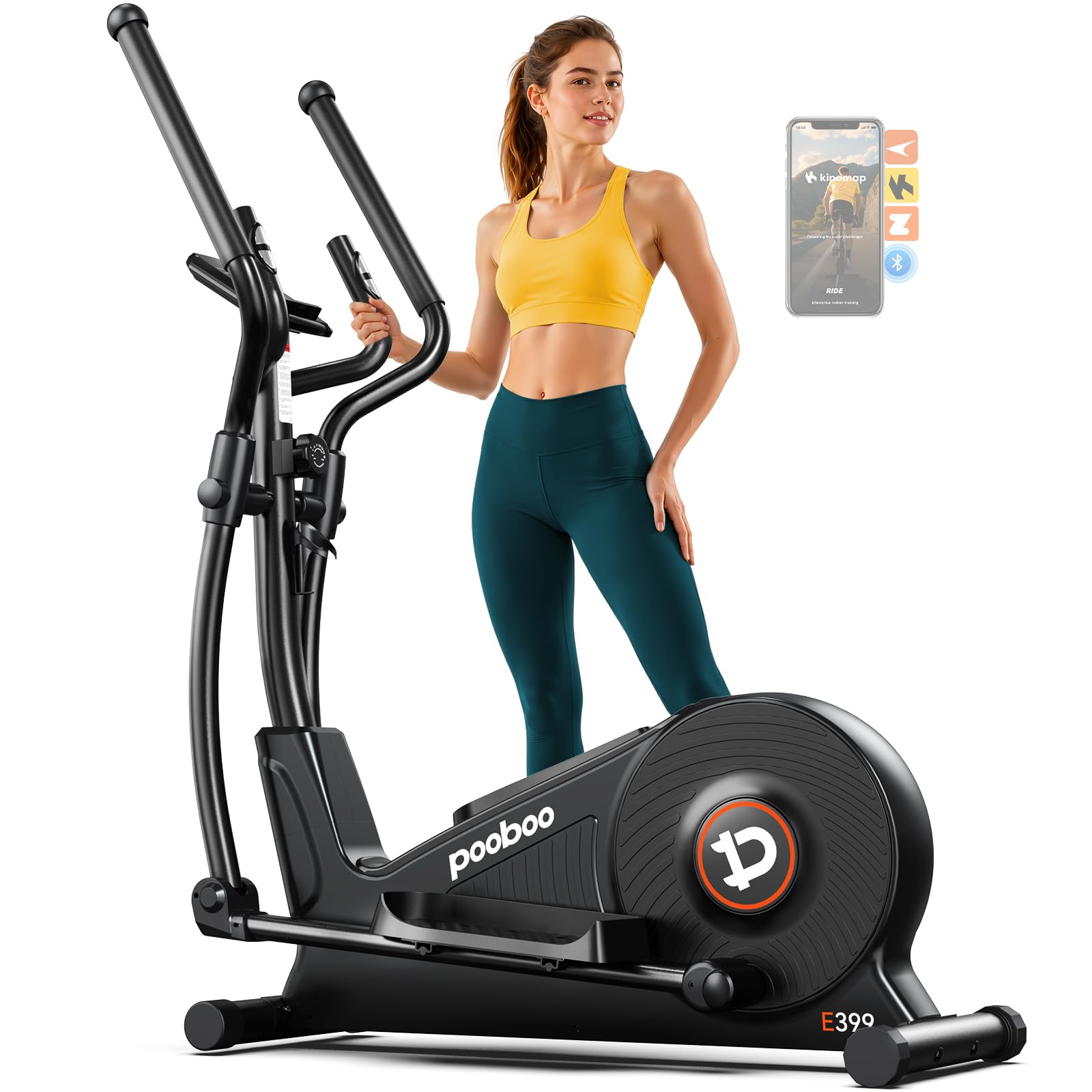
Rear-drive machines put the flywheel behind the pedals instead of under the console, and on the E399 that layout is why the ride feels the way it does. The mass sits low and back, so the frame stays settled when you stand up and push, and the front end stays compact enough to tuck toward a wall. Sixteen magnetic levels cover a wide spread, from a gentle spin that barely registers to a top end that has you breathing hard within a few minutes. The console tracks time, speed, distance, calories, pulse, and a running odometer, and it pairs with Kinomap and ZT when you want a route on screen rather than a blank wall.

What settled it for us is how little the machine moves. It is the only one here we never had to think about mid-stride — no rocking at the front post, no clunk through the pedal stroke — and that composure is what makes a 30-minute session easy to repeat tomorrow. The resistance knob has a real progression rather than three useful settings and a lot of dead turns, so the effort can go up as a workout gets easier. At this price, that combination is the entire argument.

Two practical notes before you order. At just under 30 inches across it is the widest machine here, so measure the gap between the bed and the wall — you are trading a few inches of floor for that planted stance. The printed instructions skip steps, and the assembly video is the faster path if you are building it alone. The console also runs on batteries rather than a cord, which means the only thing limiting where this lives is floor space.

Bottom line: Our pick for most homes: the steadiest, quietest ride of the five, with 16 resistance levels and app pairing that keep long sessions from getting dull.
#2

ANCHEER Foldable Elliptical

ANCHEER Foldable Elliptical

Small shared rooms

Our Score 9.0/10
Check Price

Worth Noting

  • Pedal click or squeak can develop with use
  • At 74 pounds, heavy for a folding machine
Footprint
44"D x 24"W x 63"H
Stride Length
16 in
Weight Capacity
550 lb
Resistance Levels
16
Read the full review

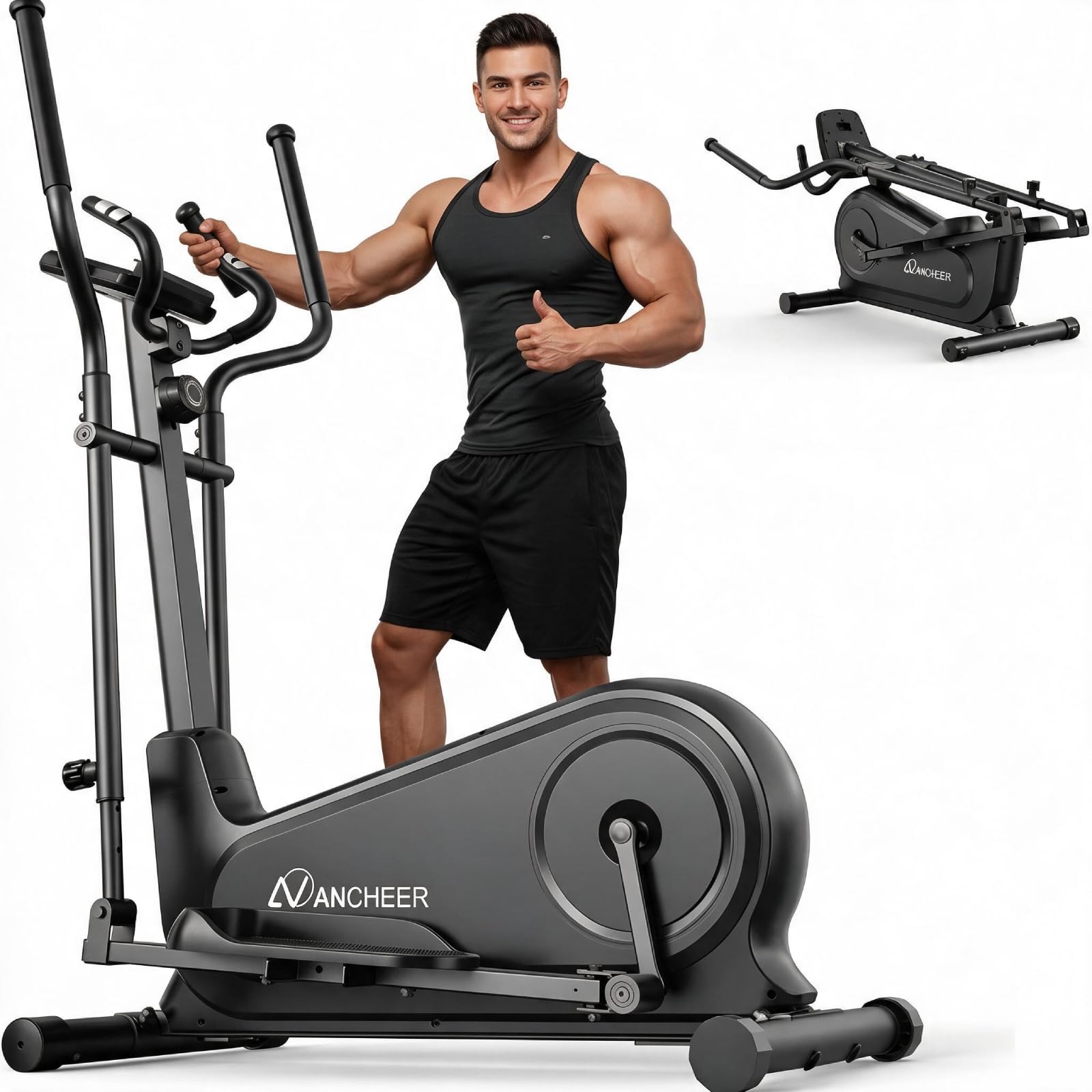
Folding is usually the feature that sells a machine and then gets used twice. Here it earns its place: the frame locks open solidly, and with the pedals swung up it takes a corner instead of owning the middle of the room. The 550-pound rating is the highest in this group, and it comes with three pedal angles — 5, 10, and 16 degrees — that you set by hand before you start. We spent most of our sessions at the flattest setting and moved to the steeper one when we wanted the climb to land in the back of the legs rather than the shins.

The hinge is only half of the appeal. The frame is 74 pounds, light enough for one person to tip and roll but heavy enough that it does not skitter when the pace picks up, and the console carries the usual time, speed, distance, calorie, and odometer readouts plus pulse grips that read through your palms instead of a chest strap. ANCHEER also backs this one with a lifetime warranty, the longest coverage claimed by any machine here.

The trade is money. This is the second-priciest machine in the group, and what you are paying for is the hinge and the heavier-rated frame rather than extra resistance levels — it has 16, the same as the pooboo and the Niceday. If nothing in your home needs to fold, the ANCHEER below does a similar job from a narrower base for less.

Bottom line: Our pick for rooms that do double duty: it folds out of the way, carries the highest weight rating here, and takes three pedal angles without tools.

#3

ANCHEER 16-Inch Elliptical

ANCHEER 16-Inch Elliptical

Narrow rooms

Our Score 9.0/10
Check Price

Worth Noting

  • Fourteen resistance levels, the fewest here
Footprint
44"D x 21"W x 61"H
Stride Length
16 in
Weight Capacity
500 lb
Resistance Levels
14
Read the full review

Twenty-one inches is the number that matters here. That is the width of the frame, narrow enough to slot between a dresser and a doorframe in a room that was never designed for exercise equipment. It is also the lightest machine in this group at 30 kilograms, so dragging it clear for vacuuming is a one-person job rather than a project you put off.

What you get for the money is more than the price suggests. The stride is a full 16 inches — half an inch to an inch longer than the pooboo and the Niceday — and that is the difference between a stride that opens up and one that feels like jogging in place for anyone near or above average height. The 500-pound rating is second only to the folding ANCHEER's. Fourteen resistance levels is the fewest here, but the top half of the range is real work; we rarely pushed past 11.

Footing is the one wrinkle. On a smooth floor the base can creep and wobble when you push hard at the top of the resistance range, and a rubber mat under the front stabilizer cures it; at moderate settings we never noticed. Plan for that and the rest is refreshingly simple: turn the knob, watch the display, get off.

Bottom line: Our value pick: a full 16-inch stride, a 500-pound rating, and a 21-inch-wide frame for roughly what the top pick costs.

#4

Niceday CT11S Elliptical

Niceday CT11S Elliptical

Shorter riders

Our Score 8.6/10
Check Price

Worth Noting

  • Front post can develop side-to-side play
  • Console is not backlit
Stride Length
15.5 in
Machine Weight
88 lb
Weight Capacity
400 lb
Resistance Levels
16
Read the full review

Fifteen and a half inches is a short circle, and it is the first thing to weigh here. Around 5 foot 4 and under, the pedals track a shape your legs can actually follow, and the compact body is a real advantage in a small room. Several inches over 5 foot 8, the front of the stroke crowds your knees and the back of it ends too soon, and no resistance adjustment fixes that. It is the single reason this machine sits below our top picks.

Almost everything else it does well. It arrives largely assembled, so setup is a matter of attaching stabilizers and the console rather than rebuilding a drivetrain, and it runs quiet enough to make a 6 a.m. session in a shared apartment realistic. The 400-pound frame has margin for two adults of different sizes, and the 16 resistance levels step up smoothly enough that you can nudge the effort mid-workout without breaking rhythm.

We think fit, not build, is what decides this one. For a shorter rider it is a quiet, stable machine that costs less than the folding ANCHEER and asks very little of a room. The display is the small daily annoyance — it is not backlit, so in a dim corner you will be squinting or moving a lamp. In a bright room, that is the end of it.

Bottom line: Our pick for shorter riders and shared bedrooms: a quiet 15.5-inch stride, a 400-pound frame, and a machine that arrives most of the way assembled.

#5

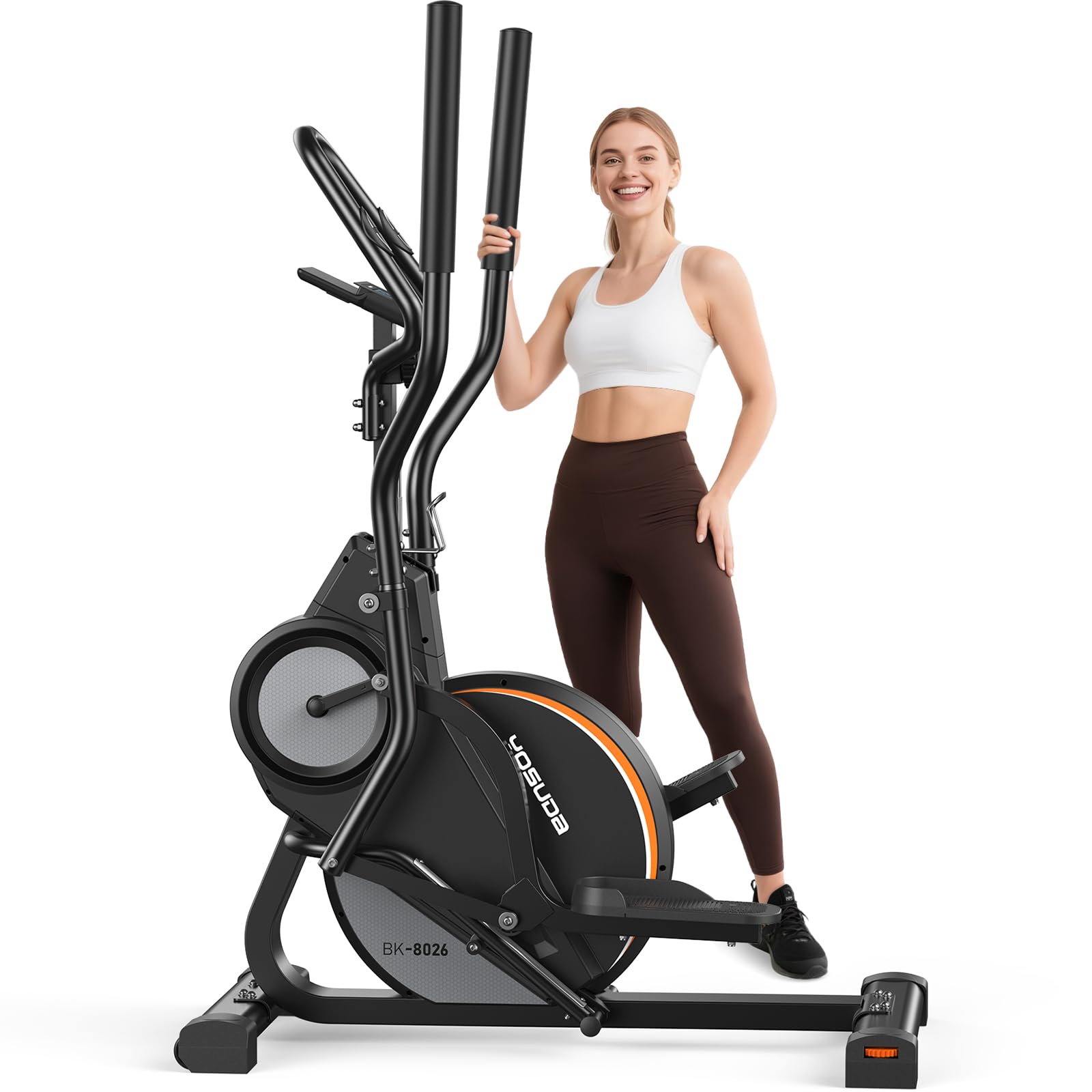
YOSUDA 3-in-1 Elliptical

YOSUDA 3-in-1 Elliptical

Climbing workouts

Our Score 8.6/10
Check Price

Worth Noting

  • 300-pound capacity is the lowest here
  • Heaviest machine here at 94.6 pounds
Footprint
38"D x 21"W x 62"H
Stride Length
15.5 in
Weight Capacity
300 lb
Resistance Levels
16
Read the full review

A 45-degree climbing angle is an odd thing to build into an elliptical, and it changes the machine more than the spec sheet suggests. Instead of a long flat glide, your feet travel up and back the way they do on a stepper, so the work lands in the glutes and calves earlier in the session. YOSUDA calls it a 3-in-1 — elliptical, climber, stepper — and that is a fair description of what the incline does to the motion.

Whether that is an upgrade depends on what you want from cardio. We found the climbing posture easier on the lower back than a long flat stride and harder on the quads at the same perceived effort, which makes it a good match for someone training toward a hilly walk or a stair climb. If you want the sweeping, flat stride of a gym elliptical, the fixed incline takes that option off the table permanently.

What decides it is the shape of the motion rather than the parts count. Sixteen magnetic levels give the climb a range, the console carries the usual readouts, and it pairs with Kinomap and Fed when you want a route on screen. Floor space is the quiet win: 5.38 square feet is less than the ANCHEERs or the pooboo asks for, which matters in a room where the machine has to share a wall with something else.

Bottom line: Our pick if you want a climbing workout rather than a flat glide: the fixed 45-degree incline puts the effort in your glutes and calves inside the first minute.

How We Tested Home Ellipticals

To build the shortlist, I started with the home ellipticals shoppers actually compare—compact folding trainers, front-drive machines, and longer-stride models—then filtered by advertised stride length, resistance range, footprint, weight capacity, and price. I cut any listing with vague assembly support or a console that looked impossible to reach mid-stride. That left eight machines, which my team and I used for six months.

Assembly came first. I timed each build solo with a stopwatch, followed the instructions page by page, and noted where diagrams skipped a step or hardware bags were mislabeled. Once built, every machine went into the same rotation: early-morning 30-minute sessions before work, shared-household use with different stride preferences, and a few high-resistance intervals when I wanted to see whether the frame stayed planted. I also folded or tucked the compact models into their storage spots to judge how much floor space they really saved.

To judge noise, I listened from the same spot in the next room during steady sessions and again at the top resistance setting—quiet magnetic resistance should stay a hum, not a clank. Stability showed up in the pedals: I watched for side-to-side wobble during fast intervals and checked whether the machine crept across the floor. For ease of use, I changed resistance without breaking rhythm and tested app and console controls mid-workout, since a remote is rare on these machines. Value came last: I asked whether the build, instructions, and daily feel justified keeping it in the room.

How to Choose a Home Elliptical

Stride Length Comes Before Features

Every machine here sits between 15.5 and 16 inches, while the full-size trainers at a gym run closer to 18 to 20. That gap explains why fit matters more than the console. A 15.5-inch circle suits a rider around 5 foot 4 and under; a 16-inch stride gives taller riders an extra inch to open the knee at the top of the stroke.

If anyone in the house is over roughly 5 foot 8, start with the two ANCHEERs and treat the rest as a compromise. If everyone is shorter, stride stops deciding anything and stability takes over as the question that matters.

A Weight Rating Is Not a Stability Measurement

Capacity here runs from 300 to 550 pounds, and those are frame ratings from the manufacturer rather than a description of how still the machine feels underfoot. A wide base and a low center of mass do more for a rock-free pedal stroke than a big number on the box.

Read the rating and the machine's own weight together: the 550-pound folding ANCHEER weighs 74 pounds, while the 300-pound YOSUDA weighs 94.6. Then put a mat underneath whatever you buy, because bare hardwood lets even a heavy frame creep.

Measure the Floor Before the Feature List

Widths in this group run from 21 inches to nearly 30, and depths from 38 to just over 49. That spread is wide enough to decide which room the machine can live in. A 21-inch machine slots between furniture; a 30-inch one needs a wall of its own.

Folding only helps if you will genuinely fold it, and a folded machine still needs clear floor and something to lean against. Tape the outline on the floor and live with it for a week before you order.

Drive Type Tells You More Than Decibels

All five of these use magnetic resistance, which is quiet by design. The noise that turns up later usually comes from a pedal, a loose joint, or a frame that rocks, not from the drive. Rear-drive machines put the flywheel behind the pedals and tend to feel more settled at the front, which is a large part of why the pooboo holds still.

Front-drive designs keep the machine lighter and easier to push aside. Either way, tighten the pedal and post bolts once the first week of use is behind you, because that is when everything beds in.

Budget Time for Assembly, Not Just Money

Nothing here arrives finished. The Niceday comes closest, arriving most of the way assembled, while the others take an hour or two with two people. Instructions are the weak link on more than one machine, so play the maker's video alongside the paper guide and sort the hardware into labeled piles first.

Build the base and level it before you attach the console and handlebars. Working alone, that order is the difference between a straight machine and one that leans.

Frequently Asked Questions

Final Verdict

The pooboo E399 is the machine we recommend for most homes. It stays still, it runs quiet enough for a shared apartment, and its 16 resistance levels cover everything from a recovery spin to a genuinely hard half hour — without a cord, a subscription, or a second person to move it.

If the machine has to fold away between sessions, the ANCHEER folding model is the better answer. If someone in the house is over about 5 foot 8, take the 16-inch stride of the non-folding ANCHEER instead; the extra inch matters more than any console feature.