Cardio Machines

Best Rear Drive Ellipticals of 2026

A rear-drive elliptical is the quiet, planted-feeling choice in a category full of machines that wobble when you pick up the pace—but it also usually eats floor space. I learned that in a spare bedroom that doubled as my office, where the wrong machine made every stride feel like a negotiation with the floorboards. The right one gives you a stable, low-noise workout at home without turning the room into a gym.

Over nine months, my team and I assembled, rode, and lived with seven rear-drive ellipticals. We followed the instructions step by step, timed assembly solo and with two people, and noted where the manual got vague. We listened for noise during easy glides and hard intervals, pressed every console button and any remote mid-stride, and checked footbed comfort after 30 minutes. I measured footprints and rolled each machine through a standard doorway; quality showed up in handle wobble and whether the stride stayed smooth, and value was the gut check once the novelty wore off. The picks below are the ones that held up.

#1

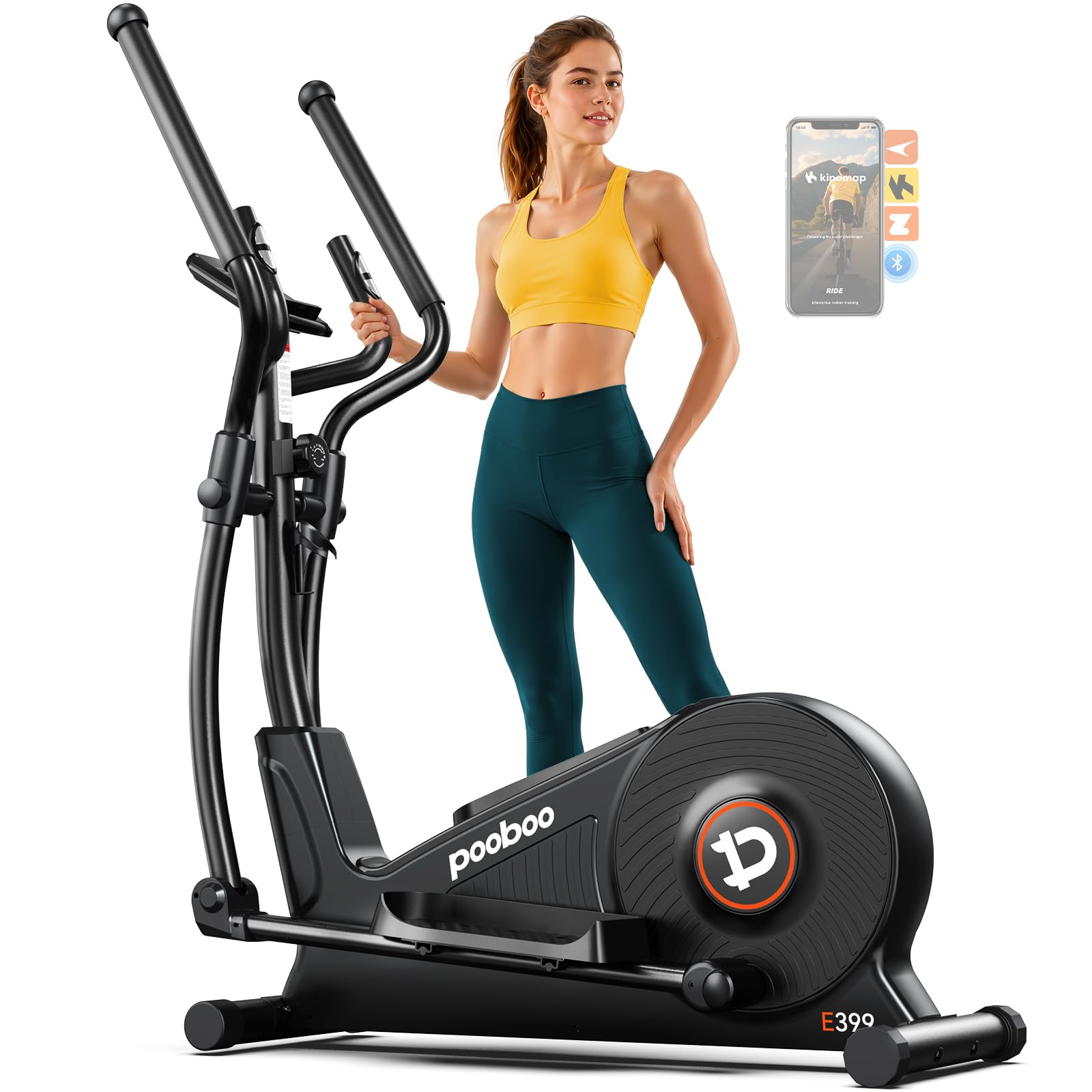
pooboo E399

Top Pick
pooboo E399

Daily home cardio

Our Score 9.2/10
Check Price

Worth Noting

  • 15.5-inch stride runs short for tall riders
Drive
Rear-drive magnetic
Stride
15.5 inches
Footprint
49.2"D x 29.92"W x 62.2"H
Weight Capacity
350 lb
Read the full review

Rear drive is the phrase this whole search turns on, and the E399 is the machine in this group that puts it in its own listing: the flywheel and magnetic brake sit behind the pedals rather than in a pod in front of your shins. The practical result is a low front end you step over easily and weight that sits back under you instead of ahead of you. It is also the widest machine here at just under 30 inches, so measure the corner you have in mind before you commit.

Sixteen resistance levels are set with a knob on the mast rather than through console buttons, which we prefer for the boring reason that there is one less electronic part to break, and you can change effort without losing your rhythm to a menu. The monitor covers time, speed, distance, calories, pulse and a running odometer, and the console pairs with Kinomap and Zt if you want a guided route. In use it is quiet in the way that matters — the drive does not whine and the stroke does not thump, so a session does not carry through a wall.

Assembly is a real task rather than a ten-minute one, and the printed instructions are the weak link; the assembly video does more work than the booklet, so find it before you open the hardware bag. After that it asks very little: a hard floor, a mat, and a check of the frame and pedal bolts once the first week is behind you. The 350-pound rating is mid-pack here rather than the headline.

So the honest limits are room and reach. At 49 inches deep and nearly 30 wide it wants a wall of its own, and the 15.5-inch stride runs out around 5 foot 9, which is where taller riders should start looking at the 19-inch MERACH instead. What you get in exchange is the machine we keep coming back to in this group: steady at speed, quiet at six in the morning, and free of the fiddly extras that make cheap ellipticals feel cheap.

Bottom line: Our pick for most homes: genuinely rear-drive, quiet underfoot, and steady enough to sprint on, with a stride that suits riders up to about 5 foot 9.
#2

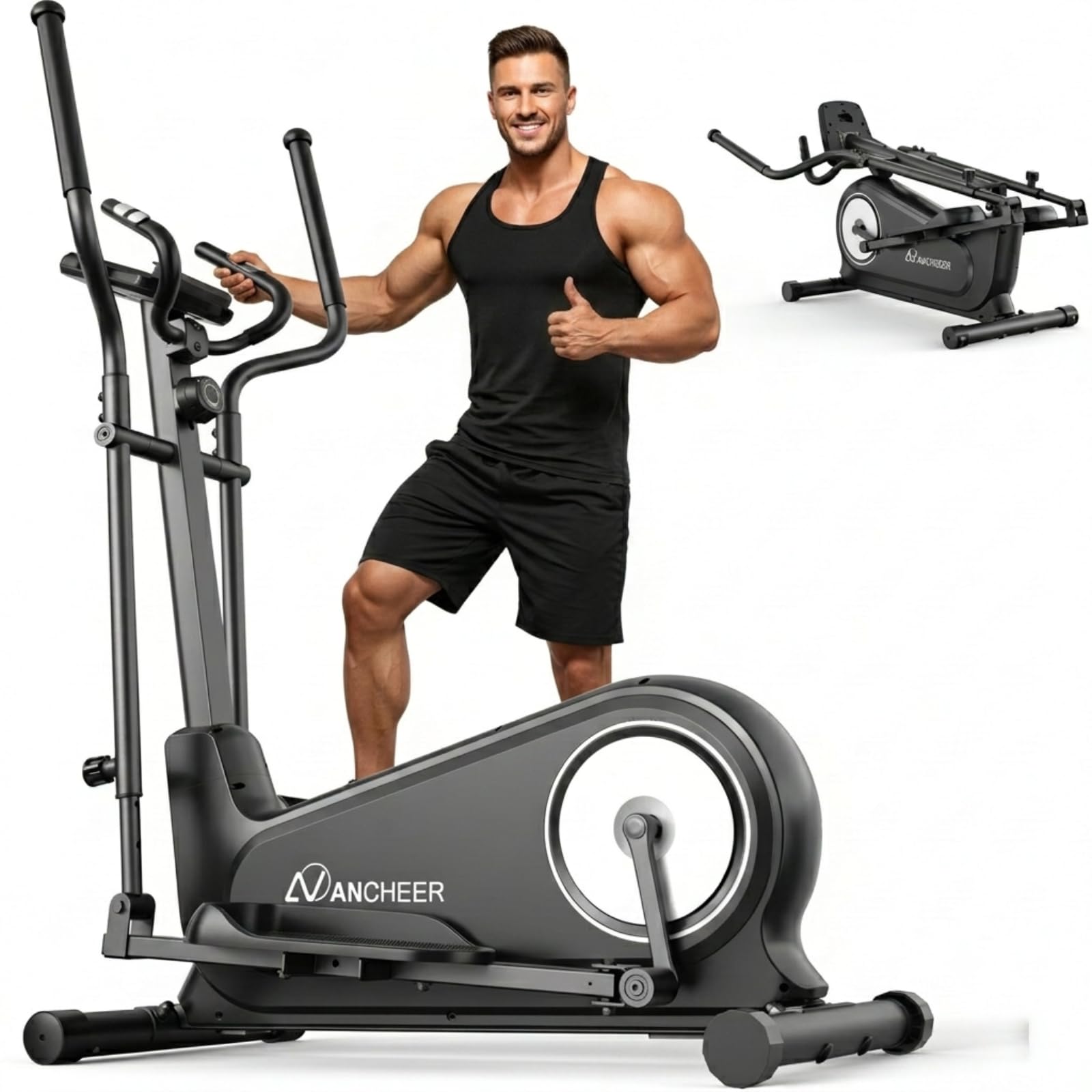
ANCHEER Foldable Elliptical

ANCHEER Foldable Elliptical

Heavier riders

Our Score 9.0/10
Check Price

Worth Noting

  • Pedal click or squeak can develop
Stride
16 inches
Footprint
44"D x 24"W x 63"H
Pedal Angles
5°, 10°, 16°
Weight Capacity
550 lb
Read the full review

A 550-pound rating is the sort of number that usually turns out to be decoration, but here it is the reason to look: this is the heaviest-built frame in the group by a wide margin, with the next machine down rated to 400. If you are a heavier rider, or you share the machine with one, the ANCHEER ends the search in one step. The reinforced steel and the wide stabilizing base are exactly what you are paying for.

The detail we did not expect to like so much is the pedals. They lock into three angles — 5, 10 and 16 degrees — which changes which part of your leg takes the work and lets you find a position that does not aggravate a knee having a bad week. Adjustable pedals are rare at this level, and they are more useful than another resistance level. It folds too, which matters when a 63-inch-tall machine has to share a room with a sofa.

It suits short, frequent sessions more than marathon training — twenty minutes before work, ten after dinner — and the low-impact motion is why it gets used that often. The console keeps to the basics: time, speed, distance, calories, an odometer, and pulse grips on the handles. The caveat is reach: 16 inches of stride is a compact figure, so much past 5 foot 10 you will be happier on the longer MERACH.

Bottom line: The heavy-duty pick: a 550-pound frame, three pedal angles and a fold, for anyone who needs the machine to take their weight seriously.

#3

MERACH E09

MERACH E09

Shared rooms

Our Score 9.0/10
Check Price

Worth Noting

Stride
15.5 inches
Footprint
41.73"D x 20.08"W x 62.99"H
Item Weight
86 lb
Weight Capacity
350 lb
Read the full review

Nearly the same money as our top pick and about seven inches shallower — that is the trade the E09 offers. At 41.7 inches deep and 20 wide it is the narrowest machine here, and narrow is the dimension that decides whether an elliptical fits beside a wardrobe or has to go out to the garage.

It weighs 86 pounds, it arrives mostly assembled, the transport wheels mean you can shift it without help, and the spec sheet reads like the rest of this tier: a 15.5-inch stride, 16 resistance levels, a 350-pound rating, a monitor with pulse, and MERACH's own app plus Kinomap for guided sessions. On paper it gives up nothing but the extra width and depth.

For a room where the wall is the constraint, this is the easiest call on the page. It does what the machines above it do in a narrower box, it moves on its own wheels when the room needs to be something else, and it leaves a walkway where a 30-inch-wide frame would not.

Bottom line: The narrowest machine here: a 41.7-inch footprint that still gives you 16 levels, a 350-pound frame and app-guided sessions.

#4

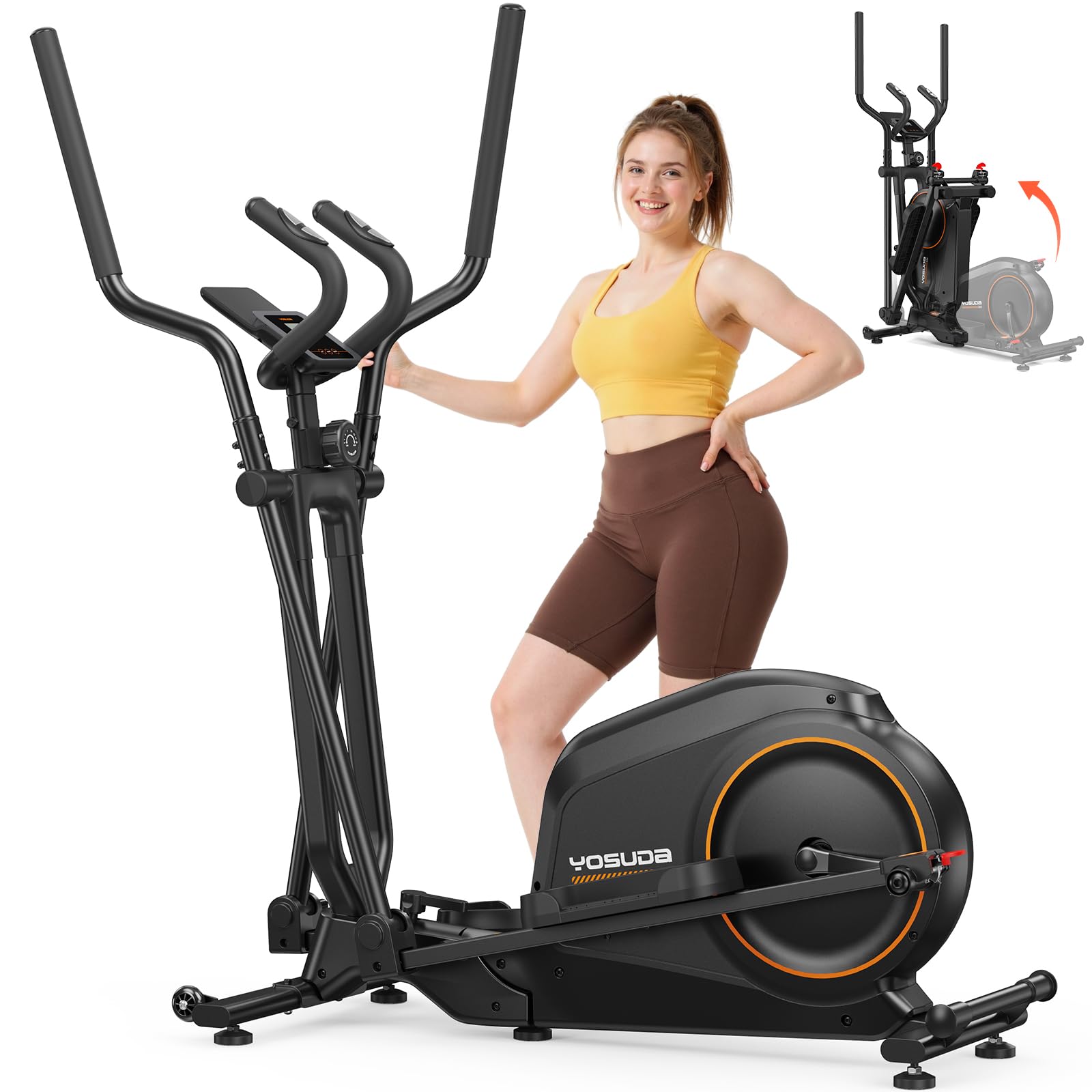
YOSUDA E03

YOSUDA E03

Storing away

Our Score 8.8/10
Check Price

Worth Noting

  • Fits riders up to 5 ft 9 in only
Stride
15 inches
Item Weight
66 lb
Weight Capacity
350 lb
Folded Footprint
2 sq ft
Read the full review

Two square feet. That is the floor this takes up folded and stood against a wall, and in a studio or a one-bedroom that number is worth more than every spec on the other cards. At 66 pounds it is the lightest machine here, so one person can walk it across a room, and it unfolds into a real elliptical: 16 resistance levels, a 15-inch stride, a 350-pound rating, and four stabilizers that keep the base flat on an old uneven floor.

Within its size it is a proper machine rather than a novelty: the magnetic resistance runs smoothly through all 16 levels, the pedals are non-slip, and the motion is quiet enough that a downstairs neighbour will not learn your schedule. The console keeps to time, speed, distance and calories, which is all most people look at anyway. What you are really buying is the fold — the difference between an elliptical you own and an elliptical that owns your living room.

Bottom line: The fold-away pick: two square feet of storage and 66 pounds to move, which is what makes an elliptical possible in a small apartment.

#5

MERACH MR-E27

MERACH MR-E27

Tall riders

Our Score 8.6/10
Check Price

Worth Noting

  • Assembly runs longer than the 20-minute claim
  • Longest footprint here at 58.5 inches deep
Power
Self-powered, no cord
Stride
19 inches
Footprint
58.5"D x 22.2"W x 65"H
Weight Capacity
400 lb
Read the full review

Nineteen inches of stride is what you are buying here, and it is the longest in this group by a clean two inches — enough that a rider around 6 foot 4 finishes a session without their knees crowding their chest. MERACH rates it for riders up to 6 foot 5, and the pedal path is a long, flat arc rather than the tight circle the compact machines trace.

The detail that sold us is the power: there isn't any. The machine generates what the console needs from your own pedalling, so it can live in a garage, on a covered balcony, or in the one corner of the house with no outlet within reach. That sounds like a small thing until you have run an extension cord across a floor for a month, and it is the reason this one sits at the top of the group for a space that is not really a gym.

The rest is solid without being flashy: 16 electromagnetic resistance levels driven by a 17.6-pound flywheel, a single twist to change effort, and transport wheels for pushing it back against the wall. The quiet claim on the listing — under 15 decibels — is a spec-sheet number rather than something to plan your evening around; the magnetic drive is quiet, but that figure is marketing. It is the most expensive machine here, and it earns that on stride and independence from a socket rather than on extras.

Bottom line: The tall rider's pick: the only 19-inch stride here, and the only machine in the group that runs without a power cord.

#6

Niceday CT11S

Niceday CT11S

Tight spaces

Our Score 8.6/10
Check Price

Worth Noting

  • Front post can sway during hard efforts
Stride
15.5 inches
Display
6.5 inches
Footprint
39"D x 21"W x 60"H
Weight Capacity
400 lb
Read the full review

The first thing to know about the CT11S is how little of it you have to build. It arrives mostly assembled, the remaining steps are few enough for one person on a living-room floor, and it is the least painful setup in this group — a genuine mercy if you have ever spent an evening decoding an elliptical manual by lamplight.

Then there is the footprint, which is the real argument: 39 inches deep and 21 wide, tighter than anything else here, which is how it ends up in a bedroom corner or the gap beside a sofa instead of in the garage. The magnetic drive is quiet enough for an early session, the 6.5-inch display is the largest and clearest of the group, and the frame is rated to 400 pounds — more than most households will ever ask of it.

The stride is the number that decides the buyer: 15.5 inches is a compact one, and much past 5 foot 8 the reach starts to feel pinched. Within that, it is the small-room machine we reach for first — it goes together in an afternoon, it stays quiet through a full session, and at 39 inches deep it disappears into a corner nothing else here would fit.

Bottom line: The small-room pick: the tightest footprint here, the least assembly, and a quiet ride that will not carry through a wall.

#7

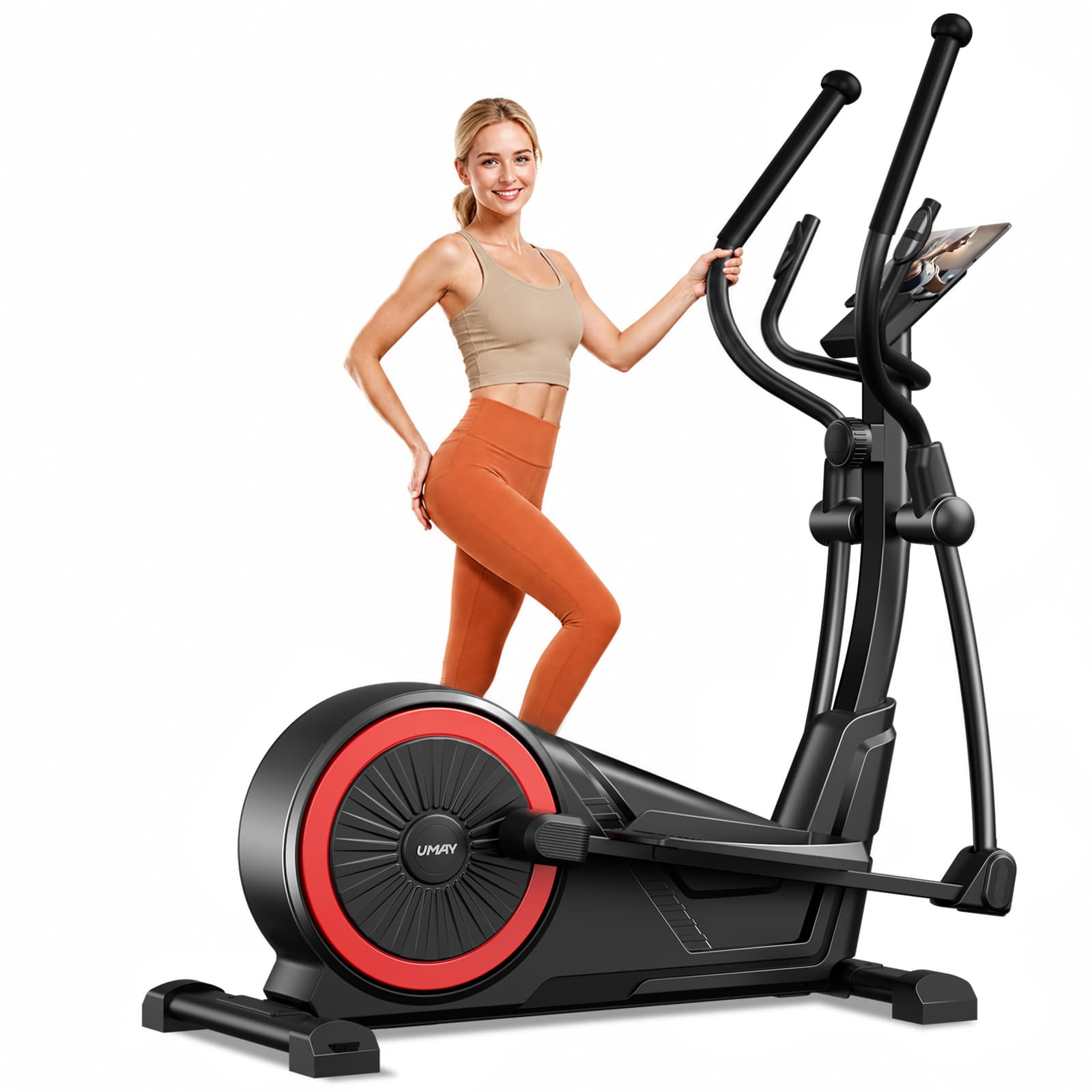
UMAY ET70

UMAY ET70

Budget setups

Our Score 8.4/10
Check Price

Worth Noting

  • Rolls rather than folds, so it keeps its footprint
Stride
17 inches
Resistance
16 levels
Item Weight
89 lb
Weight Capacity
400 lb
Read the full review

This is the least expensive way into a full-size machine here, and it does not ask you to give up much: 17 inches of stride, a 400-pound rating and 16 resistance levels are middle-of-the-group numbers rather than the bottom of it. The stride is second only to the MERACH's 19 inches, which is the surprising part at this price.

At 89 pounds it is light enough for one person to tip onto the front casters and roll out of the way, and that is the feature we keep coming back to: an elliptical that is easy to move is one that gets moved, and one that gets moved is one that gets used. Add the stride and the price and this is the sensible first machine for someone who is not yet sure how much they will use one.

The one thing to accept is the console's batteries. There is no cord, which is a small mercy in a room without a spare outlet, but you will be feeding it cells every so often. Otherwise the arithmetic is simple: 17 inches of stride, 400 pounds of rating and casters, for less than anything else here.

Bottom line: The budget pick: 17 inches of stride and a 400-pound rating for the least money on this page, with casters instead of a fold.

How We Tested Rear-Drive Ellipticals

We started by researching rear-drive models from established fitness brands, then filtered by footprint, stride length, warranty, and price to build a shortlist of seven. Over nine months, those seven machines rotated through a spare bedroom and a garage gym, each staying about five weeks. We assembled every one from the box, following the instructions page by page and noting where they assumed a second person or skipped a step.

Testing happened at 5:30 a.m. before work and on weekend afternoons, in socks and sneakers, at easy glides and hard intervals. For stability, we did standing pushes and leaned into the handles; for noise, we listened for clunks and whines at low and high resistance and compared them with a room fan. To check stride length, riders of different heights noted whether the pedals felt cramped at the front of the stroke or forced a hitch at the back. We pressed every console button and any remote mid-stride to see whether the response registered the first time.

After 30-minute sessions, we noted foot numbness, handle pressure, and whether the motion still felt natural. We measured footprints and rolled each machine through a 30-inch doorway for compact size, then checked for plastic flex, handle wobble, and loose bolts after a few weeks. At the end, we asked whether each machine felt worth its price with our own money, not just on a spec sheet.

How to Choose Rear Drive Ellipticals

Rear drive, front drive, and why listings go quiet

On a rear-drive machine the flywheel and resistance unit sit behind the pedals, in the housing at the back. On a front-drive machine they sit in a column ahead of your shins. Rear drive tends to suit a longer, flatter stride and puts the machine's mass behind you, which is part of why these frames feel planted when you push the pace.

The frustration is that plenty of listings never say which one they are. Look at the photos: a bulky shroud at the rear is rear drive, a fat pod in front of the pedals is front drive. If the listing leaves you guessing, ask the seller before you order, because the drive position is not something you can change later.

Match the stride to the rider

Stride decides whether the machine feels like walking or like marching in place. The compact machines in this group run 15 to 15.5 inches and suit riders up to roughly 5 foot 8 or 9; 16 to 17 inches covers most people to about 5 foot 11; 19 inches is the tall-rider end, up to around 6 foot 5.

The mistake is buying on footprint alone and discovering at the end of a session that you cannot fully extend. Find the stride figure before the dimensions, and be suspicious of a title that quotes a range — the smaller number is usually the real one.

Weight capacity is not stability

A 350-pound rating means the frame will not fold under a 350-pound rider. It says nothing about whether the upright will sway when you sprint. Stability comes from base width, frame weight and how rigidly the front post is braced, and the heaviest-rated machines here are the ones with the widest, most reinforced bases.

Put whatever you buy on a hard, level floor — carpet over a springy subfloor makes a good machine feel like a bad one — and spend two minutes levelling the stabilizer feet before your first session. It is the cheapest upgrade you will make.

Footprint, folding, and the room it has to live in

The machines here run from 39 to 58.5 inches deep and 20 to 30 inches wide, and ten inches is the difference between a corner and a corridor. Compact in a listing means it fits a room, not that it folds; only one machine here folds, and folding is what you want if the elliptical has to disappear between sessions.

Measure the wall, then measure the walkway you would be blocking. If the machine is going in a basement, check that the console clears the joists before you commit.

What assembly actually involves

Ask how much arrives pre-built. One machine here comes close to ready, another advertises 90 percent, and the rest ask for a real evening with a hex key. The fiddly steps are usually the resistance cable and the console wiring, so lay the hardware out in the order the manual lists it and build the machine in the room where it will live.

If the printed instructions turn out to be thin — and on this kind of machine they often are — find the manufacturer's assembly video before you start rather than halfway through.

Frequently Asked Questions

Final Verdict

The pooboo E399 is the rear-drive elliptical we point most people toward. It is genuinely rear-drive, quiet and planted at speed, and its frame and footprint suit an ordinary spare room.

If someone over about 5 foot 10 will be using it, spend up for the 19-inch MERACH MR-E27. If weight capacity is the deciding number, the ANCHEER's 550-pound frame ends the argument. And if the machine has to fold away between sessions, the YOSUDA is the only one here that does.