Cardio Machines

Best Air Rowing Machines of 2026

Air rowers make a promise the rest of the home gym can't: the harder you pull, the harder the machine pulls back. That's the appeal — and the catch, since the fan is loud enough that anyone in the next room knows exactly when you're sprinting. I've made my peace with the noise. What I won't tolerate is a seat that flattens by month two or a monitor that drops its Bluetooth pairing halfway through a session.

Over the past six months, my team and I have rowed on eight different air rowing machines, from bare-bones single-fan models to dual air-and-magnetic rigs with backlit monitors and app support. Where these machines separate is the seat, the rail, and the electronics — a long aluminum rail and a seat that still rolls smoothly at minute 30 matter far more than any number on the box. Assembly counts too: most of these arrive in a box the size of a couch and eat an evening with an Allen wrench.

The eight below are the ones that held up to all of it. Which one fits you depends on how hard you plan to go and how much noise the rest of your household will forgive.

#1

Concept2 RowErg

Top Pick
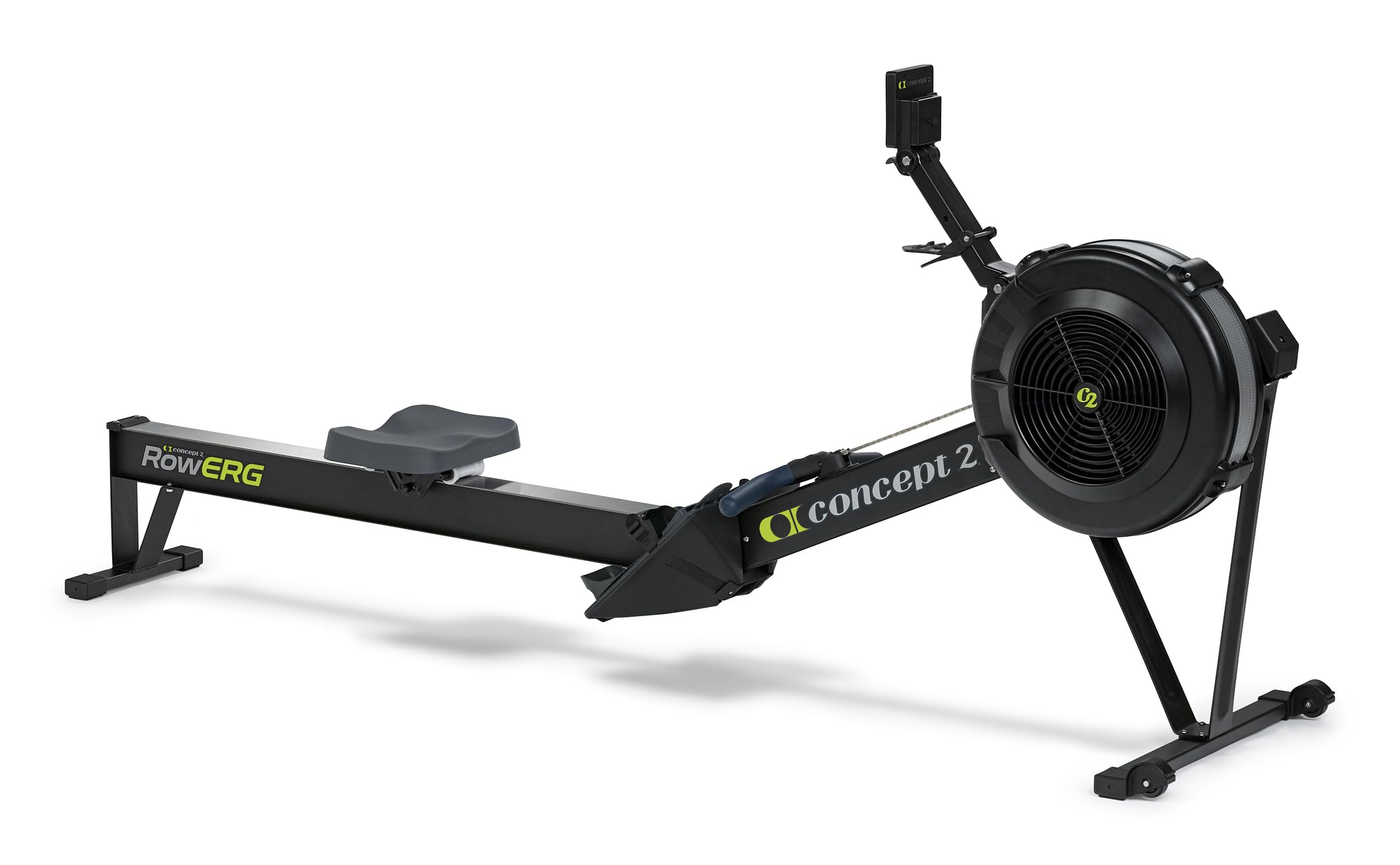
Concept2 RowErg

All-around training

Our Score 9.8/10
Check Price

Worth Noting

  • Premium price versus the rest
Monitor
PM5 with Bluetooth and ANT+
Storage
Separates into two pieces
Resistance
Air
Item Weight
57.3 lb
Read the full review

The PM5 is what makes the RowErg the default here: it shows pace, watts, and calories, and it pairs over Bluetooth and ANT+ with heart-rate straps and a long list of training apps. We like that the numbers stay consistent enough to compare one session with the next; that is the difference between training and just pulling. The device holder keeps a phone or tablet in view without blocking the screen.

The air flywheel is the other reason. Resistance rises with how hard you pull, and the damper lets you set the feel before you start. We prefer that to a knob that promises ten separate levels but still feels mushy at the top. The fan is audible when you sprint; that is the honest trade for the air-rower feel, and at steady pace it is quiet enough for a shared room.

The frame is easy to live with. It separates into two pieces, rolls on caster wheels, and the 14-inch seat height makes getting on and off less of a production than low-slung rowers. Assembly is a short job with the supplied tools. We do notice the long footprint when it is set up, so measure the floor before you commit; the storage trick only pays off if you actually split it.

Bottom line: For the most trustworthy data and the easiest two-piece storage in a home air rower, the Concept2 RowErg is our top pick.
#2

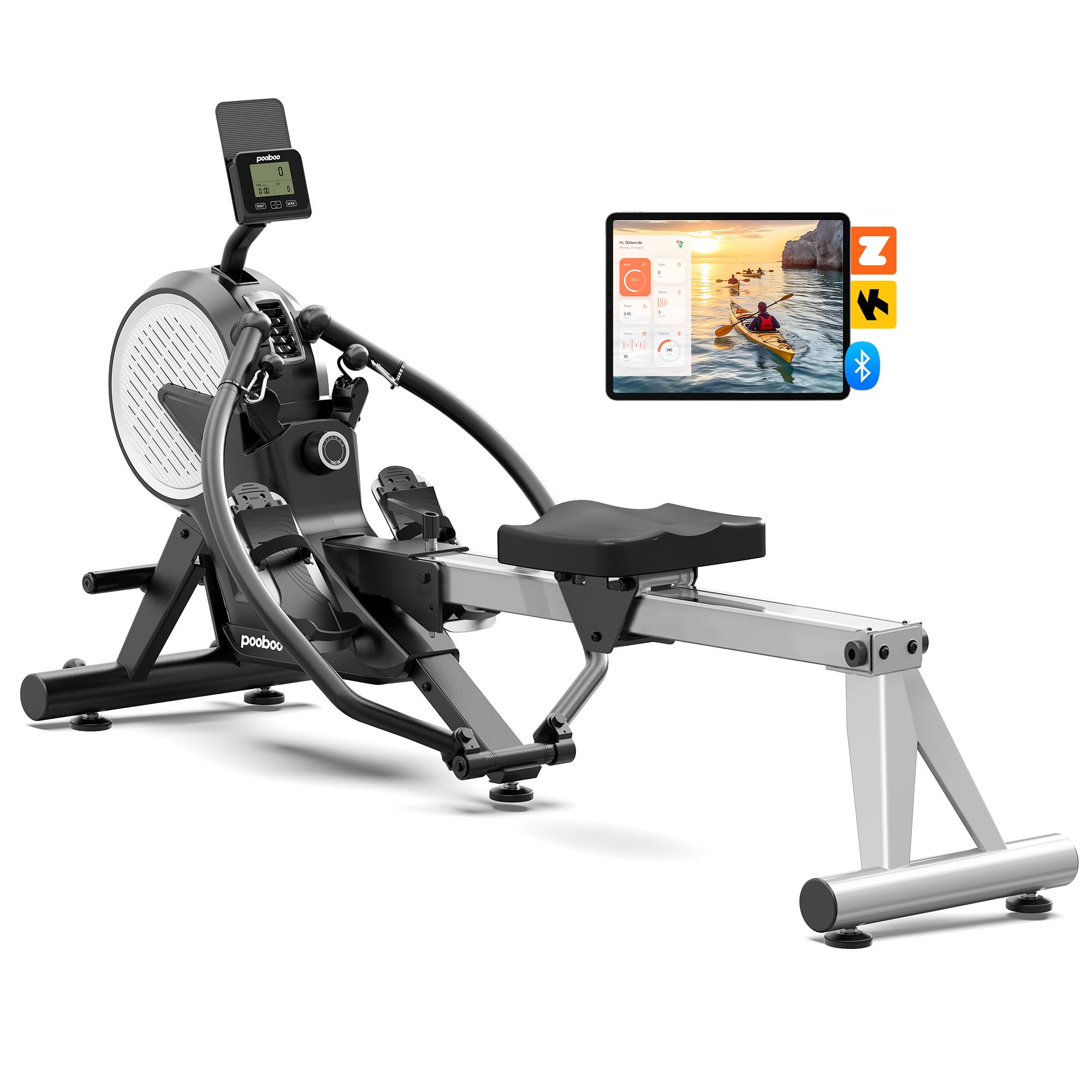
pooboo Dual Scull

pooboo Dual Scull

Small shared spaces

Our Score 9.6/10
Check Price

Worth Noting

  • Wide 33-inch stance needs floor space
Resistance
Wind and magnetic
Item Weight
132 lb
Max User Weight
400 lb
Resistance Levels
16 (8 wind + 8 magnetic)
Read the full review

Eight wind levels and eight magnetic levels give the pooboo a more useful resistance range than a single fan on a dial. You can row with the air feel at lower settings, then add magnetic drag when you want a slower, heavier stroke. That flexibility is the reason it earns a spot, even though it is not the simplest machine here.

What we noticed first is how planted it feels for a folding rower. At 132 pounds, it is heavy enough that you will not want to carry it up stairs, but that mass is what keeps the frame from walking across the floor when you row hard. The folded position is genuinely useful in a small room, and the 400-pound capacity covers most households. The seat is comfortable for longer rows, too.

The 360-degree handlebar gives your arms a freer path than a fixed handle, and the app and LCD cover the basics without getting in the way. The hardware is the reason to choose this one, not the app.

Bottom line: The pooboo is a quiet, stable hybrid for small spaces, with folding storage and a resistance range that suits steady work and moderate intervals.

#3

Merach R60N

Merach R60N

High-resistance intervals

Our Score 9.2/10
Check Price

Worth Noting

  • Resistance feels light at low stroke rates
Storage
Two-piece vertical
Resistance
Air and magnetic
Rail Length
53 inches
Max User Weight
500 lb
Read the full review

At level eight, the R60N stops being a pure air rower and brings in magnetic resistance for short, hard efforts. The first seven steps feel like a normal fan rower; the top three add magnetic drag for weight-training-style intervals. That handoff is the reason to choose it over the R50, and it is also where the machine asks you to be honest about how you train. If most of your sessions are steady half-hour rows, you are paying for a top end you may not use.

We found the split works for HIIT because the magnetic top end adds load without changing the rowing motion. The 53-inch rail and 500-pound capacity make it feel like a full-size machine, and the two-piece frame rolls away vertically. It is not a featherweight, though; moving it into storage takes more effort than the Concept2.

The weak spot is the monitor. It is hard to read in low light, and the screen takes a back seat to the training apps. The magnetic top end is the reason to put up with it; the screen is the part we notice most, and not in a good way.

Bottom line: The R60N is the pick for rowers who want an air feel for steady work and a magnetic boost when intervals get serious.

#4

Merach R50 Pro

Merach R50 Pro

Quiet daily rowing

Our Score 9.0/10
Check Price

Worth Noting

  • No magnetic resistance boost
Fan
32 blades
Resistance
10-level air
Rail Length
53 inches
Max User Weight
500 lb
Read the full review

A 32-blade fan and a backlit screen are the two reasons to look at the R50 before the rest of the Merach lineup. The fan is tuned to keep the air sound lower, and the monitor offers more than 20 training modes without demanding that you open an app first. We appreciate that combination: a machine that is easy to read in dim light and does not make a production out of starting a session.

The air resistance runs through 10 levels, so you can set a feel and let stroke speed do the rest. The 53-inch aluminum rail and 500-pound capacity give taller or heavier rowers room, and the frame separates into two sections for vertical storage with caster wheels. We also like the contoured seat for longer sessions; it is shaped to take pressure off the tailbone and thighs, which matters more than a thick pad after 30 minutes.

The fan is not silent, but the tone is smoother than the choppy rush of a basic fan rower; at steady pace it fades into the background. The 90-percent pre-assembled frame goes together quickly, and the caster wheels make the split sections easier to park. The 53-inch rail is the detail tall rowers notice first.

Bottom line: Choose the R50 if you want a full-size air rower with a backlit monitor and a fan tuned for calmer rooms.

#5

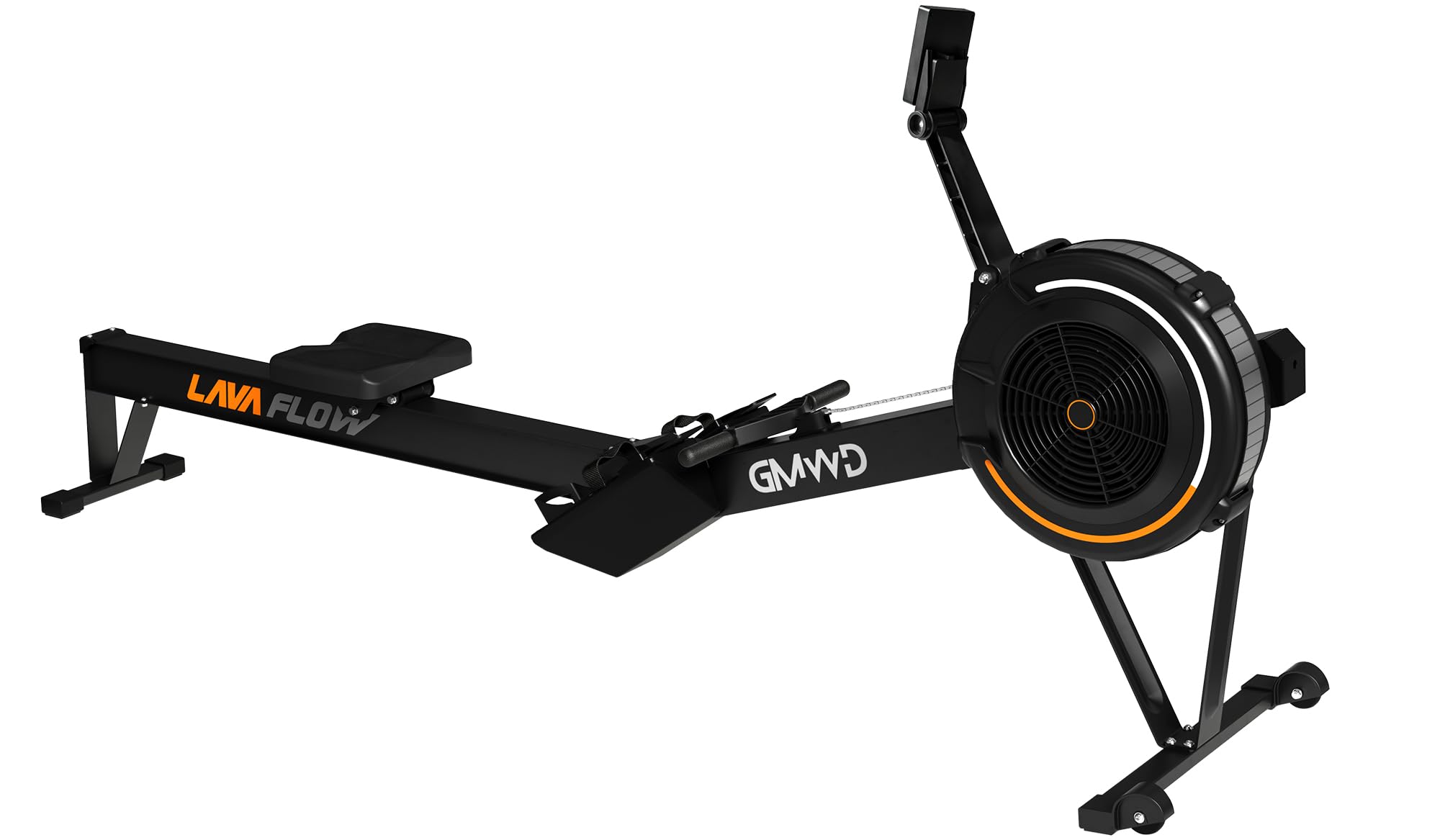
GMWD Lava Flow

GMWD Lava Flow

Taller, heavier rowers

Our Score 8.4/10
Check Price

Worth Noting

  • Distance tracking is unreliable
Resistance
Air
Rail Length
50 inches
Max User Weight
500 lb
Folded Footprint
32.7 x 28.7 inches
Read the full review

Five hundred pounds of capacity and a 50-inch rail are the GMWD's calling card. Those numbers are why the Lava Flow stays in the conversation despite a few rough edges. If you are tall or heavy enough that a compact rower feels cramped, this one gives you room from 4 feet 7 inches up to 6 feet 3 inches.

The rower folds vertically into a 32.7 by 28.7-inch footprint and rolls on casters, so it can live against a garage wall. The 10-level air resistance is responsive, with a 110-pound peak pull, and the frame feels substantial when you settle in. We were also impressed by the 90-percent pre-assembled build; the assembly is not the hurdle here. The LCD covers time, strokes, and calories and pairs with the FitShow app.

The two-piece frame joint is worth checking that it is fully seated before each row, especially if you fold and unfold often. That is a small habit, not a dealbreaker. The capacity and fold are the practical wins; the rowing feel is the reason to keep it.

Bottom line: The Lava Flow is the value pick for taller, heavier rowers who want a folding air rower and can live without precise distance data.

#6

Stamina ATS Air Rower

Stamina ATS Air Rower

Casual beginners

Our Score 8.4/10
Check Price

Worth Noting

  • Short 90-day parts warranty
Resistance
Air
Item Weight
54 lb
Item Dimensions
77"D x 18.75"W x 22"H
Max User Weight
250 lb
Read the full review

There are no resistance levels to toggle on the ATS; the only way to make it harder is to pull faster. That keeps the machine simple: a fan, a strap, a rail, and a seat. It is either refreshing or limiting, depending on how you train. For a beginner who wants one less thing to adjust, the directness is the appeal.

We think it suits casual beginners because the motion is straightforward, the seat is wide and cushioned, and the large footplates make it easy to settle in. It also folds for storage and comes with the müüv app for guided workouts. Assembly is about as low-stakes as it gets, and the 54-pound frame is light enough to move without a second person.

Where the ATS runs out of room is at the top end. The 250-pound weight limit is the first thing to check, and the fixed fan resistance will not satisfy a strong rower who wants a heavy pull. The fan is also loud when you push it. For light, steady cardio in a simple home setup, those trade-offs are livable; the simple fan-and-strap build is the reason it is easy to live with.

Bottom line: The ATS is a sensible starter rower for light, steady cardio, as long as you fit comfortably under its 250-pound limit.

How We Chose and Tested Air Rowing Machines

We started with spec sheets for more than two dozen air rowers and cut anything that couldn't handle a 250-pound rower, tuck into a corner, or pair with an app. That left eight machines, from single-fan air rowers to dual air-and-magnetic setups, assembled one at a time in a garage and a spare bedroom and lived with for six months.

Assembly came first. I built each machine alone using only the included tools, timing the job and noting where the manual skipped a step or a bolt really needed a second set of hands. Then we rowed them early mornings before work and in longer weekend sessions, with people from 5'4" to 6'3" trading off so we could feel where a seat ran out of padding or a rail came up short. Noise went on the record too, with a decibel meter held at arm's length during a steady paddle and again during an all-out sprint.

Every machine got the same work: 500-meter sprints, 20-minute steady pieces, and intervals. We noted whether resistance built smoothly or arrived in a lurch, whether the monitor's splits and heart-rate readings agreed with a chest strap, whether a tablet stayed put in the device holder, and whether Bluetooth held through a full session with a phone and tablet paired. After each session we wiped the rail and checked the bolts and seat rollers. At the four-month mark we went back to the most-used machines to look for wobble, squeaks, and stretched cords.

Comfort settled more matchups than specs did, so we judged seats after half an hour rather than five minutes and paid attention to whether the foot straps pinched. None of that rescued a machine that felt flimsy at stroke 2,000, which is ultimately where value gets decided.

How to Choose an Air Rowing Machine

Match the Resistance to the Work

Air resistance is self-adjusting: pull harder and the fan loads up, pull easier and it backs off. That is why a pure air rower feels natural for steady cardio and why the Concept2's damper is there to change the feel rather than to act like a ten-speed bike. A dual-resistance machine such as the Merach R60N adds magnetic drag at the top end, which helps for short, hard intervals. We put more value on a resistance curve that suits your sessions than on a big level count.

Fit the Machine to the Rower

Start with the maximum user weight and rail length, not the folded footprint. A 250-pound limit is fine for one light user and a poor fit for a shared household; 500-pound ratings appear on several picks here. Rail length matters for taller rowers, and footrest adjustment matters for everyone. The GMWD rail fits users up to 6 feet 3 inches, while the 53-inch rails on the Merach models give long-legged rowers more room. Leave a little capacity margin rather than buying right at the limit.

Measure the Floor, Not Just the Fold

An air rower takes roughly eight feet of length when it is ready to row, so tape that out before you buy. Folding or splitting the frame helps only if the stored position is easy for you to reach and the machine is light enough to move. The pooboo folds compactly but weighs 132 pounds; the Concept2 splits into two pieces and rolls on casters at 57.3 pounds. If you leave it set up, prioritize the rowing footprint and the seat height over the storage trick.

Treat Noise and Data as Part of the Ride

The fan is the sound of air resistance, and it gets louder as you pull harder. A 32-blade fan such as the one on the Merach R50 is tuned for a smoother tone, while magnetic-assisted rowers can be quieter at lower efforts. For the monitor, a backlight and a clear distance readout matter more than a long list of modes. The Concept2 PM5 is the benchmark here because its data is consistent enough to compare sessions. A dim or hard-to-read screen becomes annoying fast.

Plan for Assembly and Frame Checks

Most rowers arrive partly built, and the difference between a pleasant setup and a frustrating one is often the frame joint. Check that the two sections seat fully and that any folding pin or latch is engaged before you row; a loose connection is the last thing you want under load. The Concept2 goes together with simple tools, while heavier hybrids take more lifting and may need a second person. Recheck the bolts after the first few sessions and keep the rail clean.

Frequently Asked Questions

Final Verdict

The Concept2 RowErg is the rower we recommend first. Its PM5 gives you data you can trust, the frame splits and rolls away, and the air flywheel matches resistance to effort in the way that makes rowing feel right. You pay a premium, but it is the least compromised long-term choice here.

If you want more resistance for interval work, the Merach R60N is the alternative; if you want a calmer fan and a backlit screen, the Merach R50 Pro is the daily rower. Neither has the PM5's long app list, and that is the trade.