Cardio Machines

Best Magnetic Rowing Machines of 2026

A rowing machine has to earn its floor space. It should be quiet enough for a 5:30 a.m. session, smooth enough that you want to finish the interval, and easy enough to assemble without losing a Saturday. After eight months with seven magnetic rowers, I can tell you the differences are not cosmetic: the good ones make the stroke feel fluid, and the bad ones make you dread the next pull. What a magnetic rower fixes is the friction around exercise — the noise, the clunky resistance, the wobble, the setup headache — so all you have left to do is row.

Magnetic resistance has its own personality: quieter and more adjustable than air or water, but artificial if the flywheel and belt aren't matched well. That feel is what we chased. We assembled all seven in a living room, rowed through early mornings and after-work sessions, and noted what only shows up after a few weeks — a seat that rocks, a monitor that lags, a frame that creeps. The picks below are the ones that still felt solid at the end.

#1

pooboo H015

Top Pick
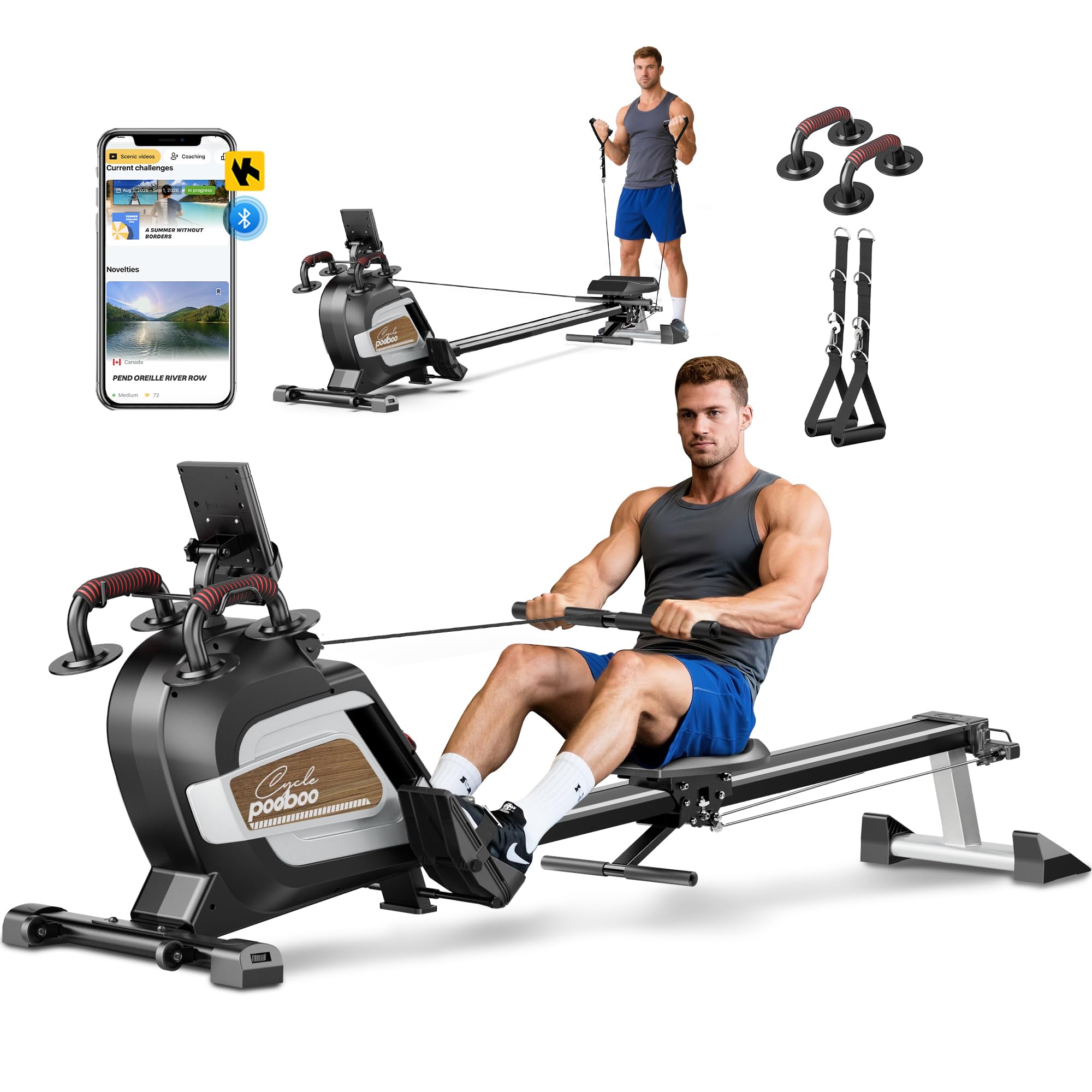
pooboo H015

Strength plus cardio

Our Score 9.6/10
Check Price

Worth Noting

  • 83-inch frame needs a dedicated stretch of wall
Item Weight
60 lb
Max User Weight
350 lb
Resistance Levels
14
Assembled Dimensions
83"D x 21.2"W x 31.8"H
Read the full review

Three exercises in one is the pitch: rowing, resistance bands, and a pair of handles for push-ups, all off a single frame. In practice the rower is the main event and the bands are the bonus — but a useful bonus, because they turn a 20-minute row into a 25-minute session without adding a second machine to the room.

The frame is the longest here at 83 inches and 60 pounds, so this is a machine you commit floor to rather than move around. The 350-pound capacity and 14 resistance levels cover the basics, the fold is a real one that comes up on transport wheels, and the motion is smooth and quiet — the seat and the handles both travel freely through the stroke.

What we can't tell you is how it holds up in year three. The build feels substantial and the fittings look tidy, but the parts that wear on any rower are the cable and the seat rollers, and those are the pieces to keep an eye on. Assembly is straightforward and the tools come in the box.

For a household that wants one machine for cardio and light strength work, this earns its place. It's a quiet, comfortable, well-finished rower that happens to come with extra handles — and if you only want to row, buy something shorter and keep the floor.

Bottom line: We recommend it for a household that wants one machine for rowing and light strength work, provided there's a long wall to spare.
#2

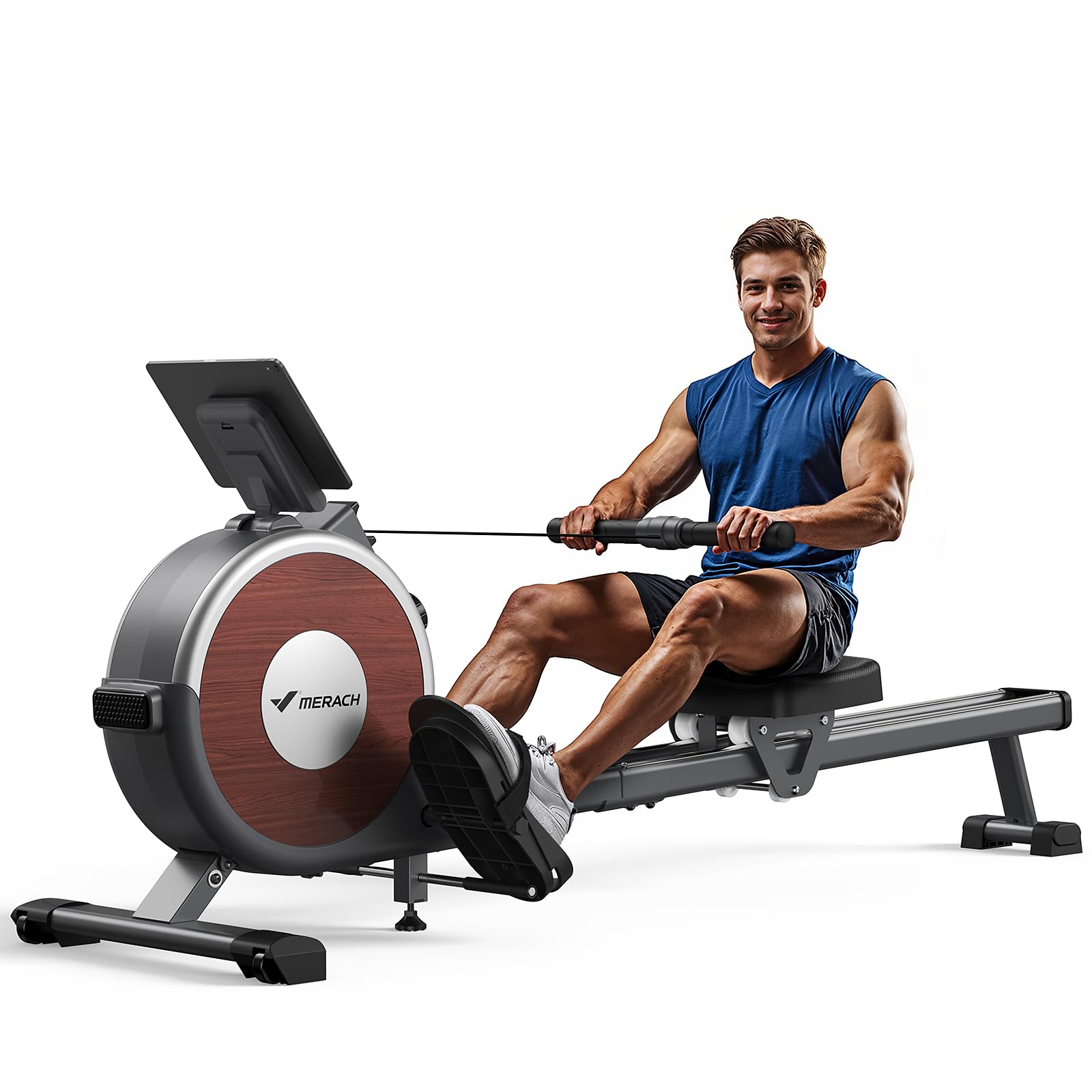
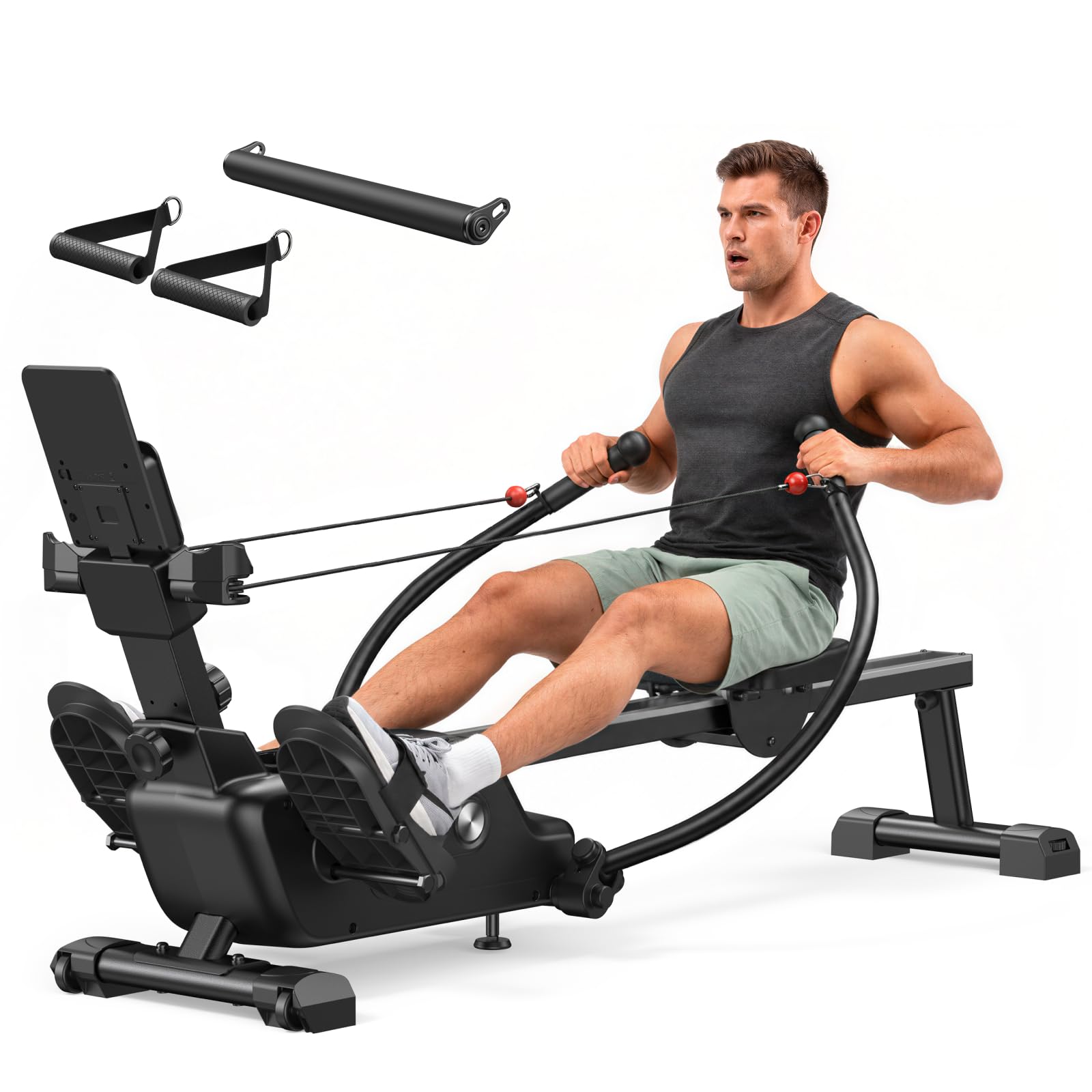
Merach RS3

Merach RS3

Stronger rowers

Our Score 9.4/10
Check Price

Worth Noting

  • LCD washes out in low light
  • Priciest machine in this group
Item Weight
58 lb
Max Resistance
88 lb
Resistance Levels
16
Assembled Dimensions
60"D x 28.3"W x 29.5"H
Read the full review

The RS3 costs noticeably more than the Q1S and it answers the one complaint we had about it: the pull. Resistance climbs to a claimed 88 pounds, which is more than enough to make the top level uncomfortable for a full session, and the two pivoting oar handles sweep a 120-degree arc meant to mimic sculling on water. Rowing on it feels like a different category of machine.

What we noticed most, though, is what happens when you stop rowing. The oars pop off and a standard gym handle clips on, turning the frame into a compact cable station for rows, face pulls, and lat work — the answer to the problem every rower has, which is sitting unused between cardio days. That's a big part of why it carries the strongest buyer rating in this group, and the rowing is the other half: smooth, heavy, and quiet, with a wide 28.3-inch stance that keeps it planted when you pull hard.

The screen is the weak point. It's a basic LCD that washes out in a dim room, and you'll want a lamp nearby or the app on a phone instead. It's also the priciest machine here, which is the honest trade for a rower that doubles as your strength setup. If you train rather than just exercise, the extra money buys a machine you'll use on the days you don't feel like rowing.

Bottom line: This is the rower we point to when you want the machine to fight back — the heaviest pull here, plus handles that swap out for strength work.

#3

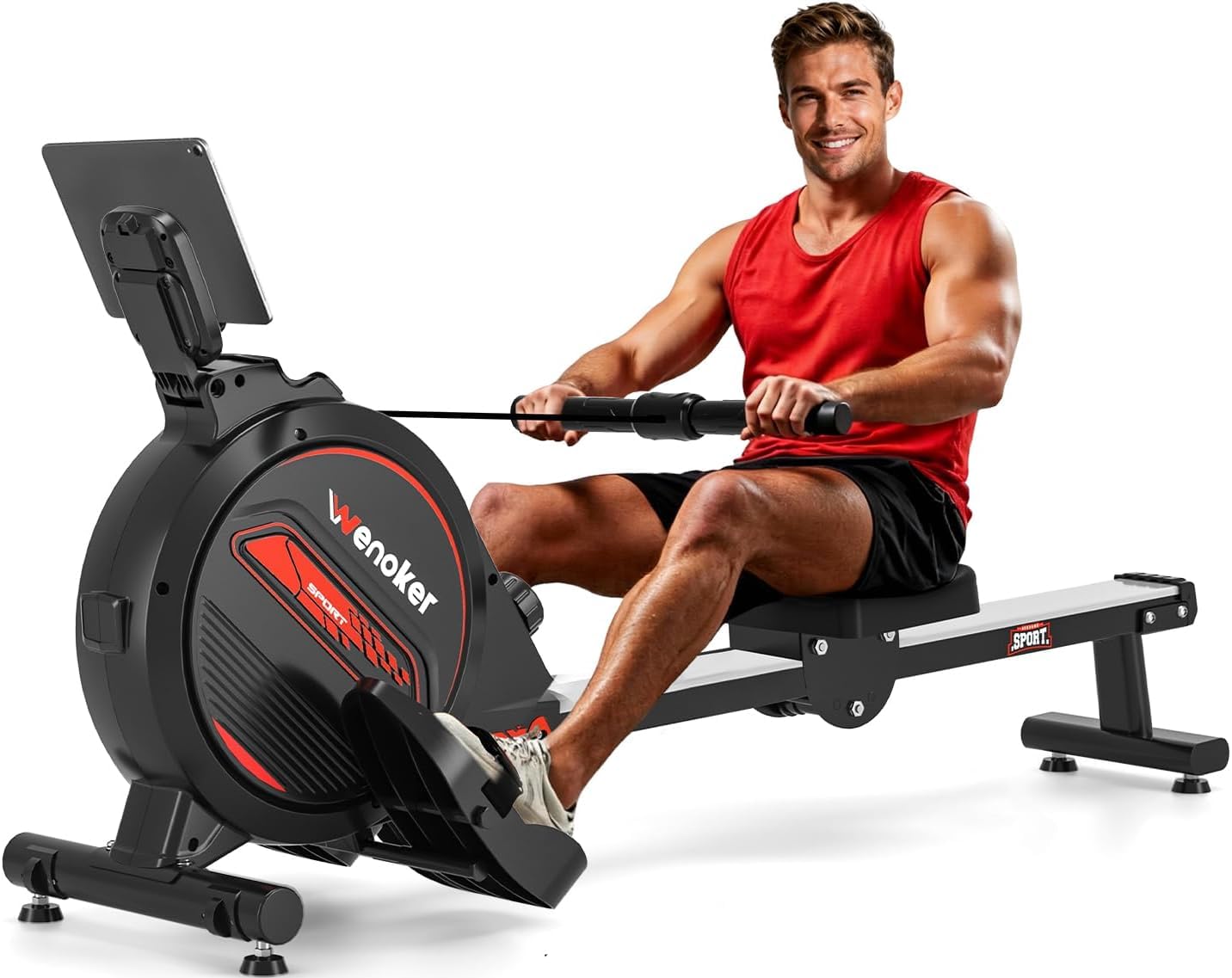
Wenoker Magnetic Rower

Wenoker Magnetic Rower

Budget home cardio

Our Score 9.2/10
Check Price

Worth Noting

  • 39-inch rail is the shortest here
Slide Rail
39 in
Max User Weight
350 lb
Stored Footprint
3.1 sq ft
Resistance Levels
16
Read the full review

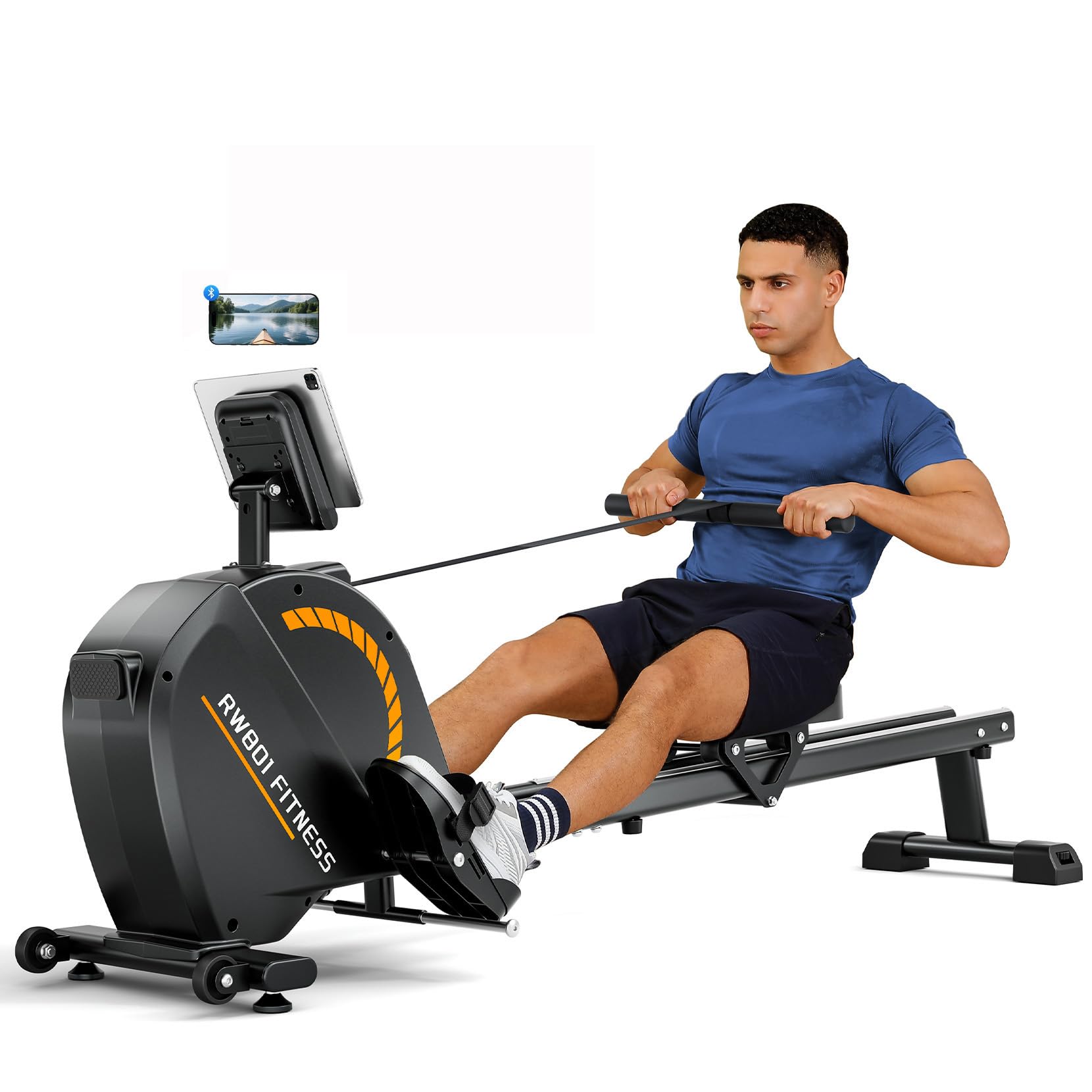
Almost all of the Wenoker arrives built. The frame comes together in about half an hour with the included tools, and once it's up it stands vertically in roughly three square feet — less floor than a folded ironing board, which is the number that matters if this is going in a bedroom or on a balcony.

For the money, the build is tight. The frame carries 350 pounds, the seat glides without the sideways slop we expected at this price, and the flywheel is quiet enough to row beside someone who's sleeping. Sixteen resistance levels give a usable run from warm-up to a decent sweat, and the seat and handle are comfortable enough that we stopped thinking about them.

Where it gives ground is stroke length. The rail measures 39 inches, the shortest here, and the trade for that compact frame is less seat travel — fine for a compact stroke, tight for a very tall rower or anyone who likes a long finish. Weigh that against the price and the storage footprint and it's still the machine we reach for when someone wants a rower they can stand behind a door. At this price, seat travel is the only thing you're buying less of.

Bottom line: Our value pick: quiet, solid, and small enough to stand in a corner, as long as your stroke fits inside a 39-inch rail.

#4

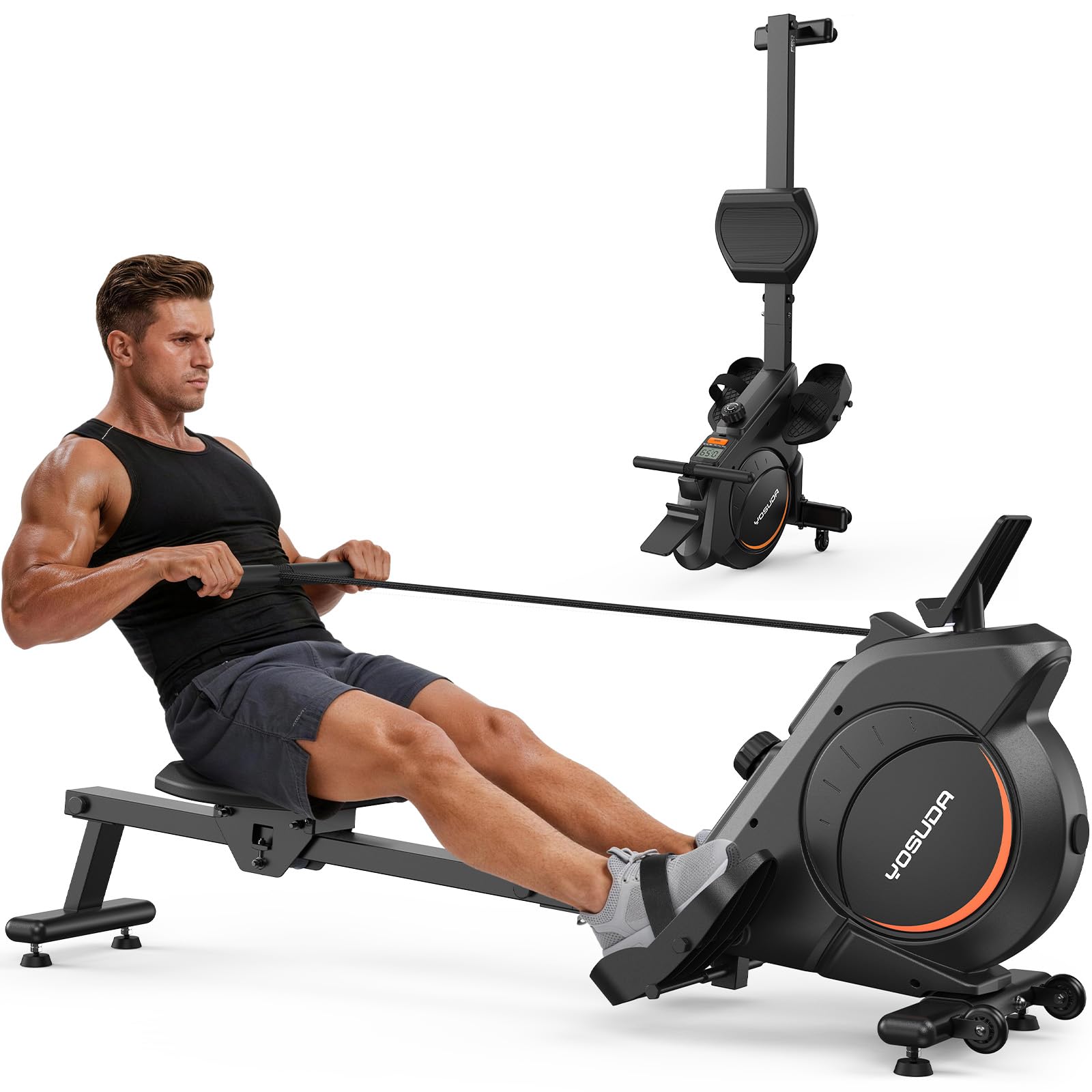
YOSUDA H-185

YOSUDA H-185

Taller rowers

Our Score 9.0/10
Check Price

Worth Noting

  • Tensioner and cable failures show up within a year
Slide Rail
50.2 in
Item Weight
54 lb
Max User Weight
350 lb
Maximum Rower Height
6'3"
Read the full review

If you're six feet or taller, this is where we start. The YOSUDA's slide rail runs 50.2 inches and the frame is built for rowers up to 6'3", which is more seat travel than anything else in this guide — the difference between finishing a stroke and running out of rail. Everything else about it is a solid mid-price rower: a heavier flywheel than the budget machines, 16 magnetic levels, and a 350-pound frame.

Small details earn their keep. The console sits at eye level rather than down by your knees, so you can watch your numbers without folding your neck, and the mono-rail beam stays put through hard intervals — 54 pounds of machine doesn't walk across the floor. Assembly is two main pieces, then the fittings, and the tools are in the box.

The pull tops out sooner than we wanted. A strong rower will find the last few levels blur together, and this is a steady-aerobic machine rather than a sprint machine. For the tall rower it fits, that's an easy trade — nothing else here gives you 50 inches of rail — and the price sits in the middle of the group, which is fair for what you get.

Bottom line: For anyone over six feet, this is the rower we choose: the longest seat travel here, on a 350-pound frame that stays planted during hard pulls.

#5

Dripex Magnetic Rower

Dripex Magnetic Rower

Narrow rooms

Our Score 9.0/10
Check Price

Worth Noting

  • Resistance tops out below the pricier machines
Item Weight
41.5 lb
Max Resistance
66 lb
Max User Weight
350 lb
Resistance Levels
16
Read the full review

The Dripex is the least expensive rower in this guide, and nothing about rowing on it announces that. The aluminum frame weighs 41.5 pounds and measures 16.5 inches across — the narrowest machine here, which is the spec that decides whether a rower fits a hallway, a spare-room corner, or the strip of floor beside a bed.

It arrives mostly assembled, and 20 minutes with the included tools finishes the job. Sixteen levels run off a 12-pound flywheel with a claimed 66 pounds of resistance, the dual-rail carriage glides without the side-to-side wobble we expected at this price, and the black-and-orange frame is one of the few here that isn't plain black.

The console is the giveaway. It's a basic LCD with the standard time, distance, calories, and count readout; Bluetooth pairing exists but the app is thin, and if you like structured sessions you'll be following your own watch instead. That's the compromise at this price, and one we can live with — a rower's screen mostly tells you how long you've been at it.

For a spare room, a garage, or a first rower you're not certain you'll stick with, it's an easy yes. It's narrow enough to fit where the others won't, quiet enough for an apartment, and inexpensive enough that leaving it unused for a month doesn't sting. What it won't do is grow with you the way the RS3 will.

Bottom line: A genuinely good first rower at the lowest price here: narrow, quiet, quick to build, with a console you'll ignore.

#6

Merach Q1S

Merach Q1S

Everyday home rowing

Our Score 8.8/10
Check Price

Worth Noting

  • Handle sits low, shortening the pull finish
  • 12-month warranty is the shortest kind here
Item Weight
42 lb
Max User Weight
350 lb
Resistance Levels
16
Assembled Dimensions
65"D x 19.3"W x 24.8"H
Read the full review

Two rails run under the Q1S's seat instead of the usual one, and that single choice is why it feels steadier than the other budget rowers we rowed. Pull hard and lean back at the finish and the seat stays flat, where a single-rail machine wants to tip. It's 65 inches long and 42 pounds, so it's a full-size rower rather than a folding one, but the frame stops just under 25 inches tall, which keeps it below a windowsill.

That stability at a modest price is what makes it our default. We worked through all 16 levels looking for the notchiness cheap magnetic units develop at the bottom of the dial and found very little of it; the flywheel stays smooth where you'll actually spend most of your time. Setup runs about half an hour, the front wheels roll it out of the way, and it runs on AAA batteries, so there's no cord to route across the floor — a small thing that ends up mattering in a room with two outlets.

The resistance has a ceiling. Level 16 is a good steady aerobic pull, not a heavy one, and a strong rower will run out of challenge before running out of stamina. The handle also sits low and fairly close to the console, which shortens the finish of the stroke for long-armed rowers. Neither undercuts what this machine is for — 20 to 40 quiet minutes, several times a week — and the Merach app adds guided sessions and heart-rate logging if you want more structure than the LCD gives you.

What earns it the top spot is the boring part: nothing rattles, the seat runs true, the console reads at arm's length, and the frame holds 350 pounds. We've rowed machines that cost more and felt less settled underfoot. If you're chasing a heavy pull, the RS3 below is the step up; for everyone else, this is the rower to start with.

Bottom line: This is the home rower we recommend to most people: steady under a hard pull, quiet enough for a shared room, and simple to set up and move.

#7

Sunny SF-RW524079

Sunny SF-RW524079

Upright storage

Our Score 8.8/10
Check Price

Worth Noting

  • 300-pound capacity is the lowest here
Item Weight
41.4 lb
Frame Warranty
3 years
Max User Weight
300 lb
Assembled Dimensions
64"D x 19.3"W x 27"H
Read the full review

At 41.4 pounds, the Sunny is the lightest full-length rower in this group, and that shapes how you'll live with it. One person can tip it onto its end and walk it into a closet, and it comes back out without a grunt. The frame is iron, and it carries a three-year structural warranty — longer than any other machine here offers.

Rowing on it is pleasant the way a good appliance is pleasant. The dual rail runs 64 inches and the seat tracks smoothly, the foam handle and padded seat stay comfortable past the half-hour mark, and the resistance dial has a firmer click than the price suggests. It's quiet enough that we forgot it was running while a TV was on in the same room.

What it won't do is push you. The magnetic system runs out of fight near the top of its range, and anyone who already rows will spend most sessions close to maximum. For a first rower, a lighter user, or a household that wants the machine gone between sessions, that's a fair trade for the weight and that warranty.

Bottom line: We recommend it to first-time rowers and anyone who needs the machine out of the way — light, quiet, easy to stand upright, with the longest frame warranty here.

#8

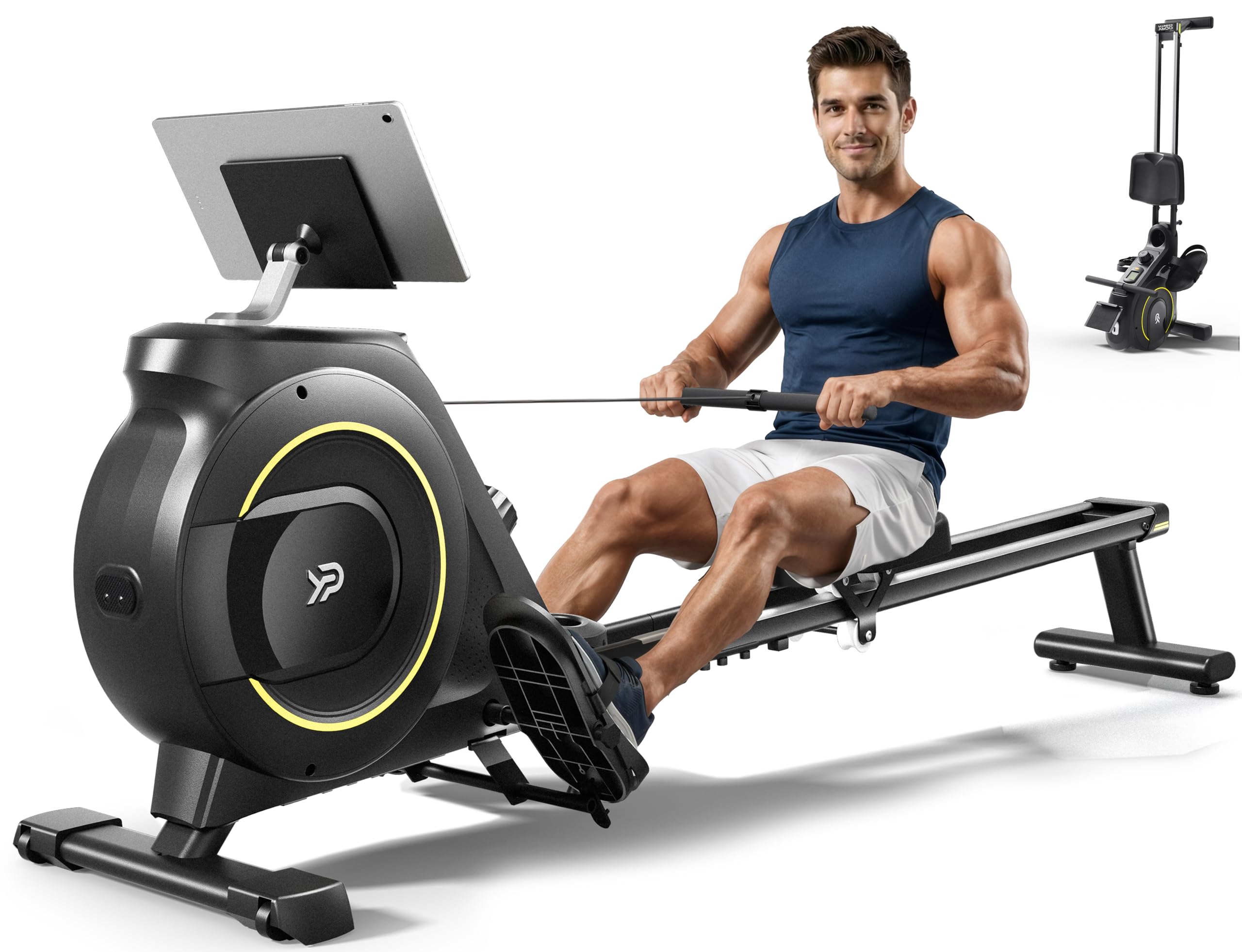
YPOO RM930

YPOO RM930

Folding away

Our Score 8.8/10
Check Price

Worth Noting

  • 46-inch rail gives less seat travel than most
Slide Rail
46 in
Max User Weight
350 lb
Stored Footprint
2.9 sq ft
Resistance Levels
16
Read the full review

For a rower that has to disappear, the YPOO makes the best case in this group: it folds, it stands, and the stored footprint comes down to about three square feet. If floor space in a shared room is the constraint, start here — the 350-pound frame, 16 levels, and 46-inch dual rail mean you give up very little to get the fold, and it's the least expensive folding rower in this guide.

Two things we noted. Unfolded, it's 65 inches long and 17.7 wide, so the fold buys storage rather than floor; you still need a clear stretch of wall while you row. And the resistance is livelier than the price suggests — the top levels pulled harder than we expected, and the flywheel stayed quiet through them. Assembly is the usual half hour, the console is a basic LCD, and the app adds sessions if you want them.

Bottom line: A folding, standing rower that pulls harder than its price suggests — the pick for anyone whose only real constraint is floor.

How We Tested Magnetic Rowing Machines

We started with a shortlist of 30 magnetic rowers, then filtered by resistance range, footprint, warranty, and price to settle on seven machines that covered the main size and price bands. For eight months, those seven lived in my home, moving between the living room and a spare corner. I assembled each one solo, timed the build, and noted whether the instructions were clear enough to follow without a second person. We rowed a mix of steady 20-minute pieces and hard interval sessions, because a machine that feels fine for five minutes can fall apart at minute 18.

Noise was the first real test. At 5:30 a.m., with my partner asleep in the next room, I rowed a steady piece and listened for flywheel hum, belt whine, and seat-rail clatter; we also took decibel readings at the same effort. During hard 500-meter pulls, we watched for frame wobble and checked whether the seat rolled smoothly or developed a flat spot. We rowed the full resistance range on each machine, from a warm-up paddle to a 30-second sprint, and noted whether the change was gradual or stepped.

We used each monitor through interval workouts, checking whether it tracked stroke rate, distance, and heart rate without dropping. We folded and rolled every machine into a corner, then got it back out the next morning to see how much effort storage really took. After eight months, we inspected the belt, seat rollers, and frame joints for wear, and we noted which machines still felt tight and which had started to creak.

How to Choose a Magnetic Rowing Machine

Start With the Resistance Ceiling, Not the Level Count

Almost everything here advertises 14 or 16 levels, and that number tells you very little. Magnetic resistance is set by how far the magnets sit from the flywheel, so a 16-level system with a modest top end can be gentler than a 14-level machine with a strong one. Look instead for a claimed maximum: 66 pounds on the Dripex, 88 on the Merach RS3. That's the ceiling you'll actually row against.

If you already train, buy the highest ceiling you can afford. If you want steady aerobic work a few times a week, a modest top end is fine and smoothness matters more — that's the calculation that puts the Q1S above machines with bolder numbers.

Match the Rail to Your Height

Seat travel along the rail is what lets you finish a stroke. In this group the rails run from 39 inches on the Wenoker to 50.2 on the YOSUDA, which is rated for rowers up to 6'3". If you're over six feet, that gap shows up in every single stroke; if you're 5'6", it barely registers and you can buy on price and storage instead.

The trap is assuming a compact machine is a compromise for everyone. It isn't — the Wenoker is a genuinely good rower for a shorter user with a compact stroke, and a frustrating one for someone who needs the seat to travel.

Measure the Floor It Uses, Not the Floor It Stores In

Folding and vertical storage solve the between-sessions problem, not the during-sessions one. The YPOO folds to about three square feet but unfolds to 65 inches, and the pooboo is 83 inches long in use. Measure the wall where the rower will live, allow space behind the seat for the catch, and only then decide whether a folding frame earns its keep.

A stored footprint is a nice number to have. The assembled length is the one that decides whether the machine fits the room you planned to put it in.

Quiet Comes Standard; Smooth Is What You Pay For

A magnetic flywheel is quiet by design, so almost nothing in this category will bother the next room. What separates these machines is the seat carriage and the frame: dual rails hold the seat flat under a hard pull, heavier frames stay planted, and tight rollers are the difference between a glide and a low rumble you'll hear through a floor.

Warranty belongs in the same conversation, because the parts that wear are the cable and the rollers. Coverage here runs from 12 months to the three-year structural frame on the Sunny, and that difference is worth more than a couple of extra resistance levels.

Frequently Asked Questions

Final Verdict

The Merach Q1S is the machine we recommend to most people buying their first or only rower. Two rails keep the seat flat, the stroke stays smooth at the settings you'll actually use, and the frame carries 350 pounds without a rattle — at a price in the middle of this group rather than the top of it.

Change one requirement and the answer changes. Want a hard pull and a machine that doubles as a cable station? That's the RS3. Need the rower to vanish into a corner? The Wenoker does it for less. And if you're six feet or taller, the YOSUDA is the only one here that gives you a complete stroke.