Cardio Machines

Best Leg Exerciser Machines of 2026

A leg exerciser is a deceptively simple machine: two pedals, a resistance dial, and a frame small enough to tuck under a desk. That simplicity is why the differences between models are easy to miss until you're using one daily — a base that walks across the rug, a pedal stroke that fights you, a remote that's never within reach. What a good one buys you is motion you don't have to think about — legs that keep moving through a long workday, bad weather, or a slow recovery when a walk isn't happening.

I've had a cheap pedal unit skate across the floor mid-meeting, so I know how fast the wrong one becomes a doorstop. Over eight months, my team and I put 12 machines through daily use in home offices and living rooms. The keepers share a few things: a base that stays put, a smooth stroke at low resistance, and controls you can reach without breaking rhythm. The picks below are the ones we kept pedaling on purpose.

#1

Cubii JR1

Top Pick
Cubii JR1

Active pedaling

Our Score 9.2/10
Check Price

Worth Noting

  • Heavy at 25.4 pounds
  • Tallest deck here
Weight
25.4 lb
Display
Battery powered
Max Stride
18 in
Resistance Levels
8
Read the full review

Twenty-five pounds is a lot for a machine that lives under a desk. It is also the reason the Cubii JR1 stays exactly where you put it while you pedal, and the reason carrying it from one room to another is a job you do once and then arrange your life around.

What that weight buys is the most convincing pedal feel on this page. There is no motor and no cord: eight resistance levels, all of them earned by your own legs, and a stroke that stays smooth when you push hard. Anyone who wants exercise rather than circulation should start here, because it is the only machine in the roundup that gets harder the harder you work.

Fit is the thing to check before you order. At 10 inches tall it has the highest deck here, and the 18-inch stride brings your knees up further than the flat electric units do. Sit in the chair you will actually use, put your feet where the pedals sit, and look at the gap under the desk. The display runs on batteries, so there is no cord to route and no outlet to negotiate for.

Assembly is two foot pads and about a minute. On a hard floor a thin mat under it keeps it from creeping, which matters more than it sounds once you are pedaling against resistance. It costs more than any of the electric units here, and the money goes into the frame and the quiet mechanism rather than into programs and screens.

Bottom line: Our pick for anyone who wants to do the pedaling: eight resistance levels, no cord, and a frame heavy enough to stay exactly where you put it.
#2

Putnen Under-Desk Elliptical

Putnen Under-Desk Elliptical

All-round desk use

Our Score 9.0/10
Check Price

Worth Noting

  • Only three preset programs
  • Motor does the pedaling
Weight
8.1 lb
Warranty
2 years
Max Stride
20 in
Speed Levels
12 manual, 3 auto
Read the full review

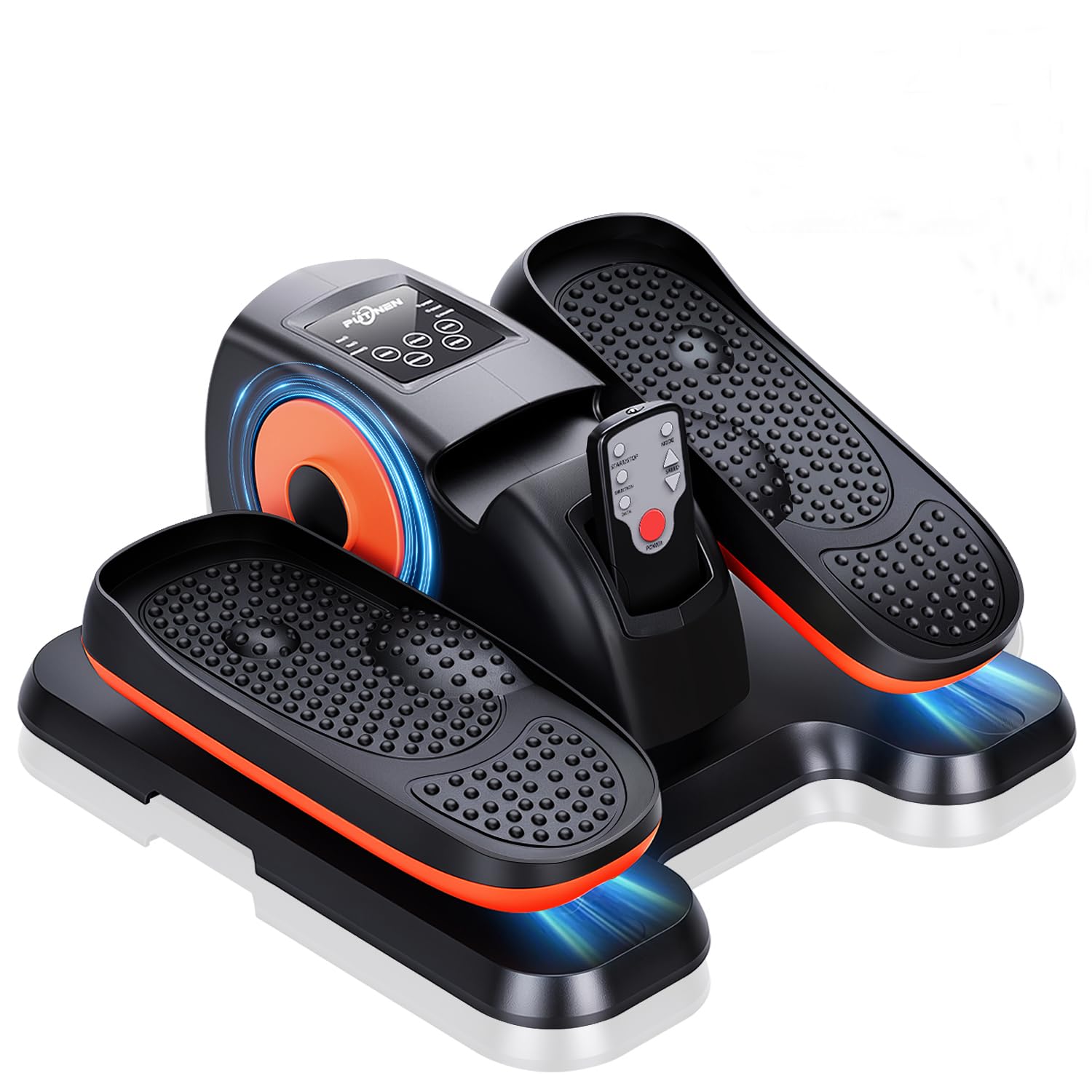
Nothing needs assembling. The Putnen comes out of the box as a finished machine — cord, remote, unit — and that single fact is why we point most people here first. A leg exerciser only earns its keep if it is the easiest thing in the room to switch on, and this one asks nothing of you beyond sitting down and pressing a button.

The controls sit where you want them. Twelve manual speeds, three auto programs, forward and reverse pedaling, and a remote that saves you folding yourself under the desk in the middle of a meeting. The LCD tracks time, distance, speed, stride count and calories. Three presets is a thin menu next to the twelve that MERACH and CURSOR offer, but the manual range covers the ground and the buttons respond the moment you press them.

At 8.1 pounds and a little over six inches tall, it slides under a desk and back out without a grunt. The 20-inch stride is the longest in this group, and that number means something: a longer pedal path sends your feet around a real ellipse instead of nudging them back and forth, which is the difference between feeling like you are pedaling and feeling like you are fidgeting.

The catch is philosophical. The motor turns the pedals and your feet ride along. For circulation, stiff knees and long afternoons in a chair, that is exactly right. For anything resembling training, it isn't — you need the Cubii for that. The two-year warranty is the longest of the electric units here, which counts for something on a machine with moving parts.

Bottom line: We recommend the Putnen to anyone who wants their legs moving while sitting without a setup ritual: it arrives assembled, the remote reaches, and the pedal stroke is the longest here.

#3

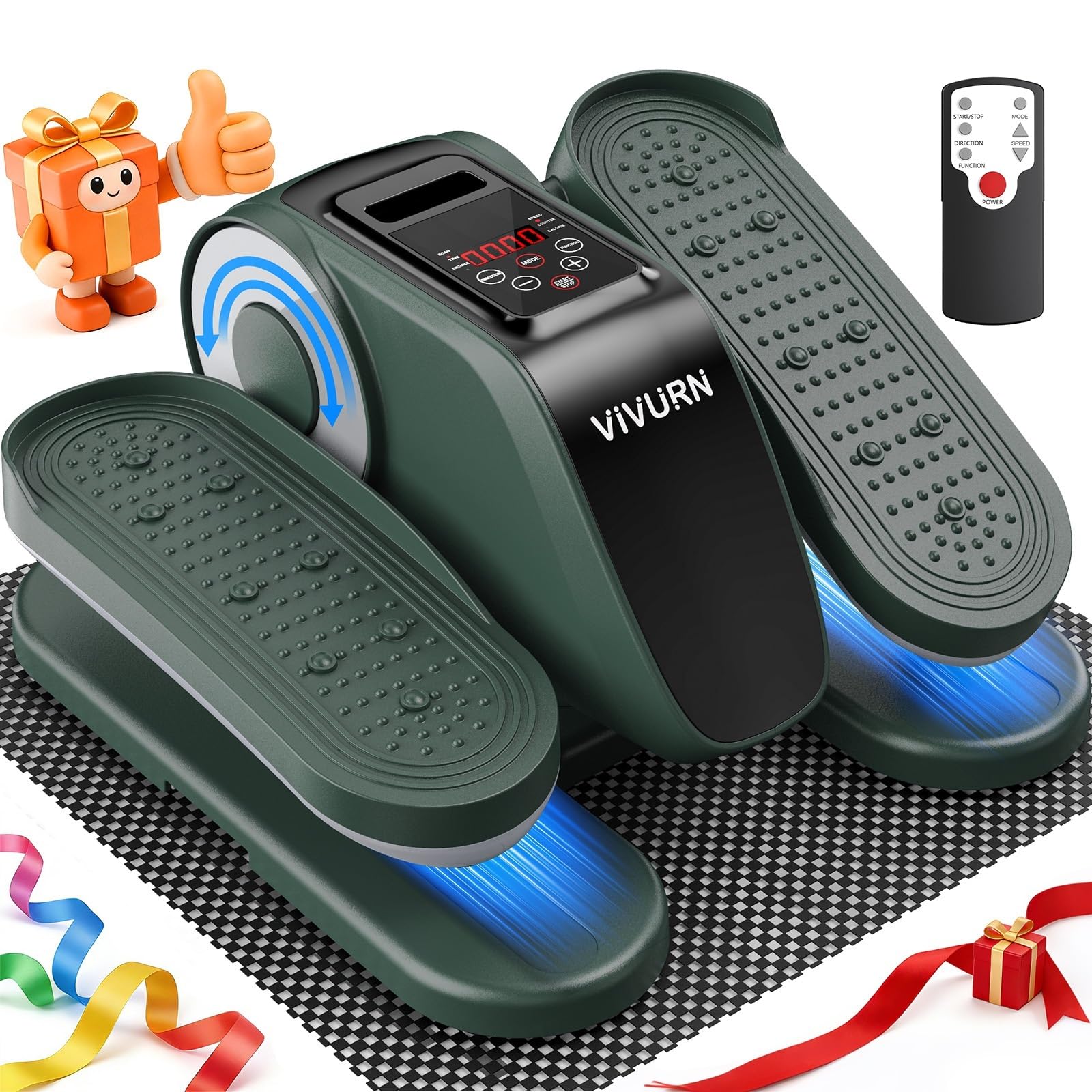
VIVURN 019 Under-Desk Elliptical

VIVURN 019 Under-Desk Elliptical

Shared offices

Our Score 9.0/10
Check Price

Worth Noting

  • Taller deck than the flattest units
  • Less long-term history than the top pick
Weight
10.8 lb
Max Stride
18 in
Speed Levels
12 manual, 3 auto
Max User Weight
300 lb
Read the full review

The listing claims under 15 decibels, which is a number to take with salt; the design behind it is what matters, and a magnetic drive with a larger motor is the right recipe for quiet. In a shared office or a living room with the television on, this is the electric unit we reach for, because nothing about it announces itself.

Twelve speeds in manual mode, three auto modes, forward and reverse, and — the useful bit — a setting that switches the motor off entirely so you can pedal under your own steam. That makes it two machines in one, and it is the reason to spend more than the Putnen costs. The 18-inch stride is the second longest here, behind only the 20-inch stroke on our top pick.

It arrives assembled, weighs 10.8 pounds and carries a built-in handle, which is more thought than most of these give to being moved. The deck is 8.3 inches tall, so it wants a little more clearance than the flattest units, and the RF remote means you don't have to point it at anything. A non-slip mat comes in the box.

What we cannot vouch for is time. This is a newer design than the Cubii or the Putnen, with less history behind it, and long-term durability is the open question. Nothing short term gives us pause; it is simply the one claim we cannot yet make.

Bottom line: We point buyers who share an office or a living room to the VIVURN: a quiet magnetic drive, a long stroke, and a motor you can switch off.

#4

DUREXO EB-032

DUREXO EB-032

First machine

Our Score 9.0/10
Check Price

Worth Noting

  • Shortest 10-inch pedal stroke here
  • Needs periodic lubrication
  • 200-pound user limit
Weight
13.7 lb
Max Stride
10 in
Speed Levels
12 manual, 3 auto
Max User Weight
200 lb
Read the full review

The DUREXO is the least expensive machine in this roundup, and its spec sheet doesn't read like a budget one: twelve speeds, three auto programs, forward and reverse pedaling, a remote and a touch LCD. That combination is why it earns a place — as a first machine, or as a spare for a parent's house where a bigger unit would be in the way.

The compromises are physical. At 13.7 pounds and 9.65 inches tall it is the heaviest and tallest of the compact electric units, so check knee clearance and plan to leave it in one place. The 10-inch pedal stroke is the shortest here, closer to a brisk shuffle than a full ellipse, and the 200-pound user limit is on the low side.

It also ships with a small bottle of lubricating oil and expects you to use it. That is the most honest thing about the package: the pedal track wants a drop now and then, and the oil is how you keep the motion quiet. Put it on the schedule and the mechanism stays smooth.

For the money, this is a sensible way to find out whether an under-desk exerciser fits your day at all. Buy it if you are light, you don't need a long stroke, and testing the habit cheaply appeals more than buying a machine to grow into.

Bottom line: We think of the DUREXO as the trial machine: it does everything an electric exerciser should for the least money here, as long as a short stroke and 200 pounds of capacity suit you.

#5

CURSOR FITNESS C2

CURSOR FITNESS C2

Tiny spaces

Our Score 8.8/10
Check Price

Worth Noting

  • Pedals are the long-term weak point
  • No manual resistance setting
Weight
7 lb
Programs
12 auto, 12 manual
Floor Space
0.12 sq m
Max User Weight
300 lb
Read the full review

Seven pounds, and 0.12 square meters of floor. Those two numbers make the C2 the easiest machine here to live with: it goes under the desk with one hand, comes out when you want it, and disappears into a closet when guests arrive.

That is the trade, and for desk workers it is a good one. You are not buying heft or a flywheel; you are buying the version of this habit you will actually keep, because nothing about using it is a chore. What gives us pause is durability — the pedals are where light units fail, and a knock or a wobble is worth investigating rather than ignoring.

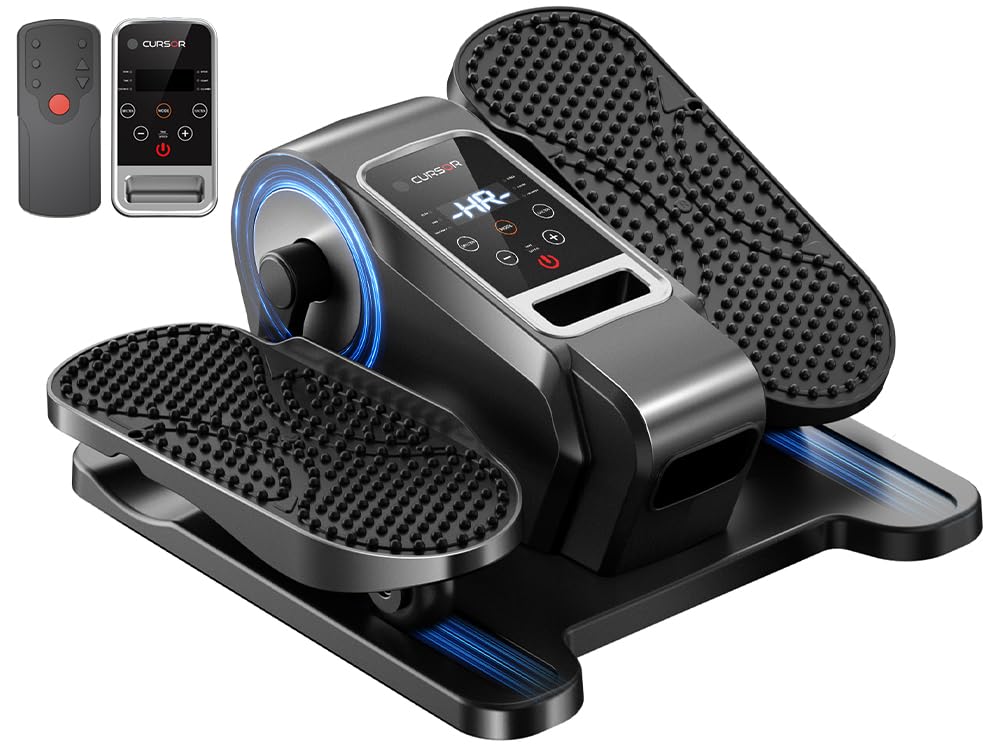
Otherwise it does more than its size suggests. Twelve automatic programs and twelve manual speeds, an LCD that counts strides as well as time and calories, and a remote so you never have to reach the floor. Cursor builds a 30 percent vertical lift into the pedal path to mimic walking, and the result is a stroke with less shuffling than the cheapest machines here manage.

Bottom line: Seven pounds and a footprint you can tuck anywhere make the C2 the one we recommend when space, not budget, is the real constraint.

#6

MERACH MR-E32

MERACH MR-E32

Programmed sessions

Our Score 8.8/10
Check Price

Worth Noting

  • 15-inch stroke is short next to the top picks
Motor
60 W
Weight
11.1 lb
Programs
12 auto, 12 manual
Max Stride
15 in
Read the full review

Twelve preset programs on top of twelve manual speeds, a 60-watt motor, and a touch panel as well as a remote. On paper the MR-E32 is the most fully equipped electric unit here, and the preset menu goes further than most: P1 through P12 vary speed and direction for you, so a whole session can run without a single decision.

The 15-inch stride is shorter than the Putnen's or the VIVURN's, and the pedals feel it — a tighter loop rather than a long ellipse. At 11.1 pounds there is enough mass to stay planted, the alloy steel frame reads as sturdier than the plastic-bodied units, and the 250-pound user limit is reasonable for the class.

Where we hesitate is the pedal mounts. A pad working loose is the failure worth catching early, so check the fixings when the box arrives and again after a few weeks of daily use. Stay on top of that and the MERACH is a good buy for someone who wants programmed sessions and a more solid feel than the cheapest units offer.

Bottom line: For someone who wants preset sessions and a steel frame rather than the cheapest shell, the MERACH earns its midrange price — just check the pedal fixings early.

#7

UMAY Eclipse U5

UMAY Eclipse U5

Secure foot placement

Our Score 8.6/10
Check Price

Worth Noting

  • Presets can't be changed or saved
  • Straps take patience to position
Weight
12 lb
Max Stride
15 in
Speed Levels
12
Max User Weight
330 lb
Read the full review

Foot straps, a PVC mat and a 330-pound user limit. The UMAY U5 is the one here that assumes your feet need help staying put — and if you have ever had a foot slide off a smooth pedal halfway through a session, that is the feature worth paying for.

Otherwise it is a conventional 12-program electric unit: auto and manual modes, forward and reverse, an LCD display and a remote. The pedals are larger and textured, which helps on its own; the Velcro straps help more, though getting a foot positioned in one takes patience the first few times.

Settings are the quirk. You can choose a program, but you can't save or edit it, and the machine sometimes does something other than what you asked for. The fix is simple — set the speed manually and leave the presets alone.

At 12 pounds with a 15-inch stride, the U5 sits in the middle of this group, and its 330-pound rating sits above the budget units. What it lacks is a reason to choose it over the Putnen unless the straps matter to you. When they do, it is a quiet, solid machine with the accessories already in the box.

Bottom line: We keep the UMAY in the roundup for anyone whose feet slip off smooth pedals — the straps and the 330-pound rating are the reasons to choose it over the top pick.

#8

LegXercise PRO+

LegXercise PRO+

Very limited mobility

Our Score 8.4/10
Check Price

Worth Noting

  • Slowest motion here, deliberately
  • Most expensive unit on this page
Power
Corded electric
Weight
10 lb
Controls
Wireless remote
Non-slip Mat
Included
Read the full review

Barely moving is the design, not a fault. LegXercise sells the PRO+ as light, slow, continuous motion and recommends it for people in their eighties; the maker points anyone under eighty to a faster model in its own range. That sounds like a limitation dressed up as a feature, and partly it is — but for a very sedentary user it is also the only thing here gentle enough to use without thinking about it.

What arrives is a corded glider with a wireless remote and a non-slip mat, five inches tall — the lowest deck on the page, which matters when the chair is low or the desk is really a TV tray. Ten pounds, a plastic body, one job. The remote is the entire interface, which is the point: no bending, no menus, no decisions.

Our reservation is price. This is the most expensive machine here and it does the least, and the motion is genuinely slow — slower than anything else in the roundup — so it will not satisfy anyone who wants to feel effort. The case for it is narrow and real: a user who needs circulation and would not tolerate anything brisker. Everyone else gets more from a Cubii or a Putnen, for a lot less.

Bottom line: Our advice is narrow: the LegXercise suits a very sedentary user in their eighties, and nobody else should pay this much for motion this gentle.

How We Chose and Tested 12 Leg Exercisers

We built the shortlist the way a shopper would: scanning the leg exercisers people actually buy — passive peddlers, motorized units with remotes, compact models aimed at limited mobility — then cutting anything too tall to clear a standard desk, too heavy to shift without help, or priced past what the category justifies. Twelve made the final cut, and each one stayed with us for eight months rather than a single afternoon.

Testing happened where these machines live: under a desk during work calls, beside a recliner during evening TV, and under the feet of an older family member using one for circulation while reading. We pedaled each unit through every speed and resistance setting, noting whether 20 minutes at a moderate setting left our calves genuinely tired or just along for the ride. We also timed how long each took to move from closet to desk, and whether that could be done one-handed.

Remotes got their own test — operated from a recliner across the room, at an angle, in low light, to see whether a button press registered the first time. We weighed every unit on a bathroom scale and compared the number to what someone recovering from surgery could lift without strain, then checked how far each crept across hardwood during a 20-minute session. Durability was judged over months, not minutes: we listened for new rattles, felt for wobble in the base, and checked whether motors ran hot after an hour. As for ease of use, the winners were the ones nobody needed the manual for after day one.

How to Choose Leg Exerciser Machines

Motorized or manual: decide who does the work

How much effort you want is the fork in the road. A motorized unit like the Putnen turns the pedals while your feet ride along — useful for circulation, stiff knees and long stretches of sitting, and close to effortless. A manual machine like the Cubii JR1 makes you supply the force against eight resistance levels, which is the only way to build strength on one of these.

Neither is better; they answer different questions. If the goal is simply to keep the legs moving through a workday, motorized is plenty. If the goal is to rebuild muscle after surgery or injury, go manual and accept the heavier frame that comes with it.

Measure clearance, not just the desk

Height is the spec people ignore and then regret. The machines here run from about five inches tall to ten, and the tall ones need room for your knees to rise at the top of the stroke. Sit in the chair you'll actually use, put your feet flat, and measure from the floor to the underside of the desk.

Watch for the trap: a low keyboard tray or a shallow drawer catches your knees well before the desk surface does. If clearance is tight, prioritize deck height over every other feature, then look at stroke length.

Stride length tells you more than speed count

Pedal strokes here range from 10 inches to 20, and the difference is obvious underfoot. A short stroke feels like shuffling; a long one feels like pedaling. If you want the motion to resemble walking or cycling, look for 18 inches or more, which the Putnen, the VIVURN and the Cubii all reach. If you only need circulation and the machine lives in a tight space, 10 to 15 inches is fine.

Speed counts are less informative than they look. Twelve levels is standard at every price here, and the top level of a cheap unit is often gentler than the top level of a good one.

Weight, noise and where it will live

Weight cuts both ways. At seven or eight pounds a machine is easy to move and easy to hide, but it creeps across a hard floor while you pedal — use the mat. At 25 pounds the Cubii doesn't budge, and you won't move it either.

Treat a 15-decibel claim as marketing and read the design instead: a magnetic drive with a bigger motor is the real signal for quiet. If the machine shares a room with a television or a work call, that's where the money belongs.

Controls you can reach and programs that behave

The remote isn't a gimmick. Reaching down to a unit under a desk mid-meeting is exactly the friction that stops people using these, which makes a cordless remote worth checking for on any model you consider.

Presets vary more than the counts suggest. Some run a genuine interval session that changes speed and direction; others can't be saved or edited once chosen. If you like setting a pace and leaving it, the manual range matters more than the program menu.

Frequently Asked Questions

Final Verdict

Buy the Putnen if you want the easiest possible start. It arrives assembled, costs midrange money, and the 12 speeds, remote and 20-inch stroke cover everything a desk-bound user needs. It's the machine we point most people to, and nothing here beats it on convenience per dollar.

Choose the Cubii JR1 instead if you want to do the pedaling yourself — eight resistance levels and a 25-pound frame that never moves are the trade for giving up portability. And if floor space is the whole problem, the seven-pound Cursor C2 disappears under a desk and out of sight.