Cardio Machines

Best Exercise Bikes of 2026

An exercise bike is one of the few pieces of home gym equipment you can use in your socks at 6 a.m. without waking the rest of the house — provided you bought the right one. The wrong one gives itself away fast: a wobble through the pedal stroke, a seat that turns minute nine into minute forty, a resistance knob that jumps from spin-class easy to bolted-down hard. What you're actually buying is a bike you'll still want to climb onto in month four.

I've kept a bike in my living room on and off for years, and the ones that stuck around were never the ones with the biggest console. The two things that decide it — how the seat feels half an hour in, and how loud the flywheel is before sunrise — never appear on a spec sheet. My team and I assembled and rode eight bikes over six months, from budget frames to near-gym machines, and those were the differences that separated them. The picks below are the ones that earned their floor space.

#1

MERACH S19 Recumbent Bike

Top Pick
MERACH S19 Recumbent Bike

Back support

Our Score 9.2/10
Check Price

Worth Noting

  • Flat pedals without heel cups
  • Compact frame for a recumbent, tight over 6 feet
Dimensions
48.03"D x 23.62"W x 46.46"H
Resistance
8-level magnetic
Seat Positions
8
Weight Capacity
330 lb
Read the full review

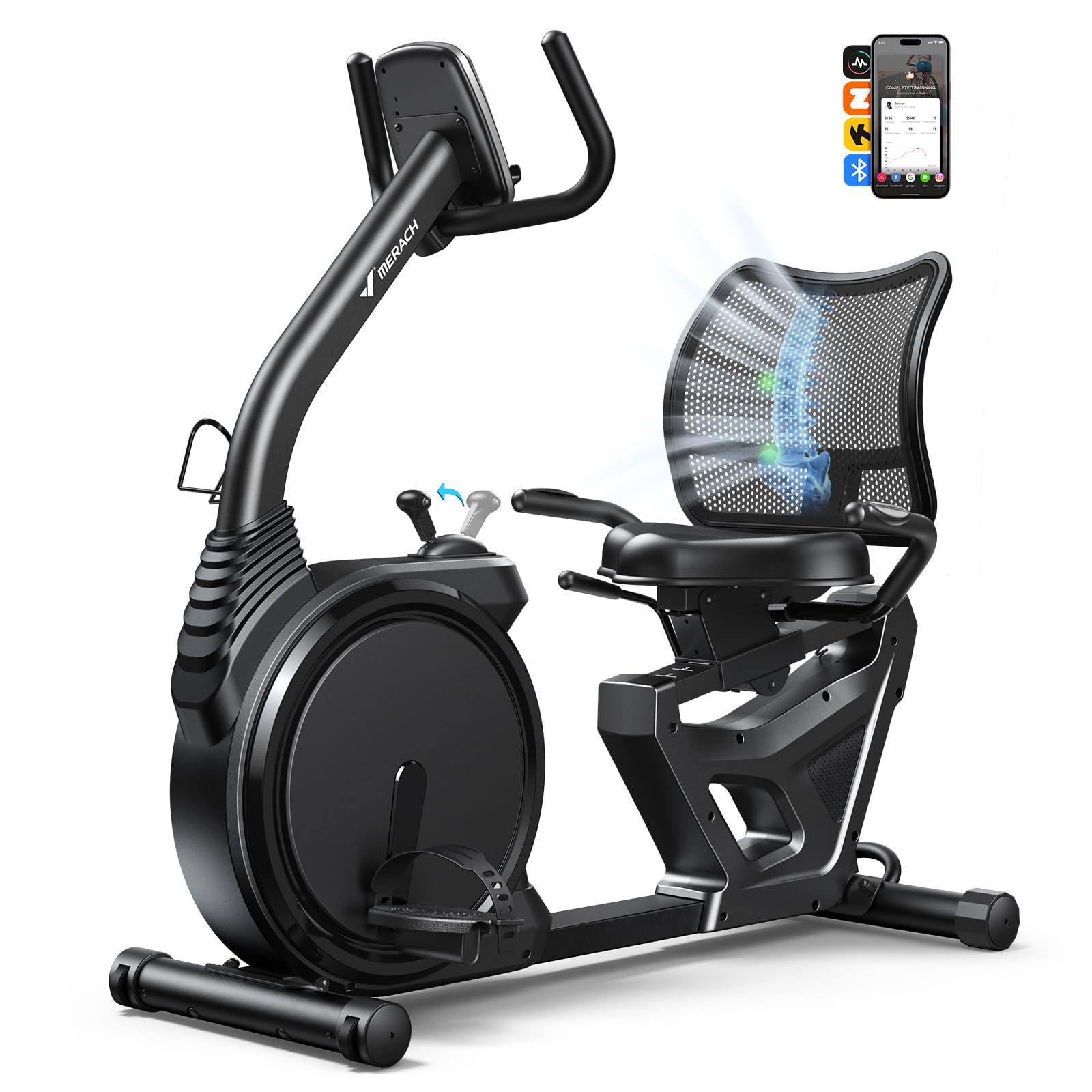
Recumbent bikes exist for a rider who wants a chair, not a saddle: someone coming back from injury, someone with balance or back trouble, someone who would rather read than sprint. The S19 is the best of that type here, and the reason is the seat — a wide padded base with a breathable mesh backrest, eight positions along the rail, and side handles to hold while you settle in.

The resistance lever is a car-style shifter under the right hand instead of a knob between your knees, so you can change effort mid-song without breaking cadence. Eight magnetic levels isn't a wide range, but the steps are distinct and the 6.6-pound flywheel keeps the stroke smooth through all of them.

Quiet comes free with a dual belt and magnets; we could ride this in the same room as a television. It's also long, near four feet front to back, so it wants a corner of its own rather than a spot beside the couch. And if standing sprints are the point, this is the wrong bike — the S26 costs less and does that.

Bottom line: For anyone who wants to sit back rather than lean forward — recovery, balance, a sore back — the S19 is the most comfortable bike in this group.
#2

MERACH S26 Exercise Bike

MERACH S26 Exercise Bike

Most home gyms

Our Score 9.0/10
Check Price

Worth Noting

  • Firm saddle gets uncomfortable past 30 minutes
  • Bullhorn handlebars sit far forward for short riders
Resistance
Magnetic, belt drive
Bike Weight
62 lb
Rider Height
4'8" to 6'2"
Weight Capacity
300 lb
Read the full review

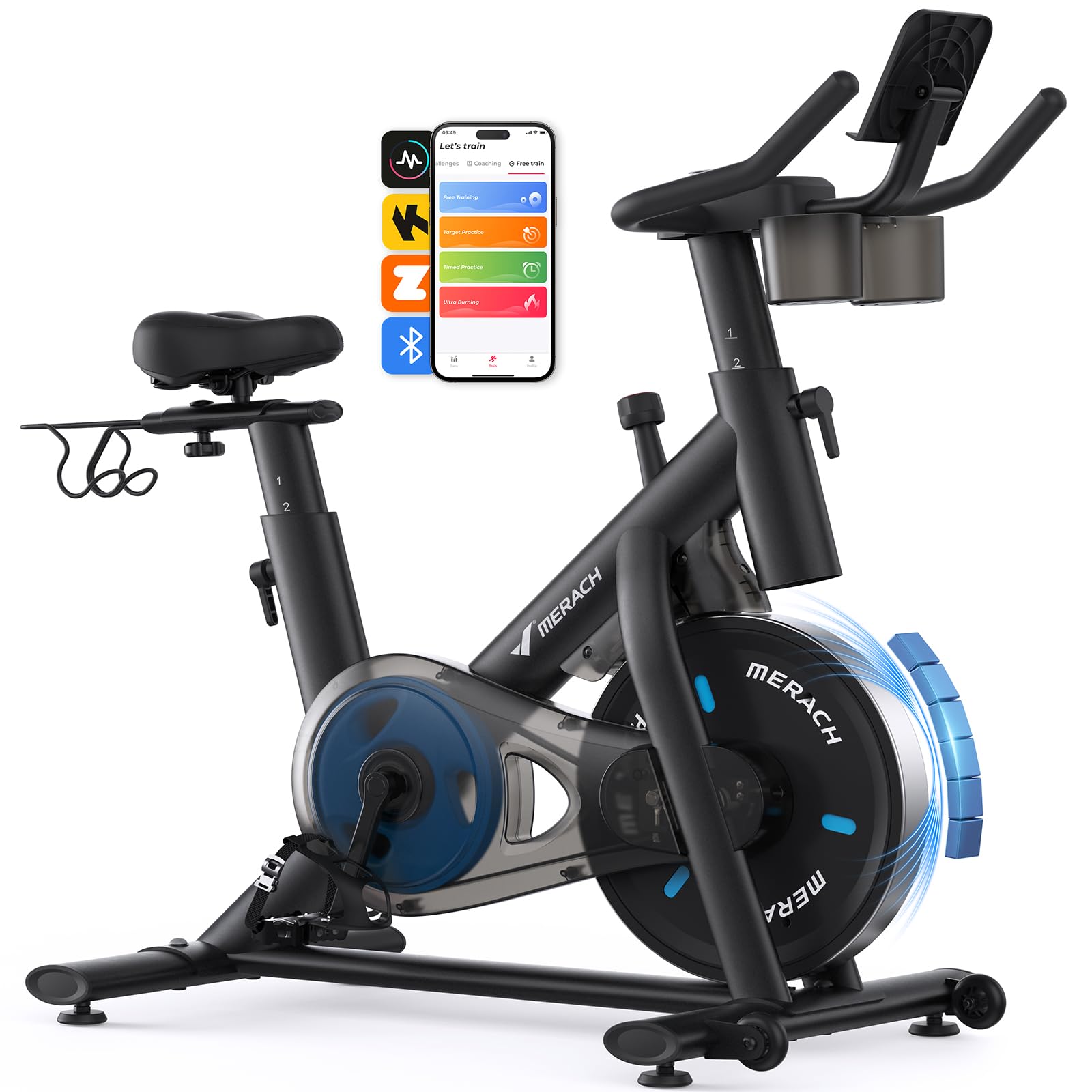
What sets the S26 apart here isn't one figure but the pairing: a magnetic resistance unit and a 62-pound frame, at a price that lands in the middle of what we compared. Magnetic resistance is the part that matters. It changes effort without a felt pad dragging on a flywheel, so the pedal stroke stays smooth and nothing develops a squeak six weeks in. The frame is heavy enough that a standing effort doesn't walk the bike across the floor.

Quiet was the thing we listened for hardest, because a bike you can hear through a wall is a bike that stops getting used. The belt drive and the magnetic unit keep this one close to silent in normal riding — fine for a shared apartment or a bedroom next to a sleeping child.

Resistance builds steeply near the top of the dial. The bottom half covers warm-ups and easy spinning, then the last quarter arrives almost at once, so holding a specific hard effort takes a lighter touch than the numbers suggest. Riders between 4 feet 8 inches and 6 feet 2 inches fit, with a four-way seat and two-way handlebars.

The tablet mount is the practical answer to a basic console: an iPad and a class subscription turn the S26 into most of what the premium bikes are selling, and the bike itself doesn't need a subscription to work.

Bottom line: We point most people to the S26: magnetic resistance, a 62-pound frame that stays planted, and near-silent pedaling for a midrange price.

#3

Schwinn IC4 Indoor Cycling Bike

Schwinn IC4 Indoor Cycling Bike

App-led training

Our Score 9.0/10
Check Price

Worth Noting

  • Hard, thin saddle
  • 112-pound frame is a two-person move
Warranty
10-year frame
Resistance
100-level magnetic
Connectivity
Bluetooth; Peloton, Zwift, JRNY
Weight Capacity
330 lb
Read the full review

At the top of this group's price range, the IC4 asks you to decide whether you want gym equipment or a home bike that happens to work. What the money buys is specific: a 112-pound frame rated to 330 pounds, 100 micro-adjustable magnetic resistance levels, Bluetooth, and compatibility with Peloton, Zwift and JRNY.

We think it earns that price for one kind of rider — someone who will actually ride along with a coach. Pairing is straightforward, the resistance moves in small enough steps to follow a call like 'add two gears,' and the frame doesn't shift when you stand to climb. Free-riding without a screen leaves most of that advantage unused, and the cheaper bikes here do plain cardio just as well.

The pedals are a detail we appreciated more than expected: one side takes clip-in cleats, the other is a cage for street shoes, so two people can share the bike without swapping hardware. The console is the weak spot — small, unlit, and dated next to the rest of the machine — which is why most rides end up on a tablet in the mount.

The warranty is the other reason it sits at the top of the range: 10 years on the frame, 3 on parts, 1 on labor, the longest coverage of anything here.

Bottom line: The IC4 is the splurge for riders who follow app-led classes: 100 magnetic levels, easy Bluetooth pairing, and a frame that feels like gym equipment.

#4

YPOO BC710 Exercise Bike

YPOO BC710 Exercise Bike

Apartment workouts

Our Score 9.0/10
Check Price

Worth Noting

  • Console can fail within months
  • Seat adjustment is fiddly
Resistance
16-level magnetic
Bike Weight
44 lb
Rider Height
4'8" to 6'1"
Weight Capacity
300 lb
Read the full review

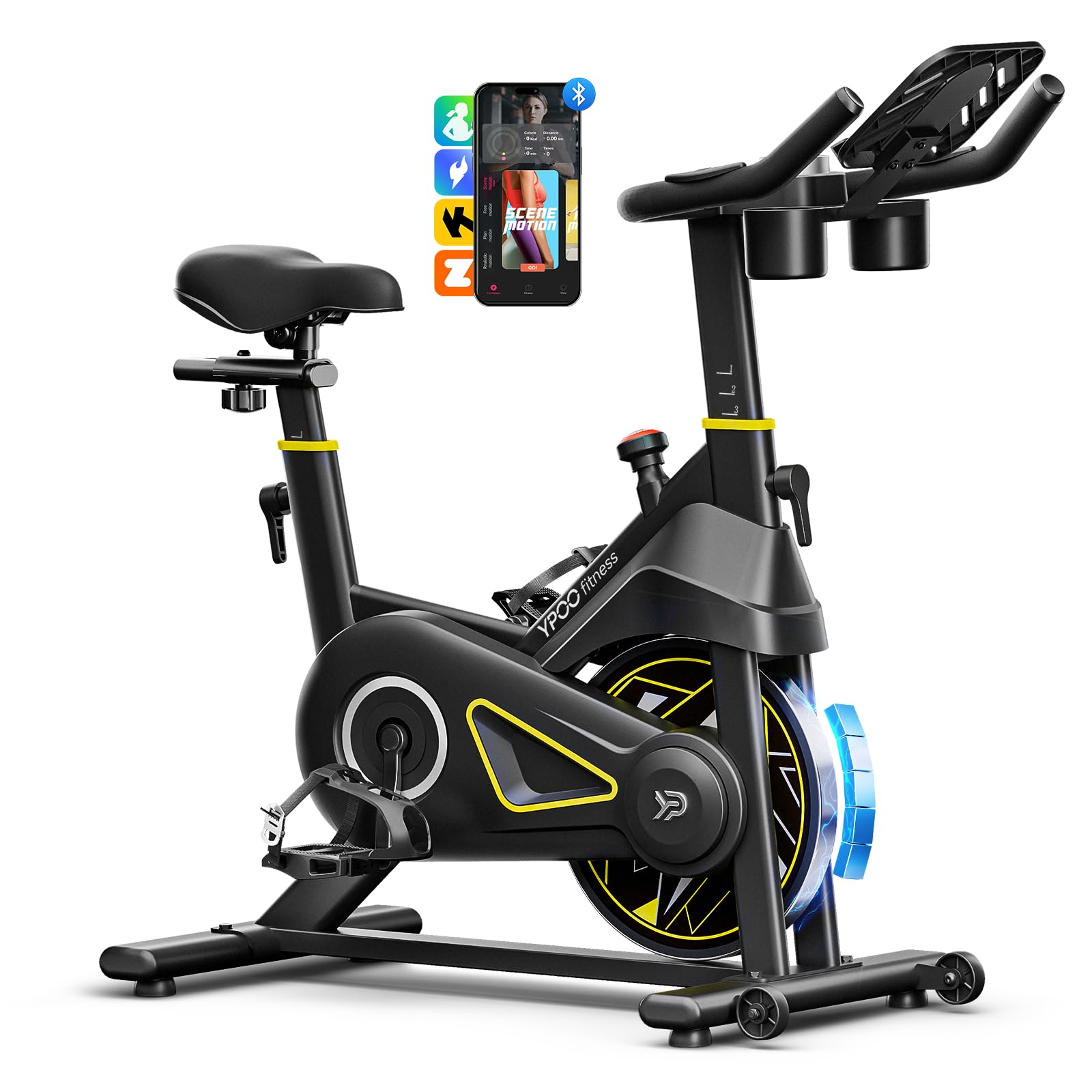
Forty-four pounds and 32.9 inches long: the YPOO is one of the smaller, lighter magnetic bikes here, and it claims under 25 dB in operation. The number that matters more day to day is 80% pre-assembled, which keeps the box manageable and the build short.

On the bike, the magnetic unit and belt drive deliver roughly what that claim suggests — a smooth, very quiet ride that won't carry through a floor. Sixteen resistance levels run from easy spinning to a hard climb, the frame is rated to 300 pounds, and the fit range covers 4 feet 8 inches to 6 feet 1 inch.

The YPOOFIT app supplies classes, and the bike pairs with Kinomap and Zwift if you already subscribe to something else. The saddle is the usual compromise at this price: firm, and not especially generous for longer sessions.

The console is the part to watch. Monitors can quit within a few months, sometimes right around the end of the warranty, so test yours hard in the first week and keep the receipt. Treat the tablet mount as the primary display and the console as a bonus, and this is a quiet, compact bike for apartment cardio.

Bottom line: The YPOO is the quiet, compact magnetic bike for a rider who wants app-led classes without paying premium money — just test the console early.

#5

Goimu G0605 Folding Bike

Goimu G0605 Folding Bike

Small spaces

Our Score 8.8/10
Check Price

Worth Noting

  • Width of the saddle can rub some riders
  • Assembly runs about an hour
Resistance
16-level magnetic
Bike Weight
50.6 lb
Rider Height
4.4 to 7 ft
Weight Capacity
330 lb
Read the full review

Start with what the Goimu isn't: a studio spin bike. The X-frame and the chair-like seating position sit you more upright than a gym bike, and the 5-in-1 label is mostly about the resistance bands and the option to pedal from a semi-reclined seat. If you want to stand and sprint, this is the wrong shape.

As a folding bike for a small home, though, we think it's the best of the type here. The backrest and side handles make it easy to get on and off, which is why it suits an older rider or anyone who wants support behind them, and the 16 magnetic levels are smooth and quiet enough for a living room. The bands are a bonus rather than a substitute for weights.

Folded, it takes a corner or a closet; open, it needs about as much floor as a dining chair pushed back from the table. The height claim runs from 4.4 feet to 7 feet, and the top of that is optimistic — tall riders will feel their knees come up before they run out of seat post. About an hour of assembly is the last thing to plan for.

Bottom line: The best folding pick here for a small home or a rider who wants a backrest: 16 magnetic levels, a 330-pound capacity, and a frame that tucks into a corner.

#6

SLUNSE 509A Exercise Bike

SLUNSE 509A Exercise Bike

Heavy riders

Our Score 8.8/10
Check Price

Worth Noting

  • Small, hard saddle
Resistance
100-level magnetic
Bike Weight
59.5 lb
Rider Height
4.8 to 6.1 ft
Weight Capacity
350 lb
Read the full review

This is one of the least expensive magnetic bikes here, which is the first thing to know about it: you get the resistance type that stays smooth and quiet without paying midrange money.

The 350-pound capacity is the highest of any upright in this group, and the frame backs it up — a 59.5-pound body on a curved rear base that doesn't wander during hard pedaling. Pairing with Zwift and Kinomap works, and the console covers time, speed, distance, calories and an odometer.

Where it earns its place is as a first bike for someone who wants quiet without the outlay, or a second bike for a household that already has a tablet setup. The gap between this and the S26 is mostly frame weight and refinement rather than function: both are magnetic, both are quiet, both take a tablet. If budget is the deciding factor, the SLUNSE gets you the parts that matter.

Setup runs about half an hour to forty minutes, front wheels make it rollable, and the 4.8-to-6.1-foot fit range covers most riders — though the tallest should check handlebar reach before committing.

Bottom line: A quiet, stable magnetic bike for a rider who wants to spend little and still get app pairing and the highest weight capacity in this group.

#7

PLENY 5-in-1 Folding Bike

PLENY 5-in-1 Folding Bike

Storing between rides

Our Score 8.8/10
Check Price

Worth Noting

  • Briefly awkward to mount past the backrest
  • Final assembly needs your own tools
Assembly
85% pre-assembled
Flywheel
6.6 lb
Resistance
16-level magnetic
Weight Capacity
300 lb
Read the full review

The PLENY and the Goimu solve the same problem — a bike that vanishes between workouts — with slightly different priorities. The PLENY is the lighter of the two, and it runs a 6.6-pound flywheel with 16 magnetic levels, which makes for a smoother pedal stroke than a folding bike has any right to have.

The 5-in-1 setup adds a backrest, padded handles and arm-resistance options, so it doubles as something to pedal while the television is on. Quiet is the other thing it does well: the belt-driven magnetic resistance doesn't announce itself, and the 300-pound capacity covers most riders.

What settles it for us is the fold. The X-frame collapses narrow enough to stand in a closet corner or beside a dryer, and it's light enough for one person to shift. A bike that stores this easily is a bike that gets used on a Tuesday night, which is more than you can say for a spin bike parked in a spare room.

Bottom line: If the bike has to disappear between workouts, the PLENY folds narrow, rides quietly on a 6.6-pound flywheel, and arrives 85% built.

#8

CURSOR CBE10 Exercise Bike

CURSOR CBE10 Exercise Bike

Tight budgets

Our Score 8.6/10
Check Price

Worth Noting

  • Friction resistance is less smooth than magnetic
  • Pad can get louder as it wears
Assembly
Tool-free, under 30 min
Resistance
Friction
Rider Height
4'8" to 6'2"
Weight Capacity
300 lb
Read the full review

Thirty minutes, no tools, most parts already hanging off the frame: that's the CURSOR's pitch, and it's the reason someone might choose it over a better bike. If the thing standing between you and regular cardio is a box of bolts, this one removes the excuse.

The rest of the spec is modest but sensible. It's a friction bike — a pad pressing the flywheel — with a claimed 100-step resistance range, a 300-pound capacity, and a 39.7-pound body that's 31.5 inches long, the shortest footprint of the uprights in this group. The seat adjusts four ways with seven vertical settings and the fit range runs from 4 feet 8 inches to 6 feet 2 inches.

There's a tablet mount and an app, and the console covers the basics you'd expect. Nothing here is trying to be a premium machine, and at this price that's the right call.

Our read: the CURSOR makes sense as a first bike for someone who isn't sure the habit will stick, because it costs the least and takes minutes to set up. If you already know you'll ride four times a week, the SLUNSE or the S26 will feel better under you for longer.

Bottom line: The cheapest way into a home bike here, with tool-free assembly and a short footprint — but it uses a friction pad, not magnets.

How We Tested Every Exercise Bike in Our Living Rooms

We started by rounding up roughly two dozen bikes from established fitness brands and filtering hard on the things that rule a model out early: a stated weight limit under 250 pounds, a footprint too wide for a spare-room corner, resistance that only moves in big jumps, and any bike that locks basic riding behind a subscription. Eight made the cut. We built each one ourselves with a stopwatch running, noting whether the box included everything needed to finish the job or sent us to the hardware store halfway through.

Then we rode. Every bike got at least three sessions a week for six months — 20-minute easy spins, 45-minute steady efforts, standing climbs — in socks and in cycling shoes, in a living room and a basement, with a decibel app running. We logged noise at a steady cadence and again during a hard standing push, and had a colleague on a call in the next room report whether they could hear us. Seats were measured by width and shape and ridden past the 30-minute mark to see where pressure landed, and three testers between 5-foot-2 and 6-foot-4 checked whether the seat and handlebars ranged far enough for their leg length.

The final stretch was about living with them: wiping frames down after sweaty rides, checking bolts and belts for loosening, and re-testing resistance at month five against what it felt like in week one. We also weighed what each price actually bought — a heavier flywheel, a more supportive seat, a steadier base — and where the money only bought a screen.

How to Choose an Exercise Bike

Magnetic First, Friction If the Budget Decides

The resistance unit is the biggest fork in the road. Magnetic bikes slow the flywheel with magnets: effort changes smoothly, there's no pad to wear out, and the ride stays quiet for years. Friction bikes press a felt or wool pad against the flywheel — usually the cheapest way in, with a slightly grabbier feel and one consumable part.

If you ride early, live above someone, or share the room with a television, pay for magnets. If none of that applies, a friction bike still delivers the cardio, and the CURSOR is the least expensive way to get one here.

Fit Beats Every Feature

A bike that doesn't fit will hurt, and no console fixes that. Look for a four-way seat (up, down, fore and aft) plus handlebars that move at least vertically: together they decide whether your knee tracks over the pedal and whether your back can stay relaxed.

The trap is the headline height range. A bike listed for 4 feet 8 inches to 6 feet 2 inches reaches the tall end by raising the seat post, which also moves you further from the handlebars. Short riders should check reach first; tall riders should check that the post stops where they need it. The S26's bullhorn bars, for instance, sit well forward.

Measure the Floor Before the Doorway

Budget three to four feet of length and about two feet of width, plus room to get on and off, which rules out the gap between the couch and the wall. Weight matters as much as footprint: a 110-pound bike is planted but stays where it lands, while a 40- to 50-pound folding model can be wheeled into a closet.

On a folder, remember that 'folds flat' still needs space to unfold — an X-frame wants its full footprint plus a step back to open out.

Plan on Replacing the Saddle

Almost every bike here ships with a narrow, firm saddle, and comfort is the complaint we see most in this category. That's not a reason to reject a bike; it's a line in the budget. A wider saddle with a cutout costs less than a month of classes and turns a 20-minute ride into a 45-minute one.

Check the seat post fitting before you order, and give yourself two weeks of short rides before deciding — some of the discomfort is adaptation, not the saddle.

Spend on Connectivity Only If You'll Use It

An LCD showing time, distance and calories is enough for free riding, and a tablet on the mount covers everything else. Bluetooth earns its cost if you want Zwift, Kinomap or the Peloton app to drive resistance; the Schwinn IC4 is the strongest version of that here.

What you don't need is a built-in screen. It dates faster than the frame, it's the first thing to fail, and the tablet you already own does the job better.

Frequently Asked Questions

Final Verdict

For most homes, the MERACH S26 is the bike to buy. Magnetic resistance, a frame heavy enough to stay put through a standing sprint, and near-silent pedaling add up to the best balance of ride quality and price in this group, and you can add classes later with a tablet.

If you'll genuinely follow along with Peloton or Zwift, the Schwinn IC4 is the upgrade that earns its price: pairing is easy, the resistance steps are fine enough to match a coach's call, and the 10-year frame warranty says what kind of machine it is. Riders who want a backrest should go to the MERACH S19 instead — it's a different bike for a different body, not a lesser one.