Cardio Machines

Best Recumbent Exercise Bikes of 2026

A recumbent bike is the rare piece of home cardio gear that doesn't punish you for using it. The wide saddle, the reclined back, the step-through frame — all of it is built so a 40-minute ride doesn't leave your wrists numb or your lower back barking. Underneath that friendly shape, though, what you're buying is a frame that stays planted when you push hard and a seat position you can live in for an hour. Get those wrong and a reasonable purchase becomes an expensive towel rack.

What nobody tells a first-time buyer: at full leg extension your knee should still keep a slight bend, so the seat's forward-and-back range matters more than most of the numbers on the box. We spent nine months riding eight recumbent bikes through early-morning workouts, long Sunday sessions, and partner swaps, and the differences came down to assembly, comfort, sturdiness, and how quiet each one stayed under load. Some earned a permanent spot in the room; a couple went back in the box. The keepers are below.

#1

TRMDDF W356 Recumbent Bike

Top Pick
TRMDDF W356 Recumbent Bike

Moving between rooms

Our Score 9.6/10
Check Price

Worth Noting

  • Newest design here, so long-term wear is unproven
Assembly
90% pre-assembled
Item Weight
35 lb
Weight Capacity
400 lb
Resistance Levels
16
Read the full review

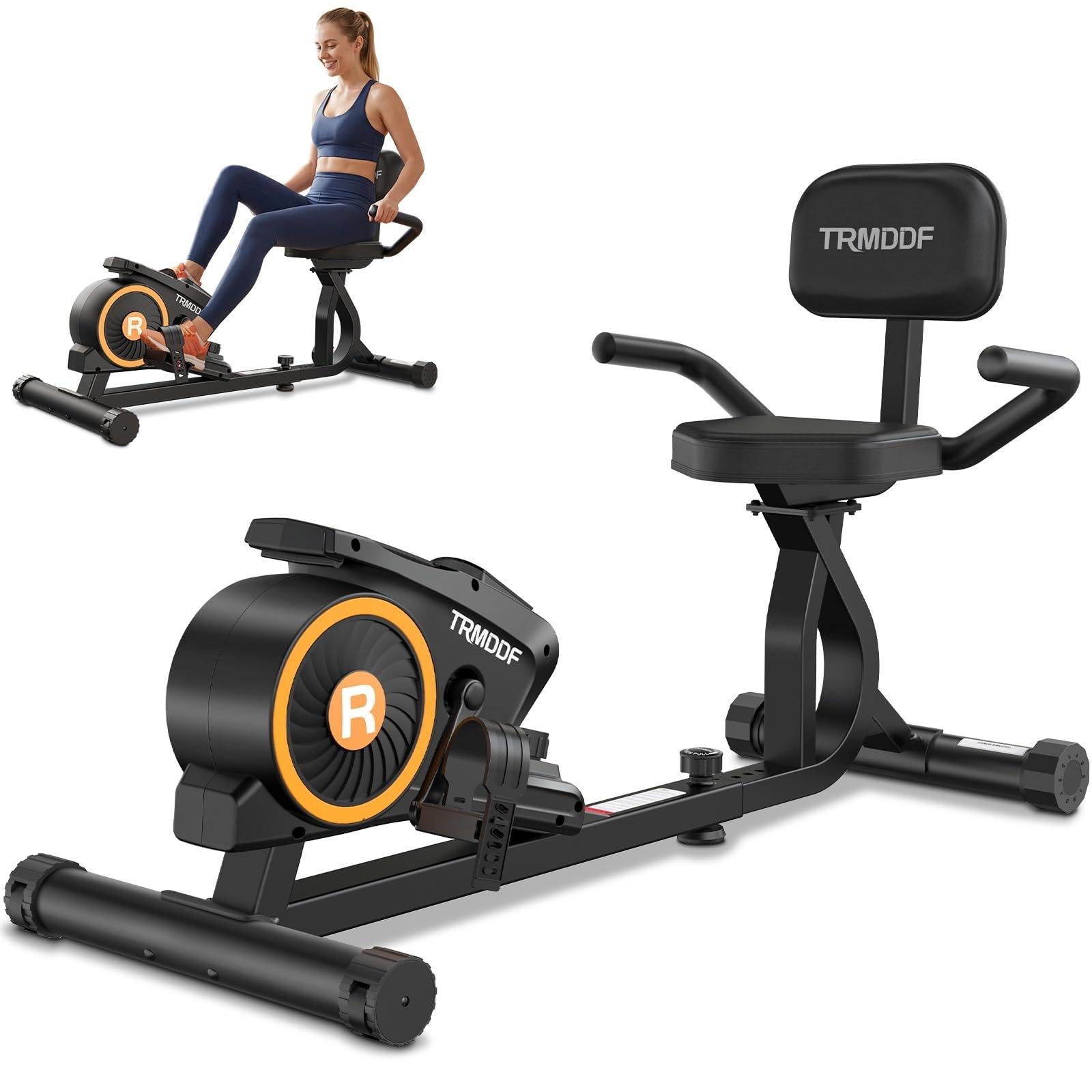
Thirty-five pounds makes this the lightest recumbent in the guide by a wide margin, roughly half the weight of our top pick. That changes what the bike is for: one person can carry it up a flight of stairs, wheel it out of a den, or lean it against a wall between sessions. What it did not change is the rating — a thickened carbon-steel frame still carries 400 pounds.

It arrives 90 percent assembled with a setup that should take about 20 minutes, and the footprint is a compact 47 by 20 inches. Sixteen magnetic levels handle the resistance, the LCD tracks time, speed, distance, calories, and heart rate, and the pedals have safety straps for feet that wander.

We point to it for two buyers: someone putting together a first home setup on the smallest budget in this group, and someone whose bike has to disappear between rides. It handles a gentle warm-up and a hard half hour equally well, and the 400-pound rating means a bigger rider is not gambling on it. Ride it properly in the first month, while the return window is still open.

Bottom line: The lightest bike here at 35 pounds and still rated to 400 — our pick when the bike has to move between rooms.

#2

3G Cardio Elite RB

3G Cardio Elite RB

Long daily rides

Our Score 9.4/10
Check Price

Worth Noting

  • Corded electric; needs an outlet nearby
Frame Warranty
Lifetime frame, 7 years parts
Seat Adjustment
25 fore/aft, 5 tilt positions
Weight Capacity
350 lb
Resistance Levels
16
Read the full review

This is the most expensive bike here by a long way, and the only one built to the standard of the machines in a health club. What that buys is weight and adjustment: a 115-pound frame, a seat that travels through 25 fore and aft positions and tilts through five, and a mesh backrest that flexes against your spine instead of pressing a hard panel into it.

It measures 49 inches long and 27 wide and rolls through a standard doorway on its built-in wheels, which is the difference between a heavy bike you can move and one that owns its corner forever. Sixteen magnetic levels run through a belt drive, Bluetooth connects to third-party apps, and a wireless chest strap comes in the box — heart rate from a strap is worth more than anything the grips can tell you.

Where the money goes is the hour-long ride. The 25 seat positions mean two riders of very different heights can share it without tools, the mesh back keeps you from finishing a session in a damp shirt, and the pedaling stays quiet and planted as the resistance climbs. For 20 minutes three times a week, the top pick does the same job for far less. For daily miles and a bike you intend to keep, this is the one.

Bottom line: Worth the money only if you ride daily and share the bike: 25 seat positions, a flexing mesh back, and a frame built like gym equipment.

#3

XVGVSV W239 Recumbent Bike

XVGVSV W239 Recumbent Bike

Most home riders

Our Score 9.2/10
Check Price

Worth Noting

  • 66 pounds is heavy, wheels or not
Assembly
85% pre-assembled
Item Weight
66 lb
Weight Capacity
400 lb
Resistance Levels
16
Read the full review

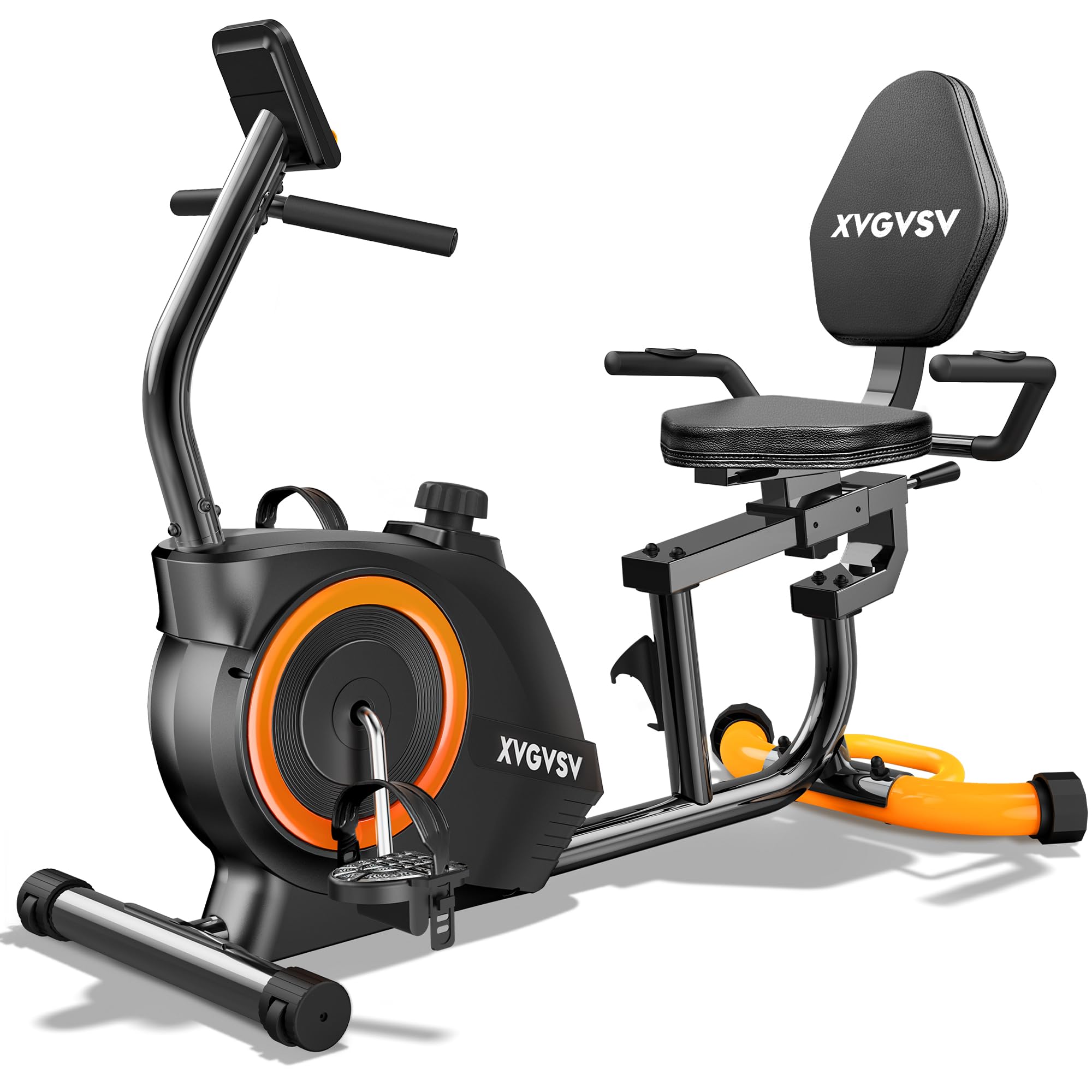
Four hundred pounds is the number that separates this bike from nearly everything else here. On a recumbent, the weight rating describes how much steel sits under the seat, and this one is built on a commercial-grade frame with 16 magnetic resistance levels hung off it. It weighs 66 pounds and arrives 85 percent assembled, which works out to about half an hour of setup.

We made it the default because it is the least compromised bike at the price most people want to spend. The seat slides on a lever rather than a pull-pin, so moving it between two riders takes a second instead of a hunt for the right hole, and the padded seat and backrest are shaped for sitting back rather than perching. Quiet is the other thing we kept noticing: the magnetic resistance runs softly enough to pedal through a television episode without reaching for the volume.

The console covers speed, time, distance, calories, an odometer, and heart rate from grip sensors, and there is a bottle holder on the frame. It is basic — the numbers you actually track, and not much else — and the pedals have adjustable straps for feet that slide. Front transport wheels let you tip the bike up and roll it away, which is how a heavy machine stays welcome in a living room.

Bottom line: Our top pick for most homes: a 400-pound frame, 16 quiet magnetic levels, and a lever-adjusted seat, at a price that undercuts most of this group.

#4

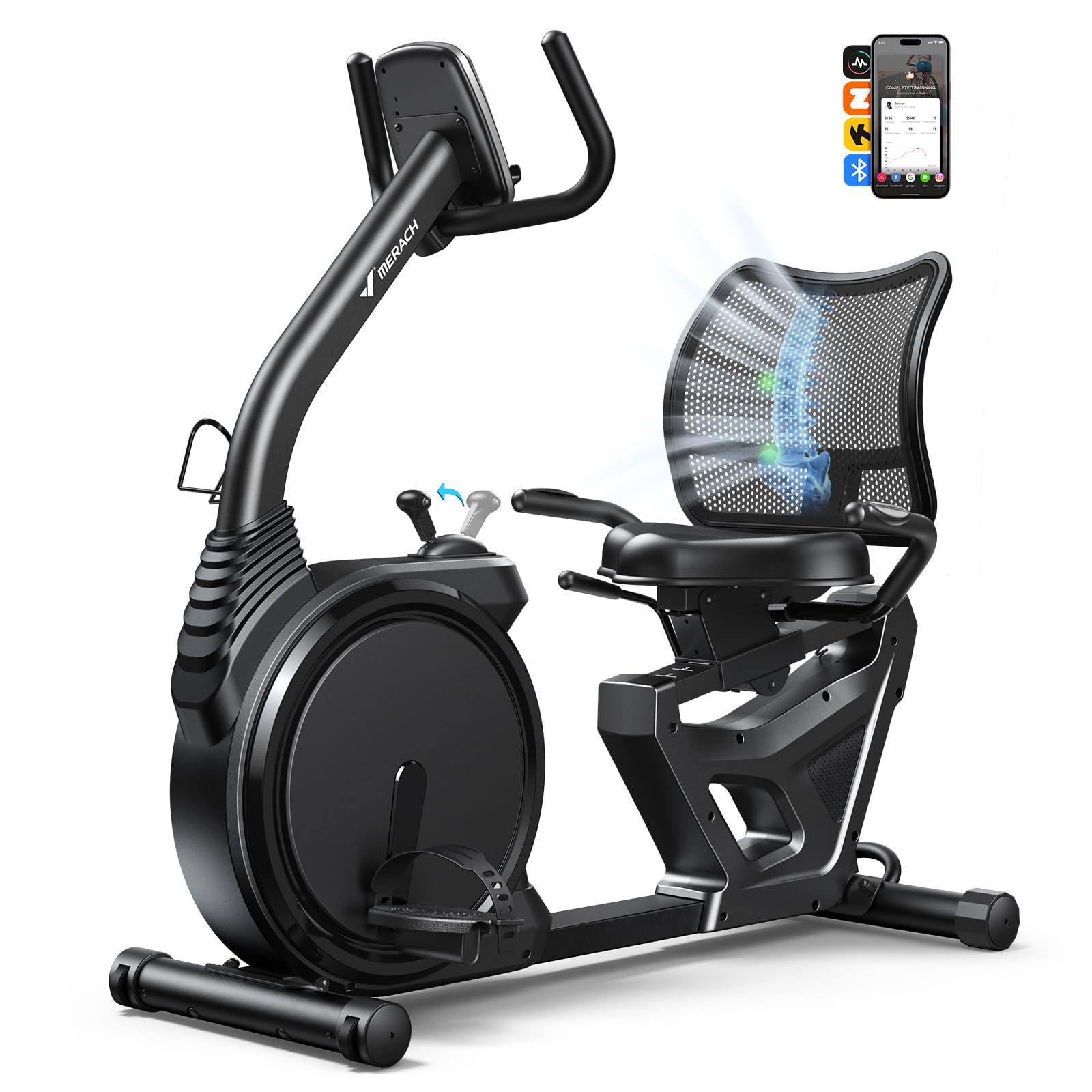
MERACH S19 Recumbent Bike

MERACH S19 Recumbent Bike

Interval resistance changes

Our Score 9.2/10
Check Price

Worth Noting

  • Eight resistance steps, half of most here
Item Weight
85 lb
Weight Capacity
330 lb
Resistance Levels
8
Resistance Control
Car-style lever
Read the full review

Resistance here is changed with a car-style lever rather than a knob you crank, and that single decision shapes the whole ride. Intervals become a flick rather than a break in rhythm, and you can drop a step the moment your legs complain without leaning down to the frame. The lever moves through eight steps.

Eight turns out to be enough. The gaps between the steps are wide, and the pedal stroke stays smooth at the top of the range thanks to a 6.6-pound perimeter-weighted flywheel and a dual-belt drive. An 85-pound frame carrying a 330-pound rider does not move around under you. We point riders who like structured intervals — or who share the bike with a stronger partner — here before the 16-level bikes.

The seat has eight fore and aft positions and a breathable mesh backrest, and the LCD covers time, distance, speed, calories, and heart rate while the free MERACH app logs the same over Bluetooth. It is 48 inches long and runs on batteries, so it goes anywhere with a flat floor. If you are well past six feet, try the seat at its furthest setting before you commit — eight positions is a shorter track than the 3G's 25.

Bottom line: The bike we recommend for interval riders: a car-style lever shifts the eight resistance steps without breaking your cadence.

#5

XVGVSV W241 Recumbent Bike

XVGVSV W241 Recumbent Bike

Arm and leg work

Our Score 9.2/10
Check Price

Worth Noting

  • Costs more than our top pick for the same capacity
Item Weight
66 lb
Workout Modes
Cycling and arm/elliptical
Weight Capacity
400 lb
Resistance Levels
16
Read the full review

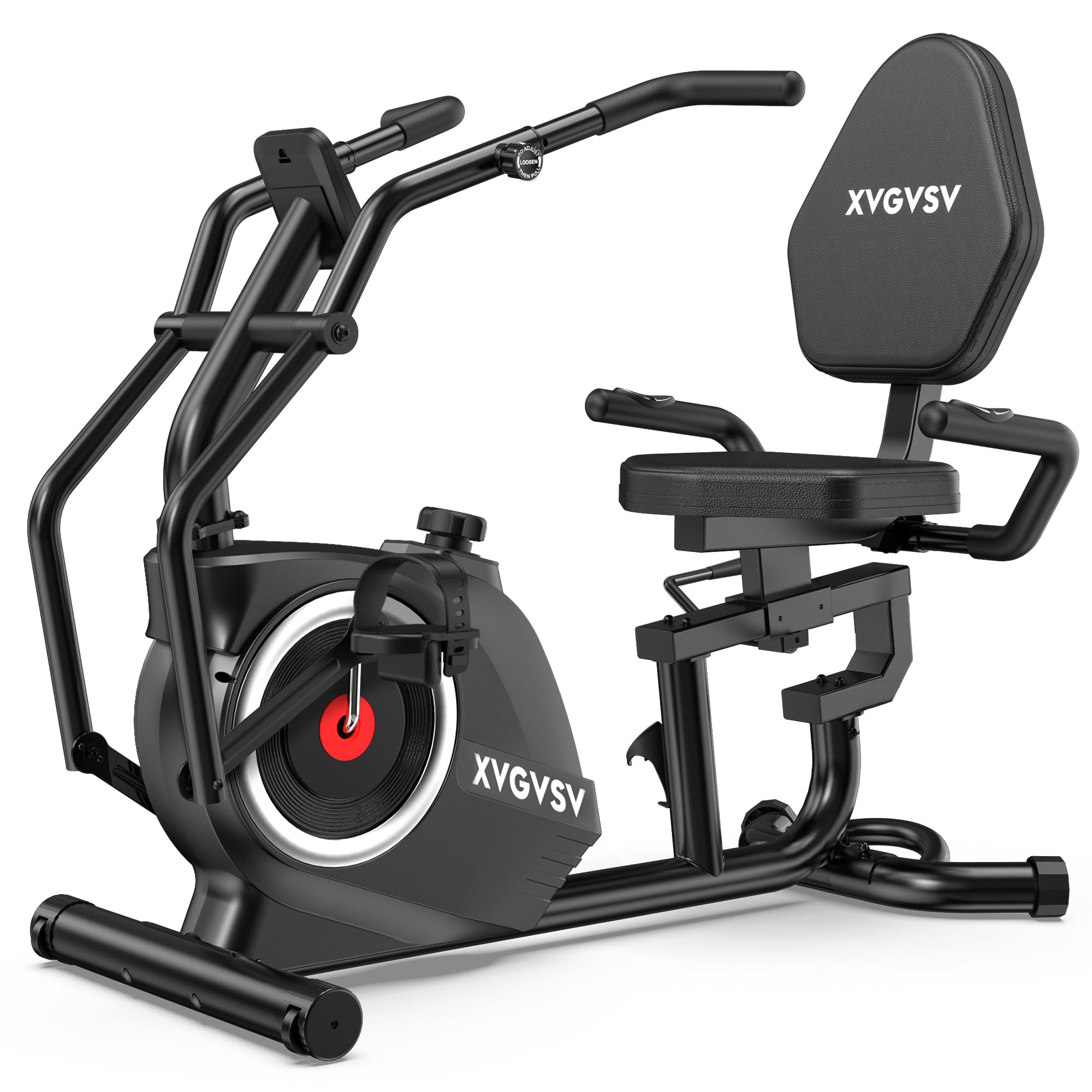
The handles on this bike move with the pedals, pulling your arms through a short elliptical arc while your legs drive. We expected a gimmick and found the opposite: three minutes in, the extra work shows up in your breathing, and a fidgety rider finally has something to do with their hands. It also changes the character of the ride — you are never fully slumped back.

Underneath the arm linkage it is built to the same brief as our top pick: a 400-pound commercial-grade steel frame, 16 magnetic resistance levels, a lever-adjusted padded seat and backrest, front transport wheels, and roughly 30 minutes of assembly out of an 85-percent-prebuilt box. The resistance runs quiet, and the LCD covers the usual time, speed, distance, calories, and heart rate.

Riders who want to sit back, hold still, and let their arms rest on a long steady ride will find the handles pulling them forward, and for pure knee or hip rehab the simpler bike is the easier one to settle into. For anyone who wants arms and legs finished in one session, this is the machine in this group that does it — and it does it on a frame that will take a 400-pound rider.

Bottom line: The one we point to when 30 minutes of legs-only pedaling sounds long: moving arm handles add upper-body work to a 400-pound frame.

#6

Sunny Health & Fitness SF-RB424006

Sunny Health & Fitness SF-RB424006

Upper-body workouts

Our Score 9.0/10
Check Price

Worth Noting

  • 300-pound capacity trails the 400-pound picks
Included
Two 20 lb resistance bands
Item Weight
64 lb
Weight Capacity
300 lb
Resistance Levels
16
Read the full review

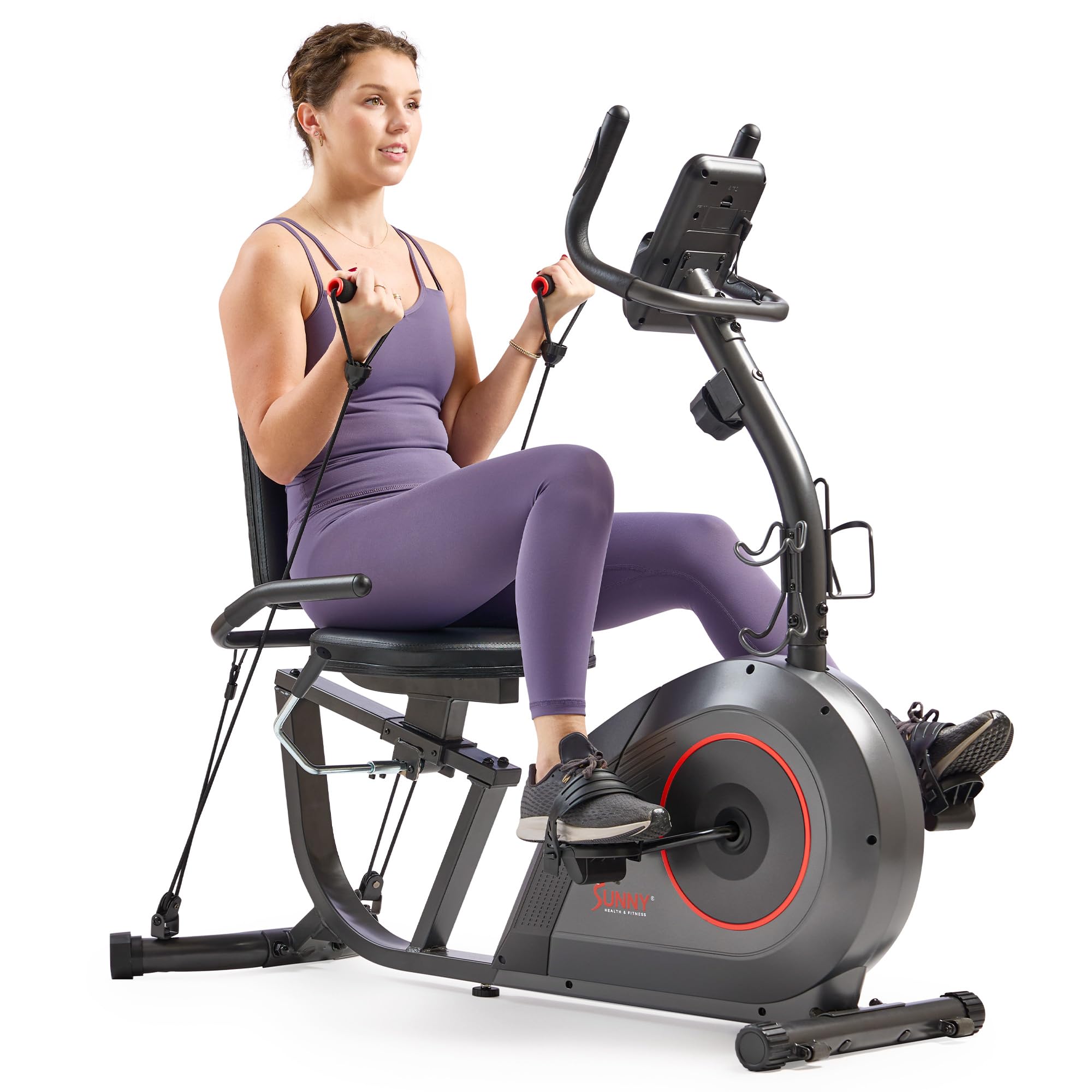
Two 20-pound resistance bands hang off the front on a pulley and swivel, so you can row, press, and pull while your legs keep turning. That is the reason to choose this bike over the cheaper ones here: 30 minutes of seated pedaling is easy to talk yourself out of, and giving your arms a job changes the arithmetic. The swivel matters — it lets the bands travel through a real range of motion instead of one fixed pull.

The rest is a well-sorted 16-level magnetic recumbent with a wide cushioned seat, a padded backrest, belt drive, and grip pulse sensors. The seat spans a 27.2- to 35.8-inch inseam, and the side handle flips out of the way so you can step through and sit down without swinging a leg over the frame — a small detail that matters a great deal in the months after hip or knee surgery.

The SunnyFit app is free, with no membership, and adds trainer-led workouts and scenic rides on a phone or tablet. It is 46 inches long, so it tucks under a window, and the console is plain enough that most riders will end up riding with the app open instead. The bike itself pedals smooth and stays quiet, which is what you want under a training video.

Bottom line: The recumbent we recommend if you want your arms in the workout: two resistance bands and a free app on a smooth 16-level bike.

#7

YOSUDA LRC-01 Recumbent Bike

YOSUDA LRC-01 Recumbent Bike

Small rooms

Our Score 8.8/10
Check Price

Worth Noting

  • Console is not backlit
Dimensions
45 x 20 x 39 inches
Item Weight
58 lb
Weight Capacity
350 lb
Resistance Levels
16
Read the full review

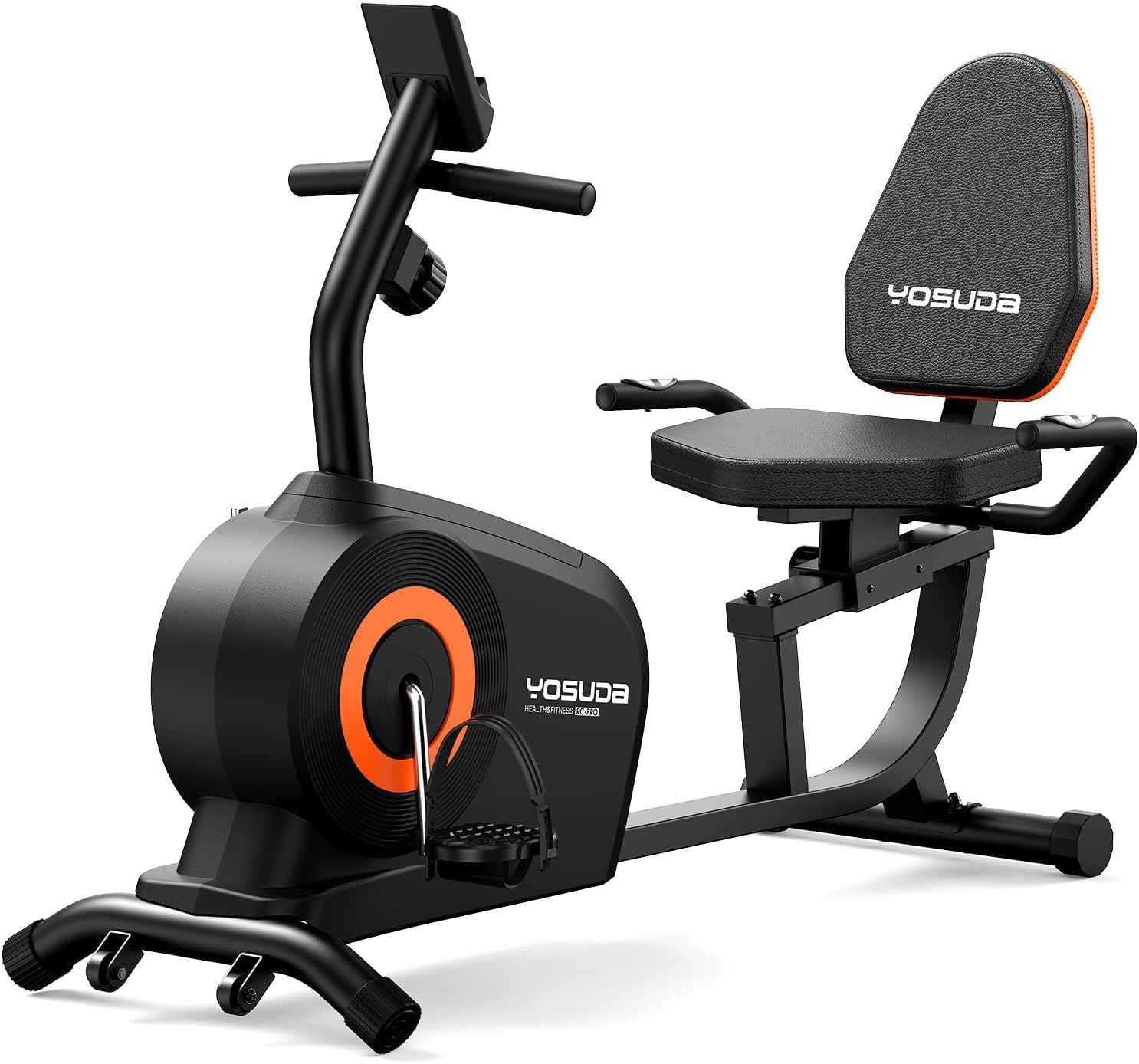
Twenty inches wide and 45 long. Set against everything else in this guide, that is the smallest footprint here — the difference between a bike that lives in the corner of a living room and one that owns a wall. It weighs 58 pounds, light enough for one person to shift on a hard floor, and the step-through frame keeps the mount low.

The build is 16 levels of magnetic resistance on a belt drive, a 350-pound rider rating, and a seat that adjusts with a knob you rotate and pull to seat in the right hole. That is a two-handed job, so swapping between riders takes a moment, but the seat stays where you put it once it is set.

The seat is where the money was saved. The padding is thinner than the top pick's, and a rider who settles in for 45 minutes will probably want a gel cover over it — a small fix next to the floor space you get back. The pedaling itself is smooth and quiet enough to use in a bedroom without waking anyone.

For a small apartment, a spare bedroom, or anyone who wants to push the bike aside when guests arrive, this is where we point. It pedals as quietly as the big bikes, carries a heavier rider rating than the Schwinn, and takes up the least floor of anything here. That combination is why it is our pick for tight rooms rather than a consolation prize.

Bottom line: Our pick for tight rooms: 20 inches wide, 45 long, and still rated to 350 pounds, with 16 magnetic levels and quiet pedaling.

#8

Schwinn 230 Recumbent Bike

Schwinn 230 Recumbent Bike

App-connected riding

Our Score 8.4/10
Check Price

Worth Noting

  • 300-pound capacity is at the bottom of this set
  • 64-inch footprint is the longest here
Connectivity
Bluetooth
Weight Capacity
300 lb
Resistance Levels
16
Rider Height Range
54 to 78 inches
Read the full review

The screen is the first thing to know about. It is a 5.5-inch LCD with 13 built-in programs, and it is not backlit, so in anything short of full daylight you are leaning forward to read it or riding by feel. On a bike at this price, that is an odd place to have saved money, and it defines who this one is for.

The rest is a competent 16-level magnetic recumbent with Bluetooth, Zwift compatibility, and Explore the World routes that speed up and slow down with your pedaling — that last part needs a subscription. The frame is 80 pounds and 64 inches long, the longest footprint here, so give it a wall and leave it there.

The seat and backrest are firm. It is a supportive shape for sitting back and pushing, less forgiving than the cushioned seats on the Sunny or our top pick, and a gel cover helps less here than it would on a saddle-style bike. The warranty is the real draw after the connectivity: 10 years on the frame, two on parts, one on electronics.

We recommend it when connected riding is the point — Zwift on a tablet, the resistance following the route, the miles logged for you. If you want to pedal while the news is on and read your numbers without squinting, the smaller bikes here do that job more comfortably and for a lot less. Neither choice is wrong; they are just different bikes wearing the same shape.

Bottom line: Our pick for connected riding: Zwift and Explore the World on a big screen, with a console that is not backlit and is hard to read in a dim room.

How We Tested Eight Recumbent Bikes Over Nine Months

We started with a list of 40-plus recumbent bikes from retailers and brands we trust, then filtered hard on the things that actually disqualify one: seat height and fore-aft range that couldn't fit a spread of inseams, a step-over that made getting on awkward, weight capacity under 300 pounds, a footprint too big for a normal room corner. Eight bikes across three price tiers survived, and we bought every one at retail and built it ourselves.

Assembly day was its own test. We timed each build solo from unboxing to first pedal stroke, counted how many tools were genuinely needed, and noted whether the pedals were labeled left and right, whether the console mast required a second person, and whether the instructions matched the hardware in the bag. Then we rode hard at high resistance, watching for side-to-side rock, creaks at the seat rail, and stabilizer feet that slid on carpet or scratched hardwood. Every couple of weeks we checked welds, pressed on the plastic housings, and looked for rust where sweat collects.

Comfort runs on a longer clock. We rode 45- to 60-minute sessions and noted where seat padding broke down, whether the backrest mesh held its shape, and whether the seat moved without tools when a shorter rider got on. For noise, we recorded each bike at low and high resistance and pedaled through a phone call while a colleague listened from the next room. We judged the display from an actual riding position: backlit or not, buttons reachable without leaning forward, resistance shown as levels or numbers, and whether app pairing worked. Value got the last word — we tracked prices across the full nine months and asked what each tier actually bought.

How to Choose a Recumbent Exercise Bike

Fit Comes Before Features

On a recumbent you move the seat forward and back rather than up and down, so the specification that matters is travel — how far the seat slides along its rail. Set it so your knee keeps a slight bend when the pedal reaches the bottom of the stroke; a leg that locks straight pushes the work into the joint instead of sparing it.

Travel varies more than you expect. The MERACH S19 offers eight positions; the 3G Cardio offers 25 plus five tilt settings. If two people of different heights share the bike, that range is worth paying for. If you are near six feet or taller, check the furthest-back setting before you buy, and mount from the low side rather than swinging a leg over the frame.

Frame Weight, Capacity, and Floor Space

A 400-pound rating means more steel in the frame, and more steel is usually what stops a bike rocking when you push hard. It is not a perfect proxy — the lightest bike here carries the same rating as one of the heaviest — but a high rating on a very light frame is worth a close look when it arrives, particularly at the welds and the seat post.

Floor space decides as much as anything else. The frames here run 45 to 64 inches long and none of them fold, so compact in a product title describes the footprint, not a bike you can put in a closet. Measure the length, then add a foot behind the seat for getting on and off.

Resistance Levels and How You Change Them

Level count gets advertised heavily and rarely means what shoppers assume. Eight wide steps can cover more useful ground than 16 narrow ones, and what separates a good magnetic unit is whether the low levels feel different from each other — a bike that jumps from almost nothing to hard in three clicks is miserable for anyone rehabbing a knee.

How you change resistance matters as much as how many steps exist. A knob on the frame means reaching down mid-ride; the lever on the MERACH S19 and the console buttons on the Sunny and Schwinn let you shift without breaking cadence. If intervals are the plan, pay for the lever or the console.

Consoles, Apps, and Assembly

Almost every console here shows time, speed, distance, calories, and a heart rate taken from grip sensors — fine for spotting a trend, not for training zones. Two things are worth checking before you buy: whether the screen is backlit, and whether the app costs anything. The Schwinn 230's display has no backlight at all; the SunnyFit and MERACH apps are free to use.

Assembly runs from about 20 minutes to an hour. The step that catches people is the resistance cable, which has to be seated at the right tension before the console registers anything. Connect it before you tighten the mast, and run the resistance through its full range before you put the tools away.

Frequently Asked Questions

Final Verdict

Most homes should buy the XVGVSV W239. It carries 400 pounds, pedals quietly through 16 magnetic levels, and puts the seat on a lever instead of a pin, all for less than most of this group — and it arrives nearly built. Choose the Sunny SF-RB424006 if you want your arms working too, or the 3G Cardio Elite RB if two riders of different heights share the bike daily and you want it to last a decade.