Cardio Machines

Best Recumbent Exercise Bikes for Heavy Riders of 2026

Plenty of recumbent bikes are rated to 300 pounds and feel fine for the first month. Then the seat post starts creaking, the stabilizer feet lift off the floor on the downstroke, and the seat that looked plush in the showroom turns a 30-minute ride into a countdown. A bike actually built for a heavier rider doesn't just survive that — it makes the whole thing unremarkable, which is exactly what you want when you're trying to get on four times a week.

My team has spent the past nine months living with eight of these, from 350-pound-rated frames up to bariatric models, and the same few things separate them: how long solo assembly takes, whether the frame stays quiet at max resistance, and how the seat feels at minute 40. The bikes below earned their spots on sturdiness and comfort for the money, not on feature lists. One thing I'd tell any first-time buyer — the capacity number is a starting point, not a guarantee, so buy a step above your weight and look hard at the seat and resistance unit before you look at the display.

#1

WFLGFT W80601 Recumbent Bike

Top Pick
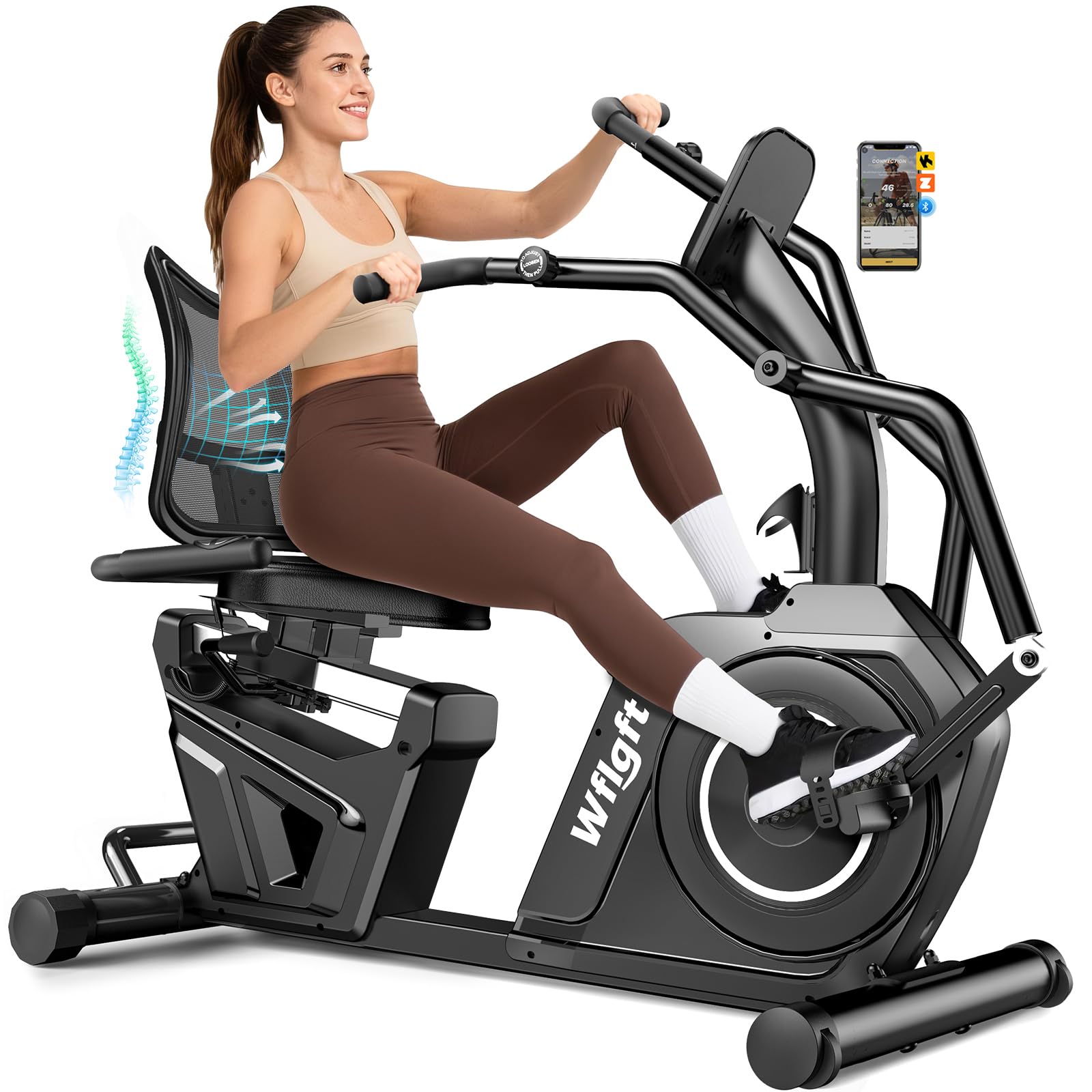
WFLGFT W80601 Recumbent Bike

Heaviest riders

Our Score 9.6/10
Check Price

Worth Noting

  • Top price tier for the capacity
  • 87 pounds is awkward to move alone
Frame
1.5T reinforced steel
Bike Weight
87 lb
Weight Capacity
450 lb
Resistance Levels
16
Read the full review

Four hundred fifty pounds is the number that matters, and it is the highest rating in this group by a comfortable margin. If you sit at or near the top of the weight range, that headroom is not marketing — it is the difference between a frame rated for you and one rated just past you. The rest of the build matches: 1.5T reinforced steel tubing, an 87-pound frame, and a belt drive that keeps the stroke smooth.

We also like that the arm cranks aren't an afterthought. The handles drive a synchronized crank set, so you can push and pull with your arms while your legs work, or leave the arms still and ride it as a plain recumbent. For anyone whose knees limit how hard they can pedal, that's a way to keep the heart rate up without loading the joint. Sixteen magnetic levels and a battery console come along for the ride.

What you trade for that headroom is money and floor space. It sits in the top price tier here, and an 87-pound bike on a 52-inch frame takes two people to shift and a tape measure before you commit to a corner. None of that matters if 400 pounds isn't enough insurance for you, because this is the bike you buy when the rating is the whole point.

Bottom line: Buy this if your weight leaves a 400-pound rating little margin: it's the highest rating here, and the arm cranks add a second way to work.
#2

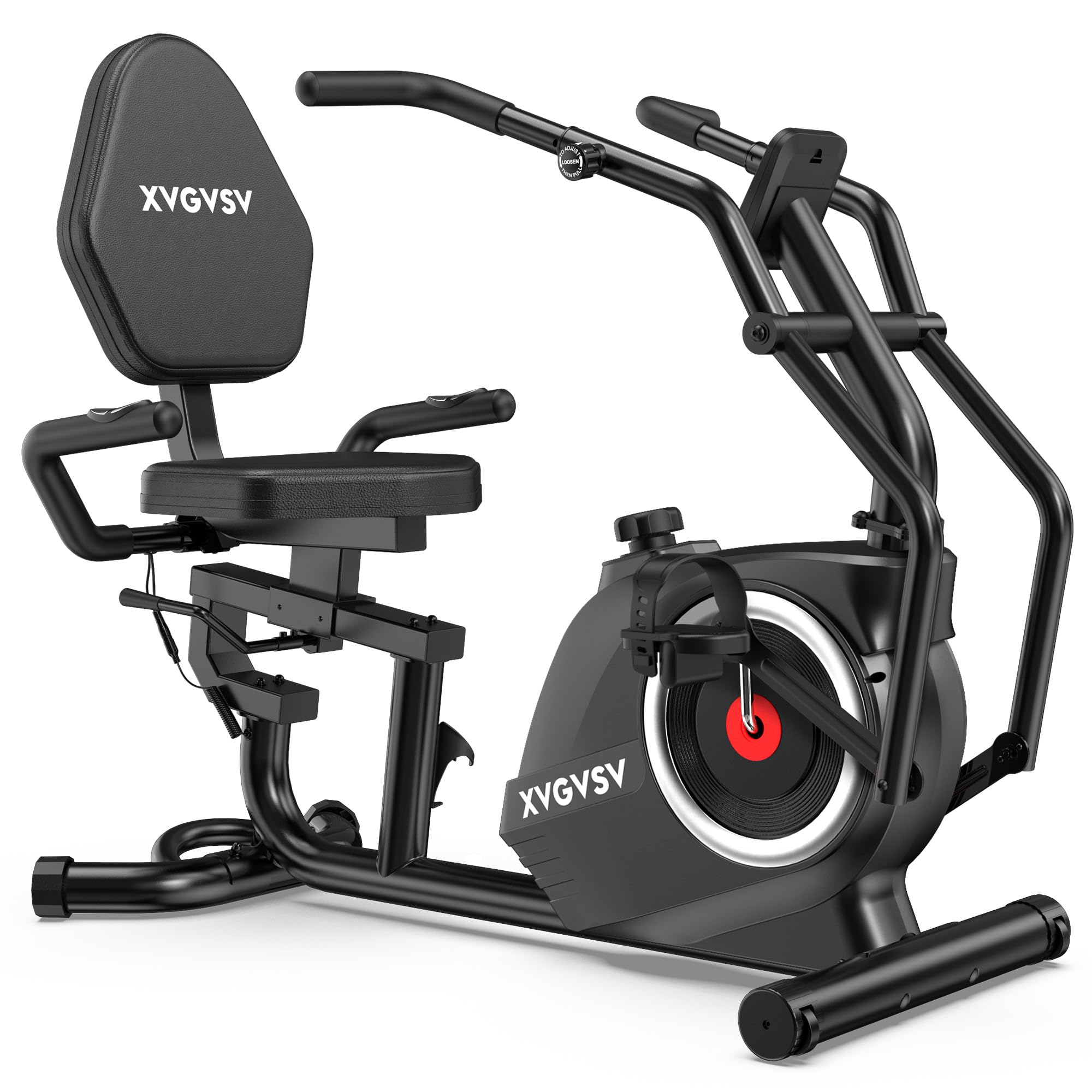
XVGVSV W239 Recumbent Bike

XVGVSV W239 Recumbent Bike

All-round home use

Our Score 9.2/10
Check Price

Worth Noting

  • Manual resistance only, with no app control
Assembly
85% pre-assembled
Bike Weight
66 lb
Weight Capacity
400 lb
Resistance Levels
16
Read the full review

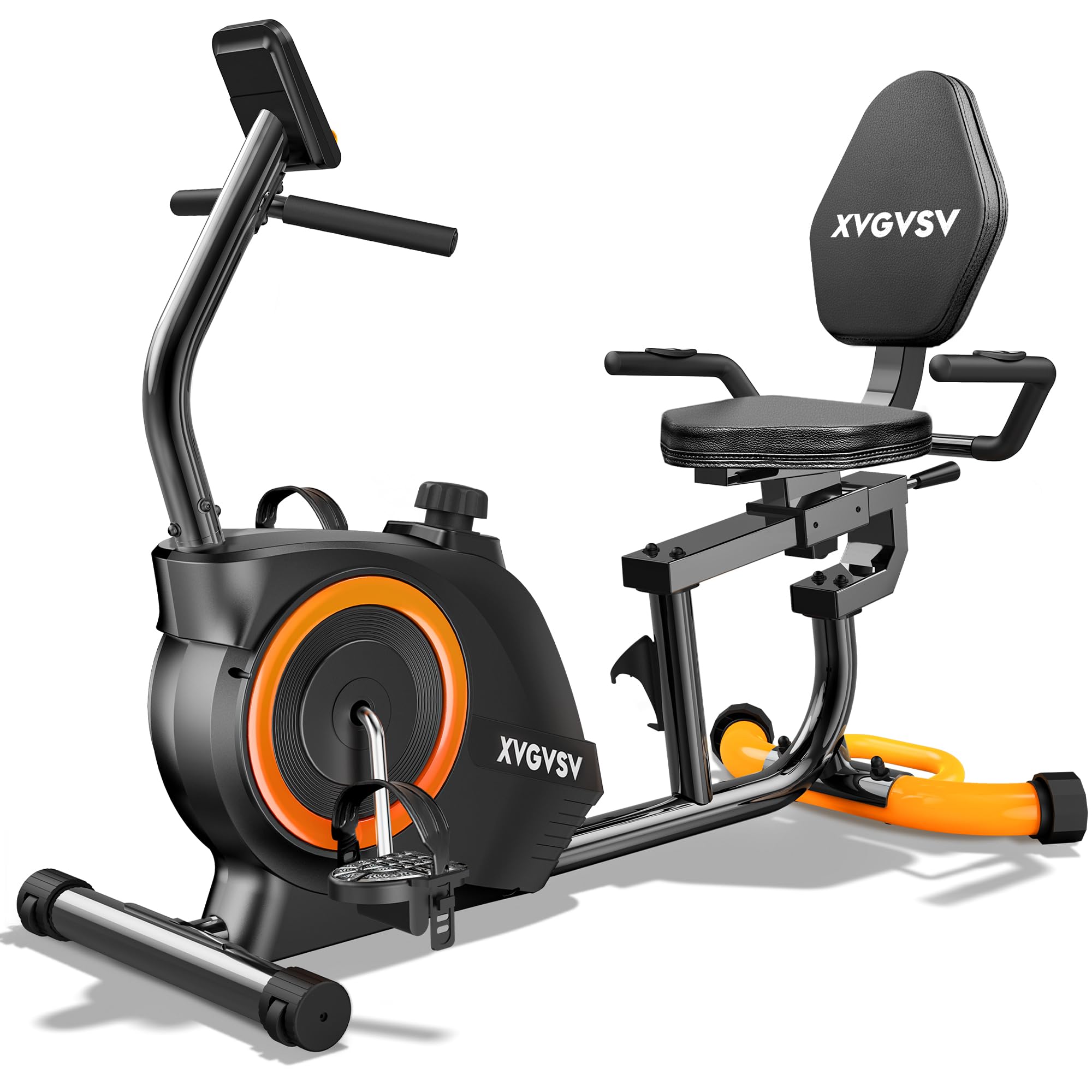
Two things undo a cheap recumbent under a heavy rider: a frame that rocks when you push, and a seat rail that lets the saddle creep backward mid-ride. The W239 clears both without asking for much money. A 400-pound rating on a 66-pound steel frame, a lever-release seat that adjusts in seconds and locks again, and a belt-driven ride that stays smooth and quiet — that combination is why it's the bike we point most heavy riders to first.

It's also the easy one to live with. It arrives 85 percent assembled, so setup is mostly bolting on the seat, console and stabilizers, and there is no cord to route because the resistance comes from the bike rather than a motor. Sixteen magnetic levels run from a flat spin to a genuine climb, and the console keeps speed, time, distance, calories and pulse in view. Front transport wheels let you tip it up and roll it out of the room.

The seat is broad with a mesh backrest, and the lever makes it a five-second job to swap between two riders. Our reservation is the resistance: it's a manual knob with no app control, so if you want an instructor's voice changing the effort for you, this isn't that bike. What it leaves you is budget for a mat and a gel cover, and a machine with fewer things to go wrong.

Bottom line: For most heavy riders this is the one: a 400-pound frame, a seat that locks where you put it, and no power cord to route.

#3

pooboo W216 Recumbent Bike

pooboo W216 Recumbent Bike

Upper-body workouts

Our Score 9.2/10
Check Price

Worth Noting

  • Only eight resistance levels
Flywheel
15 lb
Bike Weight
79.4 lb
Weight Capacity
400 lb
Resistance Levels
8
Read the full review

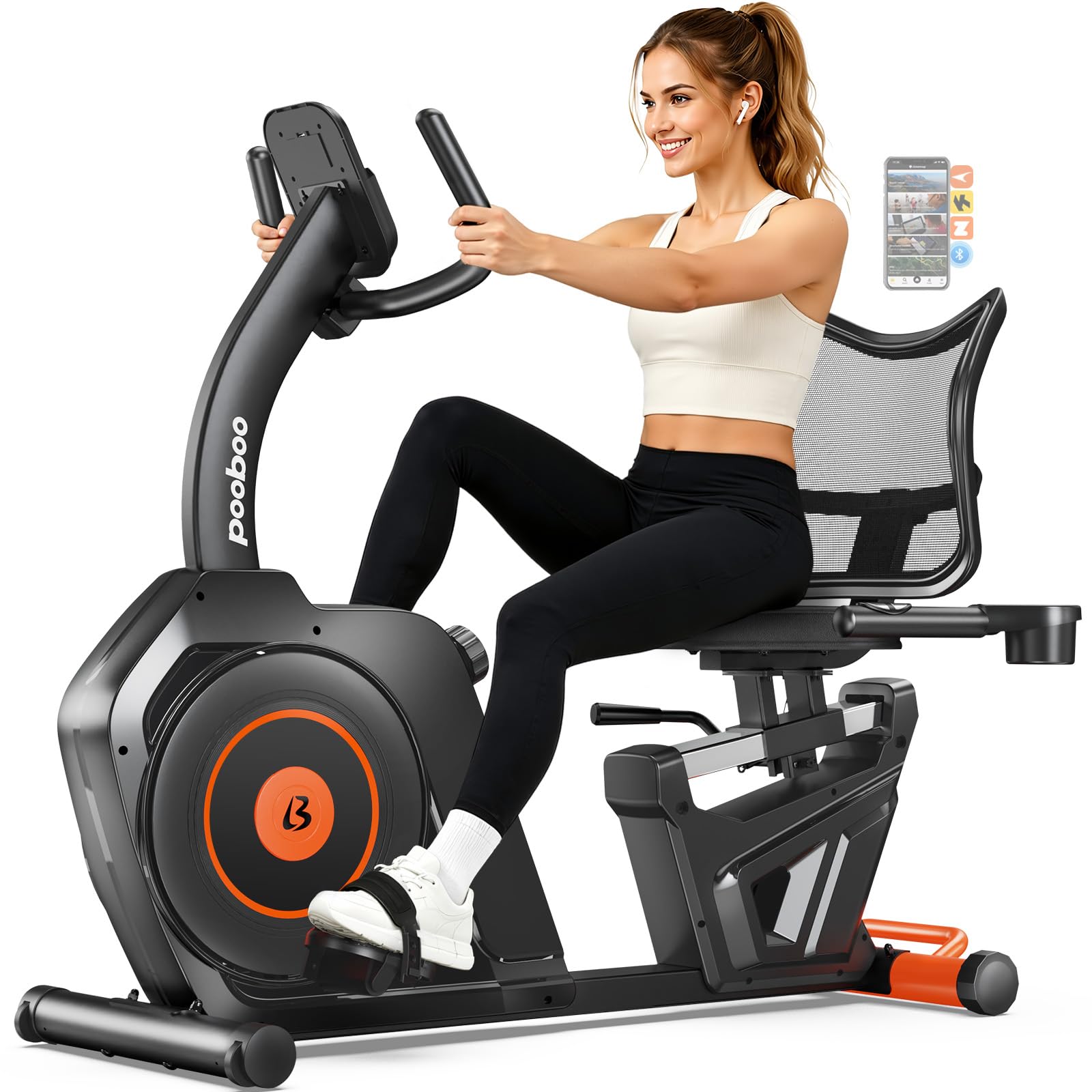
The hand cranks are what earn this one a place. On most recumbents your arms do nothing but hold on; here they drive a second crank set, so a twenty-minute session works your shoulders and back alongside your legs. We think that matters most for anyone who finds pedaling alone dull, or whose upper body has been quietly neglected since a desk job took over.

The frame is rated to 400 pounds and built like a compact: 43 inches long and 18.5 inches wide, the smallest footprint of the 400-pound bikes here. The seat slides on a rail and the front armrest adjusts for height, so a shorter rider can get the reach right, and the mesh backrest is shaped to the spine — in a warm room it breathes better than a padded vinyl one. The belt drive keeps it quiet enough for a shared living room.

Two things to know before you order. Resistance tops out at eight levels, the fewest in the group, so a very fit rider runs out of gears before running out of time. And the seat runs firm; a gel cover is a sensible add-on rather than a sign anything is wrong. For a 300-pound rider who wants a full-body session in a small room, neither is a dealbreaker.

Bottom line: A compact 400-pound recumbent whose hand cranks turn a leg-only ride into a full-body one — best for anyone who wants more from twenty minutes.

#4

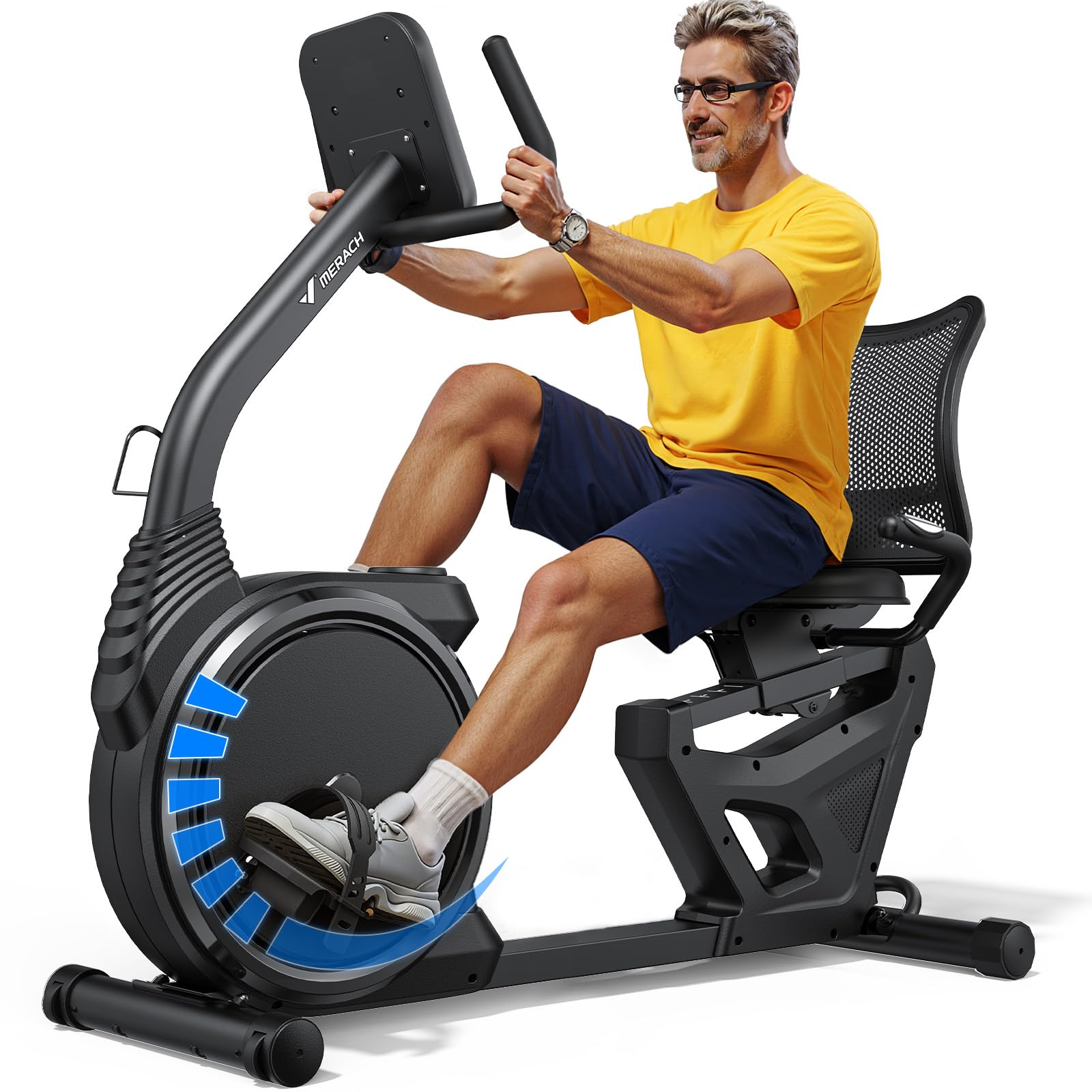
MERACH S19 Recumbent Bike

MERACH S19 Recumbent Bike

Connected training

Our Score 9.2/10
Check Price

Worth Noting

  • 330-pound rating is the lowest here
  • Corded, so it needs an outlet nearby
Bike Weight
98 lb
Weight Capacity
330 lb
Resistance Levels
8
Training Programs
13
Read the full review

Start with the number that decides it: 330 pounds. That is the lowest rating in this group, so if you sit well past 300, stop here and look at the WFLGFT instead. Under that line, the S19 is the most connected bike we'd put in front of a heavy rider — corded, app-linked, and able to change resistance on its own as an instructor calls the next interval.

There is a real difference between an app that logs your ride and one that runs it. The motorized resistance follows the MERACH app, so you spend the session pedaling instead of reaching for a knob, and 13 built-in programs cover the days you don't want a class. The frame underneath is the heaviest of the mid-priced bikes at 98 pounds, with the weight sitting low, so it stays still when you push. It also runs 54 inches long, which gives long legs somewhere to go.

Two costs come with it. It is mains-powered, so it needs to live near an outlet, and at 98 pounds it is not the bike you tuck away between sessions. Eight resistance levels also looks thin next to the Niceday's 32, though in practice the app is doing the shifting. If neither bothers you, this is the most engaging machine here for a rider inside its ceiling.

Bottom line: The most connected bike here: app-driven resistance, 13 programs and a planted 98-pound frame, provided your weight sits under 330 pounds.

#5

XVGVSV W241 Recumbent Bike

XVGVSV W241 Recumbent Bike

Full-body motion

Our Score 9.2/10
Check Price

Worth Noting

  • Firm seat out of the box
Motion
Cycling and elliptical
Bike Weight
66 lb
Weight Capacity
400 lb
Resistance Levels
16
Read the full review

This is the odd one in the group: a recumbent that also runs an elliptical-style stride, so you can drive the handles and the pedals in one motion. It comes from the same maker as our top pick and carries the same 400-pound rating and 66-pound frame, with the linkage added on top.

In practice that linkage is a real second workout and a small complication. More parts are moving, so there is more to check, and the stride is a different rhythm from plain pedaling — expect the first session to feel like learning something. Assembly is quoted at about half an hour, the bike rolls on front transport wheels, and the 48-inch frame fits where a longer machine won't.

Where it earns its place is for the rider whose knees limit hard pedaling but whose arms can take up the slack: the resistance climbs through the legs, and the cranks let you keep the effort up when the knees say stop. Sixteen magnetic levels give you somewhere to go, and the quiet belt drive means a household can carry on around you. If that isn't your situation, the W239 does the same core job with fewer moving parts.

Bottom line: A 400-pound recumbent that adds an arm-driven stride to the ride — worth it if your knees need the legs to share the work.

#6

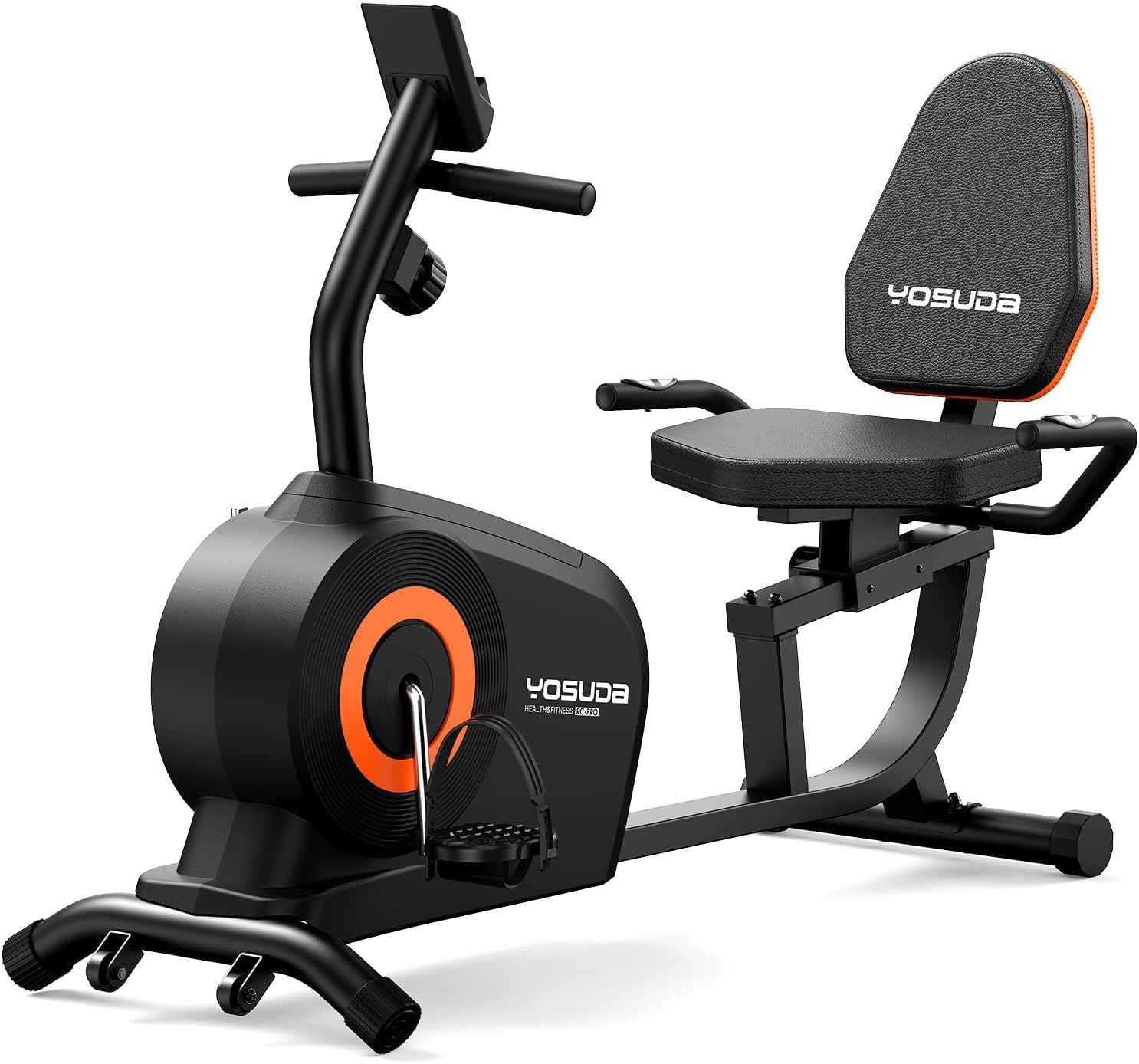
YOSUDA Recumbent Bike

YOSUDA Recumbent Bike

Small rooms

Our Score 8.8/10
Check Price

Worth Noting

  • 350-pound ceiling for a compact frame
  • Console isn't backlit
Drive
Belt
Dimensions
45 x 20 x 39 inches
Weight Capacity
350 lb
Resistance Levels
16
Read the full review

A recumbent is a big object, and plenty of people who would benefit from one don't have the floor for it. This YOSUDA measures 45 inches long, 20 wide and 39 high, so it sits in the corner of a living room or the end of a hallway and stops being something you trip over. The trade is a 350-pound rating, which is the honest ceiling for a bike this size.

The ride itself is quiet and smooth: belt drive, magnetic resistance, 16 levels on a knob, and a seat that adjusts with a pull-and-rotate pin rather than a handful of fixed holes. The console runs on batteries and tracks the basics. It is also the lightest bike in this group, so you can move it yourself when the room needs to be a room again.

The seat is where we'd spend extra. It is the one part of this bike that keeps drawing criticism — padded enough for twenty minutes, less so for an hour — and a gel cover or a swap is money well spent. The display isn't backlit either, so a dim room means squinting at your numbers. Still, for a rider around 300 pounds who needs a bike to vanish into a small space, this is the one we start with.

Bottom line: The compact pick: a quiet, 350-pound-rated bike that fits a corner, as long as you budget for a seat cushion and ride in decent light.

#7

Niceday RC88E Recumbent Bike

Niceday RC88E Recumbent Bike

Program variety

Our Score 8.8/10
Check Price

Worth Noting

  • Dim, hard-to-read console
Bike Weight
84 lb
Weight Capacity
400 lb
Fits Riders Up To
75 inches
Resistance Levels
32
Read the full review

Thirty-two levels of electronic resistance and a 13-program library make this the most feature-dense bike in the group. It is corded, with an 18-pound flywheel, so effort changes at the touch of a button rather than the turn of a knob, and the app can run a session for you. If structure is what keeps you pedaling, that is a genuinely different experience from a manual bike.

The frame is rated to 400 pounds and built for it: 84 pounds of steel, an eight-position seat that fits riders up to 75 inches, and a mesh backrest instead of vinyl. Setup is the least pleasant part of ownership. There is more to bolt together here than on the simpler bikes, so budget an hour and a second pair of hands.

The seat padding is generous, but the track it slides on is the part to watch. A seat that shifts backward mid-stroke turns a steady ride into a nervous one, and a quick check that the pin is fully seated before every ride is the habit that prevents it. Read the capacity decal on the frame before the first session as well — this is one of the bikes where the printed paperwork has carried a lower number than the listing, and the lower number is the safe one.

So the question isn't whether 32 levels beat 16; it's whether you want a bike that runs the session for you. If you do, this is the most capable machine here and the seat-track caution is a small tax. If you prefer to pedal while the news is on, the top pick does the same job with less to check and more left in your pocket.

Bottom line: The most capable electronics here — 32 resistance levels, 13 programs and a motor that shifts for you — for riders who want a plan to follow.

#8

Horizon 5.0R Recumbent Bike

Horizon 5.0R Recumbent Bike

Easy step-through

Our Score 8.2/10
Check Price

Worth Noting

  • 350-pound rating at the top price tier
  • Assembly wants two people
Dimensions
66 x 25.2 x 52.2 inches
Bike Weight
123 lb
Weight Capacity
350 lb
Resistance Levels
100
Read the full review

Swinging a leg over a recumbent is the part nobody mentions until a hip or a knee makes it hard. The 5.0R solves it with a step-through frame — you walk into the bike rather than over it — and pairs that with an extra-large seat with lumbar support and a cooling fan on the console. For anyone with limited hip mobility, that combination is worth more than a resistance count.

Underneath is a 123-pound frame with a 15.4-pound aluminum flywheel and 100 resistance levels, all driven from the cord. Bluetooth FTMS means it talks to training apps rather than locking you into one brand, and the transport handle and wheels let one person shift it around. Assembled, it runs 66 inches long, the biggest footprint here by a wide margin.

The catch is that the parts you pay for don't include much headroom. The rating is 350 pounds, lower than several cheaper bikes in this group, and assembly genuinely wants two people holding parts in line. The resistance range also divides opinion: 100 levels sounds enormous, but the top end won't satisfy a strong rider hunting for a hard effort, so treat the range as fine adjustment rather than a ladder to climb.

So buy it for the access and the seat, not for the capacity. At 300 pounds with a hip that doesn't swing like it used to, the step-through frame and the big padded seat make this the easiest bike here to get on and stay on, and the premium buys comfort rather than strength. If capacity is your priority, the WFLGFT costs less and is rated a hundred pounds higher.

Bottom line: The easiest bike here to get on, with a step-through frame and an extra-large seat — provided 350 pounds leaves you enough headroom.

How We Tested the Best Recumbent Bikes for Heavier Riders

We built the shortlist from published weight capacities, starting at 350 pounds and up, then filtered by frame construction, resistance type, and whether the seat and backrest adjust without tools. Owner reviews kept flagging the same failures — creaking seat posts, feet that lifted, consoles that quit after a few months — so anything showing a pattern of those complaints was cut before it shipped. Eight bikes made it through, and we rode them for nine months.

Assembly was timed solo, using only the tools in the box; we counted the steps that genuinely needed a second person and noted whether the hardware arrived labeled. Then each bike went through a stability check with our heaviest tester, who rode at max resistance while we watched the stabilizer feet for lift, kept a hand on the seat post to feel for flex, and listened for creaks. Every bolt got re-torqued at week four, and we wrote down which ones had backed out.

For comfort, testers logged 45-minute sessions and noted where pressure built up, whether the backrest could be reclined mid-ride, and how the seat felt the next day. On the console, we checked whether the display was readable in a dim basement and whether the resistance buttons were reachable without leaning forward. We stepped through every resistance level, paying attention to whether the jumps were smooth and whether the top setting actually felt hard. Value came last: what each bike cost against how it was holding up by month nine.

How to Choose Recumbent Exercise Bikes for Heavy Riders

Read the weight rating as a ceiling, not a target

Every bike here is rated somewhere between 330 and 450 pounds, and the number to look for is one that leaves margin above your own weight. A bike rated at exactly what you weigh is working at its limit on every hard interval. The other half of the job is what sits under the rating: our top pick carries 400 pounds on a 66-pound frame, the WFLGFT carries 450 on an 87-pound one.

When the bike arrives, find the decal on the frame and read it. Where the printed manual and the listing disagree, the lower number is the one to ride to, and it costs nothing to check before the first session.

Frame weight buys the stability you feel

A 58-pound bike and a 123-pound bike can carry similar ratings and feel nothing alike under a hard effort. Mass low in the frame is what stops the bike walking sideways when you push, and it is also what makes the thing awkward to move. Look for a heavy frame, a low center of gravity and transport wheels, then decide which matters more in your room.

The Horizon is the most planted and least portable bike here; the YOSUDA is the lightest and the easiest to shift out of the way. Neither choice is wrong, but they suit different rooms.

The seat rail is where cheap bikes give trouble

Padding gets all the attention, but the mechanism holding the seat is what decides whether a ride feels secure. A lever or pin that drops into a hole holds its position; a friction clamp can creep backward under hard pedaling, which is unnerving at speed and worse for a heavier rider. Look at how the seat locks and whether the track is steel before you buy.

After it arrives, check that the pin is fully seated every time you get on. It is a thirty-second habit that removes most of the risk.

Get the mount and the seat height right

A recumbent should be easy to get onto, which means a low step and a seat you can reach without lifting a leg over a tube. Step-through frames, like the Horizon's, are the simplest of all. Seat height matters just as much: too low and your knees come up toward your chest, too high and your hips rock with every stroke.

Set it so the knee keeps a slight bend at the bottom of the pedal stroke, then note the position. Most of these bikes mark or number the settings, which makes it repeatable when two people share the machine.

Pay for the resistance and console you will actually use

Manual magnetic resistance with 16 levels is plenty for most riders, and it never needs an outlet. Corded electronic resistance buys app control, automatic changes and, on the Niceday, 32 levels. That is genuinely more engaging if you follow structured workouts, and genuinely pointless if you pedal while the evening news is on.

Consoles are the least reliable part of any budget bike, so don't choose on the display. Choose on the frame and the seat, then treat the electronics as a bonus.

Frequently Asked Questions

Final Verdict

Buy the XVGVSV W239. It carries a 400-pound rating on a frame heavy enough that you feel the difference, holds its seat where you set it, and sits in the lowest price tier here, which leaves room for a mat and a cushion if you want them.

If your weight leaves a 400-pound rating too little margin, step up to the WFLGFT and its 450-pound frame. If the bike has to live in a corner of a small room, the YOSUDA is the one that disappears.