Cardio Machines

Best Recumbent Exercise Bikes for Seniors of 2026

The first thing to go wrong with a recumbent bike usually isn't the electronics—it's the getting on. A frame that sits too high, a seat that won't slide forward, a machine that rocks every time you push: any of those turns a daily ride into something you quietly skip. A good recumbent takes balance out of the equation. You step through, sit back against a full backrest, and put your feet out in front, so the work lands in your legs, not your lower back.

I've watched too many exercise bikes become towel racks, so my bias was simple: the right one is the bike you climb on without thinking. My team and I spent six months riding eight recumbent bikes, with testers in their sixties through eighties and from 5-foot-2 to 6-foot-1. Seat-to-pedal distance decides more than any feature—too close and your knees ache by minute ten, too far and your hips rock. Everything below was judged on that, plus how quietly each bike runs and how much assembly stands between you and the first ride.

#1

WFLGFT W80601 Recumbent Bike

Top Pick
WFLGFT W80601 Recumbent Bike

Full-body workouts

Our Score 9.6/10
Check Price

Worth Noting

  • 87 pounds to shift between rooms
Item Weight
87 lb
Arm Exerciser
Linked to pedal stroke
Weight Capacity
450 lb
Resistance Levels
16
Read the full review

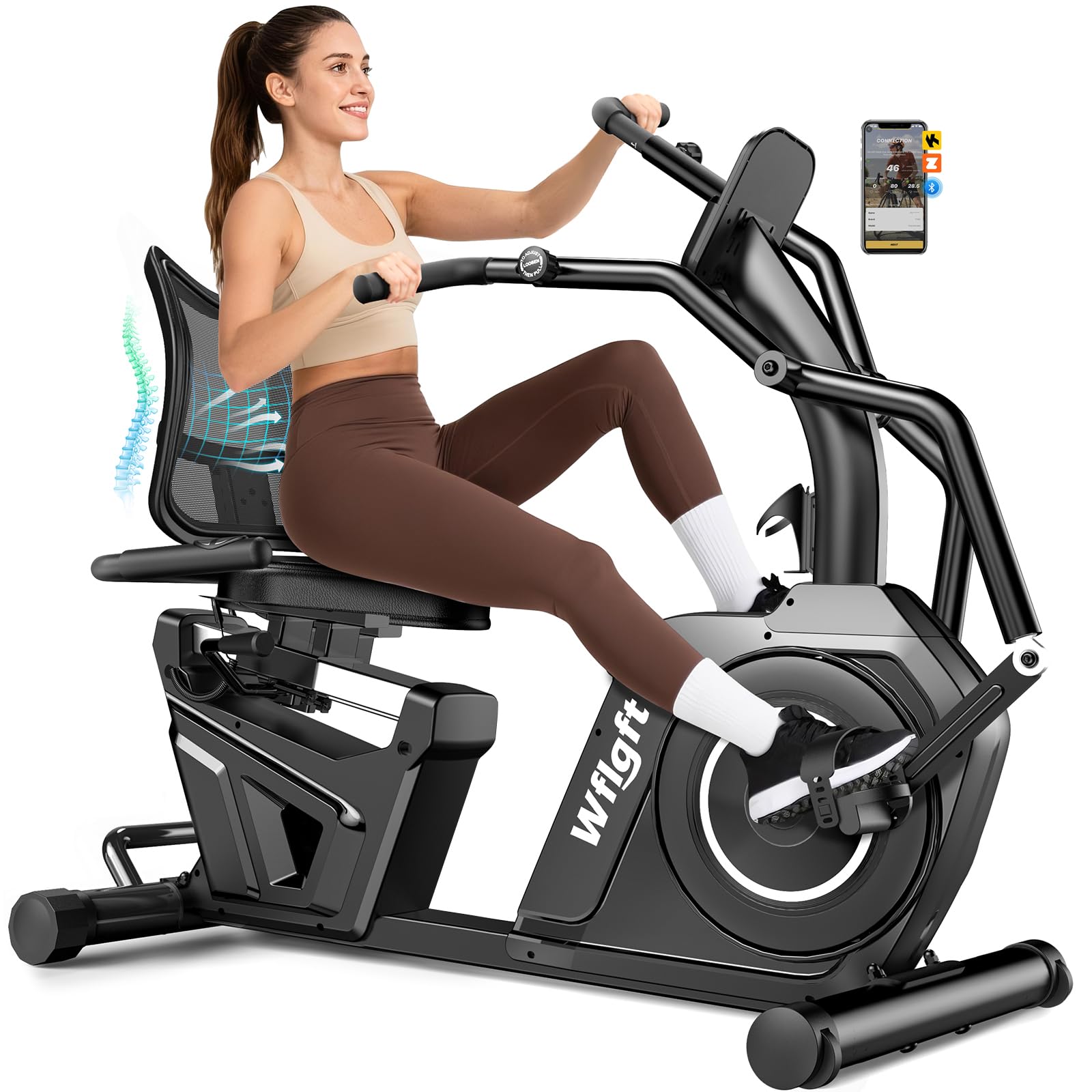
Four hundred and fifty pounds is the highest rating here, and the frame is built for it — reinforced steel tubing, a wide base, and a step-through that still lets you sit down without lifting a leg over anything.

What separates it from every other bike on this page is the arm linkage: the handles swing as you pedal, so ten minutes works your shoulders and back along with your legs. We think that is a real answer for a rider whose doctor has told them to keep the upper body moving, and it's why the price sits above the budget bikes rather than a gimmick you pay for once and then ignore.

The rest is solid — 16 magnetic levels, a belt drive quiet enough for a shared room, Bluetooth app logging and adjustable footstraps. Assembly is the one chore; an hour is realistic if you spread the parts out first.

Bottom line: We recommend it for whole-body sessions: it is the only bike here that moves your arms with your legs, and it carries the highest rating in the group.
#2

TRMDDF W356 Recumbent Bike

TRMDDF W356 Recumbent Bike

First bike

Our Score 9.6/10
Check Price

Worth Noting

Setup
90% pre-assembled
Item Weight
35 lb
Weight Capacity
400 lb
Resistance Levels
16
Read the full review

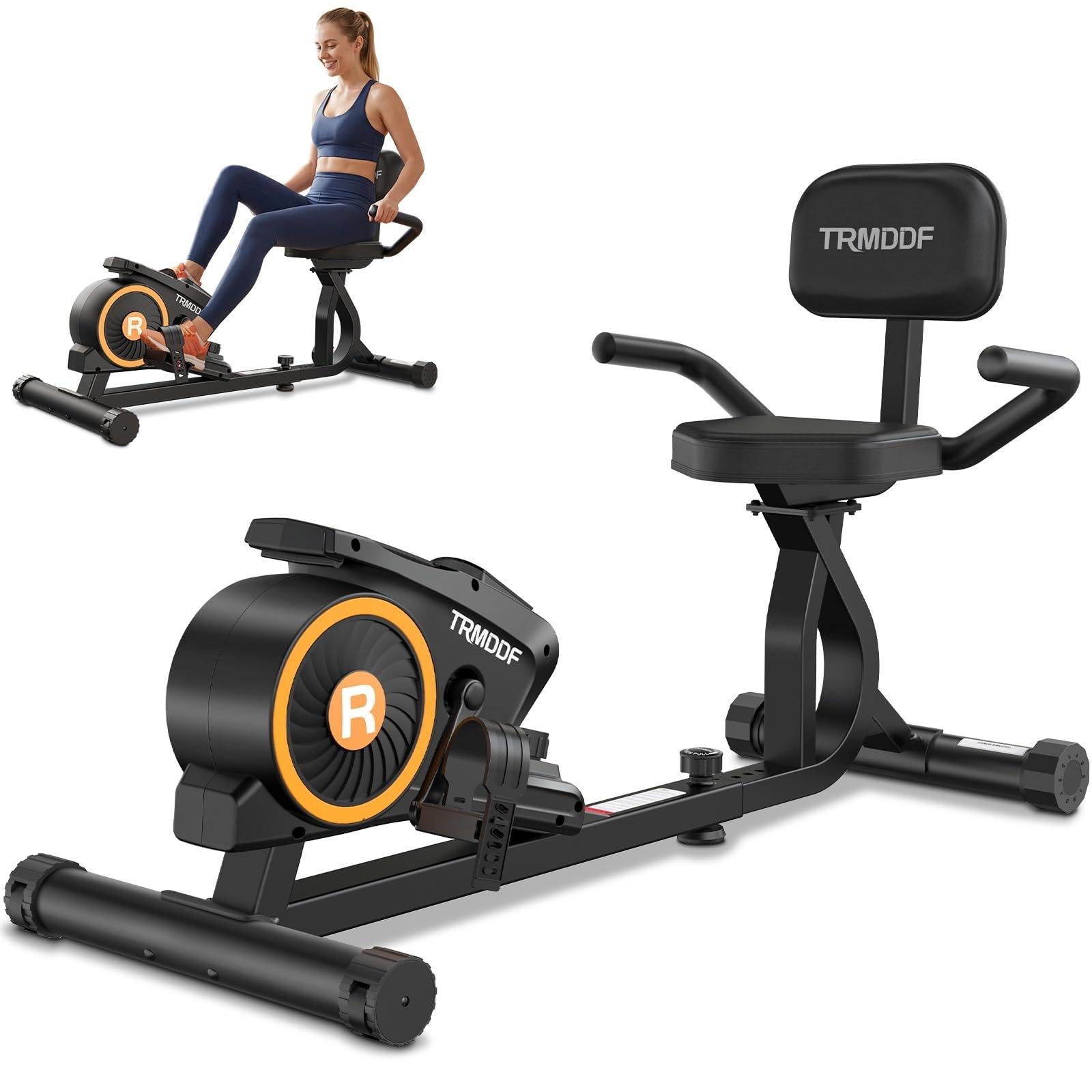
Thirty-five pounds is startling for a bike rated to 400, and it changes how you live with the thing: one person can carry it from the bedroom to the living room, or stand it against a wall when guests arrive.

It arrives 90 percent assembled and takes about twenty minutes to finish, the quickest start here. Underneath the light frame is a thickened steel spine, 16 magnetic resistance levels and a console that tracks time, speed, distance, calories and heart rate. Nothing about it reads as a toy, which surprised us.

It runs quietly and measures 20.4 inches across, so it tucks into the same slot as the YOSUDA. If you are buying your first recumbent after a diagnosis or a long layoff, this is a low-risk way to find out whether you will use one; it won't match the heavier bikes for heft, but it does the same job for less money.

Bottom line: We point first-time buyers here: the lightest and least expensive bike in this group, and it arrives nearly finished.

#3

3G Cardio Elite RB Recumbent Bike

3G Cardio Elite RB Recumbent Bike

Buy once

Our Score 9.4/10
Check Price

Worth Noting

  • 115 pounds, the heaviest bike here
  • Corded, so it needs an outlet nearby
Warranty
Lifetime frame, 7 years parts
Footprint
49 x 27 x 43 in
Seat Adjustment
25 fore/aft, 5 tilt
Weight Capacity
350 lb
Read the full review

Nothing else here costs anything like this, and we noticed the money goes into adjustment rather than badges. The seat moves fore and aft through 25 positions and tilts through five, the mesh backrest reclines to match, and the fit is quoted as covering riders from 5 feet to 6 foot 5.

That range is the reason to buy it. Most recumbent seats offer a handful of holes and hope; this one lets a 5-foot-2 rider and a 6-foot-4 rider each find the same pedaling geometry, which is what keeps a knee quiet after twenty minutes. The build matches the price: a steel frame that sits planted when you push the resistance up.

It rolls through a standard doorway on its built-in wheels, which most 49-inch bikes cannot manage, and the console pairs over Bluetooth with the heart-rate strap included in the box.

Then there is the warranty: lifetime on the frame, seven years on parts. If you are buying the last bike you intend to own, that arithmetic works.

Bottom line: We call it the buy-it-once choice: the most adjustable bike here, built to gym standards and backed by a lifetime frame warranty.

#4

XVGVSV W239 Recumbent Bike

XVGVSV W239 Recumbent Bike

Most riders

Our Score 9.2/10
Check Price

Worth Noting

  • 66 pounds; a two-person lift on stairs
Setup
85% pre-assembled
Item Weight
66 lb
Weight Capacity
400 lb
Resistance Levels
16
Read the full review

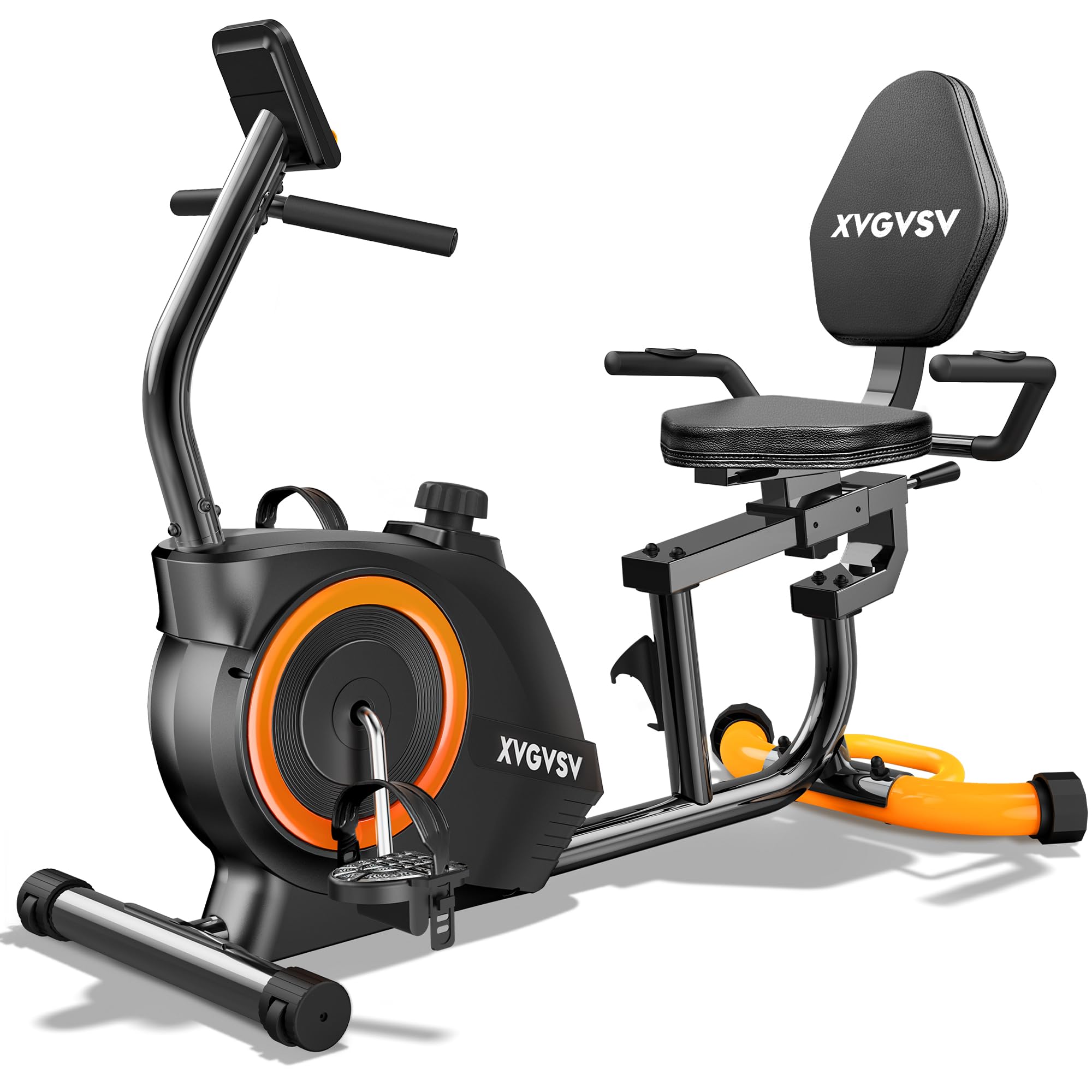
Most of this bike is already built when you lift it out of the carton — XVGVSV quotes 85 percent — and the remaining steps are bolts you can turn with the included tools in about half an hour. That head start matters more than it sounds. The bikes that get used are the ones standing in the room the weekend they arrive; the others sit in a hallway with the manual resting on the seat.

It tops our list because it handles the essentials without charging extra for them. The seat is wide and padded with a backrest you can actually lean into, and the lever under the seat slides it through a usable range without a pin to line up in poor light. The frame carries 400 pounds, a rating only the WFLGFT beats, and the 16 magnetic levels run from a slow rehab spin to something that makes you sweat.

Quiet is what we noticed most in use. The belt drive is close to silent, so the bike can sit in the corner of a living room during a phone call or an episode of something. The front wheels let you tip it and roll it aside, and the footstraps hold a slipper in place through the top of the stroke.

The console gives you time, distance, speed, calories and a pulse reading from the handle grips, with no subscription attached to any of it. If you want workouts logged to a phone, the VANSWE and both MERACH bikes do that; this one just pedals, quietly and comfortably, which is what most people in this seat need.

Bottom line: We point most seniors here: a 400-pound frame, a supportive backrest, a quiet belt drive and an assembly that is nearly finished in the box.

#5

MERACH S19 Recumbent Bike

MERACH S19 Recumbent Bike

Weak grip

Our Score 9.2/10
Check Price

Worth Noting

  • Only eight resistance levels, so the jumps are coarse
Item Weight
85.5 lb
Seat Positions
8
Weight Capacity
330.7 lb
Resistance Levels
8
Read the full review

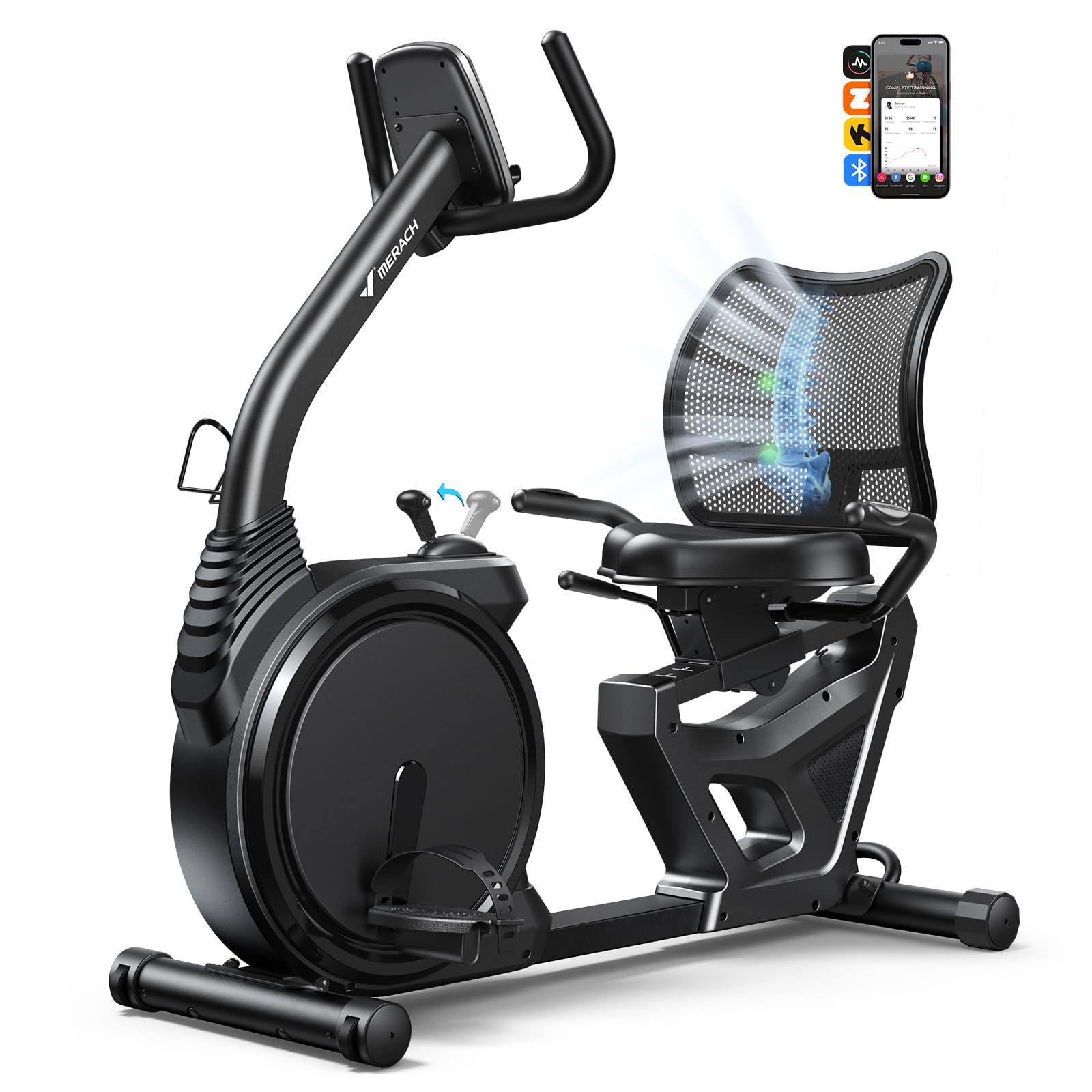
A short throw of a car-style lever changes the resistance here, and your hand never has to hunt for a knob behind your hip. For arthritic thumbs or a weak grip, that one detail decides the purchase: you can drop a level the moment a knee complains and pick it back up when it settles.

We also rate it as the coolest-backed bike in this group. The backrest is a breathable mesh panel rather than a vinyl pad, so you don't finish a session with a damp patch, and the eight-position seat sits on a generous cushion. The 6.6-pound perimeter-weighted flywheel keeps the stroke smooth all the way up the range.

The frame carries 150 kg, comfortably above the 300-pound bikes here, and the MERACH app pairs over Bluetooth to log distance, time, calories and heart rate. The console shows the same numbers for anyone who prefers not to bother with a phone.

Bottom line: We like it best for sore hands: the shift lever changes resistance without a knob, and the mesh backrest keeps a warm room comfortable.

#6

XVGVSV W241 Recumbent Bike

XVGVSV W241 Recumbent Bike

Arms and legs

Our Score 9.2/10
Check Price

Worth Noting

  • Costs more than the W239 for the same capacity and levels
Item Weight
66 lb
Extra Motion
Elliptical arm stride
Weight Capacity
400 lb
Resistance Levels
16
Read the full review

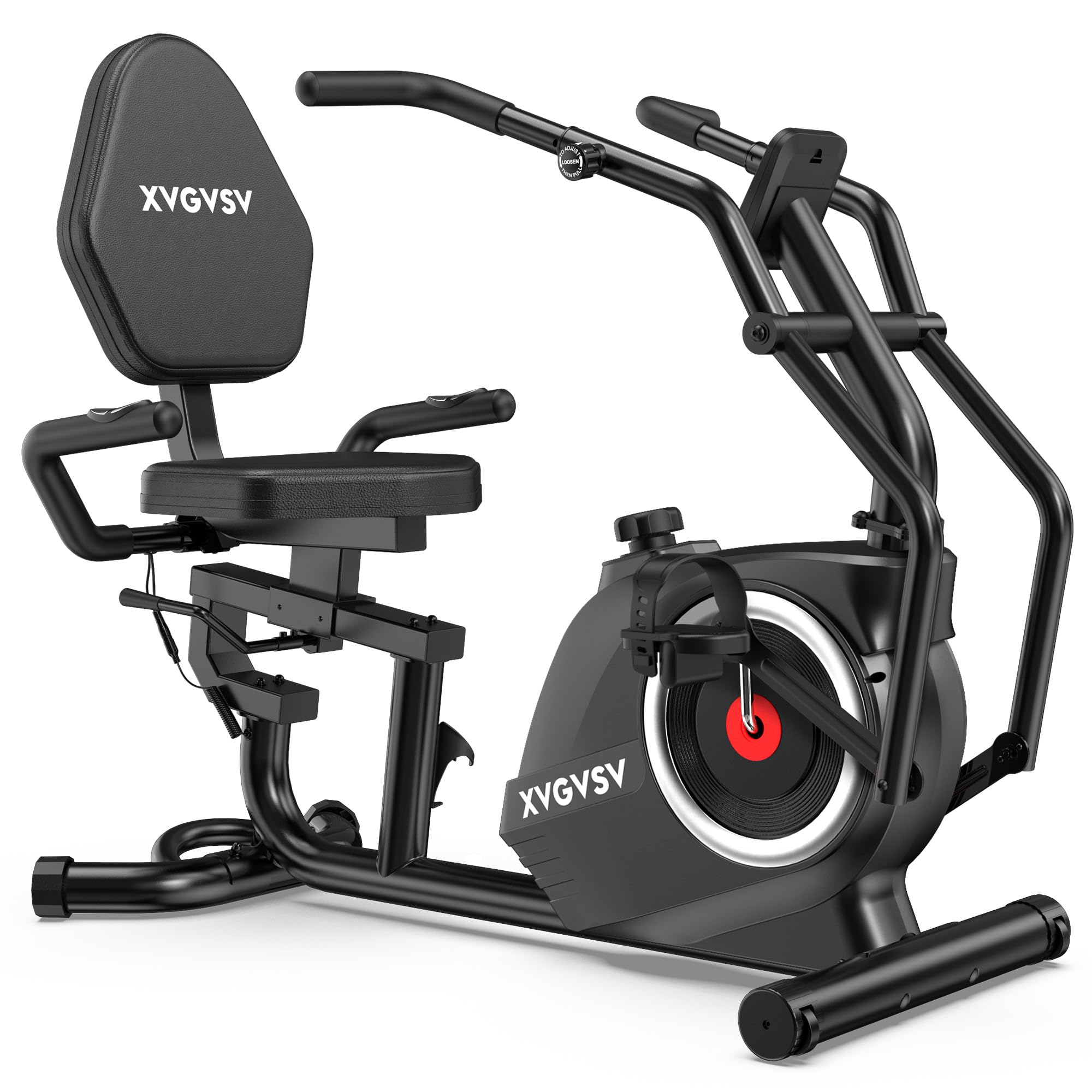
The question this bike poses is whether you want your arms in the workout. If the answer is yes, the stride handles add a second motion to the pedal stroke and turn twenty minutes into something closer to a full-body session. If the answer is no, you are paying for linkage you will never touch.

Mechanically it shares the W239's 400-pound rating and 16 magnetic levels, and it arrives 85 percent assembled with the same transport wheels. The difference is the upright handle assembly and the stride arms, which replace the plain side handles.

It stays quiet, and we found the seat and backrest padded much the same way as the W239's. The console adds heart rate to the usual time, distance and calorie readouts. It is a good machine for the right rider; that rider just has to want the arm work.

Bottom line: We like it for riders who want their arms working too: a recumbent and a light elliptical in one frame.

#7

VANSWE RB661 Recumbent Bike

VANSWE RB661 Recumbent Bike

Shared bikes

Our Score 9.0/10
Check Price

Worth Noting

  • Seat rail needs a firm hand to lock
  • Assembly instructions are the weakest here
Display
Back-lit LED
Leg Range
29–37 in
Weight Capacity
380 lb
Resistance Levels
16
Read the full review

The seat runs along a rail and clamps wherever you leave it instead of clicking through fixed holes, covering a 29- to 37-inch leg in the company's figures. We like that for a shared bike: one person finishes, the next steps on, pulls the lever and rides. No pin to lose, no counting holes in poor light.

The back-lit LED display is the other detail that earns its keep. It sounds like a luxury until you are pedaling in a dim room with the television on and can still read your own time. Bluetooth pairing to free fitness apps adds structure for anyone who wants it, and the bike runs perfectly well without a phone.

Underneath, the frame is rated to 380 pounds, the 16 resistance levels use ten magnets, and the steps build evenly rather than jumping. At 53 pounds it moves across a room on the transport wheels without a second person, and the backrest holds you upright rather than tipped into a recliner.

Assembly is the one chore. The instructions are the weakest part of the package, so give yourself an unhurried evening, keep the parts bag labelled as you unpack, and don't tighten anything until the console mast is seated.

Bottom line: Our pick for a shared bike: two riders of different heights can swap places without a wrestling match, and the backlit screen stays readable in a dim room.

#8

Sunny SF-RB424006 Recumbent Bike

Sunny SF-RB424006 Recumbent Bike

Guided workouts

Our Score 9.0/10
Check Price

Worth Noting

  • 300-pound capacity, the lowest rating in this group
  • Low resistance steps feel much the same
Included
Two 20 lb resistance bands
Inseam Range
27.2–35.8 in
Weight Capacity
300 lb
Resistance Levels
16
Read the full review

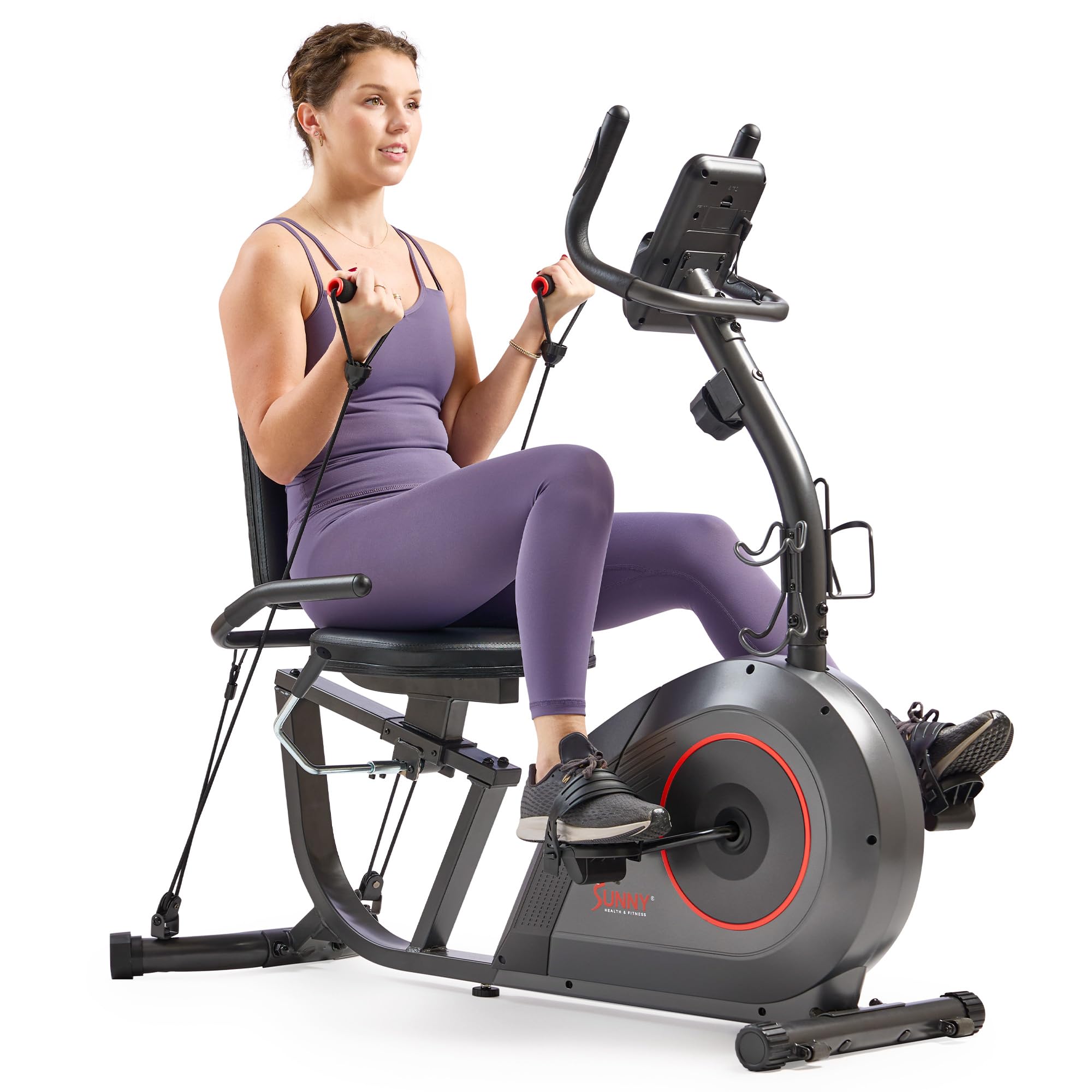
A side handle that flips out of the way is the detail we appreciate most on this Sunny. You stand beside the bike, swing the arm clear, lower yourself onto the seat and pull it back within reach — no lifting a leg over a frame, no grabbing at air on the way down. For a rider with a new hip or a shaky balance day, that is the whole ballgame.

The SunnyFit app is free with no membership, and it carries more than a thousand trainer-led sessions plus scenic rides that change pace with your pedaling. The guided workouts are the best use of it: pick a ten-minute session in the morning and the bike stops being something you have to talk yourself into.

Two 20-pound resistance bands run through a swivel pulley at the top of the console, so you can pull a set of rows before or after your ride — the most complete upper-body package here short of the WFLGFT's linked arm motion.

The inseam range runs 27.2 to 35.8 inches, which still fits a 5-foot-1 rider comfortably. Measure your own leg against that figure before you order, because the seat travel is not built for unusually long legs.

Bottom line: We reach for it when guidance matters: a flip-away handle for easier mounting and a free app full of coached rides.

#9

MERACH S08 Recumbent Bike

MERACH S08 Recumbent Bike

Shorter riders

Our Score 9.0/10
Check Price

Worth Noting

  • Eight resistance levels, half what most bikes here offer
  • Seat rail is short for riders near six feet
Footprint
51.97 x 25 x 38.39 in
Item Weight
57.3 lb
Weight Capacity
300 lb
Resistance Levels
8
Read the full review

Much past five foot eight, the S08 runs out of seat travel — the rail ends before your leg does and you end up pedaling with your knees high. Shorter riders get the opposite experience: everything lines up, and the compact frame keeps the bike out of the way in a small room.

For the right rider we think it earns its place. The seat pan is just over 14 inches across, the backrest is supportive, the belt drive is silent, and the MERACH app logs distance, time, calories and heart rate over Bluetooth so a physio or a family member can see the trend.

Assembly runs about half an hour, and the bottle cage sits where you can reach it mid-ride without unclipping a foot. One tip worth having in advance: set the resistance to its highest level before you connect the console wire, or the plug will not reach its socket.

Bottom line: We rate it for shorter riders in small rooms; anyone close to six feet should spend more on the VANSWE instead.

#10

YOSUDA lrc-01 Recumbent Bike

YOSUDA lrc-01 Recumbent Bike

Small rooms

Our Score 8.8/10
Check Price

Worth Noting

  • 350-pound capacity, below the heavier bikes here
Footprint
45 x 20 x 39 in
Item Weight
58.4 lb
Weight Capacity
350 lb
Resistance Levels
16
Read the full review

Twenty inches wide and forty-five long, this is the slimmest bike here — narrow enough for the gap beside a bed or the strip of wall between a sofa and a window. In a small apartment that isn't a compromise, it's the difference between owning a bike and not owning one.

It does the core job for very little. Sixteen magnetic levels, a frame rated to 350 pounds, a belt drive that runs quietly, and a seat that adjusts with a knob you turn and pull. The padding is thin, though, and a gel cover is the cheapest upgrade you will make.

Assembly goes better with two people — we needed a second pair of hands to hold the console mast steady while the bolts went in. Once it is up, the bike is stable and quiet enough for a shared wall, and the console covers time, speed, distance, calories and pulse without asking for a subscription.

Bottom line: We keep it on the list for small apartments: 20 inches wide, 45 long, and it does the basics for very little money.

How We Tested Recumbent Bikes for Older Riders

We started with roughly 30 recumbent bikes sold by the major fitness retailers, then filtered hard. Out went anything with a high step-over that would be awkward for someone with stiff hips or a replaced knee, anything rated below 300 pounds, and anything whose seat wouldn't slide forward far enough for a 5-foot-2 rider. Eight bikes made the cut, and each one arrived in a box we opened and assembled ourselves using only the included tools, timing the build and noting where the instructions lost us.

Then the bikes went into living rooms, spare bedrooms, and garages, where they stayed for six months. We rode them in slippers first thing in the morning, mounted and dismounted ten times in a row to see whether the step-through actually helped, and checked fit by having every tester adjust the seat and handlebars on each bike and report where the pedals landed relative to their knees.

Sturdiness got tested the unglamorous way: pedaling hard at high resistance while watching whether the frame walked across the floor or the front stabilizer lifted. For noise, we rode during phone calls and had someone watch TV in the next room, listening for the whir that makes a bike irritating to live with. Comfort was a series of 30-minute rides, paying attention to seat padding, backrest shape, and whether the handlebars left us hunched. Value came last—after six months we asked whether the pricier bikes had bought anything we'd actually miss.

How to Choose Recumbent Exercise Bikes for Seniors

Get the mount right first

A recumbent's advantage is that you sit down before you start pedaling, so the step-through frame and the seat height do the real work. A listing's low step-through describes the cutout in the frame, not how high the seat sits or how much room there is to swing a leg past the console. Sit in a dining chair, measure from the floor to your hip, and compare that with the seat height you are buying.

Inseam or leg range is the more useful figure where a maker gives one: Sunny quotes 27.2 to 35.8 inches, VANSWE 29 to 37 inches. A side handle that flips or sweeps away, as on the Sunny, is worth more to a rider with balance trouble than any console feature.

The seat is why people quit

Seat comfort is the thing most likely to end a home-bike habit. Look for a pan at least 12 inches across, a backrest that reaches the middle of your back rather than stopping at the waist, and a shape that supports the hips instead of cupping them. Firm is fine; thin is not.

A gel cover costs little and rescues an otherwise good bike, and the YOSUDA is the one here to plan that for. If two people will share the machine, a sliding rail beats a pin through fixed holes every time.

Weight ratings, with room to spare

Every bike here lists a maximum user weight, and the higher-rated frames are built heavier — you can feel the difference when you push hard at the top of the resistance range. Buy above your own weight rather than at it: the rating is a ceiling, and a frame working at its limit is a frame that moves under you.

If you are near 300 pounds, the Sunny and the MERACH S08 are the two to cross off; the XVGVSV, VANSWE, TRMDDF, WFLGFT and 3G Cardio all leave headroom.

How you change resistance beats how many levels there are

Sixteen levels is not automatically better than eight; what matters is whether you can change gear without stopping or twisting something awkward. A knob behind the hip is fine for a rider with good hands and miserable for anyone with arthritis — the MERACH S19's car-style lever is the friendliest control in this group.

Watch the bottom of the range too. On several bikes the first three or four steps feel nearly identical, so the gentle setting you are counting on may not exist. Try the lowest level before you commit to a machine you plan to use in the first weeks after surgery.

Floor space, noise and power

Measure the floor, not the bike: a recumbent needs its own footprint plus a little room to walk around it, and the difference between a 20-inch frame and a 27-inch one is the difference between a corner and a room. Belt-driven magnetic bikes are quiet enough to share a wall, which is why we favor them for apartments.

Check the power source before you settle on a spot. Most bikes here run the console on batteries, while the 3G Cardio Elite RB is corded and needs an outlet within reach. A mat under the frame keeps it from creeping across hardwood.

Frequently Asked Questions

Final Verdict

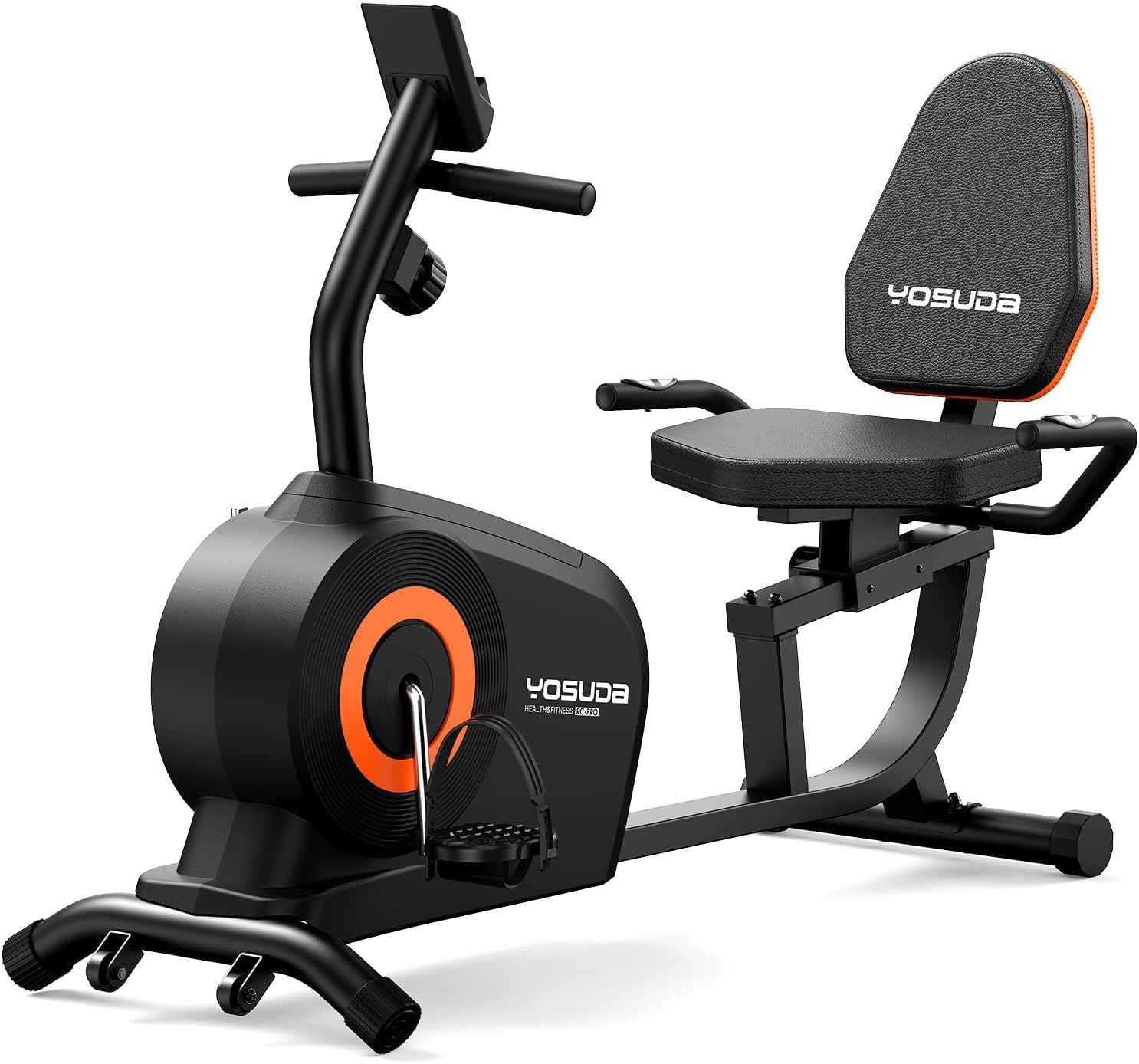
Buy the XVGVSV W239 unless something specific about it does not fit. It has the capacity, the comfort and the quiet, and it arrives nearly built, which is what actually gets a bike used rather than parked.

If two people of different heights will share it, the VANSWE's sliding seat and backlit screen justify the step up. If arthritic hands are the obstacle, the MERACH S19's shift lever is the answer. And if you intend to buy one bike and never shop again, the 3G Cardio's 25 seat positions and lifetime frame warranty are what the extra money buys.