Cardio Machines

Best Folding Exercise Bikes of 2026

A folding exercise bike promises one thing above all: a real cardio session that disappears into a closet afterward. That promise lives or dies at the hinge — a folding frame still has to stay rock-solid when you're pedaling hard, and plenty of them don't. What you're actually buying is quiet, stability, and a seat you can sit on for 30 minutes without negotiating. Get those right and the bike solves the oldest excuse in home fitness: nowhere to put the equipment.

My own bike has lived in the corner of my living room for most of this year, since it's the only way I get a ride in during the 45-minute gap between meetings. My team and I put 11 of them through six months of exactly that kind of use, and the pattern held: the quiet, steady ones had the least play in the latch and the most generous seat adjustment. Below are the ones worth the floor space, from flat-folding models for tight corners to plusher bikes that trade compactness for comfort.

#1

Birdfeel Foldable Bike

Top Pick
Birdfeel Foldable Bike

Quick setup

Our Score 9.4/10
Check Price

Worth Noting

  • Eight resistance levels limit hard efforts
Setup
70% pre-assembled
Item Weight
39.2 lb
Weight Capacity
300 lb
Resistance Levels
8
Read the full review

Seventy percent of this bike arrives already built, and that's the detail that sells it: most folding bikes here turn into an evening with an Allen key, and this one is a short session. We suggest it to people who want to be riding this week, not next weekend, and who don't want to borrow tools to get there.

What's built is decent. It switches between an upright ride, a relaxed semi-reclined position with the back cushion behind you, and a folded stance, and the magnetic resistance runs quiet through all of it. The LCD covers distance, time, speed and calories, there's a phone holder, and the foam handle covers lift off for cleaning. At 39.2 pounds it rolls on its wheels without a fight.

The seat is the caveat: comfortable at an average build, but a larger rider will feel the edges of it, and a replacement saddle is the sensible first upgrade. The stated height ceiling is six feet, so taller riders should look at the YOSUDA. Neither matters much for steady, moderate riding, which is what this bike is for.

Bottom line: We hand this one to people who want to ride, not assemble — it arrives mostly built and folds away quietly.
#2

pooboo Folding X-Bike

pooboo Folding X-Bike

Everyday home cardio

Our Score 9.0/10
Check Price

Worth Noting

  • No app or Bluetooth pairing
Item Weight
39.3 lb
Weight Capacity
300 lb
Resistance Levels
8
Assembled Dimensions
27.17"D x 15.75"W x 46"H
Read the full review

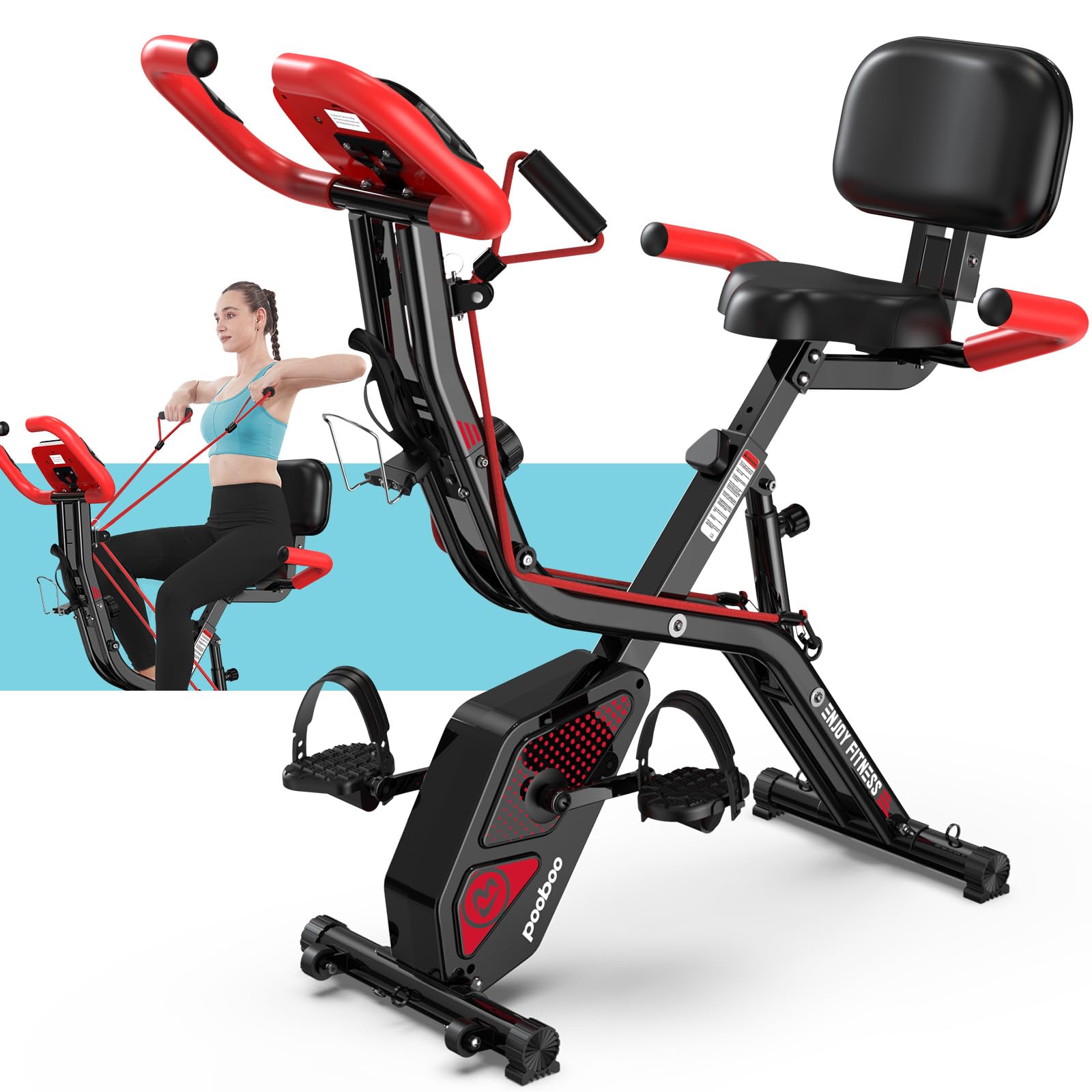
Folding a bike is only worth the trouble if it's quick enough that you actually do it, and this is the one where we stopped noticing the process. The frame collapses, the backrest drops flat, and the whole thing rolls on its own wheels into the gap beside the couch. A real riding position when it's open, a footprint you can forget when it's closed — that combination is why we point most people here first.

Open, it's a 300-pound-rated steel frame with a padded backrest and a seat that stays comfortable well past the first five minutes. The magnetic resistance is smooth and, more to the point, quiet: we could ride it while someone watched television in the same room. There are eight levels, changed with a knob by your right hand, and the resistance bands anchor at three heights if you want to pull between rides.

The frame sits fairly tall, so you swing a leg over rather than stepping through — fine for most riders, and worth lowering the seat for if your hips or knees are stiff. Once you're aboard, the seat is broad with a back cushion that gives you something to push against in the semi-reclined position, and the handlebars land within reach in both modes without a stretch.

What you give up is headroom at the top. Eight levels is fewer than the 14 and 16 on the pricier bikes here, and a fit rider will spend most of a session in the last two. That's the honest ceiling. For the walker who wants indoor cardio, the rider coming back from a knee, or a household where two people share one machine, it's a limit you won't touch — and the money you save buys the mat and the floor space.

Bottom line: We recommend it as the default folding bike for most homes: the 300-pound frame stays planted, the ride is quiet, and it folds and rolls out of the way.

#3

XTERRA FB150 Folding Bike

XTERRA FB150 Folding Bike

Small spaces

Our Score 9.0/10
Check Price

Worth Noting

  • 225 lb capacity is the lowest here
  • Upright frame with no backrest
Item Weight
32 lb
Weight Capacity
225 lb
Folded Footprint
18.1" x 18.1"
Resistance Levels
8
Read the full review

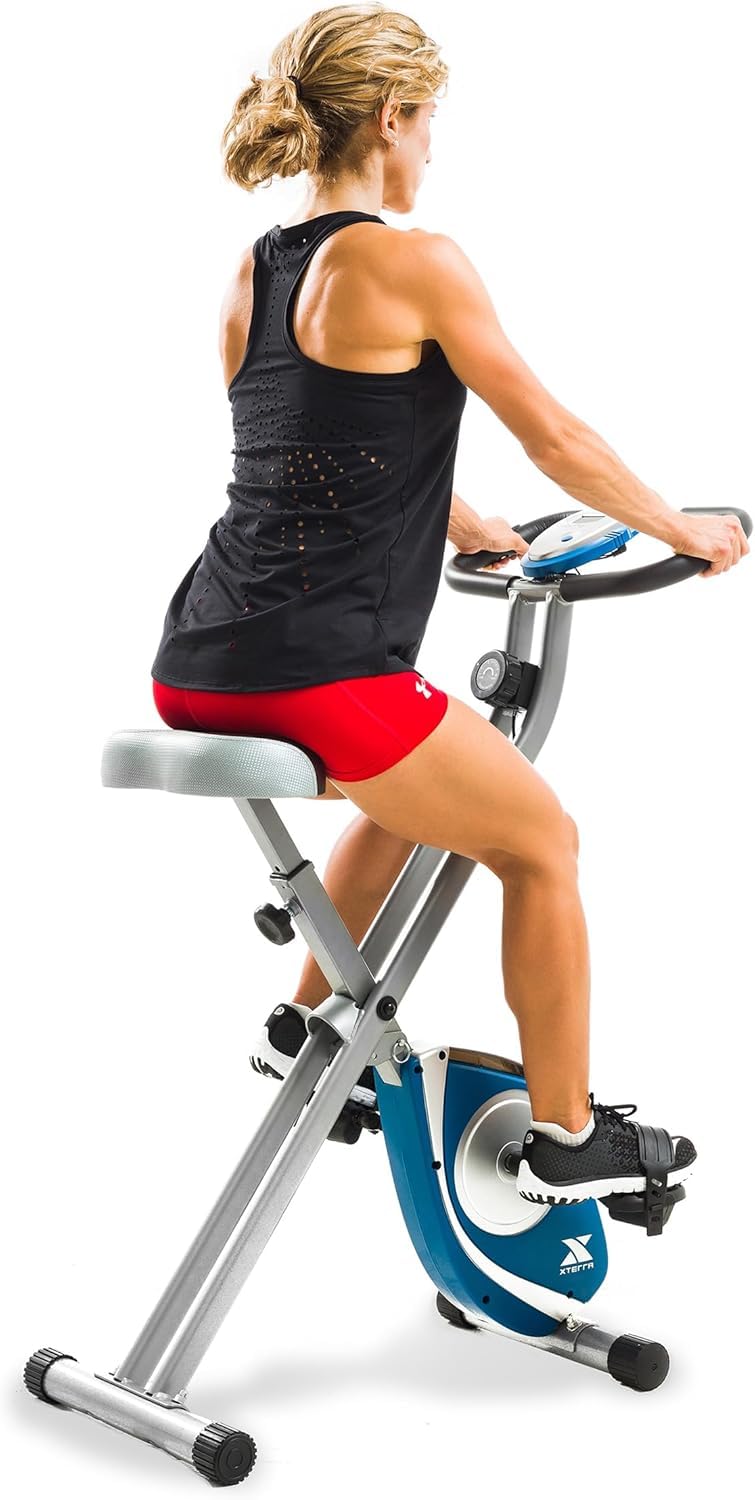
Folded, the FB150 takes up 18.1 inches square — the smallest parked footprint in this group, and small enough to sit behind an armchair instead of claiming a corner. At 32 pounds it's also the lightest bike here, and that pairing is the whole point: you can pick it up and carry it to a closet rather than roll it across the room.

We think that makes it the right answer to a specific problem — a living room where the bike has to disappear when guests arrive, or a bedroom with no free wall. What you're buying is a simple machine: eight resistance levels on a manual dial under the console, a small LCD covering speed, distance, time, calories and pulse, and multi-position padded handlebars. Assembly is about as close to foolproof as this category gets, and the belt drive runs quiet.

Rider fit is where it narrows: the stated height range runs from 58 to 70 inches, so a very tall rider will feel cramped and a very short one will reach for the pedals. If that's you, the YYFITT and the YOSUDA both publish wider ranges. It ships with the AA batteries for the console, which is about the level of fuss this bike asks for.

Bottom line: Nothing here folds smaller or lifts more easily, which makes it our choice for anyone whose bike has to live behind a chair.

#4

YYFITT 3-in-1 Exercise Bike

YYFITT 3-in-1 Exercise Bike

Back support

Our Score 9.0/10
Check Price

Worth Noting

  • Stated height range stops at 6 feet
Seat Width
12.6 in
Item Weight
40 lb
Weight Capacity
300 lb
Resistance Levels
16
Read the full review

The backrest is why you'd look at this one: it's the tallest here, it tilts to fit the curve of your back, and it holds you more upright than the X-frame bikes do. If twenty minutes of pedaling normally ends with your lower back complaining, that change of posture is worth more than any number on a spec panel.

The seat matches it. At 12.6 inches wide and 9.5 inches long it's a bench rather than a saddle, and the sixteen magnetic levels give you enough range to make a half-hour feel like something. The frame is rated to 300 pounds and folds, weighs 40 pounds, and runs quiet enough that the loudest thing in the room is whatever you're watching.

The display is the odd, likeable detail: oversized luminous digits that stay readable in a dim room, on a two-piece mount you can angle whether you're sitting up or leaning back. Assembly is a two-person job if you follow the video, and some riders take their time with it. The arm bands are there if you want them; we mostly didn't.

It's the most expensive bike in this group, and the backrest is the whole reason: nothing else here gives you one that tall or that adjustable. The stated height range runs from five to six feet, so taller riders should look at the YOSUDA's wider spread. Inside that window, and for anyone whose back decides how long they ride, the premium is easy to justify.

Bottom line: We recommend it to riders whose back decides how long they last — the tall, tilting backrest is the reason, and nothing else here offers one like it.

#5

YOSUDA X-Bike Pro 5 in 1

YOSUDA X-Bike Pro 5 in 1

Heavier riders

Our Score 8.8/10
Check Price

Worth Noting

  • Assembly takes a while with many screws
Item Weight
49 lb
Weight Capacity
330 lb
Resistance Levels
16
Rider Height Range
4'9" to 6'2"
Read the full review

The rider this was built for is easy to spot: someone who has felt a cheaper frame flex, or who reads weight capacity before anything else. YOSUDA rates it to 330 pounds, as much as any bike here, and braces the seat support rather than hanging it off a single post. If you're a bigger rider, start your shortlist here.

The rest of the package is generous for the money. Sixteen magnetic resistance levels give you a genuine ladder from easy spinning to something that hurts, the belt drive stays quiet, and the frame converts through upright, semi-recumbent and recumbent positions, plus a rowing stance and a pair of arm bands. We're skeptical of the rowing mode — you're pulling bands while seated, not rowing — but the bands themselves get used.

The app connection is the part we didn't expect to care about: phone in the holder, paired over Bluetooth, and a session has structure instead of a countdown. What we didn't love is the adjustability — the seat and backrest move through plenty of positions, but finding yours takes a firm hand and a few tries. Set it once before your first real ride and leave it.

Bottom line: We point heavier riders here: a 330-pound limit, 16 resistance levels, and a backrest that holds up over long sessions.

#6

Sunny Health SF-B223011

Sunny Health SF-B223011

App workouts

Our Score 8.8/10
Check Price

Worth Noting

  • Costs more than other 300 lb bikes here
Connected App
SunnyFit, free
Weight Capacity
300 lb
Resistance Levels
14
Assembled Dimensions
33.5"D x 21.7"W x 52.6"H
Read the full review

Most folding bikes here hand you a console and wish you luck; this one comes with the SunnyFit app, which pairs over Bluetooth and puts trainer-led sessions on the phone in the holder. That sounds like a small thing until you're three weeks in and the only reason you got on the bike is that someone was counting reps at you.

The hardware underneath is solid rather than spectacular: fourteen magnetic resistance levels, a 300-pound frame, and a wide cushioned seat that makes long sessions easier on you than the slim saddles elsewhere in this group. Getting on and off is simple, which matters more as the years add up, and the foot straps are a nice touch on longer rides.

At 20 kg it's a substantial thing to shift, though the transport wheels take most of the work on a hard floor. The seat post needs a firm hand to adjust — fine once, annoying if two riders share the bike. Folded, it still stands fairly tall, so measure the spot before you commit.

Whether the premium is worth it comes down to one question: will you use the app? If a trainer counting you through a session is the difference between riding and not riding, the free workouts plus a quiet, comfortable 300-pound frame is a fair deal. If you'll put on a podcast and pedal, you're paying for something you won't open.

Bottom line: We recommend it to people who need a trainer's voice, not just a console; the free app is what separates it.

#7

Goimu 5-in-1 Folding Bike

Goimu 5-in-1 Folding Bike

Seniors

Our Score 8.8/10
Check Price

Worth Noting

  • No seat tilt to fine-tune fit
Item Weight
50.6 lb
Weight Capacity
330 lb
Resistance Levels
16
Assembled Dimensions
27.56"D x 15.95"W x 43.7"H
Read the full review

Sixteen resistance levels usually cost more than this. Goimu undercuts the other 16-level bikes here and still rates the frame to 330 pounds — as much as anything in this group — with a backrest that folds down and side handles that give you something to hold while you get on.

Put together, it's the bike we suggest to anyone shopping on price who doesn't want to give up resistance range or weight capacity. Assembly is straightforward and the bolts arrive part-threaded, which is the difference between a project and a chore. Once built, the frame stayed steady under a hard pedal stroke, the magnetic resistance ran quiet, and the transport wheels let you move it without lifting.

Our reservation is the seat: it's wide, comfortable under you but wide enough to rub the inside of the thighs on a short inseam, so a long-legged rider may prefer one of the X-frame bikes. The side handles are the underrated part — they give you something to hold while you settle on, which is exactly the moment most upright bikes leave you wobbling.

Bottom line: We see it as the value route to 16 resistance levels, with a folding backrest and side handles that suit older riders.

#8

Marcy NS-652 Folding Bike

Marcy NS-652 Folding Bike

No-frills riding

Our Score 8.8/10
Check Price

Worth Noting

  • 250 lb capacity is the lowest here
  • Upright only, with no backrest
Riding Position
Upright
Weight Capacity
250 lb
Resistance Levels
8
Assembled Dimensions
32.5"D x 16"W x 44"H
Read the full review

The seat is the thing to plan around. It's a slim padded saddle rather than the wide bench you get on the X-frame bikes here, and an hour on it is not comfortable — a gel cover fixes it for most people, and that's the only addition this bike asks of you.

What you get instead is a plain, well-sorted upright. The eight-level magnetic dial sits within easy reach, the drive is silent enough to ride beside someone reading, and the frame stayed planted under a hard effort. Assembly is quick and the instructions are readable, which is not a given in this category. The console covers time, speed, distance and pulse, and the whole thing folds down when the room needs to be a room again.

Getting on takes a little strategy: the frame is tall with no step-through, so you swing a leg over rather than walking on. Once you're up, the ride is smooth and the resistance dial does exactly what it says. It's also the second-lightest folding frame here after the XTERRA, which makes hauling it to a spare room less of a chore than it looks.

Bottom line: A quiet, sturdy upright we recommend to riders under 250 pounds who want pedals, a console, and nothing else.

How We Tested the Best Folding Exercise Bikes

We started with research, not bikes. We pulled spec sheets for roughly 30 folding models and compared folded footprint, assembled weight, rider weight limits, and seat height range, then read through customer reviews for the complaints that repeat — a hinge that loosens, a seat that rocks, hardware that arrives missing. Anything with a recurring wobble or assembly complaint got cut. That left 11 bikes, which we built and rode over six months.

Assembly was the first test. Each bike was unboxed and put together solo, timer running, manual open, and we noted whether the hardware matched the parts list and how much of the job really needed two people. From there, every bike was folded and unfolded at least twice a day, wheeled to a closet and back, and checked for play at the latch and hinge. We measured folded dimensions with a tape and weighed each one, because "folds flat" means something different on every spec sheet.

Riding happened where these bikes actually live — living room, bedroom, beside a laptop — in 20- to 30-minute sessions, some in socks and some in sneakers. We pedaled hard and stood up on the pedals to see whether the frame flexed, and we made phone calls mid-ride to judge noise. Seat comfort got the longest look: we measured seat width and padding thickness, rode a full hour on each, and reset seat height and handlebars for two riders of very different heights to see how far the adjustment range really goes. At the end we compared what each bike delivered against what it cost, and whether it still looked new after six months of being folded.

How to Choose Folding Exercise Bikes

Measure the Storage Spot, Then the Bike

The number that matters is the folded footprint, and it's the one listings bury. Folding frames hinge at the middle: some end up small enough to stand behind a chair — the XTERRA closes to an 18.1-inch square — while others simply lean against a wall at close to full height. "Compact" in a listing can mean it fits a car trunk, not that it disappears in a bedroom.

Then decide whether you'll carry it or roll it, because that changes the shortlist. The lightest bike here is 32 pounds and the heaviest is over 50. A heavy folder on wheels is easy across a hard floor and miserable up a flight of stairs; a light one you can lift onto a shelf is the better answer for a closet.

Match Weight Capacity and Height Range to the Rider

Every folding bike publishes a maximum user weight, and it's a structural ceiling rather than a comfort note — the hinge is carrying you. The range across these bikes runs from 225 to 330 pounds, so a heavier rider is choosing from a short list. Buy margin rather than landing exactly on the limit.

Height matters as much and is easier to overlook: published ranges here run from 58 to 70 inches on one bike, 4'9" to 6'2" on another, and five to six feet on a third. Pick one whose range brackets the rider with room at both ends, then set the seat so the knee stays slightly bent at the bottom of the pedal stroke.

Read Resistance Levels as a Range, Not a Score

Eight levels, 14, 16 — the count tells you how finely the resistance steps, not how hard the hardest step is. What you want is a bottom easy enough to spin through a warm-up and a top that makes you work; on a folding bike with a light flywheel, the top often lands south of a studio spin bike regardless of the number printed on the dial.

If you're starting from sedentary, or riding thirty minutes at a conversational pace, eight levels is plenty. If you train intervals or you're already fit, spend for 14 or 16 — and expect the last two to be where you live.

Pick the Posture Before the Features

An upright frame puts you over the pedals with your hands forward and nothing behind your back; a semi-recumbent or X-frame bike reclines you slightly and gives you a backrest. That difference decides more than resistance levels do if your back, hips, or knees are the reason you're buying at all.

Two related details: a wide padded seat is kinder over long sessions but can rub the thighs on a short inseam, and a tall frame with no step-through is harder to mount than the numbers suggest. Sit on one if you can. If you can't, buy from a seller with a return window and try it on a rest day, not after a workout.

Pay Only for the Extras You'll Use Weekly

The extras divide cleanly. Resistance bands add an upper-body pull to a bike that's otherwise legs-only, and they're the add-on most people actually touch. A Bluetooth app — the SunnyFit connection on the Sunny Health bike — turns a console into a guided session, which is worth real money if structure is what gets you on the bike and worth nothing if it isn't.

Rowing modes and glowing displays are nice rather than decisive. Pick the single extra you'll use every week and let the rest go; paying for three features you'll open once is how a budget folding bike turns into an expensive coat rack.

Frequently Asked Questions

Final Verdict

Buy the pooboo if you want one answer: a 300-pound folding frame that rides quiet, sits comfortably for half an hour, and gives the floor back in seconds. It's the bike most homes should start with, and the money you keep covers the mat and a spare saddle if you want one.

Choose differently for a reason. The XTERRA if the bike has to disappear behind a chair. The YOSUDA if you need more than 300 pounds of capacity or a longer resistance ladder. The YYFITT if a backrest decides whether you ride at all. Everything else here is a variation on those four decisions.