Cardio Machines

Best Stair Climbers of 2026

A stair climber promises gym-level cardio without leaving the house, but the wrong one will rattle your floor, eat up half the living room, and take an entire Saturday to assemble. I learned that the hard way with a hand-me-down stepper that wobbled so much I had to brace it against the wall. The right machine, though, delivers a genuinely tough workout in a surprisingly small footprint — you just have to know which specs matter. It fixes the problem of bad weather, crowded gyms, and limited time by giving you a challenging climb in the corner of a room, as long as you pick one that stays stable and fits your space.

Over the past six months, my team and I tested eight stair climbers side by side, from compact under-desk steppers to full-size climbing machines. We assembled each one ourselves, timed how long it took, and noted whether the instructions were clear or required a second person. We also put them through interval workouts, checking for stability at high resistance, pedal comfort, and how easy it was to adjust intensity mid-climb. And because most of us don't have a dedicated gym, we rolled each unit around a living room and measured its footprint to see if it could tuck into a closet. The models that earned a spot below are the ones that felt solid, assembled without swearing, and actually made us want to climb again the next day.

#1

BULAPEACH Folding Stair Stepper

Top Pick
BULAPEACH Folding Stair Stepper

Beginners

Our Score 8.6/10
Check Price

Worth Noting

  • One intensity level, with nothing to grow into
Color
Pink
Frame
Steel with ABS and rubber
Weight Capacity
300 lb
Handlebar Heights
3
Read the full review

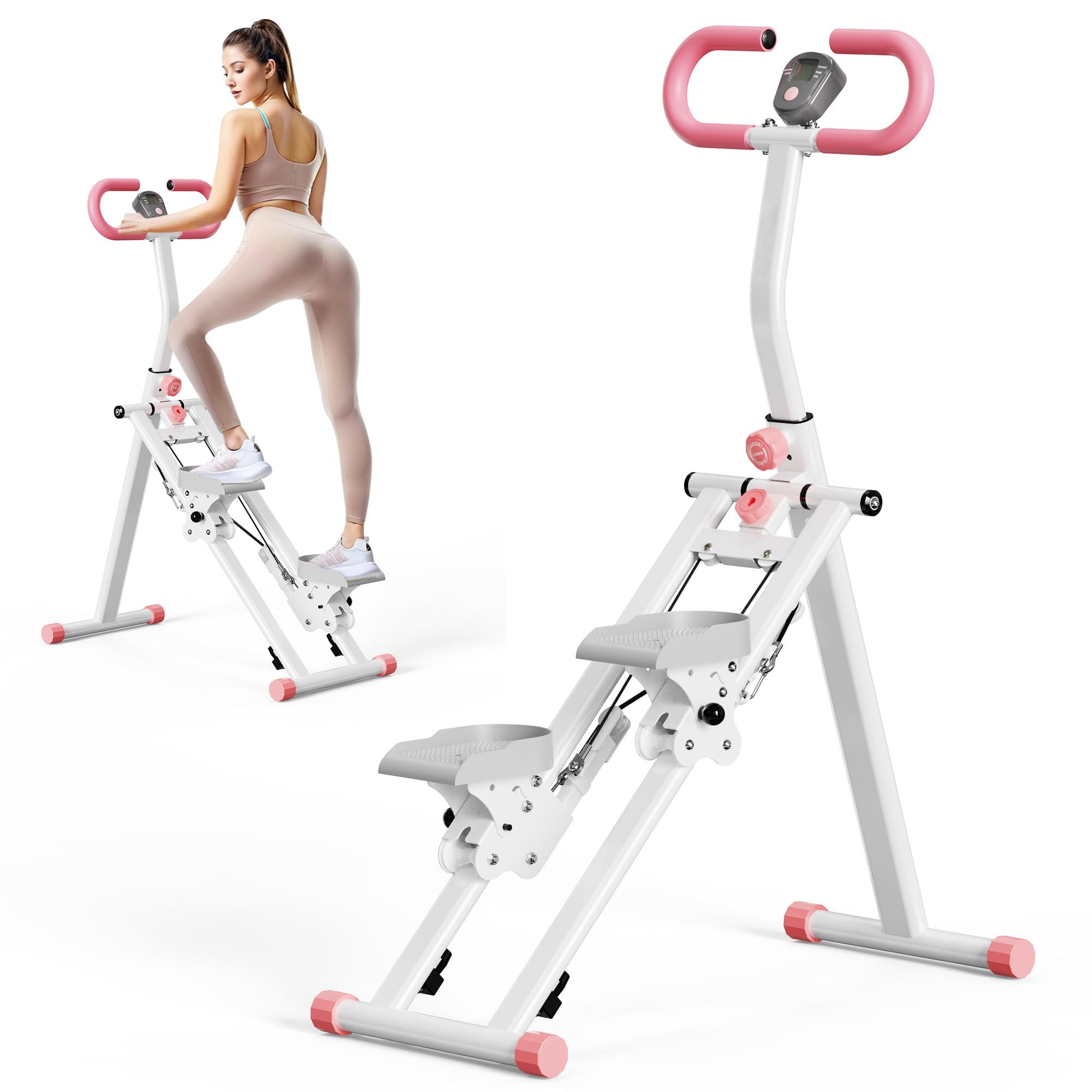
The pink finish is the first thing anyone notices, and it is the only climber here that is not black — which matters more than it sounds if the machine is going to sit in a bedroom rather than a garage.

Under the color it is a compact folding climber: 300 pounds of capacity, three handlebar heights, an LCD for time and calories, and a frame light enough to shift with one hand. Assembly is simple and the stride is gentle, which is why it suits a first machine, or a household where nobody is chasing a personal best.

Where it runs out is headroom. The effort does not change much from one session to the next — there is no resistance setting to grow into — so once twenty minutes stops being hard, you have to make it harder with speed alone. As a first climber, or a second one for a room where looks count, we think it is a nice thing to own. As the only machine you will use for years, we want more to work with.

Bottom line: A cheerful, compact first climber for a small room — just do not expect it to get harder as you get fitter.
#2

YOLEO 3-Mode Stair Stepper

YOLEO 3-Mode Stair Stepper

Heavier users

Our Score 8.4/10
Check Price

Worth Noting

  • Pedals can bottom out on the lightest setting
  • Foot position can shift on the pedals
Assembly
90% pre-assembled
Resistance
3 levels
Workout Modes
3
Weight Capacity
660 lb
Read the full review

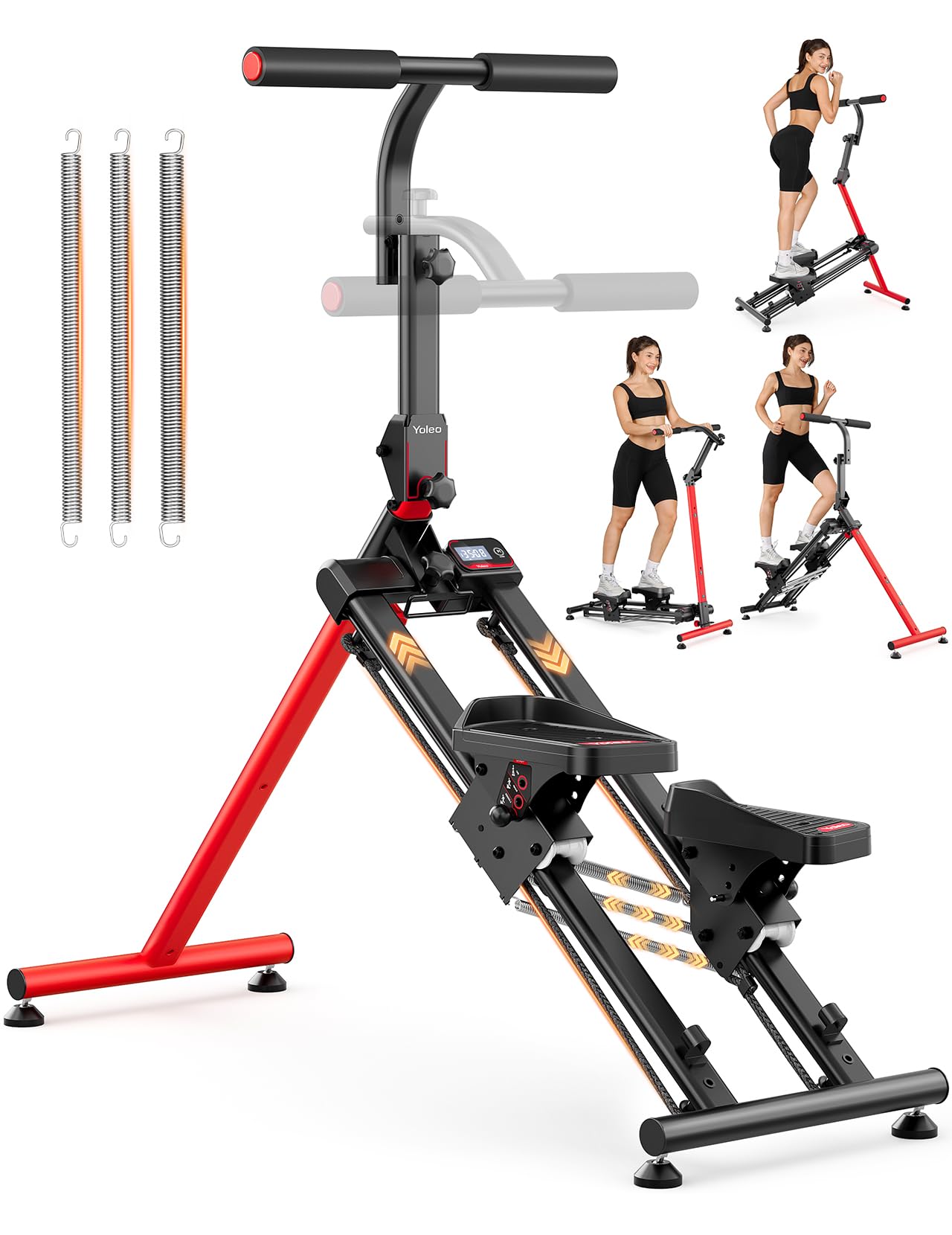
Six hundred and sixty pounds is the listed rating, double what most of the climbers here carry, and it is the reason this YOLEO makes the list at all. On a dual-triangle steel frame, it is the pick for a heavier rider or a household where two very differently built people share one machine.

Two other things earn it a place. The three resistance levels are genuinely different from one another — the top setting is work — and the frame switches between a straight climb, an incline hike, and a ski-style stride that shifts the effort into your quads. One quirk to plan around: on the lightest setting the pedal can reach the bottom stop, so settle the stroke before you commit to a long session.

At 34.8 pounds it is the heaviest machine here after the Sunny, it arrives 90 percent assembled, and it folds down small. It is also the newest design in this group, with a shorter record behind it than the Sunny or the MERACH, so the capacity and the resistance are what we are recommending rather than years of proof.

Bottom line: If you need a climber rated well past 300 pounds, or you want resistance you can actually turn up, this is the one we point to.

#3

Sunny Foldable Stair Climber

Sunny Foldable Stair Climber

All-round home cardio

Our Score 8.2/10
Check Price

Worth Noting

  • Squeaks develop at the pivots over time
  • Pedal return is slow at the top of the stroke
Handlebars
4 height levels
Step Height
8.9" to 23.5"
Stride Length
21.5"
Weight Capacity
330 lb
Read the full review

Twenty-one and a half inches of stride is what won us over. That is how far each pedal travels front to back, and it is the difference between a machine that pumps your knees in place and one that feels like climbing. The step height runs from 8.9 inches up to 23.5, so the pedals can sit almost flat for a gentle session or drop into a deep, slow climb when you want the stairs to bite. Of the climbers here, this is the one whose ten minutes felt most like ten minutes of stairs.

There is no resistance dial. Effort comes from how deep you set the step range and how fast you move, and we found that a more honest arrangement than a tension knob that changes almost nothing — you feel the work in the depth of the step rather than in a number. If turning a dial is part of how you progress, the YOLEO's three levels or the RELIFE's springs are the ones to look at instead.

The rest of the package holds up. A 330-pound capacity on an alloy steel frame, four handlebar heights so a tall user and a short one can both stand up straight, and a fold that gets it out of the living room between sessions. The SunnyFit app adds trainer-led climbs and scenic routes if you want a plan rather than a timer, and the device holder means you can watch something else entirely.

Two things to know. The deepest setting is a lot of load for knees that are not used to it, so earn that depth over a few weeks rather than starting there. And the pin that locks the frame open deserves a glance before each session — it is the piece carrying the load, and the one-year frame warranty is worth having on file.

Bottom line: We recommend it because the long stride and the huge step-height range let one machine go gentle or brutal, and 330 pounds of capacity means it does not feel like a toy doing it.

#4

MERACH Folding Stair Stepper

MERACH Folding Stair Stepper

Budget folding

Our Score 8.2/10
Check Price

Worth Noting

  • Pedal stroke stops short at the bottom
  • Frame feels light next to gym equipment
Display
Time, steps, calories
Pedal Angles
3
Assembled Size
33.9"L x 22.1"W x 47.2"H
Weight Capacity
300 lb
Read the full review

Three pedal angles is more adjustability than we expect at this money. Tilt the platforms one way and the work moves up into your quads, tilt them the other and you feel it through your glutes and calves — a cheap way to get variety out of a machine that only does one motion.

It folds, it comes mostly assembled, and the LCD tracks time, steps, and calories. The resistance is where it gets murky: the mechanism is there and the settings are labelled, but the difference between the bottom and the top is subtle, and lighter riders feel the lack of it most. If a loaded, heavy climb is the point, the RELIFE's springs and the YOLEO's three levels deliver more.

Where it earns its place is the value end of the group: pedal angles, a folding frame, and a workout that leaves you breathing hard, for less money than the top pick. If the climber lives in a small room and disappears between sessions, this is the one we reach for.

Bottom line: Our value pick: three pedal angles and a folding frame for less money than the top pick, as long as you do not need the resistance to do much.

#5

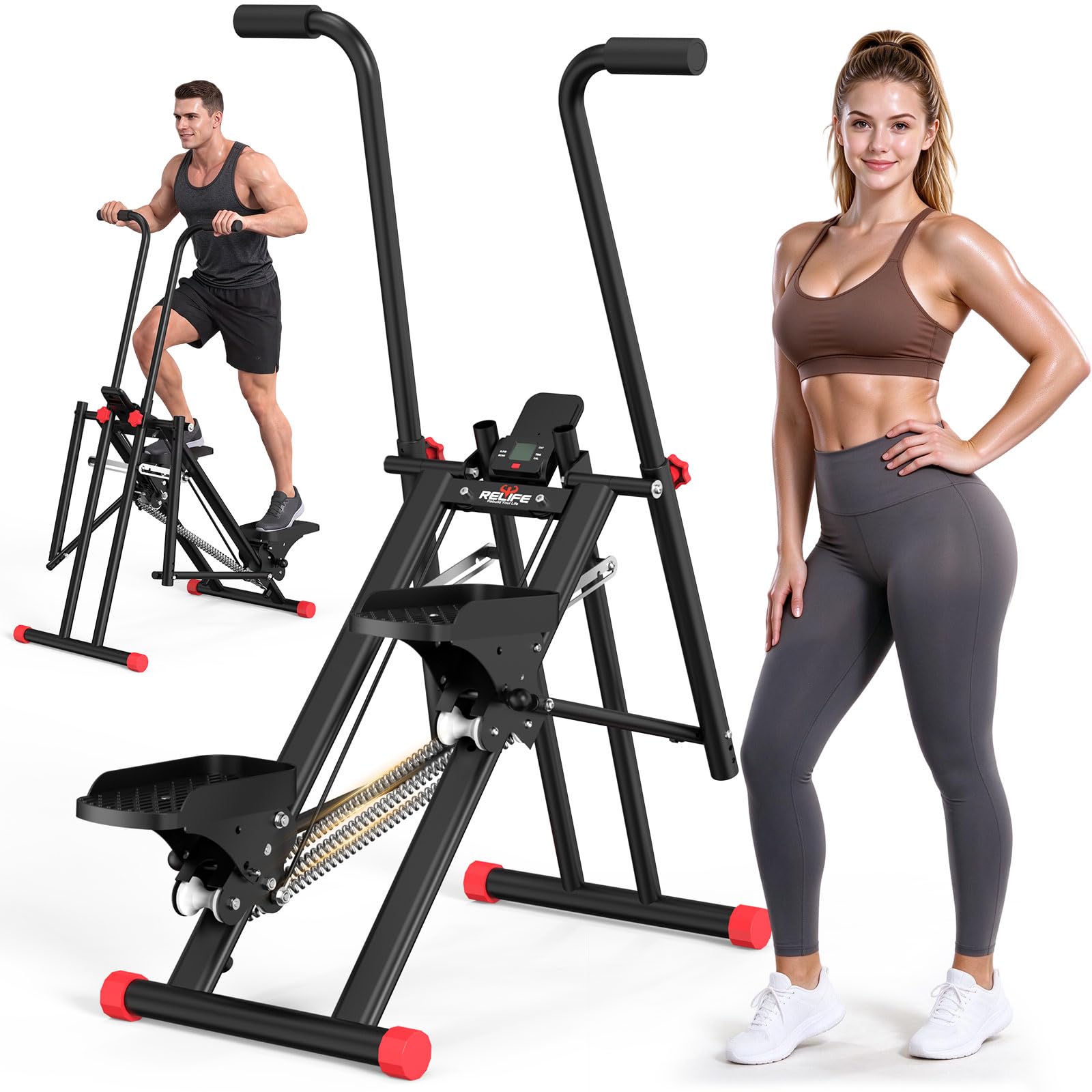
RELIFE Spring Stair Stepper

RELIFE Spring Stair Stepper

Resistance variety

Our Score 8.0/10
Check Price

Worth Noting

  • Handlebar bolts loosen and need re-tightening
  • No suction feet, so the frame can rock back
Incline
2 levels
Pedal Tilt
3 levels
Resistance
3 spring levels
Weight Capacity
350 lb
Read the full review

Three gravity springs instead of the usual hydraulics is the design decision that makes this RELIFE feel different underfoot. The resistance is firm and consistent, without the spongy give that cheap steppers have, and the pedal pushes back rather than sinking. It is the machine here that made us work hardest at a given pace.

Adjustability is the rest of the case: two incline levels, three pedal tilt positions, and three handlebar heights, which is the widest spread of settings in this group. The 350-pound capacity is the second-highest here, behind only the YOLEO, and the frame stays steady while you climb.

Two things to keep in mind. The handlebar bolts work loose with use, so tighten them in the first week and check them again after a month. And there are no suction feet — the frame can rock back if you step off mid-stride without steadying the bar. Neither is a dealbreaker, and the incline is what we miss when we go back to a flat stepper: two positions is not much, but it changes the session enough to keep us coming back.

Bottom line: We like it best for anyone who wants to feel the resistance: the spring system is firm, and no other climber here offers as many ways to change the session.

#6

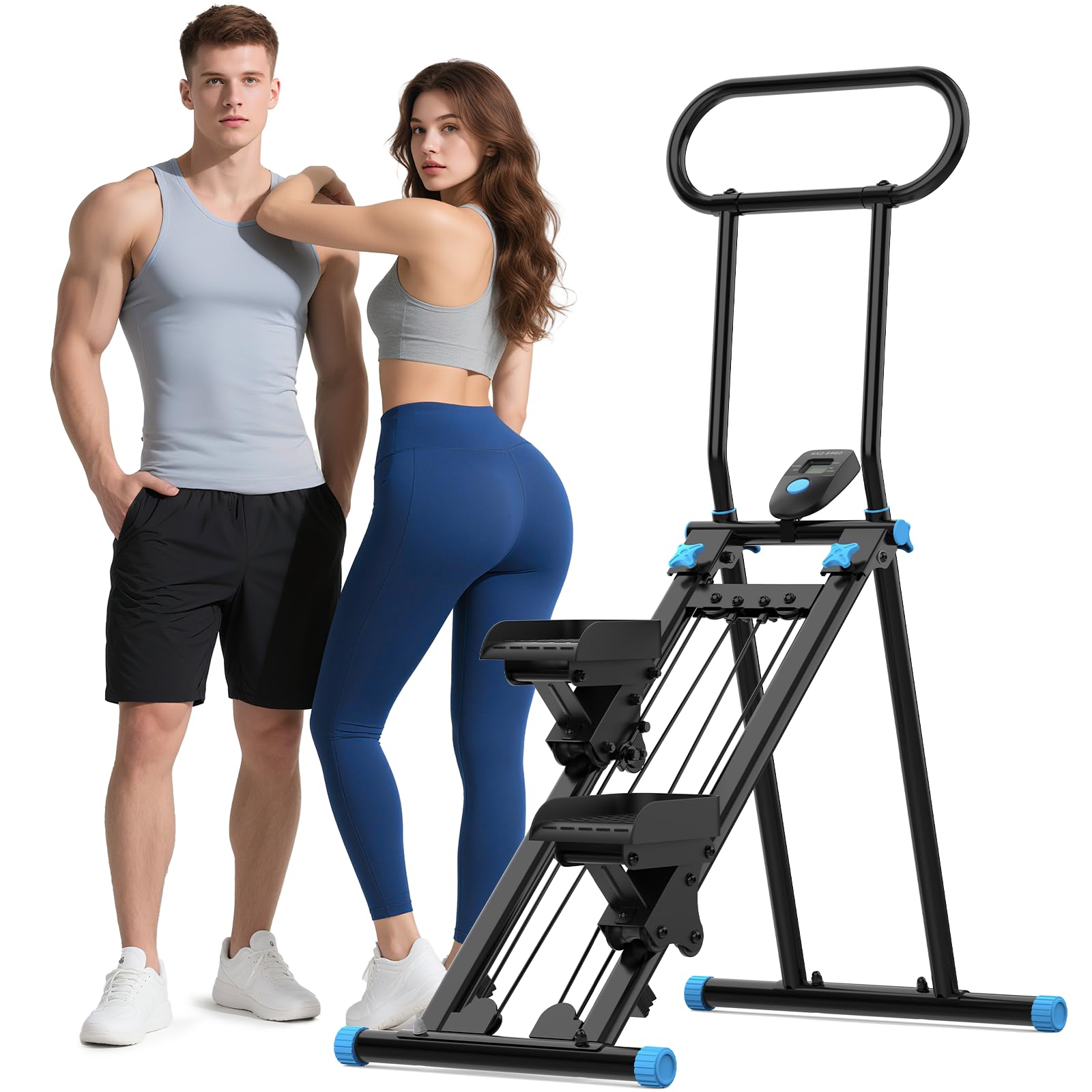
HXD-ERGO Stair Stepper with Handlebar

HXD-ERGO Stair Stepper with Handlebar

Tight budgets

Our Score 8.0/10
Check Price

Worth Noting

  • No resistance adjustment, so effort is pace alone
  • Foot pedals run small
Folding Frame
Yes
Assembled Size
20"L x 28"W x 72"H
Weight Capacity
300 lb
Handlebar Heights
3
Read the full review

Seventy-two inches is how tall this one stands at the handlebar — a full six feet, roughly a foot and a half more than the Sunny — so before anything else, measure the ceiling where it is going. A low basement, a room with a slope, or a spot under a shelf rules it out, and that would be a shame, because the rest of the package is a sensible budget buy.

Three handlebar heights, a folding frame, and 300 pounds of capacity on a triangular steel base make this the inexpensive way into a full-size climber. For walking-pace cardio in front of a screen it does the job, and the fold means it can live in a closet between sessions. Check the cord covers where they run over the guides in the first week; a split cover is the one thing worth catching early.

Bottom line: Buy it if the budget is tight and the ceiling is high; it is a solid, folding, full-size climber with nothing to adjust but your pace.

How We Tested the Best Stair Climbers

We started by researching the market, reading customer reviews, and filtering for models with adjustable resistance, a stable base, and a footprint that wouldn't dominate a room. We also looked at price relative to features — a machine shouldn't need an extra mat just to keep from sliding. We ended up with eight units, which we tested over six months in home settings rather than a lab.

Assembly was the first test. We timed ourselves putting each one together alone, noted how many steps required a second set of hands, and checked whether the included tools and instructions were actually usable.

Once built, each climber went into a rotation of 20- to 30-minute sessions three or four times a week. We did steady climbs and interval bursts, paying attention to how smoothly resistance changed, whether the pedals stayed comfortable after 15 minutes, and if the machine wobbled when we picked up the pace. We also rolled each one across hardwood and carpet to see how easily it moved, then measured its footprint to judge compactness.

Durability and value came last. After six months, we looked for squeaks, loose bolts, worn belts, and fading resistance. We compared what each machine cost against how often we actually wanted to use it — the best value wasn't always the cheapest, but the one that held up and kept us coming back.

How to Choose Stair Climbers

Step Height and Stride

Two numbers tell you more than any feature list: how far the pedals travel, which is the step height, and how long the front-to-back path is, which is the stride. A compact stepper nudges your feet a few inches. The widest machine here drops them from 23.5 inches down to 8.9, and that is a genuine flight of stairs under your feet.

If a listing says only 'adjustable tension' and never gives a range in inches, assume a short stroke. We look for a range we can set shallow on a sore day and deep when we want to suffer, because that range is what keeps a machine useful after the novelty wears off.

What the Resistance Dial Really Changes

Resistance comes three ways in this group: not at all, through hydraulics, and through springs. Hydraulic cylinders give a smooth push but can feel spongy, and the adjustment often changes less than the labeling implies. Gravity springs, which the RELIFE uses, feel firmer because the pedal pushes back rather than sinking.

The trap is a listing that advertises adjustable resistance when the only thing moving is the pedal angle. Decide what you want before you shop: if progression matters, buy one with numbered levels and expect to feel the difference between the top and the bottom; if you will control effort with depth and pace, a bodyweight machine is simpler and has less to wear out.

Footprint, Folded Size, and Ceiling Clearance

Measure two things before you buy: floor space and height. Handlebar climbers in this group stand anywhere from about 47 inches to 72 inches tall, and the tall ones need a normal ceiling and a clear spot where you will not clip a light fitting. 'Compact' in a listing usually describes the folded machine, not the one you are standing on, so check both figures.

Folding only helps if you will actually lift it — several of these run close to 30 pounds — and the best place for a climber is wherever you will see it and use it, not the furthest corner you can find.

Weight Capacity and What the Frame Has to Take

Capacities here run from 300 to 660 pounds, and the rating is a rough proxy for how much steel is under you. Choose a figure comfortably above the heaviest person who will use it rather than one that just covers them; a frame working at its limit flexes, and flex is what makes a climber feel cheap.

The parts that wear are the moving ones: hydraulic cylinders, springs, cables, pivot pins, and the bolts in the handlebar. A one-year frame warranty is standard here, and it is worth checking the hardware in the first week and again a month in.

Noise and Where You Put It

Steppers thump, and the thump travels. On a hard floor above someone else's ceiling a mat is not optional; on carpet the machine is quieter and steadier underfoot. Squeaks are a separate nuisance — they come from the pivots and the pedal arms, and they tend to appear after a few weeks rather than on day one, which is why we check the bolts instead of judging a machine on its first session.

If noise is the deciding factor, buy where you can return it and give it ten minutes on the floor it will live on before the window closes.

Frequently Asked Questions

Final Verdict

Buy the Sunny Foldable Stair Climber. The 21.5-inch stride and the 8.9-to-23.5-inch step range let one machine be gentle on a Monday and punishing on a Friday, and 330 pounds of capacity means it does not flex while you use it.

If 330 pounds is not enough headroom, or if you want to progress by turning a dial rather than deepening the step, the YOLEO is where we point you.