Cardio Machines

Best Exercise Bikes with a Screen of 2026

For two years my cardio setup was a used spin bike and a tablet wedged against the handlebars with a folded towel. It worked until it didn't: the tablet slid mid-sprint, glare washed out the instructor by 7 a.m., and the battery quit twenty minutes into a forty-minute ride. A bike with the screen built in solves all three at once, because the display is wired into the machine itself. Resistance, cadence, and heart rate land on one panel instead of three apps and a sticky note.

Here's the part that surprised me: the screen turns out to be the least interesting thing about the purchase. After six months with eight bikes split between my garage and a colleague's spare-room gym, the ones we kept coming back to were the ones that felt solid under a hard effort, stayed quiet enough for an early ride, and had a seat we could tolerate for an hour. Assembly ranged from a single easy evening to an entire lost Saturday. The picks below are grouped by what you'll actually do with the screen, whether that's guided classes or just a show while you pedal.

#1

CHAOKE 520A

Top Pick
CHAOKE 520A

Small-space value

Our Score 9.0/10
Check Price

Worth Noting

  • LCD shows workout data only, no entertainment
Display
Digital LCD
Footprint
32.3 × 19.2 in
Resistance
100 levels, magnetic
Max Rider Weight
300 lb
Read the full review

At 32.3 inches deep and 19.2 wide, the CHAOKE 520A is the smallest bike in this group — a full ten inches shallower than the MERACH and more than twenty shallower than the Peloton. In a one-bedroom apartment that is not a footnote, it is the reason to buy it, and it happens to be the best value here as well: 100 magnetic resistance levels, a 300 lb capacity and a 48 lb frame for very little money.

The rest is deliberately simple. A battery-powered LCD tracks time, speed, distance, calories and total distance, the bike pairs with apps like Kinomap if you want virtual courses, the seat adjusts for height and the handlebars for reach, and the listed fit runs about 4'7" to 6'1". Assembly runs around half an hour because most of the bike arrives pre-built, which is a pleasant change from a box of loose bolts.

Two honest caveats. The display is a data readout, not entertainment — a phone on the bars is still how you watch anything. And the saddle is firm, with a shape that does not suit every rider, so a padded cover or a replacement saddle belongs in the plan from day one. Everything else about the 520A overdelivers, which is why it holds a place despite both.

It is quiet in a way that matters more than the spec sheet suggests: the belt drive and magnetic resistance keep the sound down to breathing and pedals, and at 48 lb it is light enough to shift between rooms. If the bike has to live in the room where you watch television, this is the one that will not announce itself.

Bottom line: The smallest bike here is also the best value: we point people to this one when floor space and budget both decide the purchase.
#2

MERACH S36L3

MERACH S36L3

Screen-first home riding

Our Score 8.8/10
Check Price

Worth Noting

  • Corded, so it needs an outlet at the bike
  • Fewest resistance levels here at 16
Display
21.5 in HD rotatable
Resistance
16 levels, magnetic
Item Weight
66 lb
Max Rider Weight
330 lb
Read the full review

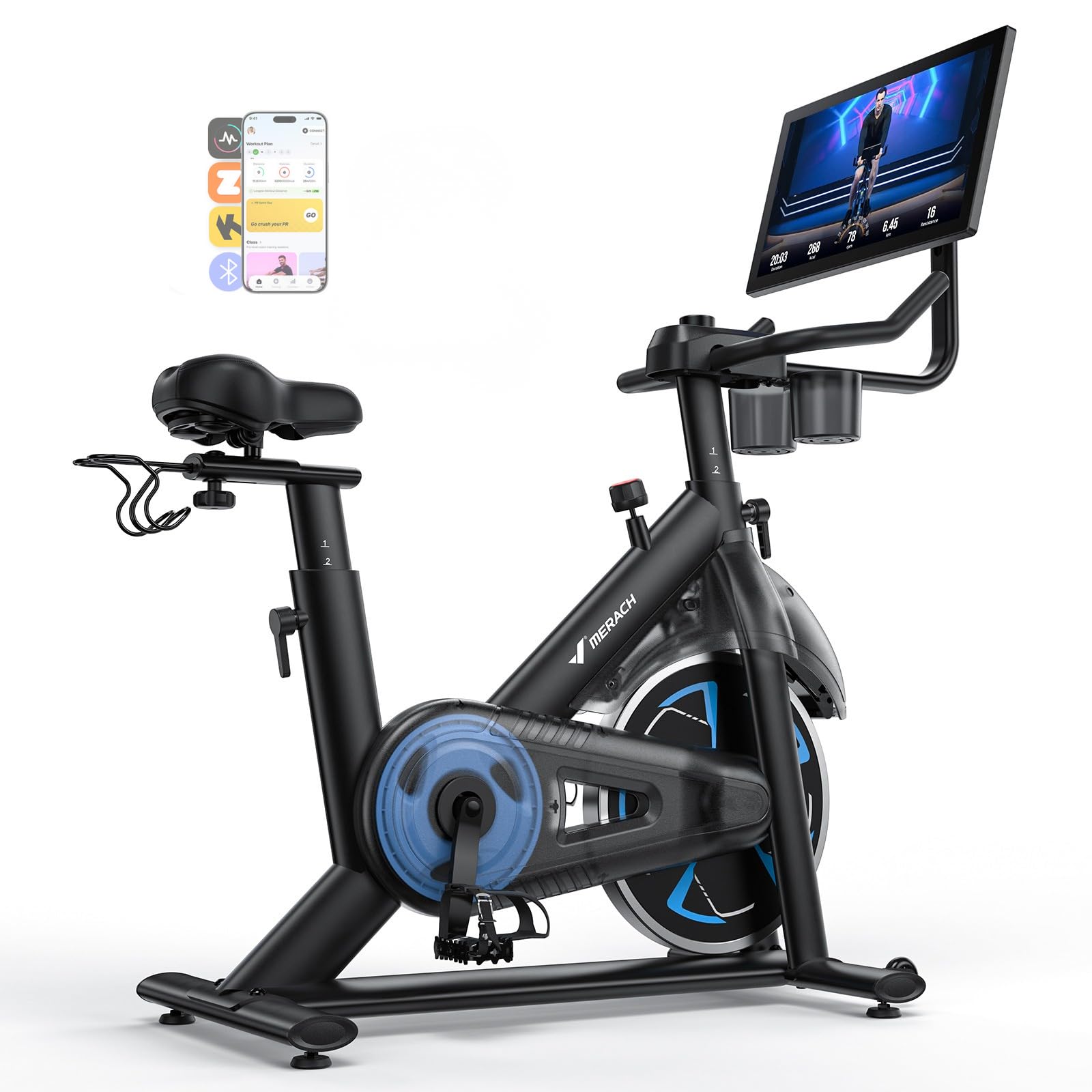
The MERACH S36L3 is built around its screen, and not in the way most bikes at this price are. The 21.5-inch panel swivels 180 degrees and tilts, so it faces you while you ride and then swings toward the floor for a cool-down stretch, and it is an anti-glare mirroring display — your phone can put a show on it. In a group where three bikes call a small LCD a screen, this is the real thing.

That is why it is our top pick. Mid-range money buys the only genuinely watchable display outside the Peloton, plus magnetic resistance that adjusts itself to the courses in the Merach app, a 330 lb capacity and a belt drive. The screen and the app do the work together: the courses drive the resistance, and the numbers land on the panel while you ride. It is the version of this purchase that does not ask you to squint.

At 66 lb it is the second-heaviest bike here, so decide where it lives before it arrives rather than after. And the saddle is the part to budget for, as on every bike in this group — a firm sport-style perch ships as standard, and a padded cover is the cheapest upgrade you will make.

Bottom line: This is the bike we hand most people: a real 21.5-inch HD screen, magnetic resistance that follows the app, and a stable 330-pound frame for mid-range money.

#3

Peloton Cross Training Bike

Peloton Cross Training Bike

Class-led training

Our Score 8.8/10
Check Price

Worth Noting

  • Class library requires a paid All-Access membership
Display
21.5 in Full HD touchscreen, 360° swivel
Item Weight
178 lb
Max Rider Weight
297 lb
Rider Height Range
4'11" to 6'5"
Read the full review

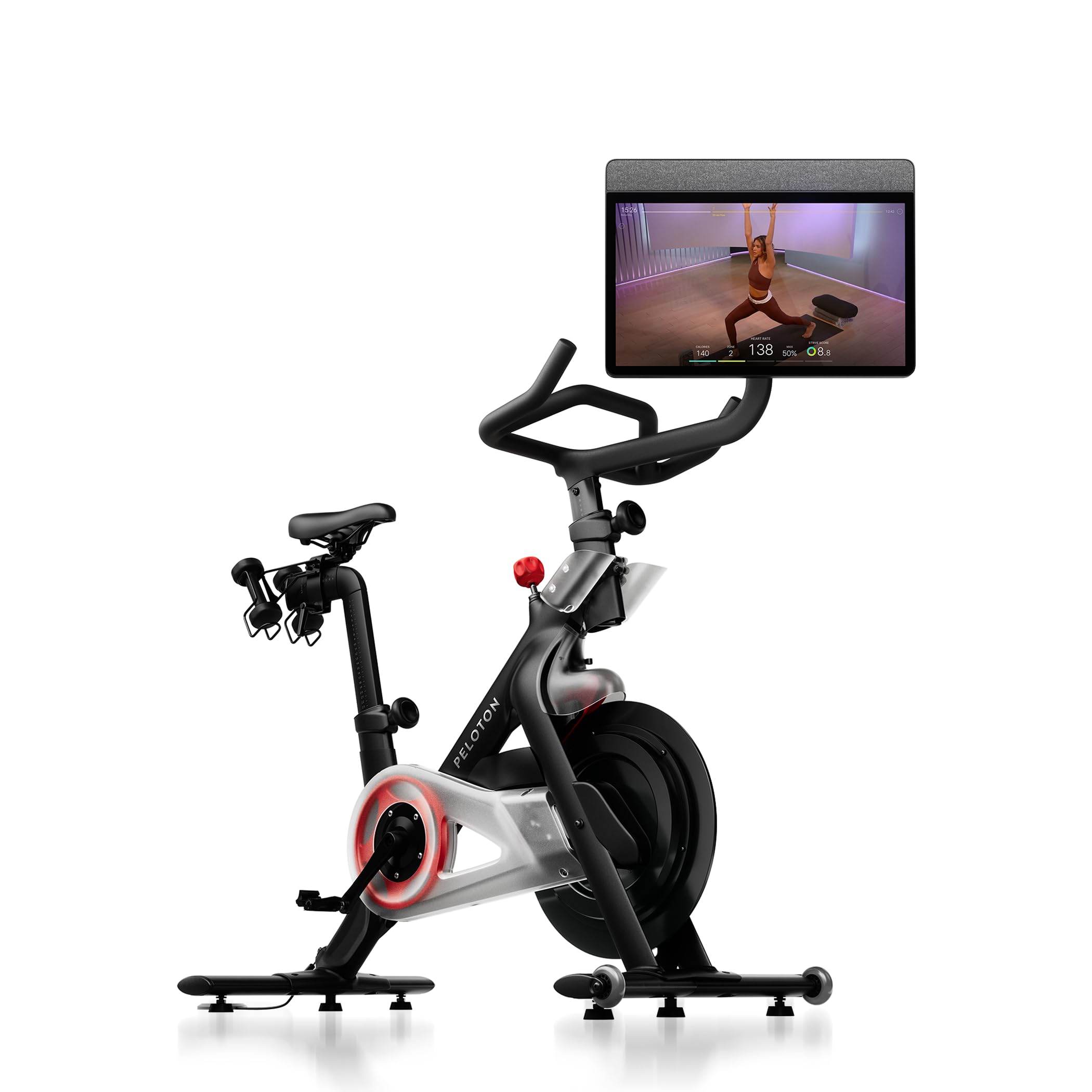
A Peloton is a subscription with a very good bike attached. The All-Access membership is what unlocks the live and on-demand classes the 21.5-inch touchscreen exists to show, so the ongoing cost, not the bike, is the number that should decide whether you buy this or something simpler.

The hardware justifies the fuss. The screen is a Full HD touchscreen that swivels a full 360 degrees, so it turns away from the bars for strength, yoga, Pilates or barre; there is a built-in speaker, and the seat and handlebars adjust to fit riders from 4'11" to 6'5" at up to 297 lb, the widest height range in this group. Resistance is manual magnetic across 100 levels, so you change gear yourself rather than letting a class do it for you.

Whether it is worth it comes down to how often you take a class. The library is deep, the coaching is the reason people stay subscribed, and four or five sessions a week turns the monthly charge into the cheapest part of the deal. If you prefer your own playlist or a Zwift route, the MERACH covers the big-screen brief for far less.

One thing to settle before it arrives: at 178 lb it is by far the heaviest bike here, and Peloton's own setup guidance calls for lifting aids and a second pair of hands. Choose its spot on the day you order, because you will not be repositioning it on a whim.

Bottom line: We recommend it to people who will genuinely use the classes; the screen and coaching are the best here, and the membership is the trade.

#4

SLUNSE 509A

SLUNSE 509A

App-connected budget riding

Our Score 8.8/10
Check Price

Worth Noting

  • Fit tops out around 6.1 ft
Display
LCD monitor with phone mount
Resistance
100 levels, magnetic
Max Rider Weight
350 lb
Rider Height Range
4.8 to 6.1 ft
Read the full review

The screen on the SLUNSE 509A is a compact LCD that logs time, speed, distance, calories and total distance, with a phone mount above it — and we think that is an honest read on what a budget screen bike actually delivers. If you want to watch something, your phone does that job. If you want your numbers, the console gives them without an app, an account or a signal.

What the money buys is more interesting than the display. The 509A carries the highest weight capacity in this group at 350 lb, 100 magnetic resistance levels, a belt drive, a four-way seat and two-way handlebars, and a listed fit from about 4.8 to 6.1 feet. Two resistance bands hang off the frame for arm work, which is a small addition but one that earns its space.

It runs on batteries rather than a cord, which solves the outlet problem the MERACH and the Peloton both have, and at 59.5 lb it rolls aside on its front wheels without much fuss. The saddle is the weak point: narrow and firm, the sort you tolerate for twenty minutes and resent at forty. A padded cover or a replacement seat fixes it, and even with that added the total still lands well under the mid-range bikes.

Bottom line: Budget-first buyers should start here: the highest weight capacity in this group, 100 resistance levels, and a console that needs no account.

#5

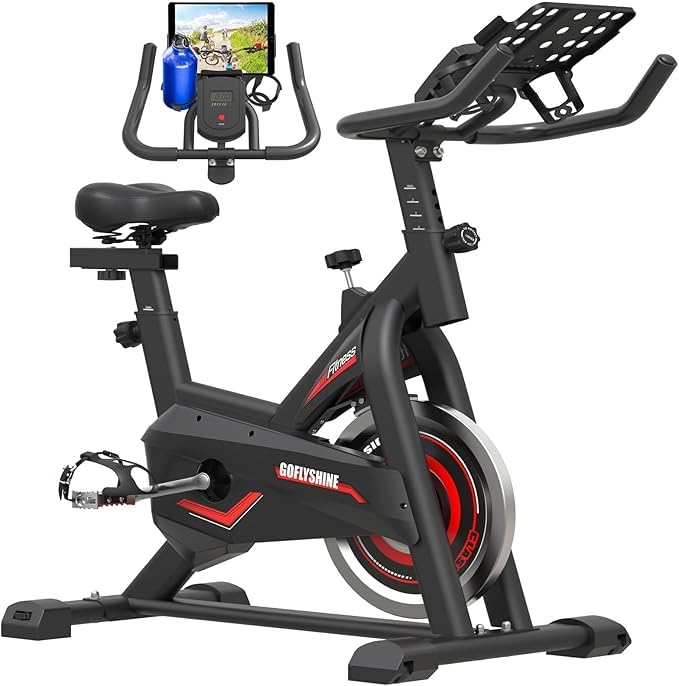
GOFLYSHINE 290

GOFLYSHINE 290

Entry-level cardio

Our Score 8.6/10
Check Price

Worth Noting

  • 200 lb rider limit, the lowest in this group
Display
LCD monitor with device mount
Resistance
Friction, 100 levels
Item Weight
50 lb
Max Rider Weight
200 lb
Read the full review

Two hundred pounds. That is the maximum rider weight on the GOFLYSHINE 290, and it is the first thing to check: the next-lowest ceiling here is 297 lb on the Peloton, and the SLUNSE takes 350. If you sit near or over that figure, this one is out before anything else about it matters.

Below that line it is a competent budget bike with one genuine difference: friction resistance. A pad presses against the flywheel instead of magnets doing the work. We prefer magnetic in a home bike because there is no wearing pad to keep adjusted, but friction has been doing this job for decades and the resistance builds steadily as you turn the knob.

The rest is the usual budget package: an LCD reading time, speed, distance, calories and miles rather than kilometers, a device mount above it, a belt drive and a 50 lb frame. The build is where it trails the others — at 50 lb it is the lightest frame in this group, so set it on a hard, level floor, tighten the base, and check the seat and handlebar knobs before each ride.

Bottom line: We call this a cautious pick: under the 200-pound ceiling it is the least expensive route to a data monitor and a device mount.

How We Tested Exercise Bikes With Screens

We started with a list of roughly 30 bikes with integrated screens, then filtered by resistance type, screen size, warranty length, and price band until eight remained. Each one was assembled by one person, alone, using only the tools in the box, and we timed it. One went together in about 35 minutes. Another ate most of a Saturday and required a hardware store run for a missing bolt, which told us plenty about what the first week of ownership would feel like.

Every bike then lived where a bike actually lives: a garage, a spare bedroom, and one small apartment living room where floor space decided everything. We rode at 6 a.m. before work, on weekend mornings long enough for a full class plus a cooldown, and in bare feet and in cycling shoes to see how the pedals and resistance dial behaved either way.

To judge quiet, we ran standing climbs and sprint intervals while a housemate watched TV in the next room and noted whether the volume had to go up. For sturdiness, we rocked the handlebars hard at max resistance and watched for frame sway, then checked whether the seat post crept down under a heavier rider. Every saddle got a 45-minute ride on day one, and we measured width and nose length, since a wide padded seat and a narrow one produce completely different soreness. We also counted the taps between powering on and pedaling; one bike demanded four screens and an account login before the resistance would budge, which is the kind of friction that ends a habit.

Six months in, we rechecked the same things: pedal wobble, paint chips near the flywheel housing, and whether resistance still stepped smoothly. We weighed what each bike included against what it asked of you, since a screen that's useless without a separate subscription is a cost, not a feature.

How to Choose Exercise Bikes with a Screen

Decide Which Kind of Screen You're Buying

A set of product photos will call a small LCD, a phone cradle and a 21.5-inch touchscreen by the same name. On the budget bikes here — the CHAOKE, SLUNSE and GOFLYSHINE — you get a compact data monitor plus somewhere to rest a phone or tablet. On the MERACH and the Peloton you get a screen worth watching on its own. Neither approach is wrong, but only one matches what most shoppers mean by a bike with a screen, and the price gap between them is the honest cost of that difference.

Then ask what the screen runs. A big display earns its size only if there is content behind it, and that content almost always comes from the maker's own platform. If you already own a tablet, pay for a streaming service and have a show you only watch while pedaling, a cheaper bike with a secure mount does the same job for a great deal less.

Work Out the Cost After You Own It

Nothing in this category costs more over three years than a content subscription. Peloton's classes sit behind an All-Access membership billed monthly, and the bike is deliberately less useful without it. Before you commit to any big-screen bike, ask what it does with no account and no internet. If the answer is very little, you are choosing a subscription with a bike attached, and you should be comfortable saying that out loud.

The budget bikes have an easier time of it. Their apps are optional, Zwift or Kinomap compatibility is a bonus rather than a requirement, and a plain ride with numbers still works when the Wi-Fi does not. For a first home bike we think that is the safer shape: you can add a tablet later, and you are not paying monthly for a habit you have not built yet.

Magnetic or Friction, and What Level Counts Really Mean

Magnetic resistance is the right default for a home. A magnet moves closer to the flywheel, nothing touches anything, and the ride stays quiet enough for an apartment. Friction, which is what the GOFLYSHINE uses, presses a pad against the wheel instead. It works, it is inexpensive, and it adds a wear part you have to keep an eye on.

As for the number of levels, 16 and 100 can cover the same spread of difficulty — the hundred just divides it more finely. What matters is whether the easiest setting is gentle enough for a warm-up and the hardest is tough enough that a minute feels long. No level count tells you that, so treat a big number as granularity rather than as power.

Fit Comes Before Features

Start with the weight ceiling, because it is structural rather than advisory: 200 lb on the GOFLYSHINE, 297 lb on the Peloton, 300 lb on the CHAOKE, 330 lb on the MERACH and 350 lb on the SLUNSE. A rider close to or over a limit moves up this list rather than gambling on it.

Height ranges are quoted as well, and they vary more than you might expect — roughly 4'7" to 6'1" on the CHAOKE and 4'11" to 6'5" on the Peloton. Then check the seat post. Four-way adjustment, where the saddle moves fore and aft as well as up and down, is what lets two people of different heights share one bike; the SLUNSE states it, and on the others it is worth confirming before you order, because a bike that does not fit is a bike you stop using.

Space, Sound and the Room It Lives In

Measure depth before anything else. The CHAOKE is 32.3 inches deep, the MERACH 43.2 and the Peloton 54, and you need room behind the bike to get on and off plus clearance to swing a screen around. Weight decides whether it stays put or gets shifted: 48 lb for the CHAOKE, 66 lb for the MERACH, 178 lb for the Peloton.

Two practical checks finish the job. Power first: the MERACH and the Peloton are corded, so an outlet has to sit within reach of where you want to ride, while the CHAOKE, SLUNSE and GOFLYSHINE run on batteries. Then noise: a magnetic belt drive keeps the sound down to your breathing and the pedals, which is what makes a 6 a.m. session possible in an apartment above someone else's bedroom.

Frequently Asked Questions

Final Verdict

The MERACH S36L3 is our top pick because it is the only bike here that treats the screen as the point rather than an accessory. A watchable 21.5-inch HD panel that swings toward your mat, magnetic resistance that follows the app's courses, and a 330 lb frame make it the most complete bike in this group for mid-range money.

If a coached class library is the reason you are shopping, the Peloton's screen and content are the best here by a clear margin, and the monthly membership is the price of admission. If the bike has to tuck into a small room instead, the CHAOKE is the one to look at first.