Accessories

Best Weighted Jump Ropes of 2026

A weighted jump rope should feel like an extension of your arms, not a chain you're fighting. The extra mass gives real feedback on every rotation, sharpening timing and turning a quick cardio burst into a shoulder-and-forearm workout. But the wrong one makes itself known fast: too heavy and your wrists ache, too light and the rope floats, and a stiff cable or slick handle can turn ten minutes into a chore. Weight matters, but so do grip, length, thickness, and construction—a rope that kinks or frays after a few weeks is not a value.

I've used weighted ropes that felt fine for a week and then started shedding fibers or loosening at the handle. To sort that out, my team and I spent four months with 16 weighted jump ropes, rotating through garage sessions, driveway intervals, and gym warm-ups. We adjusted each rope to user height, jumped bare-handed and with sweaty palms, and noted comfort, stiffness, and how the cables and handles held up. The picks below are the ones that made the workout better without making the details a distraction.

#1

Crossrope Get Lean

Top Pick
Crossrope Get Lean

Progressive training

Our Score 9.6/10
Check Price

Worth Noting

  • Premium cost for a rope system
Extras
Crossrope app workouts
Sizing
Fixed medium, 96 in
Connection
Fast snap-in clips
Resistance
1/4 lb and 1/2 lb ropes
Read the full review

The Crossrope Get Lean arrives as a small system rather than a single rope: slim handles and two weighted ropes—one at 1/4 pound, one at 1/2 pound—that click in and out with a fast clip. The idea is to warm up light, then add resistance for intervals without stopping to rethread a handle. It is the most polished setup here, and also the one that asks you to commit to a size before it ships.

Our first impression was how much more deliberate the 1/2-pound rope feels than the 1-pound Redify. The heavier rope gives you a clear bit of drag and feedback, and the handles stay comfortable when your grip gets tired. The app is a real part of the package: if you like having someone else count reps and set intervals, it turns a rope into a guided session. We did not switch ropes mid-workout often, but for progression it is the cleanest setup here.

Medium is fixed at 96 inches, so the fit is decided at checkout rather than by sliding a cable. That is the main reason to hesitate if you are near the edge of the size chart. If you want one rope to do everything and do not care about swapping resistance, the Redify is the more sensible buy. If you want a system you can grow with, this is the one we kept reaching for when we wanted a structured session.

Bottom line: We recommend the Get Lean for anyone who wants to progress between 1/4- and 1/2-pound ropes without stopping, and who values app-guided sessions.
#2

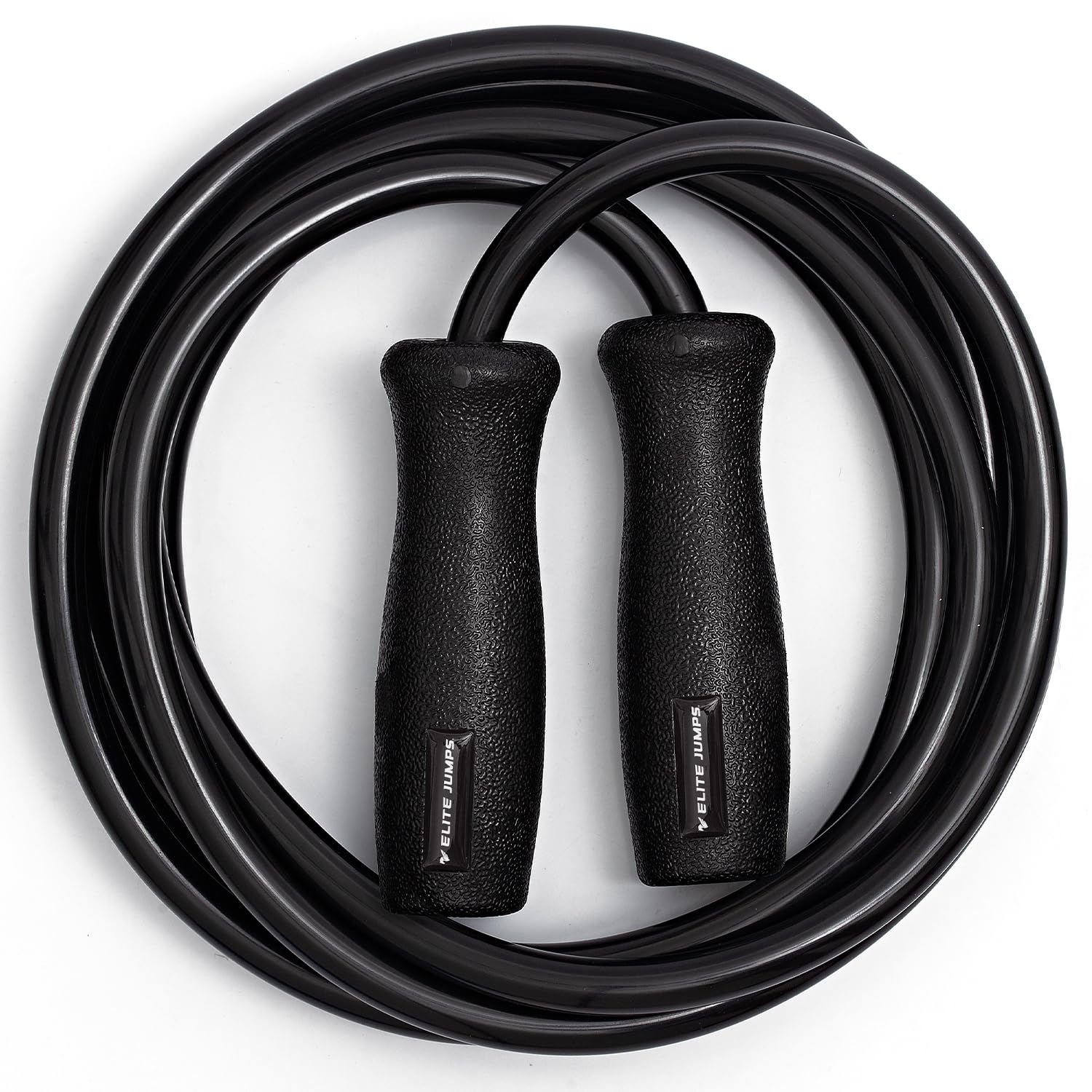
Elite Jumps Muay Thai 2.0

Elite Jumps Muay Thai 2.0

Boxing and MMA

Our Score 9.2/10
Check Price

Worth Noting

  • Stiff PVC can hold a bend after storage
Rope
Heavy-duty PVC
Length
Fixed 10 ft
Handles
Molded with foam grip
Resistance
1.3 lb
Read the full review

The Elite Jumps Muay Thai 2.0 is not trying to be a universal rope. It is fixed at 10 feet and built around a 1.3-pound PVC body, aimed at athletes around 6 feet 2 inches to 6 feet 5 inches who are training Muay Thai, MMA, or boxing. That focus is the point: the rope is heavy enough that every turn feels like a small pull, and the molded handles give you something substantial to hold when your forearms start to fatigue.

On the floor, the weight translates into a slower, more forceful rhythm. We found it easiest to use for timed rounds and footwork drills rather than long, unbroken skipping; the 1.3-pound body keeps you honest about turnover, and the ball bearings keep it from fighting you on every rotation. It has the durable, power-cord feel that makes a conditioning rope feel different from a speed tool.

For a combat-sport athlete with the right height, that weight is a fair trade for the powerful feel. The fixed length is the deal-breaker for shorter jumpers or anyone who wants a general cardio rope; the Redify or Crossrope makes more sense there. It is not a beginner's first rope. It is the one we pick when the session is built around boxing rounds, not a quick warmup.

Bottom line: We recommend the Muay Thai 2.0 for taller combat-sport athletes who want a 1.3-pound rope that makes every round feel like work.

#3

FEECCO Weighted Jump Rope

FEECCO Weighted Jump Rope

Tall jumpers

Our Score 9.2/10
Check Price

Worth Noting

  • Rope weight is unclear across variants
Fit
5 ft 8 in to 6 ft 3 in
Rope
5.5mm steel with PVC
Length
9 to 10 ft, adjustable
Handles
Aluminum with silicone
Read the full review

The FEECCO Burno Lite is the rope we hand to taller jumpers first: the 10-foot rope adjusts between 9 and 10 feet and is sized for adults from about 5 feet 8 inches to 6 feet 3 inches. On a 6-foot frame, the 10-foot setting needed no trimming, which is rare in a category where several fixed ropes stop at 9.2 feet. The aluminum handles and silicone covers feel more substantial than the plastic handles on budget ropes, and the ball bearings keep the steel rope moving without a sandy grind.

This is a light steel model rather than a heavy training rope, so the resistance is subtle—enough to feel the line in the air, not enough to turn a cardio session into a shoulder workout. That makes it a good choice for boxing footwork and quick sessions, especially if you are tall enough that most weighted ropes feel cramped. It comes with a soft carry bag and adjusts with a simple set-screw system. For fit and handle quality, this is a strong tall-jumper option.

Bottom line: We recommend the Burno Lite for taller jumpers who want a light, smooth steel rope and metal handles, not a heavy strength tool.

#4

HEREROPE Weighted Speed Rope

HEREROPE Weighted Speed Rope

Speed and footwork

Our Score 9.2/10
Check Price

Worth Noting

  • Handles can loosen under heavy use
Rope
6mm PVC-coated steel
Sizing
Four sizes, S to XL
Handles
Faux leather grip
Resistance
1/4 lb
Read the full review

The HEREROPE is a speed rope with a little weight, not a heavy conditioning rope. The 6mm PVC-coated steel cable carries about 1/4 pound, and the handles run on double ball bearings, so the rope turns quickly and stays tangle-free. It comes in four height-based sizes, which is a better approach than asking everyone to trim a single long cable.

We noticed the smoothness first: the handles spin freely, the cable holds its line, and the rope does not fight you when you pick up the pace. The faux-leather grip is comfortable for bare hands, and the 1/4-pound resistance is just enough to give the rope presence without slowing your turnover. It is a natural fit for boxing footwork, double-unders, and short speed intervals.

Where it falls short is resistance. If you want a rope that makes your shoulders and forearms work like the 1-pound and heavier picks here, this is not it. As a speed-focused tool with a precise fit, it earns its place. It is the rope we reach for when the goal is quick feet, not heavy arms.

Bottom line: We recommend the HEREROPE for speed-focused jumpers who want a tangle-free steel rope and a precise height-based fit.

#5

HPYGN Heavy Jump Rope

HPYGN Heavy Jump Rope

Heavy strength sets

Our Score 9.2/10
Check Price

Worth Noting

  • Fixed 9.2-foot length is short for taller jumpers
Rope
Polymer synthetic fiber
Extras
Carry bag included
Length
Fixed 9.2 ft
Resistance
2.8 lb, 3.8 lb, or 5 lb
Read the full review

The HPYGN is a strength tool first. The current 2.8-pound version is a thick polymer-fiber rope with anti-slip handles and a fixed 9.2-foot length; the line also comes in 3.8- and 5-pound versions for buyers who want even more resistance. It arrives with a carry bag and feels more like a battle rope you can coil than a skipping rope.

Swinging it is a different workout from the 1-pound ropes. The weight slows the turn, loads the shoulders and forearms, and makes even short sets feel deliberate. We found it best for intervals and strength circuits, not for long, unbroken cardio. The thick body also gives plenty of feedback when it clips the floor, which helps with timing but punishes sloppy footwork.

The fixed 9.2-foot length is the biggest limitation. Taller jumpers will find it short, and there is no way to add length; shorter or average-height users are the better fit. It is a specialist, not a first weighted rope.

For a dedicated strength block, that specialization is useful. The 2.8-pound version gives you a clear step beyond a 1.5-pound everyday rope, and the heavier variants go further for experienced athletes. It does not replace a general cardio rope, and it is not the one to buy if you are still learning timing. As a heavy option for shorter or average-height jumpers, it does its job.

Bottom line: We recommend the HPYGN for shorter or average-height athletes who want a dedicated heavy rope for strength intervals, not all-purpose cardio.

#6

Redify Weighted Jump Rope

Redify Weighted Jump Rope

Everyday conditioning

Our Score 9.0/10
Check Price

Worth Noting

  • Bulkier and slower than a speed cable
Ropes
9mm cotton and 9mm PVC
Length
10 ft, adjustable
Handles
Aluminum with silicone grip
Resistance
1 lb total
Read the full review

Two ropes in one box is the detail that makes the Redify our top pick: a 9mm braided cotton rope and a 9mm PVC rope share the same aluminum handles, so you can change the feel without buying a second setup. The whole rope is about 1 pound, which is the sweet spot for us—heavy enough that the swing registers in the shoulders and forearms, light enough that you can still find a rhythm. The lock adjusts across the full 10 feet, and the silicone grips have a raised oval pattern that stays put when your hands get warm.

For general conditioning, that combination is hard to beat. The cotton rope lands more quietly indoors, while the PVC version is the one for a garage or driveway. The 1-pound total also helps anyone moving up from a cheap lightweight rope: it slows the rope enough to feel where it is, but it does not drag like the 2.8-pound specialty ropes here. We kept the cotton rope on for most sessions and switched to PVC when the floor was rougher.

The weak spot is long-term wear at the handle junction, where a weighted rope takes the most stress. Ours has held up, but the rope is a wear item on any model in this group. Keep the length set correctly, store it loosely, and check the connection before hard sessions. What you get for a midrange price is two rope characters and a weight that works for cardio, boxing warmups, and simple strength circuits—the most useful all-rounder in this set.

Bottom line: We recommend the Redify as the best all-around weighted rope for most people: 1 pound, two rope options, and easy length adjustment.

#7

KUZARO Weighted Jump Rope

KUZARO Weighted Jump Rope

Heavier daily work

Our Score 9.0/10
Check Price

Worth Noting

  • Heavier swing can tire shoulders on long sets
Rope
Polymer fiber
Length
110 in, adjustable
Handles
Anti-slip TPE
Resistance
1.5 lb
Read the full review

The KUZARO sits in the middle of the weighted-rope range at 1.5 pounds, which is enough to feel more demanding than a 1-pound rope without turning every session into a grip test. The pink finish is bright and cheerful, and the TPE handles have a soft, slightly tacky feel that we appreciated once our palms warmed up. The 110-inch rope adjusts, so most average-height jumpers can dial in the swing.

Where this one earns its place is as an everyday step-up rope. The extra half-pound over the Redify slows the turn a little and makes the shoulders work harder, but the rope still rotates cleanly enough for steady skipping. We liked it for short conditioning blocks and warmups; the weight is noticeable without being a novelty. The adjustable length is a real convenience, though the 110-inch maximum is not the longest here, so taller jumpers should measure before ordering.

The color is part of the appeal if you want a rope that feels less like gym equipment, and the grip is comfortable for bare hands. It is not the rope for fast double-unders or for anyone who wants a 3-pound strength tool. What it does well is make a moderate weighted session feel approachable. If you have been jumping with a thin PVC rope and want more feedback, this is a friendly next step.

Bottom line: We recommend the KUZARO for anyone who wants a noticeable step up from a 1-pound rope without moving into 3-pound strength territory.

How We Tested Weighted Jump Ropes

To build the shortlist, I started with the weighted ropes that kept showing up in reviews and on gym floors, then narrowed by weight range, adjustable length, handle material, and price. I ruled out anything that only came in one fixed length or whose listed weight seemed wildly out of step with its handle size. That left 16 ropes, which we used for four months in the places people actually jump: a garage with a concrete floor, a driveway, and the gym before and after work.

Each rope was adjusted to the jumper's height and trimmed only when the instructions called for it. We jumped timed intervals, practiced basic steps and faster turns, and noted whether the weight felt concentrated in the handles or distributed through the rope. With sweaty hands, we paid attention to whether the grip twisted, slipped, or stayed comfortable through a full session; with bare hands, we noted hot spots and handle thickness.

Durability got its own rough treatment: repeated contact with concrete, coiling after every session, and a deliberate check for kinks, fraying, and loose connections at the handle. We compared stiffness by seeing how each rope hung when held up and how quickly it settled into a smooth arc. Value was judged on what held up after four months, not on the sticker alone—a rope that needed re-taping or a replacement handle was not a good deal. The ropes that made the final cut were the ones that felt comfortable, kept their length, and still turned cleanly at the end of testing.

How to Choose a Weighted Jump Rope

Match the Weight to the Work

Start with the resistance you can swing for your whole session, not the heaviest rope you can lift. A 1/4- to 1/2-pound rope keeps turnover quick for boxing footwork and double-unders; 1 to 1.5 pounds is the useful middle for general conditioning and longer cardio; 2.8 pounds and up turns jumping into a strength interval. The Crossrope system is the clearest example of the light end, the Redify and KUZARO sit in the middle, and the HPYGN is firmly in strength territory. Pick one primary job, then choose the weight that supports it.

Treat Length as a Fit Issue

Most weighted ropes are sold in a fixed length, and that is where a good purchase goes wrong. A 9.2-foot rope can be fine for an average-height jumper and plainly short for someone taller; a 10-foot rope gives more room. Adjustable models trim the margin for error, but check the range rather than assuming every 10-foot rope fits every body. The FEECCO and Elite are built around taller users, while the HPYGN is not. Before ordering, stand on the midpoint with the handles at armpit height; if the stated length leaves no room, choose another.

Choose the Rope Material for the Surface and Speed

Rope material decides how the rope sounds, how fast it turns, and how it wears. Cotton is quieter and softer indoors but can fray on rough concrete; PVC is more durable and gives a firmer landing; coated steel cable is the fastest option and the least forgiving on abrasive surfaces. Diameter matters too: 9mm cotton feels substantial and slows turnover, while a 6mm steel cable slices through the air. The Redify's two 9mm ropes let you choose between cotton and PVC, and the HEREROPE's 6mm cable is built for speed. Match the material to where you jump most.

Inspect the Handle and Bearing Junction

The handle-to-rope junction is where weighted ropes fail first, so look closely before you buy. Ball bearings should feel smooth, not gritty, and the connection should be reinforced rather than a thin cable pushed into plastic. A set screw or lock that holds length is useful, but it also needs checking; if it loosens, the rope can slip mid-session. The Redify's aluminum handles and the FEECCO's metal handles are sturdier than budget plastic, while the HEREROPE's lighter build asks for more frequent inspection. Store the rope loosely and check the junction before hard sessions.

Frequently Asked Questions

Final Verdict

For most people, the Redify is the one to buy: 1 pound is enough resistance to feel in the shoulders without turning every session into a strength workout, and the adjustable length plus two rope options make it easy to live with. If you want to progress between resistances and like guided sessions, the Crossrope Get Lean is worth the premium. If you are a taller combat-sport athlete, the Elite Muay Thai 2.0 is the specialist that makes more sense.